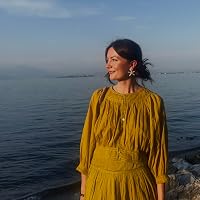
I kept putting myself in danger, and I couldn't make it stop. It rarely felt like a choice, though, of course, it was. It's only the death drive, my dear, Freud would likely tell me, if I lay my body down on his carpet covered couch. Everybody needs a little oblivion. Besides, what is the fantasy of the knight on a white charger if not an abandonment wish? A desire to be rescued from your own life by a story.
This Ragged Grace tells the story of Octavia's journey to recovery from alcohol addiction, and the parallel story of her father's descent into Alzheimer's. Looking back over this time, each of the seven chapters explores the feelings and experiences of the corresponding year of recovery, tracing the shift in emotion and understanding that comes with the deepening connection to this new way of life. Over the course of this seven-year period, life continues to unfold. Paths are abandoned, people fall ill, waters get choppy, seemingly impossible things are navigated without the old fixes.
As Octavia moves between London, the island of Stromboli, New York, Cornwall and Margate, each place offers something new but ultimately always delivers the same message: that wherever you go, you take yourself with you.
What a beautiful and intimate book. Bright resists romanticising or sensationalising her addiction, her recovery or her father’s illness, and I have rarely read a memoir of grief that felt so familiar to my own experience, which was deeply emotional to read, but also reassuring. She weaves introspection, philosophy and art into her beautifully written observations of the world in a way I found both enlightening and soothing. And you really must listen to the audiobook, read by the author. She has a lovely voice to listen to and a wonderful calm delivery that makes the writing sing.
Bright is a decent writer but in truth, she doesn’t have too much to say here and the observations made are very conventional. The sections about her father’s dementia are stronger than about the recovery from alcoholism. In places, the prose is simply beautiful; in others, it doesn’t hang together or ring true.
This is not your average story of addiction and recovery. Instead of debauched stories of drunken nights out this story starts at the beginning of the authors decision to get sober and chronicles the slow and steady process of learning to be at peace with yourself. I read this book while on holiday and I have to admit I found the many references to intellectual and philosophical quotes, art and literature a bit tough for pool side reading! But I think it’s a beautiful memoir
4.5/5 oh i thought i would like this but i LOVED it. i listen to the podcast that octavia co-hosts so have been aware of her for a while and was excited to learn that she was writing a book. i really think this is one of the most beautifully written memoirs i’ve ever read. absolutely heartbreaking and stunning, if you’re a good memoir girly like me, please pick this up
"There's a common misunderstanding that addiction is about pleasure, that addics are greedy (...) But the truth is that once it sets in, addiction is not about feeling good, it's about not feeling terrible. The pleasure found in the hit of one's substance of choice - be that whiskey, nicotine, cocaine, heroine or sugar - is not much about what it adds, but what it takes away: an immediate curb of anxiety, depression, fear, exhaustion, regret. Boredom. It keeps one's feelings at bay, the great repression."
Octavia Bright and Carrie Plitt are the hosts of probably my favourite podcast: @litfriction. Equal parts stand-up and English literature masterclass, it's gotta be one of the most nourishing pods on the market.
So when I learnt Bright had a book out I had to get hold of it. And so did half of Wellington judging by how long the reserves list was.
You won't be disappointed. Bright is in writing everything she is on the podcast: sensitive, funny, insightful, and fiendishly clever. She makes no apologies for being educated to doctorate level, and many of her philosophical touchstones are French writers I've never heard of.
But her self insight is something rare. She narrates a story of her recovery from addiction and her father's parallel descent into dementia. Her escaping oblivion while her father falls into it. While it's told using language and references that might be obscure to some, her story plumbs to the heart of what it is to live a fragile human life - longing, despair, redemption, love.
A serious book touching hefty themes. But absolutely one to read when you're in the right headspace.
Intimate and raw. Without romanticising addiction, Octavia Bright manages to walk us through her recovery with openness and vulnerability, which in turn made me examine myself closely. It felt like a privilege to be able to follow behind her as she dives deep down into herself. So many of her beautiful words, written like poetry, will stay with me long after I shut the book. Even the darkest parts. Much like our own memories, we have to carry the ragged bits with us too
I knew I would love this book because a) Dolly Alderton recommended it b) the Sunday Times Culture magazine recommended it and c) I recently started listening to the Literary Friction podcast (may or may not have been another Dolly recommendation…) and love it.
I’m an absolute sucker for memoir and this one had everything I love: languages, different places, literary references, the sea, mythology, symbols. It reminded me a bit of Deborah Levy and her autofiction with its recurring motifs and patterns. As a languages grad I found Brexit equally heartbreaking and I’ve never heard my feelings about it expressed so accurately - I can’t remember the exact quote but something like ‘my identity was stolen’.
One very small point which may jar some readers and kudos to Bright for mentioning it a few times - it’s evident she grew up with lots of privilege. For example I found myself asking a few times how she was living in a flat by herself and travelling whilst doing a PhD. Anyway very small quibble and Bright mentions it more than once, explaining that this is an important factor in aiding her recovery.
Wow. The first half of this got me thinking it was Leslie Jamison from Temu (and I mean that as a compliment) but then it became its own thing. I've been sad™ for the past couple of days and couldn't place why, but I think it was because this book was so good that I couldn't stop thinking about it. My god. Brilliant.
I loved getting lost in this book. Octavia writes in a beautifully retrospective and reflective way. Her descriptions of elements of addiction and compulsive personality ring with true accuracy and I loved the insight she shone into compulsive versus healthier forms of love later in the book. Although I didn’t always feel cultured enough to get all the literary and cultural references, I still enjoyed getting to experience life through someone else’s eyes - great read!
From a personal perspective, this memoir cracked my heart open in an unimaginatively beautiful way. Throughout, I have wept tears of empathy, affinity and ultimately gratitude. I feel lucky to have stumbled on this absolute jewel of a book at a time that it was so necessary for me to find it; within the first year of losing my own beloved Dad. I rarely write reviews but felt compelled to do so in this instance.
Spanning 7 years, each chapter explores a year in Bright’s life beginning with her ascent into recovery from alcohol addiction which coincided with her Father’s descent into Alzheimer’s.
The first two thirds are based largely on Bright’s recovery, exploring the themes of addiction because of the desire to escape self and reality via an endless search for oblivion and the concept of loneliness versus solitude. The toolbox of skills, experiences and coping strategies she acquires during this time will later prove invaluable.
For me, it is the final third of the book where the personal salience is introduced. After initially managing his illness, deterioration begins in bursts of progression and stasis heralding Bright’s passage through grief prior, during and after her Father’s death.
Bright so eloquently writes about her attempt to prepare for imminent devastation when ultimately “the sadness arrives anyway”. She describes the physical, animal pain of grief, the ever-changeable emotions during the final liminal stages between life and death, the beautiful last words exchanged and the immediate emotions within the first few days and weeks of loss. She describes beautifully the grace in accepting “The worst had happened and I was still here, not careening toward oblivion but with my feet on the ground, rooted, able to withstand it”.
Throughout her journey Bright also shares, initially tentatively, her experience in finding love. Despite the huge undertaking of navigating her way through the pre-mourning process, she realises that to close her heart to loss (as a coping mechanism) is to close her heart to love. She accepts the timing is less than ideal- though in retrospect it may be considered kismet. It is the very essence of life and living; an arbitrary and often inconvenient, messy, yet beautiful chain of events we have no control over.
Bright’s ability to write so elegantly and nakedly has both floored and inspired me. Peppered with refences to art, sculpture, literature and poetry, I frequently disappeared down a “Google rabbit hole” exploring the references further.
Thankyou for sharing your story. It really has helped me assimilate my own emotions, feelings and experiences. Grace-in a ragged form- is truly the most beautiful.
Octavia Bright tells the story of her recovery from alcoholism, as she details her father's descent into Alzheimer's. Brilliantly written, weaving symbols across space and time together to stand for the metaphors at the heart of life, time, love and death, Bright has left testament of a life lived, and so much wisdom for everyone still figuring out how to. Recovery is not so much about control over the chaos but about learning how to be at peace with it. How to integrate the void, the fear of it and love of it into your life, in a healthy way, one that confronts it like an old friend, not one that surrenders to its whims and fancies.
Love, is a form of chaos too. I found so many lessons inside those reflections, seeking the thrill of beginnings as a form of escape, "the pursuit of intensity alone, is a way of avoiding being really seen for who you are, faults, imperfections, and all". I found myself reflected in those pages, as I currently seek my own company, and 'no' has become one of my favourite words, Bright warned me that "in my isolation I'd come to take myself too seriously."But I also found reassurance, solace in my isolation, for I'm measuring myself up, seeing that "the things we seek refuge in can easily become traps that work against our emancipation". I am embarked on my own emancipation journey. I find sobriety to be part of it too curiously. What is my own relationship to obliteration?
I cried a lot reading this book. It's heart-breaking. Yet so affirming. So elegantly written. What envy.
(Actual rating 3.5)This is a candid memoir of grief and recovery from addiction and is often tender and quite emotional. Coming to terms with her father's dementia diagnosis whilst simultaneously recovering from alcohol addiction, Octavia leaves no stone unturned as she bares her soul in This Ragged Grace.
I'm always super aware that this is someone's memoir, so I try to be respectful, but there were parts of this I struggled with. I often found the writing quite pretentious, and although addiction and illness doesn't discriminate, I did feel I would have connected to Octavia more if she had acknowledged her privilege in terms of being able to travel so widely and access resources others in her situation may not. Of course, everyone deals with addiction and grief differently, and I did feel empathy for her, but I found her portrayal of grief, and the way she describes anticipatory grief more hard hitting and emotional than the story of her recovery. I would still recommend this one, and maybe it was me and not the book, but as someone who reads quite a lot of memoirs, this one wasn't my favourite.
I dipped in and out of this for months because the dementia stuff was HARD, but I adored it and would read it again and again. It was so vulnerable and intimate and full of wisdom. Although the main theme is addiction/recovery I don’t think you need to relate to this personally to relate to the slow and difficult search for peace and self that Octavia captures so beautifully <3 and she writes about grief - particularly anticipatory grief - so honestly and tenderly.
bravo! this writing is so gorgeous. in phrases and sentences that in one glance don’t really make sense, make sense by the atmosphere Octavia has placed. This was so beautiful! no words. Also has one of the best ending lines in a book. (yes i’m a sucker for those.)
Don’t regret reading but it’s quite light. Memoirs are not my favourite genre anyways, very few people are doing things differently enough to be of note. Of those that aren’t, very few can reveal the experience of their ordinary lives in ways unique enough to care about.
This Ragged Grace by Octavia Bright is a powerful memoir that is unafraid to examine the darkness of addiction and the desolation of loss while still having a hopeful and empowering tone. Though short, it is impactful and memorable and as I read I found myself rereading and highlighting passages that particularly spoke to me. such as " ..this idea that as we evolve, somewhere deep within us remains a skeletal trace of what came before that builds up in layers, a sediment of the self. But the point is that it's crucial to our continued survival to let some things sink to the bottom, recede until they are obsolete. " or " If addiction is rooted in the will to forget, recovery is an act of remembering - a slow reconnection with the parts of yourself that slipped out of reach while you hungered for escape. " This latter quote is particularly poignant given that alongside her own story of recovery the author is describing the slow but irreversible decline of her father as his Alzheimer's disease progresses. Over the course of seven chapters we see Olivia rediscover herself, and begin to thrive in her new life while simultaneously trying to help her parents come to terms with the inevitable. As the Covid-19 pandemic erupts, Olivia and her family face further challenges , and her descriptions of socially distant visits to her father who by then was living in a care home bring back just how much so many people suffered while the world tried to figure out an answer to the awful situation. I would highly recommend this memoir to anyone who enjoys thoughtful and well written prose, as well as those who appreciate bravery and honesty in their storytelling, I read and reviewed an ARC courtesy of NetGalley and the publisher, all opinions are my own.
I'm not the target age group for this memoir, but I found her account of the heartbreaking process of Alzheimer's more affecting, personally interesting and raw than her account of depression, risk taking and alcoholism. Already covered in a similar fashion by Amy Liptrot in Outrun. And yet another person who "finds themself" by walking the South West Coast Path without any preparation. That path must be ruined by now...
Heartbreaking, honest and well written. It's not an easy read as it's like being punched at time but it's a testimony of how you can face a very harsh life and win. Recommended. Many thanks to the publisher for this arc, all opinions are mine
5🌟 “I could build a whole castle out of my desire to be loved, and I also wanted to be left alone.”
📖S Y N O P S I S📖 This Ragged Grace tells the story of Octavia's journey through recovery from alcohol addiction, and the parallel story of her father's descent into Alzheimer's. Over the course of seven years life continues to unfold. Paths are abandoned, people fall ill, waters get choppy, seemingly impossible things are navigated without the old fixes.
"A real book is not one that we read, but one that reads us". And wow, did this book READ ME 🥹. I was sent this recently and just where I am mentally it aligned so well with this book, it’s like I was meant to read it at the exact time I did. I also just want to preface this by saying I have no first-hand experience with addiction, recovery and Alzheimer's. And yet, this book validated so many of my feelings about life, love and myself 💖. I guess what I’m trying to say is that if you read non-fic to relate or feel seen, the beautiful writing captures that, even if your experiences differ from Octavia’s.
This memoir is intimate with introspection, art and philosophy woven throughout - which I absolutely adored. It is the kind of book that feels like a privilege to read and I know I’ll return to it time and time again as it’s full to the brim with the most beautiful and affirming quotes ✨. I just had to include some in this post! Ultimately, what I took from this book was a deeper understanding of my own relationship with the void, the feelings of emptiness and the search for meaning. Thank you @octavia.bright for sharing your story so beautifully!
“Men could be known for their ideas alone while women were mostly known by their bodies first”
“Theres a startling power in recognising your own internal life in someone else's words” (literally me with this book)
“If I could forget my body then I could forget myself and that meant I could forget my sadness too”
This is one of the truest books I have ever read about addiction. Bright is young when she finds herself facing the unpalatable truth that she is an alcoholic. This is a memoir of recovery over many years. It has a beautiful and tragic counterpoint in that as she begins to put her life together, her father's life begins to fall apart. Dementia is unravelling him as fast as she is discovering who she really is.
There are so many things to say about this book. It's like a patchwork quilt in many respects. Forays into art and academia, memory and desire, addiction and recovery. It's all threaded through with consummate skill and real beauty.