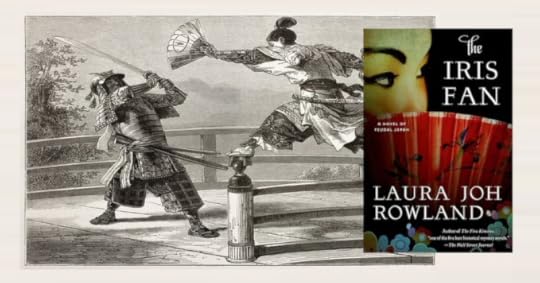
Japan, 1709. The shogun is old and ailing. Amid the ever-treacherous intrigue in the court, Sano Ichiro has been demoted from chamberlain to a lowly patrol guard. His relationship with his wife Reiko is in tatters, and a bizarre new alliance between his two enemies Yanagisawa and Lord Ienobu has left him puzzled and wary. Sano's onetime friend Hirata is a reluctant conspirator in a plot against the ruling regime. Yet, Sano's dedication to the Way of the Warrior—the samurai code of honor—is undiminished.Then a harrowing, almost inconceivable crime takes place. In his own palace, the shogun is stabbed with a fan made of painted silk with sharp-pointed iron ribs. Sano is restored to the rank of chief investigator to find the culprit. This is the most significant, and most dangerous, investigation of his career. If the shogun's heir is displeased, he will have Sano and his family put to death without waiting for the shogun's permission, then worry about the consequences later. And Sano has enemies of his own, as well as unexpected allies. As the previously unimaginable death of the shogun seems ever more possible, Sano finds himself at the center of warring forces that threaten not only his own family but Japan itself.Riveting and richly imagined, with a magnificent sense of time and place, The Iris Fan is the triumphant conclusion to Laura Joh Rowland's brilliant series of thrillers set in feudal Japan.
Granddaughter of Chinese and Korean immigrants, Laura Joh Rowland grew up in Michigan and where she graduated with a B.S. in microbiology and a Master of Public Health at the University of Michigan. She currently lives in New Orleans with her husband. She has worked as a chemist, microbiologist, sanitary inspector and quality engineer.
I've been reading the Sano Ichiro books for the bigger part of my teenage years, up until now. Considering the gap between the publication of each book, it's sort of hard to keep track of the storyline. That's also why I prefer reading a series after all of the books come out. But I'm not seeing an end to this.
What I think is positive about the Sano Ichiro series is that the books are not too long so the author doesn't have enough time to make it too lame, like, for example, The Wheel of Time series. But much like the latter, repetitiveness is bound to appear. At the beginning of each book the characters are overcome by one single emotion which turns into their personality trait for the entire book and only changes at the end of the book. This time we had Sano as vengeful and proud, even though he has already lost so much, Reiko - devastaded by the loss of her baby, weak and scared, Yanagisawa, maybe the character who is most consecutive in his moods, still decided upon ruling the empire, and so on. This time around though, I was really annoyed by Reiko's condition. As a character I've always found interesting, she was very off-putting with her constant weeping and self-pity.
The most unlikable part of this book, though, was Hirata's story. I'm firm in my belief that such an arch doesn't have a place in a series which until a couple of books ago was pretty normal. I find it very convenient for the author that when she can't solve a problem between the characters with normal means, she can just send her almighty magical characters. Thumbs down.
There were some interesting parts in the book, I can't lie about that, but as a whole, it lacks a lot in comparison to the early installments, the weakest point being the magic, obviously. The rest of the things I didn't like would be considered as spoilers so I'm just going to leave this as it is.
I have been following Sano’s adventures for quite a while now. According to Goodreads, Rowland is my most read mystery author. So I’ve grown attached to Sano, and his wife Reiko who often assists with Sano’s investigations.
I received a free copy of The Iris Fan from the publisher via Net Galley and this is my honest review.
The character dynamics and plot motifs in this series tended to repeat themselves. This is why I’ve complained that a number of these books were formulaic. I was most impressed with this series when the characters dealt with new situations or a new environment (The Snow Empress).
I was pleasantly surprised by how Rowland played with the formula in this book. I saw the same characters grappling over the same issues, but the plot brought about changes in their attitudes toward one another. The dynamic was much less predictable.
The character arcs of those who were most prominent in this series seemed complete by the end of The Iris Fan. So I felt satisfied by the resolution. There could conceivably be more stories told about Sano’s son, Masahiro or about his daughter, Akiko. A Masahiro or Akiko novel could be marketed as a YA mystery. Rowland could find a whole new audience. Yet if Rowland decides to move her career in a completely different direction, I probably won’t feel too disappointed.
I'm sadden by the end of such a captivating series. I'm sure Rowland's next endeavor will be equalling enthralling and entertaining as this fabulous series.
The Iris Fan does not disappoint with providing a riveting ending to a wonderful series. I will miss Sano and his family, I feel as if I am saying farewell to an old friend. We have experienced the multitude of challenges Sano faced, the hardships and consequences his family endured with his choices and undying allegiance to honor. By involving Sano's family into the narrative, it added an extra level of drama causing the reader to become very familiar and fond of the entire family and their overall well being.
The Iris Fan provides nonstop action, high drama, power struggles, vengeance, of course mystery and romance. The characters cause the peruser to feel pangs of endearment and loathing, kindness and harshness. A few characters more memorable than others, nonetheless the players all impressive. Rowland has no problem building momentum as the story progresses until the climatic ending. The intellectual touch Rowland adds to the plot makes it rather difficult to pinpoint the culprit, an element I always appreciate. Well written, entertaining historical matter presented, fabulous characters and a solid narrative weaved with secondary story lines create an exciting reading experience. The heavy hand of the supernatural in this particular installment gave a kick to both character and story, I enjoyed it very much. A series worth reading, highly recommend Rowland and her creative authorship. I will miss you Sano Ichirō. Mystery fans, don't miss this finely crafted series with a fascinating setting in a harsh era.
I am so glad that's over. This series completely spiraled out of control with the last four-five books. The author started including elements that were just so completely ridiculous. And the secondary characters? There was no positive growth. Reiko was awful. She didn't learn from any of her past mistakes and then decided to blame Sano for everything. Masahiro grew to be spoiled and dense. Akiko might have been the only family member in this book worth having a story of her own.
It's so unfortunate that a series with so much promise went down hill so poorly and quickly.
2 1/2 Stars. The swan song of the Sano Ichiro mystery series gets a regrettable, disappointing conclusion. I briefly debated the rating of this one, but the weaknesses of this installment far outweigh the positives. It started off promisingly, and the mystery, as usual, is interesting enough, but it's the denouement of the series as story arcs converge that does it all in.
As Sano considers at one point: "The story about the secret society and the ghost was too fantastic…to believe." And that, in a nutshell, was precisely the problem.
As a loyal reader from Shinju on, I've been increasingly dismayed and disappointed by the inclusion of a supernatural subplot that started in book #15, The Ronin's Mistress. Had it been a part of the series from the start, it wouldn't be an issue, but it's been a tangential side plot for just the last four books in a series of 18. Why would Rowland take such care to craft an immersive, realistic, and believable world in detail, plot, motives, and explanation, only to muck it up with supernatural and fantastical elements that belong in an entirely different sort of novel?
Up to this point, the supernatual elements have had minimal impact to the main plots of the respective books. The Iris Fan was obviously where this was all supposed to pay off. Whereas before, the subplot was really only incorporated through character relationships, this time it's shoehorned uneasily into the main plot. Since this series is so rooted in the history, (and Rowland sticks to the historical timeline and general facts) the endpoint is a foregone conclusion. Once Hirata's storyline is played out, it becomes clear that this story arc that's been bubbling since The Ronin's Mistress has been wasted on something that ultimately doesn't even matter. It neither enhanced nor advanced the story in any meaningful way. Worse yet, the impact of his betrayal—and everything stemming from it, including his "redemption"—are undermined and rendered pointless.
Hirata deserved better than this. The longtime reader deserved better than this. What was Rowland thinking? Where was her editor? That she betrayed the foundational reality she so meticulously worked to create in this historical series is bad enough. That she squandered such a valuable and important character like Hirata on such pointless and preposterous nonsense is worse.
As it stands, I can't separate out the ridiculous from the rest of the plot since it features so prominently in the climax and deadens the impact of what happens to the other characters—characters we've known and rooted for and against since book one. It's a shame. This should've been the last, delicious course in a long banquet. Instead, it's a fancy and exotic jello mold with Lucky Charms flambeé. The intention was there, but the execution was completely lacking in substance and quality.
Despite this sad conclusion, I have gotten a lot of enjoyment from this series over the years, especially the first ten or so books. I imagine at some point Rowland wanted to move on to something else—and did—but had to keep this one going. I really wish she'd taken more time to think it through. It could've been a fairly solid series. Now that it's complete, I'm can't say I'm all that sorry to see it come to an end.
The year is 1709 and the shogun is sick and ailing. Sano Ichiro, once Chamberlain to the shogun has been demoted to a lowly patrol guard. His home life is faring little better as his marriage is in tatters. His friend and once loyal retainer is now a wanted criminal. Yet despite all this, Sano remains dedicated to Bushido – the way of the warrior.
When everything seems at it’s worst, the unthinkable happens – the shogun is stabbed in his own bedchamber. Sano finds himself reinstated as the chief investigator charged with finding the culprit. The stakes are especially high as if the shogun’s heir is not happy with the outcome, Sano will find himself put to death with his family beside him. Forced to ally himself with friend as well as foe, Sano is racing against time. Time, which for the shogun, is quickly running out.
The Iris Fan marks the 18th and final novel in the Sano Ichiro series. A fact I wasn’t aware of (since I didn’t read the book flap) until I got towards the end of the book. I have been a fan of this series practically since the beginning and have nearly all the books in the series on my shelf at home. Over the course of the books we, the reader, have watched Sano and his family change and grow. We are with him when he first meets his wife Reiko and later when they marry. We are with him when his first child is born and later through the ups and downs of his career. Reading the last book was like saying good-bye to friends and family.
If I have one complaint about the books, it would be the growing reliance on supernatural or otherworldly forces as major plot devices. In early novels there was sometimes a thought of ghosts or spirits being the culprit but in the end it was a human who committed the deed. With the later stories these began to take a more prominent role in the story, making them – especially towards the end – unrealistic.
A bit slow in the beginning, the pace really begins to pick up in the second half of the book. Familiar faces abound, some friend with others foe. New relationships are established and new bonds are forged.
Readers familiar with this series will likely find The Iris Fan a fitting end to the series. Personally I had a few quibbles but all in all greatly enjoyed the book. I am sorry to see this series end as I have enjoyed for a goodly number of years.
I always find it difficult to read the last book in a series when I know ahead of time that it is, indeed, the last and I usually take the coward's approach, putting it off till my own mental nagging gets the best of me. I couldn't do that this time since I agreed to participate in the author's blog tour so here I am, wallowing in my own self-pity at the thought of losing a favorite hero.
Sano Ichiro---and his creator, Laura Joh Rowland---have been in my life for many years ever since I "discovered" this wonderful series with the fourth title, The Concubine's Tattoo. I immediately fell in booklove and rushed to read the three earlier novels. I've never missed one since although I've sometimes waited a year or two, my way of avoiding the oh-so-common burnout that can happen to a series reader as well as to the series author.
The attack on the shogun brings Sano back to his position as chief investigator and the twists and surprises at nearly every turn give him what some would call his most intricate case. Any number of potential assassins and intrigues present themselves and Ms. Rowland kept Sano, and me, teetering on the edge the whole way through.
Perhaps it's fitting that Sano's last investigation is rife with personal troubles and that his entire family's survival is on the line. His unwavering devotion to the Way of the Warrior even in the face of death is remarkable and gives us a clear picture of what being a samurai 300 years ago really meant. It's a world few of us can truly understand today but we can give it the respect it deserves. To put honor---true honor, not a bastardized sort---above everything else is a choice that Sano made years before and he has held to it. He's a man I can admire and think well of and I appreciate his steadfast loyalty to duty. I will miss him greatly and will miss his intelligent, wonderful wife and companion, Reiko, just as much.
Fascinating historical mystery set in 1700's Japan. The sleuth, Sano Ichiro, and his wife Reiko set out to solve the attempted assassination of the current shogun who has been stabbed with an iron fan. Although the writing style was somewhat pedestrian and simplistic, I enjoyed learning about Japan of that period. Besides the mystery, I enjoyed following the personal dramas of Sano and his family. A bit of the supernatural was introduced, which fell in line with what I've read of Japanese kwaidan, e.g., Lafcadio Hearn. After I started reading I realized this novel was a close to the series, although the author leaves the way open for Sano's son to follow in his footsteps with Dad as advisor. I am now interested enough to read the whole Sano series and I'm glad the library has all or most of the previous volumes.
I hate that the Sano Ichiro series is over. I put off reading the last book as long as possible. At least Laura Joh Rowland wrapped it up well considering this novel probably put Sano and the good characters through some of their worst trials. I read most of my mysteries by accident, stumbling across them because they've been incorrectly labeled general fiction and shelved in that area of a library, but I'm glad I found Sano all those years ago. If I said it once about a good book, I said it a thousand times (and this time about a series), it felt as if I was leaving dear friends behind when it ended. But who knows - perhaps one of Sano's descendants will make a surprise appearance some day and battle a new enemy, and my heart will burst right out of my chest. If you see me dead in the mystery section of a book store, this is probably what happened.
This is the 18th and last book of the Sano series, however it stands alone pretty well. There were some backstories I missed out on (like Sano and Reiko getting together and their adventures), but besides for that it does stand alone pretty well. I am upset, because it IS the last of the series and I feel like I cheated. XI However, it has motivated me to go back to the beginning. :)
Oh my Atlanta there was so much going on with SO many characters and POVs. Alongside the main plot about the Shogun's stabbing there was about 5 mini plots going on: Sano and Reiko's marriage issues, a love story between Teiko and Masahiro, Hirata's possession, and so much more. At first it was a little overwhelming, but everything was connected and it seemed to flow much better after a couple chapters. Hirata being possessed by a ghost worried me, because I did not see how that was going to connect to the main plot, but eventually it made sense at the end.
I honestly wasn't a huge fan of the supernatural bit...but I get why it happened and how it was important to the main plot. But still...meh.
Poor Sano and poor Reiko. They are both so angry and hurt by each other; if they honestly had a sit down chat and talked it through, their marriage could have been healed WAAAAAAAAAAY earlier. Again, COMMUNICATION PEOPLE! Whenever they did manage to talk to each other one would erupt and walk away. C'mon. I get both sides and how each one is in the wrong, but still...if only there was marriage therapy back then - all of the drama and hurt could have been avoided.
Poor Taeko. :/
Poor everyone. There is a lot of drama alongside the political bullcrap and the mystery parts and I liked it. It was addictive and I HAD TO KNOW WHAT WAS GOING TO HAPPEN NEXT! I did guess who stabbed the Shogun, but the motive and who "helped" the person was a mystery to me. I read 80% of it in one night. Boyfriend and his friend had a games night, (and since I was not included, because it was a two player game), so I read. I would have finished it off, but I couldn't keep my eyes closed, so off to bed with me.
In the end, this was a good book. There was a lot going on and at first it was hard keeping track of who was who and what was happening. Everything began to make sense and flow better after a couple chapters. The ending was good and so was the journey. I was not a big fan of the added supernatural bit, but I get WHY it was added. I am looking forward to starting at the beginning someday. I want to see how we got to this point. Anyone who loves Historical Fiction would like this book (maybe start at the beginning, LOL). I shall stamp this book with 4 stars.
Favorite Character(s): Reiko, Sano, Taeko, and Masahiro (even tho he really upset me at one point - he made it up, but still...) Not-so Favorite Character(s): Lady Yanagisawa, Yanagisawa (at first I liked him, but no...it was all a lie), and Lord Ienobu
This is the 18th and last of the Sano Ichiro books. When the first book of the saga, "Shinju" begins in 1689, Sano is a lowly policeman - or at least the equivalent of that position in feudal Japan. Over the course of the series Sano marries Reiko, fathers two children, rises in rank to become the shogun's top advisor and, through the constant machinations of his court rival, Yanagisawa, faces demotion and death too many times to count. Through it all Sano's dedication to bushido, a samurai's loyalty to his lord, determines all his actions. Sano is the quintessential honorable man in a world that, while it may espouse bushido, seldom really valued it. The shogun, Tokugawa Tsunayoshi, is a weak, ineffectual leader, easily influenced by corrupt and ambitious men. What marks this mystery series as one of the best is the way Rowland makes feudal Japan come alive. The motivations of the characters are universal (greed, love, jealousy, ambition, etc.) but also unique to that time and place - motivations involving bushido and other specifically samurai ideals of honor, loyalty, guilt and shame. (There is also a strain of the magical that weaves through some of the books - people with supernatural powers that have come through extreme spiritual training. I would have preferred to stick with straight, realistic action, but I suppose that Rowland wanted to incorporate some traditional Japanese myths into her stories.) Rowland's fictional characters are closely involved with real historical people (Tokugawa, Yanigisawa and others) as well as real historical events such as earthquakes and tsunamis. And in this final book, she brings Sano's story to a satisfying close. It is now 1709 and the shogun is dying. Sano, whose steadfast adherence to bushido has impoverished his family and alienated Reiko, becomes caught up in the power struggle among the possible successors. It could have ended in a real bloodbath, but Rowland generously allows all of the characters to be in harmony by the end of the book. Even the ones who die - and there are remarkably few of those - do so after obtaining a sense of peace. It may not be a very realistic end, but Sano and his family deserve to go out on this high note after all the grief they have suffered over the course of the 18 books!
The last four years have been disastrous for Sano Ichiro, a samuri in the 1709 court of his shogun, the ruler of Japan. During this time, he has been demoted from the court's chief investigator of crimes to a lowly foot patrol soldier, as his enemies manage to foil his attempts to reveal their crimes. Each time he fails to bring the truth forward, his livelihood is reduced again. Even more wrenching, he sees the discord his stubborn insistence on the truth has brought to his family. His wife, Reiko, formerly a partner in his investigations, is furious with him and the poverty he has brought to the family. Their children are blocked from good jobs or advantageous marriages, and one false step can mean that the whole family will lose their lives.
Then an unimaginable crime occurs. Someone slips into the shogun's sleeping chamber and stabs him with a fan, a fan with razor-sharp folds. Who could have done such a horrible crime? There are two contenders for the shogun's position when he dies. Yanagisawa and Lord Ienobu are rivals for the position, Ienobu for himself and Yanagiasawa for his son. Unfortunately, both are Sano's enemies, as he has tried to bring their crimes over the years to light. They form an uneasy alliance and are both displeased when Sano is brought back to the castle and restored as the Chief Investigator. Can he solve the crime before the shogun dies? If he doesn't find a way to reveal the assassin, one of his enemies will ascend to power and the first act will be revenge on Sano and his family.
Laura Joh Rowland has written a series of feudal Japan that has enthralled readers for many novels. This is the eighteenth book in the series and the ending one. The cruelty and constantly shifting alliances and betrayals that make up the court are stunning. Everyone seems to be out for themselves, yet profess to follow the Bushido way of honor. This book is recommended for both mystery readers and readers of historical fiction.
In the waning years of its heyday, the legendary production company Cannon Films made a risky move on a shady story and signed an impressive but unproven martial arts talent, producing the now swooned over "cult fav" BLOODPSPORT on a shoestring budget, coming in to a healthy domestic return of 900%. Gracing silver screens in February 1988, BLOODSPORT made Jean-Claude Van Damme an international star and exposed the world to the alleged true story of Frank Dux and the first stirrings of mixed martial arts tourneys, which, at the time, looked a lot like another seminal piece of chop-sockey celluloid, Bruce Lee's spectacular ENTER THE DRAGON. Proudly hailing from the Tanaka school of kicking ass, the fictional Dux has to demonstrate one of the school's signature abilities, Death Touch, to gain access to the event and honor his Shidoshi. Although styled after the theme of Clint Eastwood's terrific UNFORGIVEN--it was a matter of honor--THE IRIS FAN, the last adventure in the Sano Ichiro Samurai sleuth series prominently revolves around dim mak, Death Touch, though it doesn't veer anywhere close to a brutal competition, a sensei, and a gold tooth. THE IRIS FAN is a battle for honor, a crusade for truth and justice , and a frenzied fight against fanatics that are looking to take feudal Japan to hell on a Dutch battleship.
THE LAST OF THE MOHICANS in the Sano Ichiro series, THE IRIS FAN brandishes SHOGUN style Japan flavor and a Jedi-like mystic who can manipulate minds, draw on the forces of nature, and use powers like the chameleon in PREDATOR. Set in February 1709 and four years after THE SHOGUN'S DAUGHTER, Tokyo, the city formerly and for the purpose of this series known as Edo, still shows the effects of the Mount Fuji eruption of 1707, and the million citizens who call the city at the mouth of the bay home are the worse for wear. As so often, the social crisis of course allows the political game board to rearrange and sprouts new opportunities as well as troubles, including for Sano himself, the esteemed investigator of everything for the Shogun. THE IRIS FAN is the most important case of his long and distinguished career, and the battle he's been fighting for more than four years is shifting into a new, decisive phase. This is Sano's chance to make things right for the regime, for his family. For the last time. The attempted murder of his lord is a dangerous game that Sano might not survive, yet his strict adherence to Bushido demands that he does what he's always done; find the truth. Strapped with the additional burden of a measles epidemic that came to Japan via Chinese priests visiting Nagasaki, Sano et al start the process with the weapon and a potential witness, picking back up where he left off after being disgraced and fired as top cop for doing his job for the good of the regime.
Ever the proverbial dog with a bone, Sano Ichiro is still filled with pent-up frustration and pressure to solve an old murder, so much so that his ravenous hunger for revenge might cloud his investigation as it has created a cold space between him and his wife, effectively putting his marriage on the fritz after the disastrous loss of a baby. Now scratching fifty and slightly night vision impaired, Sano isn't just driven by duty to deliver the perp to justice and prevent a murderer from becoming the next Shogun. He wants to avenge a protege's death but he can't let sympathy get in the way of justice. Being a detective, as per Sano, sometimes means lying, but all in the name of Bushido--complete loyalty, the way of the Warrior, the samurai code of honor, where 'coward' is a much graver insult than 'liar' could ever be to a samurai. Bushido's harsh dictates for filial piety, duty, and honor are the very sources of strength that have sustained Sano through the most difficult times in his life, and naturally, the source of every problem that his flying crane insignia donning clan and family have ever experienced. If he ever gave up his honor, he was finished, though Sano's too stubborn to change or just too old. Thus, good vs evil is again in the mix, with Sano's long standing enemy of more than 20 years, Yanagisawa, making a triumphant return to his devilish ways and into the good graces of the shogun. Arraying a legion of doom against Sano, the means by which Colonel Matrix was forced to do Bennett's and El Presidente's dirty work in COMMANDO seems to be the preferred MO for all baddies in THE IRIS FAN, causing Sano to jump feet first into the grave his dedication to Bushido and honor are digging. Duty is duty for Sano, even though the expected outcome isn't to his liking. For the last time, is Sano going too far for honor?
Working with a somewhat muddled framework of the succession for the dictatorship of Japan and all the wrangling and plotting those (potentially) in line are doing, THE IRIS FAN sticks to what's worked for the previous seventeen entries in the series and is keying up for a grand finale. As the fate of all of Japan is at issue in THE IRIS FAN, it would seem natural that almost all characters quickly jump to conclusions and take everything personally, though the slant seems rather modern and steeped in the behavioral attitudes of social media. With a nod to historical accuracy, the recorded cause of death for the real Shogun Tokugawa Ieyoshi, measles, figures big time into THE IRIS FAN, sadly leading readers to the early conclusion half-way through the book of how the mystery will be unraveled. Reinforcing that the Sano Ichiro series was more entertaining and fun before supernatural powers snuck in, THE IRIS FAN reads more like fantasy than through and through feudal Japan, featuring the likes of ghosts, supernatural vision, and superhuman feats. Nonetheless doling out realism with 'Hope is a stubborn creature that refuses to die', truth is a double-edged sword, and that politics and power can destroy, THE IRIS FAN also cleverly references Merrill Flood & Melvin Dresher, BLOODSPORT, and OF MICE AND MEN. Completing the series that boldly started with SHINJU in 1994, THE IRIS FAN is a meticulous tribute to the twenty year journey of Sano Ichiro, his trials and tribulations and the fate of Japan in the Edo era under the rule of the Tokugawa clan. Duty and honor above all else, except family.
Talk about melodrama. It just needed a cane to pull people off the stage, a live audience and a piano. This was not my kind of book....at all. It could have been. I thought it was right up my alley since it is historical fiction and it is a mystery to boot. These are two genres I spend a lot of time in.
This book hit almost every one of my pet peeves. I'll only hit a few of the major ones. There wasn't any descriptive value. It was kind of sparse and dry in that department. The story seemed like a stick figure. No flesh, no heart. It had all the major pieces, but very one dimensional.
There were also many characters to shake a stick at. They all took turns at being "it" as far as the whodunit went, which then made the story unbelievable. Another thing that added to this was the modern telling of the story. I'll admit that sometimes this approach works, but it didn't with this one. It didn't match the culture and that kind of grated on me with everything else. So 2 stars.
Vějíř s kosatci přinesl napínavé, čtivé a důstojné završení celé série. A i s tím koncem, třebaže poněkud fantastickým, jsem byla v závěru spokojená. Byl akční, dojemný, trochu smutný, trochu šťastný, prostě takový jaký měl být. Přesto si Laura Joh Rowlandová nechala otevřená zadní vrátka pro případné pokračování s Masahirem v hlavní roli. Jestli se ho ale dočkáme, to ví jen sama autorka. Já bych se dalšímu dobrodružství ve středověkém Japonsku rozhodně nebránila.
Вече го докарахме съвсем на сапунена опера с добавка на фантастични елементи. Толкова по-добре си беше, когато бяха криминални истории с политичски елемент и малко любовни драми за разнообразие. Но, като съм се хванала на хорото, ще чета... Утрепахме за разнообразие някой и друг по-главен герой, Изабела е бременна и имаме и призрак. Та така...
As good as this was - I feel I'm losing a member of the family. This is the last Sano novel! I must say Rowland ends on a high note. I'll take a year off & enjoy the 18 stories again, but this time there will be no wait. I hope Sano makes his way to the silver screen.
I'm not terribly great at reviews, so there's probably a better review on this book that you can read.
That being said, let's get into it.
I started this series years ago, when I stumbled across the first book in a thrift store. Ever since then I was hooked. I've actually had a hard time tracking down all the books in this series (some of them I had to buy online), but the series was so good I wanted to get all the books! And then...the series changed. I can't remember which book Hirata was forced into the group (was it the one before this one?) but it started going downhill there. Rowland has used ghosts and the spirit world before in her books, that didn't bother me. What bothered me is she made a "get out of jail" card with Hirata and the ghost. I suppose it really started when Hirata was injured and had to turn to the mystic arts to get strong again. She was making this character...overpowered and totally different from what he used to be. He loved Midori and his kids...now he leaves them and ignores them? When he's with them he fights with Midori? That's not his character. She totally messed up Hirata.
And she keeps doing it. Giving him more and more power. Putting him in an impossible position and finally throws the character in the trash when she has the ghost possess him. She would have been better off just killing him. So now she has an overpowered character that can come in and wrap up the ending of the book, fixing all the problems she made. Lazy writing in my opinion.
I guess as series build and get longer and longer...the author just gets lazy. It's happened in other series that start off fantastic and end horribly. Steven Kings The Dark Tower series comes to mind.
I feel that she could have took her time and made a longer book or another book altogether and actually spent time on fixing the mess she made of the characters and the world. Not only did this book make a mess of everything in that world, it felt rushed. Like she just wanted the series to be over. Which after 18 books...I suppose I can see that.
It's a poor ending to what was a great series. The characters deserved better.
This entire review has been hidden because of spoilers.
I read this in 2016 or so, so I don't remember everything about it. I can tell you that the ending SUUUUUUUUUUUUUUUUUUUUUUUUUUUUUUUUUUUUUUUUUUUUUUUUUUUUUUUUUUUUUUUUUUUUUUUUUUUUUUUUUUUUUUUUUUUUUUUUUUUUUUUUUUUUUUUUUUUUUUUUUUUUUUUUUUUUUUUCCCCCCCCCCCCCCCCCCKKKKKKKKKKKKKKKKKKKKKKEEEEEEEEEEEEEEEEEEEEEEEEEEDDDDDDDDDDDDDDDDDDDDDDDDDD SO MUCH ARSE.
You expect that at the conclusion of this amazing series, Sano would use his political prowess that he's been building for eighteen years to secure a future for his family, right? Along with having been married to Reiko for so many years and knowing her and how she thinks, he'd be able to resolve all the marital issues he's been having with her, right? And the distance that's grown between him and Hirata--they've been friends for decades now, and friends would just TALK THINGS OUT, right?
Nope. It's magical ghost powers to the rescue! What a deus ex machina. Le sigh. What a disappointing ending to an otherwise amazing series. Also for some reason Masahiro falls in love with Hirata's daughter even though she's like, fourteen, and gets her pregnant, too? *shudders*
Actually, the farther I got into this series, the less I enjoyed it (besides Bundori, which was kind of a huge yawnfest). I feel like Rowland really hit her stride right around Pillow Book of Lady Wisteria and Dragon King's Palace, and then after that it started going downhill... But all the other books between those and this one were still really good, solid four-star reads. This one was just... UGH.
It was about time that this series finally wrapped up. There were only so many times I could go for the "Sano must solve a mystery to the shogun's liking or else something awful is going to happen" plot that pretty much the entire series has followed.
There were definitely some irritating moments here as Sano and Reiko have a complete communication shutdown between this book at the previous, and their fragile relationship felt more forced in for extra dramatic tension than anything else. I felt like there was plenty else going on here without the strained marriage plotline.
Overall, the conclusion worked for me. It was definitely predictable in places, and after some of the shifting allegiances in here I wasn't sure exactly how it would turn out.
Not great, not bad. The unique setting (historic Japan) is enjoyable, but the author evokes it rather than giving it full texture. This is "lite" version that is an exotic backdrop for the plot. However, Japanese cultural ideals drives the actions of most of the characters, so there's a bit of an emotional disconnect between the reader and the characters that's not fully bridged. The central character, in his dedication to "honor," is phenomenally annoying because he is entirely unrealistic about the consequences of his contradictory actions. He keeps making life worse and worse for his family, while failing to improve matters or keep his honor. I wanted to sit him down and yell at him for being a fool, so while I empathized with his idealism, he did not make the most ideal protagonist. It shows how people, in their devotion to the abstract ideas we build our Selves on, can completely screw things up. There's also levels of fantasy (ghost-magic and possession), which came to seem more like plot-device work-arounds than integral to the spirit of the novel. They form the entirely unexpected resolution, but so far I don't feel a strong urge to find out what happens next.
Did not realize that I was starting with the last book in the series but I didn't have any real problems understanding the past connections and intrigues. For the most part, the author explained enough backstory that it made sense.
Sano is/was the Shogun's chief investigator. Because of past incidents and his strict adherence to honor, he and his family has fallen out of favor. When the already ill Shogun gets stabbed, he is assigned to find out whodunit.
What follows is an adventure full of intrigue, political drama, family drama, young love, old love, redemption, revenge, more murder, and one nasty ghost. I thought the ending was a little too neatly wrapped but overall a well written story.
Excellent finale to an excellent series. All the threads are resolved in very interesting and satisfying ways. It takes til the very last page for the reader to put it together, but it's a great read. The heroes don't ride off into the sunset. There is, however, a lovely conclusion that one rarely sees in contemporary fiction and especially the mystery genre. Well worth the read on its own. More so worth reading the whole series to get to this one.
A sad day - read the final novel in the long history of Sano the Shogun's Chief Investigator. I have followed Sano through the many challenges of surviving the dangerous world of the Shogun's court, as he has fought the evil courtier Yanagisawa. I will miss him and his resourceful wife and son but content that he triumphed in the end.
This entire review has been hidden because of spoilers.
Very good historical mystery fiction. Author Laura Joh Rowland also wrote The Fire Kimono, one of the five best historical novels according to the Wall Street Journal. Set in Japan in 1709. The Shogun is stabbed to death in his own palace with a fan made of painted silk with sharp-pointed iron ribs. Sano, a Samuri, is restored to rank of chief detective to find the murderer.
Turns out there are 18 books in this series and I started with the last one! A great group of characters and a fast-moving plot. Rowland is great at describing action, the battle scene over the shogun's dead body is a masterpiece. Sano the detective is definitely a man to watch. I intend to go back to the beginning and "catch up."
I have read the Sano Ichiro series from the beginning and I am sorry to see it end. While I was pleased that plot points were all tied up for a conclusive ending, I missed Reiko acting more like her old self, both independently and with Sano. That is what I enjoyed most about this series. Nevertheless, a worthy sendoff.
I loved the Sano Ichiro series, but it slowly has been petering out. I'm glad Laura Joh Rowland said it was time to let Sano Inchiro and his families go and live their lives without us readers watching them.
I did not like the gothic/fantasy aspect of the past couple of books. I thought it distracted from the more interesting historical aspects of the story.
Everyone has put plenty of detail into their reviews so I'll keep it simple.
I so didn't want this series to end. Ever since I read the Concubine's tattoo I've been hooked, buying all the books to read and have only found two dubs in the lot.
Great finish to Sano Ichiro's story... Thanks Laura!!
Such a great end to the series, been a longtime reading this series. Sorry to see it go!! Now guess i gotta try Laura's new series in Victorian England!!