First identified in 1943, autism has over the last decade become an international topic of conversation. Knowing no racial, ethnic, or social barriers, today autism is diagnosed in one in every 150 children. No two diagnoses are the same, hence the reason autism is known as a spectrum disorder. The book divides the artwork into thematic chapters that demonstrate characteristics of the disorder, like "repetition" and "interaction."
Drawing Autism celebrates the artistry and self-expression found in the drawings, paintings, and collages created by people diagnosed with autism. The work of over fifty contributors exhibits an array of unique perspectives on how these individuals see the world and their places in it.
"It is a stunning, thoughtful, and yes, hopeful book that is not just for families touched by autism, but for all who are curious about the disorder, which affects more than 1 in 150 children. The introduction by Mullin and a foreword by best-selling author Temple Grandin provide an informative overview of autism, a disorder that even seasoned parents of children with autism like myself have a hard time explaining." --San Francisco Chronicle
Drawing Autism is a collection of art created by people who are on the autism spectrum. For some of the artists, art is the only way of communicating their experiences as a person with autism. But whether the art is highly sophisticated, emotionally powerful, playful, technically amazing or naive, the cumulative experience of this book is astonishing. There is an introduction by Temple Grandin describing how drawing became her entry into what became her very successful career and the book is then divided into themes. Each chapter consists primarily of art-paintings, collages, drawings, mosaics, a wild and exciting diversity of media and subjects, accompanied by a small amount of text written by the artist.
Jill Mullin has done a wonderful job of selecting the art. Each piece is beautifully reproduced and the companion text is taken from a questionnaire filled out by the artist. In some cases, the answer was dictated to someone who wrote it down and in a few cases, the artist is non-verbal and a caregiver has answered. The text is often fascinating and complements the work but it is the work that amazes. I couldn't put the book down. I am not an artist so I cannot critique the work technically but the emotional power was undeniable and the range of art breathtaking.
I am both a teacher of students with autism and the mother of a son who is on the spectrum and perhaps that contributed to the impact of the work. But I believe that the power of the art would be there anyway. Through art, through the use of color, pattern, drawing, subject matter, these peoples have created a powerful communication about their lives and the gift of creativity. Through art, some without any other voice, speak more clearly than many of us with words. There are expressions of grief and longing, self-definitions, sharing of joy and playfulness, that reach far beyond the page. This is a book I will continue to treasure and return to again and again.
I won this book from LibraryThing, and I feel so lucky! The only critique I have is that the type is so small.
I hope Jill Mulin continues to bring us these "voices" of people on the spectrum and that the work receives the audience it deserves. This book is the power of art to bring people together in all our difference and does so by creating a wonderful, exciting space to share who we are and enjoy our humanity. I haven't stopped recommending it since I read it and plan on continuing to do so. Everyone should have the opportunity to enjoy this experience. I would like to thank Jill Mulin and everyone who participated in this project for bringing it to the rest of us.
I loved Drawing with Autism by Jill Mullin. What drew me to it was my brother who is several autistic drew wonderful pictures of trains as a child. He is very detailed minded and loves colors. So without even opening the book I knew that I was in for a treat.
Opening this book, I was delighted to find Temple Grandin wrote the first opening essay. She describes herself as visually oriented. She struggled with algebra but excelled at geometry just like me. Now I think I know why I am always excited to hear her speak. I have never been told that I am autistic but something deep within identifies with her. She pointed out that her mother encouraged her artistic projects and that is what was really important the nurturing, without that people stop trying. I remember being proud of a picture that I made in first grade. When the teacher picked it and showed it to the entire class and then tore it down bit by bit. I could feel myself rapidly sinking into a hole.
The author points out that each of the artists in this book, no matter where they were on the autistic spectrum was nurtured and that was the difference. They were encouraged to do more, they were encouraged to do what they liked in art. I think that is the magic ingredient. The author want to feature artists with autism instead of the unusual mathematic or scientific areas.
The chapters are arranged by themes, repetition, another world etc. The book includes everything from cartoons to luminescent pictures of trees in snow to happy figures dancing with a happy dog. One of my favorite is the one with almost 400 birds. All the artists have been nurtured in whatever mode of art that they chose. I love this book! There is only one negative that I have and that is the incredibly small print in this book. I had to use a magnifying glass to read it. Other than that it is the pictures that shine in this wonderful book. I highly recommend this book to anyone who loves art.
I received this book as a win from the Library Thing but that in no way influenced my thoughts or feelings in this review.
A beautiful and inspiring book full of interest and surprises on every page. This book is going to be in danger of falling to pieces in a year because I am going to be carrying it around with me every day and showing it to those I work with to encourage them to draw out or encourage the artist in the young people on the spectrum they are working with.
It was interesting to see the wide variety of art drawn by others on the spectrum and to read their thoughts about their art. But my favorite remains this bit from Temple Grandin's intro: "Some people who are visual thinkers can do geometry and trigonometry; they possess the second kind of mind: the pattern thinker. Instead of creating photo-realistic pictures in their imaginations, they see patterns and relationships between numbers. It is a more abstract form of visual thinking.... If they do visual art, it may be more abstract and impressionistic, as opposed to photo-realistic."
A beautiful, moving and special book showing that people on the autism spectrum are not to be stereotyped as fitting best into areas like computer science or mathematics but many of them have a unique artistic sensitivity. I very much enjoyed the discovery of their imaginary world in this book!
This book comprises a wonderful little collection of art of different topics, varying skill levels and ages, and many mediums, made by people from across the autism spectrum – some diagnosed as a child, and some only recently, late into adulthood. The reproductions are excellent, and the book offers both breadth as well as depth, often showing us multiple works from the same artist.
My primary complaint is that I wish the set of questions to ask each artist wasn't fixed and thus rote-sounding, that it was more like an interview adapted for the communication capabilities and preferences of each artist. I would have also have loved to learn much more about all the interesting organizations around the world that specifically work with and nurture artists with autism.
See Ellie's review below, which seems complete, but this is a really beautiful book for a number if reasons: lovely art from people on the spectrum, an intro by Temple Grandin, and a sense you get that people with autism, who are often not very verbal (or not verbal at all, like my 17 year old son Sammy) can be richly perceptive, sensitive, thoughtful, insightful human beings, with great artistic (and a range of cognitive/affective) capacities.How do a variety of people on the spectrum see the world? How useful is it for us to know this as we live with and work with them and build a world with them?
This was a wonderful and funny art book. The cover art caught my eye while perusing the library. It was interesting to learn that autistic artists usually fall into 2 categories, photorealistic and abstract. I found the questions posed to the artists enlightening and often humorous. I especially enjoyed Chuck's ramblings on numbers. Clearly all artists whether in the autistic spectrum or not are all cut from the same cloth.
This art book is primarily a celebration of form and color as done by artists on the autistic spectrum. I counted 53 different artists with a wide range of styles. Just to note a few: there is the blueprint precision of Temple Grandin, the cubist-like work of Wil C. Kerner, the pointillism style of Esher Brokaw, the cartoons of Justin Canha and Glen Russ, the categorical detailed work of Gregory L. Blackstone, the ethereal anguish of Marilyn Cosho, and many more. I felt an overall sense of estrangement and longing that is at the heart of the human predicament. We are both part of this world and estranged from it; we are among family and friends and yet we are alone. We feel the contradictions and the confusions of life and we try to make sense of it.
I think it was at least partially the intent of Jill Mullin, who edited the book and conducted the interviews with the artists, to allow the artwork to reveal the unique soul of autism. She writes: "…I sorted the work so that it provides an overview of the spectrum while celebrating the creative individuality of every single person on the spectrum. These themes and visual tendencies do speak to aspects of the diagnoses." (p. 13)
We, so-called "normal" people, necessarily see the world in a utilitarian sense heavily colored by subsistence and social need. Consequently I have always thought that one of the things that an artist must do is free our minds from the prison of utility in which we see the world only in so far as it is useful to us or not. While most manmade objects in our lives are useful for something, art is its own reason for being.
It is in this context that I find this book most interesting. Some autistics naturally see things as they are, without the coloration of utility. Temple Grandin, who wrote the introduction for "Drawing Autism," is probably the most famous autistic in the world. (A movie about her life, Temple Grandin (2010), starring Claire Dane in the title role has recently been aired on HBO.) She is an artist herself although her work is enormously precise and detailed and in fact of great utility. But much of the "utility" in her designs for the livestock industry shows that she sees the design from the point of view of the animals themselves, and that is the secret of her success. Most designers of such equipment would naturally be interested in designs that work for the company, and would be unlikely to see things from the point of view of the animals. But Grandin did, and because the equipment that she designed calmed the animals, the equipment proved to be very useful to the industry and a godsend to the animals.
Similarly the art of Donna Williams, for example, as shown in this book depicts a unique, non-utilitarian, non-social point of view. In "Cat's Home" (p. 20) she identifies with a homeless cat. In "The Outsider" on the next page, she identifies with someone outside a social network. She says, "Being object blind and context blind, I'd tap everything to make noise, to hear its 'voice,' flick it to feel its movement, turn it to experience how it caught light…" (p. 21) The "normal" person would not see the object beyond what it is useful for, and the context would be monetary, social or sexual.
Professor Grandin sees three types of specialized minds on the autistic spectrum. First there is the visual thinker who sees the world primarily in pictures like herself. The second type is the pattern thinker who see relationships between numbers and geometric forms. The third type is the word specialist. Grandin notes, "These people are often really good with words, and they usually are not interested in art." I think people of this third type are often recognizes as "Aspies," or people with Asperger's syndrome, which is now consider part of the autistic spectrum of disorders--a designation that has been met with much controversy.
One thing is clear: most of those on the spectrum have reduced social skills and so can examine and experience the world from an outsider's perspective. In other words, we can learn from them things we could not learn by ourselves, and we can gain from them a view of the world cleansed of utilitarian bias. But is also obvious from looking at the work of the autistic artists presented here that there is a great yearning for social acceptance and understanding.
--Dennis Littrell, author of the mystery novel, “Teddy and Teri”
In a big three-drawer file cabinet, I have two heavily bulging hanging folders full of my brother's drawings. At least four of my sisters have similar collections. He used to send drawings along with his letters, and the envelopes came stuffed to bursting. We all knew that his unique perspective was reflected in his artwork.
The objects in my brother's drawings are often transparent, and often seen from above, and they generally treat the same subjects, especially tree-trimming trucks. Being a tree-trimmer is his idea of a dream job. But that dream will be hard for him to achieve, because my brother has a unique set of developmental issues that fall into a category called Autistic Spectrum Disorder [ASD].
When I heard about Jill Mullin's book, Drawing Autism, I was pleased that someone was recognizing the creativity of people who often struggle with more ordinary modes of expressing themselves. Yet I was also a little doubtful, fearing that she might paint with too broad a brush, generalizing about people who often have more differences than similarities, because autism touches individuals of every class and color, every religion, every ability. And it presents itself in ways unique to the person. I needn't have worried.
Mullin chose artworks of quite diverse styles, varied levels of sophistication, and many techniques, trying to give a sense of that individuality. Landscapes, portraits, invention plans, busy urban environments, and potent dreams are just some of the subjects. As she sorts the pieces into seven manageable chapters, such as "Bird's-Eye View" or "Getting from Here to There," Mullin demonstrates artistic features that are shared, and that reveal something of the disorder's impact on thinking and world view. She has put together a beautiful and stimulating exhibition-in-a-book.
In a fascinating foreword, the acclaimed (and autistic) author and professor, Dr. Temple Grandin, calls us to nurture all artistic ability, and to recognize the different kinds of thinking styles on the autistic spectrum, which offer different avenues of expression. Jill Mullin shows us a particular method of expression, drawing and painting, in a few of its wonderful possibilities. She accomplishes her mission: "to display another area where individuals with autism can have great abilities."
Adding to the power of this project are the artists' words. The editor asked each of them a brief set of questions about their art. The answers are informative and intriguing. Most compelling for me was Michael P. McManmon's eloquent response. "When I was young I started to draw trees and strictly used pen and ink and pencil. I did not have the courage to break out of this and was afraid to make mistakes or try new things that I many not have been successful at. When I was diagnosed with Asperger's syndrome [an ASD] in my fifties, it changed my life. I realized that I did not have to try to be perfect anymore. With my art, I began to experiment with color and then painting. I decided that it did not matter if every work was perfect or complete. The same relates to my life—I decided to be open to new ideas by default, instead of the opposite. I started to see things in a new perspective and I now see the beauty that I did not previously see. I decided that I can experience the world in any way that I want."
My brother, and many of those who live under the autism umbrella, may never make saleable paintings, but I believe they can find something of McManmon's liberation by following their own impulse to create. One in 88 children is now diagnosed with Autistic Spectrum Disorder. When my brother was diagnosed nearly fifty years ago, the condition was rare and help was almost nonexistent. As a hyperactive 6-year-old, he drew on everything, scratching stick figures on my mother's piano and coloring on her cabinets. Only my mother's ferocious determination and effort kept him out of an institution. Now he has a job, lives in his own apartment, and shovels snowy walks for his neighbors. He doesn't draw as often, and I haven't added a new picture to my folder in quite some time. I'm glad that he's doing well, yet when I open his letters, I still always hope for a drawing or two. This book reminded me of what I'm missing.
by Susan Schoch for Story Circle Book Reviews reviewing books by, for, and about women
There is a great variety of art in this book. Some of it I liked, some I loved, and some I did not like. But even if I didn't like all of it, I appreciated all the different perspectives, and I appreciate that the book showed a wide variety of art by many different artists.
The ones I didn't like, the reason I felt that way is because they were too chaotic, and it sort of hurts my head to look at them. I understand that the reason many artists choose to make this kind of art is because it shows the barrage of sensory input, and I do think that it's useful to represent that in artistic form like this. But I really can't look at it. Is it ironic that the reason I dislike many of the pictures is because my own autism causes a sensory overload when I try to look at the art? Anyway, I appreciate the intent behind them, even if I don't enjoy them, personally.
The ones I like are the ones that are detailed without being chaotic. For example, that painting of trees where you can see each individual leaf, or the drawings of buildings where the artist has drawn each brick, or detailed blueprints, maps, or complex geometric patterns. Those were also the kinds of things I liked to meticulously draw as a child, though it's been so long that I had completely forgotten. I am very happy for the reminder, and might even pick it up again.
I love this book. It serves as an inspiration to teach people about the creative nature of the mind of autistic people especially children. As a guardian and an aunt to an autistic child, people with autism have been widely misunderstood. These individuals are the most empathic, sensitive, and creative. The way they process information and see the world is one to teach us about infinite possibilities and that we are all wired differently and that is a sense of hope in a world that seems focused on the linear mind and where everything is a label and where people have lost touch with their own individual form of thinking let alone our true individuality. In absorbing so much knowledge and experience, I can only say autism is a gift not a disability, it is humanity whom is disabled with flawed perceptions for not seeing the beauty that these people bring to us teaching us everyday to look at the world and each other differently everyday with mindfulness, wonder, curiosity, and do so with no judgement. This is a Kindle version I have of the book, works of art ranging from different forms and children and adults from all ages of many different spectrum types each one enriching and an inspiration.
A brilliant book. Brilliant pictures and very interesting.
Fascinating and really interesting art. A very motivating, interesting, thought provoking and absorbing book. I was also really interested in reading more about all the artists at the end of the book. I look forward to looking up about many of them on the internet and finding out more.
The one star off is for the font. It looks really nice but is not accessible at all. The writing is tiny and light so very hard to see. The pictures captions are in a capitals font which make it even harder to read. I would have thought, given the subject and that many people with autism may be interested in reading the book, that accessibility would be high on the list.
In the end I had to use my craft magnifier to read the book! Strangely this actually added to the enjoyment as I was then able to read the text easily and also enter the world and details of the pictures.
This is a book showcasing art by autistic artists. The art was incredible and showed a fascinating insight into the artist's mind. Some of the artists are nonverbal so this is one way they communicate. Others were interviewed about their pieces and explained their inspiration. For instance Barry Kahn describing them as, "My drawings are like dreams in that sometimes they don't make sense."
I'm not much of a fan of visual art, and an ebook format is not an ideal medium for appreciation of detailed graphics. Yet, these creations speak to us on a private level, and convey feelings and emotions that would otherwise pass us by. Thanks to Jill's curation, we meet people on a unique level of communication, as if directly soul to soul.
First, to get one thing out of the way - this is a really once collection of artwork, made all the more impressive by the fact every piece in the book was done by someone with autism spectrum disorder (ASD). That's why I liked it, and that's why it gets 3 stars.
Here's why it gets only 3 stars: ASD is a spectrum disorder which, according to the DSM-5, includes Asperger's Syndrome. I don't know what percentage of the artists featured in this collection have Asperger's (vs. any other form of autism on the spectrum), though I suspect it's an extraordinarily high number. It would actually be nice to know, but that would require a bio of each artists, something that is sorely lacking. And the highly likely overrepresentation of Asperger's in this book is a major failing.
Before I inadvertently upset anyone - this is NOT a statement diminishing the real limitations of someone suffering from Asperger's. It's an important condition that I'm glad people finally recognize, and no doubt it can be socially crippling. However, I don't see any reason why someone with Asperger's would have a harder time than a person without ASD at expressing themselves through art. In fact, in many ways I think that art might be the perfect medium for a person with Asperger's to express their emotions. A picture is worth 1000 words, right?
There are several pieces in here that are obviously done by people (or children) on other portions of spectrum. In many ways this artwork is more crude, but no less powerful (and to me more powerful). I'd have no problem with a collection of artwork done by people with Asperper's - it's just not what I would have purchased. I'm much more interested in the art produced by others with ASD, those with significantly delayed motor skills or brain processing skills. But that's me. Maybe you'd like the former. In either case, they shouldn't be mixed and they should be better identified. There is some debate as to whether Asperger's should have been included as part of ASD in the DSM-5 or classified separately - that's an interesting conversation to have. There is no debate that it should be separated for the purposes of a book of artwork.
One of my favorite quotes about choosing books comes from Tony Reinke's "Lit!" in which he writes, "For every one book that you choose to read, you must ignore ten thousand other books simply because you don't have the time (or money!)." I always keep that sentiment in mind when I'm selecting books to read, and I can honestly say that this book, Drawing Autism, is definitely worth the investment of both your time and money. I think it is so important to make an effort to understand one other, and this book begins to bridge the gap between the Autistic and the non-Autistic mind.
I actually have three friends who are Autistic, and one of them - Kelvin - happens to be a very passionate artist. As an artist myself, I frequently find myself deeply inspired by the works my friend produces and I feel like reading Drawing Autism has helped me to understand just a little bit more about my friend Kelvin and the way his creative process works. I recognized a lot of the different themes talked about in the book present in his work, and I only feel ashamed that I haven't reached for a book covering the topic of Autism and art until now. I am so excited to show my friend and his parents this book! I hope that this will inspire him and/or his parents by seeing other Autistic artists' work, and that he will continue to find beauty in the things overlooked by so many others.
I am so grateful to have discovered this book through Goodreads' First Reads contests (yay!) and I would truly recommend this book to ANYONE, especially if you have an interest in the arts.
I received my book from FirstReads in the mail today: Feb 27, 2014 It is a very exciting looking book. I can hardly wait to sit and actually pour over the drawings and descriptions!
And here it is April 18, 2015. What took me so long? Why isn't this a 5 star rating? FONT! If it were for the artwork and the inspiration I felt from them it would be worth 10 stars! But it took me months to get through the reading part. I just couldn't read the tiny faded gray font. There are a couple pages at the beginning which are by Temple Grandin (Forward). I really wanted to read it as I was reading/read her book Thinking in Pictures. But I found I could only read it a line or two at a time. Even with magnifying glasses, or my large magnifying page reader. It took me a long, long time! The next two pages were by the editor Jill Mullin. I just finally gave up. My eyes were hurting so much! After the torture of the first few pages, I found I could get by, a page a day. The pictures were wonderful! But, again, it was the font explaining the artist or the work that nearly killed me.
Still, I highly recommend this book for anyone who loves art and are curious about those who think differently than yourself.
I found that I will have to make this part of my permanent collection as the pictures gave me ideas I'd like to try in my own artwork. BCID: 745-13301987
Thank you, First Reads at GoodReads.com for this win!
Drawing Autism showcases the artistic talents of individuals with autism spectrum disorder while giving perspective on how these artists relate to the world around them. Temple Grandin has written the forward which is a perfect introduction and sets the tone for the rest of the book. Author Jill Mullin, a behavior analyst with a clinical background in Applied Behavior Analysis (ABA), divided the selected works into themes. Her goal was to provide an overview of the autism spectrum while celebrating the individuality of each person. Artists selected for the book were all asked to complete the same questionnaire. Some were able to complete these on their own, some had assistance from family or a caregiver, while others were unable to answer any questions at all. Content the artists shared with Mullin is included on the page(s) with their work.
As with any art, the beauty is in the eye of the beholder. There were some pieces I enjoyed immensely and would happily hang in my house, while others I didn't care for. No matter how I felt about an artist's work however, I was able to appreciate their process and what, if anything, they were trying to convey. This is a book that we keep in our adult non-fiction collection, but can be enjoyed by anyone with an appreciation of art or someone in their life on the autism spectrum.
The methods of art can give you a real appreciation for the depth of emotion and intellectual sophistication of those on the Autistic spectrum that often isn't appreciated. The piece I liked the most, a star scape, was done by a low-functioning person from India who it is said to be dedicated with purpose in getting his work right. In this way, the obsessive interests serve an advantage. Two other pieces I liked similar: drawings of different types of items. The first were crops harvested, the second different types of balls. In the former case, the artist worked as a dishwasher but had retired. His drawings were published in the work newsletter. The latter, likely low-functioning, was unable to give explanation. It was painful reading the explanation of a boy's mother that her son had given for his drawings, that they had no mouths because they had no friends to talk to (perhaps alluding to himself). Amusing was a boy who drew multicolored Dinosaurs dubbing them "Imagifriends," and then made stories about. There are plenty of story of adult artists but I think these stuck out to me because I had trouble focusing on the images. It is good to hear of those who find success, solace, or simply relief from boredom in the world of art.
Drawing Autism runs the gamut of representing artistic voices from the autism community, and is a delightful way to pass an hour or three pouring over the art a wide selection of artists ranging from non-verbal to highly articulate, young and old, with early or adult diagnosis, have used to express themselves in colour, form, and line. A wonderful initiative for the autism community that I would love to see more of. There are so many forms of creative expression that begs being presented through a representative autism lens to illustrate the vast spectral nature of neurodiversity. This is an excellent start - now more, please!
I received this book as part of Library Thing's Early Reviewers Free Giveaway, and I thank them greatfully for this glimpse.
This is an absolutely stunning collection of art. Stunning not in the way of incredibly beautiful or popular representation, but in the way it hits one in the gut. Viewing the artworks and reading the artists' response to questions is just such a revealing truth. Perhaps they see more clearly. I actually underlined comments as I progressed through the book. There is nothing pretentious about this book, it just is - and it's wonderful, in the truest sense of the word.
2014 review: As with any art book, some of the art spoke to me and some of it didn't, but the book is well-put-together. There's a variety of art styles, subjects, and media. Some of it seems purely expressive, and some of it is complex photorealistic art. One of my favorites is a 3D computer rendering of a tightrope-rolling violin machine thing, but really quite a lot of the pieces are worth taking some time over. They provided each artist with a series of questions they could answer, and I thought the excerpts were judiciously chosen to help explain and supplement the art without trivializing it. The book itself is high quality. Recommended.
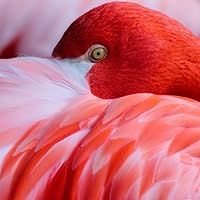
A huge range of art and artists (from low functioning to non-verbal to aspergers). I work with a young man with ASD who'sobsession is also birds, so the front cover really grabbed my attention.
What the artists had to say or share about their work is very interesting. One artist that stood out for me was the one who made graphic collages/pictures out of construction paper. It look like it was made with a computer!
I love peeking into the autistic mind and highly recommend it to others.