

What do you think?

Babylon Will Rise
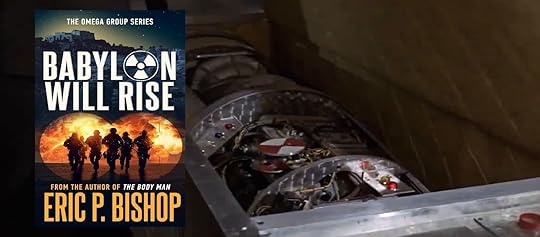
Babylon Will Rise is the latest pulse-pounding thriller from Eric P. Bishop, international selling author of The Body Man Series.
_________________________________________________________________
Of all codewords used by the United States military, Empty Quiver is one no service member wants to hear uttered. Now, two decades after they were stolen, two nuclear weapons emerge from the shadows in the hands of an international arms dealer.
THE RACE IS ON.
With the lives of millions at risk, the government goes through every contingency plan in its arsenal—desperate to end the crisis without causing panic. But when the consequences of failure have dire global implications, no option is left off the table.
ONLY ONE TEAM CAN WIN.
The Omega Group, a covert organization that works outside the restrictions of government oversight, has the skill and discretion necessary to succeed where no one else can. Led by Troy Evans, their highly skilled and close-knit team often works alone. But not this time. The team dynamic is tested when a new and unexpected member is attached to the latest mission.
FAILURE IS UNACCEPTABLE.
Troy and the expanded Omega Group will have to utilize not only their wits but every trick in their playbook to assure success. But what if their crafty enemy is playing an unconventional game?
BABYLON WILL RISE.
_________________________________________________________________
Of all codewords used by the United States military, Empty Quiver is one no service member wants to hear uttered. Now, two decades after they were stolen, two nuclear weapons emerge from the shadows in the hands of an international arms dealer.
THE RACE IS ON.
With the lives of millions at risk, the government goes through every contingency plan in its arsenal—desperate to end the crisis without causing panic. But when the consequences of failure have dire global implications, no option is left off the table.
ONLY ONE TEAM CAN WIN.
The Omega Group, a covert organization that works outside the restrictions of government oversight, has the skill and discretion necessary to succeed where no one else can. Led by Troy Evans, their highly skilled and close-knit team often works alone. But not this time. The team dynamic is tested when a new and unexpected member is attached to the latest mission.
FAILURE IS UNACCEPTABLE.
Troy and the expanded Omega Group will have to utilize not only their wits but every trick in their playbook to assure success. But what if their crafty enemy is playing an unconventional game?
BABYLON WILL RISE.
327 pages, Kindle Edition
Published December 5, 2024
Ratings & Reviews
Friends & Following
Create a free account to discover what your friends think of this book!
Community Reviews
Displaying 1 - 19 of 19 reviews
December 5, 2024
Babylon Will Rise is another great read by Eric Bishop! Nonstop action within an intense plot line with characters that are all too real make for an excellent reading experience. The first full novel, following the novella Ransomed Daughter, of the Omega Group is one hell of an adventure! I will definitely want to read the next one and the next and the next!!

November 10, 2024
The Omega Group is back in Babylon Will Rise by Eric P. Bishop. This is the second adventure with Troy Evans and his band of merry marauders, this time with some extra characters thrown in. I have followed this author since shortly before his first published book only a few years ago and I am pleased that he finally got some books available for us readers. He has four out there so far, this being number four. If you by some happenstance have missed his work it's about time you rectify it. I recommend that you start with The Body Man and then enjoy the journey through the pages. He actually lets his characters from the two series interact with each other which ic a brilliant thing to do. This time Troy and his gang are hunting for some missing nuclear devices and the chase takes us all over the place in a high speed thriller that is hard to put down with some difficulties and twists along the way. I was fortunate to get an advance copy and I highly recommend this book.

May 28, 2026
Political Thriller
This is probably closer to a 3.5. The tale is fine but it seems clunky at times, definitely bloated with exposition when it could have been more streamlined. Omega group is an elite force that is tasked to recover two nukes that a weapons dealer has gotten a hold of. It takes place around the world from the Middle East to DC as they rush to recover them before they can be used.
Overall again not a bad read, the dialogue is iffy quite a bit of the time but the actual tale is a good basis for a thriller novel. It has a lot of little details that I guess you need to read more in the series to know who they are talking about. These are character development things and I will be honest I just didn't care so didn't affect my reading. I may try others in the series.
This is probably closer to a 3.5. The tale is fine but it seems clunky at times, definitely bloated with exposition when it could have been more streamlined. Omega group is an elite force that is tasked to recover two nukes that a weapons dealer has gotten a hold of. It takes place around the world from the Middle East to DC as they rush to recover them before they can be used.
Overall again not a bad read, the dialogue is iffy quite a bit of the time but the actual tale is a good basis for a thriller novel. It has a lot of little details that I guess you need to read more in the series to know who they are talking about. These are character development things and I will be honest I just didn't care so didn't affect my reading. I may try others in the series.

November 27, 2024
Troy Evans and The Omega Group are back in their first full length novel after the novella Ransomed Daughter.
Eric Bishop is at the top of his game and has absolutely delivered a thriller you will not want to put down and will fly through.
There are two missing backpack nuclear devices missing and The Omega Group must find them and leave no stone unturned. In a race around the world The Omega Group is really fleshed out and jump off the page. With action scenes at every turn, this is begging to be made into a movie or series.
Bishop’s writing and characters are so so good. The amount of detail we gain about the Omega Group and friends lends you to wanting to learn more and read more books in the series. The plot is non stop and keeps you on the edge of your seat right till the end.
I look forward to spending more time with The Omega Group and their universe!
Eric Bishop is at the top of his game and has absolutely delivered a thriller you will not want to put down and will fly through.
There are two missing backpack nuclear devices missing and The Omega Group must find them and leave no stone unturned. In a race around the world The Omega Group is really fleshed out and jump off the page. With action scenes at every turn, this is begging to be made into a movie or series.
Bishop’s writing and characters are so so good. The amount of detail we gain about the Omega Group and friends lends you to wanting to learn more and read more books in the series. The plot is non stop and keeps you on the edge of your seat right till the end.
I look forward to spending more time with The Omega Group and their universe!

November 13, 2024
Author Eric P. Bishop knocks it out of the park with BABYLON WILL RISE, the first full novel in The Omega Group series. Join Captain Troy Evans and The Omega Group as they journey through the darkest recesses of today’s terrorism reality. The plotting, the characterization, and the tempo are burning on all eight cylinders! This is Bishop at the top of his game and installs him as a proven leader in the thriller genre.
Two US nukes are missing, and The Omega Group is tasked to hunt down the missing bombs. The mission orders are simple: Find the nuclear bombs now…at all costs. Only a tiny handful of senior government officials are aware the bombs are missing, and a smaller group know the specifics of the ultra-classified recovery efforts. But early into the mission a problem arises when someone begins to hunt the hunters.
Once you get started on BABYLON WILL RISE, the book is hard to put down and will leave the reader crying out for more.
Two US nukes are missing, and The Omega Group is tasked to hunt down the missing bombs. The mission orders are simple: Find the nuclear bombs now…at all costs. Only a tiny handful of senior government officials are aware the bombs are missing, and a smaller group know the specifics of the ultra-classified recovery efforts. But early into the mission a problem arises when someone begins to hunt the hunters.
Once you get started on BABYLON WILL RISE, the book is hard to put down and will leave the reader crying out for more.
November 18, 2024
In their first full feature length novel, Troy and the Omega team traverse 3 continents to find and secure 2 missing nuclear weapons. This fast paced novel has an intriguing plot and good story telling. For fans of Vince Flynn and Brad Thor, you will enjoy this ride. I was lucky to receive an ARC and enjoyed my sneak peak into the Omega team’s latest adventure. This is Eric’s 4th book, 2nd in the series (The Body Man series is also great!), all which are entertaining and well with the read!
November 13, 2024
Having read all of Eric Bishop’s books, BABYLON WILL RISE, is another winner! Interesting plot (and subplots) with enjoyable characters that make for great storytelling, and Bishop doesn’t disappoint. This is an action-packed page turner that makes me want to read more Omega Group adventures!
December 10, 2025
Recently, a post came across my Facebook feed promoting Babylon Will Rise by author Eric P Bishop.
Babylon Will Rise is a military and political thriller novel by Eric P. Bishop, the second book in "The Omega Group Series". The premise of the book involves a covert organization, Omega Group (led by Troy Evans) racing against time to prevent a global catastrophe caused by stolen nuclear weapons.
Babylon Will Rise brings to the imagination a harrowing scenario that we hope never comes to fruition. In the height of the Gulf War, two nuclear warheads were stolen from the US arsenal. In the US Military, this terminology for an incident of this magnitude is called “Empty Quiver.”
_______________________________
U.S. military nuclear incident terminology uses specific code words like Broken Arrow (accidental launch, detonation, theft, or loss of a nuclear weapon), Empty Quiver (loss/theft of a weapon), Dull Sword (minor issues with nuclear equipment/systems), and Faded Giant (reactor accidents, not weapons) to classify events, with NUCFLASH indicating a potential nuclear detonation or launch that risks war. These terms help rapidly communicate the severity and nature of an incident to high-level authorities and responding agencies.
Key Terms Explained:
Broken Arrow: The most well-known term, covering any accident involving nuclear weapons, from crashes to accidental detonations, or even radioactive contamination.
Empty Quiver: Signifies the seizure, theft, or loss of a functioning nuclear weapon.
Dull Sword: Minor incidents with nuclear weapons, components, or delivery systems that don't involve a weapon's immediate danger but could affect deployment.
Faded Giant: Events involving military nuclear reactors or other radiological accidents, not nuclear weapons themselves (e.g., the SL-1 reactor incident).
NUCFLASH: A severe alert for an accidental or unauthorized nuclear detonation or launch that threatens war.
Emergency Disablement/Evacuation: Operations concerning the destruction or removal of nuclear weapons during emergencies.
Incident Classification & Reporting:
These codes are part of a system to provide quick, clear updates to command centers and relevant government bodies like the White House Situation Room.
Incidents are categorized by type and severity, ranging from serious weapon loss to equipment malfunctions, with different protocols for each.
The term highlights the severe threat of nuclear terrorism, as seen in movies like Broken Arrow and games like Far Cry, where missing nukes drive the plot.
_______________________________
What’s even troubling is that these weapons of mass destruction surface in the hands of an arms dealer looking to auction them off. With the stability of the world at the brink of collapse, The Omega Group is sanctioned to ensure the weapons are safeguarded. Led by the charismatic and grounded Troy Evans and joined by a new enigmatic member, the team will dive into a dangerous mission where the enemy doesn’t play by the rules.
The book focuses on the Omega Group, led by Troy Evans, as they race against time across three continents to stop this unnamed dealer and retrieve the nuclear devices. The plot centers more on the high-stakes mission and the nature of the threat than on a single, named villain, though the arms dealer is the primary source of conflict for the protagonists.
Only a tiny handful of senior government officials are aware that the bombs are missing, and a smaller group knows the specifics of the ultra-classified recovery efforts. But early into the mission, a problem arises when someone begins to hunt the hunters.
According to the author’s website, this is the fourth novel in the Omega Group series (but apparently the first feature-length novel) and also ties in with his other series, “Body Man.”
On my self-determined five-star rating scale, I would give this novel a solid four stars (but then again, this was the first venture into this author’s literary universe). I believe that aficionados of the military and political genre will quickly come to be fans of this author. I believe that Eric P. Bishop’s style of writing might be compared to that of Tom Clancy, his plots to those of Vince Flynn and Robert Ludlum, for the intrigue that he puts in his books.
As with all my literary ramblings, this is just my five cents’ worth.
Babylon Will Rise is a military and political thriller novel by Eric P. Bishop, the second book in "The Omega Group Series". The premise of the book involves a covert organization, Omega Group (led by Troy Evans) racing against time to prevent a global catastrophe caused by stolen nuclear weapons.
Babylon Will Rise brings to the imagination a harrowing scenario that we hope never comes to fruition. In the height of the Gulf War, two nuclear warheads were stolen from the US arsenal. In the US Military, this terminology for an incident of this magnitude is called “Empty Quiver.”
_______________________________
U.S. military nuclear incident terminology uses specific code words like Broken Arrow (accidental launch, detonation, theft, or loss of a nuclear weapon), Empty Quiver (loss/theft of a weapon), Dull Sword (minor issues with nuclear equipment/systems), and Faded Giant (reactor accidents, not weapons) to classify events, with NUCFLASH indicating a potential nuclear detonation or launch that risks war. These terms help rapidly communicate the severity and nature of an incident to high-level authorities and responding agencies.
Key Terms Explained:
Broken Arrow: The most well-known term, covering any accident involving nuclear weapons, from crashes to accidental detonations, or even radioactive contamination.
Empty Quiver: Signifies the seizure, theft, or loss of a functioning nuclear weapon.
Dull Sword: Minor incidents with nuclear weapons, components, or delivery systems that don't involve a weapon's immediate danger but could affect deployment.
Faded Giant: Events involving military nuclear reactors or other radiological accidents, not nuclear weapons themselves (e.g., the SL-1 reactor incident).
NUCFLASH: A severe alert for an accidental or unauthorized nuclear detonation or launch that threatens war.
Emergency Disablement/Evacuation: Operations concerning the destruction or removal of nuclear weapons during emergencies.
Incident Classification & Reporting:
These codes are part of a system to provide quick, clear updates to command centers and relevant government bodies like the White House Situation Room.
Incidents are categorized by type and severity, ranging from serious weapon loss to equipment malfunctions, with different protocols for each.
The term highlights the severe threat of nuclear terrorism, as seen in movies like Broken Arrow and games like Far Cry, where missing nukes drive the plot.
_______________________________
What’s even troubling is that these weapons of mass destruction surface in the hands of an arms dealer looking to auction them off. With the stability of the world at the brink of collapse, The Omega Group is sanctioned to ensure the weapons are safeguarded. Led by the charismatic and grounded Troy Evans and joined by a new enigmatic member, the team will dive into a dangerous mission where the enemy doesn’t play by the rules.
The book focuses on the Omega Group, led by Troy Evans, as they race against time across three continents to stop this unnamed dealer and retrieve the nuclear devices. The plot centers more on the high-stakes mission and the nature of the threat than on a single, named villain, though the arms dealer is the primary source of conflict for the protagonists.
Only a tiny handful of senior government officials are aware that the bombs are missing, and a smaller group knows the specifics of the ultra-classified recovery efforts. But early into the mission, a problem arises when someone begins to hunt the hunters.
According to the author’s website, this is the fourth novel in the Omega Group series (but apparently the first feature-length novel) and also ties in with his other series, “Body Man.”
On my self-determined five-star rating scale, I would give this novel a solid four stars (but then again, this was the first venture into this author’s literary universe). I believe that aficionados of the military and political genre will quickly come to be fans of this author. I believe that Eric P. Bishop’s style of writing might be compared to that of Tom Clancy, his plots to those of Vince Flynn and Robert Ludlum, for the intrigue that he puts in his books.
As with all my literary ramblings, this is just my five cents’ worth.

July 18, 2025
Cunningly crafted, violent, ruthless, real & action packed, BABYLON WILL RISE to the occasion for everyone from the curious to seasoned connoisseurs of the Thriller.
The sound of reggae boldly on the world stage next to blistering crime, THE HARDER THEY COME showcased Jamaican creativity and the many talents of Jimmy Cliff, dazzling the world in 1972. Hailed for its kicking soundtrack, the Jamrock caper also featured 'Rivers of Babylon', first recorded by the Melodians two years prior. Later re-recorded by Boney M. and also used as the title of a Nelson DeMille Thriller, the riverine dwelling experience lamented by those removed from the city walls is understandable as the Bible names the Babylonians as the supposed final guardians of the Ark of the Covenant, the most powerful weapon in the world. Prophecy aside and modern nuclear warfare front row center, BABYLON WILL RISE presents a Reagan era misstep and an aggressive Persian plot as America's biggest two problems, squared, activating the Omega Group, battle hardened knuckledraggers operating in the darkest part of global shadows. Among international intrigue, slick dialogue, ferocious firefights, and proliferation posturing, it'll take THE BEST OF THE BEST to save the planet, defuse the crisis, kill the be bad-guys and get the girl--as the clock counts down and time runs out, BABYLON WILL RISE.
Much like the Omega Sector in 1994's TRUE LIES, America's last line of defense, just without the thick Austrian accent, the Omega Group in BABYLON WILL RISE maneuvers outside the normal chain of command and deep in the morass of black budget and even blacker bag territory. A group with skills not found in the SEALs, Force Recon or even the hallowed CAG (Delta Force), the Omega Group is twice the size of the legendary A-TEAM crewed by Colonel Hannibal Smith and ten-fold as deadly, though in good CANDYMAN fashion, them skills that kills are never spoken out loud. On rotation for the past three months without a day off, the motley crew of Bruckheimer/Simpson-vision operators was about to add hot dogs to their brewskis to temper the inescapable stress of perpetual missions when they're pulled into a seemingly simple and harmless weapons auction that's a curious mix of Dana Carvey's MASTER OF DISGUISE and the previously mentioned Arnie-actioner TRUE LIES. Faith, family and freedom is why they do what they do, and the Omegas, all Alphas, are about to go biblical to retrieve a couple of lost nukes.
A creative way to continue THE BODY MAN series without watering down the IP with like 27 books in the same vein, BABYLON WILL RISE is an interesting and entertaining iteration on THE EXECUTIONER and THE RAT BASTARDS. In addition to proffering an Eastern Airlines Flight 212 homage plus asserting that everyone has a boss in this life and that there's no such thing as personal liberties in the army, BABYLON WILL RISE is a masterclass in pop culture weaving, including shoutouts to GySgt Hartman, Kevin James, FARGO ('96), THE BODY MAN, FIELD OF DREAMS, Enter Sandman, TERMINATOR 2, BACKDRAFT, and Susan Swedberg of SEINFELD fame. A complete thriller with the most dastardly arms dealers the world has ever seen, rogue Iraqi nuke guardians, shifty DC insiders, a traitorous mole, and bloodthirsty Jihadis, BABYLON WILL RISE will keep the Omega Group and reader's minds busy for some time to come. Cunningly crafted, violent, ruthless, real, and action packed, BABYLON WILL RISE to the occasion for everyone from the curious to seasoned connoisseurs of the Thriller.

December 5, 2025
This book instantly grabbed me with its high-stakes premise. The idea of stolen nuclear weapons resurfacing decades later sets up nonstop tension, and the Omega Group feels like the kind of covert team you actually want to follow skilled, flawed, and pushed to the edge. I liked how the synopsis hints at internal conflict too, with a new member shaking up the team dynamic. It sounds like a fast, intense thriller where failure isn’t an option, and it definitely left me wanting to dive into the mission right alongside them.
November 18, 2024
the Omega group are top notch badass warriors that take on the most difficult challenges. A series that will have a long life. But what really set this apart is the incredible character develop that Eric Bishop creates. you feel connected to the characters like if they were real and you get to know them personally. This combined with a great story and details that draw you in make for a perfect read.

December 14, 2024
The second book in the Omega Group series is another highspeed action thriller. This time Troy Evans and his men (and woman) search for two missing nukes. Their search leads them through 3 continents and ends in the US with a dramatic showdown. It's always a pleasure to get a new book by Eric P. Bishop and this one doesn't disappoint at all. Keep them coming!

December 5, 2024
I was honoured to receive an ARC and loved it!
Babylon Will Rise is fast-paced, with an excellent storyline. The intrigue and deception kept me hooked from page one.
Like a fine, red wine, Eric P. Bishop keeps getting better
Babylon Will Rise is fast-paced, with an excellent storyline. The intrigue and deception kept me hooked from page one.
Like a fine, red wine, Eric P. Bishop keeps getting better

December 6, 2024
I read all day and cannot say enough about the evolution of of both Eric Bishop and his protagonist,
Troy Evans of the Omega Group.
Riding to the level of Brad Thor, this is a fabulous
well written story! Hurry up book #3!
Troy Evans of the Omega Group.
Riding to the level of Brad Thor, this is a fabulous
well written story! Hurry up book #3!

January 1, 2025
Another standout novel from Eric Bishop, brimming with action, intensity, and suspense. The pacing is spot-on, and the character development is exceptional. A must-read that deserves a place on your bookshelf.

January 11, 2025
Bablyon Will Rise doubles down on what I loved most about Ransomed Daughter, the dialogue between the characters is brilliant. Rapid fire action, great set peices, and characters you want to adventure with.
February 5, 2025
Very Entertaining
This was a quick read. Good action throughout and the story details were great. Also liked the personal details on the various team members. Finally I loved the reference to the Body Man. Looking forward to the next one.
This was a quick read. Good action throughout and the story details were great. Also liked the personal details on the various team members. Finally I loved the reference to the Body Man. Looking forward to the next one.
December 21, 2025
Very good
A really good special ops, nuclear bomb tale. Interesting characters and the plot keeps you interested. Nice writing style with lots of info. Highly recommend
A really good special ops, nuclear bomb tale. Interesting characters and the plot keeps you interested. Nice writing style with lots of info. Highly recommend
February 9, 2025
full of action thriller
Love the action, characters, camaraderie and humor. I didn’t appreciate this story until I read book 3. It certainly makes Troy a more interesting character. Lots of missions the Omega teams refer back to is a good set up to write many background stories.
Love the action, characters, camaraderie and humor. I didn’t appreciate this story until I read book 3. It certainly makes Troy a more interesting character. Lots of missions the Omega teams refer back to is a good set up to write many background stories.
Displaying 1 - 19 of 19 reviews