The “glorious…sweeping, full-scale biography” of Norman Mailer, the famous novelist, journalist, and public “There’s not a paragraph in this enormous book that doesn’t contain a nugget of something you…wish you had known” ( The New York Times ).
Norman Mailer was one of the giants of American letters, and one of the most celebrated public figures of his time. He was a novelist, journalist, biographer, and filmmaker; a provocateur and passionate observer of his times; and a husband, father, and serial philanderer.
Perhaps nothing characterized Mailer more than his ambition. He wanted not merely to be the greatest writer of his generation, but a writer great enough to be compared to Dostoevsky and Tolstoy. As Michael Lennon describes, although he considered himself first and foremost a novelist, his greatest literary contribution may have been in journalism, where he used his novelistic gifts to explore the American psyche. He would return to certain subjects John F. Kennedy, Marilyn Monroe, sex, technology, and the intricate relationship of fame and identity. Lennon captures Mailer in all his sharp complexities and shows us how he self-consciously invented and re-invented himself throughout his lifetime.
Michael Lennon knew Mailer for thirty-five years, and in this definitive biography, he had the cooperation of Mailer’s late widow, Norris Church, his ex-wives, and all of his children, as well as his sister, Barbara. He also had access to Mailer’s vast, unpublished correspondence and papers, and he interviewed dozens of people who knew Mailer. In Norman A Double Life he “brings Mailer thoroughly alive in this great wallop of a book…and he captures the entirety of a man who embodied his era like no other” ( The Washington Post ).
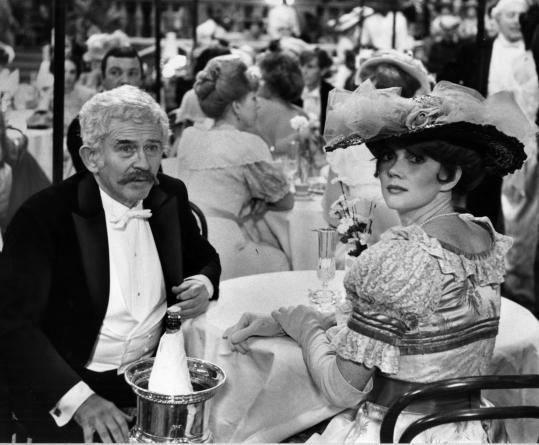
This was a shambolic upturned banquet of a life of a man who was able to live exactly as he wanted. So many books, so many wives, so many girlfriends, so many children, so much earned and spent, the energy and throughput of this life is astounding. Look at the subjects covered in the books – these are just the big ones - WW2 , the counterculture , 1960s/70s politics in all its mania, the moon landings , feminism , Marilyn Monroe, boxing, hip hop culture – The Faith of Graffiti (1973 book!!), true crime, Ancient Egypt , the CIA and the Cold War , JFK, Picasso, Christianity…. on and on. Norman didn’t have an OFF switch. His mill was vast and he ground everything. He ran for mayor of New York in the Democratic primary (got 5% of the vote) – he really thought he wanted to be a politician, do some actual good instead of all this scribbling. He made three experimental movies which were generally hated – entirely improvised, bad sound, etc. One notch above Warhol. He really thought he was going to become a film director, so he nearly bankrupted himself. He had a horror of semicolons. In the 60s he was way more famous than any novelist is now, probably including JK Rowling. He believed in telepathy and thought it explained why dogs don’t watch television. He acted in the movie Ragtime:
He had many odd obsessions, like ropewalking. Ropewalking?
It’s a feat of balancing that has religious import in some societies and is a circus act in others… Norman has a capacity not only to get totally absorbed by something like that but also to communicate his enthusiasm for it to everybody else. We hadn’t been there an hour before we were trying to find the right ropewalking shoes and Norman was showing us the basic techniques.
By the late 60s he was thought to be both an original and bracing thinker about America and a cultural loose cannon:
Vulgar, violent, and weird, spouting ideas about orgasms and existentialism that resembled the most outrageous theories of Wilhelm Reich… his novels… appeared to have been written by five different authors
Our biographer is a little kinder, describing his personality as
Sometimes brave, sometimes clownish, sometimes earnest, often peckish, invariably opinionated, regularly comic and usually honest
I knew almost nothing about this guy, that’s why I read this huge biography. I was very surprised to find out that NM was a Marxist in the 40s and 50s, and then morphed into a prophet of the counterculture in the late 50s (key essay : The White Negro). He campaigned loudly and constantly against the Vietnam War and got himself thrown in jail for it (three days, no sweat). But what was this about him being a great outspoken enemy of feminism? That didn’t square with the leftism at all, but it turned out to be just so – he was a prophet of left-right hipness, whatever the hell that was. He didn’t make any kind of consistent sense at all. The antifeminism (which biographer Lennon doesn’t trouble to explain at all – in fact he steers clear of all of NM’s theories) led to Gore Vidal traducing him in a book review by linking him with Henry Miller and – wait for it – Charles Manson.
The Miller-Mailer-Manson man (or M3 for short) has been conditioned to think of women as, at best, breeders of sons; at worst, as objects to be poked, humiliated, killed
Wow – them’s fightin’ words – and some years later Mailer finally found himself at a party with Gore Vidal and threw a glass at him followed by a fist in the mush. I mean, when was the last time Jonathan Franzen head-butted Brett Easton Ellis? These are uninspiring times.
The anti-feminism plus the wife-stabbing (reported in detail in part one of this review) kind of cemented his rep for women.
A TYPICAL NIGHT OUT WITH STORMIN NORMAN
One of his wives, I think the third, was a jazz singer and she was performing.
Halfway through Carol’s third number the man nearest Norman turned and called out “Is that broad stacked!” “Be quiet, “ Norman ordered. “Sex-y!” the man continued. With that Norman turned to face the stranger, grabbed him by the ears and in a split moment had butted his head so hard against the man’s head that there was a resounding craaaack! The stranger was holding his head and moaning….. The music stopped. Mailer and the man went outside…. (After some minutes Carol goes to see what has happened and sees a gaggle of people in the bar-room)… “Standing in the center were Norman and the stranger, no longer a stranger, bear-hugging, toasting each other. ‘You have a hard head,’ Norman said admiringly.
BAGGAGE
Now, it’s true, everyone has baggage. But Norm had more than most. He meets a new girl and likes her a lot. She eventually becomes the final wife, No 6. When they’re getting involved with each other, Norman lays out the situation for her.
He explained his obligations : three homes, seven children, three ex-wives, an estranged wife, Beverly, and Carol, the woman he was currently married to except in the eyes of the law. All told, he was the sole supporter of fourteen people.
“It was all rather overwhelming,” said the new girl, who, in the time-honoured way of rich guys and their later wives, was 26 to Norman’s 52, “but I appreciated his honesty.”
Our biographer points out that as well as the above at that point in time Norman was “seeing” three other women.
I have to say that this is live lived on a scale I simply can’t conceive. Later that year, 1976, Norman threw a party for a couple of hundred people. Guests included Jackie Onassis, Arthur Schlesinger, Dick Cavett, Kurt Vonnegut, Bob Dylan and Hunter Thompson. And just after that Norman got roped in to write something about the current cause celebre, which was Gary Gilmore. Just a little magazine article.
NORMAN ON GARY
He said he came to know Gary Gilmore “as well as I know some of my ex-wives”. The Executioner’s Song is one Mailer book I did read, and 5 starred it too. After this biography you’d have to pay me to read any of his actual novels.
DESERT ISLAND DISCS
It’s a British radio programme where a celebrity gets gently interviewed about their glittering career and asked to choose eight gramophone records to mark the stations of their particular bejewelled cross. Norman was on it in 1979 and the programme is here
He comes across as likeable! How strange – but of course he must have been something of a charmer, as well as an egomaniac. His book of choice to take to the mythical desert island was Labyrinths by Borges and his luxury was a stick of the best marijuana, which fluttered the pulse of the plummy BBC interviewer.
POP CULTURE REFERENCE NO 23
Ev'rybody's talkin' 'bout John and Yoko, Timmy Leary, Rosemary, Tommy Smothers, Bobby Dylan, Tommy Cooper, Derek Taylor, Norman Mailer, Alan Ginsberg, Hare Krishna Hare Hare Krishna All we are saying is give peace a chance
AND NOW : GOODBYE NORMAN
Leaving this biography I was punchdrunk. The ceaseless cramming in of everything in American life, the shovelling it in and shovelling it out, the appetite involved, was frankly appalling. He was like a tiny Roman emperor, charging around, owning the place, picking fights. It felt like I had been in the presence of a monster for many days. But one I was glad to have met.
For the first time I have to split a review into two parts. Because there’s just so much goin’ on here. So I take a break as Mailer is 40 years old, into his 3rd marriage and trying to write his 4th novel. Let’s say this is approximately half way.
REVIEW OF THE FIRST HALF OF THIS BOOK
Mailer started off as a Jewish intellectual Marxist and became a weird social prophet-mystic some time after he began inhaling balefuls of marijuana. Here he is in 1948 remembering his army days:
Remember that awful priest who said “There are no atheists in foxholes”?... I remember every time I got into a foxhole I said to myself “This is one man who’s an atheist in a foxhole!”
He had a genuine gift for an arresting phrase (and also a genuine gift for being arrested). On the subject of visiting brothels in the army when you’re married:
What I discovered is that an oath has a great influence upon a hard-on. You, know, don’t give an oath and think your hard-on can ignore it.
Out of the army, age 23-24, he wrote the 750 page gruntfest The Naked and the Dead, which was Apocalypse Now for the postwar generation and was a gigantic hit. So that was a problem. He was like John Lennon in 1963 – married with a kid and all these girls wanting to boff him. It was exquisite torture. Well, he didn’t think about it for too long.
After the big hit came two odd, miserablist novels Barbary Shore (a jeremiad about leftist politics) and The Deer Park (a jeremiad about Hollywood), which were not really hits at all.
NORMAN’S IDEA OF PUBLICITY
This was NM’s creation : A half page ad entitled “All over America THE DEER PARK is getting nothing but RAVES” and underneath that 15 attributes quotes like “The year’s worst snake pit in fiction”, “sordid and crummy”, “moronic mindlessness”, etc.
THE BADLY-TIMED, FATALLY COMPROMISED MISSION OF NORMAN THE HORMONE
On his 32nd birthday Mailer wrote over 10,000 words… he was preparing himself, anointing himself. In his 33rd, Christological year, he would begin his public mission as prophet and cultural hero.
As the 50s wended onwards, soaked in Red-hatred and atomic paranoia Norman, to his credit, was unable to sink into the life of a literary novelist. He had gargantuan appetites and an ego the size of a building which has not yet been built. He thought America was going badly wrong and he could hear a new Beat from the street. He consciously became what this biographer calls a “psychic outlaw”. So that was new – I mean, what the heck was one of those things anyway?
I was a wild man. I wanted the revolution to come. I wanted blood in the streets. I wanted the whole thing to start.
What this all meant was his announcement of The Hipster as a new(ish) type of American who could save the soul of the nation. This was blared out in the form of an essay called The White Negro which is here
So there was a new breed of adventurers, urban adventurers who drifted out at night looking for action with a black man’s code to fit their facts. The hipster had absorbed the existentialist synapses of the Negro, and for practical purposes could be considered a white Negro.
Was this anything more than what Jack Kerouac had been typing so wildly in his novels?
• On the Road (1957; written 1947–1951) • The Subterraneans, (1958; written 1953) • The Dharma Bums (1958)
The White Negro published : 1959
Well, whatever, it made a big impact.
The division of opinion on the essay continues: it is regularly used as a club in the continuing race-gender-power debates of academics. It rasps, it elates, it confuses, but it is unforgettable.
So, strangely enough, this 15-something page essay caused way more impact than his last 2 novels.
For the next several years, Norman liked to extrude gnomic eschatology during interviews which from someome else might have sounded pompous to the point of risibility but from Norman just sounded pompous :
I think there is one single burning pinpoint in the vision in Hip : it’s that God is in danger of dying.
And
I am more or less obsessed with the idea that sex is dying in a new ice-age of the psyche
And
There’s psychic poverty in the city today, perhaps in the whole country
A TYPICAL EPISODE IN THE LIFE OF A FAMOUS NEW YORK WRITER
He took his two poodles for a late night walk, around 1am. Passing a bunch of “hoodlums” (Norman’s word), one of them told him his dogs were “queer”. Then that he was queer. There was a fight. Mailer thought he would win as he was older and heavier, but the hoodlum gouged his eye in a clinch, “very professionally, I may say” Mailer wrote. They clinched again and the man gouged Mailer’s other eye… “some tremendous brute of a character clouted me and said “Have you had it?” Well, I had had it, I could hardly see, my eyes were bleeding… so I nodded hopelessly, muttered several times over “Yes, I’ve had it, I’ve had it”, picked up the dogs from another hoodlum who ironically enough had been holding them during the fight and shambled off.
AN EGG
In Connecticut he constructed a large, polished wooden egg large enough to hold a person in the fetal position. The idea was to get inside, curl up, and be rocked by someone outside.
A LETTER TO A FRIEND
Now here’s something nobody does anymore. Gossipers tell you that your dear friend Bill (Styron, of Sophie's Choice fame) had been badmouthing your wife. So, you write an actual angry letter:
Bill
I’ve been told by a reliable source that you have been passing a few atrocious remarks about Adele. … So I tell you this, Billy-boy. You have got to learn to keep your mouth shut about my wife, for if you do not, and I hear of it again, I will invite you to a fight in which I expect to stomp out of you a fat amount of your yellow and treacherous shit.
WOMAN TROUBLE (1)
He wrote an essay where he anatomised all his novelist contemporaries. Most of them didn’t come out of it too well (the only one who did : William Burroughs). But it was the specific bile he reserved for women novelists which has echoed down the years :
At the risk of making a dozen devoted enemies for life I can only say that the sniffs I get from the ink of the women are always fey, old-hat, Quaintsy Goysy, tiny, too dykily psychotic, crippled, creepish, fashionable, frigid, outer-Baroque, maquillé in mannequin’s whimsy, or else bright and stillborn. Since I’ve never been able to read Virginia Woolf, and am sometimes willing to believe that it can conceivably be my fault, this verdict maybe taken fairly as the twisted tongue of a soured taste, at least by those readers who do not share with me the ground of departure—that a good novelist can do without everything but the remnant of his balls.
As Lennon says
His dismissal of female writers would not only be remembered, it would be bitterly intoned by women for decades.
WOMAN TROUBLE (2)
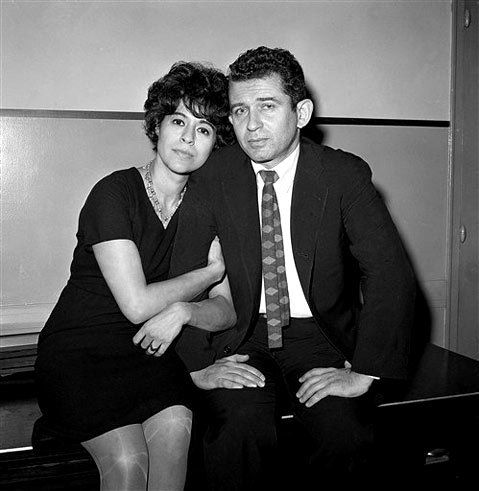
In 1960 he stabbed his second wife Adele. Just a little bit to the left and she would have died. This was the culmination of a lunatic period where he thought he’d run for Mayor of New York. So he had this big party to announce that & him & Adele were having some boozefuelled arguments and :
Finally in a rage I took out my penknife and stuck it into her with the idea “Here, you think you’re tough, I’m tougher”. It was madness. I was pretty drunk at the time… damn it it it didn’t nick her heart. She could have died from it. And of course, they took her to the emergency hospital, cut her open from the sternum virtually down to below the navel. So for years afterwards she had this huge scar and she’d sometimes show it at parties. This would give people the idea that I’d used a butcher knife.
So he was arrested and committed to Bellevue Hospital for observation.
Magistrate Rueben Levy : Your recent history indicates that you cannot distinguish fiction from reality.
In the way of these things, Adele didn’t press charges, and accompanied him to the next hearing in January 1961, telling the judge “My husband and I are perfectly happy together”. Well they weren’t, of course, and divorce followed. Mailer got a suspended sentence and three years’ probation.
THE REACTION OF HIS FRIENDS AND FAMILY
James Jones (From Here to Eternity) commented that the stabbing was partly the result of Adele being “a lousy wife”. Old army buddy Fig Gwaltney : “he finally did to Adele what should’ve been done years ago”. Fan Mailer (Norman’s mother) wrote in her memoir : “Whatever happened with the stabbing she goaded him into it.” And Norman : Looking back, he said
A decade’s anger made me do it. After that, I felt better.
Well, that was part one. Who said great writers had to be nice people? Or to put it more accurately, who said writers who were considered great around 30 years ago but probably aren’t read a whole lot now had to be even marginally pleasant? William Burroughs shot his wife dead and everybody loves him nowadays.
We will see what the next 47 years brings to Norman.
Norman Mailer: A Double Life is a fascinating, very readable saga of the life of the author provocateur. Mailer was a big, complicated guy with a flair for performance, and the book shows us no less. Not a critical study, it’s a generous embrace of Mailer the brawling, egotistical seducer. While Mailer the writer had his struggles with holding still long enough to really focus on his work, Mailer the man had a dramatic barrelroll life through the crazy period from the 50’s through the turn of the new century. He lived drama, and not some kind of internal melodrama, either. This book shows all that he did out in the world: standing against political repression, battling feminists, fighting with wives and Gore Vidal, and trying to serve the aims of art in sometimes deeply misguided ways. It’s a big sprawling look at an era, and a paean to the kind of writerly controversies and public involvement that we seem to have lost. Back then, American writers appeared on TV, were international figures – people listened to them – and Mailer ate it up. Along with Capote, Vidal, Hunter Thompson, and Tom Wolfe he appeared on magazine covers and the talk show circuit and everyone knew who he was. He was loved and hated (mostly hated) by people who probably never read his work. I doubt there’s a writer now who could get that much attention, even for a day. Whether his embrace of public performance harmed his writing is another question, one that only the reader of this book can decide. I, for one, have read nearly all of Mailer’s work, and I never fail to be surprised at how much deeper and more complex his writing was when compared to the broad strokes of Mailer the public figure. If this biography brings Mailer some new readers, then all the better.
The book covers the better known crises in Mailer’s life – the stabbing of one wife and the support of the killer Jack Abbott – along with many smaller conflicts, and does so in a straightforward, non-judgmental, almost breezy style. The writer was a friend and admirer of Mailer, and it shows. He doesn’t throw any hardballs at Mailer’s head – but then, other people can do that. He also for the most part doesn’t serve as an apologist. He has a good sense of Mailer’s failings and doesn’t walk away from them. He can use Mailer’s own guilt to reflect upon Mailer’s mistakes. Mailer apparently never got over the fact that he stabbed his wife. He also felt horrible over Abbott’s murder of a young waiter, while at the same time always defending his impulse to support Abbott’s writing. Mailer comes across as strangely naïve in both instances (it was just a little pocketknife; he only meant to give her a nick – Abbott needed more support during the hot summer). Lennon doesn’t really speculate on much of this, keeping himself out of the narrative and leaving the reader to decide. And the narrative in these sections is exciting; the story moves.
Although Mailer had many wives, I never gave much thought to his promiscuity. Lennon discusses Mailer’s many women in an observant but dispassionate way. He doesn’t seem to applaud or judge, nor does he wallow in anything too salacious. The women are simply a part of Mailer’s life, and it was revealing to see how many lifelong relationships he actually maintained. Lennon doesn’t speculate much on why Mailer needed all of these pursuits; we can tell he was just a lusty kind of guy who pursued women in the same way he pursued fame. It’s to Lennon’s credit that he talks about the women as individuals, giving us a sense of who they were. And who they were also told me a great deal about Mailer himself. I enjoyed Lennon’s complete lack of psychological speculation as to the source of Mailer’s drives; no “lack of mommy’s love” theories presented here. This is good, I think; so often in biographies writers fall into a kind of dime store psychoanalysis that may be wrong as often as it is right. Let the reader decide.
Writer Lennon keeps himself out of the narrative throughout, and you’ll not get much critical analysis here about Mailer’s personal life or his work. But there’s no room for any of that. This is a big life and it takes a lot of pages to cover it. There were times when I wished for even more information, though – more context about the period and about Mailer’s writing itself. I already knew quite a bit about the writers’ circles of the 50’s, 60’s, and 70s, and about the many conflicts and controversies of the period, just because it interested me. I also already know Mailer’s work, especially his nonfiction. I wondered as I read if someone who didn’t know that information would really “get” what was going on. Would they understand the controversy surrounding Mailer’s “The White Negro”? Would they even know who Gore Vidal was? Or George Plimpton? Although I understand market demands, I wish this could have been a two part biography, with one book able to delve further into that exciting, wild early era. With people from that period now dead or soon dead, it seems a lost and special time. Reading about Mailer made me think about all of that again, and how much I took for granted the presence of such bigger-than-life authors. I wonder if younger people today can really understand just how that happened. Through the fond tone of the book, I was able to enjoy some moments of nostalgia – even as Mailer was frittering away his time by running for mayor. (Well, he certainly didn’t see it as frittering; that’s just my take.) It was a time when politics and art truly came together out of necessity and out of a sense of urgency. And the book captures some of that tumult. I would have loved to have heard more of that. (Book two, Mr. Lennon?)
The book is crammed with information about Mailer’s big life, which did, after all, span decades. Lennon had special insight into Mailer and access to hundreds of interview subjects. The research alone must have been nearly overwhelming – never mind organizing it, deciding what was important, then determining how to bring it to life. Beyond this, though, the book is very well written stylistically, sometimes strikingly so. It moves – it never drags – and I finished it over a couple of days. There are points in which the prose itself is really fine, as in a chapter in which Lennon melds discussion of moon landings, Mailer’s writing on race, and his leaving one wife for another. Like Mailer, Lennon had to juggle the discussion of the upheaval of a country with an essay on politics, a one-night stand, a squabble with another writer, child support, the IRS, a nosy journalist, another wife, et cetera. All in a chapter. Although Lennon has to mix up the big ideas with the gritty details of life, he somehow manages to do it while making it all look easy. He keeps it flowing and the writing never sounds cobbled together or forced. It also never sounds glib. He resists the temptation to fill the book with easy gossip (which would have been awfully tempting). As Mailer might have said it, the book has meat. Bloody, dripping sirloin (okay, I’ll stop). The book doesn’t take any easy outs; it really attempts to meet Mailer head on and do the man justice. And I do feel that I understand more about Mailer by reading this than I ever did before.
Mailer’s life always seemed balanced between his embrace of big ideas and the needling impediments of everyday life. It was interesting to find how much of Mailer’s artistic life became dictated by financial concerns. So many women and children are hard to support. His need to live a big sweeping life ultimately created financial and personal burdens that he had to struggle through. His desire for the limelight sometimes got in the way of his concentration. Success didn’t necessarily give Mailer freedom; he became somewhat boxed in by his choices and turned more to his quiet life in Provincetown by the sea. His final days are poignantly described.
We’re fortunate to have this book. Fortunate that so many people were interviewed before it was too late; fortunate to revisit the man before we forget. It’s good to have read a biography that strikes a fine balance – it isn’t too academic and critical, and it isn’t too light and gossipy. The tone perfectly captures the Mailer as we like to remember him – when he was a big controversial brawling writer who could drink anyone under the table while sizing up the tall drink of water. I’m not sure such people still exist or will again.
Thorough, at times critical, and occasionally the sentences stumble. Clearly Lennon had access to much private material, as well as having Mailer's ear over a couple or more decades. Probably no need for any other biography for those interested in this writer and his apprehension of his time.
I had the privilege of meeting Mr. Mailer's last and late wife Norris while she was on her book tour for her memoir A Ticket to the Circus, she was a lovely person and obviously loved Norman and was missing him. I used to see Norman Mailer walking in Provincetown (near where I live). This book is an excellent resource for those interested in this fascinating author.
Excellent biography. I've been a fan of Mailer for a while and this book taught me something new every few pages. It's a bit too fawning of Mailer at times. It too often seeks to portray his bad behavior in the most generous light possible that the author sometimes strains credulity, but these moments are minor. A must for any Mailer fan.
J. Michael Lennon has captured Norman Mailer to the fullest extent possible, in the biography, Norman Mailer: A Double Life.
Through his meticulous attention to detail, and his extensive research, he has brought the reader a stark, undoctored, realistic approach to the life that Mailer led, both privately and publicly. There are instances where I wish that Lennon was not so illuminating with is minute word-imagery, but I am aware that those segments are a part of the whole.
In reading the biography, I could see where Mailer was very possessive and protective of his books. If anyone dare to give a negative review of one of his works, he would respond back in a defensive manner, trying to justify why he wrote what he did. He didn't feel that others necessarily understood the meaning behind the content. He wanted to be regarded as a great American writer. Many critics and readers saw him as such, yet many didn't.
Mailer's competitive edge was highlighted within the pages, and his views on other authors and their novels were not always positive. He felt that the great American novelist of the 20th century had yet to appear. He endeavored to be that author. Time will tell if he was.
Lennon has created a biography that depicts a man who, in my opinion, seems to be floundering. I could see him at odds with his sexual escapades, his divorces, his children and his own opinions of the world and of himself. At odds, meaning his actions and the consequences of them. At times, he appeared to be so full of himself, and his activities and sexual encounters and prowess never ceased, at the expense of others. But, more importantly at the expense of himself.
He didn't seem able to control his impulses, and he let them take over in social and private situations. Even if he could control the impulses, from the material garnered in the biography, I doubt he would have. Self-control did not seem to be an option. Sex and women were major factors in his life. For him the events leading to self-gratification were a form of power over another.
He seemed to use his sexual experiences as material for some of his novels. He enjoyed the self-absorption and the impulses he acted upon, while they were occurring. Afterwards, he often felt that he spread himself too wide, but it did not stop him from continuing his more or less promiscuous behavior.
Marriage and infidelity were one of his double lives. Becoming a great author and juggling fame and his personal life was another one of his double lives. Author and critic, power play and morals, hardworking and merriment, all of these and so much more are described in the several double lives that Mailer involved himself in.
Within his life as author, there is the life of husband and father. He did take responsibility for his children, and did provide for them.
His writing seemed to fluctuate, from one extreme to another, as far as subject matter. It also seemed as if he lost interest in certain subjects, putting off their completion for years, before accomplishing a final resulting publication.
J. Michale Lennon has brought every aspect of Norman Mailer's life to the forefront. From the despicable and ugly acts to the kindnesses, we are witness to a man who led a life filled with prolific writings, nine children, six wives, varied emotions, and filled with self-realized consequences for the choices he made.
Norman Mailer: A Double Life is a long book, yet within the pages, nothing is left for us to wonder regarding the context of his life.
Thank you to Goodreads and to Simon and Schuster for the complimentary copy!
I wrote my undergrad thesis on Norman Mailer in 1973. He had just published "St. George and the Godfather" and had more than half of his books ahead of him. I focused on "Armies of the Night" and "Of a Fire on the Moon" (still two of my favorite Mailer books) in my paper. At that time he was just beginning to establish himslef as a celebrity and larger than life figure, using his writing as a springboard into movies, playwriting, boxing, bullfighting, art criticism and politics. Since then I have read just about every word he has written, always looking forward to the challenge that a new Mailer book promised. Mailer did not write books that were "page turners" (he hated those) but books that were thoughtful, deep, theological, always provacative and challenging (but not necessarily good). His books are far from cookie cutter formulas and very hard to categorize. His personality often overshadowed his writing, especially in the 70's and 80's. He was pugnacious, rowdy, opinionated, chauvanistic, bawdy and often narcissistic, resulting in a public persona that was not loved by many.
Mr. Lennon's biography does an excellent job of capturing this unique man's life and writings. He tells Mailer's life story year by year, with a focus on his writing and the key events in his life that impacted his writing. He is clearly an admirer and not a critic, however, he includes the reaction of both the positive and negative reviews of each book or event so you are aware what the reaction was to each one. Throughout the narrative Lennon adds a huge amount of persoanl information that he pulled out of Mailer's 45,000 letters as well as thousands of interviews with friends and family members and, finally, drawing on his personal freindship with Mailer in the second half of his life. Lennon is able to show Mailer in all of his glory, giving us a close look at the beliefs that were important to him and that drove his life. You also get a look inside his personal life, including the six wives, many mistresses, nine kids, friendships and feuds with contemporary writers and critics and his ongoing struggle to keep financially solvent.
For those of us who lived through the decades of his publications, the biography is a reminder of those times of friction and change in the US as we moved from our position of new world power at the end of WWII to where we are today. Mailer always had his hand on the pulse of the country and never stopped pushing his beliefs on where we, as Americans, should be headed. I would expect that Lennon's biography would be interesting to younger people who may not have read any of his books or lived through any of the drama. It is a huge book, but don't be intimidated as the last 1/3 is only notes and references. I also read alongside "A Double Life" another recent publication, "The Mind of An Outlaw". This is a compilation of about 50 of Mailer's essays, assembled by Phillip Sipiora. The essays are arranged chronologically and include selections from every decade from the 50's until his death in 2007. It made for an interesting counterpoint to the biography.
I would recommend "A Double Life" to every fan of Norman Mailer and to anyone who would like to get a perspective on the coming of age of America as told by the biggest and boldest writer the country produced during that time.
J. Michael Lennon was chosen by Norman Mailer to write his biography in 2006 after his close friend and original biographer Robert F Lucid died. Lennon was also Mailer's archivist and editor on several books. He said that Mailer told him to "put everything in" and it appears he has.
I knew who Mailer was from being on the talk shows my mother used to watch. I knew he wrote The Naked and The Dead but the only book I've ever read of his was The Executioner's Song. And of course I knew him from being on the news when Jack Abbot killed a young waiter after being paroled from prison only for only a short time. The reason I wanted to read this biography was because I enjoyed reading the memoir A Ticket to the Circus by his sixth (and final) wife Norris Church Mailer. And the author does quote a fair amount from her book.
The book is so comprehensive it's hard to know where to begin.
I found it fascinating to read about the back stories for his books even without reading them. He based the characters in The Naked and the Dead on people he served with in the army. He read Pope John Paul's 1987 encyclical On Social Concerns which lead him to read the Gospel of John and the other synoptic gospels which resulted with him writing The Gospel According to the Son. Mailer also thought the writer's association PEN should have given John Paul an honorary membership but it never came to a vote.
It's easy to recommend reading this book. Read as a netgalley copy.
A large, sprawling, swamp of a book - not unlike the tomes that Mailer himself churned out. 945 pages crammed with (sometimes) superfluous detail; for example: did we really need to know what the builder who renovated Mailer's study windows thought of the finished job? On the other hand, the author ends the book abruptly on the death of Mailer; a coda which tells the reader what happened to the major players in Mailer's life after his death would have been appreciated - or did their lives cease to be meaningful when the great man died? Overall, though, I stuck with the book to the distant end so its flaws weren't critical and I'd recommend it for anyone with a passing interest in Mailer, even if it wouldn't give you the urge to read him.
Exhaustive, interesting. Mailer had an amazing number of interests and the writer enables the reader to differentiate between the 6 wives if not the eight children but the book could probably have been cut quite a few pages.
Truly the go-to source on Mailer's life. Lennon's biography is well-researched and thoughtfully told. Even those who think they hate Mailer would appreciate the virtuosity of this read. Lennon put everything in — warts and all — but makes it an entertaining and thought-provoking ride.
Mailer makes so much more sense after reading this. He was a true renaissance man. He was into so many things. Great read to develop a deeper understanding from one of Americas most under rated writers. Now i move on to Gore Vidal.
Norman Mailer is an acquired taste, personality equal to his writing, personality more central than his writing. He’d not chafe at that, seeing the two, yes, as intertwined, and yes, a taste deserving of being acquired, and yes, a personality gutsy, even at times foolhardy in attempts to wring full truth from apparent contradictions.
The largely unassailed part of his reputation rests with a cluster of writings taken publicly as ‘non-fiction novels’ – political examinations ‘on the ground’ with Mailer, under some third-person form of avatar-alias, as a character (i.e. “Mailer”, “The Novelist”, “The Reporter”, “Aquarius”). These are also labeled by some readers as excellent journalism, simply, but his persona within them as an observer-participant argues a further touch.
These include Armies Of The Night, Miami And The Siege Of Chicago, Of A Fire On The Moon. Another, The Prisoner Of Sex, is among them, and presents ‘the Mailer character’ daring to seek contradictions within the Feminist movement. His sense of dialectic reaped him there a great deal of antagonism.
Not unrelated to Lemon’s book title, Mailer’s ‘double life’ isn’t only the family/public one, the stable/risk-taking one, or the establishment/rebel one. Knowing his serial monogamy ahead of time still doesn’t prepare the outsider from discovering the pain associated with such life changes, nor does it say anything of many other sexual escapades, philandery, some of it, that went on for decades.
He was dutiful, on the other hand, fathering eight children, and caring for them. Supported his wife and all his previous wives. He lived well, but was followed by debt.
He wanted most to be a great novelist, and many of his books seek Tolstoyan length. Novelistic projects that aim (as mentally envisioned) at trilogy, but don’t get beyond the limit of a single (large) volume. His one undeniably successful ‘novel’ is his first, The Naked And The Dead. He came, within a short time, to see its naturalism to be a style uncomfortable for the kind of reality his post-war America was showing to him.
His was the bohemian world of Greenwich Village and Provincetown. A world of late Marxian thought, a dash of Freud, plenty of French existentialism. And, it seems, lots of marijuana. He co-founded The Village Voice, and wrote columns for it. His book The White Negro set out to define the 50s hipster. Parts of that seemed to sanction violence, an element even some supporters found uncomfortable.
Mailer’s sense of engagement did include the physical. He was enamoured of boxing, wrote about it, promoted Jose Torres as a champion and as a writer, and considered himself a ‘club fighter’, one who showed up and took his punches. As a minor film-maker, he sought the tough, the confrontational, the unpredictable. As a ‘public intellectual’, he frequently came out verbally fighting.
His reputation did take some punches of its own. After stabbing his second wife Adele, he spent some short time ‘under observation’ and shared space with criminals, though Adele did not press charges and Mailer himself did not see prison time. He gave years of advice to inmates who wrote, the most notorious of whom, Jack Henry Abbott, gained release partly with favorable recommendation by Mailer. Abbott shortly thereafter killed a man.
Norman Mailer was part of that generation in uniform, and the violence seen or anticipated, the great carnage of the world war and the greater potential eradication in the nuclear age, left its mark. It’s not pure accident that he shared the wildness and dope-visioning of the ‘Beats’, liked Ginsberg, Kerouac, and company – and held off from more stable and establishment figures like Saul Bellow or John Updike.
Involved as he was with the contemporary world, part of his motivation was . . . mystical. Tapping into Martin Buber and Hassidic ideas of an invisible universe, and melding that with how he saw Samuel Beckett envisioning God’s destiny linked with ours, Mailer grew early to see humans as “seed-carriers” of their own outcome. “Voyagers” on a heroic exploration of self-construction. Elements of evil abound, out and in.
J. Michael Lennon was chosen by Norman Mailer to write his biography in 2006 after his close friend and original biographer Robert F Lucid died. Lennon was also Mailer's archivist and editor on several books. He said that Mailer told him to "put everything in" and it appears he has.
I knew Mailer from being on the talk shows my mother used to watch. I knew he wrote The Naked and The Dead but the only book I've ever read of his was The Executioner's Song. And of course I knew him from being on the news when Jack Abbot killed a young waiter after being paroled from prison only for only a short time. The reason I wanted to read this biography was because I enjoyed reading the memoir A Ticket to the Circus by his sixth (and final) wife Norris Church Mailer. And the author does quote from her book.
I found it fascinating to read about the back stories for his books even without reading them. He based the characters in The Naked and the Dead on people he served with in the army. He read Pope John Paul's 1987 encyclical On Social Concerns which lead him to read the Gospel of John and the other synoptic gospels and this resulted with him writing The Gospel According to the Son. He also recommended that John Paul be given honorary membership in the literary organization PEN but a vote was never taken.
This book is easy to recommend. Read as a netgalley copy.
Not just a great biography but one of the best biographies I have ever read. It takes on the subject of Mailer - a diminutive man with an epic, sprawling life - and succeeds brilliantly. It's a hulking tome, well-written, exhaustively researched, never dull - a little like Mailer at his very best. Mailer's life was like something out of a pulpy noir: packed with sex and violence and self-destructive behaviour. However, there was redemption for Norman, while there is none in noir. Norman Mailer: A Double Life treats Mailer as a complex person - which he was: a clash of contradictions; a man of immense talent who never achieved his ultimate potential in a whole novel. Lennon tries to bring out the best in each of Mailer's novels, even his bad ones. He offers insightful commentary and a fascinating behind-the-scenes look at their creation Verdict: Hardcore Mailerites will get the most enjoyment out of reading it, but Norman Mailer: A Double Life is certainly worth a read for anyone interested in the life of Stormin Norman.
The New York Time Book Review call Norman Mailer a “giant” and this biography “glorious”. It’s hard to disagree on either count. Mailer’s writing swept across the middle and end of the twentieth century like a firestorm. Unfortunately, so did he. With six wives, countless lovers and a propensity to stir up trouble, Mailer the man could upstage his literary impact and alienate people more effectively than any bad review.
Lennon’s book does justice to the giant talent and monumental self-destructiveness of Norman Mailer, in a plain spoken, well-modulated fashion. It is entertaining without glossing over the rough spots or unduly highlighting the accomplishments. At some point, when the work of Mailer is considered without the distraction of the man’s hijinks, this book will remind future readers of both sides of the double life.
An exhaustive, though never exhausting, look at the life of one of America's last great public intellectuals and one of its most important writers. This goes year by year, book by book through Mailer's many achievements and feuds, his failures and successes. It is generous when it needs to be but doesn't pull any punches, and acknowledges that as great a writer as Mailer was, he was sometimes an awful person. I found this book beautiful and inspiring, and relished the chance to look through past generations of American writers alongside Mailer. There is a feel to each decade and it really gets inside not only Mailer's head, but puts you directly into his relationships with other people, his wives, his children, his friends, to the point where an emotional connection to each character is immense. This is my favorite book that I've read so far this year.
As one of the first books I won during a goodreads giveaway I was thrilled to received this book.
When it first arrived I was a little daunted by it's size. But I can see how the author NEEDED all these pages to give us a full and complete view of a complicated man.
I could only repeat the compliments given by the other reviewers who gave it 4 or 5 stars. So if you have any interest in Mr. Mailer I say buy a copy and give it a whirl. You will be fascinated. And you will be wanting to pass it along to friends to read or add it to your library.
"I think you're fulfilling the task we've almost forgotten, which is that we're here to change the American obsessions -- those black holes in space -- into mantras that we can live with ... Whether history will find you right is hardly the point: what counts is that you brought life back to a place in our imagination that has been surviving all these years like scorched earth, that is, just about. It's so rare when novel writing offers us this deep purpose and I swear, Don I salute you for it."
Norman Mailer writing to Don DeLillo about his Lee Harvey Oswald novel 'Libra'
I have never been a fan of Mailer's writings. I've read some of his work, and after reading this physically heavy, lengthy tome, I am sure I won't be going back to seek out more. I marvel at how his last wife, Norris Church, endured--the volume of children from a variety of wives, the siblings and parents, her own serious illnesses. Mailer was like this little bombastic whirly gig of ambition and drive. He fought with a fury to be the great American writer. Reading through page after page of those struggles and battles was hard.
This tome kept me tucked in bed during winter evenings reading and enjoyed Mike's style of getting in NM's inner thoughts and allowing the reader to share in those thoughts. I really liked this book and all the information about this writing which has inspired me to keep my daily writing schedule and continue pounding the keys.
Awesome. Mike Lennon couples rare access to Mailer with solid research and is able to show us one of the most fascinating writers ever--novelist, soldier, hipster, war protester, philanderer, drinker, wife stabber, journalist, political commentator, mayoral candidate, amateur boxer, lousy filmmaker, Pulitzer winner. Mailer was a trip, and so is "A Double Life."