It’s a true story that reads like gripping in June 1942, eight German terrorists landed by submarine on the shores of Long Island and Florida with a mission to blow up major buildings and railroad hubs throughout the United States. In Time of War tells the dramatic story of how they were ultimately betrayed by one of their own, tried by a special military tribunal appointed by FDR, and zealously defended by an army colonel. Six of the eight were executed. The U.S. Supreme Court subsequently upheld the president’s power to order the military trial that passed the death sentences.
More than sixty years later, President George W. Bush, in the wake of the deadly 9/11 terrorist attacks, cited Roosevelt’s act as precedent for imprisoning over six hundred suspected “enemy combatants” in Guantanamo Bay, Cuba, and indefinitely detaining U.S. citizens suspected of terrorist activities. In a riveting account of this remarkable episode in America’s history (much of it based on documents never before available), O’Donnell, one of the country’s leading trial lawyers, illustrates the parallels between then and now, offering a cautionary tale of the danger of unchecked executive power in a time of crisis.
It's difficult to rate this book because its title is so misleading. Don't get me wrong, the details of Operation Pastorius (the titular “terrorist attack”) are covered. However, this book is decidedly more constitutional law than military history/true tales of spycraft. It's about civil liberties (or lack thereof), the justice system and executive power “in times of war,” featuring a case study of the Nazi saboteur trial. Published in 2005, the author gives a comparative analysis of FDR's handling of the Nazi saboteurs, and the circumstances of and precedence for Guantanamo Bay and declarations of “enemy combatant” status under Bush 43.
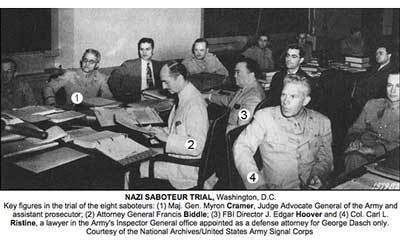
Even after resigning myself to the fact that I was drawn into reading this book under false pretenses, I still felt that it was deeply flawed. The balance between security and liberty is a rich topic for debate because there are strong cases to be made for both sides. Though I think of myself as falling more in the “pro liberty” camp, I found myself mentally fighting for the interests of security because author Pierce O'Donnell neglects them so thoroughly. If the best offense is a good defense, then this book is the 2008 Detroit Lions (or the '81 Colts, or '66 Giants, but I wasn't alive then, so they don't really count). After reading this book, I'm finding it hard to muster the energy to recount the events that led to the scene pictured above. I put in my two cents on George Dasch(the Nazi saboteur who turned himself in) and J. Edgar Hooverin my review of Enemies: A History of the FBI, and (400 pages later) I'm just as happy to to never discuss Ex parte Quirin again (if you want to read the Supreme Court case, it's here for your edification). I guess that says it all—O'Donnell drained the interest right out of me.
Enjoyable, well-written book. Unfortunately I expected more. I don't attribute that to the author but to the story. Smuggling eight Nazis into the US to execute some terrorist attacks sounds like the makings of a great story. The author builds it well, describing the Nazis who hatched the plot and their intent, as well as the background of the eight men who were recruited to implement it. The story builds as they land in the US, narrowly escape detection, and melt into the population. Then it goes "plop." I won't give it away, except to say that they are relatively easily detected - there winds up being no "there" there, so to speak.
Then the book turns to the legal struggles of the eights terrorists. This legal fight was interesting reading, and has relevance for the current "war on terrorism" - both for the precedents it created as well as illuminating the issues. Some readers might really like that. I was a little disappointed, as I was expecting more of the book to deal with what the eight men had planned and a longer, more thrilling hunt to track them down. Decent book, could be quite good if you expect and want the discussion about the legal fight and legal issues.
This is a disturbing book to read. The main point of the book covers Hitler sending two groups of men to US shores via submarine in order to conduct sabatoge missions. Before this, I didn't know subs got that close to our shores. The men had no real desire to carry out the plans and one of them arranged to turn themselves in. What the author does is take us through their trial. It was amazing to read about the diligence by the defending attorneys and the steps they, in particular Colonel Kenneth C. Royall. The overstepping of the constitution by FDR was a huge surprise. He has always been larger than life in many ways. But to read this--and of course the internment camps--made him a far more flawed human. The book is largely scholarly, but readable. The last several chapters of the book turn to George Bush's overstepping of the constitution during the beginning of the war on terror. While important to understand, I found this very difficult to plod through. The constitution and our upholding of it is fundamental to who we are as a nation. People cannot bend it to do what an individual wants. This book is a good example of what happens when someone does that.
A good review on the importance of the Rule of Law regardless of political pressure or public opinion. The specific case study deals with the 8 people sent on a sabotage mission in WW2, but the author does discuss many Presidents and their decisions.
This was an excellent look at a little remembered incident of World War II: when Hitler sent saboteurs in the United States. It was a ragtag team consisting of those who a double agent who wanted to sabotage the mission to get back at the Nazis, a true believer or two, a US citizen who wanted to work things out with his wife and some simple minded people who were recruited to join the mission in order to help Germany. The double agent sabotaged the mission, went to the FBI and then the book tells of their tales through the system all the way up to the Supreme Court. The book also exposes the impact on their case on the events of the war on terror during the Bush 43 years.
I prefer to grade on a letter grade and this one easily received an A+, which inducts it into my Hall of Fame. In addition to reading the book, I also listened to the audio version. An A+ grade converts to 5 stars on Goodread’s rating system.
Timely book. The first third was historical, discussing the eight German sabeteurs landed in NY and in Florida at the beginning of WW II. In the next third, O'Donnell discusses the parallels with the President Roosevelt decision to try them under a Military tribunal, and the precident that decision set for President Bush to follow in using Military tribunals to try prisoners at Guantanamo. He also reviews the Supreme Court review of the legality of using a Military tribunal for the trial and execution of those prisoners. O'Donnell considers that Supreme Court decision a discredited one, in which the judiciary basically deferred to the executive branch in time of war. He comments on how that decision affects the current climate, led to an idea of unlimited executive power by President Bush in this time of war, and how many people and nations feel that decision has made a mockery of our nations striving to champion human rights. The last third of the book slowed down somewhat for me, going into a little more detail about the legal issues of those decisions. All in all, an enlightening book both from a historical perspective as well as how the current administration arrived at the policies they're following.
This was an interesting account of the 8 Nazi saboteurs tried in 1942. Pierce O'Donnell gave an excellent description of the background of each player in the trial (the saboteurs, lawyers, Roosevelt, and J. Edgar Hoover). He also gave an excellent, but easily understandable explanation of the military commission and the Supreme Court legal workings that were involved in the case. You could tell that O'Donnell felt that Kenneth Royall was the abused hero in the whole case. He described all the actions used to set Royall back and keep him from defending the saboteurs in the Supreme Court and try to get them tried in civil court. If O'Donnell would have ended the story with the verdict, this would have been a 4 or 5 star book for me. However, he decided to try to connect the case with more modern Prisoner of War trials (Afghanistan and Iraq POWs). The story ended up taking a preachy/whiny turn and I quickly lost interest. If he had stuck to the facts, it would have been a much better ending.
5 stars for Importance and Thought-Provocation 2-1/2 stars for dry and artless narrative
For those of us who were alarmed at the extra-judicial tendencies of Bush/Cheney in the name of a war on terror, and in light of Obama's own troubling excesses, this is a sobering dissection of a war tribunal micromanaged by the FDR administration under dubious Constitutional legality. Taken together with Lincoln's suspension of habias corpus and current-day short-cutting (Guantánamo, Drones, etc.), this book really forces us to ask ourselves if there are times when Constitutional protections must be suspended to safeguard our very existence (a limb for the body). If the answer is a reluctant "yes", then whom can we trust to make those decisions, and how can we trust that such precedence isn't used for nefarious intents? Difficult food for thought among bleeding hearts like me.
I learned some new things in this book, found the story of the Nazi saboteurs intriguing, and felt like the book was written pretty well- initially. The reason I gave this book two stars is because it seemed to drag on towards the end and I felt like the writing got sloppier. It definitely could have been a little bit shorter. I found myself wanting to get it over with by part 3, but kept reading. The last part was really the same few points stated over and over again in different ways, with some new evidence thrown in here and there. Part 3 was quite sloppy. Nevertheless, I still recommend reading this, as it does show how important it is to protect the rule of law and human rights during a time of war. As the book makes clear, that is the real test of the legitimacy of a democratic society.
This book relates a story from WWII of Americanized Germans who Hitler sent to the US for sabatage missions. The teams were so Americanized that they turned themselves in and despsite promises from Hoover they were tried and six were sent to the chair. The decisions were all made by a very biased military commission and the case became precedent setting for violations of the laws of war by Bush and even Obama.
Freedom is always at risk and the pressures of war tempt presidents to waive habeas corpus. Lincoln did it, FDR certainly did it and Bush used that for his benefit in fighting terror. And always it was with public support. So if you love freedom, this is a good book to heighten your awareness of how easily it can be undermined.
Exciting historical thriller. Main point is the link between G.W. Bush's decision to invoke military tribunals after 9/11 and FDR's decision to do the same during WWII. Both were rooted in faulty logic and ignore the spirit of the law. Not just a legal history, this book is exciting and well written.
The title does not describe the book. This is nothing more than a bash of the Bush administration. Guantanamo Bay is still open. The released are joining ISIS and want US dead.
The Book would have been a good subject if it were truly about WWII and not about releasing evil people to kill good people.
This book is a must read to understand how we got to where we are as our civil rights and Constitutional rights have slowly been stripped away in the poor swap for "security" over "privacy".