

What do you think?
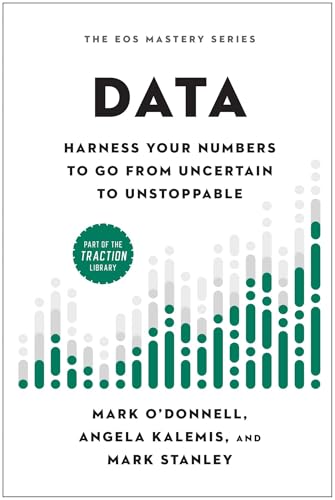
Data: Harness Your Numbers to Go from Uncertain to Unstoppable
Your comprehensive guide to mastering The Data Component of your EOS Model—taking you from uncertain to unstoppable.
Have you ever felt lost in knowing how your business is actually doing? Were you surprised by events that you didn’t see coming? Did you spend sleepless nights wondering whether or not your company was going to make it? Then Data is for you.
This data-driven handbook is the third installment of the Traction Library’s EOS Mastery Series that provides all the tools you need to build an environment of transparency and get better results through clarity and accountability.
Data will make you expert
Using data in business Creating meaningful Scorecards Implementing Measurables for every member of your team And identifying ways to drive more cash into your company.
As one of the six components of the EOS Model, The Data Component helps you refine, simplify, and achieve your vision of understanding the numbers behind how your business is operating. The Data Component is designed to help you objectively see where you are going—both as a leader and as a company. It takes assumptions, subjective opinions, emotions, and ego out of the equation. You’ll gain confidence in knowing that you are running the business and it’s not running you.
Data will give you more control and assurance in getting more of what you really want out of your team, your EOS model, and your business.
Have you ever felt lost in knowing how your business is actually doing? Were you surprised by events that you didn’t see coming? Did you spend sleepless nights wondering whether or not your company was going to make it? Then Data is for you.
This data-driven handbook is the third installment of the Traction Library’s EOS Mastery Series that provides all the tools you need to build an environment of transparency and get better results through clarity and accountability.
Data will make you expert
Using data in business Creating meaningful Scorecards Implementing Measurables for every member of your team And identifying ways to drive more cash into your company.
As one of the six components of the EOS Model, The Data Component helps you refine, simplify, and achieve your vision of understanding the numbers behind how your business is operating. The Data Component is designed to help you objectively see where you are going—both as a leader and as a company. It takes assumptions, subjective opinions, emotions, and ego out of the equation. You’ll gain confidence in knowing that you are running the business and it’s not running you.
Data will give you more control and assurance in getting more of what you really want out of your team, your EOS model, and your business.
- GenresBusinessNonfiction
208 pages, Hardcover
Published April 1, 2025
Ratings & Reviews
Friends & Following
Create a free account to discover what your friends think of this book!
Community Reviews
Displaying 1 - 8 of 8 reviews

Read
October 3, 2025Running a business can feel like steering a ship through dense fog, where every decision seems to carry enormous weight but few indicators show whether you are actually moving in the right direction. That sense of uncertainty is the central problem addressed in "Data: Harness Your Numbers to Go from Uncertain to Unstoppable" by Mark O’Donnell, Angela Kalemis, and Mark Stanley. The authors argue that while instinct and intuition often guide leaders, these qualities alone cannot provide the clarity needed to build a thriving, predictable business. Instead, the key lies in transforming complex operations into clear, actionable numbers that offer a real-time compass for decision-making. With this framework, leaders gain not just control but also confidence, enabling their organizations to grow steadily and sustainably while shedding the constant anxiety that often accompanies entrepreneurship.
Many business owners are familiar with sleepless nights spent replaying worries in their heads. They wonder if their teams are aligned, if profits are secure, or if hidden problems lurk just out of sight. The authors identify five recurring frustrations that fuel these doubts. First is the loss of control, where entrepreneurs feel enslaved by their businesses rather than empowered by them. Second are profit frustrations, when hard work does not translate into financial security. Third come the people problems, as misaligned teams, vendors, or customers generate friction. Fourth is stalled growth, a sense of having hit a ceiling without knowing how to break through. Finally, leaders face the disappointment of failed fixes, when books, seminars, or initiatives promise results but fade into irrelevance. These struggles, though varied in appearance, all stem from the same cause: relying on subjective feelings instead of objective data.
The solution, the authors suggest, is deceptively simple. By tracking the right numbers consistently, leaders replace guesswork with certainty. Just as a pilot relies on a dashboard to confirm whether the plane is on course, entrepreneurs can build a one-page Scorecard that reveals the true state of their business each week. Unlike traditional financial reports that look backward, this Scorecard highlights leading indicators - numbers that predict future outcomes and allow leaders to intervene early. For example, instead of waiting to see quarterly revenue, a company might track weekly proposals presented, qualified leads generated, or orders fulfilled. These are the activities that create future results. By focusing on them, leaders turn their businesses into systems that are visible, predictable, and manageable.
This approach transforms the daily experience of leadership. The constant 2 a.m. anxiety gives way to calm assurance, because each number tells a story about where the company stands. Problems that once appeared suddenly now show themselves early as red flags, while positive momentum becomes visible as green lights. Leaders shift from reactive firefighters to proactive navigators. The fog that once clouded decision-making lifts, and the road ahead becomes clear.
But the Scorecard is not only for executives. Its real power comes from spreading clarity throughout the organization. The authors argue that every person in a company should have a number - an objective measure of success that ties directly into broader goals. Far from micromanagement, this creates empowerment. Employees no longer guess what matters most or wonder whether they are doing well. Instead, they know exactly what winning looks like in their role. A warehouse manager might own order accuracy, while a sales representative might track qualified conversations. Each individual’s number feeds into the Scorecard, connecting daily actions to the company’s success.
This clarity transforms culture. Conversations become direct and useful. Instead of vague updates like 'things are busy,' discussions revolve around whether specific targets were met. Accountability becomes natural, as driven employees thrive on the chance to prove their value and measure progress. Those uncomfortable with transparency either adapt or move on, raising the overall level of commitment across the team. Healthy competition emerges, and people begin solving problems before they escalate, often bringing forward solutions instead of excuses. Leaders no longer have to watch every detail, because the team takes responsibility for their numbers.
Once alignment is achieved, attention turns to protecting the business’s most vital resource: cash. The authors emphasize a hard truth - profit is an opinion, but cash is a fact. Many companies look strong on paper yet collapse because they lack liquid funds. The biggest culprit is often accounts receivable, where extended payment terms tie up cash that has already been spent delivering products or services. Other dangers include unprofitable clients or uncontrolled growth that drains resources faster than revenue arrives. To counter these risks, the book introduces the concept of identifying eight cash flow drivers, such as pricing, error rates, or receivables days. Each driver is assigned to a leader responsible for measurable improvements. This exercise transforms cash management from an abstract worry into concrete actions. The result is that hidden reserves emerge, inefficiencies shrink, and cash flow becomes reliable enough to support growth.
Yet even with strong systems in place, data is valuable only if interpreted with the right mindset. The final transformation requires leaders to become truly data-driven in their thinking. Numbers on a Scorecard should not be treated as mere reports of performance. Instead, they serve as diagnostic tools, pointing to underlying causes of success or failure. A consistently red number signals a deeper issue, which can usually be traced to one of two sources: people or process. The authors stress the importance of asking whether a problem stems from an individual’s skills, motivation, or capacity, or from a flawed system that sets them up to fail. By mastering this distinction, leaders avoid treating symptoms and instead address root causes. They move from firefighting to thoughtful problem-solving, turning crises into opportunities for improvement.
Through these practices, leaders gradually embed data into the DNA of their organizations. The Scorecard evolves alongside the business, adapting to new goals and challenges. The culture of accountability strengthens, cash becomes secure, and decision-making becomes confident. Most importantly, the leader’s role shifts from overworked operator to visionary architect, building a business that runs predictably without consuming their entire life. The sense of being trapped in fog is replaced by the clarity of a clear windshield, guiding the way forward.
In conclusion, "Data: Harness Your Numbers to Go from Uncertain to Unstoppable" offers more than a set of tools; it provides a philosophy of leadership rooted in clarity and accountability. By relying on objective numbers instead of subjective feelings, leaders can overcome the recurring frustrations of lost control, financial mystery, people problems, and stalled growth. They can create alignment across their teams, protect their cash, and diagnose issues at their roots. Most importantly, they can replace anxiety with confidence, knowing that they have a reliable compass to steer their business toward long-term success. The authors show that becoming unstoppable is not about working harder or guessing better, but about embracing data as the language of certainty.
Many business owners are familiar with sleepless nights spent replaying worries in their heads. They wonder if their teams are aligned, if profits are secure, or if hidden problems lurk just out of sight. The authors identify five recurring frustrations that fuel these doubts. First is the loss of control, where entrepreneurs feel enslaved by their businesses rather than empowered by them. Second are profit frustrations, when hard work does not translate into financial security. Third come the people problems, as misaligned teams, vendors, or customers generate friction. Fourth is stalled growth, a sense of having hit a ceiling without knowing how to break through. Finally, leaders face the disappointment of failed fixes, when books, seminars, or initiatives promise results but fade into irrelevance. These struggles, though varied in appearance, all stem from the same cause: relying on subjective feelings instead of objective data.
The solution, the authors suggest, is deceptively simple. By tracking the right numbers consistently, leaders replace guesswork with certainty. Just as a pilot relies on a dashboard to confirm whether the plane is on course, entrepreneurs can build a one-page Scorecard that reveals the true state of their business each week. Unlike traditional financial reports that look backward, this Scorecard highlights leading indicators - numbers that predict future outcomes and allow leaders to intervene early. For example, instead of waiting to see quarterly revenue, a company might track weekly proposals presented, qualified leads generated, or orders fulfilled. These are the activities that create future results. By focusing on them, leaders turn their businesses into systems that are visible, predictable, and manageable.
This approach transforms the daily experience of leadership. The constant 2 a.m. anxiety gives way to calm assurance, because each number tells a story about where the company stands. Problems that once appeared suddenly now show themselves early as red flags, while positive momentum becomes visible as green lights. Leaders shift from reactive firefighters to proactive navigators. The fog that once clouded decision-making lifts, and the road ahead becomes clear.
But the Scorecard is not only for executives. Its real power comes from spreading clarity throughout the organization. The authors argue that every person in a company should have a number - an objective measure of success that ties directly into broader goals. Far from micromanagement, this creates empowerment. Employees no longer guess what matters most or wonder whether they are doing well. Instead, they know exactly what winning looks like in their role. A warehouse manager might own order accuracy, while a sales representative might track qualified conversations. Each individual’s number feeds into the Scorecard, connecting daily actions to the company’s success.
This clarity transforms culture. Conversations become direct and useful. Instead of vague updates like 'things are busy,' discussions revolve around whether specific targets were met. Accountability becomes natural, as driven employees thrive on the chance to prove their value and measure progress. Those uncomfortable with transparency either adapt or move on, raising the overall level of commitment across the team. Healthy competition emerges, and people begin solving problems before they escalate, often bringing forward solutions instead of excuses. Leaders no longer have to watch every detail, because the team takes responsibility for their numbers.
Once alignment is achieved, attention turns to protecting the business’s most vital resource: cash. The authors emphasize a hard truth - profit is an opinion, but cash is a fact. Many companies look strong on paper yet collapse because they lack liquid funds. The biggest culprit is often accounts receivable, where extended payment terms tie up cash that has already been spent delivering products or services. Other dangers include unprofitable clients or uncontrolled growth that drains resources faster than revenue arrives. To counter these risks, the book introduces the concept of identifying eight cash flow drivers, such as pricing, error rates, or receivables days. Each driver is assigned to a leader responsible for measurable improvements. This exercise transforms cash management from an abstract worry into concrete actions. The result is that hidden reserves emerge, inefficiencies shrink, and cash flow becomes reliable enough to support growth.
Yet even with strong systems in place, data is valuable only if interpreted with the right mindset. The final transformation requires leaders to become truly data-driven in their thinking. Numbers on a Scorecard should not be treated as mere reports of performance. Instead, they serve as diagnostic tools, pointing to underlying causes of success or failure. A consistently red number signals a deeper issue, which can usually be traced to one of two sources: people or process. The authors stress the importance of asking whether a problem stems from an individual’s skills, motivation, or capacity, or from a flawed system that sets them up to fail. By mastering this distinction, leaders avoid treating symptoms and instead address root causes. They move from firefighting to thoughtful problem-solving, turning crises into opportunities for improvement.
Through these practices, leaders gradually embed data into the DNA of their organizations. The Scorecard evolves alongside the business, adapting to new goals and challenges. The culture of accountability strengthens, cash becomes secure, and decision-making becomes confident. Most importantly, the leader’s role shifts from overworked operator to visionary architect, building a business that runs predictably without consuming their entire life. The sense of being trapped in fog is replaced by the clarity of a clear windshield, guiding the way forward.
In conclusion, "Data: Harness Your Numbers to Go from Uncertain to Unstoppable" offers more than a set of tools; it provides a philosophy of leadership rooted in clarity and accountability. By relying on objective numbers instead of subjective feelings, leaders can overcome the recurring frustrations of lost control, financial mystery, people problems, and stalled growth. They can create alignment across their teams, protect their cash, and diagnose issues at their roots. Most importantly, they can replace anxiety with confidence, knowing that they have a reliable compass to steer their business toward long-term success. The authors show that becoming unstoppable is not about working harder or guessing better, but about embracing data as the language of certainty.
July 14, 2025
A nice rehash of the ideas from Traction. I didn’t pick up anything novel or insightful that isn’t covered elsewhere in the EOS library. Also, the EOS end of chapter customer success stories seemed more of a marketing attempt than an educational point.

March 19, 2025
Data primarily focuses on the Entrepreneurial Operating System (EOS) and the importance of tracking key performance indicators (KPIs) through a structured scorecard. While this may be valuable for small to medium-sized business owners looking for a framework to start measuring performance, it felt less insightful for someone already familiar with KPI tracking—especially in a larger corporate setting.
As someone working at a Fortune 100 company, the concept of monitoring KPIs on a scorecard seemed like common sense rather than a fresh perspective. I had hoped the book would delve more into actionable insights on leveraging data—how to interpret it, apply it, and make strategic decisions based on it. Instead, much of the content felt like an introduction to basic performance tracking, and at times, it seemed like the authors were subtly selling consulting services rather than providing deeper insights.
That said, for those in the early stages of structuring their business metrics, Data could serve as a useful starting point. But if you’re looking for more advanced discussions on data analytics and strategy, you may need to look elsewhere.
I would like to thank the author, the publisher, and NetGalley for this ARC in exchange for my honest review.
As someone working at a Fortune 100 company, the concept of monitoring KPIs on a scorecard seemed like common sense rather than a fresh perspective. I had hoped the book would delve more into actionable insights on leveraging data—how to interpret it, apply it, and make strategic decisions based on it. Instead, much of the content felt like an introduction to basic performance tracking, and at times, it seemed like the authors were subtly selling consulting services rather than providing deeper insights.
That said, for those in the early stages of structuring their business metrics, Data could serve as a useful starting point. But if you’re looking for more advanced discussions on data analytics and strategy, you may need to look elsewhere.
I would like to thank the author, the publisher, and NetGalley for this ARC in exchange for my honest review.

March 21, 2025
I listened to the audiobook, and the narrator spoke a little too fast for me to have a pleasant read.
The authors give you tools to make you take informed decisions. Too much confidence is dangerous. You need to make a clear and consistent effort to have a framework of EOS tools, which make you take less risks.
Data is freedom as you let go of control and gain more time.
Every business needs to see clearly what needs to be done, understand what’s most important. Having a growth mindset is essential to strengthen six key components.
The book is detailed, yet I hoped to get more practical examples on how to implement it in real life. I’m a small business owner myself, without knowledge of data that why I read this book.
Thanks to Netgalley for giving, me this opportunity.
The authors give you tools to make you take informed decisions. Too much confidence is dangerous. You need to make a clear and consistent effort to have a framework of EOS tools, which make you take less risks.
Data is freedom as you let go of control and gain more time.
Every business needs to see clearly what needs to be done, understand what’s most important. Having a growth mindset is essential to strengthen six key components.
The book is detailed, yet I hoped to get more practical examples on how to implement it in real life. I’m a small business owner myself, without knowledge of data that why I read this book.
Thanks to Netgalley for giving, me this opportunity.

February 25, 2026
Good but the type of book I get the gist of from the Blinkist summary.
Synopsis: use data as a guide in business. Assign every person a number. 1 key metric that they must aim for; this introduces clarity to decision making and forecasting.
Somewhat common sense, but a decent reminder.
Synopsis: use data as a guide in business. Assign every person a number. 1 key metric that they must aim for; this introduces clarity to decision making and forecasting.
Somewhat common sense, but a decent reminder.
April 10, 2026
If you're familar with EOS material there is nothing substantially new here.
May 8, 2026
Great message, the 7 truths especially. Could have Probably more of a chapter than a book as the examples were quite repetitive

January 1, 2026
I picked this up at a particular moment: building a function from scratch at work, and an app on the side, both simultaneously in that uncomfortable early stage where you’re doing a lot but can’t quite prove it yet. So the book’s central anxiety (you’re busy, but is it working?) landed closer to home than I expected.
The leading vs. lagging indicator distinction is the real gift here. I’ve been guilty of treating brand clarity and product vision as progress, when really those are just the conditions for progress. The Scorecard framework forced an honest question: what would I actually put on mine? Not what sounds good. What moves?
It’s not a literary experience, but I think the book earns its plainness - it’s trying to be a tool, not an argument, and tools don’t need to be beautiful to work. The test I use for business books: did it change how I’ll do something on Monday? This one did.
The leading vs. lagging indicator distinction is the real gift here. I’ve been guilty of treating brand clarity and product vision as progress, when really those are just the conditions for progress. The Scorecard framework forced an honest question: what would I actually put on mine? Not what sounds good. What moves?
It’s not a literary experience, but I think the book earns its plainness - it’s trying to be a tool, not an argument, and tools don’t need to be beautiful to work. The test I use for business books: did it change how I’ll do something on Monday? This one did.
Displaying 1 - 8 of 8 reviews