

What do you think?
Win a free print copy of this book!
3 days and 03:40:48
5 copies available
U.S. only
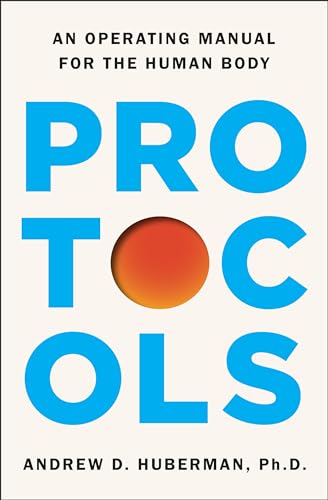
Protocols: An Operating Manual for the Human Body
Win a free print copy of this book!
3 days and 03:40:48
5 copies available
U.S. only
Dr Andrew Huberman, host of the world’s leading health podcast, Huberman Lab, and neuroscientist and tenured professor at Stanford School of Medicine, introduces Protocols, an essential guide to improving brain function, enhancing mood and energy, optimising bodily health and physical performance, and rewiring your nervous system to learn new skills and behaviours that can transform your life.
Protocols provides simple, powerful and evidence-based solutions to life’s most common challenges. Designed to improve your mental health, physical health and performance, these guidelines are customisable, allowing you to adapt them to your specific needs. With his clear and engaging style, Dr Huberman explains the scientific principles behind each protocol and how they can deliver immediate, effective results. Protocols is your essential road map for achieving optimal health.
Protocols provides simple, powerful and evidence-based solutions to life’s most common challenges. Designed to improve your mental health, physical health and performance, these guidelines are customisable, allowing you to adapt them to your specific needs. With his clear and engaging style, Dr Huberman explains the scientific principles behind each protocol and how they can deliver immediate, effective results. Protocols is your essential road map for achieving optimal health.
688 pages, Hardcover
Published September 15, 2026
About the author
Andrew D. Huberman
4 books662 followersAndrew Huberman, Ph.D., is a neuroscientist and tenured professor in the Departments of Neurobiology and Ophthalmology at Stanford University School of Medicine. His research laboratory, the Huberman Lab, has made significant contributions to our understanding of brain development, the neuroscience of visual perception and repair from blinding diseases such as glaucoma, the neural mechanisms of stress and resilience and neural plasticity—the nervous system’s ability to change and learn in response to experience.
Dr. Huberman earned his bachelor’s degree with honors and distinction from the University of California, Santa Barbara (1998), completed a master’s degree at UC Berkeley (2000) and earned his Ph.D. in neuroscience from UC Davis in 2004, where he received the Allan G. Marr Prize for the Best Ph.D. Dissertation. He conducted postdoctoral research at Stanford University School of Medicine from 2005 to 2010 and was awarded a Helen Hay Whitney Postdoctoral Fellowship.
His first faculty position was from 2011 to 2015 at the University of California, San Diego, in the Department of Neurosciences and the Neurobiology Section in the Division of Biological Sciences. In 2016, he was hired by the Stanford University School of Medicine as a tenured professor, where he currently directs the Huberman Laboratory. Dr. Huberman’s lab has published numerous peer-reviewed research and review articles in the highest-tier journals including Nature, Cell, Science and Neuron.
Across his career, Dr. Huberman has published over 75 peer-reviewed articles in top scientific journals including Nature, Science, Cell, Neuron, Current Biology, and Journal of Neuroscience. He has delivered more than 100 invited research and keynote seminars around the world, and he was a regular member of NIH grant review panels and contributor to the National Eye Institutes Audacious Goals Initiative to cure blindness. His research as a PhD student, postdoc and tenured professor made important discoveries into how the brain processes visual information, how brain circuits develop and function and are modified by experience. He has also published a human randomized controlled trial on the efficacy of stress mitigation tools and ways to improve sleep, heart rate variability and mood.
His research includes key areas such as visual circuit development; the molecular mechanisms that guide precise wiring between the eye and brain; how the brain processes the direction of visual motion; visual and brain circuits for circadian rhythm generation and timing; stress and threat detection circuits in the brain and discovery of neural pathways that trigger defensive behaviors; neural regeneration and methods to promote repair of damaged neural connections; and stress and performance, focusing on how visual inputs and breathing patterns influence brain states.
His research accomplishments have earned him numerous prestigious honors and awards, including the Cogan Award in 2017 for making crucial contributions to vision science and ophthalmology, the McKnight Neuroscience Scholar Award in 2013, and the Pew Biomedical Scholar Award in 2013 for his work on visual circuit function and plasticity. He was awarded the ARCS Foundation Graduate Fellowship for the best PhD dissertation and the Helen Hay Whitney Postdoctoral Fellowship.
Dr. Huberman served on the editorial boards of Current Biology, The Journal of Comparative Neurology, Journal of Neuroscience and Cell Reports and he has reviewed papers for Nature, Science, PNAS, Cell, Neuron and many other top tier journals. He also served on multiple grant review panels for the National Institutes of Health.
He co-directed the Cold Spring Harbor Laboratory course on "Vision: a platform for linking cell types, circuits and perception," training the next generation of vision researchers.
In his teaching roles, Dr. Huberman has taught undergraduate and graduate-level courses in neuroscience, neuroanatomy, and development
Dr. Huberman earned his bachelor’s degree with honors and distinction from the University of California, Santa Barbara (1998), completed a master’s degree at UC Berkeley (2000) and earned his Ph.D. in neuroscience from UC Davis in 2004, where he received the Allan G. Marr Prize for the Best Ph.D. Dissertation. He conducted postdoctoral research at Stanford University School of Medicine from 2005 to 2010 and was awarded a Helen Hay Whitney Postdoctoral Fellowship.
His first faculty position was from 2011 to 2015 at the University of California, San Diego, in the Department of Neurosciences and the Neurobiology Section in the Division of Biological Sciences. In 2016, he was hired by the Stanford University School of Medicine as a tenured professor, where he currently directs the Huberman Laboratory. Dr. Huberman’s lab has published numerous peer-reviewed research and review articles in the highest-tier journals including Nature, Cell, Science and Neuron.
Across his career, Dr. Huberman has published over 75 peer-reviewed articles in top scientific journals including Nature, Science, Cell, Neuron, Current Biology, and Journal of Neuroscience. He has delivered more than 100 invited research and keynote seminars around the world, and he was a regular member of NIH grant review panels and contributor to the National Eye Institutes Audacious Goals Initiative to cure blindness. His research as a PhD student, postdoc and tenured professor made important discoveries into how the brain processes visual information, how brain circuits develop and function and are modified by experience. He has also published a human randomized controlled trial on the efficacy of stress mitigation tools and ways to improve sleep, heart rate variability and mood.
His research includes key areas such as visual circuit development; the molecular mechanisms that guide precise wiring between the eye and brain; how the brain processes the direction of visual motion; visual and brain circuits for circadian rhythm generation and timing; stress and threat detection circuits in the brain and discovery of neural pathways that trigger defensive behaviors; neural regeneration and methods to promote repair of damaged neural connections; and stress and performance, focusing on how visual inputs and breathing patterns influence brain states.
His research accomplishments have earned him numerous prestigious honors and awards, including the Cogan Award in 2017 for making crucial contributions to vision science and ophthalmology, the McKnight Neuroscience Scholar Award in 2013, and the Pew Biomedical Scholar Award in 2013 for his work on visual circuit function and plasticity. He was awarded the ARCS Foundation Graduate Fellowship for the best PhD dissertation and the Helen Hay Whitney Postdoctoral Fellowship.
Dr. Huberman served on the editorial boards of Current Biology, The Journal of Comparative Neurology, Journal of Neuroscience and Cell Reports and he has reviewed papers for Nature, Science, PNAS, Cell, Neuron and many other top tier journals. He also served on multiple grant review panels for the National Institutes of Health.
He co-directed the Cold Spring Harbor Laboratory course on "Vision: a platform for linking cell types, circuits and perception," training the next generation of vision researchers.
In his teaching roles, Dr. Huberman has taught undergraduate and graduate-level courses in neuroscience, neuroanatomy, and development
Ratings & Reviews
Friends & Following
Create a free account to discover what your friends think of this book!
Community Reviews
Displaying 1 - 17 of 17 reviews

September 19, 2026
1/5 Stars: A Comprehensive Guide on How to Become an Inefficient, Sun-Gazing Cyborg
Let’s give credit where credit is due: Protocols: An Operating Manual for the Human Body is an absolute masterpiece of modern non-fiction. By non-fiction, I mean it reads like a frantic manifesto written by a sleep-deprived AI that was fed twenty years of neuroscience journals and a gallon of black coffee.
If your lifelong dream is to transform your morning routine into a high-security military operation that alienates every friend you’ve ever had, this is your bible.
Here is an objective, clinical breakdown of why this book is both a hilarious triumph of over-optimization and a total disaster for anyone trying to enjoy being alive:
The Chronobiology Trap: The author insists that your entire existence hinges on viewing low-solar-angle photons within 4.3 seconds of waking up. Objectively, this is great for your circadian rhythm. Hilariously, it means if you live in a rainy climate or have a north-facing window, your biology is officially doomed to failure.
The Supplement Economy: The book features protocols that require a pill organizer the size of a microwave. You will spend more money on adaptogens, trace minerals, and neuro-enhancers than your grandparents spent on their first mortgage. Your urine will genuinely glow in the dark.
The Joy Eradication Protocol: There is an underlying clinical tone suggesting that comfort is a sin. Want to sleep in on a Saturday? Congratulations, you have just sub-optimized your dopaminergic baseline. Want to eat a piece of pizza? Prepare for a 45-page guilt trip about glucose spikes.
Actionable Impracticality: While the science cited is often fascinating, the translation from "peer-reviewed rodent study" to "what you should do at 6:00 AM on a Tuesday" is a massive comedic leap. You will find yourself frantically adjusting the temperature of your shower to match a specific Scandinavian fjord while questioning every life choice that brought you to this exact tile floor.
Ultimately, it’s a brilliantly written text that treats the human body less like a living organism and more like a Formula 1 race car that requires a pit crew just to go buy groceries.
Let’s give credit where credit is due: Protocols: An Operating Manual for the Human Body is an absolute masterpiece of modern non-fiction. By non-fiction, I mean it reads like a frantic manifesto written by a sleep-deprived AI that was fed twenty years of neuroscience journals and a gallon of black coffee.
If your lifelong dream is to transform your morning routine into a high-security military operation that alienates every friend you’ve ever had, this is your bible.
Here is an objective, clinical breakdown of why this book is both a hilarious triumph of over-optimization and a total disaster for anyone trying to enjoy being alive:
The Chronobiology Trap: The author insists that your entire existence hinges on viewing low-solar-angle photons within 4.3 seconds of waking up. Objectively, this is great for your circadian rhythm. Hilariously, it means if you live in a rainy climate or have a north-facing window, your biology is officially doomed to failure.
The Supplement Economy: The book features protocols that require a pill organizer the size of a microwave. You will spend more money on adaptogens, trace minerals, and neuro-enhancers than your grandparents spent on their first mortgage. Your urine will genuinely glow in the dark.
The Joy Eradication Protocol: There is an underlying clinical tone suggesting that comfort is a sin. Want to sleep in on a Saturday? Congratulations, you have just sub-optimized your dopaminergic baseline. Want to eat a piece of pizza? Prepare for a 45-page guilt trip about glucose spikes.
Actionable Impracticality: While the science cited is often fascinating, the translation from "peer-reviewed rodent study" to "what you should do at 6:00 AM on a Tuesday" is a massive comedic leap. You will find yourself frantically adjusting the temperature of your shower to match a specific Scandinavian fjord while questioning every life choice that brought you to this exact tile floor.
Ultimately, it’s a brilliantly written text that treats the human body less like a living organism and more like a Formula 1 race car that requires a pit crew just to go buy groceries.

Review of advance copy received from NetGalley
Thank you Simon and Schuster Canada and NetGalley for this ARC.
One of the things I appreciated most about Protocols is that it doesn’t necessarily need to be read cover to cover. You can easily skip ahead to the topics that interest you most or return to certain chapters when they become relevant to you. That said, I loved that the author explains early on that each chapter is intended to be a building block, with the recommendations presented in order of importance. This gives the book a clear structure while still allowing readers to approach it in whichever way works best for them.
I also really enjoyed the personal elements woven throughout the book. In each chapter, the author shares what led him to research that particular area, making the information feel more engaging and accessible. The scientific evidence behind each recommendation is thoroughly explained, including why it may be helpful rather than simply telling readers what they “should” be doing.
Of course, not every recommendation will work for every person, and it is important to consider your own body, circumstances, and individual needs. However, as far as health and self-improvement books go, I found this one informative, practical, and easy to navigate.
If you enjoyed the structured, actionable approach of Atomic Habits, I think this may appeal to you as well. The books cover different subjects, but they share a similar focus on making meaningful improvements through realistic, intentional changes.
One of the things I appreciated most about Protocols is that it doesn’t necessarily need to be read cover to cover. You can easily skip ahead to the topics that interest you most or return to certain chapters when they become relevant to you. That said, I loved that the author explains early on that each chapter is intended to be a building block, with the recommendations presented in order of importance. This gives the book a clear structure while still allowing readers to approach it in whichever way works best for them.
I also really enjoyed the personal elements woven throughout the book. In each chapter, the author shares what led him to research that particular area, making the information feel more engaging and accessible. The scientific evidence behind each recommendation is thoroughly explained, including why it may be helpful rather than simply telling readers what they “should” be doing.
Of course, not every recommendation will work for every person, and it is important to consider your own body, circumstances, and individual needs. However, as far as health and self-improvement books go, I found this one informative, practical, and easy to navigate.
If you enjoyed the structured, actionable approach of Atomic Habits, I think this may appeal to you as well. The books cover different subjects, but they share a similar focus on making meaningful improvements through realistic, intentional changes.
September 19, 2026
Fascinating science. More toolbox than operating manual.
The science in this book is fascinating, and Huberman makes complex physiology approachable. Bringing sleep, exercise, nutrition, light and stress into one practical reference, and explaining why each recommendation might work rather than just what to do, is a real service. That earns the four stars.
My reservation is the promise in the subtitle. An operating manual implies that if you follow the steps, the machine runs. Knowing the steps, and even understanding the mechanism behind them, is not the same as knowing whether an approach is right for you.
To be fair, Huberman does not ask anyone to follow every recommendation. The book ranks them by importance and says they should be adapted. But there is a difference between giving readers permission to adapt and teaching them how. The same specificity that makes the protocols appealing can turn health into an ever-expanding list of things to get right. A reader comes away with more options, and more uncertainty about whether they are doing enough.
I read this as a cardiologist who has spent two decades sitting across from people whose lives have been disrupted by shift work, caregiving, pain, medication and grief. The question in that room is rarely just what would improve this person's physiology. It is what they can realistically change, what matters most, and what burden the advice itself will add. This book's knowledge came from a laboratory. It has to be applied in rooms like that one, and it does not always survive the trip.
That is the standard: help me tell the essentials from the refinements, what to try first, how to judge whether it is helping, and when doing less is the better decision. Explaining why an intervention might work does not answer those questions.
Sleep is where this matters most. Advice can turn rest into another performance task. Someone who follows every recommendation and still lies awake needs a way to read that outcome without concluding they have failed. "This is not the answer for me" should feel as available a conclusion as "I was not consistent enough."
This is an excellent education. It is not individualized guidance, and the title promises the second. Read it for the science. Treat the protocols as possibilities to consider, not standards to grade yourself against. And do not mistake difficulty getting better for a failure to try hard enough.
The science in this book is fascinating, and Huberman makes complex physiology approachable. Bringing sleep, exercise, nutrition, light and stress into one practical reference, and explaining why each recommendation might work rather than just what to do, is a real service. That earns the four stars.
My reservation is the promise in the subtitle. An operating manual implies that if you follow the steps, the machine runs. Knowing the steps, and even understanding the mechanism behind them, is not the same as knowing whether an approach is right for you.
To be fair, Huberman does not ask anyone to follow every recommendation. The book ranks them by importance and says they should be adapted. But there is a difference between giving readers permission to adapt and teaching them how. The same specificity that makes the protocols appealing can turn health into an ever-expanding list of things to get right. A reader comes away with more options, and more uncertainty about whether they are doing enough.
I read this as a cardiologist who has spent two decades sitting across from people whose lives have been disrupted by shift work, caregiving, pain, medication and grief. The question in that room is rarely just what would improve this person's physiology. It is what they can realistically change, what matters most, and what burden the advice itself will add. This book's knowledge came from a laboratory. It has to be applied in rooms like that one, and it does not always survive the trip.
That is the standard: help me tell the essentials from the refinements, what to try first, how to judge whether it is helping, and when doing less is the better decision. Explaining why an intervention might work does not answer those questions.
Sleep is where this matters most. Advice can turn rest into another performance task. Someone who follows every recommendation and still lies awake needs a way to read that outcome without concluding they have failed. "This is not the answer for me" should feel as available a conclusion as "I was not consistent enough."
This is an excellent education. It is not individualized guidance, and the title promises the second. Read it for the science. Treat the protocols as possibilities to consider, not standards to grade yourself against. And do not mistake difficulty getting better for a failure to try hard enough.

September 12, 2026
Thank you to Simon & Schuster Canada, the author and NetGalley for providing me with an ARC in exchange for an honest review.
A simple, yet effective book on improving various aspects of your overall health. Huberman presents evidence as to WHY you should consider following these tips in an easily digestible manner. One thing that surprised me was the transparency found in this novel, Huberman wasn’t afraid to share his partnerships with brands, when there wasn’t enough data to support a full conclusion, or even answering frequently asked questions directly in each chapter.
This is a book I’m certain I will be referring back to when needed.
A simple, yet effective book on improving various aspects of your overall health. Huberman presents evidence as to WHY you should consider following these tips in an easily digestible manner. One thing that surprised me was the transparency found in this novel, Huberman wasn’t afraid to share his partnerships with brands, when there wasn’t enough data to support a full conclusion, or even answering frequently asked questions directly in each chapter.
This is a book I’m certain I will be referring back to when needed.
September 20, 2026
Andrew Huberman is an absolute machine of a man. It takes a special kind of person to manage running a successful podcast, being a tenured professor at Stanford, being a social media celebrity on top of a rotation of sexual partners at his old age. They even tried to cancel him for having too much motion few years back, but it didn't work and probably barely effected his sleep score. While many critics will point out how his personal flaws detract from his overall philosophy (telling his followers to dopamine detox while sleeping with multiple women for example) they cannot deny that it is impressive and WE would likely all do the same in his position if given that status.
The book contains a good summary of protocols from his podcast over the years and is split into sections related to sleep, nutrition, exercise, learning and mental health. The advice is pretty basic: get sunlight, go to bed on time, exercise, eat your vegetables, etc and it really is the stuff your parents would have told you to do when you were a kid if they actually loved you. The true value is the detail and explanations why these things work. This kind of information does come across better in a book than his podcast I found because its easier to reference back and you really can only listen to so many podcasts about sleep before you realize this dude has just been yapping for three hours just to tell you the same thing he said in the last episode and you begin to fall asleep yourself.
Overall the book is pretty basic but solid. A huge missed opportunity to talk about relationships because I would love to see his autistic optimizing protocol mentality when it comes to dating given his credentials and success but the rizz and bedroom protocol probably could warrant a whole separate 300 page book.
The book contains a good summary of protocols from his podcast over the years and is split into sections related to sleep, nutrition, exercise, learning and mental health. The advice is pretty basic: get sunlight, go to bed on time, exercise, eat your vegetables, etc and it really is the stuff your parents would have told you to do when you were a kid if they actually loved you. The true value is the detail and explanations why these things work. This kind of information does come across better in a book than his podcast I found because its easier to reference back and you really can only listen to so many podcasts about sleep before you realize this dude has just been yapping for three hours just to tell you the same thing he said in the last episode and you begin to fall asleep yourself.
Overall the book is pretty basic but solid. A huge missed opportunity to talk about relationships because I would love to see his autistic optimizing protocol mentality when it comes to dating given his credentials and success but the rizz and bedroom protocol probably could warrant a whole separate 300 page book.

September 17, 2026
I'm only two hundred or so pages in but I'm finding this book to be helpful. There's lots of in-depth information with plentiful citations from the literature. I'm finding it helpful to bounce around a bit and read deeply about the subjects I'm particularly interested in.
The book is well organized and it's helpful to have a juxtaposition between the science and Andrew's personal experience. I imagine I'll be working through this one for a while, but really happy to have such a practical compendium on my bookshelf.
The book is well organized and it's helpful to have a juxtaposition between the science and Andrew's personal experience. I imagine I'll be working through this one for a while, but really happy to have such a practical compendium on my bookshelf.

Want to Read
December 18, 2024omg !
September 17, 2026
Wow. This book is going to stay on my shelf forever. It covers seemingly every topic you could need help with when it comes to health, with an overview of the science of how the body’s various systems work as well as behavioral tools (protocols!) for how to make those systems work more efficiently or to overcome common challenges. Immensely helpful. And inspiring: Andrew’s personal stories show how he struggled with these topics too and that gives me hope! Highly recommend!

September 22, 2026
Jumped around as instructed by the book, don’t really need to listen to all 15 sleep protocols for example - I know I need to get more sleep 😭. I did listen to the intro to each section which was what I expected overall, a sort of greatest hits from the podcast at least without hearing an AG1 ad or other fluff. Nothing new for people familiar with Huberman and the countless (researched and science backed) protocols he has inspired others to espouse in the online fitness / wellness space.
September 24, 2026
This book has too much information for me. The advice is backed up by loads of details, which I thought made it cumbersome to read. Maybe if I just kept the book around to look up particular issues it would be very useful. Most of the advice isn't new to me (eat less sugar, limit time on screens, exercise more), but if you like to read why, you will get all the chemical reactions and other scientific evidence you need.

September 16, 2026
there are good things to learn
Whether you are trying to learn, or to improve your mental and physical health, there are good points and actionable advice here. I simply loved it
Whether you are trying to learn, or to improve your mental and physical health, there are good points and actionable advice here. I simply loved it
September 16, 2026
5/5 stars.

September 20, 2026
Incredible book. Interested in living longer and stronger? The guidance in this book is superb. Huberman is a legend

September 20, 2026
Very well researched but repetitive.

Read
September 22, 2026I need to compile my thoughts..

September 22, 2026
Huberman is the GOAT. 🔆🥦🏋️

September 24, 2026
No protocol on how to have 7 girlfriends? He’s keeping the best knowledge for himself…
Displaying 1 - 17 of 17 reviews