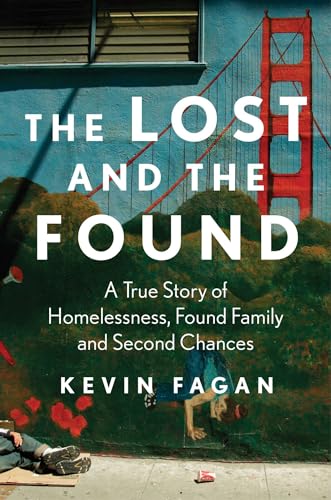
A “riveting, deeply compassionate” (The New York Times) narrative of homelessness, despair, and hope.
Award-winning San Francisco Chronicle journalist Kevin Fagan has been covering homelessness for decades and has spent extensive time on the streets for his reporting. In The Lost and the Found, Fagan introduces us to Rita and Tyson, two unhoused people who were rescued by their families with the help of his own reporting, and chronicles their extraordinary struggles to pull themselves out of homelessness and addiction.
Having experienced homelessness himself, Fagan has always brought a deep understanding to his subjects and has written here more than just a story of individuals experiencing homelessness, but also a compelling look at the link between homelessness and addiction and an incisive commentary on housing and equality. Kevin Fagan writes with “the deft touch that can come only when the ego of the journalist ebbs into something far more substantial and convincing” (TheNew Yorker). The Lost and the Found ends with both enormous tragedy and triumph to humanize this national calamity, forever changing the way we see the unhoused.
Rita and Tyson had something in common: They both had families who loved them. And they had something else in common: They were both living homeless in San Francisco. Different backgrounds had led them both to struggle with drug use, which in turn had led to the streets, and so it goes.
Fagan's The Lost and the Found tells their stories in some depth, based on months of in-depth, on-the-streets reportage—one of Fagan's particular interests as a reporter—and then years of follow-up with both Rita and Tyson. This ends up being both a general overview of homelessness in the US (and the policies that hurt, and those that help) and a compassionate, in-depth portrait of two of the people affected.
Being homeless in a big city, even with a lot of pals around, actually takes a lot of work. Not having a home to go to means every night is a coin toss, hoping someone won't cave in your teeth with a boot just to steal whatever you have in your pockets. You can find your regular haunts, and if you're lucky, you wind up at some place like Homeless Island—but even then it means putting up the tent or tarp or cardboard, arranging the shopping carts like a wall, or finding blankets to replace the ones ripped off while you were off copping dope. (loc. 793*)
This is reportage built on a long-haul project and slowly built trust. Fagan could have spent most of his time doing independent research and only interviewed people affected by homelessness for the sake of quotes, but this is a much stronger book for the time and effort he put into building relationships. In places I think the book leans a little heavily on foreshadowing and sentimentality, though perhaps that's an inherent risk of doing work where you get to know and care about your subjects.
In addition to telling these specific stories—and touching on some of the stories of other people living on San Francisco's streets—Fagan delves into some of the hows and whys of the extensive homeless population in San Francisco, and what interventions have and have not been effective to get people off the streets and into more stable housing. It's not a primer on homelessness, but it's useful context for those hoping to learn a bit more in the context of personal stories. Overall, a very thoughtful read.
Thanks to the author and publisher for providing a review copy through NetGalley.
Over the past few years, I’ve developed a keen interest in homelessness - both in terms of the forces that cause people to become displaced and also the experiences of the unhoused.
This was a visceral, eye-opening, poignant, touching and intimate look at the experiences of the unhoused through the life stories of 2 different individuals. Kevin Fagan is an exceptional journalist, ingratiating himself into the unhoused community in a manner that wasn’t contrived or exploitative. This was a look into homelessness that I have never seen before
So often, unhoused people are demonized. They’re labeled as lazy, destructive and a burden on society. Fagan tests that narrative by humanizing homelessness and offering the sobering reality that homelessness can happen to anyone. These are people who are loved and as deserving of good opportunities like the rest of us.
Being from Seattle, a city suffering the weight of homelessness much like San Francisco, I want everyone in my life and area to read this. Maybe if we empathize more with the unhoused community, we’ll be more inclined to do something.
A huge thank you to NetGalley and Atria Books for the ARC!
it’s sometimes hard to know what to do with such a huge issue of homelessness and while this book didn’t give any perfect solutions it helped humanize the experience that these people face which I have been guilty of looking the other way. addiction and mental health play a huge role but also the lack of government funding for affordable housing is the systemic issue that means there isn’t a safety net for those who need it most. 4.2 stars. i cried.
Required reading for anyone seeking to understand our nation’s crisis of homelessness. I loved the unique lens of a reporter following two people in crisis on the streets of San Francisco as their families attempt to save them and help them kick their addictions and rejoin traditional society.
I so appreciate that Fagan told it straight about addiction, panhandling, and mental health issues among those sleeping rough ~ all very real things that many attempt to gloss over in the politicization of this crisis.
Bottom line? All humans deserve dignity, assistance, and a home.
As someone who works and interacts with the homeless population in my city regularly, I loved this book. Kevin Fagan does a great job at humanizing this people group that is so often overlooked and looked down upon. I appreciated the respect he paid to Rita, Tyson, and their families. This is a book that tackles homelessness in San Francisco, but resonates true even for what I see daily in Tulsa. Homelessness is a growing problem for various reasons, many of which Fagan recognizes here.
I've seen some very moving success stories through my work, and reading Rita's was so sweet. It was incredible to see how well she did after eradicating herself from her addictions and life on the street. I knew from the start that Tyson's story wouldn't turn out quite like Rita's, but I held on to the hope that it wouldn't the entire book.
Kevin Fagan has written an incredible book that I'll be recommending to co-workers and friends over and over again. Thanks to NetGalley and Atria Books for the eARC!
A compassionate, insightful investigative journalist follows the stories of two people who found themselves on the streets. He details their lives before, during, and after (if there is an after) their experience with homelessness. All I gotta say is read this book!!!
4.5⭐️s (rounding up) — Few words to describe this book: informative, hopeful, genuine, tragic ~
The Lost and the Found details homelessness from a first-hand perspective. Kevin Fagan, a San Francisco journalist, takes to the streets, talking to those out there about the hardship they face, day to day, and what can be done to change this for people in San Francisco and beyond. Kevin follows Rita and Tyson in depth after meeting them on the streets. He shares their upbringings, homelessness, and all that follows, shedding light on how homelessness can affect anybody. You can tell that Kevin is deeply passionate about what he does, which makes this that much better of a read. This is a must-read to get a glimpse into what homelessness can be like in the United States.
I like the light the author shined on homelessness in San Francisco. He highlighted the lives of two people he found living on the streets and told us their stories, plus the story of their families.
I liked the way he accomplished this. He opened up a slice of their lives for the reader to glimpse the reality of those who, for whatever reason, have found themselves living on the streets. There is no one stereotype.
There is plenty of food for thought here....so 4 stars.
Thank you to Goodreads Giveaways and to author Kevin Fagan for providing me an advance reader’s copy of this non-fiction account that explores the causes and possible solutions to homelessness by examining the lives and decisions of Rita Grant (a mother of five, an aspiring Olympic gymnast in her youth, and runner-up to being homecoming queen in high school) and Tyson Feilzer (born into privilege in Danville, California, played football and was popular in high school) that resulted in both being chronically homeless in San Francisco. “Chronically homeless” is defined to include people who live outside for a year or more and have a disabling condition like a severe mental illness or a substance abuse problem. Chronically homeless are distinguished from people who are temporarily homeless due to job loss or leaving an abusive household. What led both Rita and Tyson, each of whom had advantages that others do not have, to become addicted to drugs and to living on the streets of San Francisco for over a year? By recounting the childhoods of Rita and Tyson and the various decisions that they made throughout their lives, the reader gains insight on how people with advantages may end up chronically homeless.
The selection of San Francisco is germane when examining the chronically homeless. The author reported extensively on the homeless issue for the San Francisco Chronicle, including when he spent 6 months living with the unhoused on the streets in the Mission and Tenderloin Districts of San Francisco. Fagan’s experience on the streets culminated in a series of articles called “Shame of the City,” which provided insight into chronic homelessness by focusing on the experiences of specific individuals and the tangential problems related thereto including the prevalence of drugs, prostitution, petty theft, and smash and grab robberies that caused concern for the residents and businesses in those areas. By living on the streets and getting to know individuals who did not have shelter personally, the reader may see each homeless individuals as somebody’s mother or father, brother or sister, aunt or uncle, friend or neighbor instead of an amorphous group of people that are often avoided and shunned. From a policy perspective, it made sense to tell the story of the homeless in San Francisco as it is often called “homeless central” due to attracting the unhoused from across the country because of its temperate climate, easy access to booze and drugs, greater tolerance for encampments and individuals living on the streets, and the generous aid provided to the homeless population. Even though San Francisco spends more money per capital on homelessness than almost any other city, the number of homeless in that city remains stubbornly high with homelessness remaining the number one issue facing San Francisco according to residents.
This book did an excellent job portraying the lives of Rita and Tyson, the poor decisions each made that resulted in each becoming chronically homeless, the love that each family had for Rita and Tyson as both families sought to get their loved one off the street and onto a recovery and treatment plan, and the difficulty, the stigma, and the hopelessness that the chronically homeless feel on a daily basis as they often frantically search for money to feed their drug addictions and fend off a sense of worthlessness. The living conditions of the homeless, including on the Homeless Island (a small triangle of concrete that was at South Van Ness and Mission Street) were described in great detail by an author intimately familiar with the streets of San Francisco.
Though the majority of the book was compelling and respectful, I found the primary solutions to the homeless problem of vastly increasing federal spending and far greater federal encroachment on the “economic system” to lack creativity. Since President Lyndon Johnson’s began the “War on Poverty” programs in the mid-1960s, the federal government has spent trillions of dollars on anti-poverty programs with too many people still falling through the cracks. With an almost 60-year track record of the federal government spending and management of this issue, it may be time to think of alternative and creative solutions.
I am not an expert on this topic so the suggestions that I share below are based on my personal experience or by listening to the reaction of others dealing with systemic problems. First, I think policy makers should focus more on having the local community take the lead on developing creative solutions to address homelessness. Local charities and local leaders know the terrain and what works and does not work in a particular community. Many find that charities like Samaritan’s Purse, local church group, and local charities can identify and address issues much more quickly and efficiently than the federal government. The federal government can provide financial assistance, but local agencies should take the lead to implement solutions as they tend to be more flexible and less bureaucratic. Second, local government should evaluate local ordinances to see if they promote or inhibit solutions. I had a friend in a large downtown metropolitan area about 15 years ago who ran a well patronized and respected bakery near a couple of homeless shelters. He sold his baked goods to customers at 4:59pm, but when his bakery closed at 5:00pm, the city would not allow him to donate his surplus products to a homeless shelter. He discarded perfectly fine baked goods. It just did not make any sense. Third, there must be a concerted effort to reduce the stigma of mental illness and those suffering need a way to get assistance. This is where an influx of money is important so people in need have access to mental health services. There is a great scene in the 1980 film “Ordinary People” where actor Donald Sutherland realized that mental illness is not a weakness but an affiliation that can impact anyone regardless of socio-economic status. Sutherland came to terms with the fact that even highly intelligent people often need professional help dealing with problems. Fourth, productive behavior and volunteering in the community need to be lauded and encouraged at school. Too many times the “cool” kids are those who throw parties with alcohol and other intoxicants while kids who do not engage in those activities are deemed “square”. Promoting healthy lifestyles and choices needs to be taught and reinforced throughout life. The best way to prevent drug addiction is likely not to experiment with drugs in the first place. Fifth, focus on policies that support the family unit. Fagan noted that loving families and friends are often the best way to assist those who are chronically homeless. The chronically homeless often need to be cooked (meaning tired of living on the streets and drugs) to seek the help they need, which often occurs when they reconnect with family and friends.
A big thank you to Kevin Fagan for dedicating his career reporting and calling attention to the chronically homeless. I recommend this book to those interested in reading more about this issue, how even advantaged people can become chronically homeless, and how a supportive community and family are needed to address this difficult problem. The solutions proposed by the author are a starting point for discussions that are desperately needed to address an issue that impacts everyone.
This was a fine book on the experiences of two individuals facing homelessness in San Francisco. The author has been a news reporter for decades and is well-versed in the community and the issues they face. Ultimately, I’ve decided a reporter’s story is not enough. I want it to go deeper: yes we know about the individual personal reasons Rita and Tyson end up in SF, but I need that interwoven with more about the social, economic, political reasons for these situations. There is a big difference between this book and Evicted: Poverty and Profit in the American City. This is similar to another reporter’s book I’ve read: You Ought to Do a Story About Me: Addiction, an Unlikely Friendship, and the Endless Quest for Redemption, which was also 3 stars.
As someone who works in human services, sees the struggles of addiction, mental health and has been given glimpses of what homelessness can look like from the the stories of those I have worked with, nothing prepared me for this book & these stories.
This is a book we can all learn from and take something from.
“If we do it right, maybe we inspire someone to push for transformative policies, funding, or programming. Maybe readers can have a bit more understanding and care for the next panhandler they meet”
Please read this book.
Hug thank you to Atria for my copy of The Lost and the Found
Thank you to netgalley and Atria Books for a digital copy in exchange for an honest review.
Wow. The Lost and the Found by Kevin Fagan was an incredibly profound, heartbreaking, yet hopeful read—offering a glimpse into humanity and the underbelly of cities that most shy away from.
When discussing the epidemic of homelessness, it would be easy to focus solely on the facts or to shy away from the harsh realities, bit Fagan approaches everything with clear eyes and an open heart. It's reflective in how he talks about all the folks he met on the street—Rita, Tyson, Little Bit, Tommy, ect ect.
The Lost and the Found weaves stories from the homeless people he met on the street and the story easily with the facts and efforts made to find solutions to the crisis—and the how and why of why these solutions aren't working. There's grace and humanity in every chapter and even as someone who feels like I have compassion and understanding for homeless in America, Fagan calls on us to give even more.
Though heartbreaking and difficult to read, this is a book that everyone should read. It's so important.
The Lost and the Found by Kevin Fagan gives the real, unfiltered story of life on the streets of San Francisco. Fagan is a journalist who tells the stories of Tyson and Rita, who each live day by day struggling with addiction and being homeless. Homeless people are often not seen as real people, they are dismissed as a problem or disturbance. Fagan gives them a voice to tell their story. Many of us never take the opportunity to listen or see them for who they are.
I recommend this book for nonfiction readers who want to understand more fully how a person can end up at the lowest of the low. This book is also about how one can overcome addiction and find a new path in life. Addiction and mental illness are not addressed in our country as treatable conditions and both contribute to many lives lost to the streets. This book explores how people survive and die on the streets of one of the most expensive places to live in America.
Thank you Atria Books and Netgalley for the advanced reader copy. All opinions are my own.
I probably would have liked this better if someone else had written it. The author really wants the audience to know what a great guy he is. He spends far too much time posturing as the hero: sharing praise-filled letters the subjects wrote him, or his responses to their social media posts. It all felt performative and gave me the ick. Further, he breaks a cardinal rule of journalism by attributing thoughts to his subjects saying things like, “He obviously knew…” and “She must have thought…” to lazily make his own point. Despite telling the reader (many times) how many tears he’s shed for his subjects and what dear friends they are, he uses some pretty judgmental language to describe them: “She broke out sobbing as only a cracked-out homeless heroin junkie could…” Overall, too much of the author singing his own praises and not enough exploration of the causes and solutions for homelessness in our country.
The Episcopal baptismal covenant asks the question, “Will you strive for justice and peace among all people, and respect the dignity of every human being?” That’s what this book is about. The phrase kept running through my head as I was reading and then the author says it: “The dignity of every human being- it’s also still there, even when it’s buried beneath grime, dysfunction, and hard times.” Even without being said, it was coming through in his stories about the people in the book, the way we wrote about them, and the obvious kindness and compassion of the author.
Kevin Fagan, a journalist from San Francisco, shares stories of reporting on homelessness and the specific stories of two unhoused people and their families. The book makes we want to weep with despair for the way we treat people in America and weep for the goodness and beauty of people who are trying, either trying to help others or trying to be better. Or both.
(I’m finding it hard to think about respecting the dignity of people with wealth and power who actively take away from struggling people. This is a spiritual topic and struggle for another moment.)
The author talks a lot about hope. Things are a mess but we have to keep going. Books like this are critical for compassion, understanding, and hopefully action, both on a personal and a societal level.
In 2003 journalist Kevin Fagan spent six months on the streets of San Francisco working on a series of articles about homelessness for the San Francisco Chronicle. During that time he met Rita and Tyson - two homeless addicts who had been living on the streets for years. When his article series came out, family members recognized Rita and Tyson and reached out to Fagan for help reconnecting with their family members. Both Rita and Tyson had loving family members who were willing to help them come back home. Things seemed to be looking up for both of them, but sadly only one made it to long-term sobriety. The Lost and the Found is about San Francisco's long history as a homeless mecca, but it's also the stories of Rita and Tyson - how they ended up homeless, how they survived, what made them decide to accept help and go home. Every homeless person you see on the street anywhere has a story and probably has family out there somewhere who loves them. Kevin Fagan does a great job of showing a "behind the curtain" view of homelessness through these two people's stories. And the fact that there is one happy ending and one unhappy ending also highlights the reality of drug addiction and how hard that cycle can be to break for many people.
This really hit home, literally and figuratively. I love the way Fagan approached the topic of housing and sharing the stories of those experiencing homelessness. He showcased the humanity behind our neighbors that so many of us often forget. But more significant to me, he highlighted the struggle and beauty that can coexist. Now don’t get me wrong, there is definitely far more struggle (with addiction, loneliness, resources, stigma, etc.), but I appreciate that he did point out hope and joy and also exist at the same time.
I’m unsure where I go from here. Fagan provided some incredible tips on how to support and help, but I need to figure out how to get out of “this feels hopeless” mindset. Will definitely utilize his resources as a starting point.
I’ve already recommended this to friends in the Bay, but I recommend it to everyone. Yes, this is based on the housing crisis in the Bay Area and follows two people experiencing homelessness in San Francisco, but this struggle and pain exists everywhere. This is an important part of our country and communities that we need to learn more about and understand.
This book is such a powerful reminder that people experiencing homelessness are not the stereotypes society often paints them to be. Too often, the narrative around homelessness is filled with negativity or blame, but this story shifts the perspective in such a beautiful and human way. It shows that behind every struggle there is a person with real emotions, real history, and a story worth hearing.
So often, people talk about those experiencing homelessness in such a negative way, but this book reminds you that these are real people with hopes, dreams, and struggles just like anyone else. I loved how it followed two people both wanting the same thing out of life, but with very different endings. Their journeys were powerful, heartbreaking at times, and so human. Their stories stayed with me long after I finished the book and reminded me how important it is to see the humanity in everyone.
This book is a great introduction into what it means to care for someone who is unhoused. We hear the stories of 2 characters and those who love them. The stories told in the book are those that can be substituted for just about any person you see on the street, housed or unhoused and reminds us of the importance of keeping one another’s humanity at the forefront.
A great story about homelessness. It's a story of love, hope, redemption, family, perseverance, tragedy, but most of all love. The final chapter summarizes the problem of homelessness very well - it's a matter of priority and compassion. Things that seems to be lacking in our society.
4.5⭐️ tragic and hopeful but so incredibly genuine.
i think this book was not perfect as the topic is complex and not easy to tackle but did an incredible job of humanizing homelessness which I think is such an issue when people speak about how to address the topic today
Thanks to NetGalley for this ARC in exchange for my honest feedback.
This is Kevin Fagan's memoir focused on two individuals struggling with addiction who he met while reporting on the homelessness situation in San Francisco. This book was really eye-opening - the author did a great job of explaining the history or homelessness in San Fran while remaining incredibly empathetic and unbiased. I've never read any of Kevin Fagan's journalism, but based on this book, I'm sure he's fantastic. I wanted better for Terry. Addiction is a terrible disease.
I think that this is a book that will stick with anyone who chooses to read it. Well done.
I didn’t anticipate reading this book in a day, but I could not put it down. While I find Rita’s story interesting, Tyson’s story was the one that took my heart. Tyson’s story was the one that kept me up late so I could read the book and know what happens.
This book is so powerful. It has so many messages that we all need to hear. None of it is in a preachy way, it is all told by discussing real world examples while backing it up with research. The story telling is really good, it’s not surprising the author has been nominated for Pulitzer Prizes.
Please read this book, and please get some narcan.