

What do you think?

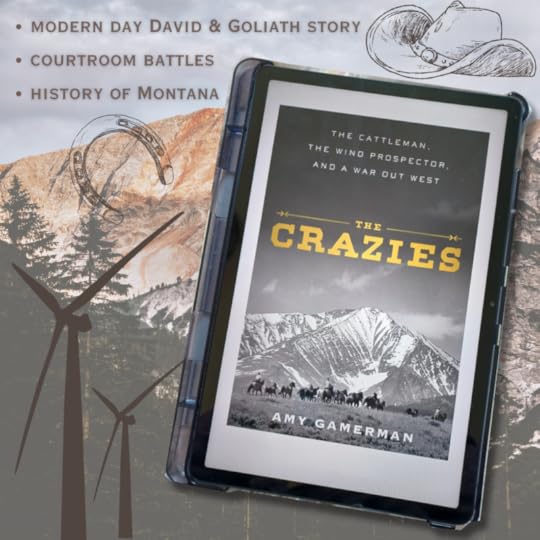
The Crazies: The Cattleman, the Wind Prospector, and a War Out West
“Yellowstone meets Matlock” (Tom Clavin) in this dazzling tale of land lust and the American West, chronicling the rise and fall of a wind farm that triggers a 21st century range war between a struggling fifth-generation rancher and the billionaires next door.
Most locals in Big Timber, Montana, learn to live with the wind. Rick Jarrett sought his fortune in it. Like his pioneer ancestors who staked their claims in the Treasure State, he believed in his right to make a living off the land—and its most precious resource, million-dollar wind.
Trouble was, Jarrett’s neighbors were some of the wealthiest and most influential men in America, trophy ranchers who’d come west to enjoy magnificent mountain views, not stare at five-hundred-foot wind turbines.
So began an epic showdown that would pull in an ever-widening cast of characters, including a Texas oil and gas tycoon, a roguish wind prospector, a Crow activist fighting for his tribe’s rights to the mountains they hold sacred, and an Olympic athlete-turned-attorney whose path to redemption would lead to Jarrett’s wind farm. A wildly entertaining yarn, the brawl over Crazy Mountain Wind would become a fight over the values that define us as Americans, even as the most coveted rangeland in the West was threatened by forces more powerful than anything one man could record drought, raging wildfires, dwindling snowpack.
“An epic tale of greed and resilience,” The Crazies “has the power to leave you feeling walloped, whip-sawed, and wildly invigorated, all within the same breath” (Kevin Fedarko, New York Times bestselling author of A Walk in the Park). It’s an exquisitely reported, ruggedly beautiful western for a warming planet—and a bighearted inquiry into how you can love a place so much you risk destroying it.
Most locals in Big Timber, Montana, learn to live with the wind. Rick Jarrett sought his fortune in it. Like his pioneer ancestors who staked their claims in the Treasure State, he believed in his right to make a living off the land—and its most precious resource, million-dollar wind.
Trouble was, Jarrett’s neighbors were some of the wealthiest and most influential men in America, trophy ranchers who’d come west to enjoy magnificent mountain views, not stare at five-hundred-foot wind turbines.
So began an epic showdown that would pull in an ever-widening cast of characters, including a Texas oil and gas tycoon, a roguish wind prospector, a Crow activist fighting for his tribe’s rights to the mountains they hold sacred, and an Olympic athlete-turned-attorney whose path to redemption would lead to Jarrett’s wind farm. A wildly entertaining yarn, the brawl over Crazy Mountain Wind would become a fight over the values that define us as Americans, even as the most coveted rangeland in the West was threatened by forces more powerful than anything one man could record drought, raging wildfires, dwindling snowpack.
“An epic tale of greed and resilience,” The Crazies “has the power to leave you feeling walloped, whip-sawed, and wildly invigorated, all within the same breath” (Kevin Fedarko, New York Times bestselling author of A Walk in the Park). It’s an exquisitely reported, ruggedly beautiful western for a warming planet—and a bighearted inquiry into how you can love a place so much you risk destroying it.
464 pages, Kindle Edition
First published January 7, 2025
Ratings & Reviews
Friends & Following
Create a free account to discover what your friends think of this book!
Community Reviews
Displaying 1 - 30 of 179 reviews

August 11, 2025
“[A]n epic story was unfolding in the Crazy Mountains, a story centuries in the making, with millionaires and billionaires, cattle barons and Crow warriors, prospectors and politicians, meat-packers and medicine men. It reached from the muck of Montana calving barns to the gleaming C-suites of Manhattan skyscrapers. It was a modern-day range war in a warming West – a fight for power in its most elemental form. It was a ghost story haunted by generations of dreamers and strivers, those drawn to the land and those who lost it, the dispossessed, the exiles. At its heart was an old cowboy in suspenders, and the all-American spectacle of neighbors suing each other…”
- Amy Gamerman, The Crazies: The Cattleman, the Wind Prospector, and a War out West
The story told in Amy Gamerman’s The Crazies is suitably wild, enough so that its title does double-duty, describing both a mountain range and the characters who inhabit it. It tells the tale of a cattle rancher struggling to hold onto his ranch; a wind prospector trying to make a big score with a turbine deal; and a billionaire willing to go to great lengths not to look at a windmill. It involves corrupt government institutions, high-priced lawyers, and more than a few unexpected twists of fortune. All of it is set in Montana, so that at times it feels like Taylor Sheridan’s Yellowstone, without the gunfights.
Well-written, deeply reported, incredibly cast, The Crazies is a really good work of investigative journalism. At any other time in the history of the United States, it would be a fun example of American excesses. Unfortunately, it is set in this time in history, and so it feels like one of many representative examples of end-stage Americanism.
***
The Crazies has a lengthy dramatis personae, but it revolves around three major players who are more than able to carry a narrative. We begin with Rick Jarrett, a struggling rancher who exemplifies the paradoxical difficulties of that calling. Hardworking and ornery, he owns land worth millions of dollars, but struggles to make ends meet from year to year, and is perpetually at risk of losing his family legacy. A solution appears to present itself in the form of wind.
This leads to the introduction of Marty Wilde, the so-called wind prospector. Like an old-time miner seeking one big score, Marty scoured Montana looking to set up a turbine projects, for which he would receive a fee. Marty determines that Rick’s land is an excellent place to build, a spot windy enough to generate enough clean electricity to power thousands of Montana homes. Though he does not believe in global warming, Rick is quite willing to cash in on renewable energy, understanding that it’s his best chance to secure his property for years to come.
The only problem with this scheme are Rick’s neighbors, chief among them a billionaire oilman named Russell Gordy. So rich that cognitive dissonance no longer exists for him, Gordy decides that in his Montana playground, he will be the conservationist, “protecting” wildlife and – far more importantly – his scenic views. Of course, as Gamerman notes, Gordy made Scrooge McDuck-levels of wealth by longwall mining, which is an effective way to extract cheap coal while destroying the surrounding environment. In other words, his beliefs regarding how much protection Mother Nature deserves is location-specific.
The collision of these three men – and how that collision plays out over the course of several years – provides The Crazies with its dramatic impetus.
***
At just over four-hundred pages of text, The Crazies is a pretty long book, especially given that it fundamentals could be captured pretty well in an article. This additional space is both good and bad.
On the plus side of the ledger, Gamerman is able to travel down some fascinating sideroads. For example, you learn a lot about the business of turbine construction, the environmental impacts of wind energy to wildlife, the byzantine nature of the electricity market, and the strange existence of public service commissions. You’ll discover things you did not expect, and perhaps did not want to know.
Because the events chronicled in the The Crazies took many years to simmer, boil, and resolve, Gamerman is also able to demonstrate a troubling trend. When the book opens, Montana is a two-party state that provides incentives for renewable energy. By the time it ends, Montana is a one-party state that has reembraced fossil fuels for no reason save political ideology. But even the conservative-liberal divide does not fully explain this aching desire to pollute, for down in Texas, landowners are reaping a fortune from vast windfarms.
***
The downside to The Crazies’ length is that there is a lot of nonessential padding. Mostly this consists of extensive backstories of some of the participants. For example, super-lawyer David Chasnoff, one of several plaintiffs opposed to Marty and Rick, gets an entire chapter devoted to his life story. I am no opponent of depth and detail, yet it’s a bit much. It also creates an imbalance. The people – such as Chasnoff, and Rick’s lawyer, Monica Tranel – who provide Gamerman access are given voluminous dimension, while those who did not remain enigmas.
***
Gamerman is a writer for The Wall Street Journal, which leads to a number of assumptions about where she might stand on certain issues. Without getting into it, I’ll say only that none of those assumptions prove correct.
In terms of journalistic objectivity, you can see Gamerman bending over backwards to be fair to everyone. Generally, her chronicle flows through the participants, so that there is no overarching viewpoint, but a clash of many opposing ones. When we are with a person, we see things through their eyes.
With that said, Gamerman is sometimes unable to avoid nodding toward the ridiculousness often on display. This is most evident with Gordy, who loves the environment that he’s standing on, but more than willing to rip it up elsewhere to extract wealth. When discussing Gordy’s fear of what turbines might do, she notes wryly: “Gordy saw the wind farm as a threat to the things he held most dear. It would kill the birds he loved to hunt.”
***
When I picked this up, I was planning on being entertained. However, The Crazies deeply bummed me out. There is just something gross in the idea that a man can own an entire mountain. But that’s just me.
There are many motifs flowing like streams through Gamerman’s work. The most potent is the idea of rights. Americans love rights. We talk about them all the time. Property rights especially. Unfortunately, the philosophy of rights is pretty damn unworkable, given that one person’s freedoms eventually intrude upon another’s. In short, as Isaiah Berlin once observed, “liberty for wolves is death for lambs.”
In The Crazies, one man’s claimed rights intersect with another man’s claimed rights, and in the end, right disappears, and money triumphs.
- Amy Gamerman, The Crazies: The Cattleman, the Wind Prospector, and a War out West
The story told in Amy Gamerman’s The Crazies is suitably wild, enough so that its title does double-duty, describing both a mountain range and the characters who inhabit it. It tells the tale of a cattle rancher struggling to hold onto his ranch; a wind prospector trying to make a big score with a turbine deal; and a billionaire willing to go to great lengths not to look at a windmill. It involves corrupt government institutions, high-priced lawyers, and more than a few unexpected twists of fortune. All of it is set in Montana, so that at times it feels like Taylor Sheridan’s Yellowstone, without the gunfights.
Well-written, deeply reported, incredibly cast, The Crazies is a really good work of investigative journalism. At any other time in the history of the United States, it would be a fun example of American excesses. Unfortunately, it is set in this time in history, and so it feels like one of many representative examples of end-stage Americanism.
***
The Crazies has a lengthy dramatis personae, but it revolves around three major players who are more than able to carry a narrative. We begin with Rick Jarrett, a struggling rancher who exemplifies the paradoxical difficulties of that calling. Hardworking and ornery, he owns land worth millions of dollars, but struggles to make ends meet from year to year, and is perpetually at risk of losing his family legacy. A solution appears to present itself in the form of wind.
This leads to the introduction of Marty Wilde, the so-called wind prospector. Like an old-time miner seeking one big score, Marty scoured Montana looking to set up a turbine projects, for which he would receive a fee. Marty determines that Rick’s land is an excellent place to build, a spot windy enough to generate enough clean electricity to power thousands of Montana homes. Though he does not believe in global warming, Rick is quite willing to cash in on renewable energy, understanding that it’s his best chance to secure his property for years to come.
The only problem with this scheme are Rick’s neighbors, chief among them a billionaire oilman named Russell Gordy. So rich that cognitive dissonance no longer exists for him, Gordy decides that in his Montana playground, he will be the conservationist, “protecting” wildlife and – far more importantly – his scenic views. Of course, as Gamerman notes, Gordy made Scrooge McDuck-levels of wealth by longwall mining, which is an effective way to extract cheap coal while destroying the surrounding environment. In other words, his beliefs regarding how much protection Mother Nature deserves is location-specific.
The collision of these three men – and how that collision plays out over the course of several years – provides The Crazies with its dramatic impetus.
***
At just over four-hundred pages of text, The Crazies is a pretty long book, especially given that it fundamentals could be captured pretty well in an article. This additional space is both good and bad.
On the plus side of the ledger, Gamerman is able to travel down some fascinating sideroads. For example, you learn a lot about the business of turbine construction, the environmental impacts of wind energy to wildlife, the byzantine nature of the electricity market, and the strange existence of public service commissions. You’ll discover things you did not expect, and perhaps did not want to know.
Because the events chronicled in the The Crazies took many years to simmer, boil, and resolve, Gamerman is also able to demonstrate a troubling trend. When the book opens, Montana is a two-party state that provides incentives for renewable energy. By the time it ends, Montana is a one-party state that has reembraced fossil fuels for no reason save political ideology. But even the conservative-liberal divide does not fully explain this aching desire to pollute, for down in Texas, landowners are reaping a fortune from vast windfarms.
***
The downside to The Crazies’ length is that there is a lot of nonessential padding. Mostly this consists of extensive backstories of some of the participants. For example, super-lawyer David Chasnoff, one of several plaintiffs opposed to Marty and Rick, gets an entire chapter devoted to his life story. I am no opponent of depth and detail, yet it’s a bit much. It also creates an imbalance. The people – such as Chasnoff, and Rick’s lawyer, Monica Tranel – who provide Gamerman access are given voluminous dimension, while those who did not remain enigmas.
***
Gamerman is a writer for The Wall Street Journal, which leads to a number of assumptions about where she might stand on certain issues. Without getting into it, I’ll say only that none of those assumptions prove correct.
In terms of journalistic objectivity, you can see Gamerman bending over backwards to be fair to everyone. Generally, her chronicle flows through the participants, so that there is no overarching viewpoint, but a clash of many opposing ones. When we are with a person, we see things through their eyes.
With that said, Gamerman is sometimes unable to avoid nodding toward the ridiculousness often on display. This is most evident with Gordy, who loves the environment that he’s standing on, but more than willing to rip it up elsewhere to extract wealth. When discussing Gordy’s fear of what turbines might do, she notes wryly: “Gordy saw the wind farm as a threat to the things he held most dear. It would kill the birds he loved to hunt.”
***
When I picked this up, I was planning on being entertained. However, The Crazies deeply bummed me out. There is just something gross in the idea that a man can own an entire mountain. But that’s just me.
There are many motifs flowing like streams through Gamerman’s work. The most potent is the idea of rights. Americans love rights. We talk about them all the time. Property rights especially. Unfortunately, the philosophy of rights is pretty damn unworkable, given that one person’s freedoms eventually intrude upon another’s. In short, as Isaiah Berlin once observed, “liberty for wolves is death for lambs.”
In The Crazies, one man’s claimed rights intersect with another man’s claimed rights, and in the end, right disappears, and money triumphs.

December 1, 2024
There were the people who honor the land which should belong to no one and everyone.
The people who wanted to profit from the land and make their fortune.
The people who struggled to hold onto the land their ancestors had settled.
And the people whose wealth allows them to own land as a plaything for their own enjoyment.
All these special interests met in a decade long conflict. It started when a rancher decided to lease his land for a wind farm. The income would guarantee his family could hold onto the land where they had lived since the late 19th c. The state of Montana required the power company to expand into renewable energy. The Crazy Mountain Range was known for its wind. It seemed a perfect solution.
But the billionaires who had been buying failed ranches fought the wind farm. They may only spend weeks or a month a year at their ranch, but they wanted pristine beauty, to indulge their fantasies.
Rich in detail and with finely drawn portraits of all the players, this is a long read about a complicated story, particular and yet universal in the essentials. It is about class and wealth and the little man. And about power, the power of money and the sway of fake news and the impact of natural beauty. Is the cost of saving the planet from climate change a degradation of its beauty, a threat to the ecosystem?
In the end, for reasons we agree with or not, the court determined who controlled the land.
A fine piece of narrative nonfiction that touches on essential issues.
Thanks to the publisher for a free book through NetGalley.
The people who wanted to profit from the land and make their fortune.
The people who struggled to hold onto the land their ancestors had settled.
And the people whose wealth allows them to own land as a plaything for their own enjoyment.
All these special interests met in a decade long conflict. It started when a rancher decided to lease his land for a wind farm. The income would guarantee his family could hold onto the land where they had lived since the late 19th c. The state of Montana required the power company to expand into renewable energy. The Crazy Mountain Range was known for its wind. It seemed a perfect solution.
But the billionaires who had been buying failed ranches fought the wind farm. They may only spend weeks or a month a year at their ranch, but they wanted pristine beauty, to indulge their fantasies.
Rich in detail and with finely drawn portraits of all the players, this is a long read about a complicated story, particular and yet universal in the essentials. It is about class and wealth and the little man. And about power, the power of money and the sway of fake news and the impact of natural beauty. Is the cost of saving the planet from climate change a degradation of its beauty, a threat to the ecosystem?
In the end, for reasons we agree with or not, the court determined who controlled the land.
A fine piece of narrative nonfiction that touches on essential issues.
Thanks to the publisher for a free book through NetGalley.

October 26, 2024
Not just for fans of the "Yellowstone" TV series. Even if you watched it mainly for the views (like I did), you should love this book. You will find similarly impressive vistas, but a much better plot.
It is an example of my favorite kind of nonfiction, where the author starts with an interesting story and uses it as a canvas for a much broader, complex, and surprising tale. At the heart of the book is a conflict between two rather extreme characters: Rick Jarrett, a "salt-of-the-earth rancher" whose family has owned a piece of Montana land for generations, and who now wants to build a wind farm on his property to make ends meet; and Russell Gordy, a Texas gas and oil billionaire, owner of a sprawling trophy ranch (one of many), who wants to stop his neighbor from spoiling his view with wind turbines.
I think the best screenwriters would have trouble coming up with more colorful protagonists, but this is just a start. Both men are just representatives of two parallel communities - hard-working, ordinary local people and very rich owners of most of the land in the beautiful Crazy Mountains, sometimes called "the Oligarchs". As we read in the preface, “it was a modern-day range war in a warming West–a fight for power in its most elemental form”. Although it was very easy for me to choose sides in this conflict, I have to admit that the author tries very hard to keep the balance and not to portray the billionaires as heartless villains.
The story of this war is worth reading in itself, but we get so much more. Providing a very broad background, the author delves into such topics as homesteading, the history of the native inhabitants of this land, a brief introduction to the workings of the American electricity market, and nature conservation, just to name a few. And despite so many details and twists, Amy Gamerman's writing is always witty and engaging.
Thanks to the publisher, Simon & Schuster, and NetGalley for an advanced copy of this book.
It is an example of my favorite kind of nonfiction, where the author starts with an interesting story and uses it as a canvas for a much broader, complex, and surprising tale. At the heart of the book is a conflict between two rather extreme characters: Rick Jarrett, a "salt-of-the-earth rancher" whose family has owned a piece of Montana land for generations, and who now wants to build a wind farm on his property to make ends meet; and Russell Gordy, a Texas gas and oil billionaire, owner of a sprawling trophy ranch (one of many), who wants to stop his neighbor from spoiling his view with wind turbines.
I think the best screenwriters would have trouble coming up with more colorful protagonists, but this is just a start. Both men are just representatives of two parallel communities - hard-working, ordinary local people and very rich owners of most of the land in the beautiful Crazy Mountains, sometimes called "the Oligarchs". As we read in the preface, “it was a modern-day range war in a warming West–a fight for power in its most elemental form”. Although it was very easy for me to choose sides in this conflict, I have to admit that the author tries very hard to keep the balance and not to portray the billionaires as heartless villains.
The story of this war is worth reading in itself, but we get so much more. Providing a very broad background, the author delves into such topics as homesteading, the history of the native inhabitants of this land, a brief introduction to the workings of the American electricity market, and nature conservation, just to name a few. And despite so many details and twists, Amy Gamerman's writing is always witty and engaging.
Thanks to the publisher, Simon & Schuster, and NetGalley for an advanced copy of this book.

March 1, 2025
Amy Gamerman is a real estate and culture journalist who's contributed to the Wall Street Journal for decades. In her first full-length book, 2025's The Crazies, she covers a real estate legal dispute that played out over multiple years in Big Timber, Montana, a small town surrounded by a mountain range called the Crazies. Big Timber residents are a mix of long-time ranching families struggling to eke out a living and wealthy investors buying vast quantities of scenic land for their private use. The dispute centered around a financially struggling ranching family seeking to build a wind farm on their land (to take advantage of the high winds in the area, and also helping to produce green energy), with their wealthy neighbors suing them due to concerns over how large wind turbines would be an eyesore, a nuisance, and a threat to the local environment. Gamerman weaves a compelling narrative, tying together many threads and fascinating characters over this 464 page book/18 hour audiobook (though at the same time, some tangents could have been omitted entirely without detriment to the central story). Definitely an interesting read.
Further reading: protracted and precedent-setting legal cases
The Genome Defense: Inside the Epic Legal Battle to Determine Who Owns Your DNA by Jorge Contreras
By the Fire We Carry: The Generations-Long Fight for Justice on Native Land by Rebecca Nagle | my review
Further reading: the American West
The Last Ride of the Pony Express: My 2,000-mile Horseback Journey into the Old West by Will Grant | my review
Bandit Heaven: The Hole-in-the-Wall Gangs and the Final Chapter of the Wild West by Tom Clavin | my review
Born of Lakes and Plains: Mixed-Descent Peoples and the Making of the American West by Anne Hyde | my review
My statistics:
Book 69 for 2025
Book 1995 cumulatively
Further reading: protracted and precedent-setting legal cases
The Genome Defense: Inside the Epic Legal Battle to Determine Who Owns Your DNA by Jorge Contreras
By the Fire We Carry: The Generations-Long Fight for Justice on Native Land by Rebecca Nagle | my review
Further reading: the American West
The Last Ride of the Pony Express: My 2,000-mile Horseback Journey into the Old West by Will Grant | my review
Bandit Heaven: The Hole-in-the-Wall Gangs and the Final Chapter of the Wild West by Tom Clavin | my review
Born of Lakes and Plains: Mixed-Descent Peoples and the Making of the American West by Anne Hyde | my review
My statistics:
Book 69 for 2025
Book 1995 cumulatively

March 31, 2026
Good book but I am not as wild about it as others. Wind Power, environmentalism, fat cats, law suits. This story had great potential but was long winded and not easy to read due to the writing style. A good story but about 200 pages too long to be effective.

March 7, 2025
Meticulously researched and detailed, Gamerman's chronicle of the attempt to develop a wind farm in Montana is a reflection of our times. The rich hire lawyers who use the law to bob and weave and manipulate the justice system to their advantage. What happens to the Jarretts and Andersons is a smaller version of a legal system that allowed a convicted felon and serial rapist to avoid prison and become president. It is no wonder ordinary people are cynical about government and law. They're right. The system is stacked against them because their pockets aren't deep enough to resist the rich and powerful.

January 27, 2025
Solid book with well-researched information, but for those comparing this to the TV series of Yellowstone, I found the digressions to be all too consuming when following the larger narrative. I doubt the show has whole episodes dedicated to flashbacks of an entire character's life, which feels like every other chapter in the first half. I'm the journalist type to find portions on the Public Service Commission fascinating, but when you're talking about what someone's great grandpa did for several pages, I find it disengaging from what is a largely contemporaneous plot. I get the point, but for some characters I couldn't be less than interested in their lineage's rise to wealth.

June 18, 2025
This was amazing. Gamerman was able to put a long drawn out court room non-drama into very human and very interesting stories. As few take home messages for me.
1. I am not sure how anything gets done that involves the courts and county commissioners. So many biases and personal agendas.
2. No one, and I am more convinced of this than ever, should have a billion dollars. It honestly isn't good for them and it very much isn't good for anyone else.
3. Land has always been fought over and todays court battles are just the new incarnation.
I am amazed however that Gamerman presented all sides to the story and I empathized/sympathized with all of them depending on the chapter I was reading. I completely get the billionaires who don't want unsightly wind turbines messing up their view that they paid fairly large dollars for. Towards then end, however, their tactics and sheer billionaire assholeness cured that opinion.
This is the second book I have read recently discussing the problems with keeping ranches and historical land in hands of non billionaires. It isn't a new problem but it does seem to be getting worse.
I would recommend this to anyone. Thank you to LibroFM for the ALC that as usual I didn't read before publication but maybe soon enough.
1. I am not sure how anything gets done that involves the courts and county commissioners. So many biases and personal agendas.
2. No one, and I am more convinced of this than ever, should have a billion dollars. It honestly isn't good for them and it very much isn't good for anyone else.
3. Land has always been fought over and todays court battles are just the new incarnation.
I am amazed however that Gamerman presented all sides to the story and I empathized/sympathized with all of them depending on the chapter I was reading. I completely get the billionaires who don't want unsightly wind turbines messing up their view that they paid fairly large dollars for. Towards then end, however, their tactics and sheer billionaire assholeness cured that opinion.
This is the second book I have read recently discussing the problems with keeping ranches and historical land in hands of non billionaires. It isn't a new problem but it does seem to be getting worse.
I would recommend this to anyone. Thank you to LibroFM for the ALC that as usual I didn't read before publication but maybe soon enough.
January 7, 2025
The Crazies is like "A Civil Action" meets "Yellowstone." With larger than life characters and magnificent prose, the story will stay with you long after you finish the last page.

April 25, 2025
Really, really boring. Rich people crying about land.

September 16, 2025
This is one of the best books I have read this year. An extremely well written, thoughtful narrative. Thoroughly researched (it took her five years and has extensive acknowledgments and notes), this is more than a local Montana story. In telling Rick Jarrett’s story, Gamerman looks at the power dynamics of a few moneyed individuals to control the land. I recently had the good fortune to hear Gamerman and Jarrett’s daughter on a panel about wealth and the West. Both made trenchant observations about how wealth is reshaping life, land and community. It is especially relevant now that the issue is water, rather than wind, as the privately owned Crazy Mountain Ranch (same owner as Yellowstone Club) builds its golf course.
https://montanafreepress.org/2025/07/...
https://montanafreepress.org/2025/07/...

June 13, 2025
This is an interesting non-fiction history book. The author goes back in the history of the area to the tribes chasing buffalo, to former Confederates homesteading in the region, and on to current events. The book is over 400 pages, has over 400 footnotes, and if you were bored in history class, this is not the book for you. If you enjoy reading about the West and the struggles of opening new territories, you will appreciate the stories of some of the people who helped build Montana.

June 17, 2026
For some non-fiction, the asides make the story. For others, it seems like the author added a bunch of random stuff to hit a certain word count. This is the latter.
It's an interesting story but would have been infinitely better with a more focused scope.
It's an interesting story but would have been infinitely better with a more focused scope.
April 23, 2026
okay this took me 8+ months to read but with that being said i really enjoyed this story and its fun because its about a place i’ve always loved. but also boo billionaires getting their way.

December 3, 2024
edit 07JAN25: Happy Publication Day!

Saddle up! I'm crazily impressed at what Gamerman has managed to wrangle into her debut book, the various subject matters as vast as the Montana plains, extending from the prehistoric Clovis people to the year 2020, where we see the end of a contentious legal battle between the proverbial David and Goliath(s) of modern day Montana.
This book covers not only the history of Montana settlement, but land and ranching rights, utility and zoning regulation, environmental law, zoology of the native animals, history of the windmill - which I never knew was so integral to advancement in agriculture or railroad capabilities - and the continued encroachment upon, but also the resilience of, the Indigenous tribes of Montana, the biggest being the Crow Indians. You might think it difficult to string these topics one after the other, but Gamerman does so seamlessly, as they all relate to each other.
The only inclusions that felt superfluous were the frequent backstories into each character, no matter how peripheral they were to the story. You'd not only get a very thorough biography of each person, but also the biography of their spouse, and their grandparents, and their kids, and their great great grandparents, and their jobs, and hobbies, and idiosyncrasies. But the characters themselves would only appear a handful of times throughout the book. It was exhausting to read after awhile, so if I knew they weren't the main character, I honestly just skimmed over those parts. I don't know if this was an attempt to bolster the page count? But all those parts could've been edited out of the book.
Another thing to note, obviously no history book - or book, period - can be 100% objective, when it comes to narrative writing. This book definitely has a slant to it, there is no attempt to remain neutral. It's not a point against the book, just an observation. For instance, a judge's decision, unfavorable to our protagonists, isn't just left at that. Gamerman would follow up with a footnote on the judge's decision on a later case completely unrelated to this book's events, that is meant to make the reader dislike the judge. The character and actions of the Goliaths in this story speak for themselves (hypocrisy and unscrupulousness out the wazoo!), so I think if Gamerman reeled back a bit, the book would come off less biased.
Through this book, I see how regulation and laws are well meaning but don't always benefit the people or property it's trying to protect, and more than once, money and influence wins over common sense and justice. I also see the tenacity and pioneer spirit of the native Montanans, who refuse to go down without a fight, and always chooses to get back up. Very admirable, and I can feel Gamerman's passion in this case, for her having followed it for so many years. Reporting on big names is fine, but stories of everyday people are just as exciting and dramatic, and I'm so glad to have picked up Gamerman's book. Highly recommend!
Thanks to Simon & Schuster and NetGalley for an advanced copy of this book.
Saddle up! I'm crazily impressed at what Gamerman has managed to wrangle into her debut book, the various subject matters as vast as the Montana plains, extending from the prehistoric Clovis people to the year 2020, where we see the end of a contentious legal battle between the proverbial David and Goliath(s) of modern day Montana.
This book covers not only the history of Montana settlement, but land and ranching rights, utility and zoning regulation, environmental law, zoology of the native animals, history of the windmill - which I never knew was so integral to advancement in agriculture or railroad capabilities - and the continued encroachment upon, but also the resilience of, the Indigenous tribes of Montana, the biggest being the Crow Indians. You might think it difficult to string these topics one after the other, but Gamerman does so seamlessly, as they all relate to each other.
The only inclusions that felt superfluous were the frequent backstories into each character, no matter how peripheral they were to the story. You'd not only get a very thorough biography of each person, but also the biography of their spouse, and their grandparents, and their kids, and their great great grandparents, and their jobs, and hobbies, and idiosyncrasies. But the characters themselves would only appear a handful of times throughout the book. It was exhausting to read after awhile, so if I knew they weren't the main character, I honestly just skimmed over those parts. I don't know if this was an attempt to bolster the page count? But all those parts could've been edited out of the book.
Another thing to note, obviously no history book - or book, period - can be 100% objective, when it comes to narrative writing. This book definitely has a slant to it, there is no attempt to remain neutral. It's not a point against the book, just an observation. For instance, a judge's decision, unfavorable to our protagonists, isn't just left at that. Gamerman would follow up with a footnote on the judge's decision on a later case completely unrelated to this book's events, that is meant to make the reader dislike the judge. The character and actions of the Goliaths in this story speak for themselves (hypocrisy and unscrupulousness out the wazoo!), so I think if Gamerman reeled back a bit, the book would come off less biased.
Through this book, I see how regulation and laws are well meaning but don't always benefit the people or property it's trying to protect, and more than once, money and influence wins over common sense and justice. I also see the tenacity and pioneer spirit of the native Montanans, who refuse to go down without a fight, and always chooses to get back up. Very admirable, and I can feel Gamerman's passion in this case, for her having followed it for so many years. Reporting on big names is fine, but stories of everyday people are just as exciting and dramatic, and I'm so glad to have picked up Gamerman's book. Highly recommend!
Thanks to Simon & Schuster and NetGalley for an advanced copy of this book.

April 3, 2025
This was an excellent nonfiction book that read like fiction. She perfectly captured life in Montana, the dreams, challenges and myriad of quirky characters.
I both read and listened to this book. The audiobook and narration by Anna Sale were excellent. I loved listening to her talk and bring this crazy tale to life.
I both read and listened to this book. The audiobook and narration by Anna Sale were excellent. I loved listening to her talk and bring this crazy tale to life.

June 10, 2025
Phenomenal storytelling and well researched. No person should be a billionaire and no person should own a mountain.
October 13, 2025
4.5 stars
Wow! First of all, I am biased because of my tiny connection to the Crazies from my time spent living, recreating, and working in areas adjacent to where the story unfolds.
Cons: Sometimes this book comes off super repetitive. At certain points I was thinking "ok I get it, David v Goliath mentality, get to the point of the chapter".
Pros: This is an incredibly well researched book. I am a girlie who loves scene setting, so the long chapters on the various histories of the literal land and the inhabitants over millennia I enjoyed. I feel like I learned a lot about mountains I have seen and hiked around in, and I love that. I also appreciated the deep-dives into wind energy, public services, Native American history & ongoing usage of the area, and the background lives of the people highlighted in the book.
Overall, I think this book has the ability to make people sit with the fact that the players in this story are not all good and not all bad. Although, there's a gross feeling for me when it comes to billionaires whining over "ruined vistas" when some made their billions off of extractive industries that harmed other communities...
There's a lot of big, unresolved questions. Who really dictates land usage? If a billionaire has more money than he knows what to do with, why are his ranch hands living in squalor, and in some cases unable to pay medical debts? Fossil fuels are a necessary evil, but what is the cost of green energy? Many times my mouth was hanging open in contempt over the attitudes and actions of these greedy, greedy people.
I could easily see this book adapted for the screen. It's emotional, thoughtful, and complicated.
Wow! First of all, I am biased because of my tiny connection to the Crazies from my time spent living, recreating, and working in areas adjacent to where the story unfolds.
Cons: Sometimes this book comes off super repetitive. At certain points I was thinking "ok I get it, David v Goliath mentality, get to the point of the chapter".
Pros: This is an incredibly well researched book. I am a girlie who loves scene setting, so the long chapters on the various histories of the literal land and the inhabitants over millennia I enjoyed. I feel like I learned a lot about mountains I have seen and hiked around in, and I love that. I also appreciated the deep-dives into wind energy, public services, Native American history & ongoing usage of the area, and the background lives of the people highlighted in the book.
Overall, I think this book has the ability to make people sit with the fact that the players in this story are not all good and not all bad. Although, there's a gross feeling for me when it comes to billionaires whining over "ruined vistas" when some made their billions off of extractive industries that harmed other communities...
There's a lot of big, unresolved questions. Who really dictates land usage? If a billionaire has more money than he knows what to do with, why are his ranch hands living in squalor, and in some cases unable to pay medical debts? Fossil fuels are a necessary evil, but what is the cost of green energy? Many times my mouth was hanging open in contempt over the attitudes and actions of these greedy, greedy people.
I could easily see this book adapted for the screen. It's emotional, thoughtful, and complicated.

May 18, 2026
This is a nearly perfect debut nonfiction book. It doesn’t do anything revolutionary, but it’s perfectly (but not boringly) structured and balanced, with wonderful little touches throughout. And its theme, which touches on everything — personal, social, governmental, legal, historical — is an important one: freedom from vs. freedom to. But Gamerman doesn’t talk much about freedom, and she doesn’t even use the single word that best describes the problem posed by wind power — nuisance — until well past the halfway point.
This is not a lawyer’s story, even though there are suits galore. The focus here is on stories, especially all the characters’ backstories, and I generally don’t like backstories, but these are as interesting ones as I’ve ever seen. And there is a lot about the Montana locale and lifestyles (of the rich and famous, and the not so). There is too much information, as with all such books, because of the years of research that goes into them, and the lack of close editorial oversight, but this book is easy to skim and required much less skimming than usual.
This is not a lawyer’s story, even though there are suits galore. The focus here is on stories, especially all the characters’ backstories, and I generally don’t like backstories, but these are as interesting ones as I’ve ever seen. And there is a lot about the Montana locale and lifestyles (of the rich and famous, and the not so). There is too much information, as with all such books, because of the years of research that goes into them, and the lack of close editorial oversight, but this book is easy to skim and required much less skimming than usual.
January 13, 2025
Fun engaging interesting. Midwest whimsical.
The ultimate story of a moment in Montana replete with excellent composition, colorful characters, and everything in between. From introduction to conclusion, the author seemingly missed nothing and captured my attention.
I appreciated the history of wind power and explanation of regulatory capture.
Beautiful passages capture the gorgeous landscape and serve the reader well.
“…straightened and brightened like a cut plant dropped in glass of water.”
“Over the years the barn slowly crumbled to the ground, its weathered, gray boards folding and splaying like a pack of splintery playing cards until only the rusted basketball hoop remained upright.”
“‘Trying to develop wind in Montana (he liked to say) was like learning how to box in prison: a difficult environment, period.’”
The ultimate story of a moment in Montana replete with excellent composition, colorful characters, and everything in between. From introduction to conclusion, the author seemingly missed nothing and captured my attention.
I appreciated the history of wind power and explanation of regulatory capture.
Beautiful passages capture the gorgeous landscape and serve the reader well.
“…straightened and brightened like a cut plant dropped in glass of water.”
“Over the years the barn slowly crumbled to the ground, its weathered, gray boards folding and splaying like a pack of splintery playing cards until only the rusted basketball hoop remained upright.”
“‘Trying to develop wind in Montana (he liked to say) was like learning how to box in prison: a difficult environment, period.’”

July 22, 2025
When I drive to Montana each year, I know I’m close to home as the Crazy Mountains loom in the sky. The book had some fascinating history about the Clovis child found in Montana, the only known burial site in North America. The child was 12,800 years old basically all the Native people of the Americas descended from the Clovis people. Also interesting history of the Crow Agency in Montana. We meet a lot of people that were involved in all sides of the battle for land rights but it was specifically about wind energy. And also wealthy “out-of-staters” and multi-generation Montanan ranchers. Fascinating story. And a fight for water rights is happening now. It was detailed and dry in parts but overall I would recommend.

December 16, 2025
My first non fiction/non romance book! 😅 It was actually pretty cool to read about the Crazy Mountains (which are right next to where I live in Montana) ⛰️

July 20, 2025
This is non-fiction, a real life Yellowstone. I loved this book. I found it in a Cody Wyoming bookstore and had to get it and I’m so glad I did. I lived in Livingston, Montana from 2002-2007 and loved the beauty of the area. I could see the Crazies to the east. I’ve taken my son to camp there. I went many times to Big Timber to eat at the Grand Hotel (great steaks and fabulous bread sticks). So I was invested in this story. The author is correct, that area is the windiest I have ever been in. It blows semi trucks over on the interstate. There is definitely enough wind for a wind farm.
The court battle between a 5th generation rancher and rich billionaires that come to visit a couple weeks a year was gripping. When I lived there I saw both types of people. The super rich come to spend a few weeks during the summer and long time Montanans would tell me what generation they were. People actually say, “ I’m a 5th generation Montanan”.
This is a story of the little guy going up against the big guy, how money talks, and justice is in the eye of the beholder. Some of the players are likable and others are not. You have a front row seat on how the game is played.
I also listened to the audiobook while in the car so I could continue reading. The narrator does a good job. The outcome? You have to read the book to find out.
The court battle between a 5th generation rancher and rich billionaires that come to visit a couple weeks a year was gripping. When I lived there I saw both types of people. The super rich come to spend a few weeks during the summer and long time Montanans would tell me what generation they were. People actually say, “ I’m a 5th generation Montanan”.
This is a story of the little guy going up against the big guy, how money talks, and justice is in the eye of the beholder. Some of the players are likable and others are not. You have a front row seat on how the game is played.
I also listened to the audiobook while in the car so I could continue reading. The narrator does a good job. The outcome? You have to read the book to find out.
November 4, 2024
Thank you to Simon and Schuster for providing this ARC for review consideration via NetGalley. All opinions are my own.
The Crazies by Amy Gamerman is a nonfiction look into the modern Wild West—property rights and energy production in the relatively isolated wilds of Montana. Interspersed between the properties of some of the richest people in America are the small ranches and family owned farmers worked by the hardscrabble Montana natives.
The best elements of this book are the beautifully written vignettes that are careful and detailed. The author clearly takes great care to craft detailed pictures of all the involved parties, from the renegade wind farm investors to the geriatric cattle ranchers and their families. It’s frankly a little surprising that some of the actors involved in this lawsuit and story were willing to open up to an outside writer, and yet, the author was able to somehow capture very nuanced and somewhat kind portraits of so many.
This book is long. While the title does give a sort of “Yellowstone” meets the green revolution vibe, it’s actually much more mundane. This is a book about a property rights lawsuit framed around sustainable energy, and a lengthy one at that. At times, despite the lovely tableaus of the scenery the lengthy description of local zoning laws, Montana statutes, and descriptions of the minutiae of wind energy production can become a slog. There are hundreds of pages of exposition before the actual court case coverage begins, and at times, without the scaffolding of the prosecutor-defense dynamic all of the information can be muddled. For a reader without a background in property and land usage dispute or energy production rights, this can get somewhat dense. Additionally, there were sections about a local Crow activist, that while valuable, didn’t fully seem to tie into the narrative in a way that didn’t make them seem like detours.
Overall, it is a very vivid and evocative story of a small and yet so coveted section of the American landscape. It’s a long, albeit very compelling David and Goliath-esque story. 4/5 stars.
The Crazies by Amy Gamerman is a nonfiction look into the modern Wild West—property rights and energy production in the relatively isolated wilds of Montana. Interspersed between the properties of some of the richest people in America are the small ranches and family owned farmers worked by the hardscrabble Montana natives.
The best elements of this book are the beautifully written vignettes that are careful and detailed. The author clearly takes great care to craft detailed pictures of all the involved parties, from the renegade wind farm investors to the geriatric cattle ranchers and their families. It’s frankly a little surprising that some of the actors involved in this lawsuit and story were willing to open up to an outside writer, and yet, the author was able to somehow capture very nuanced and somewhat kind portraits of so many.
This book is long. While the title does give a sort of “Yellowstone” meets the green revolution vibe, it’s actually much more mundane. This is a book about a property rights lawsuit framed around sustainable energy, and a lengthy one at that. At times, despite the lovely tableaus of the scenery the lengthy description of local zoning laws, Montana statutes, and descriptions of the minutiae of wind energy production can become a slog. There are hundreds of pages of exposition before the actual court case coverage begins, and at times, without the scaffolding of the prosecutor-defense dynamic all of the information can be muddled. For a reader without a background in property and land usage dispute or energy production rights, this can get somewhat dense. Additionally, there were sections about a local Crow activist, that while valuable, didn’t fully seem to tie into the narrative in a way that didn’t make them seem like detours.
Overall, it is a very vivid and evocative story of a small and yet so coveted section of the American landscape. It’s a long, albeit very compelling David and Goliath-esque story. 4/5 stars.
April 23, 2025
The quality of the writing deserves a higher rating. The problem, for me, was that I did not find the story interesting enough for the detail provided in this book.
This is another book that makes you doubt that the justice system is really about justice. Given deep enough pockets, money can often win over fairness. This comes in many forms; tort law firms can severely harm deep pocketed corporations even though their claims are not actually true. I am so glad my interest in becoming a lawyer at age 14 did not last.
This is another book that makes you doubt that the justice system is really about justice. Given deep enough pockets, money can often win over fairness. This comes in many forms; tort law firms can severely harm deep pocketed corporations even though their claims are not actually true. I am so glad my interest in becoming a lawyer at age 14 did not last.
December 30, 2025
Excellent audiobook.
August 12, 2025
This book could be a great book, if it were edited to about half its current size. There is a great story in here: one about class and beauty and the land. We just don't need to hear about the back story to every side story of every footnote in the book. Seriously. Gamerman's greatest weakness is the inability to cut out giving a detailed biography of every character's sister's dog's former owner's sister-in-law's homestead's development history. It fills the pages, but doesn't add to the essential story.
"But all my research!"
I know, I know, it's precious. But, you need to cut it. Sift the gems out of each tangent, and dump the tailings. And gems there are! Enough that a condensed narrative could feel like a whirlwind, a tour of a bizarre menagerie, rather than a slog. Every time she mentioned where so-and-so graduated from high school, I sighed and buckled in for a long ride.
In the end, a quirky, land-rich-but-cash-poor, multigenerational rancher near Big Timber, Montana tried to put in a large wind power generation project with the help of a quirky, wildcat wind prospector, but ran afoul of a number of super wealthy amenity ranch neighbors who phlegmatically and nearly effortlessly delayed the project until it was killed. Those neighbors generally lived at their properties for no more than a few months each year, and ranged from rags-to-riches oil and gas entrepreneurs to high-profile, Las Vegas criminal attorneys. That core is an excellent story, and touches on issues that echo across the American West as more and more land is bought up by billionaires just to have some privacy and a spread where they can hunt once or twice a year.
I'd love to see a revised version that spends less time in the weeds and more time filling in the context of the counterparts of how this story is happening in other places.
"But all my research!"
I know, I know, it's precious. But, you need to cut it. Sift the gems out of each tangent, and dump the tailings. And gems there are! Enough that a condensed narrative could feel like a whirlwind, a tour of a bizarre menagerie, rather than a slog. Every time she mentioned where so-and-so graduated from high school, I sighed and buckled in for a long ride.
In the end, a quirky, land-rich-but-cash-poor, multigenerational rancher near Big Timber, Montana tried to put in a large wind power generation project with the help of a quirky, wildcat wind prospector, but ran afoul of a number of super wealthy amenity ranch neighbors who phlegmatically and nearly effortlessly delayed the project until it was killed. Those neighbors generally lived at their properties for no more than a few months each year, and ranged from rags-to-riches oil and gas entrepreneurs to high-profile, Las Vegas criminal attorneys. That core is an excellent story, and touches on issues that echo across the American West as more and more land is bought up by billionaires just to have some privacy and a spread where they can hunt once or twice a year.
I'd love to see a revised version that spends less time in the weeds and more time filling in the context of the counterparts of how this story is happening in other places.

January 25, 2025
By far, the best non-fiction book I’ve read in years. Gamerman is a wonderful storyteller here, as she takes complicated people, relationships and their varied stressors and weaves the story of their battles. And she names names, politely holding folks accountable. You get to decide your protagonists and antagonists which may change a time or two on your journey through The Crazies.
A page turner it is! And you’ll learn about old and new western culture.
A page turner it is! And you’ll learn about old and new western culture.

April 15, 2025
This was one of the best non-fiction books that I have read in the last few years. There were several threads in the story all sewn together nicely by the author: fossil fuel vs wind power, old family ranches vs new people from other states, and billionaires vs working class. This book made me ponder the changing landscape and people of small town life in the American west.

May 21, 2025
For someone who cares about the rangelands and the environment as whole, this book was right up my alley. It had my attention the entire time. The author did a splendid job telling the story, and was exceptional at weaving in ALL the aspects that surround wind development. nothing was left out.
Displaying 1 - 30 of 179 reviews