Jump to ratings and reviews
Rate this book

The Missing Pieces

Rate this book
In brief, laconic evocations, Henri Lefebvre lists a series of works that are either unfinished, lost, forgotten, destroyed, or that were never even made. This inventory of lacks becomes an incantation: if only for an instant, it transmits a presence to these "units" that had previously been lost to the history of human creativity and thought.

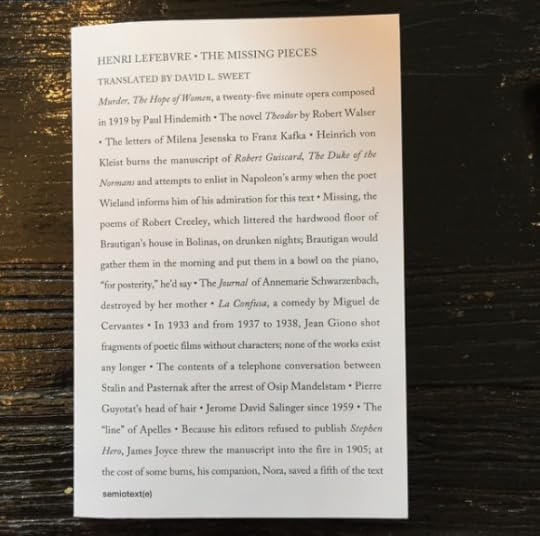
- A boarder for two years following a national funeral, Mirabeau is removed from the Pantheon and transferred to the cemetery of Clamart when his pornographic novels are discovered - A photograph taken by Hessling on Christmas night, 1943, of a young woman nailed alive to the village gate of Novimgorod; Hessling asks his friend Wolfgang Borchert to develop the film, look at the photograph, and destroy it - The Beautiful Gardener, a picture by Max Ernst, burned by the Nazis -- from "The Missing Pieces

The Missing Pieces" is an incantatory text, a catalog of what has been lost over time and what in some cases never existed. Through a lengthy chain of brief, laconic citations, Henri Lefebvre evokes the history of what is no more and what never was: the artworks, films, screenplays, negatives, poems, symphonies, buildings, letters, concepts, and lives that cannot be seen, heard, read, inhabited, or known about. It is a literary vanitas of sorts, but one that confers an almost mythical quality on the enigmatic creations it recounts -- rather than reminding us of the death that inhabits everything humans create.

Lefebvre's list includes Marcel Duchamp's (accdidentally destroyed) film of Man Ray shaving off the Baroness Elsa von Freytag-Loringhoven's pubic hair; the page written by Balzac on his deathbed (lost); "Spinoza's Treatise on the Rainbow" (thrown into a fire); the final seven meters of Kerouac's original typescript for "On the Road" (eaten by a dog); the chalk drawings of Francis Picabia (erased before an audience); and the one moment in Andre Malraux's life in which he exclaimed "I believe, for a minute, I was thinking nothing." "The Missing Pieces" offers a treasure trove of cultural and artistic detail and will entertain even those readers not enamored of the void."

84 pages, Paperback

First published January 1, 2011

9 people are currently reading
482 people want to read

About the author

Henri Lefebvre

159 books421 followers
Henri Lefebvre was a French sociologist, Marxist intellectual, and philosopher, best known for pioneering the critique of everyday life, for introducing the concepts of the right to the city and the production of social space, and for his work on dialectics, alienation, and criticism of Stalinism, existentialism, and structuralism.

In his prolific career, Lefebvre wrote more than sixty books and three hundred articles. He founded or took part in the founding of several intellectual and academic journals such as Philosophies, La Revue Marxiste, Arguments, Socialisme et Barbarie, Espaces et Sociétés.

Lefebvre died in 1991. In his obituary, Radical Philosophy magazine honored his long and complex career and influence:
the most prolific of French Marxist intellectuals, died during the night of 28–29 June 1991, less than a fortnight after his ninetieth birthday. During his long career, his work has gone in and out of fashion several times, and has influenced the development not only of philosophy but also of sociology, geography, political science and literary criticism.

Ratings & Reviews

What do you think?
Rate this book

Friends & Following

Create a free account to discover what your friends think of this book!

Community Reviews

5 stars
56 (37%)
4 stars
61 (40%)
3 stars
27 (18%)
2 stars
2 (1%)
1 star
3 (2%)
Displaying 1 - 30 of 38 reviews
Profile Image for Adam Dalva.
Author 8 books2,163 followers
January 17, 2022
Develops an extraordinary, chanting rhythm as it goes, chronicling lost, misbegotten, and destroyed things in simple list form, each entry pulsing with potential narrative. I spent longer looking up what Lefebvre was talking about than I did reading it - everything from Tintin's never shown bedroom to destroyed works of major art. VERY David Markson - and totally successful in its ambitions.
Profile Image for Paula Mota.
1,671 reviews567 followers
January 5, 2025
Patrice Quéréel, presidente da Fundação Duchamp, inaugura em Maio de 2002 o primeiro cemitério de obras de arte desaparecidas (falecidas), porque “elas são mortais como os homens”.

Partindo desta ideia de finitude dos artistas e da fragilidade das suas obras, Henri Lefebvre elaborou um inventário prodigioso com centenas de entradas que fazem a delícia de quem gosta de curiosidades e não é imune a uma boa dose de fatalismo.

Desaparecida, a corda fornecida por Boris Pasternak a Marina Tsvetaieva para atar uma mala demasiado cheia; em 1941, a corda serviu a Marina Tsvetáieva para se enforcar.

Neste rol de coisas que faltam incluem-se obras, adaptações e colaborações que nunca viram a luz do dia, bem como nações…

Desaparecida, a Bucovina, outrora situada entre a Ucrânia e a Roménia, pátria de Paul Celan.

…línguas…

Já só restam três palavras da língua cúmbrica, da família do galês, desaparecida no século VII.

…fotografias…

‘O Amante’ de Marguerite Duras: obra construída em torno de uma fotografia desaparecida.

…e planos…

O único desenho de projecto da ‘Sagrada Família’ foi destruído durante a Guerra Civil Espanhola.

…que se perderam irremediavelmente.
Inúmeros são os exemplos de museus e bibliotecas roubadas e destruídas por cheias, bombardeamentos e incêndios, assumindo o fogo por vezes a forma de auto-de-fé.

Em 1938, a junta militar brasileira queima em praça pública os livros de Jorge Amado na sua cidade natal, Salvador da Baía.

Neste inventário abundam também o caso de diários e cartas destruídas após a morte dos autores (Annemarie Schwarzenbach, Thomas Mann, Sylvia Plath, George Sand, Lou Andreas-Salomé e muitos outros), mas também por acção dos próprios artistas.

Os manuscritos de Velimir Khlébnikov, com os quais ele enchia a fronha da almofada, estão perdidos.

Há inclusive lugar para três portugueses, em que destaco a mais hilariante:

Perante a desistência sistemática das raparigas abordadas, o cineasta João César Monteiro teve de abandonar, contrariado, a adaptação de ‘A Filosofia na Alcova’, de Sade, embora não lhes pedisse “nada mais do que aquilo que aparece no livro”.

É lacónico o tom de Henri Lefebvre, mas não deixa de ser incisivo quando a ocasião o exige.

‘Bouvard e Pécuchet’, romance inacabado; mesmo que fosse terminado não teria fim, a estupidez humana não tendo limites.

O homem Peter Handke.

(“If you know, you know”…)
Profile Image for Lobstergirl.
1,923 reviews1,439 followers
December 22, 2015

This is an 83 page listicle of works of art (mostly) that have been lost, or never existed. Examples: the Buddhas of Bamiyan, dynamited in 2001 by the Taliban; Salvador Dali's Crucifixion (1965), donated by him to Rikers Island, where it hung first in the cafeteria, then in the visitors' lounge, before being stolen in 2003; George Sand's letters to Chopin, destroyed by Sand (Alexandre Dumas fils should have hung onto them, the dunce); eleven of Joseph Haydn's operas, which conceivably were cut up by his wife Maria Anna who needed strips of paper to use as hair curlers.

You can't fault her, really. They added such a je ne sais quoi to her coif.


To all of these I would add:

- the Nobel prizes in Literature for the years 1914, 1935, 1940-1943
- the second l in Anthony Powell, p. 21, line 2
- the soft porn (very soft) novella I wrote in my mother's walk-in closet at age 8
Profile Image for Tosh.
Author 15 books777 followers
March 30, 2017
Art that has been abandoned, destroyed, or even worse, lost, is a very depressing subject matter for an artist/writer. For those who write, or do art for an occupation, or enjoyment, usually start their day with pen on paper, fingers on the keyboard, or hand on brush/pen. When something stops one from finishing that project, it is like a slow painful mental death. So how great is it that there is now a book documenting every failed project by major and obscure artists. There are many ways of looking or reading this book. One can use it for inspiration for one's failure. For example, you can say to yourself, "Ha! F. Scott died before completing the last chapter to "The Last (no pun intended) Tycoon." Or an author who worked on years on a manuscript who decided on a bad or emotional night decided to burn it.

As I read the book, I thought for sure the author is THE Henri Lefebvre, who was a leading cultural theorist, especially on the subject matter of Marxism and an associate of Guy Debord. Wrong. This Lefebvre is a publisher in Paris, who runs a press called Les Cahiers de la Seine, that focuses on contemporary poetry. Nevertheless, this is a marvelous book. To read so much failure in one setting for sure, can set the day for the reader. For me, it's an inspiration to know the greats or the ones that I greatly admire, also failed miserably. One of my favorite Surrealist poets, Jacques Vaché, never actually wrote anything. Or never was published? Which reminds me that I have often read about Vaché and looked up to him as myself, a young poet, but in actuality, I never read anything by him. Now I know! Or not a single line by Raymond Chandler on his screenplay for Hitchcock's "Strangers on a Train" survived the edit.

The most disturbing to quote "In 1970, Robert Filliou offers Bengt Adlers the drawing "Meditation Bound," representing three men with closed eyes; after Filliou's death, the central figure mysteriously disappears from the drawing." That's spooky, but the majority of the lost of art/manuscripts are usually due to fires, wars, and the artist destroying their art. At times, with respect to letters, they are often destroyed by the person who received the letters.

"The Missing Pieces" is a unique way of looking at art - things that could have been, instead of merely existing. An excellent book.
Profile Image for Satyajeet.
110 reviews344 followers
February 28, 2018
A fascinating work of art. A catalog of what is no more, and what never was. This is a book of lists - of some beautiful things. I keep googling things while reading it!

Here's an excerpt:

…In 1970, Robert Filliou offers Bengt Adlers the drawing Meditation Bound, representing three men with closed eyes; after Filliou’s death, the central figure mysteriously disappears from the drawing • In British author J.G. Ballard’s office a fake Delvaux painted by an unknown artist and based on a destroyed work by the Belgian surrealist occupies a place of honor • Rather than studying law, Petrarch reads Cicero and Virgil and his father burns up his books; Petrarch leaves some six hundred letters to posterity and destroys the rest in greater proportion; his work De Viris is incomplete • According to his will, still in force, the name of Frédéric Mistral is not inscribed on his tomb • A single fragment of Heinrich Heine’s Memoirs was published in 1884; the other parts of this work are lost • A French museum loses, or destroys, the film for an installation by Alain Fleischer: the face of a young woman projected onto the blades of a fan; for want of anything better, the museum replaces this lost image with that of the curator’s secretary • Incomplete, the last novel of Brigitte Reimann (GDR) who dies suddenly in 1973 at the age of forty • During World War II, twenty-nine works by Alexander Calder, Michel Seuphor … disappear forever from the collections of the Museum of Lodz, the first European museum of modern art • In 1969, David Hockney develops a passion for the tales of Jacob and Wilhelm Grimm, reads three hundred and fifty of them, plans to illustrate twelve of them, but only illustrates six • On December 30, 1999, a painting by Picasso is stolen from the office of the director of L’Humanité; Still Life with Charlotte [Nature morte à la charlotte], 1924, disappears in 2004 from a storeroom of the National Museum of Modern Art in Paris • At twenty-nine, Sigmund Freud burns all of his manuscripts • In 1944, the Berlin studios produce Life Goes On, the last Nazi propaganda film, never recovered • The man Peter Handke • It is not known what became of Saint Charles Borromeo Giving Communion to the Plague-Stricken, a work painted by Pierre Mignard for the high altar of San Carlo ai Catenari; in 1677, he decorated the small gallery of Versailles, which was destroyed in 1736; his St. Luke Painting the Virgin of 1695 remains unfinished • Phidias’ Statue of Zeus at Olympia is lost; nothing but fragments remain of the decorations he executed on the pediments and on the outer and inner friezes of the Parthenon • The Messenger, the first film of Sergei Bodrov, Jr., disappeared with its director and film crew in an avalanche in a valley in Caucasia • Except for two receipts, no handwritten text by Molière has reached posterity • A bas-relief by Giacometti represented four legs arranged in a cross; the work was destroyed when his attention was drawn to the pattern’s close resemblance to the Nazi swastika • At the fourth chapter, Pierre Michon abandons writing his novel The Eleven [Les onze]; later, he burns his pornographic texts • Whether in life or in the novel (we no longer know), Nina Bouraoui (Nina B.) takes some photographs of Diane (D.), then tears them up “in a rage” • In the eighties, sculptor Jacques Lélut was commissioned by the French National Agency for the Recovery and Disposal of Waste to create four statues representing Earth, Air, Water and Fire; Earth and Air ended up in a dump, Fire was stolen, while Water, placed near the elevators on the third floor of the Ministry of Ecology and Sustainable Development, had its tuba stolen • In Zürich, the Cabaret Voltaire, birthplace of the Dada movement • Three mansions built by the Bauhaus at Dessau remain standing; the others, including the one by Walter Gropius, were destroyed during the war • The tomb erected near Shanghai, in which the mother of the American architect, Ieoh Ming Pei, was buried, was bulldozed during the Cultural Revolution • Jim Palette met Serge Gainsbourg, an admirer of Schoenberg, for an unrealized project of Lettrist songs • After two years of work, Julio Cortázar abandons writing a biography of John Keats…


And I like the cover

cover
Profile Image for Jim Coughenour.
Author 4 books227 followers
November 11, 2014
Another stylish book by semiotext(e), nothing but a fabulous list of things that no longer exist or never did, a list best read as a poem, a disturbed meditation on the void, a fever dream of Guy Davenport. At moments Lefebvre's list divagates into commentary, at times into absurdism.
In 1969, David Hockney develops a passion for the tales of Jacob and Wilhelm Grimm, reads three hundred and fifty of them, plans to illustrate twelve of them, but only illustrates six • On December 30, 1999, a painting by Picasso is stolen from the office of the director of L'Humanité; Still life with Charlotte [Nature morte à la charlotte], 1924, disappears from a storeroom of the National Museum of Modern Art in Paris • At twenty-nine, Sigmund Freud burns all of his manuscripts • In 1944, the Berlin studios produce Life Goes On, the last Nazi propaganda film, never recovered • The man Peter Handke
A list haunted by disappearance: music, literature, paintings lost, stolen, destroyed, imagined but never composed. And behind the art, the ghosts of the creators gone, murdered, dead by their own hands; of mysterious initials, thieves and saviors.
In 1959, Balthus asks Giacometti to give the canvas Coffee Pot with Three Fruits [Cafetière aux trois fruits] to a waiter named Henri, whom they both know; forty years later the painting is mysteriously found in Giacometti estate; Henri still hasn't been identified
Here's to Henri.

Profile Image for Steve Baule.
22 reviews1 follower
April 23, 2016
If you're thinking that this book was written by the famed Marxist Henri Lefebvre as I - think again. This Henri is a different dude (even the goodreads app appears confused). Nevertheless, this is still a great mini book written in one line eulogies to lost art and literature.
Profile Image for H.
136 reviews107 followers
December 30, 2021
Henri Lefebvre's The Missing Pieces is a remarkable document of lost (or sometimes nonexistent) human endeavor. The entries feel like tiny narratives that open up into the unknown and infinite, reverberating with the waves of creation and dissolution. An extraordinary, limitless book. Here's a compilation of some of my favorite entries:

Sophie Calle: her childhood bed burned up in a fire • Tintin's bedroom doesn't appear in a single album by Hergé • Since Ovid's error was never put in writing, the reason for his banishment by Augustus has remained unknown for the last two thousand years • A woman spreads her fingers around an object that no longer exists: The Invisible Object, a sculpture by Alberto Giacometti • We don't know what the Marquis D.A.F. de Sade looks like; his portraits are lost • Locked Drawing [Dessin Verrouillé], 1968, by Gina Pane: a metal box, welded shut, contains a drawing by the artist, permanently lost to our view • Ninety percent of the bronzes of Greek antiquity have been lost; they were melted down • Salvador Dalí's Crucifixion, 1965, hung in the mess, then in the visitor's lounge, of the penitentiary of Rikers Island, is lost in 2003 • A boarder for two years following a national funeral, Mirabeau is removed from the Pantheon and transferred to the cemetery of Clamart when his pornographic novels are discovered • It is no longer possible to replace the neon installations (1960-1970) of Dan Flavin because the production of "cherry red" neons have been suspended for reasons of toxicity • In June and July of 1961, Cy Twombly draws the Delian Odes at Mykonos; they are destroyed, for the most part, by neighborhood children
Profile Image for Lauren.
158 reviews
January 2, 2017
This list of lost or absent people, places, and artistic works reads like poetry, incantation, the names of the dead whispered in a dark room. From ancient relics to modern imaginings, this litany weaves a spell of longing with each word.
Profile Image for Ivone.
36 reviews
Read
February 10, 2025
Uma espécie de lista de obras incompletas, que se perderam, foram destruídas ou simplesmente ficaram por fazer, ela própria incompleta, naturalmente, com falhas, mas fascinante. A lista, ao contrário do que o próprio Goodreads indica, não deve ter sido elaborada pelo marxista Henri Lefebvre, que viveu entre 1901 e 1991. O livro foi publicado em 2004 e a informação sobre o autor na publicação é escassa. Indica apenas que terá nascido em 1959 em Salon-de-Provence e que publicou este texto em formato de folhetim entre 2001 e 2004 na revista IF. Será também esta uma das peças em falta? Quem será este Henri Lefebvre?

É curioso que uma das "peças que faltam" seja, na página 39, o motivo do desentendimento entre Lefebvre e Débord: "Já não sabemos por que razão Henri Lefebvre se incompatibilizou com Guy Debord" escreve Henri Lefebvre. Ora, é certo que o marxista Lefébvre e o situacionista Debord eram amigos e se desentenderam. Debord morreu em 94, 3 anos depois de Lefebvre. A não ser que este novo e enigmático Lefebvre também se tenha zangado com Debord, o que é improvável, é do primeiro Lefébvre que fala. A relação entre os dois é mais uma peça em falta.
Profile Image for Eric.
342 reviews
May 10, 2020
Lefebvre's Missing Pieces is an inventory of Lost Things--works of art mostly--which have variously gone missing, been stolen / censored / forgotten on buses, planned but not written, or left incomplete upon the death of their creator--some have fallen into wrong hands, or gone up in smoke (intentionally and otherwise--a river of fire runs through this book, terrorizing personal archives and public libraries alike), or been forgotten in cabs--some have been bulldozed, some have been seized by Nazis, some have been purely imaginary. It's a long list Lefebvre's assembled, 500 entries is my conservative estimate--there is more here than Enrique Vila-Matas's Bartleby & Co. (this work's logical and literal [in immediate sense, just years apart] antecedent), but Vile-Matas goes deeper on his subjects, with Lefebvre we are working with extreme compression--and he plays with the form. At one point we read of Peter Handke--not of any of his works--but of the man himself, Handke as entry, the reckoning being that he is a lost man.
Profile Image for pat.
13 reviews4 followers
Read
August 10, 2021
Some works are lost to time, or to fire, while others are methodically destroyed by their creators out of paranoia or intentionally as part of an act of performance, others more are stolen or destroyed by conquerors... Is an unfinished piece “missing,” even if it is intentionally unfinished? Here, time spent not making art equates to missing works, but the unconceived and unwritten works of dead artists are not missing... right??? all of these cases and more are included here in what could be a virtually endless list, sliding around in topic and tone to be frustrating overall.
Profile Image for michal k-c.
897 reviews121 followers
May 3, 2025
Catalogue of all that does not exist — if you like Markson’s index card novels I highly recommend this
Profile Image for Cristiano Jesus.
12 reviews2 followers
April 11, 2023
Um livro que dá conta do que nos escapa e muitas vezes nem conjeturamos. Aquilo que seria nota de rodapé num outro livro, por ser da ordem da historieta/curiosidade, é elevado a corpo do texto, cujo conjunto dessas narrações lhe dá uma força sublime. Trata-se de um exercício negativo: pôr em cena o que desapareceu, o que já não existe, o que foi destruído, para sonharmos o possível impacte que teria na sua época, assim como nas seguintes, se aquilo que é enumerado tivesse sobrevivido. Caso todas as obras agora aparecessem misteriosamente (como aconteceu com algumas desde a data que o texto foi redigido), nenhum dos artistas seria mais grandioso por causa disso, nós é que teríamos a sorte de poder ler mais um verso, contemplar mais um pincelada, escutar mais uma linha melódica dos nossos artistas favoritos. E alguém se negaria a tal deleite? Não havendo essa possibilidade, imaginamos em abstracto aquilo que apenas existe em potência. O livro é percorrido por essa potência que o preenche dessa aura mítica que é o poder mágico da criação, mesmo quando o seu produto é destruído ou perdido para o tempo. A beleza de «As Peças que Faltam» está também na enumeração de coisas que não têm um valor verificável. Se supomos que têm valor é porque as associamos a artistas que têm provas dadas noutras criações; todavia, a sua qualidade não está garantida. Não sendo surpreendente, também, olhar para o livro como uma espécie "vanitas" intelectual, uma vez que é difícil conceber alguém a lamentar a perda irremediável de uma obra medíocre de um artista de segunda ou terceira categoria.
Profile Image for Christopher Fox.
182 reviews3 followers
October 24, 2016
This is simply a list....albeit an exhaustive, global list of anything and everything that has been lost, destroyed, stolen, unfinished. There are no explanations, no value judgements, no editorializing - nothing more than the list. Depending on one's background, education, interests or whatever, some, maybe many, of the names of the authors, composers, architects, film makers, etc. will be familiar but even where recognition is not forthcoming, one still gets the sense of loss, the sense of what might have been or was and is no more. So in that sense it's a very sad list. But it is just a list.

What a great idea!
Profile Image for Stephen.
45 reviews14 followers
January 7, 2016
I read through this in one sitting, however, it will sit on my shelf as a reference. It is like reading a prose poem. Each entry warrants a wikipedia entry. It was a particular favorite Christmas gift and a great first book to start the new year. One favorite entry "'On the Road': the final seven meters of Jack Kerouac's original typescript were eaten by a dog".
Profile Image for Heronimo Gieronymus.
489 reviews150 followers
July 7, 2018
Endless source of interest as well as an invitation to meditate on impermanence, THE MISSING PIECES might well be read as a (perhaps all too timely) prelude to extinction. In discussing it, Wayne Koestenbaum is right to invoke the late work of David Markson, whose last three novels are compendiums of point-by-point facts concerning (primarily) artists, interspersed with spare ruminations on the condition of the aging writer-collector. Lefebvre's book is similarly a point-by-point compendium, essentially a list, but what it compiles are fragments concerning lost, destroyed, never-to-be, or incomplete works of art. What is perhaps most fascinating to me about THE MISSING PIECES is the way this listing resonates both as comedy and as tragedy, but primarily as comedy. What do comedy and tragedy fundamentally have in common? Well, things not exactly going right. The distinction with traditional comedy is that it is expected to end at a decisive moment when things just so happen to be going pretty damn swimmingly. So we can be deceived and cheery. Shakespeare's comedies are expected to end with weddings. Fine. But do you really think the ensuing marriages are going to be all candies and daffodils? Smooth sailing from here on out? Things don't tend to work that way. Things don't tend to go exactly right. And at the end of the day -- I'm talking the very end -- nothing will remain of us. Our immortal works and greatest totems? Hardly immortal, friend, great though they most certainly often are. I love the purity of improvised music. Provided there are no recording technologies on hand, improvised music is disappearing as it is being generated -- a flickering, evanescent fire. Beautiful. And as far as I am concerned: not tragedy! The inevitable extinction of mankind and beyond that the erasure of all trace of him? Not tragedy! Comedy? Yes and no. It can be as neutral as neutral gets. But let's narrow in on micro-specificities. People leaving manuscripts, subsequently lost forever, in bars or on trains is practically the stuff of Charlie Chaplin. The film negatives of Man Ray shaving off the Baroness Elsa von Freytag-Loringhoven's pubic hair being destroyed (intentionally?) during their development is delightful and kind of uproarious. Don't get me wrong. Tragedy lurks here. You don't get to put on a performance like THE MOVING PIECES without having genocide and conflagration lurking just offstage. A whole lot of mental illness going on here. If we were to wish to get reductive (without getting unreasonable about it) we might simply say that the essence of tragedy is suffering that has a certain power to it. What is human extinction if not the end of human suffering? An interesting thing about these fragments is that they are all delivered in the present tense. Such-and-such fails to complete A before his death, So-and-so's B is burned by his nonplussed widow. Lefebvre may be thinking of advanced physics or Henri Bergson. (I know I was while reading THE MISSING PIECES.) This is a book in which time is not sequential. It is a book of radical simultaneity in which the abyss is simply a fact, the honest to God right now real deal. We look forward into nothing just as we look backward into it. We are literally standing on it. It's not nothing, naturally. It's just our absence. I think of Michel Foucault's notion of the paradox of origin. The more closer we, in looking back, get to our origin, the more it retreats into the impassable night. This is directly indexed by one of my favourite fragments in Lefebvre's compendium. One which doesn't relate to a missing or destroyed work of art. It is merely a quote from Jerome Rothenberg: "There isn't a clue that the fruit into which Adam bit was an apple & not his lady's breast." Yes. The origin retreats just as we will eventually be atomized, retreated (if you will). So who is this author? This Henri Lefebvre? He is obviously not the famous Marxist philosopher of the same name who pioneered a whole discursive domain concerning social spaces. That Henri Lefebvre died (dies) well before this book was (is) written, and he would never have the gall nor take the bother to compile a comedy such as this. The bio in the back of the Semiotext(e) is no-fuss, short, and vague. It would seem our writer-collector is primarily a publisher of contemporary poetry. A perfunctory attempt to Google him keeps primarily getting me hits on that other Henri Lefebvre, pesky bugger. Christ. Even the author of THE MISSING PIECES himself retreats from us.
Profile Image for Valentina Parisi.
84 reviews2 followers
November 8, 2025
📖 Ανρί Λεφεβρ — Κομμάτια που λείπουν
(Éditions Génitrice / Les pièces manquantes)
«Μια ανθολογία από απουσίες,
ένα μνημείο στη λήθη και στα ίχνη που σβήστηκαν.»
Αλήθεια, εσείς γνωρίζετε όλα τα έργα των συγγραφέων που αγαπάτε;
Ξέρετε πότε εκδόθηκαν και αν κάποιο έργο έμεινε στο συρτάρι ή για κάποιο λόγο καταστράφηκε;
Ο Ανρί Λεφεβρ, που αγαπά τις αυτοβιογραφίες, βρέθηκε αντιμέτωπος με τα χαμένα έργα όχι μόνο συγγραφέων, αλλά και καλλιτεχνών, κινηματογραφιστών και μουσικών.
Το βιβλίο του «Κομμάτια που λείπουν» είναι μια συλλογή από χαμένα έργα· μια αναφορά στο παρελθόν, στα ίχνη που άφησαν άνθρωποι και δημιουργίες που χάθηκαν.
Προσωπικά, τη βρήκα μια υπέροχη ιδέα και ιδιαίτερα βοηθητική, καθώς πολλούς από τους καλλιτέχνες που αναφέρει δεν τους γνώριζα, όπως και πολλά έργα συγγραφέων που αναφέρει μέσα στο βιβλίο. Για μένα, είναι μια πυξίδα αναζήτησης, ένα έναυσμα να ψάξω, να θυμηθώ, να μάθω.
Οι εκδόσεις Γεννήτρια είναι σχετικά καινούργιες, και εύχομαι να συνεχίσουν να μας προσφέρουν όμορφα έργα, με την προσεγμένη επιμέλεια τους.
Το «Κομμάτια που λείπουν» μοιάζει με ένα μνημείο στη λήθη· ένα βιβλίο που τιμά όσα χάθηκαν, όσα δεν πρόλαβαν να υπάρξουν ή σβήστηκαν από την ιστορία. Μέσα από τις σελίδες του, ο Λεφεβρ δεν καταγράφει απλώς απουσίες· μας υπενθυμίζει πόσο εύθραυστη είναι η μνήμη της τέχνης και πόσο σιωπηλά μπορεί να χαθεί η δημιουργία. Είναι μια ποιητική και στοχαστική χειρονομία που μας προσκαλεί να αναζητήσουμε ξανά το χαμένο.
✒️ Ο συγγραφέας
Ο Ανρί Λεφεβρ (Henri Lefebvre, 1901–1991) υπήρξε Γάλλος κοινωνιολόγος και στοχαστής της καθημερινότητας και του αστικού χώρου. Παρότι έγινε γνωστός για το θεωρητικό του έργο (Η Παραγωγή του Χώρου, Κριτική της Καθημερινής Ζωής), στο «Κομμάτια που λείπουν» αποκαλύπτει μια πιο λυρική, ανθρώπινη πλευρά εκείνη του στοχαστή που αφουγκράζεται τη σιωπή των χαμένων έργων.
Το βιβλίο εκδόθηκε στα γαλλικά το 2004 (Les pièces manquantes) και μεταφράστηκε στα αγγλικά το 2014 από τον David L. Sweet, στις εκδόσεις Semiotext(e).
Profile Image for Ebenmaessiger.
421 reviews20 followers
November 12, 2022
You could almost write more than any other. The angles are many. You could just focus on the title and keywords as a way to frame a discussion about meaning, as this is both about things that are missing as well as missing pieces, as in pieces of art or literature. That would lead one to a Discussion about the relative merit, as it were, of the various lost pieces, which serve as a nice way to personally understand what one finds valuable. For example, I’m much more affected by the loss of Claudius work on the Etruscans than the fact that 95% of the first edition copies of some book from the 1950s are gone (indeed, he does this quite a bit. Those aren’t even missing!). Partially this must be deliberate, the juxtaposition of things gone of potential world historical importance — the fact that, for example, we have only a quarter of the history by Tacitus or Livy — set right against something like the unfinished thesis of a new wave film director about musical motifs in James Joyce.
Profile Image for Mike Errico.
Author 3 books15 followers
October 26, 2020
Henri Lefebvre, “The Missing Pieces:” This is not a book: it's a long, incantatory list of work that’s either been lost, destroyed, misplaced, unfinished, or unstarted: A sonata composed by Jean Paul Sartre. The only plan of Gaudi’s Sagrada Familia, destroyed during the Spanish Civil War. 300 works by August Rodin, lost in the World Trade Center on 9/11. Passages of Nietzsche’s “Will to Power,” suppressed by his sister. 90% of the bronzes of Greek antiquity, melted down. 11 operas by Haydn, cut up by his wife, Maria Anna, who used his manuscript scores as hair curlers. The final seven meters of Kerouac’s “On The Road,” eaten by a dog... and on, and on..

One cringeworthy loss piles on top of another until it becomes hard to ignore the circumstances, and implications, of what has survived. Recommended for fans of negative space, dark humor, comedic futility, and the void.
Profile Image for Jordan.
254 reviews27 followers
June 11, 2018
It's not quite right to call this a list. It's closer to poetry. Some entries give only a title or name and date. A favorite is "Jerome David Salinger since 1959." While others roll on, like the list of works lost in the World Trade Center or the detailed political background of some artists self-censoring. Many things are lost to fire, both through the artists own tossing or through buildings burning. Some things never existed, others lack proof of existence. One entry is about Van Gogh and the fact that the only existant photograph of him as an adult is from behind. This book is about history, how unknown and unknowable so much can still be, what paths were possible but unchosen, what desires were unfulfilled. Things were never as tidy as they now may seem.
Profile Image for Charlie Kruse.
214 reviews26 followers
August 14, 2018
A fascinating book, if not for the execution than for the potential of the project itself. An archive of burned texts, unfinished projects, half baked ideas, lost facts or motives that continue to build until the feeling of absence becomes overwhelming. Feels almost Oulipian in the simplicity of the motivation but the repercussions stay with us; what does it mean to trace the untraceable, how much potential lies hidden beneath our daily life, just waiting to be released by leisure, compulsion or madness? Who can decide which projects are worth saving, or which are worth mourning? Really fun and interesting to read just in general as well, although I would have liked if Deleuze's Le Grandeur de Marx, but I digress. Quite good.
Profile Image for Stelios Lekakis.
32 reviews1 follower
December 26, 2025
"Τα Κομμάτια Που Λείπουν" είναι ένα βιβλίο για έργα τέχνης που σιωπηρά εγκαταλείφθηκαν, καταστράφηκαν ή τελικά χάθηκαν. Για όποια γράφει ή δημιουργεί, τα ανολοκλήρωτα έργα μοιάζουν με μια ακόμα απώλεια, και αυτό το βιβλίο μετατρέπει αυτή την εμπειρία σε κάτι που μοιραζόμαστε. Ο Λεφέβρ φτιάχνει έναν κατάλογο με αποτυχίες γνωστών (κυρίως) δημιουργών, υπενθυμίζοντας ότι ακόμη και οι μεγάλοι λύγισαν, έκαψαν χειρόγραφα ή άφησαν έργα στη μέση. Η ανάγνωση ιστοριών για χαμένα μυθιστορήματα, ημιτελή ποιήματα και εξαφανισμένα έργα τέχνης λειτουργεί μάλλον παρηγορητικά, ίσως ως νηφάλια υπενθύμιση ότι η αποτυχία είναι μέρος της δημιουργικής διαδικασίας.
Profile Image for Sam.
292 reviews2 followers
November 2, 2023
A more artwork-focused variation on the same sort of themes Markson's novel This is Not a Novel covers. Works unfinished, lost, destroyed, rejected, unheard, unread, never made, metamorphosed. Traces of traces, made living through dead ink. Every artist has these, especially French artists it seems. It's short and not narrative fiction, so I think a leisurely pace is the best way to read it, looking into the projects and people that inspire your curiosity.
Profile Image for Lance Grabmiller.
593 reviews23 followers
February 11, 2022
A list, often with some commentary, of works that have been unfinished, lost, forgotten, destroyed or never made. Reminds me in ways of David Markson's work, but this makes no pretense of being in any way fictional.
77 reviews3 followers
May 13, 2021
Such a good project <3
Displaying 1 - 30 of 38 reviews

Can't find what you're looking for?

Get help and learn more about the design.