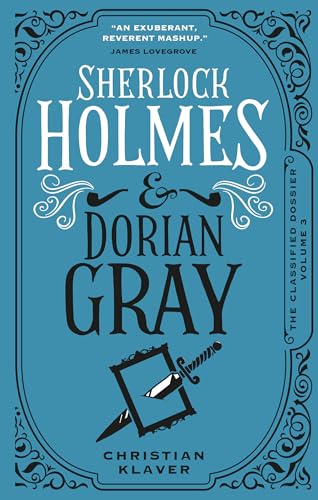
Mysterious socialite Dorian Gray is at the centre of Sherlock Holmes' latest investigation in this astonishing, uncanny mash-up of Victorian mystery and horror
1903
Sherlock Holmes and Dr John Watson have tickets to the newly arrived Egyptian Circus. Holmes is puzzled by his brother Mycroft's cryptic gift but is intrigued enough to attend the next production.
The performers, dressed as wondrous half-animal, half-human gods from Egyptian mythology, display superhuman agility and stunts. But they speak no Arabic, sequester themselves in the stables after each show and take orders from a mysterious ring master who is yet to be seen. And then one of the performers is murdered.
Holmes's enquires lead him to Montebank Manor, the home of the beautiful and secretive socialite Dorian Gray. As Holmes digs deeper, he learns Gray is hiding much more than his involvement in a murder. It's a darkly fantastical tale of lies, experimentation, hypnosis and wicked ambition.
2.0 Stars As someone who loves both classic stories, I was surprised to find that this mashup didn't work well for me. Certainly I didn't expect the same heights of the original classics. However I have read multiple modern retellings that have worked well as fun or comforting reads.
Instead this one just fell flat. I felt like the author failed to capture the soul of these characters that make them so memorable among literary classics. I wanted to love this one but I did not.
Disclaimer I received a copy of this book from the publisher.
It’s time to indulge a little but as an English graduate I’ve always had a soft spot for Wilde’s The Picture of Dorian Grey (and despite mixed reviews the movie with Ben Barnes didn’t hurt either). I’ve also always enjoyed Sherlock Holmes and Doyle’s stories. So when I learnt there was a book that planned to combine those two literary characters (and Watson of course) I was close to doing a signature Snoopy Happy Dance…If you can’t tell I was extremely excited to read it and I am even more excited to say that this would get ten out of five stars if I could.
Firstly I loved the writing. It is the perfect mixture of horror, action and crime. I was also pleasantly surprised how well the characters are written in the sense that Klavier makes them true to the original but also expands on them. On top of this it isn’t just a retelling or an alternative universe as such. There are numerous twists and turns and references to other works of the time which made my little geek heart happy. Honestly there is so much going on in this novel but not enough to confusion you, or rather Klavier keeps hold of everything together so you always know what is happening.
I never like spoilers but it is safe to say that if you like horror, mystery and literary fiction of the fin de siècle period you are going to love this. I was hooked from the start til the last.
Thanks for NetGalley for a e-ARC in exchange for an honest review!
The Classified Dossier - Sherlock Holmes and Dorian Gray is the third book in the Classified Dossier series, a supernatural retelling of Sherlock Holmes with a mashup of other classic book characters. This time, Dorian Gray is at the centre of Holmes’ newest investigation of a murder at circus.
I didn’t realize this was part of a series when I started it, and while I’m sure it makes more sense when you read the other books first, there is enough background in this to make clear. There are some mild references to previous books, but not enough to ruin the whole story or make me not want to read them, even out of order. I don’t think it should be read as a standalone book, but you are able to if you’re mostly here for the Dorian Gray mashup.
I enjoyed the supernatural aspect of the book - we have some mysterious beastmen, vampires, mad scientists, magical paintings. Little bit of everything going on. I also appreciated that it wasn’t as predictable as it could have been from everything listed. Despite the Dorian Gray connection, it wasn’t a retelling of the original book, and we get further classic books included to make it a little unexpected until you see all the books it’s referencing. I ended up being much more interested in the second book it was a mashup with than Dorian Gray, and I really enjoyed how Klavier combined all the different books.
The writing is straightforward and easy to read, while still holding on to the original type of writing and language used in Sherlock Holmes. It was a good homage to that more flowery, classic writing, while being modernized and accessible for readers who don’t always love the classic genre. The most reminiscent of the original books it’s referencing is when we get a few chapters from Dracula’s point of view, and I struggled the most with the writing style in that, but I also enjoyed the point of view of Dracula the most - he was such an interesting mix of a dry character that was filled with so passion about everything that was occurring. The rest of the chapters are, of course, told from Watson’s point of view. It did feel like this book didn’t actually have very much Sherlock in it, which I thought was an interesting choice, but one that worked. It gave other characters a bit more of a chance to shine, while still solving things with Sherlock’s help.
This was a fun way to do a retelling that I would like to see more of. The character mashups made sense, and it made it more unique than a straight retelling. I would definitely recommend The Classified Dossier for mystery and classics fans who are looking for something different from what they’re used to.
Mycroft Holmes sends his brother and Dr. Watson tickets to the Egyptian Circus on show in London. However, the distinct movements of the "animal gods" causes Holmes and his vampiric assistant to conclude that the Circus doesn't simply feature men in fantastic masks. Indeed, the Circus doesn't appear to feature men at all. When their investigation leads to a debauched party at the home of socialite Dorian Gray, Holmes begins to deduce the true secrets of the Circus.
Another fun mash up of the works of Conan Doyle and his contemporaries, the mystery is engaging and in keeping with Klaver's earlier 'Holmes' novels.
More than a hundred years since the last Arthur Conan-Doyle story was published Sherlock Holmes remains as popular as ever. Cleverly retaining the voice of Sherlock's creator, Christian Klaver, enhances the great detective's adventures with many iconic characters from other great authors of the era: Oscar Wilde, Bram Stoker, Robert Louis Stevenson and H.G. Wells. A 'Boy's Own' plot enables the author to up the tempo for a contemporary readership. There are plenty of liberties taken with the characters 'borrowed' from other authors but I can't help thinking they would all appreciate their characters being kept in the forefront of quality fiction.
This is the 3rd in The Classified Dossier series featuring Sherlock Holmes and his trusty biographer Dr Watson. I'm new to this series and I must say I wish I'd read the previous 2 in the set as there are spoilers aplenty in the 3rd book. This mix of mystery/classic horror/fantasy works well, it's probably better is you are interested is Victorian horror/mystery novels so that you get the most our of reading this. An entertaining read which made me want to read more.
This book is just plain fun, no two ways about it!
Think of it as Arthur Conan Doyle's classic series meeting up with the worlds of H.G. Wells, Bram Stoker, and now Oscar Wilde in a mash-up that's both charming and inventive. Picture Holmes and Watson back at it again, chasing down leads when a mysterious circus rolls into town. And let me tell you, things are definitely not what they seem. The trail leads them right to the doorstep of the charismatic Dorian Gray, and from there, it's a wild ride.
Honestly, trying to give you a sneak peek without spoiling everything is tough because this story kept me guessing at every turn. The writing definitely channels the original Doyle vibe, but Klavier adds his own flair that shines through. From the get-go, this book was an absolute blast. Sure, you could call it fanfiction, but don't let that fool you—it's such a fun ride, especially with all the neat literary allusions Klavier has woven into his series.
I jumped into this one without reading the other books in the series, and while it's like missing out on some inside jokes, it didn't ruin the fun for me. Actually, it made me want to go back and check out the rest! So if you dig detective stories, Wells' stuff, or if you're just curious about what Dorian Gray's been up to lately, this book is a must-read. It might not stick to Wells or Wilde's playbook, but it spins a pretty awesome "what-if" tale that's hard to put down.
Thank you to the publishers and Netgalley for the eARC.
I was very excited for the release of this book as I had loved the first two in the Classified Dossier. Unfortunately, this one fell flat for me. While, like the first two, it showcased Klaver’s creativity and skill at interweaving multiple established characters into a new story, the entire storyline felt underdeveloped and shallow, as did the portrayal of many of the characters. Dorian Gray is, in my opinion, one of the most layered characters in literature, but this version of him felt like a stand-in - an almost infallible and benevolent imp, devoid of any of the conflict or complexity of the original. Even Holmes and Watson seemed surface-level in this story, whereas Klaver’s previous representations of them had been some of my favorites in modern interpretations.
Additionally, there didn’t seem to be much of a mystery to this one - rather, it was a series of events occurring. I hope Klaver continues this series, and would love to see a return to the style of the earlier stories.
Also, while this did not impact my review, I listened to the audiobook, and the narration was horrible. The narrator did not use distinctive voices for most of the characters as the previous ones had, but seemed to change and even swap them as convenient, making it very difficult to follow conversations. He also continued to use Watson’s voice when narrating the chapters penned by Dracula, which was very discombobulating. If more stories are written and audiobooks made, please bring back one of the narrators from the first two books, both of whom were wonderful.
As always the adventures, characters, and intrigue never fail to thrill and capture. I could read dozens of these novels set in the Classified Dossier series!
The author really infuses the Victorian era with his writing style, always encapsulating Watson's voice to a 'T', adding the right amount of classic vocabulary, gothic literature, and exciting mysteries. I love the author's representation of the characters, how they feel new but old at the same time and giving a new perspective to their stories. It is nothing short of brilliant and full-on excitement!
The universe the author has created is rich and full of so many more stories. It is layered with the supernatural, classic mysteries, and non-stop adventure. Absolute perfection.
The perfect series to curl up with on a dark night, cup of tea in hand. I really hope the author doesn't stop here, as the end alluded that there was more to come and I really hope so for my sanity because I NEED MORE!
Okay, I have a confession. when I requested this title I was a bit giddy about the idea of a book with Sherlock Holmes and Dorian Gray, and, well, being a bit giddy, I may have failed to check if this was part of a series, and, yeah, it’s volume 3. So, I decided to read it anyway, it seemed the decent thing to do after all and with that I picked it up and crashed straight into an already fairly well established series – what could possibly go wrong. As it happens this was an entertaining read indeed, I enjoyed the writing and I really liked the inclusion of so many well known characters of classic fiction. My one regret – that I messed up and didn’t start the series in the order that the author intended because I feel like I would have enjoyed this so much more if I’d only read the series from the start.
As the story begins we join Holmes and Watson as they pay a visit to the newly arrived Egyptian Circus. The performance is outstanding but something seems slightly wrong about the whole set up and when one of the performers turns up dead and Holmes and Watson are called in they quickly discover that their suspicions were correct.
I can’t really tell you too much about the plot because it would involve spoilers so, as I seem to do more and more with these reviews, I shall stick to my feelings.
Well, firstly, I always enjoy a story with Holmes and Watson, well providing it’s well done of course, and I think the author does a good job of capturing their dynamic – although with some rather obvious changes that you’ll soon discover if you pick up this series. I like the writing and we have Watson providing the narration through his journal entries and I enjoy this style of storytelling.
The pacing here is fast, it starts off contemplative as you would expect from a Holmes investigation but it pretty quickly gathers momentum and as the plot unfolds the pace is ramped up – to a very dramatic finale I might add.
In terms of characters, if you like your classics you’ll be blown off your feet with this. Dracula, Mina, Dorian Gray and Jekyll and Hyde – to name just a few. The author has totally gone for the horror vibe and in fact that dramatic conclusion I mentioned is absolutely crazily OTT.
Criticisms. Well, I’ve mentioned the pacing and the crazy finale which are very entertaining, but, in being so all out action I felt like Holmes really took a back seat to all the fantastical goings on surrounding him. In fact, on reflection, Holmes involvement is pretty subdued throughout. Again, though, returning to my earlier confession about crashing into the series quite possibly I’m missing out on earlier references.
Overall, I found this very easy to read. It certainly took me in directions I didn’t foresee. I’m not sure it fully satisfied my Holmes and Watson itch but it was very entertaining.
I received a copy through Netgalley, courtesy of the publisher, for which my thanks. The above is my own opinion.
***Thank you to Titan Books for providing a copy of the book via NetGalley. My review contains my honest thoughts about my reading experience.***
Sherlock Holmes & Dorian Gray was not really at all what I expected. I requested a review copy because I like the two title characters and was curious about how the two of them would work in a mashup together. It ended up being a mashup of all sorts of classic characters, though, which was cool but not really what I wanted. I also didn't realize that this was the third book in a series. While the story worked fine on its own, there were a lot of callback mentions to the first two books, and I think the character dynamics would have been more impactful if I'd read the other books first.
While not exactly what I was wanting or expecting, the plot and writing of Sherlock Holmes & Dorian Gray were actually pretty great. The story was very action-oriented, and things moved along at a pretty quick pace. The writing felt like it belonged to the time period of the characters, which was important since the story was written like a memoir, but it also came across as modern enough to appeal to contemporary audiences and was easy to read. My one qualm with the writing was the detailed and somewhat repetitive descriptions of some of the characters. I eventually just started to skim over them.
The focus on plot in Sherlock Holmes & Dorian Gray left very little room for character development. All of the characters were entertaining, but none of them had a ton of depth. I liked that the author attempted to use Dorian's storyline to explore identity and the struggle between man's animal instincts and morality. I just wish more time had been devoted to exploring those themes and making me feel something for the characters.
My main issue with Sherlock Holmes & Dorian Gray, though, was that it largely sidelined Sherlock Holmes and Dorian Gray. The horror elements took center stage over the mystery, and there wasn't nearly enough of Holmes just doing his thing and solving mysteries. Dorian Gray felt like an afterthought. This book twisted his story into something almost unrecognizable by the end. I enjoyed the first few chapters with him, and then things went off the rails. lol. The way his story intersected with the villain's was quite interesting and imaginative, though. He just no longer felt like Gray to me.
Overall, Sherlock Holmes & Dorian Gray was an entertaining mix of various classic characters and elements of mystery and horror. I had fun while reading it. It just feels like a bit of a crime to name the book after Holmes and Gray because it caused my expectations for this book to be way off. I also highly recommend reading the other books first and wish I had read them in order. Maybe one day I'll go back and catch up with the other two. All things considered, I give Sherlock Holmes & Dorian Gray a rating of 3.25 out of 5 stars.
See more of my reviews and other bookish content on my blog.
The appeal of Christian Klaver’s revisited “Sherlock Holmes” series is the author’s ability to pair the famous detective with other renowned literary characters—and in a manner that seems totally plausible within Sir Arthur Conan Doyle’s original work. Book One introduced the reader to the legendary Count Dracula, Book Two has Sherlock and Watson teaming up with Dr. Jekyll, and now, Book Three in the series involves Sherlock with the mysterious and enigmatic Dorian Gray, a character first made famous by Oscar Wilde.
I am rather partial to Dorian Gray. Wilde’s original story shows the reader how the pursuit of self-indulgence and hedonism is ultimately unsatisfying, and Wilde displays this in brilliant color and prose.
This book eschews Wilde’s Dorian Gray for a character that is Dorian in name and mannerisms, but the lesson against living for pleasure has been waylaid. Instead, the author focuses on a different famous character from classic literature as the main antagonist of the plot, and the theme of this novel is less about cautioning the reader against living for self but instead asks us to question ourselves, “What does it mean to be human?”
Klaver uses Gray and other secondary characters as a catalyst for demonstrating to the reader that to be human means to “live,” but HOW and mainly WHY we live is of the greatest import; simply living to exist is not enough. Klaver’s lesson is that a purposeful life is one lived for the benefit and betterment of others and not simply for one’s self: a maxim that the original Dorian Gray ultimately should have learned.
This third book in Klaver’s “Classified Dossier Series” feels a little more lackluster in comparison to the previous installments. Klaver seemingly wants to connect Holmes to as many famous characters as he can, all within the confines of one story, and I fear the storytelling took a backseat in this novel. Or, perhaps it is more fair to say that I was not as interested in the direction the novel went.
Also, while it is very entertaining having Holmes and Watson battling vampires, werewolves, and other creatures of the night, I do wonder if this new trope will become tiresome and Klaver will run out of creative source material. For example: I am not sure if the reader will believe that Holmes and Captain Nemo would be solving a crime together. …Actually, scratch that last statement; that sounds amazing. I would totally read that.
This is the latest in Christian Klaver's alternative Sherlock Holmes series, with its strong infusion of horror, set in Victorian London in 1903, and Holmes is annoyed by Mycroft sending him tickets to the Circus of Amun-Ra but with no explanation as to why. He and Watson go, only to be astonished at the wonder of the half animal, half human gods of Egyptian mythology. Surveillance of the extraordinary and colourful ring master, Dorian Gray, proves to tax even Holmes, and matters become even odder with the murder of Khnum, and the discovery of a hidden compound. To protect the performers, the support of Lestrade is required, as Holmes and Watson investigate, a case so complex, dangerous, and terrifying that they need the help of old friends, Count Dracula, Mina, Mr Hyde, Miss Winter and more. And who exactly is Dorian Gray?
This is a narrative that ventures into the darkest and most unethical of territory, including vivisection, troubling experimentation, identity, torture, hypnotism, whilst being thought provoking and probing the deep philosophical ground of what being a human being is and what might separate us from the animal kingdom, what might comprise civilisation as opposed to bestiality, are we really more intelligent, more superior to animals, and can we really do whatever we like to animals? Do the achievements and advancements made by humans justify the experimentation? The story does not escape the input of Holmes old enemy, Moriarty, either as the detective faces the most formidable of foes, where his. and anyone who helps him. survival cannot be taken for granted, as can be seen as dreadful despair has to be endured and terrible losses are incurred.
This is a difficult and, simultaneously a brilliant read, with all the rising tension and suspense as the darkest secrets in London are uncovered, and the inevitable run up to a ferocious battle of all battles, and we come to understand why Mycroft had done the unthinkable and left the country. The storytelling is gripping and touches on a number of critically important themes and goes on to highlight that 'To live is the rarest thing in the world. Most people exist, that is all'. I think this will appeal to many readers, particularly those who love Victorian detective fiction mingled with elements of horror. Many thanks to the publisher for an ARC.
If you're here for Dorian Gray... I'd consider turning around.
Let me preface this by saying that I spent a portion of my degree study on Oscar Wilde. When this novel started out, Dorian's tale was linked in nicely, the web was woven and I was hooked. Then, a rather random Wilde quote was injected into the text. Not long after, another appeared, and I believe there was a third - perhaps a forth.
It reminded me of the time Wilde said that in another lifetime, he would have been Dorian Gray - this novel certainly goes some small way to achieving that.
But, it didn't make contextual sense. By chapter six I was playing Wilde quote bingo, and winning.
What's more, all things Dorian were lost along the way - if Dr [spoiler] had been revealed as Henry Wooten, you would have my five stars in a heartbeat. If Montgomery were to Basil as Dorian was to Frankenstein, I'd have loved it. But, instead Basil fell by the wayside. The portrait fell by the wayside, and sadly, the character of Dorian Gray fell by the wayside too.
I was unfamiliar with this series when I started out, but I accepted all weird and wonderful things thrown my way - Hyde's presence intrigued me, Vlad's did too, and I am interested inn retracing this novel's origins and reading its predecessors. It is written well, So, very beautifully. I thoroughly enjoyed this writer's style, and the blend of classic characters. It is exactly the kind of writing style that I love - Klaver has a tremendous grasp of language, and words...
But I was here for Dorian, and I didn't truly get him.
(Thank you to NetGalley and the publisher for the ARC)
'To live is the rarest thing in the world. Most people exist, that is all'
I requested this book as I will read anything associated with Dorian Gray although I would not classify this as a Dorian Gray retelling as there is only a brief nod to the original story.
This was a very unique concept; a mash up of Sherlock, Dorian Gray and Dracula. I didn't realise this was part of a series when I requested and started it; however, this did not take anything away from the experience. The author gives enough background from previous books so that it does not affect the plot of this particular storyline. I must say, I am now interested in reading the previous books.
The story is told mostly from Watson’s POV in the form of journal entries and it is really easy to read. The pacing starts off a bit slow but as the mystery is unravelled it moves at a quicker pace. There is a lot of sleuthing although Sherlock himself takes a more secondary role. It is heavily plot driven and I enjoyed the inclusion of supernatural elements as I believe this raised the stakes significantly.
It ended up being a very full cast of characters, who I won’t mention for avoidance of spoilers, who were very entertaining and made for a weird and wonderful story. However, as the story was heavily plot driven, I do not believe that the characters were fleshed out enough of me to become invested in them.
The crux of the story is thought provoking and makes you question what it means to be human. This will be great for mystery, classics and Sherlock fans. I give it a rating of 3.5 out of 5 stars.
Thanks to Netgalley and Titan Books for providing me with an e-arc.
'To live is the rarest thing in the world. Most people exist, that is all'
I requested this book as I will read anything associated with Dorian Gray although I would not classify this as a Dorian Gray retelling as there is only a brief nod to the original story.
This was a very unique concept; a mash up of Sherlock, Dorian Gray and Dracula. I didn't realise this was part of a series when I requested and started it; however, this did not take anything away from the experience. The author gives enough background from previous books so that it does not affect the plot of this particular storyline. I must say, I am now interested in reading the previous books.
The story is told mostly from Watson’s POV in the form of journal entries and it is really easy to read. The pacing starts off a bit slow but as the mystery is unravelled it moves at a quicker pace. There is a lot of sleuthing although Sherlock himself takes a more secondary role. It is heavily plot driven and I enjoyed the inclusion of supernatural elements as I believe this raised the stakes significantly.
It ended up being a very full cast of characters, who I won’t mention for avoidance of spoilers, who were very entertaining and made for a weird and wonderful story. However, as the story was heavily plot driven, I do not believe that the characters were fleshed out enough of me to become invested in them.
The crux of the story is thought provoking and makes you question what it means to be human. This will be great for mystery, classics and Sherlock fans. I give it a rating of 3.5 out of 5 stars.
Thanks to Netgalley and Titan Books for providing me with an e-arc.
Simply described, this is yet another Sherlock Holmes pastiche and not one of the better ones, although not the worst either. As a historical fiction book written today, it is much as many of it's kind, with modern values, views and mores that were by no means those of the time of the book's ostensible setting, which would appear to be late 19th Century. In fact, in calling this book historical fiction is a misnomer, as it fits more within either the supernatural fiction genre with it's vampires, or the fantasy genre with it's monsters. The historical aspect is rather 'by-the-way'.
The author has had a good attempt at characterisation but his Holmes and Watson are very far off the originals. The characterisation just doesn’t quite hit the mark This Holmes seems to conduct most of this investigations by sending out telegrams and then simply assessing the results. He doesn’t seem to actually go out to do anything. The Dorian Grace backstory is sketchy in the extreme and extremely fanciful Even though this is a work of fiction - and fantasy fiction at that - it requires way too much suspension of disbelief disbelief. Indeed, the entire situation and plot of this book is so outlandish that it is difficult to take it seriously.
Finally, the author's explanation of terraced houses in London was rather quaint, and clearly written by someone who has seen one, let alone been inside one!
The Classified Dossier - Sherlock Holmes and Dorian Gray, is an action packed novel filled with mystery, surprises and of course - the intricate mind of Sherlock Holmes.
Sherlock and Holmes are set to investigate another mystery, the Circus of Amun-Ra - filled with Egyptian figures such as Anubis, Osiris and Horus. The circus is fantastical, filled with wonder and unbelievable acts - but there's more than meets the eye.
As they investigate the mysterious Ring Leader, Dorian Grey seems to be at the centre of the circus scene. As murders at the circus occur, Holmes and Watson call in help from friends - Dracula, Mina, Hyde and Winters - to capture the culprit.
𝗧𝗵𝗼𝘂𝗴𝗵𝘁𝘀 I've not read many Sherlock Holmes re-tellings, but I really enjoyed this one. I've always loved the fantastical stories of Holmes and this captured the imagination.
The action, the intricate mind of Holmes and the inner workings of Watson leads you on a wild adventure to save the Circus of Amun-Ra's people.
I also loved the chapters that were told from Dracula's re-telling of the events that took place, as Watson couldn't be everywhere at once to tell his side.
Overall, this Victorian mystery/horror really captivated the mind, and took you on a dark mystery/adventure across London and Hyde Park.
Thank you to NetGalley and Titan Books for this copy. This review is voluntary.
The Classified Dossier - Sherlock Holmes and Dorian Gray is not from the oeuvre of Sir Arthur Conan Doyle. No, in this world Dr. Watson is a vampire and the Island of Doctor Moreau is a real location. Despite these, and more, changes, it still feels somehow like it belongs in the canon.
Dumping Sherlock in another paradigm is a frequent trick of authors. This book merges classic Victorian villains within a very Sherlockian plot. A new circus is in town and the actors seem unusually athletic. Mycroft has asked Sherlock to investigate so he and Dr. Watson attend. When a circus performer is found dead, Sherlock investigates the murder and the characters of the other performers as well. From there, things just get curiouser and curiouser.
I truly loved The Classified Dossier - Sherlock Holmes and Dorian Gray. It is very inventive and just pure fun. I highly recommend it to Sherlock fans that don’t take themselves too seriously. 5 stars!
This is the third book in this series and there are some serious spoilers for the others. So, while this is a standalone read, you might want to read them in order instead.
Thanks to Titan Books and NetGalley for a digital review copy of the book.
Technically, the rating I'm giving this is a 3.5. I do love that, once again, we get to see the characters from the previous books - Dracula, Mina, and Hyde. The story of Dorian Gray is interesting because of his origin. Though I knew some of the characters, like Basil, wouldn't appear in this book, . I was a bit sad that it wasn't like the classic, where he truly is a man with a painting depicting his corrupt and old soul. I guess already having immortal characters like Dracula, Watson, and Mina meant that Dorian being forever young wouldn't be as surprising. I also feel like there could have been more Holmes in this story. Usually, I was worried about the other characters, but this was the first time I wished Holmes had more of a presence. I'm not sure how to describe it. Overall, I think the second book, Sherlock Holmes and Hyde, is my favourite out of the trilogy.
Patently insane. So damn much fun though. Holmes and Watson are drawn into the strange world of a circus newly arrived in London, that Mycroft is so concerned about that he not only asks his brother to investigate but he takes the extreme action of leaving the Diogenes' Club. - gasp -
Holmes and ( vampire ) Watson investigate only to find a mystery stranger than any they have ever encounter.
The performers are strange people capable inhuman feats and wearing the most out landish animal costumes. Shortly the ringmaster who is no less amazing than the performers is discovered to be Dorian Gray. Newly acquired of a home in London and hosting the most off the chain Bacchanal debauches. Which leads Holes and ( vampire ) Watson to their old friends Edgar Hyde and his vampire girlfriend.
It becomes a tad unhinged when the entire thing is revealed to be a plot from the new series Big Bad Dr. Moreau.
The Classified Dossier series has quickly become one of my favourite Sherlock Holmes series to date. Christian Klaver does a fantastic job at not just introducing the world of the supernatural to the Sherlock Holmes universe, but draws upon inspiration and characters from other classic novels to do so; creating a fantastic and ever increasingly large shared universe.
This volume begins with Sherlock Holmes receiving a mysterious letter containing tickets to the circus. However, it doesn't take Holmes long to figure out that his brother, Mycroft, had someone send the tickets to him and wishes for him to investigate the circus. Unfortunately, with Mycroft mysteriously out of the country, he has no way of finding out what it is his brother wants him to see. As such, Holmes and Watson head off to the new Egyptian Circus in Hyde Park and watch a truly spectacular show. But some things don't quite add up, especially as Watson is able to smell animals around the circus, yet none were used in the show itself.
Further investigation leads to a startling discovery about the true nature of performers, one that shows the two of them that they're dealing with things outside of the realm of the natural. Their investigation leads them across London, to the home of the unusual socialite Dorian Gray, who has been acting as the ringleader for the unusual circus. The further the two of them dig the more unusual evidence they begin to collect, and they soon realise that they may have discovered something truly dangerous.
As the title of this particular volume of the series gives away, the character of Dorian Gray is introduced into Klaver's world. However, if you read the title and think that you know what kind of story you're going to be reading you're going to be very much mistaken. Just as with the previous volume, Sherlock Holmes and MR Hyde, this is not simply a re-telling of the original story with Holmes and Watson injected into events. There are times that this book bares almost no resemblance to The Picture of Dorian Gray, especially as Klaver sneakily includes another novel from around this era too that derails the Dorian Gray expectations in the most wonderful way.
Klaver draws from multiple other works for his plot here, and it adds some superb twists and turns into things. There's a reveal early on in the book that may give it away to some readers, but it wasn't until a particularly distinct line of dialogue was spoken that the connection was made in my head and I realised what other works were being folded in. It was an incredibly fun moment, and one that increased my excitement and enjoyment of the book. And the fact that that too was twisted and changed in new ways, brought into the extended narrative that Klaver had been working on for two other volumes, led to some wonderful pay offs further down the line.
As with previous volumes the writing here is great, things are very faced pace, with Klaver packing a lot of story and action into the books pages that ends up feeling like you've had a lot of bang for your buck. Luckily, the focus on action and story doesn't mean that the characters don't get focus as a trade-off. Holmes, Watson, some new friends, and some returning ones, all get a chance to shine and to do something important that helps to drive the narrative forward and highlights why the ever expanding cast of characters being added to Holmes' little group of paranormal investigators and fighters just adds further richness to things.
Whenever I come to the end of one of the books in this series I find myself hoping for more, and trying to guess what other stories and characters might be drawn into the next entry. And this time is no different. I was disappointed that it was over, and was thinking eagerly to the next. Hopefully this volume won't be the last, as I really want to see what Klaver does next.
The third novel in Klaver's bonkers series of Victorian novel mash-ups completely retcons Dorian Gray's origin, replacing the Faustian bargain of Wilde's original with a (somewhat) more scientific explanation.
With a cryptic note from Mycroft, Holmes and Watson are off to investigate a strange circus filled with beast creatures and ring-mastered by Gray. Holmes' investigation crashes into another classic thriller of the period (which would be telling). Then, as in the earlier installments, detective work gives way to tactics as Holmes marshals forces for arcane battle. It's silly fun that generally honors the spirits of the source materials while discarding as "fiction" any niggling details that don't fit Klaver's reconstruction.
*Rounded down from 3.5 stars A fun, comedic and interesting mystery. Intertwining the stories of Holmes, Gray, and a surprise antagonist, lead to an interesting read. I did find that it was less about Dorian gray, as the book suggests, and heavier on other characters that I can't name with out spoilers. Gray could have been someone entirely different, with a different back story, and I don’t think it would’ve changed much of the story, if anything. The book as a whole was an interesting mystery all the way through, and I did enjoy many of the characters. The relationships between said characters was particularly beautiful and I found that to be my favourite part of the book.
Two things would have given me pause upon starting this book if I had known them. 1: That it's third in a series. 2: That it is saturated with my least favorite 19th century literary figure, Dr. Moreau.
The obvious point of comparison for this book is The League of Extraordinary Gentlemen, and whether you like that graphic novel or the campy film better, both options are preferable to this heavy-handed, frankly gross crossover that does disservice to my boy Dorian and not much better by any of its other characters. The audio narrator sounds like a bored high school student trying to rush through a reading to get to lunch faster. And all of this makes me sad, because a Victorian crossover with all my horror favorites could have been brilliant.
Another very entertaining story combining iconic literary characters from the 19th century. This time, Sherlock Holmes joins forces with Oscar Wilde’s character, Dorian Gray, to fight a monstrous evil in the form of the H.G. Wells’ character, Dr. Moreau. It’s difficult to say much about the twists and turns of the plot without giving everything away because any kind of plot summary would probably be a spoiler of some sort. Suffice to say, I enjoyed the book thoroughly. I look forward to reading the next book in this Christian Klaver series.
Sherlock Holmes was a significant part of my childhood, after devouring the entire collection, I always looked out for retellings, puzzle books and what not- anything to make me experience the thrill of deduction, so when I came across the book, I was delighted. Let me premise this read was one of the best retellings of Holmes (from Watson’s perspective). Needless to say I’m going to read all the other books by the author! Special thanks to Net galley for sending across a copy.