Margaret, the first Tudor princess and queen consort and queen regent of Scotland, is the forgotten Tudor. Yet the elder sister of Henry VIII led a life of great drama, composed in equal parts of privilege and pain, highlighted by personal danger, hardship and loss. Overlooked or dismissed by historians as 'Henry VIII in a dress' (not, in itself, necessarily an insult), Margaret has been ill-served by superficial biographies or heavy-handed academic attempts to paint her as an early feminist prototype.
Yet recent research has revealed a quite different woman from the popular image of an oversexed whinger, whose main interests were her wardrobe and attractive young men. The child-woman who, at the age of thirteen, married James IV of Scotland, one of the most charismatic of all British kings, became a successful queen consort, presiding over a colourful and cultured court at some of Scotland's most beautiful palaces. James' death at the disastrous battle of Flodden in 1513 transformed Margaret's world, forcing her to make stark choices for which she has been roundly condemned. But her two spells as regent for her young son, James V, and her determination to manage the fractious relationship between England and Scotland, reveal a true dynast with considerable diplomatic skills, as well as a loving mother committed to the welfare of her son amidst the swirling currents of Scottish politics and family feuds.
The Thistle and the Rose reveals a woman who was a gifted politician and diplomatist. It will tell a story of sibling rivalry between Margaret and her brother, Henry VIII, going back to their childhoods, underlined by Henry's ambivalent attitude to his sister's welfare and his refusal to acknowledge her son, the nearest male to him in blood until 1537, as his heir. It will also explore Margaret's disastrous second marriage to Archibald Douglas, earl of Angus, and her third, little-known marriage to Henry Stewart. Her desperate flight to England while heavily pregnant in 1515 and her year-long reunion with her brother and sister, Mary, will also receive the attention they deserve, as will her relationships with her wayward daughter, Margaret Douglas, and her son's two French wives. Margaret's tragedy is that of a mother whose affection was not returned by her children and who has been belittled by history. Her triumph, on the other hand, is that of a true Tudor who had made a significant contribution to the culture and politics of her time.
Linda Porter was born in Exeter, Devon in 1947. Her family have long-standing connections to the West Country, but moved to the London area when she was a small child. She was educated at Walthamstow Hall School in Sevenoaks and at the University of York, from which she has a doctorate in History. On completing her postgraduate work she moved to New York, where she lived for almost a decade, lecturing at Fordham University and the City University of New York.
Since returning to England, Porter has had a varied career. She has worked as a journalist and been a senior adviser on international public relations to a major telecommunications company. But she has always stayed close to her roots as an historian. In 2004 she was the winner of the Biographers Club/Daily Mail prize which launched her on a new career as an author. Her first book, Mary Tudor: The First Queen was published in 2007. In 2010 her second book Katherine the Queen: The Remarkable Life of Katherine Parr was published. As of 2010[update] she is doing preliminary research for a third book.
Porter is married with one daughter. She lives in Kent.
Margaret Tudor has, unfortunately, been tainted with a poor reputation in both (Tudor) English and Scottish history books – that is, if she is discussed at all. Her relationship with her younger brother King Henry VIII of England was loveless, strained and marked with competitive bitterness; which has overshadowed her role as Queen Consort to King James IV of Scotland and the mother of King James V. Margaret has been falsely cast aside as a superficial women with one too many husbands (three as opposed to Henry’s six wives); when in reality her life was admirable and she donned a warrior personality. With few definitive biographies existing showcasing this formidable queen; historian Linda Porter highlights Margaret once and for all in, “The Thistle and the Rose” The Extraordinary Life of Margaret Tudor”.
“The Thistle and the Rose” leads off on a tentative foot as it circumvents Margaret Tudor and rather focuses on the political and social landscapes of her parents (King Henry VII and Elizabeth of York), her upbringing and the relationship between England and Scotland. At this stage, it almost seems that Porter misses her target to rehabilitate Margaret Tudor and she can be thrown into the bag of historians whom either ignore or badmouth this future queen. In usual Porter fashion, the text is even sprinkled with speculative statements and then drifts onto the sea of tangents almost losing the lighthouse that is the thesis of “The Thistle and the Rose”. Readers may begin to become weary but fear not, as this tip-toeing into the subject matter may be a premeditated strategy and Porter has not yet deserted readers.
The foundation may be shaky but the wait is worth it as “The Thistle and the Rose” jumps into an advanced text that is bursting with research from primary sources and quotes revealing more about Margaret than ever before (even to Tudor history aficionados). So much so, that readers will wonder why Margaret hasn’t been the subject of numerous works both fiction and non-fiction; being she was a multi-faceted woman that truly left a strong legacy. To say that Margaret has been deprived of proper attention is putting it lightly. Porter debunks and/or analyzes myths and confusions that truly invigorates the reader and brings a fresh perspective to a chunk of history that has been unraveled so many times over that it is astonishing that there is still an under discussed angle and figure lurking in the shadows.
Porter occasionally descends into an overly casual tone/literary language that starkly contrasts with the academic/scholarly voice that is mostly predominant. Readers will find some snarky notes regarding other historians – opinions which I don’t personally disagree with - but “The Thistle and the Rose” is still not the proper forum for such matters. Porter also occasionally uses “The Thistle and the Rose” as a memoir. For example, page 97 asserts, “I always marvel at [painting] every time I visit the National Gallery of Scotland”. Such an admission is better left for an ‘Author’s Note’ versus the main text of the work.
Another grain of salt occurs on page 165 when mentioning the statistics of the number of deaths and the noble titles of thus grieved which contrast with the numbers in other history texts/on the internet. This causes some reader confusion and unknowing whether Porter or another source is the correct faction.
One of the firecracker bursts of “The Thistle and the Rose” that truly sparkles with strength is the very-detailed battlefield military breakdown and psycho-analysis of the Battle of Flodden (where King James IV loses his life) especially being depicted from the Scottish vantage point versus the ad nauseam side of the English. This is most certainly a gripping history re-telling and follows the perfect recipe of entertainment to education making “The Thistle and the Rose” a compelling piece.
If this isn’t enough, “The Thistle and the Rose” continues to ascend into even more brightness as Porter truly finds her footing with her continued interest in debating misconceptions about Margaret as a woman and her actions; giving new insight into how misunderstood and wrongly stereotyped this astonishing woman has been for centuries. Porter unveils information that has been virtually unheard of and is mind-blowing with its enticement. Margaret finally receives the respect and attention that she has long deserved.
Porter weaves an illustrative tapestry of Margaret’s impact on her son and the inter-relations between England and Scotland which reinforces her role therein. “The Thistle and the Rose” is a genuine exploratory text which serves as both a micro and macro look at Margaret.
“The Thistle and the Rose” concludes with Margaret’s death which is slightly less eulogized than one would expect but is then redeemed by an after discussion of the effect her life left on the other key people in her surrounding sphere (and on the monarchy).
Porter supplements “The Thistle and the Rose” with a section of photo plates, notes (unfortunately, hardly annotated) and a source list/bibliography.
“The Thistle and the Rose” is a vivid undertaking that delivers Margaret from the shrouds that have long buried her illuminating not only her character and legacy; but the history of the period of Scotland and England, respectively. Quite often, biographies and portraits of historical figures lacking in existing coverage continue to create poor coverage but that is not the case with “The Thistle and the Rose” as Porter excels at pushing Margaret into the spotlight and creating reader interest in further research. Despite some flaws, “The Thistle and the Rose” may be Linda Porter’s best work yet and is suggested for all British history readers and Tudor fans.
**Note**: I would give “The Thistle and the Rose” 4½ stars but in lieu of halves; have rounded up generously to 5 stars.
This was incredibly thorough as well as interesting. This was written in a contemporary style, as in this didn't have the endless lists that seem to dominate historical texts of this period. At the same time, this balanced a more conversational tone with impeccable research and an overall deep understanding of the time and people covered.
This was accurate to the best of my knowledge and studies. The author points out that much of the modern view of Margaret is a result of sexism on the part of the men who recorded her life and has been upheld by increasingly modern historians. Scotland isn't like England and this author really helps a casual reader of history to understand how and why this is so.
I listened to this on audio and hope more of this author's work manages to make it to audiobook.
While it’s clear that Linda Porter put a lot of effort into researching Margaret Tudor’s life, the book didn’t fully hold my interest. Margaret’s story is full of political drama, failed marriages, and royal ambition which has all the ingredients for a compelling biography, but the writing often felt more dutiful than engaging. Some parts were bogged down in detail, especially the political back-and-forth between Scotland and England, and I found it hard to stay invested. Margaret comes across as complex and determined, but not especially relatable or sympathetic, and the book didn’t do much to change that. It’s not a bad read, especially for Tudor history fans, but I wouldn’t call it a standout. More informative than enjoyable.
Well, just in case anybody was still in doubt, Henry VIII was a raging pr*ck.
I enjoyed this book as much for the exploration of how history has been researched and presented as for the subject matter. Linda Porter used her study of Margaret Tudor to explore the sheer *laziness* of how women have been researched and presented in history. As history has told it, Margaret was a LUST-ADDLED NIGHTMARE who wedded for the D. As Linda Porter's research found, Margaret was an astute, politically-minded woman who recognised the precariousness of her position as Regent with an infant son (after her LUST-ADDLED NIGHTMARE of a husband, James IV, got himself killed randomly invading England) on the throne so married to strengthen her ties to Scotland. In Porter's writing, we saw how Margaret was a woman who was constantly having to navigate the inherent misogyny of the era - which saw her forcibly separated from her sons, lest she actually influence them - and, actually, doing a pretty good job of it. From her parents, she'd received a thorough education and was treated as a true partner by James IV (putting aside his extra-marital shagging) which gave her the skills and perspective to understand politics, navigating the unstable Scottish terrain and her frequent poverty to maintain a voice and influence.
I'm having all sorts of realisations about myself lately. After years of delayes I finally watched The Spanish Princess and I enjoyed myself so so so much more than I expected. I always loathed Henry VIII, so I couldn't figure out why I find this time period so attractive and interesting. Well it's because Henry VIII is completely unhinged and he creates this marvelous out of the box upheaval that is great for political intrigue storylines. I love political intrigue. It's starting to make so much more sense!
This book is tied into that, because it helped me tremendously in this realisation and I also kind of read it because I was hangover after finishing The Spanish Princess and I wanted to know how much of that was based on fact without actually reading something that would focus on Henry VIII.
This book was perfect for that, because it starts with Henry VII and Queen Elizabeth's love story/marriage and the next chapter goes to arrival of Catherine of Aragon. So this book does actually cover the whole length of that show and more. All of this is relavant because Linda Porter actually does deliver a quite severe burn of that show even if she doesn't say it outright!
This book is interesting because it does offer a different angle to look at some of the events you might know from a different perspective altogether. It's not my intention however to sideline Margaret Tudor who is quite an interesting person herself and I enjoyed following her quite eventful life.
The scholarship in this is solid and I enjoyed Porter's narrative voice a lot. The only thing that bothered me a little bit is the way she shines spotlight on the Victorian female historians who slammed Margaret Tudor quite viciously. I do understand that it influenced the way she was viewed for many years and I agree that this is a point that would be interesting to explore but I would have like it better if it was done with some nuance because the reasons for their stance is quite understandable from a certain perspective and her harshness towards them felt a bit unfair in places.
This was really quite excellent book of a perfect length and depth I believe, my interest in Margaret Tudor was quite satisfied and the needed context was presented really well as well. I do loath Henry VIII more than ever now, but I am also curious to read more stories set on his court - preferably not focusing on him. He was a terrible person, but he fascinates me for the upheaval he created. 4,5⭐
P.S. If you are curious about the other revelation I had from watching and liking The Spanish Princess, it's that I quite enjoy toxic romance. I need to find a way to enjoy more of that.
A welcome break from my normal Fantasy books. I enjoyed this book, having hardly any knowledge of Margaret Tudor directly. I always find the falling out of the Scottish Lords in the 16th century boring, during the reign of not only James V but Mary Queen of Scotts. But I loved reading about Margaret's strength and difficulties in a time period which was very patriarchal
This has been a very instructive read, since I knew very little of this Scottish queen.
Margaret Tudor (1489-1541) was a sad and difficult life, torn by her allegiance to the England of her origins and to the Scotland that received her. The men in her life were mostly terrible to her. Only her father, Henry VII and her first husband, James IV, treated her as one would expect. Her second and third husbands, Archibald Doublas, 6th Earl of Angus and Henry Stewart, 1st Lord of Methven, her pitiless brother Henry VIII (1491-1547), and her own son, James V (1512 – 1542), for a certain period, were cruel, scheming and used her as a peg in their respective political machinations.
It seems history has not treated her very well either. Both her more private decisions as well as her rulings in public political matters have inspired all kinds of negative judgments. Linda Porter sets out to amend this with this biography and overall, she succeeds, even just because she is singling Margaret out of her abstruse reputation stitched along history and focuses our attention onto this multifaceted woman.
Linda Porter bases her account on the fact that many of Margaret’s letters have survived and, as she clarifies, these have been studied in a PhD Thesis by Helen Newsome who has studied them with a forensic discipline. And though it cannot be denied that Margaret made several mistakes and errors of judgment, such as her two later marriages (both in the choice of husband and in the manner in which she carried out these weddings) as well as in passing on State secrets to the Englishman Thomas Howard, which in effect was an act of Treason, we do feel for her because she had no support in a man’s world and she was torn between two countries that were periodically at war with each other.
Porter is particularly critical of her brother, Henry VIII. She portrays him as not just an unstable man, with little interest beyond his Southeast England and his women and his paranoias but also as a callous brother with little love for his kin. And with this complex and difficult framework, Porter’s Margaret comes across, certainly impulsive and emotional, but also as a courageous and determined woman.
A strength of this biography is the attention that Porter devotes to recreate a Renaissance court, with their pageants, their costumes, their ceremonies, their jewellery, their castles and palaces and their hunts. A considerable section is devoted to following Margaret’s move up north, to meet her husband in her new country, after her marriage by proxy, introducing all the nobles who accompanied her in this royal procession. As Porter says, no accounts have survived of Henry VIII’s weddings to any of his wives.
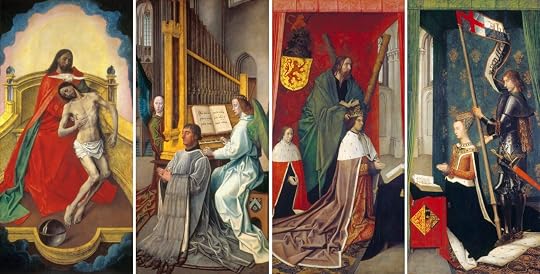
An interesting aspect for me was the art works mentioned, of which two stand out. One is the Trinity Altarpiece depicted most probably by Hugo van der Goes during the 1470s, that shows James III and his wife Margaret of Denmark, with a young future James IV.
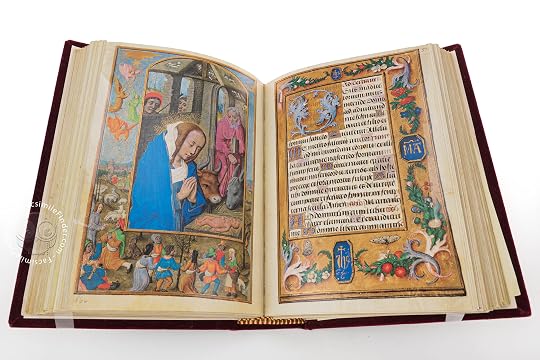
And the other is the Book of Hours that James IV gifted her queen in their 1503 wedding. This manuscript is currently in the Imperial Library in Vienna.
A couple of the facts that surprised me most have been to realize that Margaret was the grandmother not only of Mary Queen of Scots, but also of her second husband Lord Darnley. And last, that the Emperor Charles V had awarded James IV with the Order of the Golden Fleece.
The Tudors have been an area of fascination for historians and history nerds alike for centuries. The attention tends to focus on either Henry VIII and his six wives or his daughter, Elizabeth I, but we need to remember that they were not the only Tudors. In fact, we should remember that Henry VIII had siblings, Arthur, Margaret, and Mary. While Arthur and Mary tend to get more attention due to their proximity to Henry VIII and his marital life, Margaret Tudor had her own eventful life as Queen of Scotland and the mother of King James V. Linda Porter tells Margaret’s story in her latest biography, “The Thistle and the Rose: The Extraordinary Life of Margaret Tudor.”
I had heard that Porter was writing a new biography about Margaret Tudor, so I knew I wanted to read it. I have read a few books about Margaret Tudor, but they have been relatively short, so I wanted to see what new information Porter would include in this book.
Margaret Beaufort was the second child of King Henry VII and Queen Elizabeth of York. As such, she was destined to marry a foreign prince and create a strong alliance for the brand-new Tudor dynasty. Since her brother Arthur was betrothed to Catherine of Aragon, Margaret’s parents chose a match with Scotland and King James IV, who was twice the age of Margaret. As Queen of Scotland, Margaret did her best to bridge the gap between England and Scotland, deal with her husband’s mistresses and illegitimate children, and be a mother to her son, King James V.
Everything changed when James IV died at the Battle of Flodden. Margaret was now a widow and regent for the young King James V. To protect her family, Margaret decided to marry Archibald Douglas, 6th Earl of Angus, which turned out to be a trainwreck. Although Archibald did give Margaret her daughter, Margaret Douglas, he was stealing from Margaret’s own properties, which was a jerk move. Margaret wanted a divorce, but her dear brother Henry VIII was against the idea. A bit hypocritical, especially since he would divorce Catherine of Aragon a few years later. Eventually, Margaret would divorce Archibald and marry a third time to Henry Stewart, Lord Methven.
Throughout history, Margaret Tudor has been viewed negatively because she married Archibald so quickly, but Porter showed that Margaret should be applauded for how she survived during difficult circumstances. She fought for herself and her children, even if it meant that she was at odds with her husbands or her brother. Through her letters, we see how Margaret was a diplomat trying to make peace between England and Scotland.
Porter does an excellent job telling Margaret’s story in a respectful manner. This book is extremely well researched and easy to read. If you are a Tudor fan and you want to learn more about Henry VIII’s sister Margaret Tudor, I highly recommend you read “The Thistle and the Rose: The Extraordinary Life of Margaret Tudor” by Linda Porter.
Margaret Tudor, the elder sister of King Henry VIII, is the single most important individual of the Tudor era that historians have continually overlooked. Married at thirteen to a man more than twice her age, Margaret had hoped that her marriage would have been built on duty and love; but instead her husband, King James IV of Scotland was young, attractive and a notorious philanderer, with an established mistress and numerous illegitimate children. But she would learn the skills of statecraft that would enable her to survive her husband’s early death, and as such, construct a powerful position in Scotland as she dealt with domestic issues as well as navigating turbulent waters with England and France. Often reviled (and heavily criticised) for her hasty remarriage which resulted in the loss of the regency, Linda Porter shows that Margaret was damned if she did remarry and damned if she didn't - an unfair double edged sword. And as it turned out, both of her two subsequent marriages were disastrous, but she never gave up on her dream of her son attaining the throne in his own right, which in 1528 happened, mainly through his mother's grit and determination. Telling the lives of women from this period can be challenging, however, Linda Porter draws on an extensive collection of Margaret’s letters and manages to weave a compelling story of a misunderstood and underestimated Tudor monarch.
This book will appeal to the unstinting appetite of Tudor fans.
An in-depth look at Margaret Tudor, Queen of Scots and Henry VIII's older sister. Porter goes back to the originals - Margaret's own letters - instead of using later sources, many of which she calls out for their biases. Much of Scotland's history is filtered through English lenses (and their obvious superiority complex) as an isolated, ignorant place just waiting for England to lead them. It is refreshing to see Porter place Scotland at the center of Margaret's story, with all it's connections to the rest of Europe restored.
Margaret is usually on the sidelines of her family's story, married off young and fluttering around ineptly, constantly getting in the way of the men trying to rule. Porter shows instead that she was a well-educated, savvy leader forced into the background simply because she was female. By going back to Margaret's actual words, many of her actions become clearer.
Keeping track of all the different people does become difficult at times, especially the ambassadors popping in and out of the story. But Porter does a good job distinguishing between the 6 or so names everyone shares, defining how they interact with the queen while keeping Margaret at the center of her life.
This was an interesting look at the life of Margaret Tudor, Queen of Scotland. As the daughter of Henry VII and Elizabeth of York, Margaret was left in no doubt of the role she was born to play on the international stage. The stage set for her was in Scotland. Her husband, James IV, taught her how to be a queen, and showered her with the accoutrements that her high office needed. However, fate conspired against her. Most of her pregnancies ended in sorrow, James IV was killed in a battle against the forces of Henry VIII, Margaret's brother, and she was unlucky enough to enter into two more marriages with men who weren't all that great.
The book is basically a rehabilitation of Margaret. The author wants to correct certain misconceptions we may have based on older (usually nineteenth century) writers. I'm not sure how successful it was, as I don't really know enough about Margaret to consider myself an authority on the subject. I can say the book is interesting, though drags a bit in places. I was fascinated by Margaret's relationship with her brother, Henry VIII, and how she was unafraid to stand up to him when she felt she needed to.
This is a decent look at the life of a Tudor we don't get much about, and it's also a good look at life at the court of Scotland.
I knew little about Margaret Tudor before I read this book. She was Henry VII’s eldest daughter, and when only 13, she left England to marry James IV of Scotland. Apart from having mistresses, James treated her well. Sadly, out of their six children, only James V survived into adulthood. After her husband died at the Battle of Flodden, Margaret had to navigate the complicated politics of 16th century Scotland and England to secure her son’s future. A troubled relationship with her younger brother, Henry VIII, added to her difficulties. Unfortunately, her later marriages proved disastrous. Margaret may not have been perfect, but she deserves to be recognised. It was her great-grandson, James I of England and VI of Scotland, who succeeded Elizabeth I, and began the reign of the Stuarts. This book offers an excellent introduction to Margaret’s life and highlights the difficulties faced by a woman holding power at this time. This well researched account has also made me think about Catherine of Aragon a different light.
Excellent modern look at the life of Henry VIII’s older sister, Margaret Tudor. Although this is nonfiction, it doesn’t read like a textbook. It’s engaging, and there were times I didn’t want to put it down.
As much as I enjoyed it, I’ll admit there were moments when I got a little confused about who was who…though that’s probably more about listening versus reading, plus the ridiculous number of reused names. One small distraction and I found myself backtracking to sort out the various Margarets and Marys who had entered the story.
I’d definitely recommend this to fans of British royal historical fiction who may not usually gravitate toward nonfiction. It brings the real story to life while also pointing out where earlier historians or Hollywood have gotten it wrong.
Earlier this year, I read Sisters of Richard III and found myself intrigued by the women behind the throne. Wanting to dive deeper into the period following the Wars of the Roses, I picked up The Thistle and the Rose by Linda Porter. This biography promised a fresh look at Margaret Tudor—a figure often left in the shadow of her more famous relatives—and I was curious to learn more. There was a lot I liked, and a few things that didn’t quite work for me. So, let’s get into it.
The book opens by situating Margaret within the Tudor dynasty, offering context on her parents and the fragile nature of the new regime. While the book description suggests she’s the forgotten Tudor, I’d argue her sister Mary—and even their brother Arthur—have faded more from public memory than Margaret. Still, I went in knowing very little about her, and I thoroughly enjoyed learning.
One of the standout sections covers Margaret’s marriage to James IV and her journey north to become Queen of Scotland. Her royal progress was elaborate and meticulously documented. Your head might start hurting from the amount of nobility accompanying and greeting Margaret, but it’s well worth it to read through. Margaret’s life between 1503 and 1513, her time as queen consort, was so interesting. That may be partly because I have a soft spot for James IV. Porter’s vivid descriptions of James’s effort to unite the nobles was fascinating and really made me appreciate James a lot. The lead-up to the Battle of Flodden was genuinely gripping. In fact, her depiction of the battle itself might be my favorite section. The English victory over the Scots is often attributed to Katharine of Aragon, as Henry was campaigning in France at the time, but I found it disappointing that one of my least favorite characters, Earl of Surrey, was actually the commander.
Where I struggled a bit was in how sympathetically Margaret is portrayed throughout. I understand that historians—particularly women—often face the uphill task of defending historical figures from centuries of dismissive male scholarship. Still, I sometimes felt that Porter leaned too far in the opposite direction, justifying or glossing over Margaret’s more questionable decisions. I recognize that Margaret was in a difficult position following James IV’s death, and I can sort of understand justifying her second marriage. Everything after that feels like Margaret was struggling, and made the decisions she made out of fear and financial struggle—which is very human and oddly relatable. So it’s okay to admit that she made mistakes—what powerful figure didn’t?
However, an episode of Not Just the Tudors with Linda Porter really helped me better appreciate the author's perspective—even more than the book itself did at times. I came away with a better understanding of where she was coming from. But on the page, I sometimes found myself wishing for a more balanced analysis.
One thing the book made crystal clear: Margaret’s legacy is far greater than most give her credit for. Despite all of Henry VIII’s scheming, it’s Margaret’s bloodline that ultimately inherited the English throne. Elizabeth I died the Virgin Queen, never married and had no children. The crown passed to James VI of Scotland—Margaret’s great-grandson—who became James I of England and founded the Stuart dynasty. The current royal family still traces its lineage to her. There’s something poetic about that… or maybe I’m just petty. Either way, it’s satisfying.
This was a solid 3.5-star read for me. It’s well-researched, accessible, and offers a detailed portrait of a woman who deserves more attention. While I didn’t always agree with the author’s interpretations, the book definitely sparked my interest in both Tudor and Scottish history. I’d love to read more about James IV and Margaret, and who knows—maybe that will change my perspective on this book with time.
An excellent new biography of Margaret Tudor, which critically examines past biographies of James IV of Scotland's queen. Porter examines Margaret's voluminous correspondence to assess her impact on Anglo-Scottish relations during the sixteenth century. I would have been interested to read more context about Scottish history and culture during this time.
At first, I did not realize that this was non-fiction as I'm a fan of historical fiction authors who do their due diligence relative to accurate research. Nonetheless, I found this book intriguing and an easy read. I very much appreciated the author's candid approach and opinions. I most definitely will read another of Linda Porter's books.
Margaret Tudor -older sister of Henry Viii and wife to James IV of Scotland - a very readable account of her life at a very turbulent time in Anglo - Scottish relations and shedding some positivity on her reputation 🏴 🏴
Well researched and written as far as I know. not a period of time I know a lot about but it was interesting in getting a glimpse of it through the life of someone like Margaret Tudor. It was also entertaining whenever the author critiques the previous sexism of other historians.
Little is known about Margaret Tudor Queen of Scots. After reading a couple of novels about her life it was nice to have a factual account of her life published. Highly recommend to anyone who enjoys royal history and strong female figures.
I usually read about Margaret Tudor in conjunction with books I read about her brother, Henry VIII. This was an interesting, deeper dive into her life. As always when I have finished a book about the Tudors and the tumultuous times they lived in, I am so thankful to be alive in the time I am!