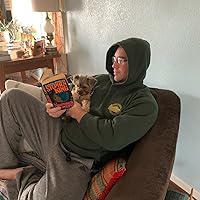
Fiction. Native American Studies. Stephen Graham Jones' first collection of flash fiction, STATES OF GRACE, is aptly named: these stories balance drama, play, and puissance, like forty-nine high-wire feats. While some stories arc through the briefest moments and interstices, others seem to examine an entire lifetime in a page. There are alcoholic fathers, definitions of infidelity, conversations in the middle of the ocean, murder, plotting murder, polite murder, shooting fish in a barrel, sons, and daughters. Never predictable, from the real to the surreal; there's no knowing what to expect from an attempt at a state of grace.
Stephen Graham Jones is the NYT bestselling author thirty-five or so books. He really likes werewolves and slashers. Favorite novels change daily, but Valis and Love Medicine and Lonesome Dove and It and The Things They Carried are all usually up there somewhere. Stephen lives in Boulder, Colorado. It's a big change from the West Texas he grew up in.
4☆ In his 917 Words Before We Begin, SGJ makes it very clear that he loves flash fiction. States of Grace is filled with nearly 70 pieces of just that.
I think this collection is a glimpse into the mind of SGJ. Each piece is a bind bending trip. The Umbrella Tree and Why I Write are two pieces that stood out to me the most.
Jones' writing is always conversational in tone. One feels as though they are sitting with a master storyteller, sharing his horrific tales first hand.
But short stories are where you feel like you're getting little glimpses of SGJ's brain, his genius and his madness. If I were stranded on a desert island with his short fiction, I could read them again and again and again, and still learn something new each time. The gift that keeps on giving...
I don’t generally read much flash fiction since it only sometimes clicks for me. But I greatly enjoyed this collection. A majority of these pieces work really well, striking just the right emotional chords, being both impactful and thought provoking. Two standouts for me were The Umbrella Tree and The Real Batman Story.
This was my second exposure to what is referred to as 'flash fiction', which are stories that can be as short as one minute in reading time. This collection started out rather disappointing in the first few installments, but quickly took off to be a satisfying read. The tone was a broad mix of comical, poignant, and downright surreal.
One of the things I like about Jones' style is his unique way of turning a phrase, seeing a scene, or creating his atmosphere in just a few words or sentences. States of Grace is a collection of short-short stories (the longest one in this collection runs just five pages), which gives him ample time to show off that unique talent, over and over again.
This isn't an easy book to find, but for anyone who likes his style, it's well worth the effort to track it down.
Really enjoyed this collection of Flash Fiction. With some stories being 1 sentence long and some being a few pages you're able to move through it quickly and dip in and out as needed.
I write because fiction is magic. You can reach across centuries to another person with it. Across galaxies.
Stephen Graham Jones's States of Grace is a collection of flash-fiction that reads very much like an experiment in language and literary form; an absurdist study of the poetry of prose that collects witty, weird, and disturbing anecdotes, idea-purging, trauma-dumping, and character-development and dialogue exercises—often all rolled into one clever, f*cked-up monstrosity. I have all of the same issues here that I have with short-story collections, in general, but even at their most unfulfilling, SGJ's ideas are artfully executed.
There does seem to be a lot of filler—stories that either miss their mark or are too ambiguous for their own good—but the best of the whopping 69 short-stories in this book are good enough to make the very brief time spent with the worst well worth the effort. The best of those best stories—The Top 10 of the Book—show off SGJ's brilliant writing in a way that shines a blinding light on the devastating, disturbing absurdities that so completely define his singular literary mind.
1.The Real Batman Story: This one was so damn good! SGJ takes key childhood moments of Bruce Wayne's—as best shown in Batman Begins—and poses the question “what if he didn’t get up from the fall?” What if the Batman lore we know is nothing more than fleeting fantasies sparked by dying synapses in a broken, bleeding brain? 2.The Umbrella Tree: SGJ’s knack for setting is on full display, here, and his characters feel exceptionally complex for how short a piece this is. It’s the story of a woman reflecting on her childhood after burying a family member for the second time. Its sentimentality and poignant depiction of memory and the hold those secret little worlds from your childhood forever have over you are significantly more emotionally affecting than I’d expected. SGJ’s storytelling is beautiful and his themes universal, making the ideas within hit home in an overwhelmingly authentic way I was not prepared for, at all. 3.Why I Write: He just gets it. 4.The Joneses: A f*cked-up game of Keeping Up with the Jonses that finds neighbors getting exceedingly dangerous pets to the point of unnecessary death after rabid death. After that round is done, the neighbors start one-upping each other with home damage. And so on... Wild and absurd and so, so good. 5.The Girl Who Kept Killing People When They Came To Her House: A single sentence that—paired with the title—is perfectly executed. It's effective. It's clever. It's dark. And I loved it. 6.A Footnote on Tickling: A hilarious dialogue about a species observing a lower species (us, obviously) who procreate by "tickling". Things get out of hand and now their own kind have discovered the appeal of tickling, thus bringing an end to their superior intellect. Ha! 7.The Sadness of Two People Meeting in a Bar: Complex, astute exploration of the destructive cycles we find ourselves repeating time and time and time again. 8.Kiss the Chef: The host of a party double dips a bunch before people arrive. Then when he’s had his fill, he adds a 'special ingredient' to the dip, giving the guests an extra creamy treat. Gross and totally f*cked-up. Ha! 9.The Broaching: Another scene of dialogue, this time between a married couple discussing infidelity if the other is in a coma. A contract is discussed and loopholes including backdating arise. A minefield that opens trust shattering possibilities. Yikes. This effectively displays SGJ’s knack for nailing not only the rhythm of how people communicate, but also the intentions within what they're saying to one another. 10.Spear Father: And another scene of dialogue, this time a nonsensical conversation between father and daughter about the importance of spears during an important pause in a TV show. It's a bit silly, but the rhythm is great and the characters feel especially rich given the two pages.
. . . and nothing ever really stops, you just have to decide where to get off.
This is a beautiful little book filled with micro-short stories. It's just astounding to me how Jones is able to tell a full narrative in such small literal spaces. But he does. And these tastes or maybe peeks into the brief moments of these characters are stunning and gorgeous and so intriguing. So much emotion captured but not in a showy, overdone way. Actually, it's all very quiet and perfect.
You'll sit down with this tiny book of tiny stories and blink and you'll be through them all. That's okay! You can go back and reread and still blink and be done.
I don't want to scare off any non-writers off with my next comment. But this is definitely a book for writers. However, it's easy to stop paying attention to how Jones crafts these shorts, when the stops are so compelling; so be aware. Pay attention. And also allow yourself to fall in. And enjoy!
SGJ is probably my favorite author, however ultra short stories like these just don't stick with me. So, 3 stars seems fair.
Upon finishing the collection of almost 70 stories, I tried to list which ones I remembered: The Piano Thief, the batman one, the bullet in the arm one, The Wages: An argument (because I have read it before multiple times), the water between the graves one, the dad in hospital one, the brother getting shot one, the alien currency one, the baseball bat one, and..... maybe that's it. But, maybe that's enough because all of the above are ones I want to return to.
A lot of these stories are almost auto-biographical, and are in a similar vein to his earlier collection Bleed Into Me (which is excellent).
I would also say that this is not a collection of horror stories as some people might expect. Just stories.
Lean and loaded flash fiction! Orgies, voyeuristic neighbors, and compromised party salsa..and the stories in this book aren’t even Jones at his weirdest–but it just might be him at his best.
Jones’s writing here is top-tier and these flash stories will feel familiar if you read his long fiction. Themes of coming of age, family, severed nipples, and identity. These pieces are told in intimate, playful, peculiar, and unsettling vignettes that are written lyrically and occasionally some even teeter toward verse. My favorite stories here showcased his ability to reveal the beauty, absurdity, and emotional weight of seemingly ordinary moments. They show just how much can be carried with so few words.
I'm a latecomer to SGJ's ultra-short stories, and I really enjoyed reading these after having read multiple novels--to encounter a really distinct mode of shaping tales! Noticed a few echoes of anecdotes from his totally memorable guest spots on The Kingcast too.
Stories this size feel like wildly different workouts from the sustained intensity of going into a novel world for multiple days. Singular images or dialogue lines have more pressure on them and exert more power when they're part of these concentrates.
A collection of 69 short-shorts, or flash fiction, from a bestselling horror novelist. Each of these stories is only a few pages long, so it's easy to read three or four of them while you're eating lunch, which is how I read them. Many of them have knockout first sentences that place you immediately into an eerie situation. Despite the brevity of the stories, they're carefully, precisely written, with powerful imagery and dark wit. They also feature Jones' offbeat conversational voice, which seduces until it shocks.
The collection was originally published in 2014, but this 2025 edition by Open Road Integrated Media, Inc. features 20 previously uncollected tales, including 10 original stories. Fortunately, Jones is obviously fond of flash fiction, in which every word must serve the story.
First off, shoutout to my library for tracking down a copy of this book. All the way from Maine!
There’s some real gems in here. Lots of great stories that pack a punch in a tiny package. I might have to reread some to better understand them, but overall, the ones I understood rocked!
I love reading something that inspires me to explore other formats. “Why I Write” is my favorite, but the one liner story hit just enough to remind how much anything can be a story if you wield it deftly enough.
Stephen Graham Jones can do more in a flash fiction story than many authors can do in a full novel. Truly, a remarkable book full of many weird and wonderful tales.
After examining the facts for eight-odd years, in which both his wife and his job fell away like a second, unnecessary skin he’d never even known he had, Rick finally decided that it had been obvious, really, and, being not just rational but bound by the smallest of indicators, he had no choice but to admit that that day he’d taken his four-year old son to the beach it had, yes, been almost solely to have him dragged out by a shark.
—From “Seafood”
The above sentence is but one example of SGJ’s literary prowess. That is, in fact, the first sentence of “Seafood,” and all his hooks go that way. For instance, the next story in the collection, “Cops & Robbers,” begins thusly: “My wife’s glasses were driving her crazy, so before too long she started killing people in quiet ways.” Words can’t really express the genius of a line like that. It works more like a painting—a vast visual expression that you stand back and absorb as a whole, rather than pick apart and micro-analyze. And this is the case with every word in the book.
While there are certainly stories that stood out more than others (the aforementioned “The Piano Thief,” “Seafood,” “Cobs & Robbers,” as well as “The Sadness Of Two People Meeting In A Bar,” “Bulletproof,” “Dirty Sanchez,” “Backsplash,” “The Bridge,” “Easy Money,” and last but certainly not least, the title story were personal favorites), there really aren’t any all-out stinkers here. Because this is a collection of flash fiction, States of Grace is a lightning-fast read, and yet each piece feels as fleshed-out and dense as a novel, with SGJ often spanning decades and a wide range of emotions in no time flat. You’re probably familiar with Stephen Graham Jones if you frequent this site, but if not, this is a good place to start.
“I write because, for a few pages at a time, I can make the world make sense.”
4.00 / 5.00
States of Grace is a collection of Stephen Graham Jones’s flash fiction work, recently updated and re-released with 10 additional stories. All stories fall into the horror spectrum.
I am going to preface this review by saying I don’t really care for flash fiction. I like the world-building aspect of books - stepping into a world that’s similar to but not quite our own, or even vastly different from anything we’d find here. In that aspect, flash fiction is usually pretty boring to me. This was an extra in my December 2025 Night Worms subscription box, and it’s by one of my favorite authors, so I was very excited to read it. I didn’t know it was flash fiction until I started reading. I probably wouldn’t have sought this book out on my own.
Surprisingly, I liked a good number of the stories in this collection, but I didn’t really get the point of many of them. Flash fiction tends to go over my head sometimes with the “get to the point as quickly as possible” aspect. Quick trigger warning that there is a fair amount of body horror mixed into this collection.
I will say, out of all the collections of flash fiction I’ve read, this has been my favorite.
Since there’s not any recurring characters or themes and since there are more than 50 vastly different stories in this collection, I will not be picking a song to represent this book.
This was the perfect book to keep in my purse and pocket. Great for the few minutes here and there, bits of stolen time, where you desperately need to read and make a connection to a character or another world for a moment, but you only have two minutes till you’re at the front of the line/the bell rings/break is over/the phone is going to ring/the killer leaps out of the bushes. Dr. Jones fits a whole world onto a single, small page. And there are enough layers in each short, short story to keep you thinking about it for the rest of the day. These stories are like concentrated, medicinal doses of literary impact. Take two and call me in the morning.
While it's wonderful to see how vividly Stephen Graham Jones can paint a world with just a paragraph and impressive how many ideas teem inside his brain, some of these images will remain seared in mine, making it even harder to interact with (and certainly eat with) other humans.