

What do you think?
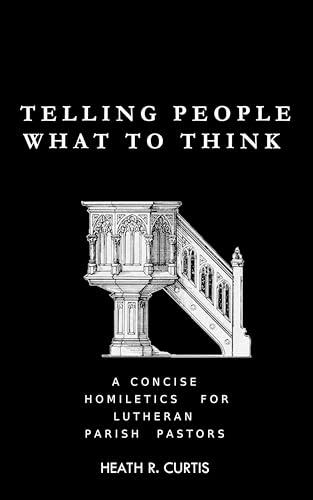
Telling People What To Think: A Concise Homiletics for Lutheran Parish Pastors
This is a book about the preacher’s task and how to perform it written by a fellow practitioner of the craft. What would you say that craft is? What is it that you do for a living, Pastor?
You get paid to tell people what to think.
You tell people what to think while they lie on their death beds. You tell them what to think about God and eternity. You tell jilted wives what to think when their husbands run off. You tell failures what to think about their future. You tell the melancholy what to think about being sad. Folks pile into a building once a week and sit on uncomfortable benches so they can listen to you tell them what to think for 15 minutes. And they put money in a bucket for the privilege.
This is a craft worthy of your best efforts. It is a matter of life and death. It's what you were called and ordained to do.
1 What Do You Do For a Living?
2 The Sermon Does Not Exist in a Vacuum
3 The Characteristics of the Lutheran Sermon
4 Resources for Sermon Preparation
5 Sermon Forms and Structures
6 A Method of Sermon Preparation for Parish Pastors
7 Preaching Through the Year
8 Illustrative Sermons (28 sermons from 11 different preachers)
About the Author
Rev. Heath R. Curtis has been serving as a parish pastor in Illinois since graduating from CSL (MDiv) and Washington University (MA Classics) in 2004. Through the years he has utilized his spare time in various endeavors alongside his parish as assistant editor for Johann Gerhard’s Theological Commonplaces, as a translator for the ongoing Luther’s Works project, as an adjunct professor (CUC), and as the instructor in Latin and Greek for Wittenberg Academy. He is a regular guest on Issues, Etc., and a frequent speaker at conferences around the Synod. His recent books include Stewardship for the Care of Souls (with co-author Rev. Dr. Nathan Meador; Lexham Press); Five Things You Can Do to Live a Jesus-Centered Life (CPH), and Stewardship Under the Stewardship for Confessional Lutheran Parishes (lcms.org/stewardship).
You get paid to tell people what to think.
You tell people what to think while they lie on their death beds. You tell them what to think about God and eternity. You tell jilted wives what to think when their husbands run off. You tell failures what to think about their future. You tell the melancholy what to think about being sad. Folks pile into a building once a week and sit on uncomfortable benches so they can listen to you tell them what to think for 15 minutes. And they put money in a bucket for the privilege.
This is a craft worthy of your best efforts. It is a matter of life and death. It's what you were called and ordained to do.
1 What Do You Do For a Living?
2 The Sermon Does Not Exist in a Vacuum
3 The Characteristics of the Lutheran Sermon
4 Resources for Sermon Preparation
5 Sermon Forms and Structures
6 A Method of Sermon Preparation for Parish Pastors
7 Preaching Through the Year
8 Illustrative Sermons (28 sermons from 11 different preachers)
About the Author
Rev. Heath R. Curtis has been serving as a parish pastor in Illinois since graduating from CSL (MDiv) and Washington University (MA Classics) in 2004. Through the years he has utilized his spare time in various endeavors alongside his parish as assistant editor for Johann Gerhard’s Theological Commonplaces, as a translator for the ongoing Luther’s Works project, as an adjunct professor (CUC), and as the instructor in Latin and Greek for Wittenberg Academy. He is a regular guest on Issues, Etc., and a frequent speaker at conferences around the Synod. His recent books include Stewardship for the Care of Souls (with co-author Rev. Dr. Nathan Meador; Lexham Press); Five Things You Can Do to Live a Jesus-Centered Life (CPH), and Stewardship Under the Stewardship for Confessional Lutheran Parishes (lcms.org/stewardship).
- GenresTheology
256 pages, Kindle Edition
Published June 9, 2024
Ratings & Reviews
Friends & Following
Create a free account to discover what your friends think of this book!
Community Reviews
Displaying 1 - 6 of 6 reviews

October 14, 2024
This is the book I wish I had read first year of seminary.
This is a book that should be included in a little gift baggie to all graduating seminarians, along with a visitation stole and a small communion set for shut in visits.
Really. I am serious.
There is a lot to appreciate about Pr. Curtis' work in this book. I'll hit a few highlights.
1. Winsome in tone, yet serious about his task.
I'll be very honest, I am turned off by a good portion of Lutheran writings on things, especially because the tone is usually angry, acidic, jaded, or cynical. If it doesn't descend into outright bullying it just comes across as incredibly bitter. This is not the case with this book. It was a genuine joy to read, while not coming across as pompous and stilted. It is evident that preaching is something that Pr. Curtis takes seriously, yet he talks about it as though it is a genuine joy, because it should be.
2. Generosity and fairness to all the tools available to the parish pastor.
Frequently, I find myself frustrated with what seems to be frequent purity testing when it comes to preaching. If you're not on XYZ lectionary, you're lost. If you're not killing yourself over the Greek, your sermon is going to be terrible. If you use such and such structure, it's gonna be a dumpster fire. Pr. Curtis will have none of this in this work. He treats both the historic and the 3 year lectionary with respect and care, though he does say he uses and prefers one year, for a variety of reasons.
One thing he does say is that lectionary preaching is the way to go. He doesn't give much in the way of advice to sermon series, crafting your own lectionaries, etc. He does caution against more of the "goofier" things that sometimes creep into pulpits (props, jokes, overly long stories, etc.)
He has an exceptionally fair treatment of sermon structures, and I mean all of them.
Give this book a read if you are a LCMS pastor.
This is a book that should be included in a little gift baggie to all graduating seminarians, along with a visitation stole and a small communion set for shut in visits.
Really. I am serious.
There is a lot to appreciate about Pr. Curtis' work in this book. I'll hit a few highlights.
1. Winsome in tone, yet serious about his task.
I'll be very honest, I am turned off by a good portion of Lutheran writings on things, especially because the tone is usually angry, acidic, jaded, or cynical. If it doesn't descend into outright bullying it just comes across as incredibly bitter. This is not the case with this book. It was a genuine joy to read, while not coming across as pompous and stilted. It is evident that preaching is something that Pr. Curtis takes seriously, yet he talks about it as though it is a genuine joy, because it should be.
2. Generosity and fairness to all the tools available to the parish pastor.
Frequently, I find myself frustrated with what seems to be frequent purity testing when it comes to preaching. If you're not on XYZ lectionary, you're lost. If you're not killing yourself over the Greek, your sermon is going to be terrible. If you use such and such structure, it's gonna be a dumpster fire. Pr. Curtis will have none of this in this work. He treats both the historic and the 3 year lectionary with respect and care, though he does say he uses and prefers one year, for a variety of reasons.
One thing he does say is that lectionary preaching is the way to go. He doesn't give much in the way of advice to sermon series, crafting your own lectionaries, etc. He does caution against more of the "goofier" things that sometimes creep into pulpits (props, jokes, overly long stories, etc.)
He has an exceptionally fair treatment of sermon structures, and I mean all of them.
Give this book a read if you are a LCMS pastor.

October 8, 2024
I had the joy of serving in Easter Vigil services with Pr. Curtis when I was a seminarian. It was through those that I was introduced to the joy that is Chrysostom's Easter Homily. I am glad he included it here.
This book is a friendly guide to how to preach and how to be a better preacher. With malice toward none and charity for all, Curtis approaches the preaching craft as something that the pastor should enjoy and find edifying, and not be afraid of! I would have much preferred reading this book as a seminarian than other homiletical textbooks, as I think it demystifies the whole tangled world of sermon structures that can so easily confuse a young preacher, and Curtis even-handedly treats them all, highlighting their strengths and weaknesses but never saying one is better than another. They all have their place in his preaching toolbag.
I also appreciate the way Curtis speaks of how one should preach. He provides guidelines on sermon length, how one should preach to maximize your preaching time, and how to cut down on things that are distracting to the congregation or that distract from the message. All is expressed in a supportive way.
If you're a seminarian, read this book. If you're a pastor, read this book. It certainly re-energized me.
This book is a friendly guide to how to preach and how to be a better preacher. With malice toward none and charity for all, Curtis approaches the preaching craft as something that the pastor should enjoy and find edifying, and not be afraid of! I would have much preferred reading this book as a seminarian than other homiletical textbooks, as I think it demystifies the whole tangled world of sermon structures that can so easily confuse a young preacher, and Curtis even-handedly treats them all, highlighting their strengths and weaknesses but never saying one is better than another. They all have their place in his preaching toolbag.
I also appreciate the way Curtis speaks of how one should preach. He provides guidelines on sermon length, how one should preach to maximize your preaching time, and how to cut down on things that are distracting to the congregation or that distract from the message. All is expressed in a supportive way.
If you're a seminarian, read this book. If you're a pastor, read this book. It certainly re-energized me.
January 9, 2025
Sometimes concise packs more power than extensive discussion. And it's impressive how much Curtis packs in in such few words. Despite some quirks (and I'm certain all of us preachers have our quirks) I am giving this five stars. It grounds preaching in the rich theology of the Word of God and gives clear, practical guidance for the preaching task. Very helpful and worthwhile for thinking about the preaching task and going about it.

November 1, 2024
The most helpful and encouraging (as well as convicting) work on preaching I have encountered. A breath of fresh air for someone constantly anxious about the preaching task.

February 25, 2025
A good review of principles and good new information. It is nice that I seem to be doing well keeping to the basics. Good place for pastors to check their work against
April 7, 2026
Excellent practical guide to homiletics. Anything from sermon structure to resources to read and improve your preaching, this is a great source. Will definitely be referring back to it.
Displaying 1 - 6 of 6 reviews