Winter is savage and cold in Lapland. When a priceless local relic is stolen from Kautokeino, a village in the middle of the isolated snowy tundra, detectives Klemet Nango – a familiar face in the rural community – and Nina Nansen, fresh out of the local police academy, are called to investigate.
There are just a few days until the locals will host a UN World Heritage conference, and Klemet and Nina are under pressure to retrieve the artefact, due to be presented to a world-renowned French scientist as part of the celebrations. When a local reindeer herder is found brutally murdered, Klemet and Nina immediately suspect that the two events are linked. But the villagers don't take too kindly to having their secret histories stirred up and the duo is forced to cross the icy landscapes alone in search of the answers that will lead them to a killer.
Olivier Truc was born in France in 1964. He has worked as a journalist since 1986, and is based in Stockholm since 1994, where he is currently the Nordic and Baltic correspondent for Le Monde and Le Point. As a reporter, Olivier Truc covers subjects from politics and economics to social issues like immigration and minorities. He has also produced TV documentaries, including one that portrays a group of Norwegian policemen in Lapland ("The Reindeer Police," 2008). He has previously published two non-fiction books. Forty Days Without Shadow is his first novel, and will be published in the original French by Éditions Métailié in September 2012.
4.5 Stars. This fascinating, well-researched, and informative novel transported me to the snowy, frozen tundra in the Scandinavian North. I was completely immersed in a previously unknown place and could feel the chill. The plot was multi-layered, complex and dense. The characters were intriguing, with hidden and surprising backstories. The storytelling kept me riveted with its descriptive and atmospheric writing. There was plenty of tension, suspense and excitement throughout this interesting book
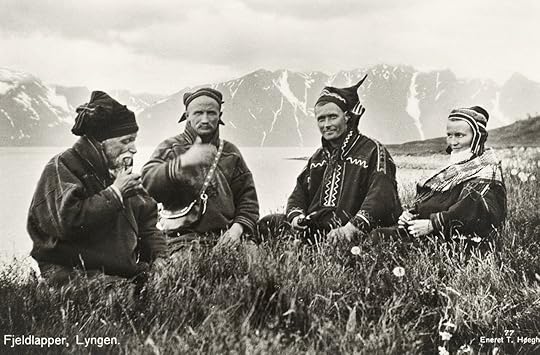
I found myself searching the internet for more background information. There were many historic and recent photos of the Sami people. They are the indigenous natives of Arctic Norway, Sweden, Finland and Russia. Many had tried to adhere to their traditional way of life, which was disrupted when Europeans moved into their grazing land. They were considered primitive and subjected to ethnic and racial prejudice. An ultra-conservative branch of the Lutheran religion destroyed many traditional and spiritual symbols, calling them the devil's works. The Sami were herders of reindeer, and their pastures were often destroyed by the newcomers taking their land and mining industries causing destruction. It was a hard, bleak life for the reindeer herders; many had to give up their way of life and were forced to work in the mines. Some reindeer breeders managed to become wealthy. Photos online show modern Sami herders with their reindeer, colourful clothing, and unique hats. Rare, sacred Sami drums have a significant role in the mysteries. There are articles about their traditional drums with pictures showing their designs and pictograph decorations.
Some Sami characters recalled being sent to harsh boarding schools and beaten if they uttered a word in their native language. They were forced to learn the majority language, deprived of their spirituality, and dominated by the fundamentalist Christian religion. I did not expect to find any information about the Reindeer Patrol Police, thinking this was a fictional literary device and was surprised to discover that this police force actually exists. There were not only photos but a documentary film to be found online.
We are introduced to two members of the Reindeer Patrol. 50-year-old Klemit Nanga is of Sami origin but was not brought up in their traditional way of life. He is shy, dour, taciturn, and awkward around women but is considered an admirable police officer. His partner is an enthusiastic new officer Nina Nansen who just completed her training at the police academy in Oslo. The North is new to her, but she is enthusiastic, intuitive, imaginative and makes clever speculative connections, whereas Klemet is cautious and requires irrefutable evidence that can be proven. They are quite different but work well together.
The small isolated town (2000 population) of Kautokeino is preparing for a UN World Heritage conference. A rare and priceless antique Sami artifact, a spiritual drum, has been stolen from the museum where it was stored. It was to be shown to the public for the first time and presented to a renowned French scientist during the celebrations. The next day an elderly, drunken, and failing reindeer herder is murdered in his messy, neglected trailer home. Nina suspects the two crimes are connected.
The local police officer is hostile to the Reindeer Police. He is rude and obnoxious, dislikes the Sami and new immigrants. He insists that the murder is the result of a dispute between reindeer herders. The Reindeer Patrol is under pressure to retrieve the drum before the conference. Among the characters are several reindeer herders who may be in conflict over grazing land and straying animals. A Sami activist is stirring people to protest their lack of equal rights. Wealthy reindeer breeders can be contentious. A middle-aged Sami woman works as a cleaner for a farmer who treats her with contempt. Her secrets, if revealed, may help the investigation. Into this mix comes a French geologist looking to get rich by finding gold. He has some papers that give hints about where gold may be located. He is a vile creature with a history of crimes in the Congo and preys on underage girls. He hires a tough elderly herder that has never known fear to be his guide. The old herder has no use for modern methods and inspires fear and admiration among other herders. The herder's wife is mentally ill, and he gently takes care of her. Does the geologist find the gold or something else?
The geologist brought minerals, lost gold mines, and historical documents into the story. I wanted to stay with the Reindeer Patrol's investigation and the Sami, a story that enthralled me. I felt this thread belonged to another book, making the story seem bloated. However, It was well-planned and later would be integrated into the plot, leading to a brutal and exciting ending. There was a long section where an expert on the rare drums was explaining his interpretation of clues decorating the drum to Klemet and Nina. As he described the primitive inscriptions and pictographs, I felt an artist's rendering of the drum should have been included.
Forty Days Without Shadow was written in French in 2012 and translated into English in 2014. It was supposed to be #1 in the Klemet, Nango series, and I have been searching for subsequent English translations but have been unable to find any. I would certainly read them if they ever become available.
This entire review has been hidden because of spoilers.
¿Un policial nórdico escrito por un francés? Hay que lanzarse a la lectura sin prejuicios (?). La historia nos sitúa en la bella e inhóspita Laponia. En todas las novelas Laponia es "bella e inhóspita" (A todo esto, espero haber escrito bien "inhóspita") El día más emocionante del año, el del retorno del sol después de una eterna noche, se volverá inesperadamente sombrío: Un pastor sami ha sido asesinado. Y un valioso tambor sami ha desaparecido del Museo ¿Hay relación entre ambos sucesos o la desgracia se encaprichó con los lapones justo ese día?
Oliver Truc se desenvuelve con sereno atrevimiento y no solo decide ser ambicioso con sus explicaciones acerca de la cultura, historia y actualidad sami (aquí debemos creer que se ha documentado a la altura de las circunstancias) sino que ingresa en un espiral de temas diversos: el avasallamiento de los derechos y las tradiciones de los pueblos originarios, el racismo, la minería y el impacto medioambiental, el alcoholismo, la pedofilia, las enfermedades mentales...en fin, un poco mucho. Tal vez se relacione con la ansiedad nerviosa de una primera novela. Truc utiliza hábilmente a uno de los personajes, Nina, una de las novatas en la "Policía de los renos" para convertirla en nuestra guía. Nina está tan perdida como nosotros en el inmenso paisaje lapón y en las costumbres samis y tiene mucho por aprender. Es un poco ingenua, pero buena alumna.
Ignoro si todo lo que se cuenta sobre los samis es verdad, pero me ha despertado interés por tan lejana cultura. La historia es atrapante, misteriosa y humana. Este toque de "calor humano", de proximidad con algunos personajes, es su punto alto. El hecho de que abarque mucho para apretar poco...lo más decepcionante. Pero me gustó y leería otras con mucho gusto.
Eso sí, qué sueño maravilloso debe ser poder ver, con tus propios ojos, una aurora boreal en la bella y, por supuesto, "inhóspita" Laponia.
Thank you Trapdoor for providing me with a free copy for an honest review!
A priceless local relic is stolen from Kautokeino, a village in Lapland, that lies in the middle of the isolated snowy tundra. Two reindeer polices, Klemet Nango, an experienced police, and Nina Nansen, fresh from the local police academy, sends out to investigate the crime. Then a local reindeer herder is murdered and Klemet and Nina suspect that the two events are linked to each other.
The Sámis in Sweden, Norway, and Finland has during century’s, just like other indigenous populations, been oppressed, and one thing the church did against them was burning their drums, there used to be thousands of them, now there are only 71 documented left. I have been for years fascinated by the Sámis so that made the experience of reading this book so much greater. Because even though this is a crime novel, it’s also a glimpse into the Sámi world, both the present one and the one the high power was hell bent on destroying when they sent up people to colonize and make Christians out of the natives.
This book was truly well written, I mean it took me days to get through because I just couldn’t skim any part because it was so well-written and interesting to read. Of course, the characters was great even though the police, for instance, fell into the risk of being stereotypes, bad cop, good cop, a new cop, but I didn't mind that. One character I really came to like was Aslak, the reindeer herder that preferred the old traditional way of herding reindeer instead the modern way with snow scooters.
The only part that I didn’t like was the abrupt ending; suddenly the book was just finished and I wanted more. I hope Olivier Truc writes more books, because this, his debut book was marvelous!
4.5 stars!
Olivier Truc was born in France in 1964. He has worked as a journalist since 1986 and has been based in Stockholm since 1994, where he is currently the Nordic and Baltic correspondent for Le Monde and Le Point. As a reporter, Olivier Truc covers subjects from politics and economics to social issues like immigration and minorities. He has also produced TV documentaries, including one that portrays a group of Norwegian policemen in Lapland. This is his debut novel.
Being Swedish I have to take into account that the author is not from this part of Europe. One of the main characters, Nina, is from the south of Norway, but I don't for a second believe anyone from Scandinavia can be so totally ignorant of the history and reality of life in Sapmi. Especially not one with a police education, that must have contained at least some elements of sociology and overview of national ongoing conflicts. But if I try to see Nina as the eyes of the author it makes more sense. This might be a good introduction to Sapmi controversies for someone from outside of Scandinavia. Sadly it gives a picture of a culture that is already more or less extinct. In many parts that may be so, but in others there are still positive forces. I hope that a few other native authors from this region will soon be avaliable in translations, so outsiders can get a more nuanced perception. Still, the political dimension, of a growing nationalist party in Norway, and the effects they have on local communities in the North was interesting. And the crime investigation became pretty good too after Nina had overcome a bit of her initial naivite.
Ilgai trunkanti naktis pamažu atsitraukia ir dienos pradeda ilgėti. Kiekvienas skyrius ir pradedamas dienos trukme. Ar galite įsivaizduoti, kad diena truktų tik pusvalandį, valandą..? Man ypač patiko gamtos aprašymai. Sniegynai, šaltis, elniai.. viską pajutau. Neįprasti papročiai, gentis, simboliai. Vietiniai - šeimos, iš kartos į kartą saugantys savo kultūrą ir atvykėliai siekiantys pralobti. Nieko baisaus, ne siaubo knyga, nėra žiaurumų ar pan. Trileris, kurį puslapis po puslapio seki ir supranti, tokia vidutinė knyga.
🖋️ Šaltis, kaip ir naktis, atima protą, pažadina siaubingas šmėklas. 🖋️ Dievas buvo meilė, tačiau reikėjo jo bijoti. 🖋️ ... sniegas tarsi migdė gamtą. 🖋️ Gal išsilavinimas - geras privalumas, pagalvojo. Tada nebijai plačiau mąstyti, tirti kokią nori versiją, suklysti, vėl pradėti iš naujo. 🖋️ ... pasišildė įprastus pusryčius - tyrę iš elnio kraujo.
Intresting premise and it was engaging but I didn't love it as much as I had hoped. Will most likely continue on with the series as it was somewhat entertaining and I hope it will pick up in later books. (I think it's a series or there are at least more books by this author)
Vai, šajā romānā gan labas lietas, gan vairākas problēmas ar tekstu. Ģeniāls šis romāns noteikti nav. Paredzami, ar eksaltētām beigām, bet ļoti interesantu darbības vidi. Pilnā atsauksme https://gramatas.wordpress.com/2017/0...
There's something about the cold reaches of the Far North which appeals to me endlessly. I loved M.J. McGrath's series set in the Northern Territories of Canada and I love this depiction of cross-border Lapland and the Reindeer Police. I keep hesitating between 3 and 4 stars, because the atmosphere, the promising main characters (a Sami nearing retirement and a fresh-faced young Norwegian woman just out of police school), the description of a lifestyle in danger of getting lost, the intricate plot were all worth 4 stars, but there were some longish passages in the middle which sagged a bit, too many explanations and repetitions, and some rather stereotypical situations or side characters.
La première étoile pour une bonne histoire policière qui m’a accrochée dès les premières pages. Un vrai mystère qu’on tente de percer avec des indices, un trésor, des vilains et des gentils. L’auteur a su éviter quelques clichés du genre. Les indices pointent vers un dénouement logique sans être prévisible.
La deuxième étoile pour m’avoir fait découvrir la Laponie et les Lapons. Une région du monde et un peuple dont je ne savais rien. Qui aurait cru que qu’il existait une police des rennes? L’auteur nous fait sentir à la fois le poids et la beauté de l’hiver au nord du cercle arctique. Avec des jours où le soleil ne se montre que quelques heures et des nuits illuminées par les aurores boréales. Avec le froid qui est une présence toute au long du roman. Un peuple dont j’ai découvert un peu de l’histoire et des coutumes à la fois proches et très différentes de celles des Inuits du Canada.
L’auteur, Olivier Truc, semble avoir un grand respect pour les Lapons. IL nous fait voir la Laponie à travers les yeux de Nina une recrue du Sud qui habite la région et rencontre ses habitants pour la première fois. Le partenaire de Nina à la police des rennes est Klemet un policier Lapon à qui Nina adresse ses nombreuses questions.
La troisième étoile pour avoir réussi à m’intéresser à la géologie. Suite à la lecture de ce livre, je suis allée sur mon heure de lunch au Musée Redpath près de mon travail pour voir des roches. L’auteur a bien fait ses recherches et les scènes de géologie me paraissent crédibles.
Deux étoiles refusées. **
Pour les héros d’abord. Oui les héros sont sympathiques mais j’aime les miens plus torturés, moins héroïques. J’aime surtout dans un roman les voir évoluer à travers les épreuves. Oui, il y a bien la différence culturelle entre Nina et Klemet qui s’amenuise à mesure qu’ils tissent des liens professionnels mais il n’y avait pas assez de tension au départ pour qu’on parle d’une vraie tension narrative.
Pour les autres personnages ensuite qui sont intéressants mais trop stéréotypés. Il y a le policier raciste, le dernier lapon du titre, l’alcoolique, le policier raciste, la vieille Lapone et le vilain méchant qui, à part être dénué de bonté ou de compassion, est plutôt plat.
En bref ce fut un récit divertissant qui sans transcender le genre, m’a fait découvrir la Laponie et les Lapons. Il s’agit d’un premier roman pour Oliver Truc. J’espère qu’il poursuivra les aventures de Klemet et Nina car je les lirais avec plaisir.
Prečítal som 50 strán a túlajúce sa soby a ukradnutý bubon (bez hlbšieho významu) ma fakt nezaujímajú natoľko, aby som pokračoval v čítaní tej 500-stranovej bichle. A to som a tešil na niečo mrazivé počas týchto sviatkov.
Fascinating novel concerning the Lapps or Sami, as this people calls itself. They live in Lapland, the harsh, unforgiving tundra encompassing parts or northern Sweden, Norway, Finland, and even Russia. A ancient shamanistic drum is stolen from a museum, then the death of a failed, alcoholic Sami reindeer herdsman follows soon thereafter. Two Reindeer Police partners, Nina, a rookie fresh out of police academy, and the experienced detective, the Sami Klemet set out to solve this double mystery. Are these two incidents tied together as Nina feels and does a legend about a gold seam and a curse have anything to do with them? Why is the drum so important and what secrets does the drum hold, besides being an unusual relic of a bygone time? The novel gave us an insight into Sami life both of today and the traditional lifestyle, consisting of reindeer breeding. The character Aslak, a Sami who doesn't succumb to any modernism, exemplified the traditional. A crooked policeman, a crooked farmer/city councilor and French geologist obsessed with finding the truth of the legend add spice to the story.
The setting for this book is the Scandinavian Arctic. The title refers to the mid-winter period at high latitudes, during which the sun does not rise above the horizon for forty days. No sun = no shadow.
Lapland is the traditional home of the indigenous Sami people. The author prefers to use its traditional name of Sapmi, a cultural region which sits astride political boundaries to include northernmost parts of Sweden, Finland, Norway, and Russia. While the Sami have their own Parliament, it is tokenistic at best, and the majority of the administration of the region is done via intergovernmental agencies, mainly sourced from Olso and Stockholm.
One of these agencies is the Reindeer Police, a force set up to enforce laws and manage issues relating to the annual migration of reindeer from winter to summer pastures. A minority of Sami continue to live a traditional lifestyle, breeding reindeer and managing the herds as they move across the region in age-old patterns.
Our heroes, Klemet Nango, a Sami, and his young partner Nina Nanson, newly arrived from southern Norway, make up Patrol P9 of the Reindeer Police, stationed at Kautokeino. In the course of routine procedures to warn local herder Matti Labba about straying reindeer, they discover his mutilated corpse at his trailer out on the tundra. What looks like a simple case of murder over a boundary dispute soon turns into a complex situation.
In addition to the mysterious death of Matti, a second crime in 24 hours has occurred, with the theft of a rare artefact from the local museum. An ancient Sami shaman drum, used by traditional priests for healing and communion with the spirits, has been stolen. In a remote community where the most action for the police is the usual Saturday night barroom brawl, these two major crimes galvanise the local constabulary.
Thus Olivier Truc sets up the plot in which this intriguing mystery plays out.
I heard a radio review of Forty Days without Shadow on ABC Radio National’s Blueprint for Living program recently. The review was given by Mary Dalmau, of Melbourne’s much loved bookshop Reader’s Feast, whose opinions I value.
The book was represented as a crime novel, and its own subtitle is An Arctic Thriller. The publisher’s blurb describes it as a ‘compelling thriller’ and ‘a truly dark, gripping crime novel’. Sorry, but I beg to disagree. I’ve read much better crime fiction and tighter thrillers than Forty Days without Shadow.
After a longish prologue set in the 17th century, the present-day story commences with us being introduced to the detectives, Klemet and Nina of the Reindeer Police, and the initial crime, the theft of a precious tribal drum. Within a short space the author brings in a whole host of minor characters, Sami and non-Sami, and the second crime, the murder of Matti. We meet characters like the coarse Rolf Brattsen, with his petty hates and undisguised prejudice against the Sami, who is in cahoots with the equally odious Councilman Karl Olson. Truc introduces two key characters, Aslak, an enigmatic Sami herder who is living an authentic, traditional lifestyle on the tundra, without modern conveniences, and Andre Racagnal, a rather unsavoury yet brilliant French geologist, making applications to prospect for minerals in Sapmi.
In my opinion we are introduced to so many minor characters, most with their own sub-plots, that the narrative becomes rather confused for a while. Somewhere after the halfway point of the book, the various elements swirling around the pages like an Arctic snowstorm start to converge, and then we get a bit of forward momentum with the plot. The pace picks up eventually, leading to a dramatic climax and resolution of the mysteries.
Truc brings into the story a welter of issues which are fascinating, but somewhat distracting from the central tale. He uses the characters as plot devices to air political, social and cultural issues which are relevant to modern Sami society. Brattsen represents the red-neck element, contemptuous of so-called liberal perspectives, always ready with spiteful racist remarks. Charismatic Sami activist Olaf Renson represents the perennial provocateur, poised ready to make political mileage out of any situation. Murder victim Matti Labba is a classic example of the damaged indigenous individual, trying to fit into modern society while holding on to traditional beliefs. His life is dogged by poverty, mental health issues and alcoholism.
As well as the social and political wrangles that Truc plays out among his characters, the environment features in an important way. There are implications for the entire region if Racagnal’s geological survey finds a major source of precious minerals. The delicate ecosystem of the tundra might be unbalanced, and the annual migration of the reindeer herds could be disrupted. Those Sami clinging to the vestiges of the traditional way of life would lose their livelihoods. It is thought-provoking stuff, sufficiently so to get me googling the topic. For readers of this book, I recommend looking up Sami drums on-line, to get a decent visual sense of what the author is describing. While looking at the shape and make of the drums, I viewed a number of historical photos of the Sami, which gave me a better sense of the character of this indigenous culture.
This story has much relevance for us in modern Australian society. We too have an indigenous population whose traditional way of life has been thoroughly disrupted. Many of our aboriginals live impoverished existences on the margins of today’s society. Like Sapmi, we have vast areas of under-populated land, where riches may be gained from exploiting natural resources. Our unique Australian environment is just as fragile and subject to degradation as that of Sapmi. Our politics at local, state and federal levels is bedevilled by vested interests and ambitious, uncaring politicians, just like those portrayed in Forty Days without Shadow. The spectres of paedophilia and rape stalk the pages of our newspapers and our TV screens almost weekly.
As a crime novel, yeah, it’s not bad, though I’ve read much better books in this genre. As a thriller, it is certainly no edge-of-seat, can’t-put down kind of read. Yet it is an enjoyable and intriguing book. As a slow-burning mystery novel, it really works well.
I see this novel as a very good piece of contemporary fiction, which uses the device of a murder as the platform from which the author launches his examination of key issues in modern society. This is a rich, multi-layered story, which stimulated my mind and triggered thoughts about my own society and culture, and the situation of Australia’s indigenous peoples.
9 APR 2020 - this one promises to be a great read. Another Better World Books purchase.
Page 1 - . . . They had been tracking him for a long while. It had to end.
16 APR 2020 - Meh. I did not hate it and I did not love it. I found this book enjoyable whilst reading; but, when I was not reading Forty Days, I was not thinking about it nor was I excited to pick it up and resume reading. Perhaps, the fault is not the book; but, rather, this could be a case of a good book at the wrong time.
Detektīvos man ir galvenais, lai ir laba detektīvintriga ar labu noslēgumu (reizēm ir tādas tjap ļap (paviršas) beigas vai sateigtas, kad ir sajūta, ka autors ir smuki audzējis intrigu un pēkšņi atjēdzies, kas grāmatu vajag pabeigt un tad tās beigas ir kā pielipinātas). Un nozīme ir fonam.
Ar detektīvintrigu un noslēgumu te ir ok. Savukārt, kad sāku lasīt, sapratu, ka man vajag mātes Googles palīdzību, lai vizualizētu fonu (jo ģeogrāfijā man galvā ir tikai obligātais minimums (nepavelk mani šī joma) un Skandinācijas ziemeļi man līdz šim nebija nekas vairāk kā sausā teorija). Tāpēc pirmā ceturtdaļa lasījās diezgan lēnu. Pēc tam gan aizgāja uz urrā un sajūtu līmenī mani pat pavadīja tas aukstums. Vēl es piedzīvoju kultūršoku par norvēģu attieksmi pret sāmiem (lapiem). Un man patika autora attieksme pret politkorektumu - galvenais, lai uz ārpusi viss izskatās labi, bet kas darās "iekšiņās"...
Ce n'est pas parce que Le Dernier Lapon est absolument génial, ni même excellent, qu'il m'a plu, mais tout simplement par son originalité. Originalité d'abord de la localisation géographique, pour moi tout à fait exotique ; d'un petit aperçu socio-politique de la Scandinavie, rouages et mécanismes qui ont l'air de pas mal accrocher et ce, depuis des siècles ; d'une culture, la culture Sami, c'est-à-dire des lapons, qui m'était complètement inconnue. Le tout sur fond de crise politique internationale, crise identitaire nationale également, et avec un petit ingrédient supplémentaire sur l'exploitation des ressources naturelles et minières contre modes de vie ancestraux.
Pas mal de positif qui se trouve, à mon goût, être également du négatif : je suis la première enchantée que l¡on ne me donne pas le nombre de tâches de rousseur sur l'omoplate gauche de l'héroïne, ni le traumatisme enfantin qui fait que le héros ne mange pas d'aliments de couleur verte, et bingo ici, pas du détails et listes de caractéristiques inutiles pour les personnages. Malheureusement, des rencontres ou événements passés et essentiels (semble-t-il à l'intrigue) sont mentionnés sans que l'on sache au final ce qu'ils avaient de si essentiels. Des fausses pistes s'esquissent sans cesse et on dit "youpi !" mais finalement, on découvre que ces pistes n'ont rien de faux... Etc., etc....
Un livre long et lent dans lequel chaque indice, chaque élément est recueilli après de multiples voyages en motoski durant de longues heures, ponctuées de rencontres avec des personnages étranges et hostiles. Mais ceci est un bel écho aux paysages de la Laponie, à ses étendues glacées et hostiles. J'ai beaucoup aimé le tout début et la toute fin, l'image très poétique de l'ombre retrouvée de Klemet, et la manière dont la boucle de l'affaire et la vie d'un homme se boucle... c'est ouvert tout ça, et c'est très bien !
Bon, en somme, oui, c'est un polar original, avec une intrigue originale, une police originale (la police des rennes, hahaha ! Excellent !), des personnages tous originaux mais qui parfois auraient mérité d'être un peu moins bruts. Un bon moment, bien que j'ai passé trop de temps à tourner les pages en me demandant où voulait en venir l'auteur, et une bonne découverte culturelle. Dans le genre polar polaire, avec un peu de sciences un peu secrètes, du trafic aussi secret, des étendues glacées et des personnages aussi ambigus qu'originaux, j'ai meilleur souvenir de Miss Smilla's Feeling for Snow de Peter Hoeg.
When I was a child my favorite book was Lapland Outlaw by Arthur Catherall which I got from the Weekly Reader Book Club. Catherall’s children’s book may have involved some inaccuracies, but it taught me that people in other cultures have different values which need to be respected. The sixteen year old Sami boy who was the central character had grown up as a nomadic herder of reindeer. He felt panicked by being enclosed within four walls and fought to maintain his ancestral way of life.
I haven’t visited with the Sami through the pages of a book for a great many years, but it was my memory of Lapland Outlaw that caused me to obtain Forty Days Without Shadow which is an English translation of the French thriller Le Dernier Lapon by Olivier Truc.
I was very interested in finding out more about the Sami. I found it especially intriguing that the roofs of traditional Sami tents were covered with interlaced antlers that were supposed to be arranged so that you could see the sky through them. This is similar to the huts that are constructed for the Jewish holiday of Sukkot. My Jewish ancestors were also once nomadic herders. Perhaps this is why I feel a connection to the Sami.
I thought the characters were well drawn and well-motivated. I found both of the protagonists sympathetic, and although the villains weren’t at all sympathetic, they were very credible. I appreciated the fact that Nina played an active role in the case. Since she knew French, she went to France to interview the French collector who had donated the drum to the museum to find out more about the stolen drum and the circumstances in which he acquired it. She also brought about a major break in the case due to her rapport with a female Sami who trusted her.
This was an excellent novel from the thriller perspective. There were issues involving party politics in Norway, racism, World War II and predatory behavior by mining companies. It was a suspenseful and involving story line from start to finish. I loved Forty Days Without Shadow.
No conocía a este autor pero enseguida me llamó la atención el tema de la cultura y sociedad sami en la época actual. No conocía prácticamente nada de ellos, aunque los problemas suelen ser muy similares en todos los lugares cerca del círculo polar ártico, donde existían culturas ancestrales muy parecidas (ya sea a uno u otro lado del mundo) que se han difuminado bajo la influencia occidental. Lugares donde la vida, ya difícil en cualquier época del año, en invierno se apaga y donde las relaciones sociales son muy complejas debido a las rivalidades y enfrentamientos en un entorno tan duro, que aumenta los problemas de depresión, alcoholismo o suicidio.
La novela no tiene demasiadas pretensiones, pero está bien escrita (pese a la traducción). El argumento te atrapa desde la primera página y te va llevando por diferentes caminos que en ningún momento vislumbran el sorprendente final.
Aparte del desarrollo de la parte policíaca, que por sí sola vale la pena leerlo, es un libro excelente para conocer la realidad de Laponia hoy en día; un lugar que imaginamos idílico cuando lo visitamos en tours de unos días pero que en su existencia cotidiana no tiene nada que ver con las ideas preconcebidas que podamos tener.
Las descripciones del paisaje son magníficas, así como las de la cultura sami y su realidad actual.
Livro ainda não publicado em Portugal e escrito por um jornalista francês radicado na Suécia. Passa-se na Lapónia no final do inverno polar. Os primeiros dias de sol a aparecer são uma das curiosidades. Dois polícias da unidade das renas (sim, há de facto uma polícia das renas!) deparam-se com o roubo de um tambor tradicional sami e, depois, com o assassinato de um proprietário de renas e fabricante de tambores. Pelo meio, aparece um geólogo sinistro que é aliciado para um negócio na busca de uma mina perdida misteriosa. Vêm à tona histórias anteriores à II Guerra e tudo acaba por fazer sentido. Interessante porque fala de assuntos tão distantes, comovente por apresentar dados sobre o povo sami e as dificuldades que enfrenta. Dificultou-me a leitura o facto de estarem 30o lá fora e me custar a compreender como são 40 negativos...
5 estrelas pela localização: a Lapónia e toda a descrição do local, da cultura, costumes, hábitos e a vida dos habitantes na área;
3 estrelas pela forma como o enredo foi desenvolvido. Também pelos erros ortográficos e gramaticais; sinceramente, é assim tão difícil dar uma última leitura e corrigir os erros? Até um word assinala este tipo de erros, imagino que os programas utilizados na tradução sejam ainda melhores.
Começou melhor do que terminou. O que parecia a investigação de um assassinato seguiu para algo completamente diferente. A segunda metade do livro até foi bastante chata e parada. A conclusão acabou por melhorar tudo, com uns pormenores inesperados e interessantes mas o final, aquele último evento na última página, devia ter sido mais pormenorizado, dar seguimento para uma conclusão mais satisfatória.
The respectful focus on Sami history and culture -- and the fact that it's written by a Frenchman -- sets this apart from the flood of Nordic Noir. I figured out quite a bit of it before the Reindeer Patrol officers did, but the interesting characters and unique setting made this a compelling page turner. Reading Forty Days Without Shadow inspired a lot of googling -- I love when I can learn something from a crime novel. Really, really hope that Truc's next novel gets an English translation as well -- can't wait to see what's in store for Klemet and Nina!
Una novela negra distinta, que te adentra en una Laponia desconocida, llena de conflictos raciales, personajes oscuros, el robo de un objeto histórico y un asesinato con mutilación incluida, y una pareja protagonista que puede tener un gran futuro.
Me ha gustado mucho, tal vez sea un poco lenta para algunos, pero yo he disfrutado de todo el ambiente, y de esa fría, oscura y desconocida Laponia.
Tras leer la contraportada, me acerqué a la dependienta de la librería y le pregunté... "¿Existe realmente La Policía de los Renos?" No únicamente afirmó que existía sino que me recomendó ampliamente al autor y a esta trilogía. Resultó una gran compra. La “Policía de los Renos” en la Laponia noruega es la única fuerza en su tipo en el mundo. La historia y personajes son ficticios obviamente, pero la ambientación es tan real que hasta pasas frío.
Su gran mérito estriba en que permite descubrir aspectos de una cultura ciertamente desconocida, bajo la coartada de una peculiar investigación policial, con una cuidada ambientación y una trama original y bien desarrollada que logra mantener la atención hasta el final de la novela.
If accurate, the insight this book gives to the Sami culture and it's clashes with modern day Norway are really interesting. Overall though I found this book a bit of a drag to read. The characters were one dimensional and lacked subtlety. I found the male gaze throughout the story extremely tiresome and the ending was oddly abrupt and ultimately unsatisfying.
Lähdin lukemaan tätä kirjaa hyvin kriittisesti, sillä ranskalainen kirjoittamassa saamelaisista vaikuttaa jo asetelmaltaan ongelmalliselta. En osaa sanoa, miten autenttista lopulta oli Pohjois-Norjan saamelaisalueen kuvaus, mutta mutuillen sanoisin että sekä nykyajan saamelaisten että lestadiolaisten kuvaukseen kuului vähintään aavistuksen yksinkertaistamista. Jäin myös pohtimaan, olisiko eteläisemmästä Norjasta kotoisin oleva hahmo, Nina, todella voinut olla niin täysin tietämätön saamelaisten menneisyydessä kohtaamista vääryyksistä kuin hän oli.
Teoksen kieli ei oikein vedonnut minuun. Varsinkin jotkut sanavalinnat rakensivat pohjoismaalaiselle selvää vierauden tunnetta. Minun on vaikea kuvitella esimerkiksi luterilaisen viittaavan toiseen luterilaiseen ”hartaana protestanttina” tai toisaalta norjalaisen toteavan toiselle norjalaiselle: ”Hän ei ole mikään kuoripoika.” Kielessä oli myös jotain vaikeasti määriteltävää kömpelyyttä, joka saattoi olla joko alkuperäistekstin tai liian suoran käännöksen syytä.
Itse rikosmysteeri ja tapahtumaympäristö olivat kuitenkin sinänsä kiinnostavia. Kirja myös sivusi ristiriitoja, joita on yksilön sisällä, ihmisryhmien välillä ja menneisyyden ja nykyisyyden suhteessa. Näillä ansioilla kirja yltää juuri ja juuri kahteen tähteen.
Naishahmojen käsittely oli erittäin häiritsevää. Vaikka vahvojakin naishahmoja periaatteessa esiintyi, katsottiin kaikkia naisia jotenkin hyvin vahvasti mieskatseella (male gaze), eli naiset määrittyivät sen kautta, mikä heidän haluttavuusasteensa heteromiehen silmissä oli. Miespäähenkilö muistelee vuosikausien jälkeen katkerana, kun tytöt eivät nuorena kiinnittäneet huomiota ja pohtii, kuinka naiset kuitenkin menettävät kaiken kauneutensa vanhetessaan. Yksi pahis on pedofiili – mutta samaan aikaan hyvikset ihastuvat itseään vuosikymmeniä nuorempiin naisiin ja naiset ovat hommassa mukana. Jäin pohtimaan, oliko tämä ironia tarkoituksellista vai ei.
The language almost felt like it was translated by someone not quite native in Swedish, or somehow trying to incorporate the original French syntax into Swedish. It just seems odd at times. The first half of the book is pure world-buildning, meant to entice people that probably hasn't experienced a true Scandinavian winter (far up in the north) where -20 degrees Celsius is considered milder weather. But at the same time, if you have, it describes it so vividly it's like you're there, like you can feel and taste and smell the cold. The second half picks up the pace and the search for a native drum and a murderer gets you really involved in the story. I love reading about the Sami, their history and traditions, since I'm terribly uneducated about them. I can't attest to how accurate the info is or the depiction of them, but for what I have heard of the awful treatment of them, so similar to how other indigenous people are treated elsewhere. In the end, most storylines are neatly tied up, just a few loose ends that I think the author might have saved for book 2. I did enjoy it more than I predicted in the beginning, but it's getting a bit of a reduction for being almost glacially paced at times.