The fan-favorite creative team of Si Spurrier and Aaron Campbell (John Constantine, Hellblazer) have reunited for a brand-new series featuring the DC Universe’s most beloved occult con man/detective, John Constantine!
This is certainly not the first time John Constantine has had a brush with death — but if he doesn’t play his cards right, it may be his last!
Far from home and with precious few allies to call upon, Constantine, his son Noah, and his “bodyguard” Nat are on the run in America and wanted for murder. To make matters worse, John’s heart has stopped beating and his body is quite literally decaying more and more with each passing day.
Thankfully, he may have a chance at winning a favor from the King of Dreams himself, Morpheus of the Endless, to save himself— that is, if he can figure out who is using Dream’s sand to weave its terrible will into America’s collective unconscious! Afterall, when has playing quid pro quo with all-powerful, extra-dimensional entities ever blown up in Constantine’s face?
A very good script, marred by 2 major flaws: - Too long. The original script called for 8 issues instead of 11 and obviouly should have stuck to that. - Spurrier's tendency - not unlike Tom King - to love his own prose and show off big time. While some of the lines are excellent and full of cynicism and rejoicing sarcasm, others are wordy, pompous, and really not as subtle as they would like to be.
These 2 faults cost the book 1 full * (In fact, from now on, I'll systematically remove 1* from any book including Etrigan in its plot). It's unfortunate because the story is really excellent with Constantine the ultimate con-man again, the characters are perfectly mastered, much of the dialogue is perfect, and Campbell's artwork is top-notch.
Nearly disappears up its own backside a few times and it was a shame about the fill-in issue but, overall, a fun read for Constantine fans. I loved the ending.
SI Spurrier and Aaron Campbell's run in the previous "John Constantine: Hellblazer" series was, by oretty much every fan's account, a masterstroke. It avoided the post-new52 flame-flinging and sigil mage characterization altogether, while arching deeply back to John's Vertigo characterization and events (and even side-stepping Peter Milligan's tremendously divisive - and straight-up loathed, for good reason, to my mind - run). In short, it did away with the least liked elements by most long time fans, and presented a whole new continuity that is very much in line with old time HB.
Sadly, the run was cut-short prematuraly, despite decent numbers and readership for the type of title it is. But, lo and behold, Spurrier and Campbell were given the chance to continue the previous run, which had even ended on quite the cliffhanger, but this time as a mini-series. Hence, "Dead in America", a eight, later streched to eleven, issues mini-series.
The series picks up where the previous run had left off, but reads very good even if you missed out on it (there's and handy recap at the start to leave readers up to speed). John is in America, for spoilery reasons I won't disclose. Nihilistic drama and humour ensues, with cracking dialogue, politically-heavy plot and alegories, and gorgeous artwork that presents Con-Job very much in line with how he was written back in Vertigo days. Nat and Noah are in tow, as in the previous run.
Its a expertly-written book, with razor-sharp dialogue and witt that gets most of everything right, some would say everything. There are, however a few issues I had with it, at least at first reading.
Firstly, its slightly overwritten and overlong. Some of it is due to the fact that the series was streched from initial eight issues to eleven, which of course, left Spurrier with a few issues to fill unexpectedly - and other writers came to the aid, Campbell himself. As for the overwritten part, I feel it comes down to how deeply alegoric and metaphorical the whole plot is rooted on. It doesn't demand as much explanation and exposition as its sometimes given, which at times makes the flow somewhat jerky.
I also felt that its overly metaphysical plot, dream-like quality and even the main foes made it feel more like a Sandman story than a Hellblazer one that hapenned to feature Constantine as its main focus.
I wasn't also complelty on board with the backstory they gave Clarice. It seemed off for what (little, admittedly) we know of the character from the original Hellblazer series.
I hope what I felt were shortcomings does not give out the impression that I didn't love the book. I did, but felt it wasn't as good as the previous run, and it meandered somewhat.
Still, it was a cracking read, as Hellblazer as one could hope for. Great characterization, Con-Jon particularly, sharp dialogue, and the visual storytelling by Campbell is flawless.
An easy 9/10.
A side note - loved that it was published in Harcover, with glossy paper. Hopefully DC will release the previous Spurrier/Campbell run in the same format. It's well deserving of it.
It’s a follow up and more proper ending to Spurrier and Campbell’s Hellblazer.
Which itself was an attempt at a more proper ending to the long running Vertigo run of Hellblazer. This is arguably the best ending g we have gotten so far.
It’s a continuation and (probably) conclusion to the attempted reboot of The Sandman Universe, which Spurrier was a big part of.
It’s a continuation of Swamp Thing, who hasn’t had a regular ongoing in the years since Ram V’s run, but this one is the classic Swamp Thing, and we get mention of his wife and daughter, major characters we haven’t heard about in about a decade.
It’s an exploration of the current state of American politics and culture. For the first few years of Constantine’s history, he was an Englishman in America, serving as the mysterious mentor to Swamp Thing. In American Gothic, he is taking Swamp Thing on a tour of American nightmares. This is a very similar kind of road trip. And writers of Hellblazer regularly had him returning to America, including in Hellblazer issue 1.
It’s also almost certainly not the end of anything. Vertigo Comics is making its overdue return in the near future, and I’d be surprised if this team isn’t involved in some way.
Beyond exceptional, and the perfect ending to the Spurrier/Campbell Hellblazer trilogy. It's visceral, profound, challenging and captivating throughout. If Si Spurrier could write John Constantine forever then we'd be in for a brilliant eternity. He has a grasp on the complexity of not only John's character, but that of everyone else in the story. Each one feels nuanced and alive, even those that are clearly brought in as caricature. The book plays with the horror of the situation the trio face together, flitting between genres deftly, and portraying the beauty and the beast of America as she is today with a precision that feels so poignant in the world we're living in.
Places, systems and people may be broken, but everyone has the right to try to be better, even if their soul is more IOU than spirit.
This hardcover is gorgeous! Not only do you get a ghost book sleeve, but you get a glossy variant cover on the book itself.
I read and reviewed this series as comics originally, but the flow is so much better going chapter to chapter here. It's more cohesive and I picked up on finer details that I missed due to the time between issues.
I loved this series and couldn't help smiling as it came full circle in the end. I hope we get to see more of John in the future.
A fascinating take on the mythmaking of America, combining Greek intellectual influence and colonial history framed through The Waste Land and the modern subversions and aversions and perversions and isolationism fueling whatever the current moment is.
Unlike the prequel, The Best Version of Yourself, the metaphors are not as clean. The discussion is inherently messier, grappling with a country that doesn't really understand its own story even as various factions fight to restrict that story for their own ends.
Despite the more chaotic and meandering nature of the plot, the visceral horror stays.
And what sort of creatures do we need to face that horror?
The answer to that question is really not as clear as we've been led to believe.
This story is more ambitious than its predecessors, and perhaps because of that more flawed as well. Towards the end, the focus is not really about the landscape of America itself, but more about the dream and story realm -- what's story do we push out and encourage, what stories are we willing to view as being part of America, and what does it take to change that sort of storytelling?
Even what I'm writing now is a simplification, a collapse of the the layers and layers of creative sediment Simon Spurrier and his team was willing to excavate to produce this dense, resonating, literary finale to Hellblazer.
A worthy conclusion, fulfilling not in spite of but because of its willingness to embrace ambiguity and anxiety in the end.
I adored Spurrier’s first run on Hellblazer and was heartbroken when it died before its time. Imagine my excitement when years later a proper conclusion/ sequel is announced. Unfortunately, it just didn’t do much for me. It felt horribly overwritten with pretty cartoonish, obvious messaging on more than one occasion. Maybe it’s just me, though, because plenty of others seemed to love it.
The story is great. Just great. BUT, some dialogues are so bad, it is just ridiculous. The art is amazing, I love Aaron Campbell's art.
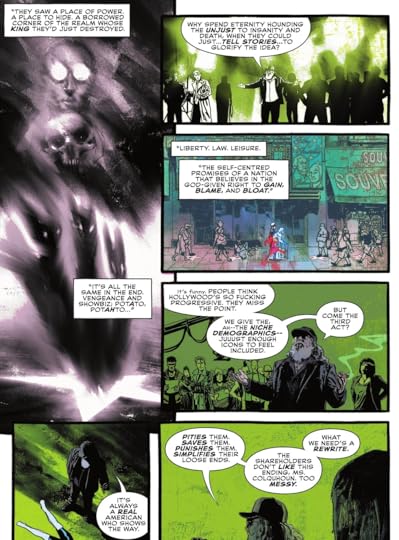
What about the story? John Constantine is dying. He is slowly decaying and dying. He is in America with Nat (I have no fucking idea who the fuck is she) and Noah (somehow his son). I have read only 75 issues of original Hellblazer (because most of them are bad), so I don't recognize these characters. Daniel Hall promises to revive John if he finds out who stole his sand and using it in America. John agrees. The antagonist — the Fates (The Kindly ones) — are a cosmic force for vengeance, eg, infanticides and familial murder and other violations of etiquette. They have situated themselves via Dream sand in one subconscious source of America: Hollywood.
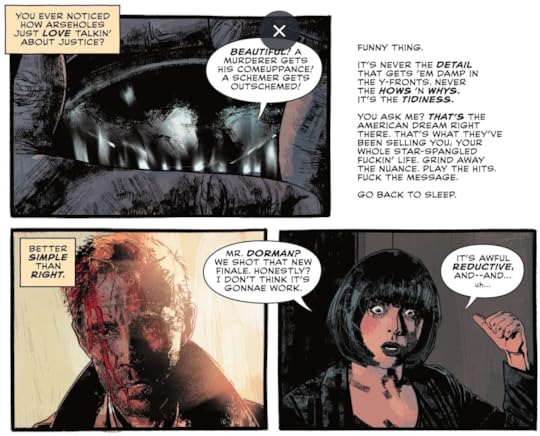
Now Hollywood tells stories; often times, to simplify it, tales of revenge or some force getting their due. And America is a history of story as well, where the ones with power are able to alter the reality to deem what’s right or wrong or appropriate.
Much of American culture — you name any facet of it — can get oversimplified into black and white. Extremes on any side can go unchecked and lose any nuance. In the lack of nuance, dueling narratives will ravage and destroy the other with a ferocity that leans towards vengeance (the Fates) while a better way of tolerance and perhaps forgiveness is the higher choice (what Constantine achieved).
Here, Dream, who is Daniel striving to overcompensate from various traumas and possibly events in the Spurrier The Dreaming series, is enforcing his power for the cosmos to witness. It is a performance so no one will fuck with him. He didn’t care about the loss of sand, nor was he threatened by the Fates in this go around. He was simply squaring debts, playing with the idea people like John can’t use his magics without answering to him, which all led to his goal to murder the Fates. He is the new Dream killing old adversaries and declaring no one can take advantage or challenge the dreaming. Daniel Hall is straight up killing anyone who threatens him. He kills them because The Fates (The Kindly Ones) killed Morpheus, his previous life(?). So he just shows everyone to not fuck with him.
Swamp Thing attacks The Dreaming through Hell and John blackmails him. He asks him to forgive Furies and Daniel does so. He forgives Furies and revives John. BUT, he didn't heal him. He revived him with all his scars and tumors. John has 2 hours before dying. Hahaha, he conned John, the master of cons. In the end, Swamp Thing puts his corpse in the ocean and John dies. Death meets John. But when Death was about to go with John ... he disappears? What happened? Where did John go? The last thing John Constantine said was "How do you confuse an anxious reader?" and then he disappeared. What happened?
We see the trick "Metamancy" in the comics. This is the ability to manipulate the story itself. So in the end, he used it to escape death. The whole story he was trapped in The Sandman story, so in order to escape he has to con the story itself. He broke the fourth wall to escape everything. Wow.
It's the most "John Constantine" ending possible: he won by cheating the rules of his own existence.
But the question, why didn't he used this trick earlier? Why didn't he used it to fight everyone, to heal himself and etc. Apparently, this trick costs a shit ton of yourself, you have to sacrifice your body part to do it, which makes it useless for healing. But why didn't he used it to fix himself, to revive himself? Well, some guy in "League of the Geeks" pointed that metamancy is about controlling story, not reality. Which means, that he just teleported somewhere else, where he can't be found. I still have no idea how the fuck is that supposed to work, how did John learn this shit? So you can teleport somewhere, where The Endless can't find you? Angels can't find him too? What?
Let's break it down. Basically, John Constantine is the player. Angels, The Endlesses and etc. are game administrators. They can ban, revive and basically do tricks players can't do. The God is the game. John found a bug in the game. He used this bug, to hide in non-playable area, so no-one except The God himself can find him. The God can find him, but he wouldn't, because why would he? So John just run away. He tricked everyone. Again. This still doesn't make any sense because John just learnt this shit from nowhere, the shit that High Beings can't do.
The idea of the ending is amazing. Like really amazing, BUT it has SO MANY FLAWS and PARADOXES that it loses its uniqueness. 4/5 ending, to be honest. I would like the ending with John in the Hell more to be honest.
Viniendo de los tomos anteriores donde aprovechaba para retratar la inglaterra del brexit, Spurrier decide llevar a Constantine al país favorito de nadie para darle un carpetazo final a su etapa en Hellblazer con esta miniserie, y lo hace de una manera espectacular.
En estas páginas Constantine y sus acompañantes recorren Estados Unidos entrando en contacto con sus mitos y leyendas mientras buscan los granos de arena de Morfeo, primero con una estructura episódica similar a sus anteriores números pero que acaba diluyendose conforme se acerca el final. Por el camino irán apareciendo tanto viejos conocidos como nuevos personajes extravagantes que Simon utiliza para lo que mas le gusta: hacer una crítica afilada, en este caso a lo que hoy en día representa EEUU como nación.
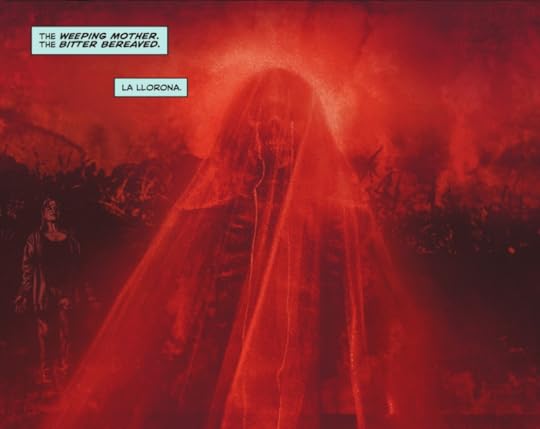
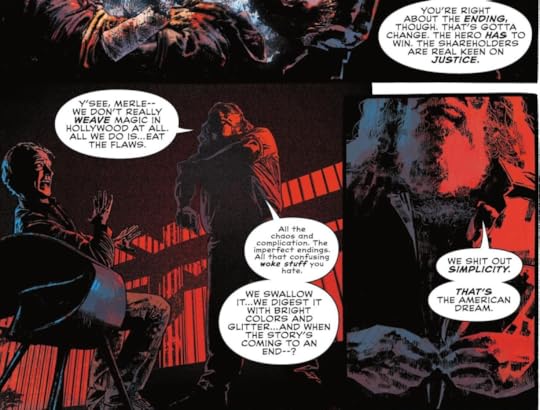
La prosa de Spurrier es a su vez la mayor virtud y la mayor pega de este tebeo, pues es capaz de hacer números brutales como el de la llorona o de dejarnos ideas brillantes como SPOILER ~las furias utilizando la arena de morfeo para influenciar la industria cinematográfica y asentar su idea de la venganza en el imaginario colectivo~ pero por otra parte en ocasiones se recrea demasiado haciendo que la lectura resulte un poco farragosa, pero si se supera esta barrera el resultado es magnífico.
Como cierre a la andadura que comenzaron los autores en 2019 funciona muy bien, dejando en conjunto una etapa muy solida y con un final mas que a la altura, aunque algo a tener en cuenta es que esta historia se disfruta mas habiendo leido comics como la cosa del pantano o sandman, ya que muchos puntos de la trama se sostienen sobre personajes que vienen de estos tebeos, especialmente de sandman.
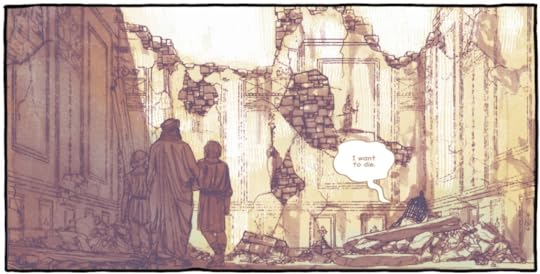
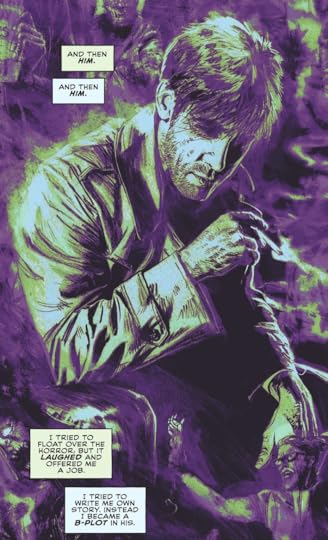
En el apartado visual Campbell se lo pasa en grande, con un dibujo sucio y detallado que en ocasiones se desdibuja como si de una fotografía borrosa se tratase, pero no podría haber dejado un resultado tan memorable sin los colores de Jordie Bellaire, que una vez mas viene a recordarnos que es una de las mejores en lo suyo con unas paletas magistrales que recalcan sobretodo el lado onírico de esta miniserie. Una mención tambien a los artistas invitados, sobretodo a Lisandro Estherren y Patricio Delpeche, que retratan el capítulo del infierno con un estilo mas cartoon y vibrante que le sienta tremendo.
Me consuela saber que lo que para muchos es el final (al menos de momento) de las aventuras del mago sinvergüenza, para mi es otro paso en el camino ya que aun me quedan muchas etapas clásicas del personaje que disfrutar, y después de esta lectura voy a atacarlas con mas ganas.
I never would have guessed Spurrier would get to continue his great but cancelled Hellblazer series, and never would have guessed he’d pivot it so drastically if he could. But he did, and it’s great. Each issue is partially episodic again, but the overarching plot between them feels grander and more urgent this time; there’s a pervasive sense of catastrophe looming in the near future. That’s not to say these issues are a bummer; they’re often very funny in the distinctly nasty nihilistic way Constantine tends to be, while still letting through glimpses of the real heart underneath that sentiment. Aaron Campbell’s stark, realistic art style looks great and compliments the caustically humorous tone Spurrier writes with in these issues.
There’s also a ton of Vertigo-y faces showing up as this goes along, with Sandman and Swamp Thing and a few other threads from that era playing major supporting roles that were fun and interesting (and understandable) to me even having not read many of the actual comics they’re pulling from.
“We anticipate you will lie, cheat and betray in pursuit of whatever flexible definition of the greater good you presently choose to adopt.”
“…it don’t work the way you’re used to. Like…they call it ‘civilized,’ but there’s an asterisk, ain’t there? Tiny little footnote, says: ‘but only if you can afford it.’ And if you can’t? Well, maybe you’re lucky and it don’t actively attempt to kill you…but it sure as fuck won’t lift a finger to save you.”
“Mind you—difficult to judge a culture whose approach to the unknown is to put bullets in it—when you come from one that spent centuries doing the same with flags.”
“Yeahyeahyeah, we ain’t here for the purple fuckin’ wordcount, mate. Vision quest, innit?”
“Mm. Story of the country, innit? Torrents of blood, swept under the rug with a smile ‘n’ a nod.”
“Nowadays it’s not guilt that lives here, but pride. And profit. Nowadays, there’s a new nostalgia in this land.”
“This never used to be here. It’s all been modernized. It’s all been written over!” “Yeah, well. I s’pose everythin’s a palimpsest when you’ve been around long enough.”
Not before time, Spurrier, Campbell and Bellaire get chance to wrap up their Hellblazer run; and not for the first time, comics' greatest cynical Brit crosses the fishpond to prod at what's happening with the American dream. It's par for the course that DC's other occult characters, US pieties, and humanity's myths and legends will come in for some rough handling along the way – though I still laughed out loud at one Roman rewriting which made perfect sense as soon as I saw it expressed. But what really surprised me was the willingness to play fast and loose even with Sandman itself, cornerstone of this whole imprint. They mostly get away with it, just like John always does, however much collateral damage he leaves in his wake – though this time he really is trying not to do that, which made for an interesting wrinkle. The unsparing take on quite how curdled the States have got is leavened with some merciful darts of humour, not least the quiet-part-out-loud of having Constantine and co. doing their big Stateside road trip in a Routemaster. I was also taken with the savage ingenuity of having Etrigan rhyme John's name as though it were pronounced Constanteen; how better to indicate what Hell really is? But more than anything, I was impressed going on unsettled by how often the delay in production worked to the story's benefit. Even leaving aside the time taken from writing through art, printing and shipping, I bought the penultimate issue on Hallowe'en, read it a week later, and in the intervening period its eloquently damning summations of America had been distilled to a vastly greater strength without a thing changing on the page. Similarly, the portrait of the Dream King as a far less sympathetic picture than he's often been presented in the past...well, definitely the right year for that too. I can't think of a better team to keep telling the tale of one of DC's two best characters, but if they do leave it here, what a brilliant run.
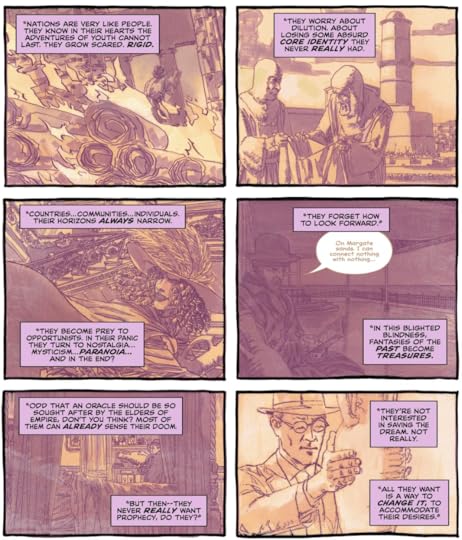
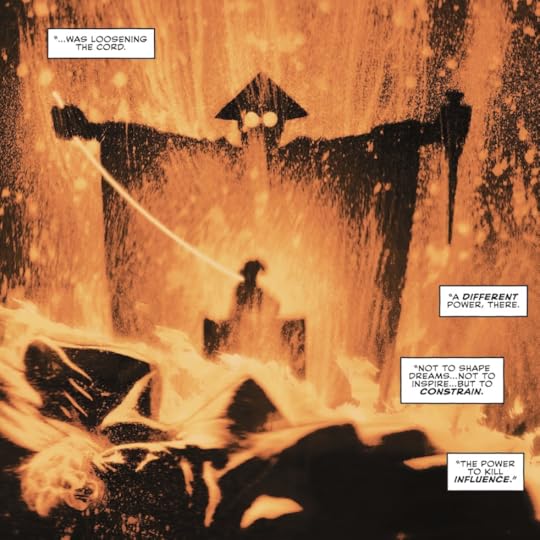
It was something. Each word balloon taxed my mental powers of interpretation. It did not help that sometimes the art was so mystical and shadowy and obscured with a color palette of nearly identical shades of red or green or brown or ochre that it makes things muddy and indistinct.
It was a very intensive, cerebral, complicated and complex read that literally boils down to something akin to a spiritual successor to Hellblazer and The Sandman and American Gods: it's a roadtrip fetchquest meandering search for the heart of America, to find what's poisoned this great land and who or what is using Dream of the Endless's mystical sand to twist the American Dream and make everything ten shades darker than it should be.
Enter tirades and multiple POVs about mythic figures and culture wars and cryptids and demons and cult leaders and Hollywood starlets and lore about vampires--and a literal walking zombie in the form of Constantine shambling about and trying to hold his ragtag group of United Kingdomers alive and thriving in the foreign soil of the USA that they have been thrust inside and through which they meander along its highways and byways, always a step behind the malicious forces that daunt them.
John's a liar, but he's smart and knows who to use as sacrificial lambs and how to approach characters who might be antagonistic if they knew what he was really plotting.
It's really a very long-winded character piece that thrusts you into this twisted world full of wrath and anger and injustice, with our characters coasting by by the skin of their teeth, dealing with complexities far beyond the ken of mortal man.
You need a ton of prior reading to even remotely appreciate the bulk of this tale, but for what it's worth, if you have patience and can take it slowly, you'll find something weird and unsettling and deeply ominous.
Is it worth reading? It depends on your mileage. Not for the faint of heart.
Spurrier returning Constantine to his peak, classic style.
This book/series follows up Spurrier and Campbell's previous run on the book, which had been ended prematurely. It is definitely a direct continuation, so you will get more enjoyment if you read that run, but it isn't necessary.
We have here a full, classic Hellblazer story, based entirely in the world of Vertigo from the late 80s up through the mid 90s. The central conceit is based on the early issues of Gaiman's Sandman, but the story itself feels much more like Delano's Omnibus 1 (meaning, Delano, plus some Swamp Thing).
The art is excellent throughout (with the possible exception of an issue in the middle which has guest artists), and Spurrier really does give us the Constantine that we knew in the classic days, scheming and all. (well, except for more leaning into the bi side than the original run really was ever explicit about)
Like Delano, there's a lot to unpack in the story, and not all of it succeeds on every level, or at least not on the first read. I recommend reading only a couple of issues at a time, no rush, and making giving a re-read a while later.
Like classic Constantine, the ending is not quite perfect, and leaves a bit to be desired, but it's still a heck of a ride along the way. I'm very curious to see whether the next run we get of the character will keep what occurred here, or act like Black Label is some sort of Elseworlds.
One of the biggest tragedies in recent memory in comics was the cancellation of Si Spurrier and Aaron Campbell's Hellblazer series before it got to finish the story they wanted to tell. Thank Darkseid, the DC gods have seen sense, and the pair reunite for this eleven issue series that does just that.
Sending John and his latest group of friends both old and new on a cross-country American roadtrip at the behest of Dream Of The Endless himself, Dead in America is a scathing look at the American Dream and all its fallacies, told with Spurrier's usual flair and wit, with the occasional C word thrown in because it's a Vertigo book and it should have at least one. We get a trip to Hell, some Swamp Thing, some deep cut Hellblazer characters, and an all-around good time (to read, John has a terrible time) from cover to cover. The jam session issue midway through is a bit of a momentum killer, but I expect it was included so that Campbell could finish up the rest of the series in time, and it's as solid as even the worst of the original Vertigo run's one-and-dones.
Bravo. I'm glad we got to see this, even if it took a lot of yelling to get it.
Really disappointed in this one- I don’t want to say I told you so, but I have never read Sandman because Neil Gaiman always gave me the creeps. He was like the most “nice guy” I had ever seen and I knew he was up to no good so I always steered clear of the series, please don’t look at the other books I’ve read by other perverts. I’m a man of contradictions.
With that being said, I have loved the Spurrier run on Hellblazer and found his idea of pursuing America really intriguing. This was not at all what I was expecting or hoping I really feel like there is a great Hell blazer story in here, but this just felt like a slog. The art is brilliant and there are interesting moments like the cryptid convention and of course the evils of Hollywood but it just failed to connect.
'Dead in America' is a pretty good Hellblazer story. Offering up full servings of supernatural Maguffin chase, self-loathing, and social commentary, the comic moves briskly and offers a creative visual style.
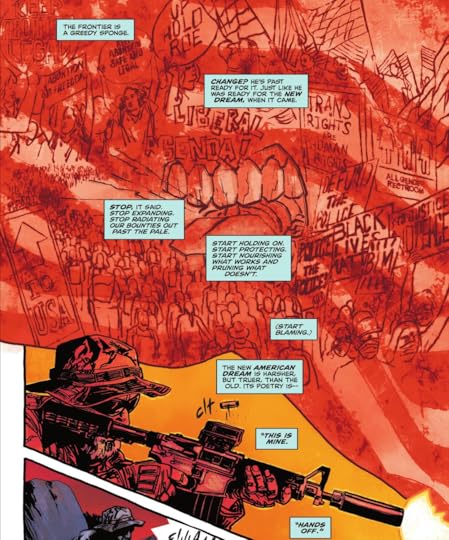
It's hobbled, however, with a moral viewpoint somewhere between "angry college kid" and "disillusioned twenty something." Its take on the American experience is superficial, not getting much past your basic accusations of shallowness, greed, and racism. And the artwork, while audacious, sometimes borders on the incomprehensible.
Nevertheless, 'Dead in America' does tell a compelling story that kept me engaged through its climax. I liked it. I recommend to those attracted to the weird, sad, bereft little moral universe occupied by John Constantine.
I expect m a lot of people will disagree with me about the rating.
Constantine has cut too many bargains and ravaged his body too much. The bill has come due and as part of an attempt at penance, and stretching things out, John and some companions go on a road trip across America.
This story compares well to Alan Moore's similar Swamp Thing story where he had that character travel the country, and he found some disturbing things (like vampires, and serial killers).
John find the underbelly of the USA. But, what is disturbing is how some of what he finds runs very close to real life.
Uff, was ein psychedelischer Trip ey! Ich hab ehrlich gesagt kaum was von der Story verstanden, haha 😅 John ist tot, wird von einem Geist besucht, der seinen Sand zurück will und deswegen sind er, sein Sohn und Nat unterwegs den zu finden. Zuhause in England werden sie nämlich wegen Mordes gesucht und nun sind sie nach Amerika geflüchtet. Sie erhoffen sich nach erfolgreicher Suche alles wieder gerade zu biegen.
Zwischendurch dachte ich echt, ich wär auf nem Drogentrip. Die Zeichnungen sind anfangs noch sehr ähnlich, aber zum Ende hin ändern die sich dann doch nochmal extrem. Ich mag die grotesken Bilder und dass es ziemlich abgefahren ist. Aber ich verstehs leider nicht wirklich! 😂
2 stars only, for the following reasons. The story wasn’t bad. And the ending was spectacular. However. It was both too topical, and very obviously gratuitously ‘PC/woke’. Personally, I read books to get away from the depressing state of the real world. Additionally, the book itself is missing Sandman Universe branding. For no good reason other than the guilty before innocent mentality the world has today. It’s still going on my NG booklist, but it’s a shame that pushing agendas and cancel culture have successfully infiltrated the world of literature. That said, this is unsurprising coming from DC Comics.
Despite a few lulls this was a good story. Spurier really 'gets' Constantine and it was a shame his ongoing series was cancelled. Here we are treated to some old favourites - Swamp Thing, Morpheus, Etrigan - and some solid new characters. The whole is a riff on the American Dream (Nightmare) as dead John crosses the U.S. on a quest for Dream's pouch of sand whilst getting up to his usual wheeling, dealing shenanigans. A solid tale with the usual high stakes which left me constantly wondering, "How is he going to get out of this one?
the level of detail and care brought to the story by the entire team remains so remarkable, as always. and its best in the middle, when weaving the characters through a road trip of american mythology. unfortunately I found that adding so many and so much of heavy hitters from the vertigo universe weighed down the best parts of what had previously made the JCH series so exceptional.
it still worked, totally, but I did feel as if I was missing out on the impact for not being a diehard vertigo-head. still, an impressive work and I'd definitely be delighted to see more
Read the singles digitally, The only thing stopping me from giving this a 5 is how much spurrier still doesn’t understand Dream and the Dreaming. Outside of the Swamp Thing / Daniel issue, the pacing is also not perfect considering the sheer number of extensions this had. Other than those issues it’s as close to a perfect Hellbalzer it can possibly be.
I'm both at a loss for words and with lots of things to say about Hellblazer: Dead in America. However i'll give some days to fully process it to form a better judgement. I'll probably come back to this review when the physical book is released on February. In the meantime, i can only say that if this is supposed to replace Milligan's conclusion of Hellblazer, I wholeheartedly accept it tbh.
Spurrier does a great job of really highlighting the greats of Vertigo, including not just John and some of his classic cast, but also Swamp Thing and others.
The stories vary. Some are entirely great one-and-dones. Some are a little slow going, but they all have some real oomph to them.
This book’s by no means perfect, it’s a few issues too long, and still feels like it skips some steps towards the back end, but the first few issues and the last two were absolutely spectacular, the third issue especially is one of my favorite I’ve ever read. All of that puts it at an easy 4.5-4.75/5 even if the middle drags a bit.
This is really pretty good, though a bit long-winded and repetitive. Would have been much tighter (and, better?) as an eight-issue series than eleven. Great to have this team on this title once again--in a just world, they would have been telling us Hellblazer stories for time immemorial.
What a bold and definitive conclusion to the Hellblazer's story. The greatest conman indeed.
If you put this together with his previous run, Spurrier has joined Delano and Ennis in the podium of Hellblazer writers. And he might not even be in the third spot.