Jump to ratings and reviews
Rate this book

The Star:

Rate this book
It was on the first day of the new year that the announcement was made, almost simultaneously from three observatories, that the motion of the planet Neptune, the outermost of all the planets that wheel about the sun, had become very erratic. Ogilvy had already called attention to a suspected retardation in its velocity in December. Such a piece of news was scarcely calculated to interest a world the greater portion of whose inhabitants were unaware of the existence of the planet Neptune, nor outside the astronomical profession did the subsequent discovery of a faint remote speck of light in the region of the perturbed planet cause any very great excitement.

26 pages, Paperback

First published January 1, 1897

15 people are currently reading
895 people want to read

About the author

H.G. Wells

5,366 books11.1k followers
Herbert George Wells was born to a working class family in Kent, England. Young Wells received a spotty education, interrupted by several illnesses and family difficulties, and became a draper's apprentice as a teenager. The headmaster of Midhurst Grammar School, where he had spent a year, arranged for him to return as an "usher," or student teacher. Wells earned a government scholarship in 1884, to study biology under Thomas Henry Huxley at the Normal School of Science. Wells earned his bachelor of science and doctor of science degrees at the University of London. After marrying his cousin, Isabel, Wells began to supplement his teaching salary with short stories and freelance articles, then books, including The Time Machine (1895), The Island of Dr. Moreau (1896), The Invisible Man (1897), and The War of the Worlds (1898).

Wells created a mild scandal when he divorced his cousin to marry one of his best students, Amy Catherine Robbins. Although his second marriage was lasting and produced two sons, Wells was an unabashed advocate of free (as opposed to "indiscriminate") love. He continued to openly have extra-marital liaisons, most famously with Margaret Sanger, and a ten-year relationship with the author Rebecca West, who had one of his two out-of-wedlock children. A one-time member of the Fabian Society, Wells sought active change. His 100 books included many novels, as well as nonfiction, such as A Modern Utopia (1905), The Outline of History (1920), A Short History of the World (1922), The Shape of Things to Come (1933), and The Work, Wealth and Happiness of Mankind (1932). One of his booklets was Crux Ansata, An Indictment of the Roman Catholic Church. Although Wells toyed briefly with the idea of a "divine will" in his book, God the Invisible King (1917), it was a temporary aberration. Wells used his international fame to promote his favorite causes, including the prevention of war, and was received by government officials around the world. He is best-remembered as an early writer of science fiction and futurism.

He was also an outspoken socialist. Wells and Jules Verne are each sometimes referred to as "The Fathers of Science Fiction". D. 1946.

More: http://philosopedia.org/index.php/H._...

http://www.online-literature.com/well...

http://www.hgwellsusa.50megs.com/

http://www.britannica.com/EBchecked/t...

http://en.wikipedia.org/wiki/H._G._Wells

Ratings & Reviews

What do you think?
Rate this book

Friends & Following

Create a free account to discover what your friends think of this book!

Community Reviews

5 stars
321 (20%)
4 stars
554 (35%)
3 stars
541 (34%)
2 stars
125 (7%)
1 star
27 (1%)
Displaying 1 - 30 of 206 reviews
Profile Image for Adina.
1,296 reviews5,523 followers
November 22, 2023
Read in The Big Book of SF anthology

H.G. Wells is a master of the classic SF, that cannot be refuted. However, I did not know he also writes excellent short stories and that he possesses a fine knowledge of the human psyche.

One day, a luminous star appears in the sky. It is newly formed and it seems that it will swallow the earth in its expansion. It was an excellent short account of the Apocalypse.
Profile Image for Alex ☣ Deranged KittyCat ☣.
654 reviews434 followers
May 24, 2016
“It is brighter!” cried the people clustering in the streets. But in the dim observatories the watchers held their breath and peered at one another. “It is nearer!” they said. “Nearer!”

description

Me and my good friend Sandra decided on a May Short Story Month Marathon that would last this week. We are to read as many short stories of our choosing as we like. We started this as we had a similar experience at the end of last year, when we read a few at the same time (by coincidence only). Not to mention, we like discovering these precious, little gems.

Now, back to H.G. Wells' story, I loved it. I'm an addict of space and space related knowledge. If I need to relax, I just watch a Solar System documentary. So The Star fit me like a glove.

The premise is that a rogue planet hits Neptune, merging with it and setting it on a collision course with the Sun. The problem is Jupiter alters its course so as it might hit or pass closely by Earth. As the star approaches our planet, the night gets brighter and brighter, violent storms and earthquakes take place and people start dying.

What impressed me the most was the ending:
➊ The fate of the Earth. (<--- I didn't see that coming!)
➋ The alien astronomers observing our planet.

Which only shows how small the vastest of human catastrophes may seem at a distance of a few million miles.
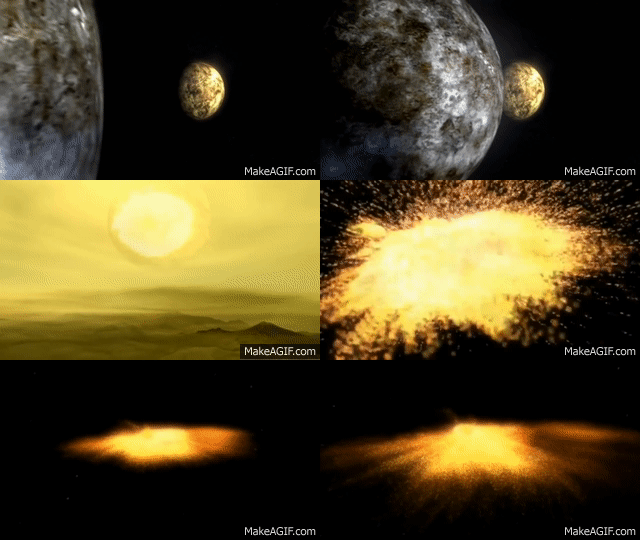
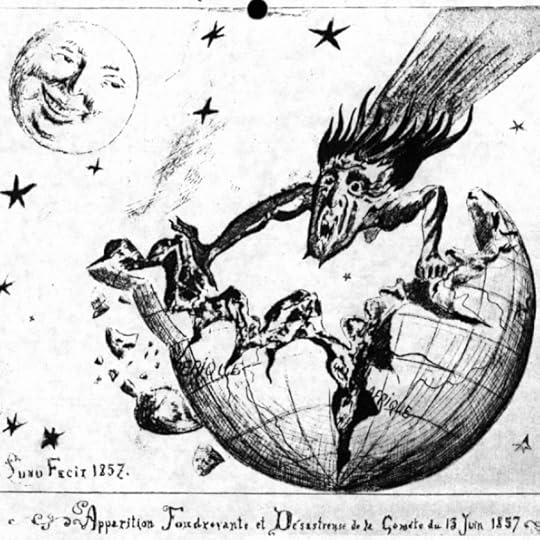
P.S. You can read The Star here.
Profile Image for Lynn.
224 reviews33 followers
July 28, 2019
In 1986 I took a college course entitled Science Fiction Literature. Our textbooks were Science Fiction: A Historical Anthology and The Science Fiction Hall of Fame #1. I have begun rereading many of the short story selections from these books recently. Over the last 32 years memories of these stories have stayed with me. They are that good and that memorable. My copy of Science Fiction: A Historical Anthology pairs this short story by H. G. Wells with The Star. Arthur Clarke wrote his version of "The Star" in response to "The Star" written by H. G. Wells.

"The Star" by H. G. Wells is remarkable in its freshness considering it was written in 1899. The science is remarkably good for the time period. It concerns an astronomical event which impacts the people of Earth. It is well worth the time to read.

"The Star" by Arthur Clarke was written in 1955 as a response to the H. G. Wells story. It is a story that will stay in your memory for decades. This too is about an astronomical event and its impact upon the people of Earth, but with an ending which will give the reader much to contemplate.

Both of these stories were written at a time when people could still believe there was senscient life on each planet of our solar system, or on planets surrounding nearby stars, and that this life thought and behaved much as we do. This innocent belief is part of their charm.
Profile Image for Karla.
1,455 reviews367 followers
September 8, 2024
Story 3.5 stars**
Audio 3.75 stars**
Narrator Greg Wagland
Profile Image for Tracey.
459 reviews90 followers
December 31, 2018
Scary, cataclysmic, disaster short story, published between The time machine and The war of the worlds.
This mans imagination is phenomenal, his descriptive writing second to none.
4*
Profile Image for Raffaello.
197 reviews74 followers
May 7, 2021
Racconto apocalittico davvero notevole tenendo in considerazione che è datato 1897.
Profile Image for Manuel Alfonseca.
Author 80 books214 followers
April 4, 2021
ENGLISH: In 1897, Wells published this story about an astronomic catastrophe that would take place at the beginning of the twentieth century, when an extrasolar planet arrives at our solar system, collides and merges with Neptune, and creates havoc in the Inner Solar System.

Wells takes advantage of the catastrophe to introduce his ideas about the future of human society, in the same way as in his novel The World Set Free, although in much less detail, as this is a short story. See my review of Wells' novel here: https://www.goodreads.com/review/show....

ESPAÑOL: En 1897, Wells publicó esta historia sobre una catástrofe astronómica que tendría lugar a principios del siglo XX, cuando un planeta extrasolar llega a nuestro sistema solar, choca y se fusiona con Neptuno, y crea estragos en el Sistema Solar Interior.

Wells aprovecha la catástrofe para presentar sus ideas sobre el futuro de la sociedad humana, de la misma forma que en su novela The World Set Free, aunque con mucho menos detalle, ya que se trata de un cuento corto. Véase aquí mi reseña de la novela de Wells: https://www.goodreads.com/review/show....
Profile Image for PinkPanthress.
268 reviews82 followers
August 27, 2025
A brilliant short story. 🌠 Hard to believe it was published in 1897 — and yet, it still managed to creep me out a bit in 2025.
The pacing, the choice of words, the slow build of dread and despair... it’s short, but oh so powerful.
I could feel it, the anticipation and all.

What struck me most was the theme of cosmic indifference — how something so vast and distant could wreak havoc on Earth without malice or intention. It’s not a villain we can fight, not a disaster we can predict. Just the cold, silent mechanics of the universe doing what it does. That idea unsettled me more than anything, like a monster, demone, etc., ever could.

Reading it made me feel small, but not in a bad way — more like I was reminded of how fragile and miraculous our little planet really is. It’s eerie, humbling, and weirdly beautiful.

Minor Spoiler

A short story of about ~10 pages / ~34 minutes.

The Links for you to enjoy it for free.
For your ears -> »The Star« @ Youtube
For your eyes -> »The Star« @ ProjectGutenberg

Auähhh!
Profile Image for Alison Raleigh.
20 reviews1 follower
March 19, 2014
In the selected readings by H.G. Wells, the stories show very compellingly what happens when a person tinkers with science, visibility, control, biology and religion. These stories are powerful and frightening at times and challenge our notions about humanity, ethics and social structure. “The Star”, however, is distinctly different in that it shows how powerless mankind is in reality to the might of the universe. It shows what nature can do to us and not how mankind can control nature.
Wells wants to contrast the immensity and size of the universe to the inconsequential incidentals with which mankind concerns itself. The narrator expounds that “few people without a training in science can realize the huge isolation of the solar system.”
The seriousness of the new star is noticed at first only by scientists, while the average person failed to care past their own little world to give much notice to the event taking place. “’What is a new star to me?’ cried the weeping woman, kneeling beside her dead”, while “pretty women, flushed and glittering, heard the news told jestingly between the dances, and feigned an intelligent interest they did not feel.” As the star grew nearer, people continued to be nonplussed, and “save for the talk of idle moments and the splendor of the night, nine human beings out of ten were still busy at their common occupations.” Wells is suggesting that humans are merely interested in what directly affects their own lives: “Do we come in the way? I wonder —” asks the school boy.
The devastation sustained by the star was inevitable, and there was nothing, not even the learned scientists, could do to stop it. Prayer was futile. The havoc and destruction changed the earth irreversibly.
Compared to the other Wells selections, “The Star” shows the overwhelming domination of nature and the pettiness of mankind in comparison. As the master mathematician says, “Man has lived in vain.”
Profile Image for Abdel Aziz Amer.
981 reviews111 followers
August 6, 2018
الحكمة من هذه القصة كتبها المؤلف في آخر سطر فيها .. وهي أن أشد الكوارث البشرية لتبدو ضئيلة إذا نظرت إليها من على بعد بضعة ملايين من الأميال.

يتعرض كوكب نبتون أبعد كواكب المجموعة الشمسية عن الأرض للإصطدام بكويكب آخر يؤدي إلى هلاكه ويستمر الجسم في حركته العشوائية في الفضاء .. وأيضاً الناس على الأرض مستمرة في الحركة تمارس حياتها العادية .. فما قيمة إصطدام كويكب بكوكب آخر بعيد عنا لا نعرف عنه أي شئ؟ .. حتى يأتي اليوم الذي يصحو فيه الناس على ظهور جسم غريب مضئ أشبه بالنجم ولكنه أكبر وكل يوم يزداد حجماً .. يتنبأ عالم رياضيات بحدوث إصطدام وشيك بيننا وبين هذا النجم .. ولكن الناس تسخر ولا تهتم .. حتى تحدث الكارثة وتنهار الحياة على كوكب الأرض.

من بعيد يشاهدنا سكان المريخ ويسجل علمائهم أن الإصطدام الذي حدث لم يسبب إلا خسائر بسيطة للأرض يتمثل في إنكماش اللون الأبيض (الجليد) الموجود عند القطبين !!
Profile Image for Jessica.
425 reviews
June 4, 2014
The overall idea of the story is good, but I just don't care for H.G. Wells. I've read books by him, that after finishing I think, "wow that was really good." but while reading the story I think "JESUS! JUST GET ON WITH IT!" he seems to drag things out so so so so long! This was a short story that could have been told in four pages, but he just kept going on with it. I think it must be the time difference between when it was written and now. I understand why he's considered a great SF writer. The ideas he has are wonderful. I just don't care for his writing style.
Profile Image for Sacha.
343 reviews102 followers
May 20, 2025
The Star by H. G. Wells

⭐️⭐️⭐️⭐️ (4*)

I came across this story on a YouTube channel that narrates many different shorter books, most of which are not that well known. "The Star" by H. G. Wells was one of them. Wells is a true master of sci-fi, and I really liked this story. The writing style is easy to follow and feels very scientific. It's fascinating that it came out in 1897 but still manages to be so accurate and thoughtful in its scientific descriptions.

„The people of Earth awaken to the news that a strange luminous object has erupted, into the Solar System, after disturbing the normal orbit of the planet Neptune. Although initially it is only of interest to astronomers, eventually the world media announces that it is a whole star, heading in a collision course toward the center of our star system. The star has already consumed Neptune.“

The initial reaction of the so-called normal people was surprising and a bit unsettling. I'm not sure if we would react the same way today. Then again, with all the information we have and the constant stream of news from around the world, maybe we would. We all have to filter the noise and decide for ourselves what really matters.
I also found it shocking to see what such an event could mean for humanity and how many lives would be lost, while the planet itself just keeps spinning. That hit hard. It really shows how small and fragile we are in the grand scheme of the universe.

The story could have been a bit longer, but it still delivered its message effectively. Solid 4 stars from me.

Want to see more reviews from me or looking for other book-related content, check out my blog: https://sachareads.com 🙂
Profile Image for Rachael.
607 reviews98 followers
January 1, 2020
You can read this for free online here. A very good short story that shows how good HG Wells' writing is. Plus, if you swap the star for climate change then you have a very frightening idea about what could happen to our planet.
Profile Image for Brian .
429 reviews5 followers
January 30, 2019


"The Martian astronomers...were naturally profoundly interested by these things...one wrote, 'it is astonishing what little damage the earth, which it missed so narrowly, has sustained'. ...Which only shows how small the vastest of human catastrophes may seem, at a distance of a few million miles."
The Star, H.G. Wells

A distant bright spot in the sky grows larger every day. Following calculations of a Doomsday Mathematician spreading over the world, the calculations prove correct. The distant star comes closer, grows to the size of the moon, approaches the sun and the earth. As it draws near, ocean tides cover the earth, spreading floating bodies. Earthquakes swallow mountains and cities. Volcanoes spew blankets onto cities in a goodnight embrace.

H.G. Wells amazes me. I underestimate him. I should know by now the unwise choice to underestimate the old. The man's writing grips my gut in deep terror. This story made me feel like a child again, fearing the nuclear warheads of the eighties, the impending destruction of humanity, gone in a ball of flame. It almost brought tears of fear to my eyes. That shows literary power.

Profile Image for Delmy .
148 reviews
January 6, 2015
Well, this is my least liked H.G. Wells. Even though it was a short read, it was weirdly boring. I am not even sure what the point of the story was supposed to be, it seemed like it was going nowhere.
Profile Image for Tim Pendry.
1,154 reviews488 followers
July 27, 2018

Published in 1897, this story appeared two years after 'The Time Machine' and a year before 'War of the Worlds, containing themes of huge scale (space rather than time) from the first and intimations of the second with its passing reference to the observations of Martian astronomers.

It is a tale of near-apocalypse told in clinical and detached terms with little direct human drama whose main purpose is to trigger a feeling of awe not only at the immensity of space but of the random chance within it and the material insignificance of humanity faced with raw natural power.

Indeed, for all its pretension to be a tale of scientific vision, this story owes just as much to religious discourse as scientific. Like God, nature is (in this story) unknowable and surprising, with immense power to which we are but as flies. More pagan than Christian perhaps but bigger than us.

It was perhaps an expression of widespread cultural anxiety as science displaced God in the popular mind. It presents us with something that might be known but was not yet known. This was both impersonal and experienced by us as random, even if scientists might eventually master its laws.

Knowing the laws behind such major events might not, in fact, avail our survival if we discovered that the forces involved were so great that there was nothing we could do to avoid our near or actual annihiliation if we got in the way.

About two decades later Lovecraft would be working up such themes to a new level of despair and horror, replacing the old God or gods with unknown creatures who would have near god-like cosmic powers and be uninterested in our paltry existences as much as the 'star' of this story.
Profile Image for Mónica Cordero Thomson.
554 reviews85 followers
August 15, 2018
Alucinante.
Este relato corto me ha dejado impresionada y a la vez con los pelos de punta.
Escrito en 1897, este hombre se adelantó a uno de los miedos del siglo XX, sobre un posible impacto de un cometa sobre la tierra. Y además lo hace coincidir con el cambio de milenio. Un genio.
Están muy bien descritas los posibles efectos geológicos (mareas, subida de la temperatura, desaparición de los casquetes polares,...) pero también del miedo o escepticismo de la humanidad.
Es increíblemente extraordinario como en estas líneas describe este posible fenómeno mejor de lo que han hecho un gran número de películas, que obviamente beben de aquí.
Magnífico.
Lo primero que leo de H.G. Wells, y sin duda no será lo último. Me ha dejado impactada,...
Profile Image for Ramsey Meadows.
316 reviews26 followers
March 1, 2022
This story had a very ominous feeling. Something called the star which is beyond Humanity’s control devastates the Earth. On the way towards Earth there is the wait for impending doom. I found it very interesting.
Profile Image for Iván López.
41 reviews
February 20, 2025
Esto es una mezcla entre un documental cutre de la 2 y un timeline cutre de gente asustada.
Profile Image for Marcelo Toledo.
186 reviews1 follower
March 24, 2024
Gostei, é um conto de ficção científica que descreve a chegada de uma estrela passando pela órbita da Terra. A história é contada a partir da perspectiva de um astrônomo que observa a estrela se aproximando e prevê as consequências catastróficas que ela trará ao planeta.

Profile Image for Bassant.
14 reviews
November 13, 2025
❞ إنْ دلَّ ذلك على شيء، فإنما يدل على مدى ضآلة أشد الكوارث البشرية وأوسعها نطاقًا حين يُنظَر إليها على بُعْد بضعة ملايين من الأميال. ❝

⭐️⭐️⭐️⭐️½

ليست مجرد قصة عن نجم يقترب من الأرض، بل عن الإنسان حين يقف عاجزًا أمام اتساع الكون.
هربرت جورج ويلز كتب عن هشاشتنا، عن خوفنا، وعن غرورنا الذي يتهاوى أمام قوة لا نهائية.

القصة تبدأ برصد فلكي هادئ، لكن مع اقتراب الجرم السماوي، تتحوّل الأرض إلى مسرح للكوارث: فيضانات، زلازل، وانقلاب الطبيعة. وبينما النجم يمر، يبرز سؤال صامت: هل نحن فعلاً مركز الكون، أم مجرد نقطة صغيرة تتأرجح في فضاء لا يعرفنا؟

ما يجعل القصة عظيمة ليس الدمار فقط، بل ردود فعل البشر، وتباين تصرفاتهم بين الخوف والإنكار والبحث عن تفسير علمي.
اللغة دقيقة، والخيال ممتد بين الواقع العلمي والرمزية، لتترك القارئ في مواجهة صامتة مع نفسه ومع الكون.
Profile Image for Mennah.
132 reviews42 followers
December 18, 2024
❞ إنْ دلَّ ذلك على شيء، فإنما يدل على مدى ضآلة أشد ا��كوارث البشرية وأوسعها نطاقًا حين يُنظَر إليها على بُعْد بضعة ملايين من الأميال. ❝
March 13, 2025
DePenguin books, 2007.
A typical journalistic language style, we are presented to an end of the world, or a potential end of the world in the danger of an asteroid collision with the Earth.
The language is thus not full of elements of language actualization ( in the sense of the theoretical work of Viktor Šklovski), so it wasn't so interesting to read.
This short story is a paradigmatic example of Wells's zeitgeist. The nineteenth century was a hyperscientific, ultrarationalist and steelish time to live in.
The time of Darwin, Marx and eugenics.
How they were all wrong.
The nineteenth century was the true dark age, not the luminous Middle Age of Thomas Aquinas.
It's so sweet how Wells thought that our physical reality is a "world".
Hasta luego mis murciélagos!
Profile Image for Hákon Gunnarsson.
Author 29 books162 followers
April 18, 2017
This H. G. Wells short story may not be the most suspenseful science fiction tale you're going to read, but I found it strangely relevant in today's world. It's not as if it is predicting anything that is about to happen, but still there was something about that it rings true.

In some sense it shows it's age. It does that for example in the roles of women, or lack of them in the story, and perhaps in its slowness, but I still think it is a good story. It's wonderfully descriptive, and it slowly, but surely builds up to a quite interesting ending.
Profile Image for Paula.
314 reviews82 followers
September 5, 2019
3.5 stars

"The Martian astronomers--for there are astronomers on Mars, although they are very different beings from men--were naturally profoundly interested by these things. They saw them from their own standpoint of course. 'Considering the mass and temperature of the missile that was flung through our solar system into the sun,' one wrote, 'it is astonishing what a little damage the earth, which it missed so narrowly, has sustained. All the familiar continental markings and the masses of the seas remain intact, and indeed the only difference seems to be a shrinkage of the white discoloration (supposed to be frozen water) round either pole.' Which only shows how small the vastest of human catastrophes may seem, at a distance of a few million miles." 
Profile Image for Cassandra Kay Silva.
716 reviews337 followers
October 18, 2020
I listened to this on Audiobook on youtube and the reader on there was absolutely phenomenal. It has some brilliant background music and was highly gripping in that format. I don't know if I would have enjoyed it as much without that format so please listen to that way if you are considering this one. I really thought it looked at some of humanity and how it deals with Chaos in a mass scale taken back view which I really thought was interesting and different. I really liked it.
Profile Image for Scott Whitney.
1,115 reviews14 followers
February 1, 2022
I am using this story to help teach theme to my students by comparing this theme to "There Will Come Soft Rains."

I like this story, but if I can find another with a theme closer to the other story in this pair, I would change this one out. My students do not like it as much as I do. Any suggestions for a different story, which has a theme of technology continuing on despite humanity destroying itself, would be appreciated.
Profile Image for Julia Leporace.
143 reviews7 followers
November 18, 2018
“The sun with its specks of planets, its dust of planetoids, and its impalpable comets, swims in a vacant immensity that almost defeats the imagination.”

The first paragraphs reminded me of Melancholia by Lars von Trier.
Displaying 1 - 30 of 206 reviews

Can't find what you're looking for?

Get help and learn more about the design.