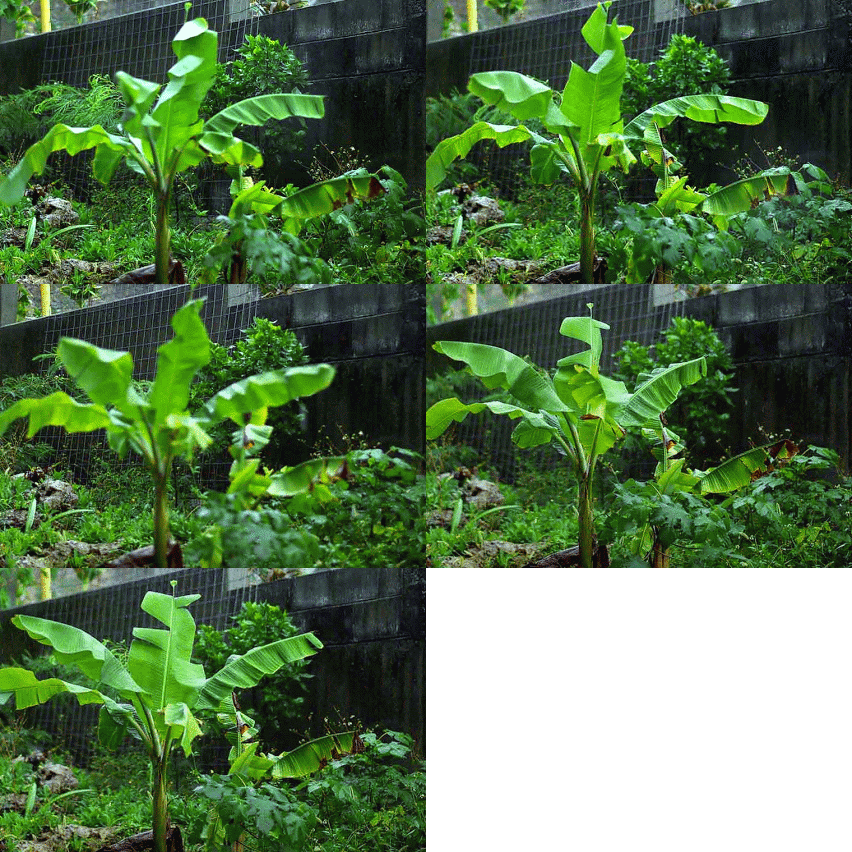
A deadly fire rips through the American Fruit Company's most lucrative banana plantation, destroying all evidence of a massive cover-up.
That same night, Teresa Cepeda Valverde’s mother is murdered, and her husband vanishes into the darkness.
Decades later, as a hurricane twists through the streets of Barrio Ávila, Teresa’s estranged daughter Lyra begins to piece together the mysteries lost in the blaze. In her desire to find the truth of her own family's rupture, she uncovers a web of devastating betrayals, stoked by machismo, jealousy and greed.
Where There Was Fire brims with ancestral spirits, omens and the forces of nature. John Manuel Arias’s extraordinary debut novel weaves a brilliant tapestry of love – lost and found again – and, ultimately, redemption.
John Manuel Arias is the National Bestselling author of Where There Was Fire, named a Best Debut by Apple Books and a Finalist for the Barnes & Noble Discover Prize. A Canto Mundo fellow & an alumnus of the Tin House Summer Writers Workshop, his prose and poetry have been published in Harper's Bazaar, Electric Lit, The Kenyon Review, and PANK. He has lived in Washington D.C., Brooklyn New York, and in San José, Costa Rica with his grandmother and four ghosts.
A lethal fire in one of the most profitable banana plantations owned by the American Fruit Company in Costa Rica in 1968 ended in a night of personal tragedy for Teresa Cepeda Valverde ‘s family. Following the tragic death of her mother Amarga and the disappearance of her husband of eleven years José María, employed with the company, Teresa leaves for the United States, leaving her children, eleven-year-old Lyra and eight-year-old Carmen, in the care of friends. The tragedy and secrets that surround their family, their mother’s abandonment and her abrupt return six years later cast a long shadow on the lives of both sisters – the impact of which follows them into their adult lives. Twenty-seven years later, we meet adult Lyra, a fertility counselor in San José who is raising her deceased sister’s ten-year-old son. Estranged from her mother, who is approaching her sixtieth birthday and has recently been diagnosed with cancer. Lyra tries to piece together her family’s history with the American Fruit Company, the cover-ups, corruption and how the same poisoned their lives in more ways than one. Will her sixtieth birthday celebrations help bridge the rift between Teresa and her daughter and pave the way to healing or will the revelations that come to light tear them further apart?
With its strong premise, an atmospheric setting, folklore and magical realism incorporated into the narrative, an element of mystery and the realistic depiction of unethical and exploitative corporate practices that put the well-being of employees at risk, Where There Was Fire by John Manuel Arias holds a lot of promise. Unfortunately, I wasn’t quite taken with the execution. The author addresses several important themes such as tragedy and generational trauma, corporate greed and corruption, racism and colonialism, mental health, post-partum depression, suicide and dysfunctional family dynamics. I found the central plot intriguing and I thought that the main characters were well-thought-out. The narrative is presented through multiple perspectives, spanning past and present-day timelines. I found the narrative to be more than a tad disjointed and lacking in much-needed depth and closure, which detracted from the overall reading experience. I struggled to stay invested in the story on account of the uneven pacing and the several supporting characters who were interesting but the relevance of whom to the main plot was left largely unexplored, thereby rendering them somewhat unnecessary. There were several plot holes and the dynamic between the main characters and their individual storylines should have been explored in more depth.
I listened to the audiobook narrated by Adriana Sananes. While I did enjoy the narration, I thought that the narrative was a tad difficult to follow on audio alone because of multiple timelines and perhaps too many characters and PoVs. Perhaps involving more narrators would have made the same easier to follow. I would recommend keeping the book handy if you opt for the audio. Many thanks to Macmillan Audio and NetGalley for the ALC of this novel. All opinions expressed in this review are my own.
I'm so conflicted about this review because the book had so much potential.
Where There Was Fire is a multi-generational, multi-POV , dual timeline story set in Costa Rica about a banana plantation incident and the lasting repercussions. It highlights the exploitative choices and violence American based companies enact on Latin American countries and the complete disregard for worker's well being. Aria also blends in elements of magical realism that adds depth to the storyline and setting. This is a hard hitting book as many family sagas tend to be. You can expect heavy content, and heartbreak.
I really thought I was going to love this story. It has all of the elements that I usually enjoy. I should've known what I was signing up for when the Goodreads synopsis described this book as being "steeped in machismo." Aria purposely decided to write the majority of this book from a female perspective. I'm not implying men can't write female characters but I do think there is a degree of research required to pull this off. I found myself constantly being pulled out of the story due to some misogynistic and weird statements.
One that comes to mind is when one of main characters goes to the doctor to get examined as she has been unable to get pregnant. Now I can't remember the exact phrasing but this experience is followed by the narrator insinuating women go to the doctor for the every single thing without justification as if it is all in our minds.There was also a weird sexualization of women at different points in time that felt very much like they were coming from the male gaze.
It's a bummer because the story had potential. If you can get past the misogyny and male gaze there are elements of brilliance in this book.
As to the narration. This is narrated by Adriana Sananes. It is my first time listening to a book narrated by her. I thought she did a great job. I did see some comments attacking her 'accent' which I will say did not bother me. Every narrator is going to have an accent. Get over it.
Thank you to netgalley and Macmillan Audio for an audio ARC of this book. Publication date is Setptember 19,2023.
Are we still doing the looking in the mirror and “scrutinize[ing] the state in which age had left her reflection: Crows left careless footprints around her eyes. Gravity swung rambunctiously from her jowls, her breasts” thing? Rambunctiously obsessing over women’s body parts?? In 2023???
Sorry, I had to...
I get what the author was trying to do with this story and I would have let this and many others slide if he had spent less time on adverbs “the old river—or what was left of it—dribbled languidly like urine from a man with cirrhosis” and overdoing descriptions with two adjective sentences—“Spotty, subjective.”—and focused more on fleshing out his characters, allowing the reader to spend time with these women and care about their individual stories. The timeline jumps, narrative structure, and constant shifts in perspective don’t help either.
Yet another debut that tries too many things at once.
We are taken to Costa Rica in the 1960s with the burning down of a banana factory. This fire has repercussions for generations to come and we find out how through the multiple POVs.
Honestly, this one did not work for me. It felt tedious getting into it and once I did, I didnt feel deeply for the characters. What's more, there were too many characters that their backstory felt watered down. I finished the book with more questions than answers.
I've been looking forward to this book since I first heard about it. I'm always on the lookout for authors from Central-America since I'm Salvadoran.
I loved this book! I loved the complicated family relationships, the gray characters, magic realism and atmosphere of this book. It also had so many of my favorite tropes.
The story takes place in Costa Rica, from 1960's thru 1990's. At the center of the story is Lyra who is estranged from her mother Teresa. Teresa has also been battling her own demons.
There are quite a few POV's so I was really glad I had the physical book so I could see the family tree. It helped a lot! Slowly we start finding out the tragedy that happened in Teresa's life and what led to Lyra no longer wanting a relationship with her mother.
I thought for a debut novel this was an amazing book and can't wait for more future books from this author. I have read some reviews about having issues on how the women were written by a man. I had no issues but maybe because I've read some that are so much worse than this. Just wanted to give a heads up about that.
I thought the narrator was great. I had no issues with her accent. It was very easy to follow along with her narration. I also noticed that the audiobook skips the very last chapter and goes straight to the epilogue. Not sure if it was my copy that was faulty, but hopefully it gets fixed!
To be honest, I struggled a bit following this one. There were parts that weren’t clear and I had a hard time keeping the characters straight. Other parts were really good though and I can see where the characters had some profound breakthroughs. There were some pieces of the culture I didn’t understand but really wanted to!
I went into this without any knowledge of the banana plantations. So that's where I should start. This book did a good job of detailing the issues with the plantations and how exploitative they were. It was a good enough jumping off point that I didn't feel like I needed to research in the middle of writing. The characters were interesting and the past and present POVS were easy enough to follow. The mysticism and magical realism of it all was a little less clear but that's just kind of how magical realism works. In this book were the ghosts real or were they metaphorical? Did Carmen actually read the thoughts of others or was she just very perceptive and emotional herself. The theme of being haunted by your past and the ghosts of the mothers that came before you was done well because Theresa talked to her mother and her mother talked back. The twists within the book were so well done that you actually believed the issues until later it was revealed that people lied and manipulated. I liked this book. It feels weird to say I enjoyed this read because of the subject matter but I did. The type of writing was lyrical. The book was one big metaphor with little metaphors mixed in. In the end, Where there was fire there is ash. And it is up to you to pick up the pieces of your life and in this case the pieces of your family.
A compelling journey into unearthing dark secrets and finding the road to reconciliation. Where There Was Fire follows a Costa Rican family in the wake of a sinister cover up and devastating fire, and the decades of trauma and resentment that follow. Starkly exposing the often practiced but seldom thought about exploitation of locals that corporations enact, and showcasing the generational harm of colonialism and its ideologies, this novel is a grim parallel to many contemporary global struggles for equality and ethical farming and business practices. Also exploring the family dynamics in the years following tragedy and abandonment, Where There Was Fire casts a knowing eye towards the many lives thrown off balance by corruption and racism, giving a personal view of systemic harm. Powerful and succinct.
Based on the description, I thought this would be right in my wheelhouse, but I just could not engage with the narrative at all. In a twist I've only experienced a couple of times, I found the narration to be more of a distraction than an opportunity to highlight the content. I will be looking to reread this piece by sight at some point to see if the medium alters my perception of the story in a positive way.
I hate to leave reviews without much positive content, but I just really struggled to stay engaged with the characters and plotting and also to manage the...enthusiastic?...narration style. Unfortunately, this one just didn't work for me, at least in this format.
*Special thanks to NetGalley and Macmillan Audio for this alc, which I received in exchange for an honest review. The opinions expressed here are my own.
This was one of my most anticipated released of the year, and it didn't disappoint. Arias weaves an ambitious, intricate web of time and events surrounding three generations of a family before and after the fire at the banana plantation that devastated their lives. It's a novel deeply rooted in magical realist tradition and demands a reader's attention. Can't wait to see what Arias does next.
I LOVED IT!! It's so sad that it's a story that is happening in real life, but the way John wrote about a families life dealing with the suffering of AFC, was spectacular.
The writing was amazing, and the family aspects he writes about are relatable to my own Latino family.
When a lethal fire erupts at the American Fruit Company's most lucrative banana plantation in Costa Rica in 1968, the future of Teresa Cepeda Valverde's family is changed forever. In the present day, Teresa is estranged from her daughter Lyra and haunted by her mother's ghost. As Teresa approaches her 60th birthday, the secrets of the fire, corporate greed, and family grief once again threaten to swallow everything.
Gorgeously written and sprawling in its depth, FIRE is a mesmerizing exploration of family, secrets, and the lasting impact of generational trauma. Centered around a fire that both consumes and enlightens, Arias weaves a tale that delves deep into the complexities of revenge, forgiveness, and the relentless passage of time.
Perhaps because I read this during Booker season, I find Arias' beautiful prose on par with the books on the Longlist, while covering themes I care much more about 🤣 The writing is a work of art in itself, evoking vivid imagery and immersing the readers in a literary dream.
At its core, FIRE explores fractured families and the hidden truths that tear them apart. There are some parallels with BANYAN MOON (Thao Thai), sharing a similar thematic underpinning of the past's insidious grasp on the present. Arias masterfully illustrates how unprocessed trauma shapes and defines us, while not putting the burden entirely on those who are trapped in grief.
I want to write so much more about why I love FIRE, as it is inspired by true events at banana plantations all over the world, affecting Central America, the Caribbean, and Asia. But I don't want to give anything away 🙈 I went into the book almost completely blind and found the revelation so profound it took me down a Googling rabbit hole.
More than just a beautifully written novel, FIRE is a work that resonates with the soul, a spellbinding tale that lingers long after the last page. For fans of complex mother-daughter relationships but want a break from the usual Asian immigrant tropes, FIRE is a great alternative that explores similar themes with depth and compassion.
Congratulations to Arias for this powerful debut novel. I can't wait to see what he writes next 🔥
This novel makes magical realism feel more real than ever before. The romances & tragedies of five generations of the Cepeda Valverde family are grounded in historical fiction & elevated by literary flare. All tying back to one night when there was a deadly fire at a Costa Rican banana plantation in 1968, secrets are slowly peeled back—from the layer of the family to the geopolitical layer connecting the U.S. to Costa Rica via the American Fruit Company.
Every piece of description is poetry. Every episode in the unraveling of the plot is like a personal truth revealing itself in a dream.
At first, I expected this story to be written by a woman, since it is told from the perspective of various women. However, in the end, the story is really about a young man and the family history that precedes him. So in a way, the story matches the author, who resembles the eventual protagonist (albeit only in gender and sexuality as far as I know).
Regarding the story itself, you can really grasp the poetic nature of the prose alongside the taut family dynamics. I enjoyed this read, and I started to well up on the subway at a particularly heartwarming scene.
Thank you to John Manuel Arias and Flatiron Books for an advanced copy of the book.
I really enjoyed the imagery and language used in this novel. It was excellent in how the imagery used was seen throughout the book on multiple occasions and to be able to make the connections between the different timelines and characters.
The only problem I saw in my ARC was the family tree because Dolores is actually Amarga's mother-in-law, not her mother.
reading around the world one book at a time 2024: costa rica*
2.25
Okay, so. The book is fine. But it drags on so much about a secret that is not secret at all and I feel like so many books are like that just to keep you hooked to an unsatisfactory ending that pisses me off even more. The prose is not spectacular enough to justify all this. I do think that someone with more patience than me could love it, so happy reading to the lucky bunch.
I'll have to look up some nonfiction books about the Chiquita plantations scandal - even though I had heard about it years ago I'd love to know more details; if you have recommendations send them along!
*This is one of those books that I'm not sure if I should count towards my reading around the world challenge: I found out while I was reading that the author is Costa Rican-American, and moved to Costa Rica later in his life (don't know when) - I usually try to read books written/published in the target country by a local author, even though it's not always possible to find one for many reasons, but after all this story is a Costa Rican one, and it's set in the country, so for now I'm counting it unless I find something better later on.
Wow. The kind of book that someone writes. So much care and curiosity in the pages; picked it up just to read about CR, but was pleasantly surprised by a powerful twisting book. Extra meaningful— as I noted the buses and neighborhoods and details I’m learning here in CR, I was then unexpectedly thrown into my home in DC. What serendipity
This novel tells the story of a Costa Rican matriarchal family. In this not-quite-historical-fiction novel, John Manuel Arias explores how fruit companies have committed crimes in Latin American countries and used powerful lawyers to cover it all up. A few parting thoughts:
1. I quickly noticed that the magical realism elements and use of storytelling in Where There was Fire is reminiscent of Gabriel García Márquez’s work. The author’s inspiration from Márquez was solidified in the epilogue when a character was said to be “quoting the good book- One Hundred Years of Solitude.” I enjoyed reading an interview that Arias did with The Offing, that reaffirmed his inspiration from the classic Colombian author.
2. Also from the interview with The Offing, we learn that Arias chose to use the upside down punctuation in dialogue to remind the readers that the characters were communicating in Spanish. I love this artistic choice.
3. There are constant signs of Costa Rica in this book. Someone who knows about the country or has visited is easily transported there through the many small and large signs of CR that the author gives, such as cacique/guaro, butterflies, Queen of Night, yuca chips, pejibaye in mayonnaise, and much much more.
4. This novel is a reminder of the atrocities committed by large fruit companies acting in Latin America (think-United Fruit Company’s 1954 operation to overthrow the Guatemalan government). It also highlights the multi-generational effect that these companies have on families. It reminds me of Tommy Orange’s Wandering Stars, which also explores the intergenerational impact of the US government’s actions against Native Americans.
The author circles “That Night” when Teresa, Lyra, and Carmen’s world are forever turned upside down. He weaves in folklore, colonialism, US destabilization from the American Fruit Company, classism, colorism, and a cast of satellite characters who piece by piece provide all of the understanding about “That Night.” The masterful weaving together of these elements accompanied by artful language and phrasing makes this work ring with magical realism, pain, and will make you gasp when you discover what is behind “That Night.”
The ghosts of this work are found in a decaying box of papers in a bodega, in black sculpture, in a railroad line that runs through a community to the remains of a banana plantation, in the fractured mind of a child, and in the decay in which a collection of elderly women survive. So many ghosts all pointing towards peace and justice.
Punctuated throughout this decay are the sparks of life that resist the long tentacles of destruction. It comes from Cristina’s pink Pontiac, pink shell house with blue Moroccan tiles, Lyra’s cherry red Peugeot, the green wax coated guest house, the colorful flora and fauna that shine like jewels, and always the moon. The moon. Over and over again, the moon. The entire work is vibrant and unapologetically pursues joy through all of this haunting.
The author has described Where There Was Fire as a speculative family history, and that invented genre totally fits. All the characters in this novel seem haunted, plagued by both personal and generational trauma. The story is moody, lyrical, violent, sad, enraging, and, toward the end, it teases us with a little bit of hope. The narrative jumps around in time and switches point of view; we as readers only slowly discover how things are connected and just how deep the damage runs. If that sort of slow burn makes you impatient, you might not love this book, although there’s enough poetry and interesting family dynamics to keep you distracted while the whole picture comes into focus.
I don’t want to give anything away, but I will say that the book reminded me a little of a Costa Rican version of One Hundred Years of Solitude, complete with ghosts, grandmas, and an evil multinational banana company that treats its workers like toxic dirt. In fact, the author references Gabriel García Marquéz’s magical realist masterwork, so he, too, must feel the pull of that classic. In Where There Was Fire, the evil banana company just may get its comeuppance, while the main character, a gay man, comes to better understand himself and his heritage.
A story of a mother and daughter’s journey through tragedy, loss and mystery. Theresa has lost her husband as he disappeared one day and has also lost her daughter, Carmen to suicide. Lyra has adopted Carmen’s son after her suicide since she is unable to have a child herself. After 27 years, Theresa and her daughter Lyra are brought back together and forced to navigate what happened all those years ago.
This was a tougher audiobook for me to get into because of the back and forth between timelines. I did love the narrators way of conveying emotion and the eerie way they spoke about the omens. I enjoyed the mystery of people’s disappearance as well as the potential coverup from a company in Costa Rica.
A mystery of a husband and father’s disappearance. A cover up from the company he worked for and the aftermath of the fire that started it all. This was a beautiful debut novel and I would recommend.
for me, this book starts off very strong and hooks you immediately. although, as i neared the end of the book, i felt we’d gone in too many directions and the prospect of john manuel arias wrapping it up was becoming more and more distant. HOWEVER! these last 2 chapters were absolutely masterful.
this is such an incredible magnifying glass on the devastation caused by American imperialism, but in a way i found super unique. it was far more microscopic in it’s storytelling and focusing on the impact on one family was perfect!
my one gripe is that i wish we spent more time with the ‘current-day’ characters and that’s not even to say i wanted less of the past - it all felt necessary. but, i do think another 50-100 pages of exploring lyra, teresa, and gabriel would have added a lot more emotional attachment to the characters!
overall, i think this is an interesting read! the commentary is poignant and the prose is beautiful.
Highly recommend you read this book in big chunks or 1-2 sittings because it requires you to be lost in the best way. The magical realism elements, the lyrical flow of the prose of the chapters, all of the symbolism is so rich it deserves to be savored. The historical fictional elements taken from facts and woven into a beautiful fictional story really grounded everything and will open folks' eyes to some of the happenings in Central and Latin America. Highly recommend.
An emotional read that comes with all the feels. Loss of their plantation, their relationship and so much more. Learning to heal and then moving forward can be bumpy and emotional. John Manuel Arias gives us one heck of an amazing story that I highly recommend.
absolutely loved this book. the themes & setting were an incredible fusion of all my interests and the writing was so deliciously descriptive. AMAZING!