Jump to ratings and reviews
Rate this book

In the Belly of the Whale

Rate this book
Winner of the 2025 Prometheus Award for Best Novel of the Year

"Pursuing humanity’s redemption to its final interstellar frontier, Flynn delivers an impressive and original epic.”—Publishers Weekly, starred review


Experience a truly extraordinary journey aboard a colossal generation ship, where Earth’s brightest minds have forged a strict regime to ensure survival of the human race. The unintentionally-oppressive rules form uniquely distinct societies as the years pass, until differences in ideology, class, and cultural identity stirs up rebellion among the beleaguered crew, igniting the first whispers of revolution.

A masterful exploration of humanity’s relentless quest for freedom, In the Belly of the Whale pushes the boundaries of the genre, offering a deeply insightful examination of societal evolution and personal resilience. Each character is so set in their convictions it will make you continuously reevaluate what is right and wrong as you dive into the depths of the human spirit and space.

A gripping epic that will take readers on a profound voyage of the mind and space.

472 pages, Kindle Edition

Published July 16, 2024

26 people are currently reading
254 people want to read

About the author

Michael Flynn

115 books237 followers
Librarian Note: There is more than one author in the GoodReads database with this name. Please see this page for the list of authors.

Michael Francis Flynn (born 1947) is an American statistician and science fiction author. Nearly all of Flynn's work falls under the category of hard science fiction, although his treatment of it can be unusual since he has applied the rigor of hard science fiction to "softer" sciences such as sociology in works such as In the Country of the Blind. Much of his short fiction has appeared in Analog Science Fiction and Fact.

Flynn was born in Easton, Pennsylvania. He earned a B.A. in Mathematics from LaSalle University and an M.S. in topology from Marquette University. He has been employed as an industrial quality engineer and statistician.

Library of Congress authorities: Flynn, Michael (Michael F.)

Ratings & Reviews

What do you think?
Rate this book

Friends & Following

Create a free account to discover what your friends think of this book!

Community Reviews

5 stars
35 (33%)
4 stars
42 (40%)
3 stars
16 (15%)
2 stars
4 (3%)
1 star
6 (5%)
Displaying 1 - 22 of 22 reviews
Profile Image for Phil.
2,432 reviews236 followers
October 8, 2024
My favorite read by Flynn, and unfortunately, his last one, being published posthumously. So many authors have done generation ship sagas in science fiction that I was initially a bit put off on In the Belly of the Whale; what more can be done with this old theme? Well, Flynn managed to write a fascinating tale here, part hard science fiction, part sociology, about the events of The Whale in (roughly) its 200 year of flight, with 800 more years to go on its way to Tau Ceti.

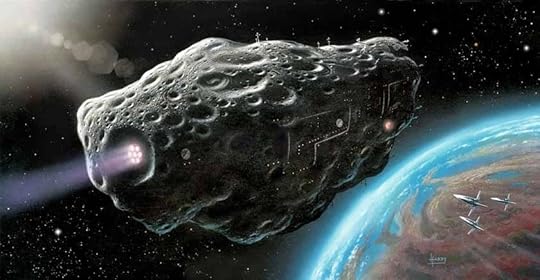
The massive Whale, essentially a carved out asteroid, holds 40,000 people and about 10 generations have passed before the story begins. The leaders of Earth sent several ships off to the nearest stars, but the ship lost contact with Earth about 100 years ago. They put social scientists to work to come up with the 'ideal' crew structure and ended up with something akin to Plato's Philosopher Kings as a governance structure. The 'elite', e.g., 'capewalkers', consisted of two groups-- the 'pilots' and the 'elementals'-- the latter being in charge of maintaining the vast craft during its long journey.

Flynn oscillates the narration among a rather large cast, consisting of a detective, a marine, several officers (both petty and capewalkers), among others. A key moment in the ship happened 80 years ago, known now as the 'Big Burnout', where 10% of the ship went haywire, killing lots of people. That portion of the ship, the Burnout, now sits unused, and largely unrepairable. What caused it remains a mystery, but it induced a shakeup of sorts, and we quickly learn that several 'tribes' (dwellers) now live there in the remains.

The plot revolves around a planned munity, although Flynn plays his cards on this pretty close to this vest. We start off learning about the main characters and their daily lives and the 'class structure' of the ship. originally, the elites could not own property, nor have children to avoid creating dynasties, but things have changed. The capewalkers largely hold the crew in contempt, and their corruption has become legendary. Maintenance, for example, extorts the crew to fix things, building up a war chest of graft. The water lord keeps raising rates to enrich herself, and forecloses on crew housing to build her son a new palace. You get the picture. Well, the crew has had just about enough, and the slogan 'The Whale as it was' keeps popping up.

With the mutiny in the background, Flynn builds a very carefully a very realistic world here. The designers created a vast melting pot of cultures from Earth, which of course cross-fertilized each other in creative ways. Flynn also provides great pacing to this tale, frequently shifting POVs adroitly, which give it a lively feel. If you are in the mood for a clever, gripping space saga, you could do a lot worse. 4.5 generational stars!! Thank you Charles for the rec!
Profile Image for Charles.
616 reviews118 followers
October 19, 2024
Crossover Mystery/Dystopian/Political/Military/Science Fiction novel taking place on a Generation Ship 200 years into a millennial-long voyage from Earth to the star Tau Ceti.

description
Generation ship Whale carved-out of the body of an asteroid

My dead pixels version was a hefty 472 pages. It had a 2024 US copyright.

Michael Flynn was an American science fiction author. He passed in 2023. He had published about twenty (20) novels in several series and standalone along with short fiction. This was the author’s last book. It was published posthumously. I've read several of his books. The last book I read by him was In the Lion's Mouth (Spiral Arm, #3) (my review).

Flynn was one of my mostly reliable science fiction authors. His stories were typically grounded in hard science, although they were also thickly laced with politics and sociology. He was also an Ole Skool (70’s thru 90’s), conservative science fiction author of the Larry Niven and Jerry Pournelle ilk. Having written that, I could never guarantee if I’d like one of his books. Some could be real stinkers, whilst others could be really, pretty good.

His strongest suite was he wrote hard science fiction well. Most contemporary science fiction is written by folks who don’t know the difference between an au and a light year, or a millisecond and a microsecond (that’s space and time). On the other hand the MFA-written sf novels of today, have a more nuanced characterization. They're better at the feels. However, these authors think that a trip to Mars is as easy and as time consuming as taking the Redeye from LA to NYC.

This book was one of Flynn’s ‘good’ ones.

TL;DR Synopsis

Hundreds of years in the future, a generation ship leaves the solar system for a habitable planet orbiting the star Tau Ceti. The Whale is a large ship using a hollowed-out asteroid for its hull. The ship is traveling at a low sub-light velocity, on a 1000-year voyage. The story takes place about 200-years after leaving Sol whilst in interstellar space.

The Whale is manned by and carrying 40,000 folks of multiple ethnicities. Eight human generations have passed in the voyage. The population’s: language, customs, spiritual beliefs, appearance, social organizations, etc. have become well mixed. However, a lot of their history has become lost in the creation of their common identity. Also during the voyage, the ship’s officers have developed first into an aristocracy, and at the time of the story, into an oligarchy. A minority of the rank and file, had had enough of rule by self-interested power brokers and foment a revolution.

Flynn creates an ensemble cast of characters. They illustrate the polyglot, social organization and roles of Whale’s crew, and the revolution’s: Underlying Causes, Outbreak and Escalation, the Seizure of Power , it's Consolidation, and the Post-Revolution. The revolution was not civilized. . Parallel to this there was a murder mystery, a dungeon crawl through a ruined and evacuated volume of the ship, and Space Marines in combat!

The Review

The writing was good. Although, it was a hard start. Firstly, Flynn immediately immerses the reader into Whale culture without initial context or explanation. It was very cyberpunkish in that way. Secondly, the story was written completely in the third-person limited POV. This was peculiar, because of the large number of characters. It’s rarely done. It took me awhile to get used to what I was reading.

The text was edited, but not scrupulously. I found three (3) errors in spelling. There was also some repetition. Prose errors show a lot about the author’s attention to detail. However, I happen to know this book was in a late draft state, when Flynn passed. He may not have created the print galleys?

With the dialog, Flynn was playing with the reader. In it, he used a lot of foreign words from a diverse set of cultures, Polish to Malay for the speech of the hoi polloi . The aristocratic officers had a sesquipedalian English vocabulary. This sent me to the dictionary several times for words like: “maledictions”, “superordination”, and “triune”. I thought the descriptive prose was more conventional. It was good. I would have liked the story to have been more gritty and adult. This book could qualify as New Adult Fiction, in terms of what was left out.

The narrative was also quite humorous. There were numerous Shout-Outs . For example, from Battlestar Galactica . A highfalutin officer remarked “So perhaps he ought not enumerate poultry prematurely.” And, I’d really like to have a pint with my mates in a bar named The Pursuit of Hoppiness.

There was sex, drugs, and rock ‘n roll and violence in the story. This always results in me regarding a book more highly.

Sex happened. There was a rather blandly described orgy. The rank and file’s dialog could be bawdy. Folks talked about shagging and “Doing it”, sometimes very humorously, and there were post-coital scenes, but no detailed descriptions. “mount” was the operational word. All sex was heterosexual. Alcohol was regularly consumed, sometimes in immoderate amounts. Flynn’s interest in Craft Beers was evident. Unusually, there were neither hard or softcore drugs mentioned. Hydroponic marijuana was unknown. Live musical entertainment was also consumed. However, it was either revolutionary songs, folk or classical music.

Violence was: physical, edged and impact weapons, and military small arms. Body count was high. I would estimate a few hundred folks perished. Flynn was not reluctant to kill-off characters that featured significantly in the POV narrative. I thought the body count was large. In a total population of only 40,000, losing almost 1% of the population means everyone knew someone who was killed. In addition, it was a loss of genetic diversity, lost to a population being stringently kept small, to conserve resources. The loss of life in the story was a mission, minor disaster. Violence was moderately graphic.

Flynn lists 28 characters in the Dramatis Personae. I thought eight of them qualified as co-protagonists, although I’ll only mention four for brevities sake. All these characters were members of The Squad who go on the story’s dungeon crawl. Two of them are involved in the murder plot. They also all became embroiled in the Revolution. Note as mentioned above, the POV was strictly 3rd Person. Bùxiè deSōuxún, Detective Chief Inspector (DCI) was the local “nick’s” detective with spidey sense. He could suss a phony situation or person and was quick to act. Winsome (Winnie) Alabaster, Eugenicist 2nd class was Bùxiè’s love interest. She was also an unexpected Action Girl and a widow. She was involved in both a murder being investigated by the DCI and officer malfeasance. Dhikpāruṣya Spandhana, “Big Dhik,” Enforcer of Filial Devotion was the Invincible Minor Minion . A mountain of a man, he was a beat cop and a bully that became a better man. How Flynn resisted not calling him "Swinging Dhik”, for his proficiency with his nightstick, was an act of authorial restraint. Alessandro Fanghsi, “Little Face,” was a burnsider. He was a scavenger who made a living from the dark, ruined and evacuated volume of the ship that resulted from a catastrophic ship industrial accident. He was a Reluctant Participant in the revolution and the dungeon crawl. I’d also like to call attention to the enigmatic, Peng, the Commander of Ship Security. He was the classic Chessmaster . I was disappointed that Flynn relied so heavily on a character like that near the end of the story.

The antagonists were a mixed lot of: officer-aristocrats, a psychopath and Dwellers in the Outer Darkness.

In addition to the above there were: crewmen, officers, tutors, enforcers, mutineers, blackbirds (Internal Security), and Marines,

The POV interleaving was technically well-handled. However, I thought that the change in POV should have been demarked by more than a new paragraph. As a result the POV changes felt abrupt. As with most books with a large number of POVs, the character development and pacing suffered with the frequent character switching. There were too many separate narratives, and not enough pages, even with 475 of them.

Plotting was good, but also very busy. There were three in a Third Line, Some Waiting configuration. The first two plots were the murder mystery, and the revolution. They received the most attention. The third plot was MIL-SF. Flynn had a soft spot for MIL-SF. This third plot, involved a Reluctant Hero, Ynigo “Lucky” Lutz, Staff Sergeant, first Platoon, Fleet Marines. In addition, I was dissatisfied with the ending. The switching between the POVs retarded the pacing. The convergence of the plotlines took place appropriately in the story, but there were still too few pages for them to develop. Scholars have characterized revolutions. Revolutions have been broken-down into phases, like the acts in a play. Flynn did his reading. In particular, in Flynn’s revolution, the Post-Revolutionary period felt rushed, and the Long-Term Outcome of the revolution, and the description of its Legacy ended up being weak. Flynn could have used another 50-pages to ease the reader into his HEA.

World building was good, better than I might have expected.

Flynn devoted a lot of words to Whale and its crew. It was one of the better descriptions of being inside a vaguely dystopian, confined environment. Whale was a combination of, indoor: malls, urban villages, administration complexes, manufacturing facilities, and spaceship engineering. However, it had the accoutrements of a commercial or military naval vessel, and not a passenger liner. For example, there were air-tight hatches to isolate volumes of the ship. Flynn, never revealed the dimensions of Whale other than:
She ran a hundred frames, fore to aft, and fifty Decks, top to orlop.
However, it was a few kilometers in length, and perhaps breath because its rocky, overall shape was not divulged. It was likely a cylindrical shape? This was a clever bit of legerdemain by Flynn, in not confining himself by time and distance whilst shipboard.

Frankly, I'd have thought when Whale left the solar system, tech would have been further advanced than was described on the ship? I did note the contemporary use of makers in manufacturing. However, the future tech described contained remarkably few computer-based systems. I also would have thought that after 200-years of constant use, Whale (burnside aside) and its artifacts would have been more shopworn than described? Finally, the asteroid ship Whale also had a lot of mass (M). Those Higgs engines must have provided a lot of thrust (T)?

The sociology of the “root ethnoi” was also very interesting. The crew consisted of:
Polonis, and Roos, Chinos and Malayas, Yurpans and Roomies
These populations were administratively crossbred to wipeout group identities. This was the job of the ship’s Eugenicist. It occurred through computer “arranged marriages” of the crew (mostly). The Eugenicist also operated to maintain a sustainable population. I thought this was a brutally practical and clever piece of worldbuilding. The use of language drift was also clever.

Flynn devoted a lot of pages to the worldbuilding. Too many. This with the overly large number of POV contributing characters pinched him plot-wise in the end.

Summary

The book’s worldbuilding was an admirable, labor-of-love. Setting the story on a Generation Ship was brilliant. Its a neglected trope. However, worldbuilding alone does not make great books. This wasn’t a great work, because the ending was too abrupt, and the characters developed unevenly. There were too many characters contributing their POV. This consumed too many pages, not all of them were well spent. In the end, some characters stayed thin, others uninterestingly, rapidly inflated, and a few developed naturally—but I found these to be old fashioned. The story should also have been edgier. Which reminds me that Flynn was an Ole Skool author whose formative years were in the 80’s and 90’s. This would have been a great work if it had been written then, and not in the somewhat different world of now.

However, this was a good work. The author’s best abilities shown through. In particular, with his dystopian closed world building including the blurred ethnicities, his not-a-lot-of-handwaving hard sf, and his humor. I can recommend reading it. I'm giving this story four stars, because I can see that had he another 30-50 pages he could have given the story its ideal soft landing. I write this knowing he won’t be writing another book, or may not have made-it to writing those last 50-pages.
Profile Image for Julie.
319 reviews14 followers
October 24, 2024
This one is hard to rate. On reflection I think the main problem I had with the book was that I didn't connect to any of the characters. Ok, maybe one character I liked, but the rest seemed so blah. And there are a lot of characters. The writing flicks from a short stop telling what this charcter is doing then flicks again to another character. And in e-book format sometimes there's no line of empty space separating one characters scene from the next's which was confusing at first.

What also made the book difficult was all the Chinese names like Bùxiè deSōuxún and, I assume, Indian names like Dhikpāruṣya (Big Dhik) Spandhana. There were three races or cultures, whatever you want to call them, that made up the population of Whale: Chinese, Indian, and Hispanic. But instead of letting everyone stick with their own race there's a department that makes matches of who you can make a baby with. From the beginning they purposefully matched people with other races in order to end up with a more homogeneous population by the time they reach their new home.

40,000 souls in a hollowed out asteroid traveling to a star system they hope will have a nice planet for them. It will take a thousand years to get there. Meanwhile we're about 200 years into the journey and things are teetering on the edge of a knife, though most don't know it.

About 100 years ago there was a great fire on the ship that schmucked a good portion. The then captain decided the area of the Burnout was too great to expend human resources fixing thing so they just left it dark and empty. However now they find out that there are actually people living in the burnout, people who can't be tracked because the main computer MOBI doesn't know their faces.

The reading got easier the more I read and I don't know if I just got used to the author's writing style, or started knowing some of the characters and getting involved in their stories? Whatever the reason by the middle I was hooked and the last quarter of the book is excellent in a "gotta keep reading so I can find out what happens" way. Oh and warning, there are characters who die as well as a lot of red shirts and background people who get shmucked.

There's a ton of stuff I haven't even covered, like the blue capes and the gold capes, that I just decided was not all that relevant to you knowing whether you want to read the book or not.

Profile Image for Dylan Lawless.
50 reviews1 follower
March 24, 2024
In the Belly of the Whale is a story about the inhabitants of a generation ship during a middle period of the ship's 800 year-long journey - being centuries removed from those that begun the journey, as well as those that will live during its end. The story captures a period in which the noble aims of the ship have become less important to the leaders of its crew. The Whale has devolved from the aristocratic society of its departure with an effective, fair division of maintaining the ship's various systems, to an oligarchic society squabbling for power over another and oppressing its larger crew, that has finally had enough.

Following characters from numerous social-classes and roles within the ship, the book was an interesting story of how life on such a ship might exist - being large enough for complex social structures and dynamics, but small enough to where the fragile amount of resources and space remain important. I thought that the many characters and plot lines introduced were all aptly developed, and engaging to read. In particular, I thought that the focus on the 'Burnout' - an abandoned, semi-destroyed area of the ship due to a catastrophe 80 years ago - was a very interesting setting within the larger one of the ship itself, as well as for the people that continue to inhabit it.

As for improvements to the book, I thought that the 'mini chapters' or switches in perspective within the larger chapters were not very smooth to read, being somewhat confusing and not always well-placed. To add upon this, some of the plot events felt drawn out, and perhaps a bit stiffly written, leaving me wishing for more concise chapters at times.

Overall, I felt that the core of the story was always about how the faults of human nature can corrupt society at the detriment to our delicate, shared environment. When the book had this in view, it was very engaging to read, yet sometimes I felt like it got too caught up in its own events. Still, I would recommend giving the book a read.
Profile Image for Clyde.
961 reviews52 followers
November 16, 2024
Mike Flynn has passed. He is missed.
This is his last book -- and a good one it is. If you would like a twisty and witty tale with unusual characters and lots of action in an unusual place, this one is for you.
As John once put it, "So you say you want a revolution … well you know …" . 🌌⚔️🔥
Author 8 books22 followers
March 17, 2024
The formality of the language the author used makes this story stiff and hard to enjoy. It would have been better if the author had relaxed both the description and the narrative.
Profile Image for Dann Todd.
253 reviews7 followers
October 27, 2025
This is a 4-star review. This was closer to 4.5 stars, but not enough to push it to 5.

The book tells the story of a generation starship on its way to a far flung star with the purpose of expanding human habitation. The ship is home to roughly 40000 humans largely consisting of people taken from Asian and UK/European cultures. The ship has completed less than a millennia's worth of travel with more than a millennia to go. The crew are all great, great, great....great grandchildren of the first generation that launched from the Earth.

Roughly 80 years prior to the current story, the ship experienced a catastrophe where a section of the ship collapsed rendering that section theoretically uninhabitable. "Theoretically" as there are people who live there. They don't live well, but they are free of the strictures and structures imposed on the crew.

Those legal and social constraints form the core of the conflict within the novel. There are two leadership classes. One is in charge of navigation of the ship. These elites are viewed as being mostly benign as they are prevented from having children and thus cannot form any sort of dynasty. Instead, they "adopt" the next generation of navigators from the crew based on aptitude.

The other leadership class runs the various systems needed to keep people alive; i.e. food, air, water, maintenance, security, etc. Those leaders have evolved a self-limiting social structure whereby their children frequently inherit positions of great power. They use the power of those positions to accrue great wealth and still greater power.

The rest of the crew finds this situation intolerable. A mutiny/revolution eventually unfolds.

That is the general plot of the book. The subtext comments on what it means to be elite, what it means to lead, and what sort of organizational principles are needed to ensure that power is not turned toward the support of private/personal interests at everyone else's expense. The author does a great job of keeping the subtext from subsuming the plot/text of the book and becoming a thinly veiled polemic.

There are two features of the book that limited my enjoyment. The first is the number of characters. The book begins with a listing of the cast/crew including formal and informal names. Perhaps my age may be getting in the way, but the number of characters and the number of names (formal/informal/nicknames/positional) for each character got in my way a few times. There wasn't enough differentiation between the characters/names.

The second feature is the author's choice to include disparate scenes within a single chapter with no visual demarcation between those scenes. The book will spend several paragraphs and/or pages following one set of characters. The following paragraph then jumps to a different group of characters and different location without any additional visual indication that the location has shifted. This sort of jump occurs several times within a single chapter. This storytelling technique was unusual, quirky, and periodically disconcerting. Perhaps it is a byproduct of reading an e-book rather than a physical book.

One very positive feature of the book is the author's ability to show a culture that exists hundreds of years after our own. There are many cultural facets that are obviously derived from our time. But it is equally obvious that time has changed those cultural touchstones. The result is that the reader experiences a bit of anticipation for the next moment when an echo of our modern society is revealed through the lens of a culture that exists hundreds of years in our future.

Another positive feature is that the author has carefully considered the technical demands of maintaining a starship and crew for thousands of years. What limits must be put in place to prevent over population? How can problems associated with inbreeding be avoided? What sort of weapons are going to be acceptable? How much security/surveillance will be tolerated?

Overall, this is a highly enjoyable book. Well worth the effort.
Profile Image for John Purvis.
1,356 reviews23 followers
August 9, 2024
Michael Flynn (https://tofspot.blogspot.com) is the author of 6 novels. In the Belly of the Whale was published this past July. It is the 64th book I completed reading in 2024.

I received an ARC of this book through https://www.netgalley.com with the expectation of a fair and honest review. Opinions expressed here are unbiased and entirely my own! Due to scenes of violence, I categorize this novel as R.

The Whale is a generational starship headed to Tau Citi. It is an enormous vessel constructed within a hollowed-out asteroid, carrying more than 40,000 passengers and crew. Their journey was to last hundreds of years. A society was created for the Whale before launch to ensure its safe arrival. The years spent thus far on their journey have eroded and changed that society.

Officers for the ship have become hereditary positions, and these gold-capes are treated and act more like royalty. The reproductive restrictions placed upon the populace by the Eugenics department further stirs anger. The stratification of the classes has fomented discontent over the years, and it is near exploding into open rebellion.

Bùxiè deSōuxún is a Detective Chief Inspector. He begins investigating the blunt-force trauma death of a young man. The corpse cannot be readily identified as his biometrics are not in the system, and he has no locator. He has lived completely outside the tight society of the Whale. Winsome Alabaster is an eugenicist. Her ‘special man’ went to work one day years before and never returned. Dhikpārusya Spandhana is a huge man. His size guided him to become an Enforcer of Filial Devotion. Staff Sergeant Ynigo ‘Lucky’ Lutz is one of the Marines on board the Whale. These are just a few of the characters in the story.

The Burnout is a section of the Whale where gravity plates and power had failed more than 80 years ago. Officially, no one lives there, but a few on the fringe of society have moved there for the freedom they can enjoy. It is from the Burnout that the dead man is thought to have come from. When a body is found in the Burnout and identified as Jaunty Alabaster, a troop is assembled to enter the Burnout and retrieve it. The characters mentioned above are among the 12 in the recovery party.

The recovery mission turns out to be a trip into hell. The Burnout is far from empty, and not all inhabitants are from the fringe. Those in the party who survive are bound together through their experiences.

Not long after the recovery party returns, open rebellion breaks out. Who will survive the open combat within the Whale? Will there be enough experienced people left to crew the Whale when all is said and done?

I enjoyed the 13.5 hours I spent reading this 472-page science fiction novel. The idioms and language used by some crew and passengers on the Whale were sometimes difficult to understand. While this is science fiction, the story is more about how people can change and the endurance of emotional distress. And how disastrous circumstances can bind unlikely people together. The cover art is very sci-fi, but I’m not sure if it has any relationship to the shape of the Whale. I give this novel a rating of 4 out of 5.

You can access more of my book reviews on my Blog ( https://johnpurvis.wordpress.com/blog/).
Profile Image for futureboy.
76 reviews3 followers
June 27, 2025
Oh my - this wasn't good.

In the Belly of the Whale is Flynn’s version of a generation ship: Living spaces carved into an asteroid provide room for 40,000 people on their long journey to alien worlds. While some parts of the asteroid are still being mined for resources, most parts have been turned over into a complex city and a smaller section has been destroyed by a blast a long time ago and is now home to a group of outcasts, performing occasional raids on the more organized parts of the ship for supplies.

Over the centuries since the ship’s departure from Earth’s solar system, the ship’s society has become a rigid oligarchy: Run by a group of families overseeing aspects of the ship supported by a group of well-off cadres, but ultimately run by a large number of underprivileged and in many cases outright poor ordinary citizens, the society on board appears ripe for rebellion. And rebellion is what we get.

In the Belly of the Whale is a vast story as Flynn tries to portray as many people in the different parts of the ship’s society as possible. At its core, however, the story centers on a Detective Chief Inspector: Initially portrayed as an ordinary police man, he gets drawn into the ship’s political machinations and a looming rebellion against a ruling class that appears to have lost touch with reality.

The problem with this book is its scope and ambition: Flynn simply packs too much into hundreds of pages. From the evolution of language over centuries in a closely confined space to navigational challenges, and from petty crime to politics and revolution Flynn wants it all and as a result the book ends up with a confusingly large cast and too many parallel threads into a book that would have benefited from a much cleaner and more novel storyline. While the generation ship is the background, nothing in this book actually requires it to be set in space. In the Belly of the Whale could just as well have played on a remote island on Earth, a a recently colonized planet, or - if you prefer a different genre - in a fantastical world of dragons and magic powers. Science fiction often explores themes of power, control, and resistance, but where it excels, it extrapolates existing trends into the future or shows how technological development can shape societies. In this book, however, the asteroid feels like an arbitrary backdrop for the story.

For more sci-fi reviews (and to get them before they make their way here), check out my Futureboy Substack where you will find the original version of this review.
Profile Image for Lori L (She Treads Softly) .
2,949 reviews117 followers
July 11, 2024
In the Belly of the Whale by Michael Flynn is an epic science fiction journey that follows inhabitants aboard a colossal generation ship. This is a highly recommended final novel from Heinlein Medalist Flynn (1947–2023).

The Whale is a generation ship built within a hollowed-out asteroid that is set on a centuries-long journey to colonize the planet Tau Ceti and ensure the survival of the human race. Along with the hard science fiction elements involved with life aboard the unique space ship, Flynn closely follows the sociological changes that take place among the crew after generations spent on the ship.

After the Big Burnout, where a tenth of the ship has been basically abandoned, the original rules set in place for the efficient running of the ship and fair division of labor have now devolved into a stratification of the society with the privileged classes seeking power over everyone. The differences in ideology, class, and cultural identity stirs up rebellion among the beleaguered crew, igniting the first whispers of revolution.

Admittedly, the list of personal at the start of the narrative was my friend as I tried to keep numerous names of characters and their stories straight. The main characters followed represent a selection of the diverse people across the society and include an detective, young lovers, politicians, and a non-commissioned officer, NCO. Once you can keep the unique names straight and come to know the characters, it makes following the plot a bit easier because you are no longer trying to keep characters straight.

There is no doubt that this is a dense novel, in scientific principles, language usage, the vision of the city in the ship, and the insightful examination of societal changes. It is a pleasure to read Michael Flynn's final novel as he is an intelligent writer who has always delivered a great story. Thanks to CAEZIK SF & Fantasy for providing me with an advance reader's copy via NetGalley. My review is voluntary and expresses my honest opinion.
http://www.shetreadssoftly.com/2024/0...
Author 12 books2 followers
October 7, 2024
Farewell to a master

This is Michael Flynn's last novel, one clearly set in the same time-line as his excellent Spiral Arm tetralogy, but far in the past before FTL travel has been discovered. Once again, Flynn serves up a marvelous mishmash of cultures, this time aboard a generation ship headed for Dao Chetty -er, I mean Tau Ceti. Lots of fascinating subplots, lots of dead people, and even some romances. This is one of Flynn's best stories, and it makes me sad that there will be no more.
Profile Image for Micheal Boudreaux.
93 reviews
July 23, 2024
A Final Wonder

It is a strange thing, reading the last novel of an author who you adored but has passed. There is so much to love and so much I still wonder about, in Michael Flynn's vision of our future. In the Belly of the Whale is a brilliant tale, in a lively world, with endless fascinating characters, and the richest blend of cultures and languages I've ever encountered in SF.
939 reviews102 followers
December 25, 2024
RIP Michael Flynn. This is a 3.5 star book, but I'm rounding it up because it's Christmas and the book was published posthumously. I think if Flynn had a few more months this would have earned all 4 stars. As it was, still a good entry into the Spiral Arm series. Always interesting, always erudite. You will be missed.
Profile Image for Neil.
21 reviews1 follower
March 14, 2025
it wasn’t bad, but i didn’t love the experience of reading this.

in ebook (kindle) format, the frequent changes in character perspective often had no line break, combined with the large number of characters, and long names that were hard to parse by my western experience, meant it was hard to know whose perspective things were from at many moments.

the plot is fine, and the scene is semi novel.
26 reviews
October 6, 2024
WTF

I gave up reading this after 1/3 of the book . Waste of time when there are so many other worthy books to read . Life is short, read something that makes more sense than this of pretentious crap!
Profile Image for Grant.
1,402 reviews5 followers
December 9, 2024
Flynn creates an exotic but entirely believable world on a generation ship between the stars. The characters are compelling and the stakes are high. Plus, it's nice to read a self-contained story, with no prequels, sequels, or alternate universes.
2 reviews
May 5, 2025
great book with beautiful language! Not all Sci Fi have this "literary" style, but this one has!

It is not so much technology in this one, but more sociological topics.
Great characterisation had me hooked!
really recommend!! 😍👨‍🔬🧑‍💼
Profile Image for Michael Norwitz.
Author 16 books12 followers
November 28, 2025
A self-contained space opera, of sorts, which details political turmoil inside a sphere-shaped generation starship. One of Flynn's more accessible novels in terms of prose. Very worth reading, and I'd be interested to revisit this setting a couple generations hence.
Profile Image for Scooter.
101 reviews2 followers
March 4, 2025
Well, Belly was a bust. Had to force myself to finish it. Last 10% took 4 days. Didn't care for any characters and it could have taken place anywhere, hardly mattered that ot was a generation shop.
49 reviews1 follower
March 12, 2025
Sad that this is Flynn's last book. In the revolution in the Whale you can see the seeds of the CCW from the Spiral Arm books and the revolution to come.
Profile Image for Michael Hirsch.
580 reviews7 followers
July 19, 2025
this is one of the better generation ship stories. the characters were great and the society original but believable. 4.5 stars
Displaying 1 - 22 of 22 reviews

Can't find what you're looking for?

Get help and learn more about the design.