

What do you think?

الغرب المختطف
في رسالة إلى هيلفيتيوس، كتب فولتير هذه الجملة الرائعة: "لا أتفق مع ما تقوله، لكنني سأقاتل حتى الموت ليكون لك الحق في أن تقول ذلك." فإن أي تدخل في حرية التفكير والتعبير - كيفما كان أسلوب هذه الرقابة أو اسمها - هو يمثل في القرن العشرين فضيحة، ويشكل عبئا ثقيلا على أدبنا الذي يعيش نشاطا ملحوظا.
ميلان كونديرا
ميلان كونديرا
79 pages, Paperback
First published November 1, 1983
About the author
Milan Kundera
171 books19.7k followersMilan Kundera (1 April 1929 – 11 July 2023) was a Czech and French novelist. He went into exile in France in 1975, acquiring citizenship in 1981. His Czechoslovak citizenship was revoked in 1979, but he was granted Czech citizenship in 2019.
Kundera wrote in Czech and French. He revises the French translations of all his books; people therefore consider these original works as not translations. He is best known for his novels, including The Joke (1967), The Book of Laughter and Forgetting (1979), and The Unbearable Lightness of Being (1984), all of which exhibit his extreme though often comical skepticism.
Kundera wrote in Czech and French. He revises the French translations of all his books; people therefore consider these original works as not translations. He is best known for his novels, including The Joke (1967), The Book of Laughter and Forgetting (1979), and The Unbearable Lightness of Being (1984), all of which exhibit his extreme though often comical skepticism.
Ratings & Reviews
Friends & Following
Create a free account to discover what your friends think of this book!
Community Reviews
Displaying 1 - 30 of 276 reviews

March 31, 2025
5 ⭐
’Geographic Europe” (extending from the Atlantic to the Ural Mountains) was always divided into two halves that evolved separately: one tied to ancient Rome and the Catholic Church, the other anchored in Byzantium and the Orthodox Church. After 1945, the border between the two Europes shifted several hundred kilometers to the west, and several nations that had always considered themselves Western woke up to discover that they were now in the East. As a result, three fundamental situations developed in Europe after the war: that of Western Europe, that of Eastern Europe, and, most complicated, that of the part of Europe situated geographically in the center—culturally in the West and politically in the East.’
This really sets the scene well for the contents of these works. Included in my kindle edition were both Kundera’s address to the Czech Writer’s Congress in 1967 titled ’The Literature of Small Nations’ and the titular essay, ’A Kidnapped West’ or ’The Tragedy of Central Europe’ from 1983 .
The speech to the writer’s congress was, as far as I can tell, a call to intellectual arms directed at the Czech people, as a whole. He presents two options to the “small nation” together with their pros and cons: ”either let the Czech language wither till it is reduced to a mere European dialect—and Czech culture to mere folklore—or else become a European nation with all that that involves." The implication here is that were they to let their culture die, along with their inimitable traits that would be their contribution to a larger Western Europe, then they would have no defence against political absorption into Eastern Europe. Kundera urges the people to embrace, and to become more conscious of, the essential role played by Czech literature and the two fundamental sources of the (Western) European mind in Greco-Roman antiquity and Christianity, which he believed to have all but vanished from the consciousness of young intellectuals of the time. He condemns any repression of opinion, bigotry, vandalism, lack of culture or narrow-mindedness; Indeed, anything that would ”obstruct the cultural wheels accelerating” as compromising the very existence of their people.
’Men who live only their own contextless present, who know nothing of the historical continuity around it and who lack culture, can transform their nation into a desert with no history, no memory, no echoes, and untouched by beauty.’
In the titular essay, Kundera laments that Europe (the larger nations of the West) were, themselves, in the process of losing their cultural identity. It is as a result of this blindness to culture that they perceived Central European nations not as brothers with mutual cultural connections but rather as Eastern Political Regimes. I’ve used the word culture a lot so here’s a passage from Kundera that makes the term feel a little bit more concrete:
’I want to stress a significant circumstance: the Central European revolts were not nourished by the newspapers, radio, or television—that is, by the “media.” They were prepared, shaped, realized by novels, poetry, theater, cinema, historiography, literary reviews, popular comedy and cabaret, philosophical discussions—that is, by culture.’
The sword of revolution had been blunted by the replacement of nuanced and meaningful art (culture) by the mass media, too often used as a tool by the oppressors. If Kundera was onto this in 1983, excuse my French, but can you imagine how fucking true that is in 2025!!
There is, of course, more covered in this work but I think what I’ve mentioned gives a sufficient idea of the contents. It is a very short work and despite the time in which it was written, much of it still feels remarkably, and unfortunately, very relevant. I don’t usually say this because, who am I to tell people what to read? But I really think, given its brevity, prescient relevancy to current events, and penetrating intellect of its author, everybody should read this! I highlighted about 90% of this so I’m glad it wasn’t a physical copy but I’m going to add a few more random quotes here because I want to and there’s not a damn thing you can do about it! :)
Adieu!
’“…I’m still horrified by certain stories by Gogol and by everything Saltykov-Shcedrin wrote. I would have preferred not to have known their world, not to have known it existed.” Brandys’s remarks on Gogol do not, of course, deny the value of his work as art; rather they express the horror of the world his art evokes. It is a world that—provided we are removed from it—fascinates and attracts us; the moment it closes around us, though, it reveals its terrifying foreignness. I don’t know if it is worse than ours, but I do know it is different: Russia knows another (greater) dimension of disaster, another image of space (a space so immense that entire nations are swallowed up in it), another sense of time (slow and patient), another way of laughing, living, and dying. The deep meaning of their resistance is the struggle to preserve their identity—or, to put it another way, to preserve their Westernness.’
‘But what is a small nation? I offer you my definition: the small nation is one whose very existence may be put in question at any moment; a small nation can disappear, and it knows it. A Frenchman, a Russian, or an Englishman is not used to asking questions about the very survival of his nation. His anthems speak only of grandeur and eternity. The Polish anthem, however, starts with the verse: “Poland has not yet perished …”’
‘Central Europe as a family of small nations has its own vision of the world, a vision based on a deep distrust of History. History, that goddess of Hegel and Marx, that incarnation of reason that judges us and arbitrates our fate – that is the history of conquerors.’
‘Central Europe therefore cannot be defined and determined by political frontiers (which are inauthentic, always imposed by invasions, conquests, and occupations), but by the great common situations that reassemble peoples, regroup them in ever new ways along the imaginary and ever-changing boundaries that mark a realm inhabited by the same memories, the same problems and conflicts, the same common tradition.’
’The Russians like to label everything Russian as Slavic, so that later they can label everything Slavic as “Russian.”’
‘One of the great European nations (there are nearly forty million Ukrainians) is slowly disappearing. And this enormous, almost unbelievable event is occurring without the world realising it.’
’Geographic Europe” (extending from the Atlantic to the Ural Mountains) was always divided into two halves that evolved separately: one tied to ancient Rome and the Catholic Church, the other anchored in Byzantium and the Orthodox Church. After 1945, the border between the two Europes shifted several hundred kilometers to the west, and several nations that had always considered themselves Western woke up to discover that they were now in the East. As a result, three fundamental situations developed in Europe after the war: that of Western Europe, that of Eastern Europe, and, most complicated, that of the part of Europe situated geographically in the center—culturally in the West and politically in the East.’
This really sets the scene well for the contents of these works. Included in my kindle edition were both Kundera’s address to the Czech Writer’s Congress in 1967 titled ’The Literature of Small Nations’ and the titular essay, ’A Kidnapped West’ or ’The Tragedy of Central Europe’ from 1983 .
The speech to the writer’s congress was, as far as I can tell, a call to intellectual arms directed at the Czech people, as a whole. He presents two options to the “small nation” together with their pros and cons: ”either let the Czech language wither till it is reduced to a mere European dialect—and Czech culture to mere folklore—or else become a European nation with all that that involves." The implication here is that were they to let their culture die, along with their inimitable traits that would be their contribution to a larger Western Europe, then they would have no defence against political absorption into Eastern Europe. Kundera urges the people to embrace, and to become more conscious of, the essential role played by Czech literature and the two fundamental sources of the (Western) European mind in Greco-Roman antiquity and Christianity, which he believed to have all but vanished from the consciousness of young intellectuals of the time. He condemns any repression of opinion, bigotry, vandalism, lack of culture or narrow-mindedness; Indeed, anything that would ”obstruct the cultural wheels accelerating” as compromising the very existence of their people.
’Men who live only their own contextless present, who know nothing of the historical continuity around it and who lack culture, can transform their nation into a desert with no history, no memory, no echoes, and untouched by beauty.’
In the titular essay, Kundera laments that Europe (the larger nations of the West) were, themselves, in the process of losing their cultural identity. It is as a result of this blindness to culture that they perceived Central European nations not as brothers with mutual cultural connections but rather as Eastern Political Regimes. I’ve used the word culture a lot so here’s a passage from Kundera that makes the term feel a little bit more concrete:
’I want to stress a significant circumstance: the Central European revolts were not nourished by the newspapers, radio, or television—that is, by the “media.” They were prepared, shaped, realized by novels, poetry, theater, cinema, historiography, literary reviews, popular comedy and cabaret, philosophical discussions—that is, by culture.’
The sword of revolution had been blunted by the replacement of nuanced and meaningful art (culture) by the mass media, too often used as a tool by the oppressors. If Kundera was onto this in 1983, excuse my French, but can you imagine how fucking true that is in 2025!!
There is, of course, more covered in this work but I think what I’ve mentioned gives a sufficient idea of the contents. It is a very short work and despite the time in which it was written, much of it still feels remarkably, and unfortunately, very relevant. I don’t usually say this because, who am I to tell people what to read? But I really think, given its brevity, prescient relevancy to current events, and penetrating intellect of its author, everybody should read this! I highlighted about 90% of this so I’m glad it wasn’t a physical copy but I’m going to add a few more random quotes here because I want to and there’s not a damn thing you can do about it! :)
Adieu!
’“…I’m still horrified by certain stories by Gogol and by everything Saltykov-Shcedrin wrote. I would have preferred not to have known their world, not to have known it existed.” Brandys’s remarks on Gogol do not, of course, deny the value of his work as art; rather they express the horror of the world his art evokes. It is a world that—provided we are removed from it—fascinates and attracts us; the moment it closes around us, though, it reveals its terrifying foreignness. I don’t know if it is worse than ours, but I do know it is different: Russia knows another (greater) dimension of disaster, another image of space (a space so immense that entire nations are swallowed up in it), another sense of time (slow and patient), another way of laughing, living, and dying. The deep meaning of their resistance is the struggle to preserve their identity—or, to put it another way, to preserve their Westernness.’
‘But what is a small nation? I offer you my definition: the small nation is one whose very existence may be put in question at any moment; a small nation can disappear, and it knows it. A Frenchman, a Russian, or an Englishman is not used to asking questions about the very survival of his nation. His anthems speak only of grandeur and eternity. The Polish anthem, however, starts with the verse: “Poland has not yet perished …”’
‘Central Europe as a family of small nations has its own vision of the world, a vision based on a deep distrust of History. History, that goddess of Hegel and Marx, that incarnation of reason that judges us and arbitrates our fate – that is the history of conquerors.’
‘Central Europe therefore cannot be defined and determined by political frontiers (which are inauthentic, always imposed by invasions, conquests, and occupations), but by the great common situations that reassemble peoples, regroup them in ever new ways along the imaginary and ever-changing boundaries that mark a realm inhabited by the same memories, the same problems and conflicts, the same common tradition.’
’The Russians like to label everything Russian as Slavic, so that later they can label everything Slavic as “Russian.”’
‘One of the great European nations (there are nearly forty million Ukrainians) is slowly disappearing. And this enormous, almost unbelievable event is occurring without the world realising it.’

June 18, 2023
Eseul e din 1983, dar cred că multe din lucrurile de acolo ne explică multe dintre traumele de azi. În eseul său, Kundera conturează imaginea țărilor Europei Centrale, precum Ungaria, Cehoslovacia și Polonia, aflate sub influența unor mari puteri și luptând pentru a-și conserva patrimoniul cultural de sorginte occidentală. Deși România nu e focusul său principal, Kundera o portretizează ca fiind parte a Europei Centrale și având lupte similare pentru identitate și independență. Surprinzător sau nu, eu cred că această luptă își găsește ecouri puternice în realitățile contemporane, în contextul în care creșterea naționalismului și a tendințelor autoritare devin tot mai evidente (și o să vi-i recomand iar pe Ivan Krastev și Anne Applebaum).
O privire mai atentă asupra poziției României în acest peisaj sună destul de familiar. La fel ca alte țări din Europa Centrală, România continuă să se lupte cu propria identitate în contextul european. Își dorește o integrare mai profundă în Europa și o renegociere a poziției ei acolo, în timp ce tânjește să-și păstreze identitatea culturală și națională unică - o tensiune pe care Kundera a identificat-o și a analizat-o cu o remarcabilă previziune.
Și mai e ceva foarte bitter-sweet în eseul ăsta pentru că planează o întrebare foarte antipatică: în absența unei identități culturale comune, ce valori comune pot uni Europa astăzi? Eseul său subliniază rolul incontestabil al culturii și vieții intelectuale în rezistența împotriva controlului totalitar, însă întrebarea e dacă mai putem vorbi de niște personaje similare în țările Europei Centrale de azi. Sau nu o mai fi nevoie de ele? (sau o fi boală europeană mai extinsă asta cu intelectualii publici?)
Ideea lui Kundera despre Europa Centrală, o regiune prinsă în ghearele marilor puteri, este la fel de pertinentă astăzi ca în timpul Războiului Rece. În pofida promisiunii unei integrări mai profunde în blocul occidental, insistența aproape obsedantă pe o identitate națională distinctă rămâne, iar dezamăgirea față de promisiunile sau marile așteptări neîndeplinite este palpabilă. Experiența unică a Europei Centrale, așa cum o surprinde Kundera, oferă o lentilă critică prin care putem interpreta și aspirația către valorile democratice, și naționalismul, și deziluzia acestor țări. Și conceptul (sau urmele lui) de regiune prinsă perpetuu între puterile mai mari nu este doar o relicvă a Războiului Rece. Rămâne surprinzător de relevantă și astăzi, când suntem martorii războiului Rusiei împotriva Ucrainei.
Virajul către naționalism și, în unele cazuri, autoritarism pe care Kundera l-a avertizat, este un trend pe care România, alături de Ungaria și Polonia, trebuie să-l abordeze cu precauție. Promisiunea unui întoarcere la valorile naționale tradiționale, deși atrăgătoare pentru unii, vine cu riscul xenofobiei și al compromiterii instituțiilor democratice.
Deci, dacă nu ați făcut-o deja, citiți „Tragedia Europei Centrale” a lui Kundera. Nu oferă doar un context istoric, ci și aproape o sesiune de terapie prin care putem înțelege mai bine dinamica de astăzi din Europa Centrală, inclusiv conflictul în curs din Ucraina. În fața provocărilor contemporane, reflecțiile lui Kundera reprezintă un ecou puternic care ne îndeamnă să privim cu respect și înțelegere lupta și reziliența regiunii noastre.
O privire mai atentă asupra poziției României în acest peisaj sună destul de familiar. La fel ca alte țări din Europa Centrală, România continuă să se lupte cu propria identitate în contextul european. Își dorește o integrare mai profundă în Europa și o renegociere a poziției ei acolo, în timp ce tânjește să-și păstreze identitatea culturală și națională unică - o tensiune pe care Kundera a identificat-o și a analizat-o cu o remarcabilă previziune.
Și mai e ceva foarte bitter-sweet în eseul ăsta pentru că planează o întrebare foarte antipatică: în absența unei identități culturale comune, ce valori comune pot uni Europa astăzi? Eseul său subliniază rolul incontestabil al culturii și vieții intelectuale în rezistența împotriva controlului totalitar, însă întrebarea e dacă mai putem vorbi de niște personaje similare în țările Europei Centrale de azi. Sau nu o mai fi nevoie de ele? (sau o fi boală europeană mai extinsă asta cu intelectualii publici?)
Ideea lui Kundera despre Europa Centrală, o regiune prinsă în ghearele marilor puteri, este la fel de pertinentă astăzi ca în timpul Războiului Rece. În pofida promisiunii unei integrări mai profunde în blocul occidental, insistența aproape obsedantă pe o identitate națională distinctă rămâne, iar dezamăgirea față de promisiunile sau marile așteptări neîndeplinite este palpabilă. Experiența unică a Europei Centrale, așa cum o surprinde Kundera, oferă o lentilă critică prin care putem interpreta și aspirația către valorile democratice, și naționalismul, și deziluzia acestor țări. Și conceptul (sau urmele lui) de regiune prinsă perpetuu între puterile mai mari nu este doar o relicvă a Războiului Rece. Rămâne surprinzător de relevantă și astăzi, când suntem martorii războiului Rusiei împotriva Ucrainei.
Virajul către naționalism și, în unele cazuri, autoritarism pe care Kundera l-a avertizat, este un trend pe care România, alături de Ungaria și Polonia, trebuie să-l abordeze cu precauție. Promisiunea unui întoarcere la valorile naționale tradiționale, deși atrăgătoare pentru unii, vine cu riscul xenofobiei și al compromiterii instituțiilor democratice.
Deci, dacă nu ați făcut-o deja, citiți „Tragedia Europei Centrale” a lui Kundera. Nu oferă doar un context istoric, ci și aproape o sesiune de terapie prin care putem înțelege mai bine dinamica de astăzi din Europa Centrală, inclusiv conflictul în curs din Ucraina. În fața provocărilor contemporane, reflecțiile lui Kundera reprezintă un ecou puternic care ne îndeamnă să privim cu respect și înțelegere lupta și reziliența regiunii noastre.

June 20, 2022
Adelphi pubblica due discorsi inediti di Milan Kundera, uno del 1967 e l’altro del 1983, nei quali il grande scrittore ceco riflette, da un lato sul destino delle piccole nazioni e dall’altro sulla deriva culturale dell’Europa (da cui tale destino sembra in qualche modo dipendere).
Grazie all’acume e alla profondità di analisi di Kundera troviamo via via leggendo molti e sorprendenti riferimenti ante litteram alla situazione critica odierna (guerra russo ucraina).
Riflettendo sulla storia frammentaria della nazione ceca, sul suo traballante equilibrio (e sarà evidente di lì a poco) nel 1967 lo scrittore si chiede: “Il valore culturale del nostro popolo è tale da giustificarne l’esistenza? E a questa domanda se ne aggiunge una seconda: questo valore basterà di per sé, in futuro a proteggerla dal rischio di perdere la propria sovranità?”
La mancata comprensione e la sostanziale indifferenza dell’Occidente europeo verso il destino delle piccole nazioni dell’Est, che finiranno fagocitate dal gigante totalitario russo, sono corresponsabili di questa perdita di identità e cultura vivente.
Nel secondo testo - e siamo nell’83 - Kundera si interroga sulla “scomparsa” dell’Europa come orizzonte ideale (ma anche come forza concreta): unita nel Medioevo dalla religione cristiana, nel Settecento dalla filosofia dei Lumi, e in età moderna dalla cultura in senso lato, quali valori comuni ne costituiscono oggi il fondamento? Forse la tecnologia e l’industria dello svago?
Perché “ Non sono dunque i confini politici (inautentici, sempre imposti da invasioni, conquiste e occupazioni) a delineare e determinare l’aggregazione centro-europea, ma le grandi situazioni comuni che riuniscono i popoli, e li raggruppano in maniera sempre diversa, entro confini immaginari e sempre mutevoli, dove permangono la medesima memoria, la medesima esperienza, le medesime tradizioni comuni.”
Se non c’è questo tessuto unitivo (e bisogna capire da quali fili viene tenuto saldo) ogni piccola nazione è destinata a vedere messa in questione la propria autonoma e libera esistenza.
Ed è precisamente ciò che sta accadendo oggi sotto i nostri occhi increduli e atterriti.
Grazie all’acume e alla profondità di analisi di Kundera troviamo via via leggendo molti e sorprendenti riferimenti ante litteram alla situazione critica odierna (guerra russo ucraina).
Riflettendo sulla storia frammentaria della nazione ceca, sul suo traballante equilibrio (e sarà evidente di lì a poco) nel 1967 lo scrittore si chiede: “Il valore culturale del nostro popolo è tale da giustificarne l’esistenza? E a questa domanda se ne aggiunge una seconda: questo valore basterà di per sé, in futuro a proteggerla dal rischio di perdere la propria sovranità?”
La mancata comprensione e la sostanziale indifferenza dell’Occidente europeo verso il destino delle piccole nazioni dell’Est, che finiranno fagocitate dal gigante totalitario russo, sono corresponsabili di questa perdita di identità e cultura vivente.
Nel secondo testo - e siamo nell’83 - Kundera si interroga sulla “scomparsa” dell’Europa come orizzonte ideale (ma anche come forza concreta): unita nel Medioevo dalla religione cristiana, nel Settecento dalla filosofia dei Lumi, e in età moderna dalla cultura in senso lato, quali valori comuni ne costituiscono oggi il fondamento? Forse la tecnologia e l’industria dello svago?
Perché “ Non sono dunque i confini politici (inautentici, sempre imposti da invasioni, conquiste e occupazioni) a delineare e determinare l’aggregazione centro-europea, ma le grandi situazioni comuni che riuniscono i popoli, e li raggruppano in maniera sempre diversa, entro confini immaginari e sempre mutevoli, dove permangono la medesima memoria, la medesima esperienza, le medesime tradizioni comuni.”
Se non c’è questo tessuto unitivo (e bisogna capire da quali fili viene tenuto saldo) ogni piccola nazione è destinata a vedere messa in questione la propria autonoma e libera esistenza.
Ed è precisamente ciò che sta accadendo oggi sotto i nostri occhi increduli e atterriti.
June 8, 2026
I am writing from a small nation which is currently under threat, not only from the Orange Buffoon who wants a 51st, 52nd and 53rd State (as if that would get his face on Mt. Rushmore, or even a 666 dollar bill), but also from that weakness which politicians and political parties throughout the ‘West’ have for their true constituents, those billionaires and corporations, whose ‘donations’, and lobbyists have procured those low-tax, lax-regulated environments which threaten to forever enshrine their monopolistic, trans-national dominance—at the expense of whatever is left of what we once called our culture—
OK, that’s culture, but: small nation? Leopold Bloom took a stab at the second half of that term in his confrontation with the Nationalist in the Cyclops episode of Joyce's Ulysses:
Such gate-keepers are one species of the genera that Kundera labels as ‘Vandals’:will be are dutifully trumpeted at us in the troughs of our ‘feeds’ (and, for the not-so-’OK’-boomers, don’t forget ‘legacy media’), all of which are owned by the new Vandals in Chief (heck, just today, we Canadians found that, while we likely will be offering-up our ID/private data to prove to the likes of Palantir (or, you-name-the-Tolkien-inspired post-humanist data-harvester) that we aren't children-on-the-interwebs, we won’t be even ever-so-slightly taxing foreign ‘streaming media’ giants and are in desperate need national ‘AI Literacy’ education, buy-in, and ‘trust’, hmm, wonder why?)
And before any lovers of all things ‘trad’ and ‘northern European’ out there get their panties wet for this book, buying it thinking that its title means that ‘our West’, ‘the Western Tradition’ of Greek sculpture and Petrarchan Sonnets and obeisance to whatever J.D. Vance imagines he thinks that St. Augustine meant by a book whose title, The City of God is all that that sad, sycophant extraordinaire and hollow simulacrum of a man has ever read of thar Church Father…now hang on just a blessed minute.
For Kundera, the word ‘West’ hearkens to an intellectual history which may begin with the schism between Rome and Byzantium, but which finds its true expression first in the coffee houses of the eighteenth century...
So, culture as an imagined, then created (and grass-roots-nourished/fostered) movement as well as ideal, and capital-H History as a looming threat…
The West has kidnapped itself, it seems, for
You know, it used to be (in Czech of 1968, also Latin America not so long ago, e.g.), if you banned or tried to control the arts, the nation/the people rose up and the artists upped their game in a tag-team/mutually-reinforcing kinda way.
‘a particular way of life, whether of a people, a period, a group, or humanity in general.’—as good a starting partial definition as any, I suppose (if but one of Williams's tripartite initial forays into the topic) , or, with Milan Kundera in this book,
(Raymond Williams, Keywords)
‘The identity of a people and of a civilization [as] reflected and concentrated in what has been created by the mind’—a collectively-imagined homeland-of-the-soul which seeks out not so much political, corporate incarnation (though that, too, is by force majeure necessary for peoples from small nations, nations under threat), as continued expression and development in the lives of those who have staked a claim on that shared, imagined identity.
OK, that’s culture, but: small nation? Leopold Bloom took a stab at the second half of that term in his confrontation with the Nationalist in the Cyclops episode of Joyce's Ulysses:
—But do you know what a nation means? says John Wyse.And here is Kundera's supplement:
—Yes, says Bloom.
—What is it? says John Wyse.
—A nation? says Bloom. A nation is the same people living in the same place. . . . Or also
living in different places
I offer you my definition: the small nation is one whose very existence may be put in question at any moment; a small nation can disappear, and it knows it. A Frenchman, a Russian, or an Englishman is not used to asking questions about the very survival of his nation. His anthems speak only of grandeur and eternity. The Polish anthem, however, starts with the verse: “Poland has not yet perished. . .”Ironically, though, cos even circa 1983, the larger nations, too, are stealthily imperilled by those forces which Kundera diagnoses in the second of the two essays (‘The Tragedy of Central Europe’) to be found in this book—forces which had by then already swallowed up small nations such as his own native Czechoslovakia, those totalizing, totalitarian forces of
uniform[ity], standardiz[ation], [and] centraliz[ation], determined to transform every nation of its empire /[…] into a single […] people.—a single, dispossessed, deracinated, subjected people, the overlords of whom for Kundera was of course, in the ‘East’, the Soviet Union, but in the West? Even then, he saw that mass ‘culture’ (mass media, delivered to the masses top-down, access to and the imprimatur of which which for artists, intellectuals and so-called ‘consumers’ was sanctioned/gate-kept by the mid-level bureaucrats of another form of debased culture—’corporate culture’.
Such gate-keepers are one species of the genera that Kundera labels as ‘Vandals’:
Who is a vandal? It is absolutely not the illiterate peasant who in a fit of fury sets fire to the rich landowner’s mansion. The vandals I myself run into are all of them educated, pleased with themselves, socially well situated, and not especially resentful toward anyone. The vandal, rather, is that prideful narrow mind, pleased with itself and ever ready to claim its rights. That proud narrow-minded fellow believes that the power to fit the world to his own image is among his inalienable rights and, since the world is largely made up of matters beyond his capacities, he adapts the world to his image by destroying it. Thus, an adolescent knocks the head off some statue in a park because the statue infuriatingly seems a better human than he; and since any act of self-affirmation brings man satisfaction, he does it with delight. Men who live only their own contextless present, who know nothing of the historical continuity around it and who lack culture, can transform their nation into a desert with no history, no memory, no echoes, and untouched by beauty.So, Vlad the ImPutinator, and Xi Jinping? Yeah, sure, but where I live it’s the Larry Ellisons, the Elon Musks, the Mark Zuckerbergs, the Peter Thiels and Alex Karps and Sam Altmans, etc., etc., who are actively at work making not illiterate peasants, but AI-literate serfs of us all for that almost-here ‘contextless present’ in which we will all submit to whatever ‘rules-based order’ funds and fuels and produces (but needs no longer bother manufacture consent for) those forever-wars which
And before any lovers of all things ‘trad’ and ‘northern European’ out there get their panties wet for this book, buying it thinking that its title means that ‘our West’, ‘the Western Tradition’ of Greek sculpture and Petrarchan Sonnets and obeisance to whatever J.D. Vance imagines he thinks that St. Augustine meant by a book whose title, The City of God is all that that sad, sycophant extraordinaire and hollow simulacrum of a man has ever read of thar Church Father…now hang on just a blessed minute.
For Kundera, the word ‘West’ hearkens to an intellectual history which may begin with the schism between Rome and Byzantium, but which finds its true expression first in the coffee houses of the eighteenth century...
the era founded on the authority of the thinking, doubting individual, and on an artistic creation that expressed his uniqueness... and its apotheosis in the modernist cosmopolitan cultures (plural) of nineteenth and early twentieth centuries, characterized not by any uniform notion of culture, but by their very multiplicity and by the spontaneous, organic growth of arts (literature, music, film and other visual arts, theatre) in the hearts and lives of the people—and especially by those ‘Reviews’ (intellectual-artistic journals, sort of, kind of like the LRB or NYRB, etc., but read by an enormous number of ordinary people in countries such as Kundera’s own, and which celebrated and protected and disseminated the avant-garde movements in those very arts).
So, culture as an imagined, then created (and grass-roots-nourished/fostered) movement as well as ideal, and capital-H History as a looming threat…
Central Europe longed to be a condensed version of Europe made up of nations conceived according to one rule: the greatest variety within the smallest space. How could Central Europe not be horrified facing a Russia founded on the opposite principle: the smallest variety within the greatest space?Alas, here in the (now post-History, eternally-present) West…? With its potentially greatest variety in the greatest space (what Leonard Cohen said of the USA, where ‘they got the range, and machinery for change)…?
The West has kidnapped itself, it seems, for
‘ The disappearance of such reviews from Western public life or the fact that they have become completely marginal is, in my opinion, a sign that “culture is bowing out.”’(In France none of his friends even understood what they had already given up for TV-land back then, let alone what Kundera’s homeland was losing, let alone…everywhere…what we all stand to be losing now…)
You know, it used to be (in Czech of 1968, also Latin America not so long ago, e.g.), if you banned or tried to control the arts, the nation/the people rose up and the artists upped their game in a tag-team/mutually-reinforcing kinda way.
The identity of a people and of a civilization is reflected and concentrated in what has been created by the mind—in what is known as “culture.” If this identity is threatened with extinction, cultural life grows correspondingly more intense, more important, until culture itself becomes the living value around which all people rally. That is why, in each of the revolts in Central Europe, the collective cultural memory and the contemporary creative effort assumed roles so great and so decisive—far greater and far more decisive than they have been in any other European mass revolt. […] It was the theater, the films, the literature, and the philosophy that, in the years before 1968, led ultimately to the emancipation of the Prague SpringNow, though? Can we re-learn what we have lost? Can we defend what left of the human(e) world before it disappears up the spout of the algorithm? Listen to just a bit of the song that MK sings of the West, in spite of the atrocities we have piled up around us, we once had the possibility of…great variety.
Central Europe as a family of small nations has its own vision of the world, a vision based on a deep distrust of History. History, that goddess of Hegel and Marx, that incarnation of reason that judges us and arbitrates our fate—that is the history of conquerors. The people of Central Europe are not conquerors. They cannot be separated from European history; they cannot exist outside it; but they represent the wrong side of this history; they are its victims and outsiders. It’s this disabused view of history that is the source of their culture, of their wisdom, of the “nonserious spirit” that mocks grandeur and glory. “Never forget that only in opposing History as such can we resist the history of our own day.” I would love to engrave this sentence by Witold Gombrowicz above the entry gate to Central Europe.
[…] in our modern world where power has a tendency to become more and more concentrated in the hands of a few big countries, all European nations run the risk of becoming small nations and of sharing their fate. In this sense, the destiny of Central Europe anticipates the destiny of Europe in general, and its culture assumes an enormous relevance.
It’s enough to read the greatest Central European novels: in Hermann Broch’s The Sleepwalkers, History appears as a process of the gradual degradation of values; Robert Musil’s The Man without Qualities paints a euphoric society that doesn’t realize that tomorrow it will disappear; in Jaroslav Hašek’s The Good Soldier Schweik, pretending to be an idiot becomes the last possible method for preserving one’s freedom; the novelistic visions of Kafka speak to us of a world without memory, of a world that comes from historic time. All of this century’s great Central European works of art, even up to our own day, can be understood as long meditations on the possible end of European humanity.
June 19, 2024
The recent events in Ukraine undoubtedly impelled the release of this (too) slim book. It consists of the texts of two addresses by the Czech novelist Kundera—one delivered in 1967, and the other in 1983— and introductory remarks for each. I was left wanting more—more pages, more exposition.
Here are some teasers that may also leave you wanting more:
“Is communism the negation of Russian history or its fulfillment?
“Certainly it is both its negation (the negation, for example, of its religiosity) and its fulfillment (the fulfillment of its centralizing tendencies and its imperial dreams).”
“But what is a small nation? I offer you my definition: the small nation is one whose very existence may be put in question at any moment; a small nation can disappear, and it knows it. A Frenchman, a Russian, or an Englishman is not used to asking questions about the very survival of his nation. His anthems speak only of grandeur and eternity. The Polish anthem, however, starts with the verse: ‘Poland has not yet perished…’”
“[T]he Central European revolts were not nourished by the newspapers, radio, or television—that is, by the ‘media.’ They were prepared, shaped, realized by novels, poetry, theater, cinema, historiography, literary reviews, popular comedy and cabaret, philosophical discussions—that is, by culture…
“That's why, when the Russians occupied Czechoslovakia, they did everything possible to destroy Czech culture. This destruction had three meanings: first, it destroyed the center of the opposition; second, it undermined the identity of the nation, enabling it to be more easily swallowed up by Russian civilization; third, it put a violent end to the modern era, the era in which culture still represented the realization of supreme values.”
“All of the literary and cultural reviews were liquidated! Every one, without exception! That never happened before in Czech history, not even under the Nazi occupation during the war…If all the reviews in France or England disappeared, no one would notice it, not even their editors. In Paris, even in a completely cultivated milieu, during dinner parties people discuss television programs, not reviews. For culture has already bowed out. Its disappearance, which we experienced in Prague as a catastrophe, a shock, a tragedy, is perceived in Paris as something banal and insignificant, scarcely visible, a nonevent.”
“But if to live means to exist in the eyes of those we love, then Central Europe no longer exists. More precisely: in the eyes of its beloved Europe, Central Europe is just a part of the Soviet empire and nothing more, nothing more.”
Here are some teasers that may also leave you wanting more:
“Is communism the negation of Russian history or its fulfillment?
“Certainly it is both its negation (the negation, for example, of its religiosity) and its fulfillment (the fulfillment of its centralizing tendencies and its imperial dreams).”
“But what is a small nation? I offer you my definition: the small nation is one whose very existence may be put in question at any moment; a small nation can disappear, and it knows it. A Frenchman, a Russian, or an Englishman is not used to asking questions about the very survival of his nation. His anthems speak only of grandeur and eternity. The Polish anthem, however, starts with the verse: ‘Poland has not yet perished…’”
“[T]he Central European revolts were not nourished by the newspapers, radio, or television—that is, by the ‘media.’ They were prepared, shaped, realized by novels, poetry, theater, cinema, historiography, literary reviews, popular comedy and cabaret, philosophical discussions—that is, by culture…
“That's why, when the Russians occupied Czechoslovakia, they did everything possible to destroy Czech culture. This destruction had three meanings: first, it destroyed the center of the opposition; second, it undermined the identity of the nation, enabling it to be more easily swallowed up by Russian civilization; third, it put a violent end to the modern era, the era in which culture still represented the realization of supreme values.”
“All of the literary and cultural reviews were liquidated! Every one, without exception! That never happened before in Czech history, not even under the Nazi occupation during the war…If all the reviews in France or England disappeared, no one would notice it, not even their editors. In Paris, even in a completely cultivated milieu, during dinner parties people discuss television programs, not reviews. For culture has already bowed out. Its disappearance, which we experienced in Prague as a catastrophe, a shock, a tragedy, is perceived in Paris as something banal and insignificant, scarcely visible, a nonevent.”
“But if to live means to exist in the eyes of those we love, then Central Europe no longer exists. More precisely: in the eyes of its beloved Europe, Central Europe is just a part of the Soviet empire and nothing more, nothing more.”

March 23, 2023
Két magvas és nyúlfarknyi esszé – olyan magvasak és nyúlfarknyiak, hogy ha muszáj volna, többet tudnék írni róluk, mint amekkorák. De nem muszáj.
Az első 1967-ben, a prágai tavasz előtt nem sokkal hangzott el egy parázs hangulatú írószövetségi ülésen – mert bizony akkoriban még nem csak azért lehetett parázs hangulatú egy írószövetségi ülés, mert száraz volt a pogácsa. Akkor még számított, hogy mit gondol egy író az ország dolgairól. És Kundera pont azon van, hogy ez maradjon így, mert a közép-európai kisállamok túlélésének záloga pont a nyelv, a kultúra – ez az, amivel meg tudja őrizni identitását. No most ez első blikkre hasonlít arra a kultúrnemzet-definícióra, amit a jobboldali populista kormányok is szoktak hirdetni aktuális demeterszilárdjaik* száján keresztül, de a kunderai és a demeterszilárdi kultúraértelmezés között akkora szakadék van, mint... nos, mint Kundera és Demeter Szilárd között. Utóbbi ugyanis azt állítja, hogy a magyar kultúra értékét az adja, hogy magyar, ezért kell tisztelni. Ami marhaság. Kundera jobban tudja: szerinte a cseh kultúrának ki kell érdemelnie, hogy nagy kultúrának tekintsék, fel kell emelkednie, egyetemessé kell válnia, mégpedig úgy, hogy megőrzi sajátos ízeit, amelyekkel aztán gazdagítja majd a világirodalmat. No most ez a szemlélet minőségi kritériumokat állít fel, ellentétben a másikkal, amelyik végső soron izolációt szorgalmaz. Kundera még azt is látja, kik azok, akik a cseh kultúra egyetemessé válásának kerékkötői, és ezáltal a nemzethalál ügynökei: a "vandálok". Azok, akik meg akarják mondani az irodalomnak, hogy meddig merészkedhet. Akik kihúznák a mondatokat. Akik elhallgattatnának. Kundera persze a szovjetekre és helyi szövetségeseikre gondol. Én meg Demeter Szilárdra. Pedig nem jó ám rá gondolni, úgyhogy most abba is hagyom. A rágondolást.
A második írás '87-es, és tulajdonképpen a fenti kultúraértelmezést viszi tovább, néhány ponton kibővítve. Az egyik, hogy sokkal több hangsúlyt fektet arra, hogy a fenn tárgyalt sajátosságok egész Közép-Európára jellemzőek. Tulajdonképpen szép gondolatok ezek, amelyekből lepárolhatjuk akár a közös Duna-menti Kultúrköztársaság eszméjét is, ahol az írók az egymásra rímelő tapasztalatokból táplálkoznak, és ezeket a tapasztalatokat a Nyugatba integrálják– a Nyugatba, ahová érzésük szerint mindig is tartoztak. A másik új elem viszont egy mélyen pesszimista meglátás arról, hogy a Nyugat elveszítette önmagát – mert elveszítette kulturális önazonosságát. Ami azt illeti, én ezt elég homályosnak érzem. Igaz persze, hogy nincsenek manapság olyan egyértelmű irodalmi tekintélyek, mint mondjuk anno Sartre volt (bár ugye kinek volt Sartre tekintély... a konzervatív jobboldalnak aligha - és ami azt illeti, egy random alsó középosztálybeli nyugalmazott trafikos se feltétlenül Sartre szavai alapján orientálódott), de nem gondolom, hogy ez speciálisan nyugati probléma volna. Itt vannak például a zsidók, akikről Kundera igazán szép szavakkal emlékezik meg – hogy ők voltak a sokszínű, multikulti Közép-Európa „intellektuális malterja”. No de ezt a maltert már jóval azelőtt kivonták a képletből ebben a régióban, hogy Nyugat-Európa írástudói eljelentéktelenedtek volna. A numerus clausushoz hasonló törvényeket a mi államaink szavazták meg, önerőből, külső segítség nélkül idézve elő a kultúra kilúgozását. És szép dolog az elképzelt közép-európai kulturális közösség – de nem akadt még olyan író (bármily tekintélyes legyen), aki rá tudta volna venni honfitársait, hogy ne fújjanak a szomszéd ország lakóira, hanem tanuljanak meg együttműködni velük. Akkor meg valójában mennyit is ér az írók tekintélye? Szóval nyilván van baj tőlünk nyugatra is, és lehet, puszta provincialitás részemről, de a magunkét nagyobbnak érzem. Nekem elég a nyugati életszínvonal meg a pluralizmus, a kulturális identitást meg majd kidolgozom magam, magamnak.
* Különben azt vettem észre, Szilárd mostanában már hanyagolja az irodalmat, és inkább a zenészekre telepedett rá. Talán úgy érzi, vagányabbnak tűnik, ha rockerekkel mutatkozik. Mi olvasók ennek csak örülünk.
Az első 1967-ben, a prágai tavasz előtt nem sokkal hangzott el egy parázs hangulatú írószövetségi ülésen – mert bizony akkoriban még nem csak azért lehetett parázs hangulatú egy írószövetségi ülés, mert száraz volt a pogácsa. Akkor még számított, hogy mit gondol egy író az ország dolgairól. És Kundera pont azon van, hogy ez maradjon így, mert a közép-európai kisállamok túlélésének záloga pont a nyelv, a kultúra – ez az, amivel meg tudja őrizni identitását. No most ez első blikkre hasonlít arra a kultúrnemzet-definícióra, amit a jobboldali populista kormányok is szoktak hirdetni aktuális demeterszilárdjaik* száján keresztül, de a kunderai és a demeterszilárdi kultúraértelmezés között akkora szakadék van, mint... nos, mint Kundera és Demeter Szilárd között. Utóbbi ugyanis azt állítja, hogy a magyar kultúra értékét az adja, hogy magyar, ezért kell tisztelni. Ami marhaság. Kundera jobban tudja: szerinte a cseh kultúrának ki kell érdemelnie, hogy nagy kultúrának tekintsék, fel kell emelkednie, egyetemessé kell válnia, mégpedig úgy, hogy megőrzi sajátos ízeit, amelyekkel aztán gazdagítja majd a világirodalmat. No most ez a szemlélet minőségi kritériumokat állít fel, ellentétben a másikkal, amelyik végső soron izolációt szorgalmaz. Kundera még azt is látja, kik azok, akik a cseh kultúra egyetemessé válásának kerékkötői, és ezáltal a nemzethalál ügynökei: a "vandálok". Azok, akik meg akarják mondani az irodalomnak, hogy meddig merészkedhet. Akik kihúznák a mondatokat. Akik elhallgattatnának. Kundera persze a szovjetekre és helyi szövetségeseikre gondol. Én meg Demeter Szilárdra. Pedig nem jó ám rá gondolni, úgyhogy most abba is hagyom. A rágondolást.
A második írás '87-es, és tulajdonképpen a fenti kultúraértelmezést viszi tovább, néhány ponton kibővítve. Az egyik, hogy sokkal több hangsúlyt fektet arra, hogy a fenn tárgyalt sajátosságok egész Közép-Európára jellemzőek. Tulajdonképpen szép gondolatok ezek, amelyekből lepárolhatjuk akár a közös Duna-menti Kultúrköztársaság eszméjét is, ahol az írók az egymásra rímelő tapasztalatokból táplálkoznak, és ezeket a tapasztalatokat a Nyugatba integrálják– a Nyugatba, ahová érzésük szerint mindig is tartoztak. A másik új elem viszont egy mélyen pesszimista meglátás arról, hogy a Nyugat elveszítette önmagát – mert elveszítette kulturális önazonosságát. Ami azt illeti, én ezt elég homályosnak érzem. Igaz persze, hogy nincsenek manapság olyan egyértelmű irodalmi tekintélyek, mint mondjuk anno Sartre volt (bár ugye kinek volt Sartre tekintély... a konzervatív jobboldalnak aligha - és ami azt illeti, egy random alsó középosztálybeli nyugalmazott trafikos se feltétlenül Sartre szavai alapján orientálódott), de nem gondolom, hogy ez speciálisan nyugati probléma volna. Itt vannak például a zsidók, akikről Kundera igazán szép szavakkal emlékezik meg – hogy ők voltak a sokszínű, multikulti Közép-Európa „intellektuális malterja”. No de ezt a maltert már jóval azelőtt kivonták a képletből ebben a régióban, hogy Nyugat-Európa írástudói eljelentéktelenedtek volna. A numerus clausushoz hasonló törvényeket a mi államaink szavazták meg, önerőből, külső segítség nélkül idézve elő a kultúra kilúgozását. És szép dolog az elképzelt közép-európai kulturális közösség – de nem akadt még olyan író (bármily tekintélyes legyen), aki rá tudta volna venni honfitársait, hogy ne fújjanak a szomszéd ország lakóira, hanem tanuljanak meg együttműködni velük. Akkor meg valójában mennyit is ér az írók tekintélye? Szóval nyilván van baj tőlünk nyugatra is, és lehet, puszta provincialitás részemről, de a magunkét nagyobbnak érzem. Nekem elég a nyugati életszínvonal meg a pluralizmus, a kulturális identitást meg majd kidolgozom magam, magamnak.
* Különben azt vettem észre, Szilárd mostanában már hanyagolja az irodalmat, és inkább a zenészekre telepedett rá. Talán úgy érzi, vagányabbnak tűnik, ha rockerekkel mutatkozik. Mi olvasók ennek csak örülünk.

January 10, 2026
Ця крихітка змушує мене волати ‐- ЧИТАТИ КОЖНОМУ!!!
Мілан Кундера написав «Втрачений Захід» як есе про Чехію, Польщу та Угорщину — але сьогодні цю книжку неможливо читати інакше, ніж як текст про Україну. Про країну, яка належить до Заходу культурно, історично і ментально, але була викрадена імперією й примусово записана в «Схід».
Кундера визначає Центральну Європу не як географію, а як долю: простір малих націй, які Росія не просто підкорює, а позбавляє голосу, імені та права на власну історію. Саме тому в цій книзі мені так боляче відчувалась відсутність України. Україна тут — відсутній герой, найбільша стерта нація Центральної Європи.
Сьогодні, під час війни, цей текст читається майже пророчо. Росія знову намагається довести, що Україна — «не Європа», «не історія», «не Захід». І саме це Кундера називає трагедією Центральної Європи: коли твою цивілізаційну приналежність вирішують за тебе.
Ця книжка з’явилася українською з великим, років на 30 мінімум, запізненням. Але виглядає це доволі символічно: тепер ми читаємо її вже не як мовчазний об’єкт, а як той народ, який повернув собі голос. «Втрачений Захід» — це не просто есе з 1980-х. Це маніфест України в Європі, написаний ще до того, як нас почули.
Мілан Кундера написав «Втрачений Захід» як есе про Чехію, Польщу та Угорщину — але сьогодні цю книжку неможливо читати інакше, ніж як текст про Україну. Про країну, яка належить до Заходу культурно, історично і ментально, але була викрадена імперією й примусово записана в «Схід».
Кундера визначає Центральну Європу не як географію, а як долю: простір малих націй, які Росія не просто підкорює, а позбавляє голосу, імені та права на власну історію. Саме тому в цій книзі мені так боляче відчувалась відсутність України. Україна тут — відсутній герой, найбільша стерта нація Центральної Європи.
Сьогодні, під час війни, цей текст читається майже пророчо. Росія знову намагається довести, що Україна — «не Європа», «не історія», «не Захід». І саме це Кундера називає трагедією Центральної Європи: коли твою цивілізаційну приналежність вирішують за тебе.
Ця книжка з’явилася українською з великим, років на 30 мінімум, запізненням. Але виглядає це доволі символічно: тепер ми читаємо її вже не як мовчазний об’єкт, а як той народ, який повернув собі голос. «Втрачений Захід» — це не просто есе з 1980-х. Це маніфест України в Європі, написаний ще до того, як нас почули.

August 15, 2024
Yıllar yıllar sonra yeni bir Kundera metni okuyabilmenin mutluluğu içindeyim. Rehin Alınmış Bir Batı, Kundera’nın 1967’de Prag Baharı’nın ortasında, Çek Yazarlar Birliği’nde verdiği “Edebiyat ve Küçük Uluslar” başlıklı konferans ile 1983 yılında Le Débat dergisi için yazdığı “Rehin Alınmış Bir Batı ya da Orta Avrupa’nın Trajedisi” makalesini bir araya getiriyor.
Şayet benim gibi Kundera külliyatını tamamladıysanız, bu metinler size yeni bir şey söylemeyecektir. Ancak kendisinin zihnime kazınmış pek çok cümlesi arasından unutamadığım birkaç tanesinin öncüllerini bu kitapta bulabildiğim için mesudum - bir de beynimin içinde nasıl devasa bir Kundera çekmecesi olduğunu fark etmemi sağladı ve hoşuma gitti açıkçası, eheh. Örneğin 1986 tarihli Roman Sanatı'ndaki aşağıdaki pasajın neredeyse çok benzeri, bu kitapta yer alan 1983 tarihli makalede yer alıyor, ama o unutulmaz son cümlesi yok. Demek ki aradan geçen 3 senede o cevaba varmış kendisi. Bu pasajı anımsatmak isterim:
“Ortaçağ’da Avrupa birliği, din ortaklığına dayanıyordu. Modern Çağ’da din, yerini Avrupalıların kendilerini tanımladıkları, kendilerini buldukları, kendileriyle özdeşleştirdikleri yüksek değerlerin gerçekleştirilmesi olan kültüre (sanat, edebiyat, felsefe) bıraktı. Oysa bugün kültür de yerini terk ediyor. Ama neye ve kime? Avrupa’yı birleştirebilecek yüce değerlerin gerçekleşeceği alan nedir? Teknik ilerlemeler mi? Pazar mı? Demokrasi ideali taşıyan, hoşgörü ilkesine dayalı siyaset mi? Ama artık hiçbir zengin yaratıyı, hiçbir sağlam düşünceyi koruyamıyorsa bu hoşgörü, boş ve yararsız hale gelmiş olmuyor mu? Ya da kültürün el ayak çekmesi insanın kendini rahatlıkla teslim edeceği bir çeşit kurtuluş olarak algılanabilir mi? Bilemiyorum. Sadece kültürün, yerini çoktan terk ettiğini bildiğime inanıyorum. Böylece, Avrupa kimliği imgesi geçmişte kalıyor. O halde Avrupalı nedir? Avrupalı yoktur yahut Avrupalı, Avrupa özlemi çekendir.”
Keza yine 2005 tarihli Perde'de yaptığı müthiş büyük ulus - küçük ulus ayrımının da nüvelerini bu metinde bulmak mümkün. Şöyle diyordu orada: "Küçük ulusları büyük uluslardan ayıran nüfuslarının sayısı değil, daha derin bir şey: Varoluşları onlar için kuşkuya yer bırakmayan bir kesinlik değil, her zaman için bir sorun, bir tartışma konusu, bir risk; tarihe, onları aşan, onları kaale almayan, hatta onları fark etmeyen güce karşı savunma halindeler."
Bu kitapta da küçük ulus meselesini, ne Doğulu ne Batılı olabilmiş Orta Avrupa milletleri üzerinden güzelce didikliyor Kundera. Şöyle diyebilirim sanırım; benim gibi külliyatı tamamladıysanız size pek yeni bir şey sunmayacak bu kitap, ama Kundera'nın denemelerine çok hakim değilseniz, onlarda ne bulacağınızın güzel bir önizlemesi olabilir.
Bir küçük parantez: Hep söylüyorum, Kundera tam anlamıyla bir Avrupalı yazardı, edebiyatının her yerine sinmiş bir Avrupa meselesi vardı; Avrupa'nın ne olduğuna, nereye gittiğine dair akıl yürüten, bir coğrafi bölgenin ötesinde her şeyi biçimlendiren bir koca unsur olarak ona romanlarında yer veren biriydi. Bence o bayrağı Javier Marias teslim almıştı, onu da yitirdik. Şimdi bana sorarsanız Ali Smith taşıyor bayrağı, Mevsimler dörtlemesiyle bu meseleyi derinlemesine didikleyerek bu derdi devraldı gibime geliyor. Neyse sonuçta bu kitap da, Kundera'nın Avrupalılığı derken ne kastettiğimin anlaşılmasını sağlayabilir. Ne söyleyeceğini biliyor olmama rağmen ilgiyle okudum.
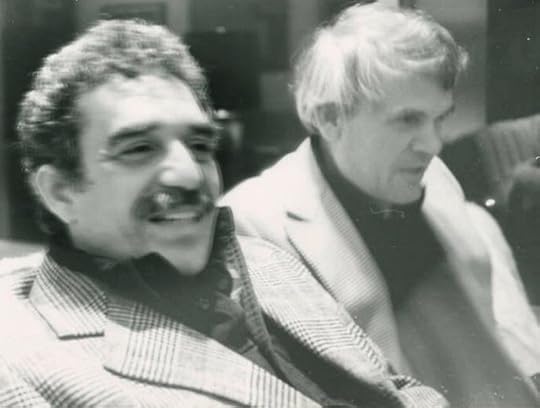
Son olarak; 1968'de, yani kitaptaki ilk konuşmanın hemen ertesinde Julio Cortazar, Carlos Fuentes ve Gabriel Garcia Marquez, o konuşmanın yapıldığı kongrenin bir anlamda tetiklediği Prag Baharı ayaklanmasına destek vermek için Prag'a gitmişlerdi. O seyahatten çok sevdiğim bir fotoğrafı da bu gönderiye eklemek istiyorum, bulunsun.
Of amma uzun oldu ya. Arz ederim.
Şayet benim gibi Kundera külliyatını tamamladıysanız, bu metinler size yeni bir şey söylemeyecektir. Ancak kendisinin zihnime kazınmış pek çok cümlesi arasından unutamadığım birkaç tanesinin öncüllerini bu kitapta bulabildiğim için mesudum - bir de beynimin içinde nasıl devasa bir Kundera çekmecesi olduğunu fark etmemi sağladı ve hoşuma gitti açıkçası, eheh. Örneğin 1986 tarihli Roman Sanatı'ndaki aşağıdaki pasajın neredeyse çok benzeri, bu kitapta yer alan 1983 tarihli makalede yer alıyor, ama o unutulmaz son cümlesi yok. Demek ki aradan geçen 3 senede o cevaba varmış kendisi. Bu pasajı anımsatmak isterim:
“Ortaçağ’da Avrupa birliği, din ortaklığına dayanıyordu. Modern Çağ’da din, yerini Avrupalıların kendilerini tanımladıkları, kendilerini buldukları, kendileriyle özdeşleştirdikleri yüksek değerlerin gerçekleştirilmesi olan kültüre (sanat, edebiyat, felsefe) bıraktı. Oysa bugün kültür de yerini terk ediyor. Ama neye ve kime? Avrupa’yı birleştirebilecek yüce değerlerin gerçekleşeceği alan nedir? Teknik ilerlemeler mi? Pazar mı? Demokrasi ideali taşıyan, hoşgörü ilkesine dayalı siyaset mi? Ama artık hiçbir zengin yaratıyı, hiçbir sağlam düşünceyi koruyamıyorsa bu hoşgörü, boş ve yararsız hale gelmiş olmuyor mu? Ya da kültürün el ayak çekmesi insanın kendini rahatlıkla teslim edeceği bir çeşit kurtuluş olarak algılanabilir mi? Bilemiyorum. Sadece kültürün, yerini çoktan terk ettiğini bildiğime inanıyorum. Böylece, Avrupa kimliği imgesi geçmişte kalıyor. O halde Avrupalı nedir? Avrupalı yoktur yahut Avrupalı, Avrupa özlemi çekendir.”
Keza yine 2005 tarihli Perde'de yaptığı müthiş büyük ulus - küçük ulus ayrımının da nüvelerini bu metinde bulmak mümkün. Şöyle diyordu orada: "Küçük ulusları büyük uluslardan ayıran nüfuslarının sayısı değil, daha derin bir şey: Varoluşları onlar için kuşkuya yer bırakmayan bir kesinlik değil, her zaman için bir sorun, bir tartışma konusu, bir risk; tarihe, onları aşan, onları kaale almayan, hatta onları fark etmeyen güce karşı savunma halindeler."
Bu kitapta da küçük ulus meselesini, ne Doğulu ne Batılı olabilmiş Orta Avrupa milletleri üzerinden güzelce didikliyor Kundera. Şöyle diyebilirim sanırım; benim gibi külliyatı tamamladıysanız size pek yeni bir şey sunmayacak bu kitap, ama Kundera'nın denemelerine çok hakim değilseniz, onlarda ne bulacağınızın güzel bir önizlemesi olabilir.
Bir küçük parantez: Hep söylüyorum, Kundera tam anlamıyla bir Avrupalı yazardı, edebiyatının her yerine sinmiş bir Avrupa meselesi vardı; Avrupa'nın ne olduğuna, nereye gittiğine dair akıl yürüten, bir coğrafi bölgenin ötesinde her şeyi biçimlendiren bir koca unsur olarak ona romanlarında yer veren biriydi. Bence o bayrağı Javier Marias teslim almıştı, onu da yitirdik. Şimdi bana sorarsanız Ali Smith taşıyor bayrağı, Mevsimler dörtlemesiyle bu meseleyi derinlemesine didikleyerek bu derdi devraldı gibime geliyor. Neyse sonuçta bu kitap da, Kundera'nın Avrupalılığı derken ne kastettiğimin anlaşılmasını sağlayabilir. Ne söyleyeceğini biliyor olmama rağmen ilgiyle okudum.
Son olarak; 1968'de, yani kitaptaki ilk konuşmanın hemen ertesinde Julio Cortazar, Carlos Fuentes ve Gabriel Garcia Marquez, o konuşmanın yapıldığı kongrenin bir anlamda tetiklediği Prag Baharı ayaklanmasına destek vermek için Prag'a gitmişlerdi. O seyahatten çok sevdiğim bir fotoğrafı da bu gönderiye eklemek istiyorum, bulunsun.
Of amma uzun oldu ya. Arz ederim.
March 22, 2025
*
Oamenii care nu trăiesc decât în prezentul lor necontextualizat, care ignoră continuitatea istorică și cărora le lipsește cultura sunt în stare să își transforme patria într-un desert fără istorie, fără memorie, fără ecouri și lipsit de orice frumusețe.
**
Într-o scrisoare catre Helvetius, Voltaire a scris această frază magnifică: “Nu sunt de acord cu ceea ce spuneți, dar mă voi bate până la moarte ca să aveți dreptul s-o spuneți.”
Avem de-a face, aici, cu formularea principiului etic de bază al culturii noastre moderne. Cine regresează în istorie înainte de apariția acestui principiu părăsește Luminile și se întoarce în Evul Mediu. Orice reprimare a unei opinii, inclusiv reprimarea brutală a unor opinii greșite, merge, în fond, împotriva adevărului, a acelui adevăr care nu poate fi aflat decât prin confruntarea unor opinii libere și egale.
Orice imixtiune în libertatea de gândire si de exprimare— oricare ar fi metoda si denumirea acestei cenzuri— reprezintă, în secolul al XX-lea, un scandal, si o grea povară pentru literatura noastră aflată în plină efervescență…
in other words, in our famous and present XXI century, Romania is welcomed to the Early Middle Ages…I guess I won’t get to see the High or Late Middle Ages in this lifetime 🤓
Although I am touched to the heart, there is no great relief and/or satisfaction to my mind, that I cannot separate my feelings from those of Kundera, it can only be a sign I've grown old(er) too fast! Well, he is a very clever fellow, that he is sure it would not bore anyone to have that taste of his writings quality 🥳
Oamenii care nu trăiesc decât în prezentul lor necontextualizat, care ignoră continuitatea istorică și cărora le lipsește cultura sunt în stare să își transforme patria într-un desert fără istorie, fără memorie, fără ecouri și lipsit de orice frumusețe.
**
Într-o scrisoare catre Helvetius, Voltaire a scris această frază magnifică: “Nu sunt de acord cu ceea ce spuneți, dar mă voi bate până la moarte ca să aveți dreptul s-o spuneți.”
Avem de-a face, aici, cu formularea principiului etic de bază al culturii noastre moderne. Cine regresează în istorie înainte de apariția acestui principiu părăsește Luminile și se întoarce în Evul Mediu. Orice reprimare a unei opinii, inclusiv reprimarea brutală a unor opinii greșite, merge, în fond, împotriva adevărului, a acelui adevăr care nu poate fi aflat decât prin confruntarea unor opinii libere și egale.
Orice imixtiune în libertatea de gândire si de exprimare— oricare ar fi metoda si denumirea acestei cenzuri— reprezintă, în secolul al XX-lea, un scandal, si o grea povară pentru literatura noastră aflată în plină efervescență…
in other words, in our famous and present XXI century, Romania is welcomed to the Early Middle Ages…I guess I won’t get to see the High or Late Middle Ages in this lifetime 🤓
Although I am touched to the heart, there is no great relief and/or satisfaction to my mind, that I cannot separate my feelings from those of Kundera, it can only be a sign I've grown old(er) too fast! Well, he is a very clever fellow, that he is sure it would not bore anyone to have that taste of his writings quality 🥳
June 23, 2024
Есе Мілана Кудери 1984 року про повільне стирання з карти Заходу країн Центральної Європи.
Описано:
- процес русифікації й те, що він характерний Російській імперії, а не тільки СРСР;
- важливість культури в революційних процесах;
- розбивається міф про загадкову словʼянську, вона рос., душу;
- про відмінність країн ЦЄ з великими імперіями;
- кризу культури на Заході.
Також в цьому виданні є промова Кундери на конгресі письменників 1967 року, де він виступає за подальшу лібералізацію чеської культури, що читається по-особливому щемко, знаючи, подібне станеться доволі не скоро.
Описано:
- процес русифікації й те, що він характерний Російській імперії, а не тільки СРСР;
- важливість культури в революційних процесах;
- розбивається міф про загадкову словʼянську, вона рос., душу;
- про відмінність країн ЦЄ з великими імперіями;
- кризу культури на Заході.
Також в цьому виданні є промова Кундери на конгресі письменників 1967 року, де він виступає за подальшу лібералізацію чеської культури, що читається по-особливому щемко, знаючи, подібне станеться доволі не скоро.

June 7, 2024
Przepiękny, mądry, odważny esej, w którym Kundera z perspektywy roku 1983 kreśli i próbuje zdefiniować ramy tożsamości środkowoeuropejskiej i zrozumieć jej odrębność. Jego zdaniem Europa Środkowa została po II wojnie światowej "porwana", bo politycznie zaczęła należeć do Wschodu, a kulturowo wciąż stanowiła Zachód. Na to rozdarcie nałożyło się poczucie osamotnienia i porzucenia przez Zachód, który stał się tożsamy z Europą jako taką. Esej rozpoczyna zresztą przywołanie hasła węgierskiej depeszy "Umieramy za Węgry i za Europę", a gdzieś ponad tekstem unosi się konkluzja, że przecież "za Europę" nie umierałby żaden Francuz ani Anglik. A przecież w Polsce też walczyliśmy ze sztandarami "Za wolność Naszą i Waszą".
To wszystko może wydawać się szalenie teoretyczne, mało aktualne w rzeczywistości 2024 roku, w innym ustroju i realiach historycznych, a także miejscami bardzo konserwatywne - a jednak moim zdaniem stanowi świetny i bardzo rzeczowy punkt wyjścia do refleksji o źródłach współczesnego eurosceptycyzmu i euroentuzjazmu.
Intelektualna uczta!!!
To wszystko może wydawać się szalenie teoretyczne, mało aktualne w rzeczywistości 2024 roku, w innym ustroju i realiach historycznych, a także miejscami bardzo konserwatywne - a jednak moim zdaniem stanowi świetny i bardzo rzeczowy punkt wyjścia do refleksji o źródłach współczesnego eurosceptycyzmu i euroentuzjazmu.
Intelektualna uczta!!!

July 28, 2024
Il fatto che questo saggio sia datato - anni ‘80 - nulla toglie alla sua potenza.
Kundera approfondisce il concetto di Europa centrale, quali e che cosa siano le cosiddette Piccole nazioni, sia nel contesto contemporaneo a lui (sotto il giogo sovietico), che soprattutto dal punto di vista culturale.
In cosa risiede l’identità della Cecoslovacchia, dell’Ungheria, della Polonia?
In che modo abbiamo smesso di considerarle parte integrante dell’Europa, per liquidarle e posizionarle per sempre nell’Est europeo?
Kundera risponde a tutto ciò con una grande profondità di pensiero ed analisi.
Molto interessante.
Kundera approfondisce il concetto di Europa centrale, quali e che cosa siano le cosiddette Piccole nazioni, sia nel contesto contemporaneo a lui (sotto il giogo sovietico), che soprattutto dal punto di vista culturale.
In cosa risiede l’identità della Cecoslovacchia, dell’Ungheria, della Polonia?
In che modo abbiamo smesso di considerarle parte integrante dell’Europa, per liquidarle e posizionarle per sempre nell’Est europeo?
Kundera risponde a tutto ciò con una grande profondità di pensiero ed analisi.
Molto interessante.
April 20, 2023
I first read the title essay "The Tragedy of Central Europe" in The New York Review of Books. I pre-ordered this slender volume hoping to find in it also a follow-up, or at least a reflection on those ideas in our new historical context. I'll be honest that I'm disappointed to find the 1984 essay only coupled with one more essay by Kundera -- the 1967 Address to the Czech Writers' Congress -- and two brief commentaries (by Jacques Rupnik and Pierre Nora) whose dates of composition are not included on the copyright page. The essays are thus served as beautiful inclusions, flies preserved in amber, which is ironic given that they articulate important insights not only into Central European culture not just as it was but also as it is today.
The title essay addresses a misconception common in the West that Central Europeans are somehow Russians who are for mysterious reasons pretending not to be Russian. It sounds crude when I write it this way but I don't know how else to put it. Central Europe is a category largely absent from Western discourse. This has puzzled me for a long time. It is as if there is a general sense of comfort with Cold War's absolute divide into West versus East, whose simplicity and starkness is inconveniently complicated by any suggestion of a middle, of a difference, of a dissenting vision.
Kundera's essay delves more elegantly and succinctly into the problem of Central Europe asserting its existence than I ever could. In the early days of Putin's invasion of Ukraine in 2022, how many people spoke about "spheres of influence" with a straight face not realizing that they were calling for the world to be carved up like an apple for the purposes of establishing something like a new Cold War order? I found that comfort difficult to understand and accept, and almost impossible to interact with. But, unlike me, Kundera remains focused and thus is able to put forward some definitions that shed light on the different ways of thinking about Europe:
The Ukrainian anthem has a very similar line, and the only interesting polemics with Kundera that I’ve encountered come from Ukrainians. The polemic is explicit in this piece and implicit in Oksana Zabuzhko’s Planeta Piołun (a book that I hope will soon get finally published in English). I take on board Ukrainian critiques of Kundera’s definition of Central Europe — they elucidate the blind spots in Central European thinking about the nations that had been absorbed directly into the USSR. Nonetheless, the Czech and Polish perspectives, as described by Kundera, indeed have those blind spots. He offers a rather accurate account of our understanding of Europe rather than anything like a flawless vision for Europe.
And so despite this book not being what I hoped it would be (longer, containing a follow-up of some sort to the two essays that actually comprise it), I hope it gets more readers.
The title essay addresses a misconception common in the West that Central Europeans are somehow Russians who are for mysterious reasons pretending not to be Russian. It sounds crude when I write it this way but I don't know how else to put it. Central Europe is a category largely absent from Western discourse. This has puzzled me for a long time. It is as if there is a general sense of comfort with Cold War's absolute divide into West versus East, whose simplicity and starkness is inconveniently complicated by any suggestion of a middle, of a difference, of a dissenting vision.
Kundera's essay delves more elegantly and succinctly into the problem of Central Europe asserting its existence than I ever could. In the early days of Putin's invasion of Ukraine in 2022, how many people spoke about "spheres of influence" with a straight face not realizing that they were calling for the world to be carved up like an apple for the purposes of establishing something like a new Cold War order? I found that comfort difficult to understand and accept, and almost impossible to interact with. But, unlike me, Kundera remains focused and thus is able to put forward some definitions that shed light on the different ways of thinking about Europe:
"What is Central Europe? An uncertain zone of small nations between Russia and Germany. I underscore the words: small nations. (...) But what is a small nation? I offer you my definition: the small nation is one whose very existence may be put in question at any moment; a small nation can disappear, and it knows it. A Frenchman, a Russian, or an Englishman is not used to asking questions about the very survival of his nation. His anthems speak only of grandeur and eternity. The Polish anthem, however, starts with the verse: ‘Poland has not yet perished’...”
The Ukrainian anthem has a very similar line, and the only interesting polemics with Kundera that I’ve encountered come from Ukrainians. The polemic is explicit in this piece and implicit in Oksana Zabuzhko’s Planeta Piołun (a book that I hope will soon get finally published in English). I take on board Ukrainian critiques of Kundera’s definition of Central Europe — they elucidate the blind spots in Central European thinking about the nations that had been absorbed directly into the USSR. Nonetheless, the Czech and Polish perspectives, as described by Kundera, indeed have those blind spots. He offers a rather accurate account of our understanding of Europe rather than anything like a flawless vision for Europe.
And so despite this book not being what I hoped it would be (longer, containing a follow-up of some sort to the two essays that actually comprise it), I hope it gets more readers.

May 19, 2022
Questa raccolta contiene due discorsi tenuti da Milan Kundera rispettivamente nel 1967 e nel 1983 ed è sorprendente come siano così attuali, anche alla luce del conflitto russo-ucraino, nonostante abbiano rispettivamente più di cinquant'anni, il primo, e quasi quarant'anni, il secondo.
Entrambi i discorsi ruotano attorno a due domande, a mio avviso: Cos'è l'Europa e chi ne fa parte? Cos'è una piccola nazione? "Ma la domanda riaffrontata nel 1967 assume anche un significato singolarmente contemporaneo allorché Kundera ne anticipa un’altra dimensione: il destino delle piccole nazioni nel quadro delle «ampie prospettive integrazioniste» che si sono dischiuse nella seconda metà del XX secolo."
Con estrema lucidità e durezza, Milan Kundera apre gli occhi all'Europa occidentale, per farle notare che si sta perdendo il cuore, cioè l'Europa centrale, costituita da quei Paesi che, pur trovandosi più a Est rispetto alla Francia, alla Spagna, non significa che siano territori appartenenti alla Russia: essere slavo, non significa essere russo.
"Che cos’è l’Europa centrale? L’incerta zona di piccole nazioni strette fra Germania e Russia. Insisto su questi termini: piccola nazione. Che altro sono gli ebrei, del resto, se non una piccola nazione, la piccola nazione per eccellenza? L’unica di tutte le piccole nazioni di ogni epoca che sia sopravvissuta agli imperi e alla marcia devastatrice della Storia."
Nel primo discorso, Kundera rimarca la necessità della Cecoslovacchia di preservare la propria lingua e cultura, grazie anche al preziosissimo supporto dei traduttori: "Ed è mediante la traduzione letteraria, in definitiva, che i cechi hanno fondato una letteratura europea in lingua ceca e che la letteratura ha formato i lettori europei in grado di leggere il ceco."
Nel secondo discorso, Kundera dà una definizione di piccola nazione: "Ma che cos’è una piccola nazione? Vi propongo la mia definizione: è una piccola nazione quella che in qualsiasi momento può vedere messa in questione la propria esistenza, che può sparire, e ne è consapevole."
Sorprendente l'attualità delle parole di Kundera, quando si riferiferisce alla Russia che, invadendo l'Ucraina, lancia, in realtà, una minaccia all'Europa.
Questi due discorsi di Kundera sono un invito accorato rivolto all'Europa perché ritrovi e tuteli la propria identità, da oriente a occidente.
"Ma l’Europa sta smarrendo il senso della sua identità culturale, sicché non vede nell’Europa centrale che il suo regime politico; in altre parole: non vede nell’Europa centrale che l’Europa dell’Est. L’Europa centrale deve dunque opporsi alla forza schiacciante del suo grande vicino, e insieme anche alla forza immateriale del tempo, che lascia irrimediabilmente dietro di sé l’Europa della cultura. Per questo le rivolte centroeuropee hanno un che di conservatore, direi quasi di anacronistico: tentano disperatamente di restaurare il passato, il passato della cultura, il passato dei Tempi moderni, perché solo in quel periodo, solo nel mondo che conserva una dimensione culturale, l’Europa centrale può ancora difendere la propria identità, può ancora essere percepita per quello che è. La sua vera tragedia non è dunque la Russia, ma l’Europa."
Entrambi i discorsi ruotano attorno a due domande, a mio avviso: Cos'è l'Europa e chi ne fa parte? Cos'è una piccola nazione? "Ma la domanda riaffrontata nel 1967 assume anche un significato singolarmente contemporaneo allorché Kundera ne anticipa un’altra dimensione: il destino delle piccole nazioni nel quadro delle «ampie prospettive integrazioniste» che si sono dischiuse nella seconda metà del XX secolo."
Con estrema lucidità e durezza, Milan Kundera apre gli occhi all'Europa occidentale, per farle notare che si sta perdendo il cuore, cioè l'Europa centrale, costituita da quei Paesi che, pur trovandosi più a Est rispetto alla Francia, alla Spagna, non significa che siano territori appartenenti alla Russia: essere slavo, non significa essere russo.
"Che cos’è l’Europa centrale? L’incerta zona di piccole nazioni strette fra Germania e Russia. Insisto su questi termini: piccola nazione. Che altro sono gli ebrei, del resto, se non una piccola nazione, la piccola nazione per eccellenza? L’unica di tutte le piccole nazioni di ogni epoca che sia sopravvissuta agli imperi e alla marcia devastatrice della Storia."
Nel primo discorso, Kundera rimarca la necessità della Cecoslovacchia di preservare la propria lingua e cultura, grazie anche al preziosissimo supporto dei traduttori: "Ed è mediante la traduzione letteraria, in definitiva, che i cechi hanno fondato una letteratura europea in lingua ceca e che la letteratura ha formato i lettori europei in grado di leggere il ceco."
Nel secondo discorso, Kundera dà una definizione di piccola nazione: "Ma che cos’è una piccola nazione? Vi propongo la mia definizione: è una piccola nazione quella che in qualsiasi momento può vedere messa in questione la propria esistenza, che può sparire, e ne è consapevole."
Sorprendente l'attualità delle parole di Kundera, quando si riferiferisce alla Russia che, invadendo l'Ucraina, lancia, in realtà, una minaccia all'Europa.
Questi due discorsi di Kundera sono un invito accorato rivolto all'Europa perché ritrovi e tuteli la propria identità, da oriente a occidente.
"Ma l’Europa sta smarrendo il senso della sua identità culturale, sicché non vede nell’Europa centrale che il suo regime politico; in altre parole: non vede nell’Europa centrale che l’Europa dell’Est. L’Europa centrale deve dunque opporsi alla forza schiacciante del suo grande vicino, e insieme anche alla forza immateriale del tempo, che lascia irrimediabilmente dietro di sé l’Europa della cultura. Per questo le rivolte centroeuropee hanno un che di conservatore, direi quasi di anacronistico: tentano disperatamente di restaurare il passato, il passato della cultura, il passato dei Tempi moderni, perché solo in quel periodo, solo nel mondo che conserva una dimensione culturale, l’Europa centrale può ancora difendere la propria identità, può ancora essere percepita per quello che è. La sua vera tragedia non è dunque la Russia, ma l’Europa."

May 21, 2026
Без жодного сумніву есей Кундери 1983 року (!) надзвичайно важливий, як вияв протесту та опору комуністичній системі.
Цей текст чітко і голосно заявляє, що малі нації Центральної Європи (автор вказує на чехів, поляків, угорців) живі, цінні, своєю культурою та ідентичністю належать до Заходу/Європи, Росія їм абсолютно чужа та незрозуміла, і задумується, чи потрібна їхня самобутність самій Європі?
Актуально для нас як ніколи.
Боляче, що ми, українці, стільки часу залишались "непомітними та неназваними" серед цих малих європейських націй як і в цьому есеї.
Після прочитання так і хочеться закричати "Ще не вмерла Україна!"
Цей текст чітко і голосно заявляє, що малі нації Центральної Європи (автор вказує на чехів, поляків, угорців) живі, цінні, своєю культурою та ідентичністю належать до Заходу/Європи, Росія їм абсолютно чужа та незрозуміла, і задумується, чи потрібна їхня самобутність самій Європі?
Актуально для нас як ніколи.
Боляче, що ми, українці, стільки часу залишались "непомітними та неназваними" серед цих малих європейських націй як і в цьому есеї.
Після прочитання так і хочеться закричати "Ще не вмерла Україна!"

September 11, 2023
Nesta pequena coletânea de dois discursos distanciados de cerca de duas décadas o autor aborda o conceito de Europa, mais propriamente o de uma Europa central herdeira do Império Austro-húngaro. Ao contrário do se poderia pensar ambos os discursos não se centram isoladamente na asfixia marxista ao mundo do pensamento livre, mas combinam a invasão da Europa central pelo leste, não apenas pelo seu aspecto político mas sobretudo com a perda de uma ocidentalidade assente no legado da antiguidade clássica e na tradição judaico cristã.
No último dos discursos, o da década de 80, Milan Kundera assinala e identifica uma Europa (a ocidental) a afastar-se da sua tradição cultural, e a deixar-se envolver no imediatismo cultural do mainstream, da televisão, dos media e dos tablóides, território mais tarde ocupado pelas redes sociais. Premonitório
Reflete Milan Kundera, e cita o director da agência noticiosa Húngara que quando em 1956 viu os tanques Soviéticos a entrar em Budapeste, que terá dito que a Hungria morria pela Europa.
Curiosa é a apreciação que Kundera faz desta afirmação reapreciada numa altura em que os tanques russos estão em força na Ucrânia. O que está em questão não é um redefinir de fronteiras, algo com que a Europa central sempre conviveu. Em causa está o confronto de duas civilizações, uma de Leste e outra, a nossa.
No último dos discursos, o da década de 80, Milan Kundera assinala e identifica uma Europa (a ocidental) a afastar-se da sua tradição cultural, e a deixar-se envolver no imediatismo cultural do mainstream, da televisão, dos media e dos tablóides, território mais tarde ocupado pelas redes sociais. Premonitório
Reflete Milan Kundera, e cita o director da agência noticiosa Húngara que quando em 1956 viu os tanques Soviéticos a entrar em Budapeste, que terá dito que a Hungria morria pela Europa.
Curiosa é a apreciação que Kundera faz desta afirmação reapreciada numa altura em que os tanques russos estão em força na Ucrânia. O que está em questão não é um redefinir de fronteiras, algo com que a Europa central sempre conviveu. Em causa está o confronto de duas civilizações, uma de Leste e outra, a nossa.

June 30, 2024
يقدم كونديرا في هذا الكتاب وجهة نظرة كمواطن تشيكي نظرته وتحليله السياسي والثقافي والجذري لموقع أوروبا الشرقية التي تتضمن التشيك بلده وموطنه وجذره بالنسبة إلى العالم الأوروبي ،
ماهية موقعية وأصالة هذه الدول بالنسبة إلى العالم الغربي والأوروبي وكيفية تثبيت جذورها الثقافية والأدبية واللغوية والفلكلورية والشعبية ككيان مستقل له ماله وعليه ما عليه من تاريخ وامتداد محللًا ما آلت إليه هذه الدول بعد الاحتلال السوفييتي الذي حاول طمس هويتها ولغتها وثقافاتها وما يتلاقفها أي هذه الدول من تأثير أوروبي غربي يمتد إلى الهوية والثقافة والسياسة والاعتراف بمواطني هذه الدول ككيانات مستقلة وفي ذات الوقت جزء من الاندماج الأوروبي في المشهد الثقافي العالمي ..
ماهية موقعية وأصالة هذه الدول بالنسبة إلى العالم الغربي والأوروبي وكيفية تثبيت جذورها الثقافية والأدبية واللغوية والفلكلورية والشعبية ككيان مستقل له ماله وعليه ما عليه من تاريخ وامتداد محللًا ما آلت إليه هذه الدول بعد الاحتلال السوفييتي الذي حاول طمس هويتها ولغتها وثقافاتها وما يتلاقفها أي هذه الدول من تأثير أوروبي غربي يمتد إلى الهوية والثقافة والسياسة والاعتراف بمواطني هذه الدول ككيانات مستقلة وفي ذات الوقت جزء من الاندماج الأوروبي في المشهد الثقافي العالمي ..

May 21, 2025
I presume this 'book' was published in 2023 as Milan Kundera died in that year although the information at the front of the book indicates the book was published in 2021 in French.
Anyway, the 'book' comprises the written version of a speech Kundera gave at the 1967 Czech Writers' Congress and an essay that appeared in 1983 in the magazine Le Debat called 'The Tragedy of Central Europe'. Together they've been packaged as 'A Kidnapped West'.
The important point that Kundera was making is that Europe as a continent is losing its cultural identity and as a result sees Central Europe only as the countries of Eastern Europe bordering Russia, and doesn't include small countries such as Austria in their definition of Central Europe. This means that Central Europe is trying to restore the past, the culture of the past, as it's only then that Central Europe can still defend its own identity.
Anyway, the 'book' comprises the written version of a speech Kundera gave at the 1967 Czech Writers' Congress and an essay that appeared in 1983 in the magazine Le Debat called 'The Tragedy of Central Europe'. Together they've been packaged as 'A Kidnapped West'.
The important point that Kundera was making is that Europe as a continent is losing its cultural identity and as a result sees Central Europe only as the countries of Eastern Europe bordering Russia, and doesn't include small countries such as Austria in their definition of Central Europe. This means that Central Europe is trying to restore the past, the culture of the past, as it's only then that Central Europe can still defend its own identity.

January 5, 2026
Нема культури, нема газєт, всім похуй

July 27, 2024
orta avrupa’nın ezelden beri sıkışmışlığını çek edebiyatının en popüler yazarlarından kundera’dan dinlemek güzel oldu. orta avrupa kültürel açıdan batı, siyasi açıdan doğu ve coğrafi açıdan ortada kaldığı dönemdeki sıkışmışlık ve çek-macar-leh üçgeninin her şeye rağmen kültürel varlıklarını devam ettirebilmeleri tam da bu ülkelerin üretimindeki iz bırakan gayretin kanıtı. biraz fazla kısa olsa da yine de hoş bir kurgu dışı oldu benim için.

May 14, 2022
Due scritti tradotti per la prima volta in italiano, rispettivamente risalenti alla fine degli anni Sessanta ed agli inizi degli anni Ottanta - dunque aventi rispettivamente 55 e 39 anni - contengono concetti tuttora attuali, anzi potrei quasi dire che sono stati precursori a difesa dei valori che l'attuale clima di estremismo politically correct, unito ad una prevaricazione dei radical chic, sta tentando di distruggere.
Citando Kundera, "l'antichità greco-romana e la cristianità, fonti decisive dello spirito europeo giacché da esse scaturisce la tensione di ogni sua conquista, si sono pressoché dileguate dalla coscienza di un giovane intellettuale ceco", ma potremmo sostituire 'ceco' con qualsiasi altra nazionalità europea.
Ciò non significa ritornare ai tempi greco-romani, o convertirsi al cristianesimo, bensì riconoscerne l'importanza quali fonti primarie dello spirito europeo, e da esse partire.
Mi ha colpito molto la lucida analisi di come l'Europa centrale sia stata bistrattata, specie dopo il 1945, andando a porla nell'elemento est europeo, quasi russo, nonostante fosse geograficamente al centro dell'Europa, ed intellettualmente si sentisse più europea che russa. In particolare, la comune derivazione linguistica del ceppo slavo (eccezion fatta per ungheresi e rumeni) non impone una automatica assimilazione alla cultura russa, anzi, e l'esempio di ciò che l'Impero Asburgico avrebbe potuto essere, ma non vi riuscì, è tanto lampante quanto la sua vivacità intellettuale dei vari protagonisti sudditi di quel regno.
Tremendamente crudo, ma realista, nella sua analisi circa chi prenderà il posto della cultura.
Citando Kundera, "l'antichità greco-romana e la cristianità, fonti decisive dello spirito europeo giacché da esse scaturisce la tensione di ogni sua conquista, si sono pressoché dileguate dalla coscienza di un giovane intellettuale ceco", ma potremmo sostituire 'ceco' con qualsiasi altra nazionalità europea.
Ciò non significa ritornare ai tempi greco-romani, o convertirsi al cristianesimo, bensì riconoscerne l'importanza quali fonti primarie dello spirito europeo, e da esse partire.
Mi ha colpito molto la lucida analisi di come l'Europa centrale sia stata bistrattata, specie dopo il 1945, andando a porla nell'elemento est europeo, quasi russo, nonostante fosse geograficamente al centro dell'Europa, ed intellettualmente si sentisse più europea che russa. In particolare, la comune derivazione linguistica del ceppo slavo (eccezion fatta per ungheresi e rumeni) non impone una automatica assimilazione alla cultura russa, anzi, e l'esempio di ciò che l'Impero Asburgico avrebbe potuto essere, ma non vi riuscì, è tanto lampante quanto la sua vivacità intellettuale dei vari protagonisti sudditi di quel regno.
Tremendamente crudo, ma realista, nella sua analisi circa chi prenderà il posto della cultura.

August 15, 2024
Benim için zihin açıcı bir okuma oldu…
Kitapta, Kundera’nın 1967’de Çek yazarlar Birliği’ne verdiği “Edebiyat ve Küçük Uluslar” başlıklı konferansın metni ile 1983 yılında Le Débat dergisi için yazdığı “Rehin Alınmış Bir Batı ya da Orta Avrupa’nın Trajedisi” makalesi var…
Kundera, bu metinlerde Doğu ile Batı arasında sıkışmış Orta Avrupa ülkelerinin Batı kültürüyle ilişkilerini irdeliyor. Kültür ile dilin kimliğin inşasında ve egemenliğin korunmasında oynadığı önemli role dikkat çekmesini özellikle sevdim…
Kitapta, Kundera’nın 1967’de Çek yazarlar Birliği’ne verdiği “Edebiyat ve Küçük Uluslar” başlıklı konferansın metni ile 1983 yılında Le Débat dergisi için yazdığı “Rehin Alınmış Bir Batı ya da Orta Avrupa’nın Trajedisi” makalesi var…
Kundera, bu metinlerde Doğu ile Batı arasında sıkışmış Orta Avrupa ülkelerinin Batı kültürüyle ilişkilerini irdeliyor. Kültür ile dilin kimliğin inşasında ve egemenliğin korunmasında oynadığı önemli role dikkat çekmesini özellikle sevdim…

August 19, 2022
Μαγευτική προφητεία!

December 31, 2024
2 interesting short pieces by Kundera from 1967 and 1983 with introductions on context of the original pieces and translations. I particularly enjoyed the second piece, The Tragedy of Central Europe, which takes up the idea of the central European identity and its loss. Kundera speaks to the struggle for existence of the central European nations from the cultural perspective rather than taking up in detail historical events, and does so masterfully in a way that still seems relevant 40 years later. My attempt to summarize and reflect on some of his key points is below, but I would highly recommend reading his short piece in full as it will much better summarize the ideas than I can.
I found Kundera discussion of Russian influence and ultimate dismissal of Russia as a driver of central European culture interesting. He asserts that central Europe is more western than Russian. The main Russian influence on central europe is an eraser of culture/ identity after World War II. The idea of the common Slavic identity serves only to unite and erase and then join as a common Soviet identity, not to preserve some deeper older identity.
Kundera paints Europe, as originally unified by a common religion and later unified by a common culture. God and then culture served as underlying hosts of common values. He notes that in his time culture has been ousted, and he is not sure what it has been or will be replaced it. In a statement that resonates today, he speculates that it could be replaced by a populous that worships mass media or a populous that worships the idea of tolerance, but speculates that this could end in tolerance as an empty and useless idea that no longer protects the free thinking it initially sought to protect. I can see echoes in this thinking of his fiction – in particular, The Book of Laughter and Forgetting, which I now think I will have to reread.
Ultimately, it seems that the plight of central Europe is the plate of Europe in general. Large nations risk becoming small nations and small nations are those which always have a sense of their possible impermanence. He references the first line in Poland’s national anthem: “Poland has not yet perished.” And notes how different this sentiment is from that of large nations, the victors and drivers of Hegel‘s capital H History. However, he notes death of culture in large European nations and the risk to the survival of the European identity that this death poses. Kundera by culture seems to mean a literary and artistic/critical culture. An interesting tidbit – the Czech literary journal had a circulation of 300,000 in a nation of 10 million. This data point serves to underscore of the importance of literary culture at the time and is a striking contrast to the reading habits of today/of western Europe at the time Kundera is writing . He contrast it to western Europe today that may worship mass media television shows, or other things he refers to as or empty.
This is where I’d love to hear a bit more from him – many might suggest that there is culture in mass media and television. I suspect that Kundera would say well then what values does it stand for? I think the Seinfeld argument here is that the modern idea that is worshiped is a pointlessness or nothingness in the same way that Seinfeld is sort of about nothing. In this way, then Kundera‘s culture has been replaced by worship of meaninglessness in America and arguably much of the west/modern Time broadly. This would seem to be consistent with the claim he makes of Sartre as the last great world figure/moral authority above politics “ in a world strip of values”. He knows the irony in this given that Sartre himself represents and purports the abdication of culture/values.
Kinda points out that the desire to preserve central European identity makes this project fundamentally conservative, a fight against “ the relentless pressure of time”. There is a tension, then, between this conservativism / the choice to create and preserve an identity in a small nation and a modern globalism. Kundera ends with the assertion that the tragedy of central Europe does not manifest in Russia but Europe as a whole – that Europe is no longer experienced as a value.
I found Kundera discussion of Russian influence and ultimate dismissal of Russia as a driver of central European culture interesting. He asserts that central Europe is more western than Russian. The main Russian influence on central europe is an eraser of culture/ identity after World War II. The idea of the common Slavic identity serves only to unite and erase and then join as a common Soviet identity, not to preserve some deeper older identity.
Kundera paints Europe, as originally unified by a common religion and later unified by a common culture. God and then culture served as underlying hosts of common values. He notes that in his time culture has been ousted, and he is not sure what it has been or will be replaced it. In a statement that resonates today, he speculates that it could be replaced by a populous that worships mass media or a populous that worships the idea of tolerance, but speculates that this could end in tolerance as an empty and useless idea that no longer protects the free thinking it initially sought to protect. I can see echoes in this thinking of his fiction – in particular, The Book of Laughter and Forgetting, which I now think I will have to reread.
Ultimately, it seems that the plight of central Europe is the plate of Europe in general. Large nations risk becoming small nations and small nations are those which always have a sense of their possible impermanence. He references the first line in Poland’s national anthem: “Poland has not yet perished.” And notes how different this sentiment is from that of large nations, the victors and drivers of Hegel‘s capital H History. However, he notes death of culture in large European nations and the risk to the survival of the European identity that this death poses. Kundera by culture seems to mean a literary and artistic/critical culture. An interesting tidbit – the Czech literary journal had a circulation of 300,000 in a nation of 10 million. This data point serves to underscore of the importance of literary culture at the time and is a striking contrast to the reading habits of today/of western Europe at the time Kundera is writing . He contrast it to western Europe today that may worship mass media television shows, or other things he refers to as or empty.
This is where I’d love to hear a bit more from him – many might suggest that there is culture in mass media and television. I suspect that Kundera would say well then what values does it stand for? I think the Seinfeld argument here is that the modern idea that is worshiped is a pointlessness or nothingness in the same way that Seinfeld is sort of about nothing. In this way, then Kundera‘s culture has been replaced by worship of meaninglessness in America and arguably much of the west/modern Time broadly. This would seem to be consistent with the claim he makes of Sartre as the last great world figure/moral authority above politics “ in a world strip of values”. He knows the irony in this given that Sartre himself represents and purports the abdication of culture/values.
Kinda points out that the desire to preserve central European identity makes this project fundamentally conservative, a fight against “ the relentless pressure of time”. There is a tension, then, between this conservativism / the choice to create and preserve an identity in a small nation and a modern globalism. Kundera ends with the assertion that the tragedy of central Europe does not manifest in Russia but Europe as a whole – that Europe is no longer experienced as a value.
This entire review has been hidden because of spoilers.

November 13, 2025
Читав дуже давно, але з нагоди виходу українського видання нарешті відмічу тут. Попри сентимент автора до Австро-Угорщини і ту саму славнозвісну примітку все ж ставлю цьому есею 5.

February 6, 2026
الكثير والكثير من عزيزى كونديرا
يقول ميلان كونديرا فى كتابه الشهير "كائن لا تحتمل خفته " ان الحياة لا تصلح ان نطلق عليها الخطوط الاولى لعمل ما .. فهى لا ترقى ان تكون مسودة للوحة او عمل فنى او كتاب
انها خطوط للا شئ.. نحن نعيش الحياة ارتجالا .. دفعة واحده .. مثل ممثل على مسرح دون بروفات .. فقط نعيشها مرة واحدة
كلما تقدم بى العمر واتأمل فى حياتى الماضية واتعجب كيف لقرار بسيط ان يخلق شكل حياة بأكملها .. شئ مرعب !!
منذ تلك السطور التى قرأتها له فى الكتاب الاول .. ادركت انى سأبقى مع هذا الكاتب فترة لابأس بها
لم يخذلني كونديرا فى اى كتاب او رواية قرأتها له .. دائما ما تصدمني اراءه وفلسفته .. يعبث بعقلى ويتركنى بهذا السؤال " هو انت وصلت للحته دى ازاى جوايا " ؟!
يبهرنا بقدرته على نبش المشاعر الانسانيه الى ذلك الحد .. قدرته على ان يأخذك لاعماق نفسك ويشرح لك خباياها بكل عبقريه وذلك ماحدث معى فى روايته "الهوية " التى قرأتها من مده طويله
اتذكر كلماته عن كيف تكون عزلة المحبين عظيمة ومشبعه للنفس لكنها عزله مخيفه تأخذك من كل هذا الصخب الى تلك المنطقة التى تشعر فيها احيانا بوحدة كريهة ..
فى رواية اخرى له "الخلود " يقول فيما معناه بأن بطلة روايته قررت ان تستيقظ صباحا فتضع وردة بجانب وجهها حتى لا ترى قبح العالم من حولها ..
لايستهين كونديرا بقارئه.. لكنه يستهين بعالمنا فى"حفلة التفاهه " ورغم عبثية عالم كونديرا .. لكنه يأخذنا فى رحلة عقليه لفلسفة عميقه ومختلفه تبدو لك وقتها الافعال البسيطه حدثا جلل ..
كعادته يكتب لنا رواية عن "الجهل " لكن كقارئ نهم يعرف بأن الرواية ستحمل معنى اخر وتفسير اخر لتلك الكلمة .. وقد كان فهنا يخبرنا ان الحنين هو الم الجهل .. فانت تحن لوطن يجهل وجودك بأكمله لتعود اليه فتتفاجأ بأن ماكنت تحن له لم يعد موجودا فتشعر بالغربه الحقيقيه عندئذ ..
لكنه فى تلك الرواية وفى وصفه لمحاولات البطل فى استحضار صورة زوجته الراحله على مر السنين .. ورعبه من الفراغ الذى يحيط صورتها فى ذاكرته .. اجده يحكى لى عن اسوأ كوابيسى .. هو ان استيقظ يوما فلا اتذكر صورة ابى !! ان الذكريات ليست كتابا او فيلم يمكن احياءها مرة اخرى باستحضارها !!
ها انا اصل معه للكتاب الثانى عشر " الغرب المختطف " الذى يصرخ فيه صرخة المثقف -خائفا مذعورا- شاعرا بالوحده والفراغ .. "فراغ انسحاب الثقافه "
يخبرنا فى صفحات قليله عن دول اوروبا الوسطى وعن ثوراتها و المحاولات المضنيه لمثقفيها وادباءها فى تنمية الادب والثقافه والحفاظ عالهوية ولغة البلاد ضد الاحتلال الروسى .. الذى يميل ويناقض كليا الطبيعه الاوروبيه .. التى تتنتمى اليها دول اوروبا الوسطى ثقافيا ..
ويتنبأ بكل عبقريه لاحداث اصبحت واقع نعيشه الآن فى كلماته " ففي عالمنا الحديث حيث تميل القوة إلى أن تتركز أكثر فأكثر في أيدي عدد قليل من الدول الكبرى، فإن جميع الأمم الأوروبية معرضة لخطر التحول قريباً إلى أمم صغيرة والخضوع لمصيرها"
تقييم الكتاب ٤/٥
ببساطه انا مهووسه بكونديرا ! ❤️
يقول ميلان كونديرا فى كتابه الشهير "كائن لا تحتمل خفته " ان الحياة لا تصلح ان نطلق عليها الخطوط الاولى لعمل ما .. فهى لا ترقى ان تكون مسودة للوحة او عمل فنى او كتاب
انها خطوط للا شئ.. نحن نعيش الحياة ارتجالا .. دفعة واحده .. مثل ممثل على مسرح دون بروفات .. فقط نعيشها مرة واحدة
كلما تقدم بى العمر واتأمل فى حياتى الماضية واتعجب كيف لقرار بسيط ان يخلق شكل حياة بأكملها .. شئ مرعب !!
منذ تلك السطور التى قرأتها له فى الكتاب الاول .. ادركت انى سأبقى مع هذا الكاتب فترة لابأس بها
لم يخذلني كونديرا فى اى كتاب او رواية قرأتها له .. دائما ما تصدمني اراءه وفلسفته .. يعبث بعقلى ويتركنى بهذا السؤال " هو انت وصلت للحته دى ازاى جوايا " ؟!
يبهرنا بقدرته على نبش المشاعر الانسانيه الى ذلك الحد .. قدرته على ان يأخذك لاعماق نفسك ويشرح لك خباياها بكل عبقريه وذلك ماحدث معى فى روايته "الهوية " التى قرأتها من مده طويله
اتذكر كلماته عن كيف تكون عزلة المحبين عظيمة ومشبعه للنفس لكنها عزله مخيفه تأخذك من كل هذا الصخب الى تلك المنطقة التى تشعر فيها احيانا بوحدة كريهة ..
فى رواية اخرى له "الخلود " يقول فيما معناه بأن بطلة روايته قررت ان تستيقظ صباحا فتضع وردة بجانب وجهها حتى لا ترى قبح العالم من حولها ..
لايستهين كونديرا بقارئه.. لكنه يستهين بعالمنا فى"حفلة التفاهه " ورغم عبثية عالم كونديرا .. لكنه يأخذنا فى رحلة عقليه لفلسفة عميقه ومختلفه تبدو لك وقتها الافعال البسيطه حدثا جلل ..
كعادته يكتب لنا رواية عن "الجهل " لكن كقارئ نهم يعرف بأن الرواية ستحمل معنى اخر وتفسير اخر لتلك الكلمة .. وقد كان فهنا يخبرنا ان الحنين هو الم الجهل .. فانت تحن لوطن يجهل وجودك بأكمله لتعود اليه فتتفاجأ بأن ماكنت تحن له لم يعد موجودا فتشعر بالغربه الحقيقيه عندئذ ..
لكنه فى تلك الرواية وفى وصفه لمحاولات البطل فى استحضار صورة زوجته الراحله على مر السنين .. ورعبه من الفراغ الذى يحيط صورتها فى ذاكرته .. اجده يحكى لى عن اسوأ كوابيسى .. هو ان استيقظ يوما فلا اتذكر صورة ابى !! ان الذكريات ليست كتابا او فيلم يمكن احياءها مرة اخرى باستحضارها !!
ها انا اصل معه للكتاب الثانى عشر " الغرب المختطف " الذى يصرخ فيه صرخة المثقف -خائفا مذعورا- شاعرا بالوحده والفراغ .. "فراغ انسحاب الثقافه "
يخبرنا فى صفحات قليله عن دول اوروبا الوسطى وعن ثوراتها و المحاولات المضنيه لمثقفيها وادباءها فى تنمية الادب والثقافه والحفاظ عالهوية ولغة البلاد ضد الاحتلال الروسى .. الذى يميل ويناقض كليا الطبيعه الاوروبيه .. التى تتنتمى اليها دول اوروبا الوسطى ثقافيا ..
ويتنبأ بكل عبقريه لاحداث اصبحت واقع نعيشه الآن فى كلماته " ففي عالمنا الحديث حيث تميل القوة إلى أن تتركز أكثر فأكثر في أيدي عدد قليل من الدول الكبرى، فإن جميع الأمم الأوروبية معرضة لخطر التحول قريباً إلى أمم صغيرة والخضوع لمصيرها"
تقييم الكتاب ٤/٥
ببساطه انا مهووسه بكونديرا ! ❤️

April 26, 2025
Książka, chociaż krótka, to jest absolutnie napakowana treścią. To o czym pisze Kundera jest, niestety, nadal aktualne i widoczne zarówno w rosyjskiej agresji na Ukrainę jak i niezrozumienia Europy środkowej przez zachód.
Tę książkę absolutnie powinien przeczytać każdy kto interesuje się historią czy krajem w którym mieszka. Jest absolutnie fenomenalna i otwiera oczy na złożoną historię współczesną Europy środkowej.
Tę książkę absolutnie powinien przeczytać każdy kto interesuje się historią czy krajem w którym mieszka. Jest absolutnie fenomenalna i otwiera oczy na złożoną historię współczesną Europy środkowej.
December 30, 2025
ніякі драматичні реалістичні романи можна не читати якщо є "викрадений захід", від цієї книжки сумно настільки що хочеться залізти на стіну. нічого з тих пір не змінилось, і стало тільки гірше. і буде ставати тільки гірше. а, і ще це прочитає тільки купка міських божевільних яка це і так знає, на жаль.

July 15, 2023
Written during the Soviet era, this has parallels to what’s going on regarding Central Europe vs a former Soviet KGB guy.
October 20, 2024
În cartea cehoslovacului Kundera, cunoscut pentru romanul Insuportabila ușurătate a ființei, ce se bucură de o excelentă ecranizare în regia lui Philip Kaufman, avându-i în rolurile principale pe Daniel Day-Lewis și Juliette Binoche, alcătuită din două părți, două texte: Literatură și națiunile mici, urmat de Un Occident răpit, avem șansa de a da peste o nouă binevenită recomandare cinefilă. La pagina 29 este menționat titlul peliculei Margarete (în original: Sedmikrásky), cătându-l, îl veți găsi și sub titlul Daisies din 1966, film de avangardă al regizoarei Věra Chytilová.
"Am văzut, recent, un film intitulat Margarete, care spune povestea a două domnișoare de o neînchipuită abjecție, foarte mândre de superba îngustime a minții lor, distrugând cu bucurie și bună dispoziție tot ce le depășește propriile orizonturi. Mi s-a părut că văd aici o alegorie a vandalismului cu bătaie foarte lungă și de o arzătoare actualitate. Cine este vandalul? Nu, nu este țăranul analfabet care, într-un acces de furie, dă foc conacului moșierului cel bogat. Vandalii pe care îi întâlnesc eu sunt cu toții educați, mulțumiți de ei înșiși, bucurându-se de o poziție socială destul de bună și neavând resentimente față de cineva anume. Vandalul este semeața îngustime a minții care își este autosuficientă și gata oricând să își revendice drepturile. Această semeață îngustime a minții crede că puterea de a adapta lumea la propria ei imagine face parte dintre drepturile ei inalienabile și, dat fiind că lumea este alcătuită în cea mai mare parte din tot ce o depășește, ea adaptează lumea la propria imagine, distrugând-o."
Și al doilea lucru care mi-a captat atenția și care m-a surprins într-un mod mai mult decât plăcut, flatant aș putea spune, este menționarea scepticului nostru sibian într-o notiță bibliografică făcută de autor la cel de-al doilea articol. Aici el ne spune așa: " Cel mai frumos și mai lucid text pe care l-am citit vreodată despre Rusia privită ca o civilizație aparte este acela al lui Cioran, intitulat <>, publicat în cartea sa Istorie și utopie (1960). Ispita de a exista (1956) conține alte excelente cugetări despre Rusia și Europa. Cioran este, mi se pare, unul din puținii gânditori care încă mai pun demodata problemă a Europei, în deplina ei dimensiune. De altfel, nu Cioran-scriitorul francez este cel care o pune, ci Cioran-central-europeanul, venit din România, țară <>. Nu ne gândim la Europa decât din Europa scufundată."
Oare cât de vandali mai suntem azi într-o Europă demult scufundată în globalism și care totuși își păstrează, pe alocuri, nuanțele local-autohtone?
"Am văzut, recent, un film intitulat Margarete, care spune povestea a două domnișoare de o neînchipuită abjecție, foarte mândre de superba îngustime a minții lor, distrugând cu bucurie și bună dispoziție tot ce le depășește propriile orizonturi. Mi s-a părut că văd aici o alegorie a vandalismului cu bătaie foarte lungă și de o arzătoare actualitate. Cine este vandalul? Nu, nu este țăranul analfabet care, într-un acces de furie, dă foc conacului moșierului cel bogat. Vandalii pe care îi întâlnesc eu sunt cu toții educați, mulțumiți de ei înșiși, bucurându-se de o poziție socială destul de bună și neavând resentimente față de cineva anume. Vandalul este semeața îngustime a minții care își este autosuficientă și gata oricând să își revendice drepturile. Această semeață îngustime a minții crede că puterea de a adapta lumea la propria ei imagine face parte dintre drepturile ei inalienabile și, dat fiind că lumea este alcătuită în cea mai mare parte din tot ce o depășește, ea adaptează lumea la propria imagine, distrugând-o."
Și al doilea lucru care mi-a captat atenția și care m-a surprins într-un mod mai mult decât plăcut, flatant aș putea spune, este menționarea scepticului nostru sibian într-o notiță bibliografică făcută de autor la cel de-al doilea articol. Aici el ne spune așa: " Cel mai frumos și mai lucid text pe care l-am citit vreodată despre Rusia privită ca o civilizație aparte este acela al lui Cioran, intitulat <>, publicat în cartea sa Istorie și utopie (1960). Ispita de a exista (1956) conține alte excelente cugetări despre Rusia și Europa. Cioran este, mi se pare, unul din puținii gânditori care încă mai pun demodata problemă a Europei, în deplina ei dimensiune. De altfel, nu Cioran-scriitorul francez este cel care o pune, ci Cioran-central-europeanul, venit din România, țară <>. Nu ne gândim la Europa decât din Europa scufundată."
Oare cât de vandali mai suntem azi într-o Europă demult scufundată în globalism și care totuși își păstrează, pe alocuri, nuanțele local-autohtone?
Displaying 1 - 30 of 276 reviews