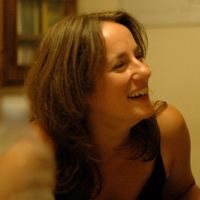
Winifred Mary Beard (born 1 January 1955) is Professor of Classics at the University of Cambridge and is a fellow of Newnham College. She is the Classics editor of the Times Literary Supplement, and author of the blog "A Don's Life", which appears on The Times as a regular column. Her frequent media appearances and sometimes controversial public statements have led to her being described as "Britain's best-known classicist".
Mary Beard, an only child, was born on 1 January 1955 in Much Wenlock, Shropshire. Her father, Roy Whitbread Beard, worked as an architect in Shrewsbury. She recalled him as "a raffish public-schoolboy type and a complete wastrel, but very engaging". Her mother Joyce Emily Beard was a headmistress and an enthusiastic reader.
Mary Beard attended an all-female direct grant school. During the summer she participated in archaeological excavations; this was initially to earn money for recreational spending, but she began to find the study of antiquity unexpectedly interesting. But it was not all that interested the young Beard. She had friends in many age groups, and a number of trangressions: "Playing around with other people's husbands when you were 17 was bad news. Yes, I was a very naughty girl."
At the age of 18 she was interviewed for a place at Newnham College, Cambridge and sat the then compulsory entrance exam. She had thought of going to King's, but rejected it when she discovered the college did not offer scholarships to women. Although studying at a single-sex college, she found in her first year that some men in the University held dismissive attitudes towards women's academic potential, and this strengthened her determination to succeed. She also developed feminist views that remained "hugely important" in her later life, although she later described "modern orthodox feminism" as partly "cant". Beard received an MA at Newnham and remained in Cambridge for her PhD.
From 1979 to 1983 she lectured in Classics at King's College London. She returned to Cambridge in 1984 as a fellow of Newnham College and the only female lecturer in the Classics faculty. Rome in the Late Republic, which she co-wrote with the Cambridge ancient historian Michael Crawford, was published the same year. In 1985 Beard married Robin Sinclair Cormack. She had a daughter in 1985 and a son in 1987. Beard became Classics editor of the Times Literary Supplement in 1992.
Shortly after the 11 September 2001 attacks on the World Trade Center, Beard was one of several authors invited to contribute articles on the topic to the London Review of Books. She opined that many people, once "the shock had faded", thought "the United States had it coming", and that "[w]orld bullies, even if their heart is in the right place, will in the end pay the price".[4] In a November 2007 interview, she stated that the hostility these comments provoked had still not subsided, although she believed it had become a standard viewpoint that terrorism was associated with American foreign policy.[1]
In 2004, Beard became the Professor of Classics at Cambridge.[3] She is also the Visiting Sather Professor of Classical Literature for 2008–2009 at the University of California, Berkeley, where she has delivered a series of lectures on "Roman Laughter".[5]
'How Do We Look/ The Eye of Faith' is a brilliant survey in which Mary Beard reframes the significance of art to focus on the consumer rather than the object, distancing herself from traditional narratives on Western superiority to consider civilisation as a whole concept.
'How Do We Look' is digestible, easy to read, and fascinating. Beard opens with fascinating case studies which immediately raise the question around the meaning of 'art' - how would these have been viewed at the time of their creation, and how does this compare to how they are viewed now?
The singing Colossi of Menmon (or not) was a particular favourite piece within this book for me. The fact that ancient tourists were carving their experiences into this piece, and that these writings preserve even the interactions between Hadrian and the statue is fascinating, and so distant from modern interactions with art.
I don't usually bring this up in my reviews (although it's happened to me almost more times than not in the last year) there was a disappointing typo in which Beard describes Muslim writings from the 10th century BC - not necessarily her fault, but still.
The study is divided into a survey on representations of the human body, and representations of religion. I don't necessarily have a problem with this framework, but I found the two to be a little disconnected. They could have been woven together slightly more for a more cohesive narrative - not to say that they were completely disparate.
In the second section, I found Beard's survey of iconoclasm across different religions and time periods really gripping. The way that religious imagery is used to shape art and culture - whether by opposition or definition - is a rich subject full of nuance and human debate.
I liked Beard's thematic approach, and her opposition to Kenneth Clark's overly Western-hellenic view of art and civilisation. Beard's reasoning was thoroughly explained, and she admits that although her continent and time spanning materials may seem unrelated, they each present their own significance on humanity as a whole.
"Where do I come from? Where do I belong?What's my place in human history? There is a modern faith here, even if we do not recognise it as such. It is one we call 'civilisation'. It is an idea that it behaves very much like a religion, offering grand narratives about our origins and our destiny, bringing people together in shared belief."
A shorter book to read during my endless procrastination on reading the other books I've bought, I was pleasantly surprised by this Mary Beard's 'Civilisations'. I've been a fan of Mary Beard for a long time and have enjoyed her work immensely, so it was fascinating to see her dive into the big questions of art and how it reflects back on us the notions of "civilisation", self-perspective, and religiosity. the discussions of these questions were wonderful, putting the art back into its cultural time and place, wondering why people decided to depict religious works - or themselves - in certain ways, and how it can help us understand these societies better. I do wish she would continue with some of these discussions, though, as by the time she had really gotten to the crux of a couple of points, she had already packed up and moved on to a new artwork or location.
Overall, however, a wonderful read that leaves the reader pondering and with a greater appreciation of the arts of the world beyond just its aesthetic value.
A different view of the art through history from the eye of the consumer rather than the creator. Particularly engaging regarding the lens of faith and purpose. Really accessible and digestible