Taking the form of one long email addressed to an estate agent, Goodlord is a fictional memoir of habitation, a genre-defying novelistic text that beautifully evokes the people and places of our lives--the spaces of work, those that may or may not be 'home', sites of trauma and ecstasy. Showing all the control of voice one would expect from a poet of her rare skill, Ella Frears has created a book that is as funny as it is harrowing, and beautifully skewers the contemporary housing crisis while questioning the fundamental desires, drivers and disappointments that lie at the heart of our obsession with 'property'.
Longlisted for the 2025 Republic of Consciousness Prize, UK & Ireland, for small presses
Shortlisted for The Forward Prize for Best Collection 2024 (for poetry)
We’re delighted to be renewing your tenancy. We’ve partnered with Goodlord, a property technology company, so you can sign your renewal contract online. To get started, you’ll need to set up an account with Goodlord. Ava, Nestor Estate Agent
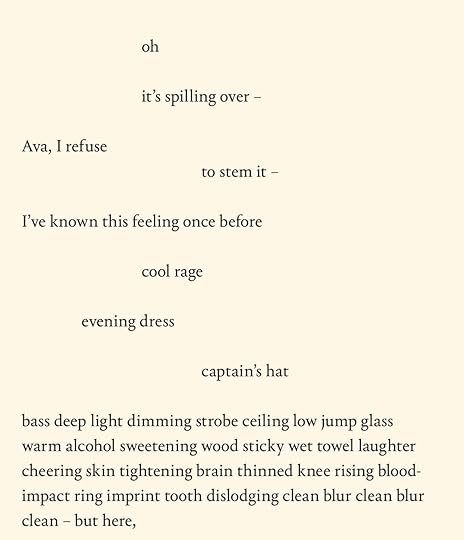
Goodlord - An Email by Ella Frears opens with the receipt, by the novel's narrator (if that's the right term) of an email from her landlord's letting agent as per above, which proves to be a triggering event for her. The rest of the novel consists of a lengthy email reply she is drafting to the agent, Ava, one she composes in something of a stream of thoughts and over time (e.g. there is a phone conversation with Ava during the composition). In form though the 'email' is more like a prose poem - this from near the opening:
The 'email' explains what led her, an artist in her early 30s and living in poorly maintained rented accommodation, to this point, taking us through her life from teenage years, through university, to now - the reference to the captain's hat explained in the closing pages.
It's a story of the difficulties of getting on even the rented property ladder, a succession of short-term stays in shared flats. But even more so one of a woman whose emerging sexuality was exploited by a succession of men, both those she is friendly with with but also strangers, work colleagues a particularly pertinent combination of the two, leading her into a succession of short-term abusive relationships, which themselves provide a mirror for her living arrangements.
This is a blackly comic novel - at times very funny, at others bleak, both in terms of what the narrator experiences but also, it has to be said, the hostility she shows towards Ava, who she has cyber-stalked and, although only in the confines of her mind, wished violence towards.
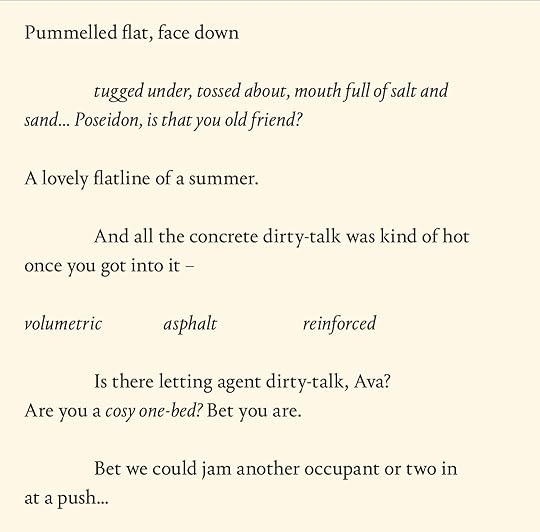
This passage refers to a former lover, a surveyor with a fetish for concrete, and crosses into thoughts about Ava:
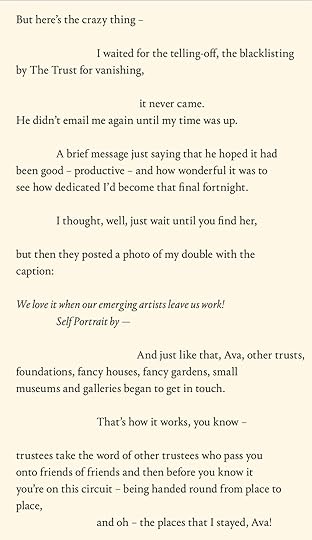
The one time where she does have access to another life is when she somehow receives an artistic residency, which at first seems to end comically badly (and from which she ultimately flees after a flirtation with some local fishermen turns rather darker) but ultimately leads her to more residencies and a succession of stays in properties which one serve to highlight property inequalities.
Original, and entertaining and disturbing in equal measure. A potential Goldsmiths Prize contender.
The judges' citation
“A taut, brilliantly sustained novel in fluent verse. A mordantly witty tirade against the dark forces of toxic masculinity and the Wild West that is today’s property rental market.”
The publisher
ROUGH TRADE BOOKS, is a publishing house brought to you by the minds behind Rough Trade Records. This new adventure in ‘capitalism’ is in the spirit of the pioneering independent record label, trading books and other wares of the same originality and radical direction.
It's the year 2024, and secure, affordable housing is the stuff of fiction. However, the "property technology company" that triggers Ella Frears' striking novel-in-verse – lending it its unusual format and even its title – is wholly real.
Goodlord begins with our anonymous and promising young female narrator receiving an email from her letting agent, urging her to sign up to said company in order to proceed with renewing her tenancy. The rest of the book is her 'unhinged' response to the aforementioned email, one that deftly explores the lack of freedom and choice that comes with renting, and with being a woman in one's twenties.
Here, Frears makes some rage-filled observations about the structural issues underpinning what is normalised as the everyday inconveniences of having to rent: the poorly maintained properties going for atrocious prices, houses chopped up willy-nilly into flats into multiple and unlivable 'bedrooms' to maximise the rent owed to landlords with glossy portfolios; the nonsensical, deceptive online listings that morph into mouldy, poorly-ventilated flats with asbestos-laced Artex ceilings; the rarity of getting a viewing and the endlessly disappointing ritual of having a slimy, patronising estate agent coax you into putting a higher offer in because, let's face it, we're living in a housing crisis; the lack of human connection in homes shared with strangers – We might have been good friends had/ architecture/ allowed; the untenable social decisions not having a secure place to call home at the end of the night leads us to; the fact of being made to feel grateful for having a bed when a bed is all some people really have, and still others not even that; the fear of becoming those others, teetering on the edge; insecure housing and insecure employment, that old cycle, the bleakness of it all.
That being said, the 'email' is largely a gimmick within which nests a much broader, multi-layered memoiristic poem, one that becomes deeply, uncomfortably personal in deliberate opposition to the cold and transactional nature of the leaseholding process. I was interested in the way Frears links the volatility of the rental crisis with the violence and exploitation faced by young women: in the narrator's email, a succession of terrible tenancies in less-than-comfortable houseshares begins to mirror a string of unhappy flings and short-term, abusive relationships. She finds herself being taken advantage of in both kinds of situations as circumstances render her passive; finds both types of experiences increasingly difficult to talk about because – as Frears puts it in an interview with Dazed magazine, it is "more complex than just non-consensual." There is a lot of anger in this 'email', lots of dark humour and plenty of the cheerlessness that accompanies living a life on survival mode, all written with a forcefulness that I appreciate both in poetry and fiction.
Is this the novel about generation rent? Probably not – Jo Hamya's Three Rooms is in my opinion still the most mature and even-handed experimental work on the subject. But is enjoyable, funny, and worth your time? Goodlord. Good grief. Good girl. Goodreads. Yes, yes it is.
«Gostei do formato do livro e da maneira como a autora conciliou o passado da protagonista com o que estava a acontecer na vida dela no presente, mas tive pena que não houvesse mais momentos em que discorria sobre a crise da habitação. Para mim, os momentos em que o fez foram os mais interessantes, e gostava de ter tido mais.»
I enjoyed the style of the poem very much but I was expecting a lot more insight into the property crisis. Frears makes some good points on the reality of renting (such as the bus fumes image) but the poem to me seemed a lot more focused on critiquing rape culture. The number of sleazy men and descriptions of sexual exploitation in the poem is staggering, and while that’s a very important topic, I kept hoping for the poem to return to the idea suggested by its title. The relationship between the name Goodlord, God, landlords, titled Lords and the power dynamics implied by it all - that’s what compelled me to pick up the book in the first place, but to me the potential didn’t feel fully realised.
This has to be the work of art about the great 21st-century UK housing crisis. All jokes aside, I'm in awe of how Ella Frears has so deftly managed to control my affects and make them swing widely and wildly from abjectness and horror to laughing out very loudly... And then becoming terrified of myself for laughing because of the terrible things being described and implied. All that in the form of what appears to be a novel in verse. Thank you Ella for making me feel meta-horrified.
Unhinged frog boil of a book and I loved every goddamn word. Laughed loudly and also had buried memories turfed up. The rental crisis conceals something dirtier and meaner!!!!!!!!
4.5 - way more people should read this! i found it so compelling and engaging, and of course, love the concept of completely losing your mind in an email to your landlord.
Ella Frears style is baffling, chaotic and quite fast. While reading this I was not exactly enjoying it but at the same time I couldn’t put it down. Also, it was the first time I read fiction about the housing crisis.
The parallel between the lack of ownership of stable and comfortable housing (i.e. a home); and the lack of ownership of her own body is brilliant and extremely well constructed.
I enjoyed the book much more after discussing it at my girls’ bookclub, which was such an enriching experience.
“Worst part is, Ava, now I can't stand the gummy fuckers. They taste like shame or him or adolescence which is sweet but terribly unstable, and with the added sugar now feels sickly, I can't stomach even the slightest recollection. Am I making sense?”
I like the writing style, but at the same time I didn’t enjoy reading most of the novel, if that makes sense? Sujet over fabula etc. The writing is giving Claire-Louise Bennett and Ottessa Moshfegh. But the actual events (esp. towards the end of the book) are so uncomfortable…
This was an impulse buy based on the cover and a few quotes on the back. What I expected was a comedy in the form of an e-mail, somewhat related to the seemingly eternal struggle of renting. What I got was poetry (surprise!) about the deeply traumatic experiences of the protagonist.
It was a quick and fascinating read but certainly not what I expected. I would have loved some trigger warnings at the beginning or at least a summary that would have alluded to some of the darker topics. Believe it or not, I do not expect to read about SA when something is marketed to be about renting and the cost-of-loving crisis. (The whole living situation struggle also gets very little showtime, it really just serves as the "trigger point" for the start of the story/email.)
All in all: I think this book is good at what it wants to do. I just wish it would have been marketed accordingly.
After The Möbius Book by Catherine Lacey, this was another book playing with form that unfortunately didn't quite work for me. I appreciated the idea behind the stylistic choice: the narrator is writing an email to her estate agent, expressing her rage with their behaviour toward her, the state of the rental market and access to real estate in contemporary Britain in general, all while continuously drifting off to past traumatic events of her life.
This book is written in a stream of consciousness style that evoked a feeling of dread, discomfort and underlying threat in me throughout. The narrator jumped between a present timeline in which she was writing to the estate agent about her anger toward her and various scenes from her past, involving traumatic experiences, usually involving men threatening and abusing her, constant feelings of loneliness and a lack of stability in her life which led to feelings of unworthiness and treating herself as less than because of that.
Looking back, I think the throughline of the different scenes was how every scene related back to real estate and how it (or the lack of consistent access to it) affected the narrator's life in many different ways. However, reading it, the scenes felt disjointed and seemed like they had no connection to the present timeline. I understand the intention behind it all looking back, but while reading it, there was an element of 'what's the point' that kept bugging me, plus I did wonder why this was even titled as "An Email". The formatting didn't start as an email and slowly went off the rails; it reminded me of Little Scratch by Rebecca Watson from the start. Why not play with the style a bit more and show the deterioration? Based on the ending of the book, I'd say that there is an argument to be had that this was never really an email within the plot either. I still think it could have been used to play with the content and style a bit more.
Overall, I appreciated the message of this book and found it interesting, but it just didn't quite work for me as a reading experience, if that makes sense.
Comparison is the thief of joy and here if I’d never read Rebecca Watson’s Little Scratch then Goodlord would’ve been more than it turned out to be. It’s a steam of consciousness book with funny formatting and much white space and a fractured narrative that is very easy to get lost in but rarely lost by. Very very like Little Scratch but didn’t get to me in quite the same way. That’s not to say it isn’t a very good book. It really is. If you’re ever rented and felt the all encompassing panic of living in places without security, held at the whims of faceless landlords and unpleasant estate agents (honestly have you ever met one that isn’t a patronising little diktat) then you’ll take a lot from this novel, it’s the best on the housing crisis I’ve encountered and that’s not a problem that’s getting sorted anytime soon. I don’t actually think it’s a problem anyone with power has any intention of even attempting to solve. And in terms of unsolvable problems this book treats the traumatic encounters, violence and misogyny women tend to face in one way or another, in a fleeting but powerful way. I imagine it’s hard to write about the things people experience that they don’t for the most part feel able to talk about. The author has to sort of get the narrator to lead the reader up the garden path and trust them to fill in the gaps. Ella Frears is very good at it. You like the narrator, she’s funny and matter of fact but not in an intimidating way. She’s odd and slightly unhinged but understandably so. I’m more concerned by people that aren’t a little mad. It’s a book very worth reading. 4/5
This is a long poem written as a letter to ‘Ava’, a rentals agent. It is full of anger, humour, tragedy, terror, insight and beauty. It’s a bit hard to say what it’s about, because it’s about so much - but big themes are home, exploitation of many different kinds, class, art and trauma. I really loved it - I’ve never really read anything like it. Read it!
I'm not sure if I've just read a novel, a poem or an email (pretty sure it doesn't really matter) but that feeling of being kept permanently slightly off balance persisted the whole way through reading this... whatever it is. Very dark in places which put me in mind of Eliza Clark and modern without feeling instantly outdated, which did too. Superb.
“Please find attached my gaping hole. A video where I slap myself like steak.”
Starts as a caustic and unhinged reply to landlord scum; ends with us needing to take men off the planet for good. Unpredictable, angry, hilarious, and mostly satisfying.