Pseudonym A. A. Craig, Michael Karageorge, Winston P. Sanders, P. A. Kingsley.
Poul William Anderson was an American science fiction author who began his career during one of the Golden Ages of the genre and continued to write and remain popular into the 21st century. Anderson also authored several works of fantasy, historical novels, and a prodigious number of short stories. He received numerous awards for his writing, including seven Hugo Awards and three Nebula Awards.
Anderson received a degree in physics from the University of Minnesota in 1948. He married Karen Kruse in 1953. They had one daughter, Astrid, who is married to science fiction author Greg Bear. Anderson was the sixth President of Science Fiction and Fantasy Writers of America, taking office in 1972. He was a member of the Swordsmen and Sorcerers' Guild of America, a loose-knit group of Heroic Fantasy authors founded in the 1960s, some of whose works were anthologized in Lin Carter's Flashing Swords! anthologies. He was a founding member of the Society for Creative Anachronism. Robert A. Heinlein dedicated his 1985 novel The Cat Who Walks Through Walls to Anderson and eight of the other members of the Citizens' Advisory Council on National Space Policy.[2][3]
Poul Anderson died of cancer on July 31, 2001, after a month in the hospital. Several of his novels were published posthumously.
Poul Anderson, the consummate science fiction “idea man” came up with quite a few great ideas and then built stories around them. Some were OK, many were much better than OK, and only a few were not so good.
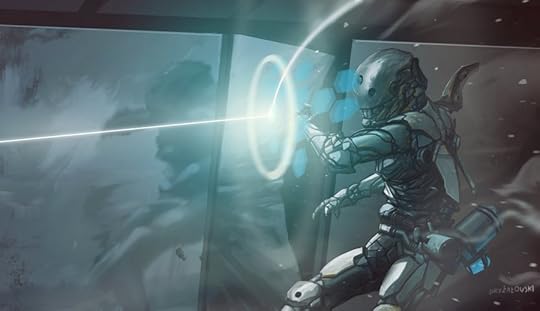
In 1963, Anderson released Shield, which most definitely fits into the “much better than OK” category. Peter Koskinen returns to Earth after an extended scientific stay on Mars. Like Heinlein and Bradbury, the Martians from Shield are an ancient and technologically advanced race, but whose science is far different than anything Terrans had imagined. One such idea is the shield, a device that can create a force field around a person or thing and the shielded individual is damn near invulnerable.
But Earth is no longer green fields and blue skies. A second thermonuclear war has decimated much of the United States, which stands alone as the world’s sole remaining superpower. As power corrupts, absolute power corrupts absolutely, and America’s constitutional protections have eroded as a fast as a 60s mass market paperback left out in the rain.
As with so many other of his works, I am amazed at how forward thinking was his vision. Rather than crafting your run of the mill dystopian drivel, Anderson focuses on how life continues and moves forward, here describing an anarcho-capitalistic underworld ruled by warlord gangsters and doing business from the craters and from the lower levels of society (here literally as most of the well to do inhabit the upper floors George Jetson like).
Further, Anderson illustrates how a thinly disguised military state has emerged to “protect the peace” and the ills this government fosters. Poul dons his libertarian cap and speaks through characters to wax ideological on what defines freedom and the inherent costs of despotism. This section will lose some readers but he has a purpose, dealing out a solution reminiscent of Salvor Hardin’s in Isaac Asimov’s classic Foundation (published 1951).
Told with a Philip K. Dick like sentimentality and vaguely similar to Heinlein’s Between Planets, this is one of Anderson’s better novels.
Pete Koskinen returns to Earth from the first long-term expedition to Mars, where he communed with the martians and created a portable invulnerability shield. Now forces are out to get him, and the secret of the shield! Yup, it's mostly just pulpy old-school nonsense. A few chases, a few fights and a bit of romance. Scratch beneath the surface though, and there is some good work here. Anderson does some very nice world-building, believably positing a United States of America that has taken on the role of world policeman. All other countries have become protectorate states, and the U.S. has become, out of necessity a fascist overlord run by a secret police. All this background is interwoven nicely into the prose, as well. No "As you know..." monologues for Anderson. It's a short book and it moves along at a good pace (except near the end, where we get some quite Heinlein-esque passages where people bang on for a few pages about what an awesome society they could create if only they were in charge). If you like the pulpy stuff, give this one a go.
If you read science fiction, drop what your reading and find this book. If you read history or political science, drop what your reading and find this book.
It is amazing how close Anderson nailed our political climate today in a book written in 1955. The only real problem is that, we don't have the shield.
If you combine "The Fugitive" with political/sociology wrangling, this novel is precisely what you get.
Most readers are going to be minimally surprised and confused by the enigma that is the female character (Vivienne). She is very much unexpected; I'm not saying I think she is super, but only that readers will be surprised by her.
The technology that provides the focal point for the plot is in a way simplistic and yet developed enough to provide enough meat for the whole storyline. The assistance from Martians adds exotic and fun flavor to what could otherwise be very annoying.
The political-sociological stuff does get a bit heavy; far more intensive than one expects in novels (proving this is far from some action-pulp of the 50s). So, some readers may tire in those sections. Nevertheless, it is thought provoking and relatively fleshed-out, so that the argumentation is not merely rant.
Minor spoilers ahead: This is a prime example of what I mean when I say that Libertarianism will probably occur as a result of some technological breakthrough rather than as a result of activism or political action. I was pretty impressed with the overall pacing, story, hard scifi tech elements, and short philosophical diatribes. The female character is also pretty damn good for a scifi book. Will read more of Anderson as a result of this book.
The protagonist of this early 1960s novel, Koskinen, returns from the first Mars trip with a shield, an invention he and friendly Martians developed that creates an impenetrable force field bubble around its wearer. Earth since he left has had another nuclear war and become a more dog eat dog society. All anyone can see is the shield's military applications. Competing factions vie to possess the shield so they can conquer the world with it. Koskinen does not want his invention used this way, so he takes on the mission of keeping it away from the various would be abusers of this technology.
This sounds like a good plot idea, doesn't it? Sadly, the story denigrates from this promising premise into becoming a platform for Anderson's Libertarian political views. There is a love interest that helps Koskinen decide the shield's ultimate fate. That relationship is somewhat of a surprise in how maturely written it is, even if the love scent takes place off camera (of course), not something one would expect from a geeky SF writer of the pulp era. Ultimately though, it fails to save the novel which crashes under the weight of its Libertarian didacticism.
There is a SF school of readers out there that love this kind of stuff. The Libertarian Futurist Society under American author and activist L. Neil Smith established the Prometheus award in 1979 and created a Hall of Fame Award (for classic works of libertarian science fiction, not necessarily novels) in 1983. There is a Wikipedia page listing all the awards winners and what novel won for any given year. I guess this novel has never been nominated because it precedes the award, but if retro Prometheus awards are ever given, as retro Hugos are, this book certainly deserves to be a candidate. Recommended for readers who think Libertarians have wonderful (rather than simplistic) insights (instead of naive prejudices) into the way our society ought to be organized.
EDIT: I just revisited the Promethus award site. Oh my goodness! Anderson is a poster child. He has the following books listed as either winning or having been a candidate: The Avatar, Orion Shall Rise, The Boat of a Million Years, The Stars Are Also Fire, The Fleet of Stars, Trader to the Stars, The Star Fox, "No Truce with Kings", and "Sam Hall." He won a lifetime achievement award in 2001. Talk about dedicated!
Some of the charm of Anderson's 1962 book is that it takes place in our approximate present, though we missed out on a minor atomic war and 2012 "blue Eisenhower" air cars. Pete Koskinen, age 23, has returned from Mars with a disruptive technology, a personal force field. Most of the world lives under a pax Americana that is descending into tyranny. Koskinen has to escape his own US Military Security, gangland bosses and Chinese spies. It's a great hard sf action thriller with a few twists and turns and a smattering of romance.
The novel lags a bit when the author gets too preachy with his political messaging however the musings on Martian language, albeit somewhat similar Heinlein's Stranger in a Strange Land (1961) and the potential uses of the titular shield both get an imaginative workout, though no attention gets paid to the cost of constructing such a device. Dave Egge's cover design of Koskinen falling to earth inside the active shield is a spot on description of a scene in Chapter 3 which complements the text nicely. Classic fun and a quick but very enjoyable read!
Under-appreciated. A little dated now, in a few ways, but still there's a lot more insight & thoughtfulness here than in, say, Heinlein or Haldeman.
The female character is a person in her own right, with her own agency & motivations & intelligence & history... she could almost be tagged as a hero. The hero himself has a lot of learning & growing up to do, but fortunately he retains his innocence and optimism until the end so we can root for him. The villains, well, most of them are people first, bad guys second.
It would (still, with only minor updates) make a good movie. Lots of adventure, a little romance, a good but complex hero, nuanced but not complex themes, fun visuals.
This sci-fi novel from 1963 had a great premise - a spaceman returns to earth with a personal defensive technology that renders all forms of weaponry obsolete. Where it fails is in the extensive pontification for limited government. Of note, like many science fiction novels of the 50s-60s, following McCarthyism and leading to the dishonest administration of Nixon, Anderson's comments on the presidency seem inspired for 2019: "You have to respect the integrity of a government organization, or you'll soon have no government whatsoever. Furthermore, every leader has to make compromises; otherwise he'd set everybody against him and get nothing accomplished..."
Maybe I expected too much from this book, considering its age, but it really wasn't an interesting read. Cliché-ridden, naive, sexist, and wasteful of the few good ideas it contains.
Of course, a lot of this is down to the time of its writing, but still. American chauvinism isn't only present here, it's practically the most important plot point beyond the shield itself.
The writing is bland and the dialog is stilted. I haven't read much sci-fi from this era, but this book felt like it had all the stereotypes on full display. Some will probably like it, but it really wasn't my thing.
I was impressed with Poul Anderson’s minor novel, Shield. Many other reviewers point out that the novel is dated. Yes. But so are almost all sci-fi novels written in the 1960s when it came to describing computers etc.
Accidentally started and decided to just finish this. was not expecting it to turn into The Moon is a Harsh Mistress level of political theorizing 3/4 of the way through. Good enough considering it's age.
"Blitzschnell legte er den Schalter um und aktivierte den Schild. Da er sich automatisch immer in der Mitte des Kraftfeldes befand, wurde er vom Sitz gerissen und hing plötzlich mitten in der Kabine. Der Pilot und der große Bursche wurden gegen die Kabinenwand gepreßt. Für Koskinen waren sie nur lautlose Schatten, denn er konnte ihr Gebrüll nicht hören.Koskinen steckte seine Brieftasche wieder ein und beruhigte sich. Jetzt war er unangreifbar..." Die Marsexpedition war wieder heimgekehrt, doch der Empfang auf der Erde war anders, als die Teilnehmer der Expedition sich vorgestellt hatten. Man verhaftete oder tötete die Männer - bis auf Peter Koskinen. Ihm konnten die Jäger nichts anhaben, denn er trug den Schild der Unangreifbarkeit!
Dieser Roman hat seine Stärken, aber auch seine Schwächen. Zu seinen Stärken gehört die Beschreibung der gesellschaftlichen und politischen Situation, das Verhältnis zwischen den einzelnen Gesellschaftschichten und ihrer Lebensweisen. Auch die Idee eines von den Marsbewohnern entwickelten Schutzschilds hat was, womit wir aber auch schon zu seinen Schwächen kommen. Da sind zum einen die erwähnten Marsbewohner, die eigentlich nur eine Statistenrolle haben und meistens nur in Rückblenden des Protagonisten Koskinen vorkommen. Zum anderen ist da der Schild oder besser gesagt dessen technische Unzulänglichkeiten. Was nützt mir ein Schild der mich zwar unangreifbar macht, aber auch unbeweglich. Eine weitere Sache mit dem Schild ist ein eindeutiger Logikbruch. An einer Stelle können ein paar Gangster den Protagonisten, dessen Schild aktiviert ist, ohne Probleme in ein Taxi bugsieren und er ist wehrlos. An einer anderen Stelle kann er allerdings in einem Raum den Schild ausweiten und ein paar Gangster an einer Wand zerquetschen. Wie nun, in einem Raum funktionierts, in einem Taxi nicht?
Der Roman ist nicht schlecht, man hätte aber mehr daraus machen können.
I was really impressed with this book. It has everything in perfect measure - action, politics, romance, science - and the characterisation is superb. An intelligent, strong-willed, motivated woman who isn't an emotional deadzone? Written in the 60s? (it's more likely than you think!). Characters had their own motivations and goals that intersected, and I would love to read about some of the others that crossed paths with the protagonists - the Polish insurrectionist, the crime boss, the martians. It's a really rich world.[return][return]This is exactly what good sci fi should be. Likeable characters, complex worldbuilding, tight pacing and rational plotting. I would love to see this adapted for film or tv, or even radio. Anything to bring it to a wider audience.[return][return]www.solelyfictional.org
I first read this back in the early 1970s and I remember enjoying it immensely. Now, I had trouble just listening to literally hours of political theory talk, with just a little action interspersed in between. The use of the shield was minimal, but my childhood memory recalled a lot more of it. Needless to say, I was disappointed .... growing old SUCKS !!!
This reminded me of some early Robert A. Heinlein stuff. Not only does the hero overthrow the tyrannical government, but there is a lot of discussion about the political system they want to set up, afterwards.
The romantic subplot takes a weird twist at the end.
Good, but dated, and kind of short. Given that it was written in the mid-60s, it has held up remarkably well. There were a couple sections with intricate political discussions that seemed excessive, although they were certainly well thought out.
This is an old book, but a good one. New technology is brought back from Mars, rather naively, because everyone wants it for their own ends. The way the situation is resolved is good, but I won't give it away. Good characters, good plot, really enjoyable.