

What do you think?
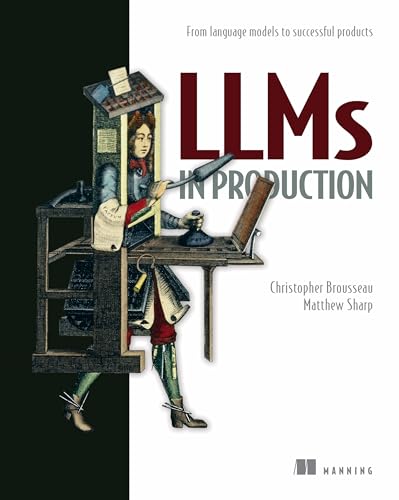
LLMs in Production: From language models to successful products
Learn how to put Large Language Model-based applications into production safely and efficiently.
This practical book offers clear, example-rich explanations of how LLMs work, how you can interact with them, and how to integrate LLMs into your own applications. Find out what makes LLMs so different from traditional software and ML, discover best practices for working with them out of the lab, and dodge common pitfalls with experienced advice.
In LLMs in Production you
• Grasp the fundamentals of LLMs and the technology behind them
• Evaluate when to use a premade LLM and when to build your own
• Efficiently scale up an ML platform to handle the needs of LLMs
• Train LLM foundation models and finetune an existing LLM
• Deploy LLMs to the cloud and edge devices using complex architectures like PEFT and LoRA
• Build applications leveraging the strengths of LLMs while mitigating their weaknesses
LLMs in Production delivers vital insights into delivering MLOps so you can easily and seamlessly guide one to production usage. Inside, you’ll find practical insights into everything from acquiring an LLM-suitable training dataset, building a platform, and compensating for their immense size. Plus, tips and tricks for prompt engineering, retraining and load testing, handling costs, and ensuring security.
Foreword by Joe Reis.
About the technology
Most business software is developed and improved iteratively, and can change significantly even after deployment. By contrast, because LLMs are expensive to create and difficult to modify, they require meticulous upfront planning, exacting data standards, and carefully-executed technical implementation. Integrating LLMs into production products impacts every aspect of your operations plan, including the application lifecycle, data pipeline, compute cost, security, and more. Get it wrong, and you may have a costly failure on your hands.
About the book
LLMs in Production teaches you how to develop an LLMOps plan that can take an AI app smoothly from design to delivery. You’ll learn techniques for preparing an LLM dataset, cost-efficient training hacks like LORA and RLHF, and industry benchmarks for model evaluation. Along the way, you’ll put your new skills to use in three exciting example creating and training a custom LLM, building a VSCode AI coding extension, and deploying a small model to a Raspberry Pi.
What's inside
• Balancing cost and performance
• Retraining and load testing
• Optimizing models for commodity hardware
• Deploying on a Kubernetes cluster
About the reader
For data scientists and ML engineers who know Python and the basics of cloud deployment.
About the author
Christopher Brousseau and Matt Sharp are experienced engineers who have led numerous successful large scale LLM deployments.
This practical book offers clear, example-rich explanations of how LLMs work, how you can interact with them, and how to integrate LLMs into your own applications. Find out what makes LLMs so different from traditional software and ML, discover best practices for working with them out of the lab, and dodge common pitfalls with experienced advice.
In LLMs in Production you
• Grasp the fundamentals of LLMs and the technology behind them
• Evaluate when to use a premade LLM and when to build your own
• Efficiently scale up an ML platform to handle the needs of LLMs
• Train LLM foundation models and finetune an existing LLM
• Deploy LLMs to the cloud and edge devices using complex architectures like PEFT and LoRA
• Build applications leveraging the strengths of LLMs while mitigating their weaknesses
LLMs in Production delivers vital insights into delivering MLOps so you can easily and seamlessly guide one to production usage. Inside, you’ll find practical insights into everything from acquiring an LLM-suitable training dataset, building a platform, and compensating for their immense size. Plus, tips and tricks for prompt engineering, retraining and load testing, handling costs, and ensuring security.
Foreword by Joe Reis.
About the technology
Most business software is developed and improved iteratively, and can change significantly even after deployment. By contrast, because LLMs are expensive to create and difficult to modify, they require meticulous upfront planning, exacting data standards, and carefully-executed technical implementation. Integrating LLMs into production products impacts every aspect of your operations plan, including the application lifecycle, data pipeline, compute cost, security, and more. Get it wrong, and you may have a costly failure on your hands.
About the book
LLMs in Production teaches you how to develop an LLMOps plan that can take an AI app smoothly from design to delivery. You’ll learn techniques for preparing an LLM dataset, cost-efficient training hacks like LORA and RLHF, and industry benchmarks for model evaluation. Along the way, you’ll put your new skills to use in three exciting example creating and training a custom LLM, building a VSCode AI coding extension, and deploying a small model to a Raspberry Pi.
What's inside
• Balancing cost and performance
• Retraining and load testing
• Optimizing models for commodity hardware
• Deploying on a Kubernetes cluster
About the reader
For data scientists and ML engineers who know Python and the basics of cloud deployment.
About the author
Christopher Brousseau and Matt Sharp are experienced engineers who have led numerous successful large scale LLM deployments.
456 pages, Paperback
Published February 11, 2025
Ratings & Reviews
Friends & Following
Create a free account to discover what your friends think of this book!
Community Reviews
Displaying 1 - 11 of 11 reviews
May 11, 2026
The book LLMs in Action positively surprised me from the very first pages. A big plus for starting with a clear outline of the boundaries of responsibility and the limitations of language models. This creates a solid foundation, especially at a time when discussions around AI can easily swing either toward excessive optimism or overly strong skepticism.
The introduction is interesting and ambitious, although at times slightly too optimistic. The authors present multiple perspectives and take a broad view of model development, but occasionally I felt they approach the very idea of building models and their future a bit too radically.
I particularly enjoyed the introduction to language models from the perspective of language itself. It feels like a fresher approach than the typical immediate dive into architecture or mathematics. There is also clear attention to the quality of the technical material: the source code is explained very well, and the footnotes genuinely improve readability and help organize knowledge.
The scope of the book is much broader than both the description suggested and what I personally expected. This is definitely a plus. The long historical introduction alone could easily stand as a separate publication and shows that the authors wanted to build a broad context rather than just another “how to use prompts” handbook.
At the same time, this is also where my biggest issue with the book appears: very large jumps in abstraction levels. At one moment, you get light and accessible analogies, only to move a few pages later into highly technical, mathematical explanations and code. Because of this, I sometimes struggled to determine who exactly this book is written for.
After the long introduction, the book becomes more systematic, although it still feels somewhat chaotic at times. It is not a disruptive kind of chaos, but rather likely the result of the authors’ strong ambitions to create a comprehensive guide to the world of LLMs. They partially succeed, although the thematic jumps make it difficult to see the book as fully cohesive—especially since some areas are noticeably omitted.
At times, I missed better introductions to certain concepts or simply a broader answer to the question: why is this important? Even with prior experience in this area, some transitions felt too abrupt and not entirely intuitive.
The writing style is one of the book’s strong points. It is written in a very narrative and engaging way, which makes it genuinely enjoyable to read for most of the time. Of course, there are also more technical sections that naturally slow the reading pace.
I do not agree with all of the claims presented. There were also a few oddities and unclear moments, although some of them may be the result of translation choices rather than actual issues with the content itself.
To summarize: this is not a perfect book, nor does it provide a complete picture of the LLM landscape, but it does a very good job of organizing knowledge about language models, from the fundamentals to more advanced topics. The sections focused on models themselves are particularly strong. The chapters on agents and LLM-based applications are broader and more general.
I get the impression that the authors aimed very high. They wanted to create as broad a guide to the world of LLMs as possible. And while not everything is structured perfectly, the final result is still a valuable, broad perspective. It will not answer every question or provide a ready-made framework for action, but it serves as a very good introduction and a strong way to organize existing knowledge.
The introduction is interesting and ambitious, although at times slightly too optimistic. The authors present multiple perspectives and take a broad view of model development, but occasionally I felt they approach the very idea of building models and their future a bit too radically.
I particularly enjoyed the introduction to language models from the perspective of language itself. It feels like a fresher approach than the typical immediate dive into architecture or mathematics. There is also clear attention to the quality of the technical material: the source code is explained very well, and the footnotes genuinely improve readability and help organize knowledge.
The scope of the book is much broader than both the description suggested and what I personally expected. This is definitely a plus. The long historical introduction alone could easily stand as a separate publication and shows that the authors wanted to build a broad context rather than just another “how to use prompts” handbook.
At the same time, this is also where my biggest issue with the book appears: very large jumps in abstraction levels. At one moment, you get light and accessible analogies, only to move a few pages later into highly technical, mathematical explanations and code. Because of this, I sometimes struggled to determine who exactly this book is written for.
After the long introduction, the book becomes more systematic, although it still feels somewhat chaotic at times. It is not a disruptive kind of chaos, but rather likely the result of the authors’ strong ambitions to create a comprehensive guide to the world of LLMs. They partially succeed, although the thematic jumps make it difficult to see the book as fully cohesive—especially since some areas are noticeably omitted.
At times, I missed better introductions to certain concepts or simply a broader answer to the question: why is this important? Even with prior experience in this area, some transitions felt too abrupt and not entirely intuitive.
The writing style is one of the book’s strong points. It is written in a very narrative and engaging way, which makes it genuinely enjoyable to read for most of the time. Of course, there are also more technical sections that naturally slow the reading pace.
I do not agree with all of the claims presented. There were also a few oddities and unclear moments, although some of them may be the result of translation choices rather than actual issues with the content itself.
To summarize: this is not a perfect book, nor does it provide a complete picture of the LLM landscape, but it does a very good job of organizing knowledge about language models, from the fundamentals to more advanced topics. The sections focused on models themselves are particularly strong. The chapters on agents and LLM-based applications are broader and more general.
I get the impression that the authors aimed very high. They wanted to create as broad a guide to the world of LLMs as possible. And while not everything is structured perfectly, the final result is still a valuable, broad perspective. It will not answer every question or provide a ready-made framework for action, but it serves as a very good introduction and a strong way to organize existing knowledge.
February 14, 2025
The authors have dedicated a fair amount of effort to choose the topics to build a foundational level knowledge and have stretched enough to create a useful product. I liked how the authors have explained the simple concepts and expanded to design and build an AI product. The book offers a sound knowledge of LLMs, comparison of different LLMs, when to use existing LLMs, how to train and fine tune existing LLMs, scaling up to ML platform and finally deployment of the LLMs to the cloud. Due to the expansive nature of LLMs, a thorough understanding of AI product design to deployment phase it would be helpful to reduce the iterations of AI product. The covers the complete lifecycle of LLMs products.
The book can be very useful for AI Product designers/developers, MLOps and Business development teams or the newcomers to the field to understand the integration of LLMs into production.
The book can be very useful for AI Product designers/developers, MLOps and Business development teams or the newcomers to the field to understand the integration of LLMs into production.
February 27, 2025
When to use LLMs and when not to; and considerations for buy vs. build are discussed. The book explores the challenges of deploying LLMs to production, including long deployment times, costs, and security concerns. Topics include evaluating LLMs and preparing training data, data annotation and training data challenges.
The book compares different strategies for storing LLMs.
It covers the implementation of rate limiting, access keys, and K8s setup, including Seldon for ML model management.
It discusses prompting, application development with chat history, and challenges of running LLMs on the edge.
Additionally, the book implements and productionizes Llama 3, creates a coding copilot, and deploys a model on Raspberry Pi. It also touches upon legal implications.
The book compares different strategies for storing LLMs.
It covers the implementation of rate limiting, access keys, and K8s setup, including Seldon for ML model management.
It discusses prompting, application development with chat history, and challenges of running LLMs on the edge.
Additionally, the book implements and productionizes Llama 3, creates a coding copilot, and deploys a model on Raspberry Pi. It also touches upon legal implications.

June 26, 2025
It’s clear that the writers are very knowledgeable people.
But the book for me seems to be more of a “jazz jam” about topics they like. Like history of linguistics or deploying LLM on Raspberry Pi.
They have a whole chapter on Raspberry Pi and several subsections in other chapters, but only 6 pages for hallucinations.
And in many cases instead of explaining the concept of algorithm they just put a code listing with a few comments.
But the book for me seems to be more of a “jazz jam” about topics they like. Like history of linguistics or deploying LLM on Raspberry Pi.
They have a whole chapter on Raspberry Pi and several subsections in other chapters, but only 6 pages for hallucinations.
And in many cases instead of explaining the concept of algorithm they just put a code listing with a few comments.

July 28, 2024
This is an excellent book to understand fundamentals of how LLMs work, and how to go about using LLMs to develop and deploy production-grade applications. The hands-on exercises make it very easy and a lot of fun to grasp and learn the concepts discussed in the book.

June 18, 2026
This book describes how to use LLMs in your code. I appreciate how this book does provide a variety of code examples you can use in your projects directly or as an example to build something more thorough.
March 7, 2025
A really interesting book to put LLM in real projects and with great examples. I liked a lot the LLama part and the prompt engineering.


January 21, 2026
Incredibly written and edited (source: I edited it).

January 9, 2026
Very, very good. I liked not only the tone and layout, but also their approach to make this as much of a real world implementation guide as possible. While practically any book on this topic will become outdated before long, it is still very relevant as of January 2026.
June 27, 2025
good outline of llms and how to put them into production. very interesting.albeit quickly getting out of date it is a good overview
Displaying 1 - 11 of 11 reviews