The story of the greatest invasion in history, as told by a master military engineer
Thousands of men desperately struggling through the surf, blood spilling into the sea and mud, bullets whizzing by their ears—this is the Far Shore of Omaha Beach on June 6, 1944. Here, we see D-Day through the eyes of an experienced engineer, brought out of a brief retirement to help make this invasion and eventual Allied victory possible: Rear Admiral Edward Ellsberg.
The final book in Ellsberg’s World War II trilogy, The Far Shore takes the reader right up to the front lines. In Under the Red Sea Sun and No Banners, No Bugles, Rear Admiral Ellsberg cleaned up impressive wrecks in the Red Sea and North Africa. He answers the call to action despite his advancing age and failing heart, to once again do the impossible. Ellsberg is tasked with floating the artificial harbors that are key to Operation Overlord. Ellsberg, a celebrated writer in addition to his gifts as a naval engineer, pulls no punches in this firsthand account of the preparations and bravery necessary to win on D-day.
Edward Ellsberg (1891-1983) graduated first in his class from the United States Naval Academy in 1914. After he did a stint aboard the USS Texas, the navy sent Ellsberg to Massachusetts Institute of Technology for postgraduate training in naval architecture. In 1925, he played a key role in the salvage of the sunken submarine USS S-51 and became the first naval officer to qualify as a deep-sea diver. Ellsberg later received the Distinguished Service Medal for his innovations and hard work.
Rear Admiral Ellsberg was awarded the C.B.E. by His Majesty King George VI, and two Legions of Merit by the United States Government.
General Omar Bradley is credited with saying: "You can almost always force an invasion, but you can't always make it stick." Edward Ellsberg's The Far Shore detailed how the Allies made D-Day "stick."
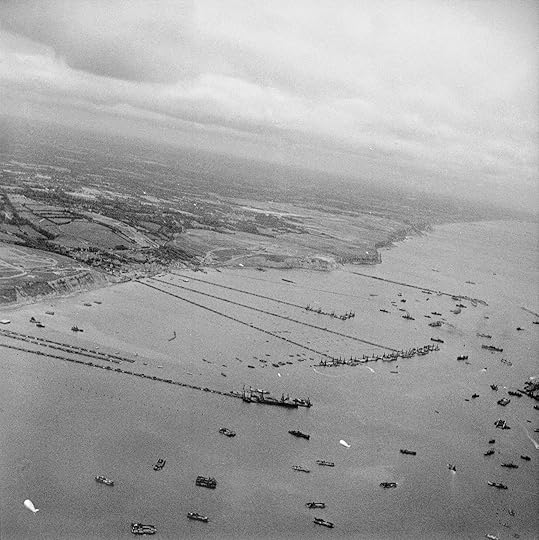
Captain Edward Ellsberg, the U.S. Navy's preeminent expert on maritime salvage, was sent to London by his old friend Admiral Ernest King, the commander of the U.S. Navy. His mission was to advise the staff of the U.S. Navy in Europe on all matters pertaining to Operation Mulberry. Mulberry was the code word for all equipment and activities connected to the emplacement of artificial harbors off the invasion beaches of Normandy. Often confused for the caissons themselves (erroneously called Mulberries), Mulberry was all encompassing. The project included: the Phoenix 2,000 - 6,000 ton floating caissons that would anchor the breakwater, the Bombardon 200 ft. floating steel breakwater stations, the Lobnitz semi-floating 200 ft. pierheads, the Whale pontoon-supported roadways, and Gooseberry -- the cover word for the plan to sink superannuated ships to create a temporary breakwater. The artificial harbor operations would shape the invasion's progress until the Allies could seize a port and make it usable (a key point considering German skill in demolition of all types of facilities. After Cherbourg was captured on 27 June, Col. Viney of the U.S. Army Engineers wrote: "The demolition of the port of Cherbourg is a masterful job, beyond a doubt the most complete, intensive, and best planned demolition in history." Cherbourg's port facilities were inoperable until late July). Without Mulberry, the tanks, soft vehicles, food, ammo, gasoline and troops needed to repulse German counterattacks could not have landed in adequate amounts nor with the necessary speed. Even the four-day gale of 19-22 June didn't cut off supplies over the beaches. Despite the loss of all the Whale roadways, the serious damage to many Phoenix caissons, and the destruction of a number of the scuttled vessels of Gooseberry, the work went on. The Allies' huge fleet of DUKWs took cargo directly from anchored freighters and ferried the loads ashore in a endless merry-go-round of resupply. On 24 June, 11,500 tons came in -- beating the Lobnitz and Whale record of 9,000 tons. By June 26, the daily rate was 14,500 tons. By 3 July (D+27), 929,000 troops, 586,000 tons of supplies, and 177,000 vehicles had passed over the British and American invasion beaches combined. Operation Mulberry succeeded.
The Far Shore provided a different perspective on D-Day, but included a blow-by-blow account of the landing and fighting on Omaha Beach. Ellsberg devoted considerable attention to the supporting units ashore. The actions of the U.S. Army combat engineers and the U.S. Navy demolition groups were awe-inspiring. Those servicemen deserved the highest recognition for dedication to duty under the bloodiest and most chaotic of circumstances. The author gave detailed descriptions of various naval activities on and before D-Day, including rundowns with the pros and cons of the various amphibious vessels and other sea craft supporting the invasion and conducting the landing. High praise was awarded to the U.S. Naval Shore Fire Control Parties (NSFCP). The Germans learned to their misery the impact of observed fire from a battlewagon's 14 inch naval guns augmented by a shower of 4 inch and 5 inch shells from Royal Navy and U.S. Navy tin cans.
Ellsberg was an accomplished writer. He enjoyed much success as a novelist and memoirist in the thirties. His professional expertise as a salvage officer and well-honed skills as a wordsmith were both on display here. The Far Shore was just a step behind Under the Red Sea Sun, as in the former Ellsberg was simply an observer, but in the latter an actor. He dedicated his book to Captain Dayton Clark and the men of the U.S. Navy who played vital roles in the success of D-Day. As he wrote: "They made it stick."
Readers with an interest in the hows and whys of D-Day's success or the particulars of Operation Mulberry should pick up a copy of The Far Shore. It is solid Four Star material.
I have not read all that much about the Allied landings at D-Day other than what happened with regard to the Canadians at Juno beach, but I have visited Normandy and seen the remains of the Mulberries so I picked this book as part of a Goodreads Buddy read on amphibious landings. It is the third part of a trilogy and I have not read the other books in the series but felt it stood well on it's own.
It was written by Rear Admiral Edward Ellsberg who had many years experience working in salvage. He had been retired from active service due to cardiac problems but after some rest in the US he managed to talk his way back into active service and was sent to the UK where he was assigned to sit in a locked room reading the "book" with all the details on operation Overlord.
The dedication at the beginning of the book is quite telling: "You can almost always force an invasion, but you can't always make it stick." (General Omar Bradley to the war correspondents on the eve of D-Day in Normandy) To CAPTAIN DAYTON CLARK and THE MEN OF THE NAVY HE LED in FORCE MULBERRY They made it "stick."
Captain Clark was charged with getting the Mulberries to Omaha Beach and getting them established and running to their top capacity as without a natural port, the Allies were in desperate need of an artificial one so they could maintain ammunition supplies and transport both men and equipment ashore as needed. The task of refloating the Mulberries was initially given to the Royal Engineers, but Captain Clark was convinced they could not succeed at it and that the job should be given to the Royal Navy. He had spoken to everyone he could think of but no-one seemed to believe him. Ultimately, Ellsberg was sent to Selsey Bill to see the Mulberries and give his opinion based on his experiences as a salvager. He discovered to his dismay that Clark had a valid concern but initially had difficulty getting anyone to act on his recommendations. Ultimately his superior used networking to reach the King who sent Churchill to have a look. The job was then quickly transferred to the Royal Navy but Ellsberg was commanded to stay close in case they wanted to consult his American expertise. They didn't, but he still found ways to be useful and he had a good view of what was going and ultimately did go to the "Far Shore" where his skills and advice were utilized.
His descriptions of the early events of D-Day and the slaughter involved were horrific and difficult to read. It seemed like a total catastrophe with the weather being one of the worst enemies as it led to damage to the Mulberries as they were being transported. There had been six different things set up to help protect the soldiers who would be landing, but every single one of them failed! In spite of that, progress was made and ultimately the Mulberries had much to do with the success of the invasion at Omaha Beach. Cherbourg as a naval port had been basically destroyed by the Germans before they abandoned it so the Mulberries continued to be important.
Ellsberg did a good job describing the tension and action as it evolved but there were two things missing for me. I was reading a Kindle Book and don't know what a hard copy of the book is like, but there were no maps in the Kindle version and they would have been very helpful in understanding the action as it was evolving.Secondly, the glossary came at the end of the book rather than the beginning. Ellsberg referred to lots of equipment by initials and until I read the glossary at the very end, I wasn't really sure what all of them meant. I would definitely read other books by this author though and felt that the book contributed a lot to my understanding of what happened at Omaha Beach.
"Amateurs study strategy. Experts study logistics" --Some French Guy, probably"
Okay, that French guy was allegedly Napoleon, who might know a thing or two about war. And if you've been paying attention, you know that industrial warfare is in practice often a matter of logistics. Braver men and better equipment aren't much use if those men are starving and the guns have nothing to shoot. As difficult as a forced amphibious landing is, and the Allies had plenty of experience with them after Africa, Italy, and various islands in the Pacific, the initial assault is nothing without continued sustainment. Every port in France was surrounded by coastal fortifications and heavily mined. Conventional wisdom was that supplying an army over the beach was impossible. Ellsberg had a ringside role in showing that conventional wisdom was wrong.
Mulberry artificial harbor, Wikimedia
I went into this book with some trepidation that it'd be bone dry, and was delighted to find that along with being a skilled naval salvage officer, Ellsberg was a commercially successful writer with 18 books. He's an engaging raconteur, who ably describes the organizational chaos attending the Phoenix caissons which formed a vital part of the Mulberry breakwater. The Phoenixes were floating sinkable concrete structures, and in the absence of anchors and chains to moor over a hundred of them, the British had stored them by sinking them in a harbor on their side of the channel. The British Royal Engineers, an Army unit, had a plan to refloat them in time for the landing which amounted to 'trust us, guys', and which to a naval officer was slapdash and technically infeasible because they were using the wrong kind of pumps. Ellsberg helped demonstrate that it wouldn't work, and then risked inter-allied political disaster by writing a memo saying the Royal Engineers would botch the job. The memo went to US Naval Commander Admiral Stark, who had been a US observer on the HMS Collingwood at Jutland with a junior officer with the unlikely name Albert Frederick Arthur George Windsor on the HMS Collingwood, currently King George VI, who told Winston Churchill that Operation Mulberry was doomed, and the PM himself should set it right. Churchill inspected the Phoenixes for two hours, asked not a single question, and assigned the chief salvage officer of the British Navy to get it done, with they did.
The middle chunk of the book is an action packed account of the landing at Omaha beach, with the US Army attacking into the teeth of the strongest defenses in the landing zone and triumphing with heavy casualties. Ellsberg writes well, but he wasn't at Omaha, and so this is just one of many secondary accounts. His own time around D-Day was hardly risk free. He feel down a ladder on a Phoenix, which nearly broke his leg and could have broken a lot more, fell into the English channel while crossing between ships where he could have easily drowned or been crushed between the hulls, and was nearly blown up by a mine on the beech on D-Day +3. Once on the Far Shore, Ellsberg assisted getting the Omaha Mulberry up, moving over 10,000 tons of supplies into the invasion zone daily before a freak storm destroyed the Omaha Mulberry, leaving the invasion dependent on the better protected British artificial harbor until better ports had been captured.
Ellsberg has written a thrilling account of what it felt like to be a vital, behind the scenes member of what Eisenhower called the Great Crusade, one which puts you in his shoes, showcases individual cleverness and energy in the face of bureaucratic confusion, and is just a damn good tale.
The descriptions of the events before, during, and after D-Day equal Elksberg's descriptions of his personal accomplishments in the Red Sea and the Mediterranean. However we see him only occasionally in this book. Most of the book is a description in exquisite detail of the preparation for and execution of the invasion of Normandy. Ellsberg 's major contribution to this effort is his work with the floating bridges onto Omaha Beach. A great story well told, but the lack of the personal thoughts of this Salvage Officer left me wanting.
As someone who has read extensively about World War II, I found Ellsberg’s book a remarkable and highly detailed explanation of the complexities and unanticipated realities of the D day invasion. His explanation and description of the Mulberry Harbor project, added to his description of the actual invasion day and the subsequent days to follow was eye opening for me. His description of all of the complexities that struck versus the plan on paper is fascinating. This was definitely one of the best books on World War II I have ever read. Additionally, Ellsberg is a very good writer, and he makes the circumstances and situations come alive.
A tale well told of the importance of Omaha Beach and the amazing portable harbor, and its integral role in the Battle for France. How important the supply chain to equipping troops and material—perhaps mundane to us civilians but vital to winning a war. I found it helpful to watch some YouTube documentaries on Operation Mulberry A and B to fully grasp the magnitude and understanding of this operation. A non fiction book that reads like a novel thanks to Admiral Ellsberg’s talent as a story teller.
One of most detailed accounts of D-Day and Normandy by the man who helped provide the massive materiel needed when no shipping ports were available. The portable Mulberry docks allowed up to 15,000 tons a day of equipment, ammunition, and gasoline to flow from transports at sea to the beach and beyond - allowing Allied armies to overwhelm German defenses.
Having been to the Beaches of Normandy on a tour did I learn about the concrete boxes there, and wonder what they were. We did the Tourist not and claimed the dunes, trying to manage what it must have like for the troops and boats on D Day..... But if course could not even begin to truly know " how" it was really done. This book was a wealth of information, and makes me very proud to be an American..... Thank you for these facts of War.
The story telling style is not what I'm used to, and I don't necessarily agree with all of the larger picture side stories. But that said, this lends nice details that I don't always see in books discussing the difficulties that the mulberries posed.
The only OCR issue that really bothered me was consistently spelling Pointe du Hoc as Pointe du Hoe. But at least it was consistent.
The author's writing skills are second to none. The book is interesting from a logistical standpoint yet never slow or boring. This is a subject only rarely covered in relation to the invasion, and then only in general. The details covered in this book make it truly a WW II must read. I wished it were much longer.
A great revealing of some of the bad luck and bungling of operations involved in the Normandy invasion. So many young men died because of some serious mistakes. Bet this side of the story was never told.
Sometimes you forget all the things that had to happen to make the invasion a success. From food to especially armor and artillery that had to get to where it was needed. This book made me feel as if I was there.
This book gives an inside view of logistics and engineering driving the success of a large scale invasion. Much of this information I have never read a detailed account of, and personally found it fascinating. Different from most war stores, I recommend this book for anyone who likes detail.
Heavy on very readable technical information, this was a fascinating read. Learned many things. Could not put this down! Been reading WWII books all my life, this is one of the best.
The story of the invasion of Normandy is well known. This book does a great job of throwing light on a seldom told aspect, the critical role of the Mulberry harbor. Highly recommend!
A wonderful overview of D-Day and the following French battles that I had not known. The lives lost in the first wave of D-Day are a testimony to that "great generation" to which we owe so much.
This is such a big story with so many facets it would like moulding an exciting novel. Always knew of Mulberry but the author exposed it for the juggernaut it was. Thank you Mr Ellsberg, Sir.
A blow by blow account of part World War II. A detailed narrative, with famous leaders on both sides, including Romeo, Montgomery and many others. Written in a conversational style, the book brings real historical events to life.
Information I didn’t know about the docking facilities and the fighting at the beaches. The difficulties, both physical and political, were unknown to me.
I am a retired minister, (if ministers ever really retire), having been ordained almost thirty-four years ago. My first love, (occupation-wise, dating back to my first decade of life), is radio and radio broadcasting. Therefore, in my retirement I have retained a job I have held for more than ten years: I host a gospel music show on a local radio station every Sunday morning. The reading of THE FAR SHORE brought to my remembrance the four Sundays I shadowed my predecessor. I was not a novice to radio, having worked off and on (mostly off) at radio stations for more than forty years, but this was a whole new kettle of fish. Mr. C was retiring at the age of eighty-three after twenty-three years on the show. The program had a simple format: play a song, ad lib a commercial, play a song, ad lib a commercial, etc. Mr. C. was the host, but he had a producer who played the music and made sure his microphone was turned on or off. As I watched and listened to Mr. C, one thing became quite clear: there were favorite artists on the show, favorites at least to Mr. C if not to the audience. Therefore, Mr. C. favored these performers on his show. One example of this partiality came during the Sunday show before I started shadowing, when I was part of the audience: Mr. C played seven songs in a row sung by one of the male favorites. What has this to do with THE FAR SHORE? Over the years I have read many books featuring the Allied invasion of France, D-Day. How much can one say about it that hasn’t been said? It was like hearing this male performer over and over again. What I needed was a fresh voice and a different perspective. I got it through Admiral Edward Ellsberg in his book THE FAR SHORE. It was at least twenty years ago that I read Cornelius Ryan’s The Longest Day. I had seen the movie quite a few times on television and so was eager to read the book. Oddly, my favorite chapter is Ryan’s description of the equipment, vehicles, supplies, etc., that were needed to support the troops, to guarantee the success of the invasion. Ellsberg adds a crucial element to that equation. Yes, all that was important, but it would be useless if it was laying at the bottom of the English Channel. How were the Allies to get all that from the Near Shore (England) to the Far Shore (the beaches of Normandy, France)? That’s the thrust of this book. As a salvage expert for the United States Navy, Ellsberg was a vital cog in the operation, although it seems he was underused and underappreciated. The Mulberrys, the Phoenixs, thousands of tons of concrete, had to be dragged across the Channel and placed perfectly near the beaches in order to construct the harbor required to unload the vehicles of their precious cargo. This is a part of D-Day that we rarely read or hear about. It is not as “romantic” or exciting as the troops storming the beaches or breaking out into France, but without the success of this operation the Invasion would have failed. Adding to the enjoyment of the book is Admiral Ellsberg’s wonderful, poetic writing. Too often I have been disappointed by the writing of one who was a witness to the events he/she were sharing with us. For the most part, I was thrilled with Ellsberg’s prose. That is not to say that I found it all perfect. Ellsberg sometimes repeated paragraphs, not verbatim, but very nearly. There were also words missing from time to time, although I wonder if that is because I was reading from a Kindle edition. One interesting aspect of the narrative, not surprising, was the loyalty of Ellsberg to the Navy. There are times when, in our loyalty to a person or organization or country, we are blind to their shortcomings. Ellsberg correctly gives credit to the Navy whose destroyers blasted Nazi defense positions above the beaches, relieving the troops were pinned down. However, in heaping this praise upon the Navy, he forgets something he reported earlier: the Naval bombardment prior to the landings at H-Hour was supposed to eliminate all Nazi resistance. Instead, it was stiff and unrelenting. I also thought Ellsberg spent too much time and paper on the landings, although I’m sure that was of great interest to most readers. Four stars
This book is about D Day through the eyes of a experienced engineer where thousands of men struggled through the suf, blood spewing into the sea as bullets whizzed past their heads from the germans on the hill, part of a trilogy of the World War 11 series whereby the reader experiences as those brave men who died on the front lines.
The logistical side of war rarely gets much ink. Ellsberg, however, makes a case that the men behind Mulberry and Capt. Drayton Clark in particular were critical to the success of the Normandy invasion. It's an intriguing addition to my library.
This is a great book that details the problems of supplying men and arms before and after D-Day on Omaha beach. I thoroughly enjoyed reading this book.