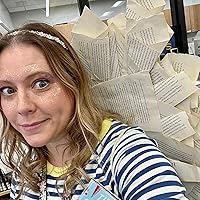
"My gown suited me as well as I could ever hope, though I could not but envy the young ladies who would attract the honest compliments of the night. My bodice did not plunge as dramatically as some, and no man--no man I would ever want to meet, surely--could fit his hands round my waist. What I lacked in beauty I would simply have to earn with charm..."
Benevolence is not your typical princess--and Princess Ben is certainly not your typical fairy tale.
With her parents lost to assassins, Princess Ben ends up under the thumb of the conniving Queen Sophia. Starved and miserable, locked in the castle's highest tower, Ben stumbles upon a mysterious enchanted room. So begins her secret education in the magical arts: mastering an obstinate flying broomstick, furtively emptying the castle's pantries, setting her hair on fire... But Ben's private adventures are soon overwhelmed by a mortal threat to her kingdom. Can Ben save the country and herself from tyranny?
I grew up in small-town Connecticut, on a tiny farm with honeybees, two adventurous goats, and a mess of Christmas trees. My sister claims we didn’t have a television, but we did, sometimes – only it was ancient, received exactly two channels, and had to be turned off after 45 minutes to cool down or else the screen would go all fuzzy. Watching (or rather, “watching”) Alfred Hitchcock’s The Birds was quite the experience, because it’s hard to tell a flock of vicious crows from a field of very active static; this might be why I still can’t stand horror movies, to this day.
My sister Liz, who is now a Very Famous Writer with a large stack of books, was my primary companion, even though she was extremely cautious – she wouldn’t even try to jump off the garage roof, which involved crouching right at the edge for ten minutes working up your nerve, and then checking each time you landed to see if you’d broken anything – and she learned early on that losing at games was easier in the long run than putting up with me losing. Now, of course, she travels all over the world collecting stories and diseases, while I stay at home scowling over paint chips, and losing on purpose to my kids. So the cycle continues. (Read an New York Times article by Catherine and Liz.)
People sometimes ask if I played football in high school: no. I ran cross country and track, badly, but I have absolutely no skill whatsoever with ball or team sports. Plus my high school didn’t even have a football team. Instead, I was part of the art clique – taking extra art classes, spending my study halls and lunch periods working on my latest still life. (Please tell me this was not a unique experience.) I didn’t do much writing – my sister was the anointed writer – but I read my little eyeballs out. I was the queen of our library’s YA section.
In college I studied architectural history. The formal name was “Growth and Structure of Cities Program,” but for me, it was all about buildings. I’ve always been fascinated with the built environment – how spaces fit together, how streets work, how they read. And curiously (Warning: Life Lesson approaching), it’s paid off in the oddest ways. For example, several of us in our neighborhood recently got quite upset about a enormous building going in across the street, and while everyone agreed that they didn’t like the way it looked, I was the one who stood up at public meetings and used words like entablature and cornice line and fenestration – all this architectural jargon I’d learned back at Bryn Mawr – and sounded like I knew what I was talking about. And because of that, the building ended up getting redesigned, and – in my humble opinion – now will look much more attractive and appropriate, which is nice because I’ll be looking at it for the rest of my life. So don’t be afraid to study what you love, because you do not know now, and you may not know for twenty years, how amazingly it will pay off. But it will.
Dairy Queen was my first stab at creative writing since high school, not counting several years as a struggling screenwriter (which followed several years as a struggling scholar). I unabashedly recommend screenwriting for mastering the art of storytelling; just don’t pin any hopes on seeing your work on the big screen. But you’ll learn so much in the process that this won’t matter. I also recommend, you know, living. I've been passionate about food pretty much my whole life – first eating it, now preparing and then eating it. And so it plays a pretty big role in my writing, and adds so much flavor . . . not literally, of course, but the more you can add that's true, whether it's emotion or geography or gardening (that’s me in the picture above), then the stronger that story is.
Started to write this here and realized it was developed enough to be worth posting on my blog. So here is my post:
I’ve read, loved, studied, and taught fairy tales all my life. Every three years I co-teach a graduate school fairy tale course and, since 1990, I’ve been doing a Cinderella unit with my fourth graders. So I’m always interested in new versions of these old tales as well as original ones. At the same time, because many of these come up short for me, I am a wary reader of them, especially those featuring feisty oppositional heroines who are too often pallid cousins of Gail Carson Levine’s Ella and Patricia Wrede’s Cimorene. So I was both curious and dubious as I started reading Catherine Murdock’s Princess Ben. And here I am, having finished it last night, having enjoyed it sufficiently to want to write about it at length. (I don’t write that many book reviews here and, in fact, started writing this casually over at goodreads and then realized that it might actually be decent enough to post here for more to see.)
So getting to the book itself, what was it that I liked so much? First of all, I was captivated immediately by the mannered writing style and voice. Murdock has really pulled off that old-fashioned first-person epistolary style and voice; it is very nicely done indeed. At first I was very conscious of this as I read (in a good way — I was simply enjoying her sentences and vocabulary) , but once I got into the plot I stopped paying attention; I’m guessing she sustained it all the way through. For the last few years I’ve been listening to a lot of Dickens, Collins, and now Eliot so I’m very conscious of this old-fashioned style and it grates on me when writers try it unsuccessfully. So bravo to Murdock for pulling it off.
The characters are all very complex — no one is totally bad or totally good; a very nice way of deepening and complicating the usual good/bad cast of characters in traditional fairy tales. I began thinking they would be stock versions or variations or opposites of the traditional types and enjoyed the way every single one of them turned out to be more nuanced than I originally thought they were. My main quibble would be with Ben’s parents. They are left as single-dimensional ghosts of her memory and perhaps that is as it should be, given her circumstances, but I did feel that I wanted to know more about them, especially her mother. For a while I did wonder about Ben’s gluttony, thinking Murdock was going for a large-princesses-are-lovable-too. But she went a different and original direction that I found worthwhile (and I’m not usual one for psychological meanings, but this was interesting enough for me to feel okay with it).
The plot is captivating, engaging, and kept me reading and guessing. If I were on an award committee this year I would want to consider harder the climax of the story and whether it is a bit out-of-nowhere. (Won’t say more for fear of spoilage.) But since I’m not, I’ll just leave it as is. It worked just fine for me.
So, all in all, a very elegantly written and satisfying literary fairy tale.
YA alternate-world fantasy. Chubby Princess Benevolence had a scrappy, indulged childhood: she was heir to the throne, but she was the daughter of only the king's younger brother, and therefore didn't actually have much to do with the court. When her parents are killed and Ben falls into the custody of her pitiless aunt the queen, she is entirely unequipped to deal with the strict and interminable lessons in courtesy, the tiny portions of ladylike food her aunt allows her, or, when relations with her aunt reach an impasse, her imprisonment in a bare tower room for everything but meals. But that little stone room has a secret, and soon Ben is learning magic from on an old and dusty book - magic that gets her in worse trouble than she's ever been in, but might also allow her to save her kingdom from the danger besetting it.
For most of the length of this, I thought it was a fun read - not great, but inoffensive and nice, in a not-quite-fairy-tale-themed way. My only real complaint was with the narrative voice: the frame is that the heroine is recounting these events as an old woman, and the voice really did feel like an old woman's. Which is a valid style, but not what you expect from YA, especially given the very contemporary-YA-ish cover.
I finished it with some niggling annoyance at a couple of character choices, but still with the impression that it was a fun, harmless read. But the niggling annoyance has grown, to the point that I'm actually angry at the book at this stage - and I didn't think I'd cared about it enough to be angry, but there.
The general gist of the book's message is that people aren't black-or-white, and that a rather immature sixteen-year-old's idea of wickedness is probably going to be rather overblown. Ben grows up a lot over the book, and realises that she's been doing several people rather an injustice, and making things worse for herself. In particular, she realises that the queen is actually admirable in a lot of ways, and that a good part of why they got on so badly was Ben's own immaturity and stubbornness. Which, all right, as far as it goes, complex characters are a good thing - except that the queen doesn't have any similar revelation, and never suffers or feels badly for her treatment of Ben. She locked up her niece for months and denied her enough food to eat. To turn around and say that this was her niece's fault and they're all going to get on like wildfire now that Ben's grown up some is, actually, incredibly disturbing.
The other character I wanted to strangle was the love interest, a prince from the warlike kingdom over the other side of the mountains. He and Ben fail to get on from their first meeting, and continue failing to get on through all their subsequent meetings. The author seems to be working with the idea that enmity-turns-to-love is more interesting than admiration-turns-to-love, but the thing is that there has to be a reason for the enmity to turn to love. Prince Florian is a war-mongering, arrogant, petty boy, who treats the heroine appallingly when he knows who she is, and even more appallingly when he thinks, as he does for a good part of the book, that she's a fat little peasant boy his soldiers have taken prisoner and chained in the kitchen tent. He also tries to invade her kingdom, and makes free comment to the fat-little-peasant-boy about how doltish and repulsive Princess Benevolence was. We as readers are let in on how he's really misunderstood and a true prince when the two of them have a heart-to-heart one evening in which Florian makes some atrociously sappy and entirely out-of-character revelations about his ideals for true love, which do nothing to establish his decency as a human being, only his rather tenuous grip on reality. When Ben confronts him later about the gap between his ideals and his plan to marry somebody he barely knows and dislikes, he has her thrown into jail with a death threat hanging over her head, for her disrespect.
Somehow she gets over all this when she thinks he's dying, and they have a rather rapturous kiss. This doesn't even need the Stockholm Syndrome thing to be a terrible romance, but I might be OK with it if there was even some acknowledgment that he was desperately unlikeable but she liked him anyway. Instead we just have Ben feeling terrible and apologising about having accidentally done something to humiliate him once, without even mentioning that maybe she's still ahead in the humiliation stakes, as far as their personal interaction goes. Just. Angry reader fists, all right?
This entire review has been hidden because of spoilers.
I liked the premise immensely, but was disappointed by how it was handled. I mean, dragons. Magic. Locked in a tower. Arranged marriage to the prince of your country's enemy, same enemy that probably killed your parents. Lots to love, but somehow these elements did not come together as I had hoped they would. I wanted more one on one time for the two protagonists and felt that, honestly, Benevolence was really a little too spoilt. She had next to no self control and even less of a desire to try and be a better person for such a long time throughout the story that you begin to get frustrated with her character.
I really loved how her aunt was written throughout though! At first you think she is the typical "evil" step-mother/ guardian figure, out to ruin Ben's life and make her thoroughly miserable for no good reason. Then you realize that, however flawed her methods and behavior toward Ben, she was really and truly trying to help Ben and prepare her to rule the country when the time came. She recognized many of the foibles in Ben's personality and was trying to get Ben to exert some self determination to improve herself. Ben's constant self pity was tiring and I can imagine why Auntie S. was getting royally fed up with her childish and immature fits. But I loved that although she is a villainess in the reader's eyes, at first, by the story's conclusion, we can see that she is just a very well portrayed character, with her own flaws that rival Ben's, just at opposite ends of the spectrum.
Overall, a decent enough story for a one time read, but I doubt I will reread this offering anytime soon, if at all.
This entire review has been hidden because of spoilers.
I have got to say this keep me up at night. Literally. The urge to read the last word was so great I forced my eyes to pry open. At first it was slow going, but that was understandable. We needed the whole background. I had mixed feelings going in because I had already gobbled and enjoyed reading Dairy Queen and The Off Season by the same author. This series has one of the best protagonist I've seen in young adult books, so my expectations were almost unreachable but I was pleased to find that I was thoroughly satisfied. This is an incredibly different style for this author, but when you are gulping the pages down you forget that. Murdock has great talent; that much is for certain.
One point that has to made is that this has the typical fairy tale elements but at the same time it doesn't. Let's talk about what made it so different from the others. First off our heroine is rotund. Not the typical princess protocol. It was refreshing to see, but at times got to be too much for my taste. Don't get me wrong I love food, but you got to draw the line somewhere. I think it was to show how much she indulged herself, so it was reflective of her behavior in general. Anyways Ben (or Benevolence) is a bit whiny and well frankly immature in the beginning, but I for one liked that. Most of the time the princesses are almost already perfect. Which is fine, but can get boring sometimes. At the end we find that she had a lot more to do with her own predicaments than what she thought. Kind of like owning up that you have a lot more to do with what happens in your life than anyone else. That's a fine lesson to learn at any age.
I truly enjoyed the magic in the story. I want to own the mirror in that tower darn it!(You'll see what I mean when you read it) The plot was done well, even though I would have liked more character development in Prince Florian. We didn't get to see as much of him as I would have liked. You could see some things coming from a mile away, but you always need a little predictability in fairy tales. I can't finish without saying that Queen Sophia is the most interesting character in the book by far. Props to the author for being able to show us the many shades of her persona.
So go forth fairytale lovers! Enjoy, savor, and relish in reading the tale of Ben.
I remember something Diana Wynne Jones wrote that went something along the lines of this:
"In Fantasyland, a princess is either a
1. Wimp, or 2. Rebellious spunky swordswoman with a sprinkling of freckles across the bridge of her tip-tilted nose."
Needless to say, the rebellious-princess character has become something of a cliché. So it's quite refreshing when an author takes this setup (of an "ordinary princess" rejecting the frou-frou court, then escaping and having grand adventures) and can make it new again -- indeed, Murdock turns it almost on its head. In this gentle fantasy, we learn that sometimes learning good table manners, small-talk, proper dancing, etc. are tools of statecraft just as powerful as magic spells or fencing. Ben's emergence from dowdy teen to responsible leader is just a few steps shy of becoming "The Seven Habits of Highly Effective Princesses," but steers clear of becoming too preachy. Indeed, it's something quite fabulous. The second half of the book demands constant page-turning.
Bonus Points: the language uses the grand epislatory style of a Victorian novel, and carries it off well. Many, many ways to beef up your verbal SAT score here. Kudos all around to what may be my favorite YA fantasy of 2008.
I was really disappointed in this book. The premise is great. I was excited at the prospect of a protagonist who, while a princess, is not skinny and beautiful.
I was expecting something that would go against the "only the beautiful people get the guy" mindset so common in our society; however, the book did the absolute opposite, and it was only once she changed (lost weight, became more beautiful and ladylike and submissive, etc) that she was able to get the guy, earn respect, and save the day. Needless to say, this disgusted me. It definitely killed any enjoyment I had of the book (I did rather enjoy it up until the point that it was made obvious where it was going in terms of morals.) I will give it a 1.5 because I did enjoy it a bit, at least for a while, as a fun read. But I can't forgive that awful theme (a main theme, nonetheless). It's especially awful that this is a young adult novel, and so it is only exposing more and more young girls who are already extremely self-conscious, to that mindset.
I wish I could give half stars because this book deserves four and a half. As the inside jacket says, this isn't your ordinary fairy tale. Princess Ben (short for Benevolence), is a whiny, overweight, spirited girl who recently mourns the loss of her parents. Her country is threatened by a neighboring kingdom, who claim no part in the murdering of the king and Ben's parents. Orphaned, Ben is put under her strict aunt's wings, Queen Sophie. Completely miserable, locked up and starved until she can behave properly, Ben has many unforgettable experiences that may be familiar to fairy tale lovers. The only reason that this book did not get a 5 star rating is because I feel like the author forgot to mention/ wrap up a few points in the epilogue (MAJOR pet peeve of mine. If you have an epilogue, DO IT RIGHT DARN IT!!!)
This was really disappointing - I'm a huge fan of her Dairy Queen trilogy, so I was expecting to enjoy this. Unfortunately it has tons of enormous gaping plotholes, impossible characters, and a bad habit of showing something entirely different to what it tells. And the thing is - this was her third novel published (and, as far as I can tell, written), so she'd already done vastly superior work.
She can do so much better than this that I can't understand why she let it be published. It's not even a flawed first novel - her first novel was good. Man, I dunno.
I really wish I could give this less than one star. This is probably the worst book I have ever read. I seriously don't think I can even review this properly because I am so dumbfounded by the stupidity of this book. It's written as if the Princess herself is writing her own memoir, and she keeps breaking in saying things like, "If I haven't yet addressed the matter of..." in order to explain certain parts of the world she has poorly built. Also, she repeatedly says, "I thought my situation couldn't get any lower, but it did." This happened probably six or seven times in the book. Oh, woe is Ben. She is not likable at all, and while I realize the author intended for her to be that way so people would love her "great transformation" and supposed development of her character, this character is so flat and annoying. There was no depth to the characters or the story. This book was just soo poorly written. Seriously, at the end of the book, just to show you how bad it is, this is the dramatic conclusion:
I was pleasantly surprised by this book. First let me say that I'm not a fan of these realistic book covers, which seem to be all the rage recently. I much prefer the more artistic covers that allow me to imagine what the main character etc. look like. I'm also usually a little skeptical of fairy tale retellings because it seems that they can so easily go awry.
This one, however, did not. Yay! Murdock takes all the most familiar parts of the princess fairytales (the tower, the sleep-enchanted princess, the glass coffin, the wicked step-mother) and skillfully adapts and transforms them. Ben is a feisty and independent main character who is able to take charge of her own destiny and her own story. And while she is spoiled at the beginning of the story (as some of the reviews have complained), that is the whole point. Plus, it makes her a refreshingly complex and multi-faceted character.
I'm also a big fan of Murdock's narrative style, which sounds a lot like the epistolary novels of the 16th and 17th centuries. It started off a little strong, but either I got used to it or it became less self-conscious as the story went on. Murdock includes all kinds of challenging vocabulary in her narrative, and I think it's wonderful to challenge teen readers that way.
So the moral of this story is: "don't judge a book by its cover!" I have to tell myself that repeatedly, and I'm glad Princess Ben had a chance to prove its importance to me one more time.
Definitely could've been more exciting. I feel like the author spent so much time trying to develop the main character that she just forgot about everything else. I expected perhaps a bit more magic and and bit less " I hate the queen so I'm going to be a little bitch". The writing just wasn't compelling and fun to read. It felt more like a badly writing diary which was a tad upsetting. The romance is hardly believable but since this book takes on a fairytale-ish side, I'll let it pass. Overall decent book but could be a lot better.
A princess locked in the tower who discovers magic? Sign me up! I was looking forward to start listening to this book. I wanted a fairy tale type of story that would be enjoyable. Unfortunately, this book was a disappointment.
The concept of the story was promising but the execution was poorly done. Benevolence, aka Ben, lost her parents and was then locked up in a tower. She soon discovered a secret room where she learned to control magic. Afterward, she ran away trying to avoid an arranged marriage, got kidnapped and was treated as a servant, met a prince, and so forth. My head was spinning on all the things that were happening. The loss of the parents was very interesting because I was curious to find out what really happened to them. When the magic began to happen, I found myself scratching my head because it felt as if the author could not decide what the plot of the story was. Was it about who killed the parents, about her acquiring magic, or her getting married? My interest to the story began to wither.
The most disappointing thing about this book was the message: in order to succeed, you must slim down to conform to people's ideal on true beauty. Ben was gluttonous throughout the book. It was sad to listen to how her actions and descriptions were portrayed in a mocking way. She would binge eat and was constantly talking about food. Her clothes were also constantly ripping because she was fat. Because she was a spoiled princess who would throw tantrums if she didn't get her sweets, her weight was looked upon as something undesirable. At the last part of the book, Ben was told to eat like a "sparrow" so she could lose weight, catch the attention of a suitor, and be a great ruler. The fact that she was encouraged to starve herself, which caused her character to change for the positive, made me nauseous. It was as if the author was telling readers that it was okay to be anorexic.
I would have given up on this book about halfway, but I kept hoping that it would get better. The author read the audio version herself so she made the events go smoothly. However, when I found myself with about two hours left of the story, I simply gave up. I began to skip many tracks so I could get the gist of how the story ended. I didn't miss much.
Overall, I would have wished to have liked this book and its production. Unfortunately, I have to give it a low rating. The story got sour and I disliked the theme.
I'm all for fairy tale romances and such, but Princess Ben falls short in so many ways. Murdock seems like she is attempting to write a unconventional heroine in the beginning of her novel, but Ben herself develops into such a bland character. Then again, she wasn't exactly a marvelously crafted character to begin with--she doesn't like to do anything but eat. She's got some serious eating disorder and eats her feelings, spends her time feeling sorry for herself (and later, practicing magic that for some strange unrevealed reason Ben is able to perform), and hates doing anything, including playing music, dancing, and READING. Who wants to read about a heroine that is so lazy, and doesn't even like to read? And while Murdock might have known her heroine was lacking in qualities that engage readers, thus leading her to change her character to a completely conforming, boring princess...well, never mind. You get the point.
The romance in this novel was also exceptionally forced. Not only does the love interest not show up until half way through the novel, he is so frustratingly unattractive (personality-wise, for we get several accounts in the narrative about how handsome he is). Bad boys are good and all, but he's just annoying. Not to mention his character is painfully inconsistent, making Murdock's hate-turned-love cliche a disaster.
And the writing was such that any regular teenage girl who would be reading this book would need a dictionary at her side at all times--there were words that even I didn't know. The writing was a joke. The author was trying too hard to be clever.
Overall, though, there were some redeeming qualities. A few supporting characters made the plot pop with little bits of interaction with Ben. As far as fantasy elements go, I was less than impressed. The whole "learns to do magic by stumbling upon it" feels copied straight from a Diana Wynne Jones novel, and while Jones is successful, Murdock stumbles with cliched and uninspiring magic tricks.
Well, its time to move on from this book. I wouldn't recommend it to anyone, really, unless to show someone how not to write character development and how not to write stylistically.
There was one quote that made this one on my favorites shelf, because lo and behold I look up and see this on the news after reading it.
“With that, I hurled the slipper at him, not caring if I caused his decapitation. (I did not.) Marshaling what little dignity I yet possessed, I stomped down the corridor - challenging indeed with one shoe - and around the corner. I lay awake for hours. The prince had no right, not one, to indict me so, and if I had held the slightest hope of the book's assistance, I would have climbed at once to my wizard room for a spell with which to punish him. Death, perhaps, or humiliation. A croaking frog would be nice, particularly a frog that retained Florian's dark eyes. I should keep it in a box and poke it occasionally with a stick; that would be satisfying indeed.” ― Catherine Gilbert Murdock, Princess Ben
If I myself had been in Ben's position I would have done the exact same thing. Yes truly, ask my husband about my shoe throwing tendencies. Oh a girl after my own heart.
In conclusion this was just a really fun book to read.
I thought this book was rather charming and unique. I enjoyed Ben’s character, and reading about her many adventures. I thought she was easy to relate to because she wasn’t perfect, and things didn’t always turn out the way she wanted. It was fun to follow her progress throughout the book, as she turns from a somewhat spoiled girl to a Queen. I liked the concept of Prince Florian, but thought his character was underdeveloped. He didn’t really appear until about 200 pages and even then they barely spent any time together. The time they were together was fun to read, because of the tension and misunderstandings. Also, I would have preferred if instead of Ben using her newfound freedoms to steal from the kitchens, I would have enjoyed reading about her learning more spells, or finding other secrets. Too much focus was put on her love of food.
One aspect I really enjoyed was the references to other fairytales. Ben trades some “magic beans” for a cow, loses her shoe after a ball (by throwing it at the prince), is stuck in a tall tower, has an “evil” step-aunt, and is under a spell of sleep, just to name a few. It almost makes me want to re-read to see if there were any others that I might have missed.
If you enjoy fairytales than you would enjoy this book, it is a fun read with plenty of twists to keep you entertained.
After reading Dairy Queen and The Off Season by this same author I really had no idea what to expect in this book. The transition to fantasy seemed easy. I still enjoyed this book after the second time I read it. I like Ben and enjoyed seeing her grow from a self-pitying but soft-hearted girl to a determined ruler.
I've always liked fairy-tales and if anything this book has made me like them even more. Ben is a dynamic protagonist. She was not raised as a real princess so she is more relatable. And although she is uncooperative and self-piying in the beginning I could understand, because she lost her parents and is just thrown into her new princess duties without warning. Plus she is not treated with much sympathy.
There are a few tidbits of other fairy tales such as sleeping beauty, the princess and the pea, and jack and the beanstalk. There's also magic, a prince, disguise (my favorite) and so much more.
Where do I start with this one? As with the last book I read, Enchanted, I certainly would have DNF'd this one early on had it not been for a team challenge. As it was, I soldiered on. And I had a lot of problems with it. SPOILERS AHEAD.
I'm sorry, but no. This message is not healthy and could be harmful, especially considering the young target audience. I just can't be ok with this.
Benevolence is the beloved only child of the royal family. When the king (her uncle) and the princess (her mother) are killed, Ben's life takes a terrible turn. No longer is she allowed the cozy, unpretentious, rough-and-tumble childhood she so enjoyed. Instead she must live in the palace with her aunt, the queen regent, who is so controlled and controlling that it nearly drives Ben mad. Her only solace is learning magic on the sly. After a disastrous ball, Ben embarks on an adventure by turns horrifying and exhausting, and at last becomes someone worthy of her crown.
The twists on common fairy tales are fun to note--at one point Ben conjures an inanimate double to sleep in her place, thus giving rise to the Sleeping Beauty story; at another she exchanges some conjured beans for a cow. Ben's narration is wonderful, with a great dry sense of humor and a lot of personality. And the story adroitly and gradually shows the importance of living up to one's responsibilities and being a good, useful person.
This book was actually insane. It was... way different from what I was expecting, and the writing engaged my mind and forced me to think, which was a very nice change from most modern books. I loved the characters, and the plot, and how she twisted tiny little things from other stories into it. This was an incredibly good book, and I would gladly read it again.
Meh. Pretty standard medieval world fairy-tale-ish fantasy. Really had difficulty liking "Ben" or believing in the predictable relationship. Also found prissy, pseudo-formal voice really irritating.
2025 Review This book (along with The Goose Girl and Ella Enchanted and Princess of the Midnight Ball and, well, a whole bunch of others) absolutely absorbed my early teen years. I re-read it many times. Especially that kiss scene. Heights of romance!
But also this one really wasn't my favorite of those re-reads so it has taken me a while to come back. I am glad I did. Yes, Ben is incredibly spoiled. Yes, she eats her feelings and makes really stupid decisions. But she also grows a lot as a character.
More importantly looking back, I think Princess Ben is the only plus size heroine I remember reading about. Even though she loses weight over the course of the book, she remains a curvy girl by the end. This book long pre-dated the current trend for curvy girls as main characters. It was something I took for granted as a kid, but now looking back, I'm particularly impressed and appreciative that we got this kind of diversity in a book.
I really liked this book. Until the end, but I'll get to that later. I love novelizations of fairy tales, and this was a good one with a bit of a twist. It was part Sleeping Beauty, part Cinderella, with some Jack and the Bean Stalk thrown in for fun. I liked the old fashioned verbage and was glad I was reading on my Kindle which made looking up words a breeze (there were quite a few). Princess Ben starts out a bit spoiled, but I like how her character develops through the story, and I think the author does a good job fleshing out most of the other characters. Although, I wish she would have spent more time developing Prince Florian and hence the budding relationship with Princess Ben. My biggest gripe is that we are rushed through the end. The author does a great job setting everything up in the beginning, and then when it comes to the best parts, where I finally get and like Ben, she's gone and finished before I know it. Because of the extensive vocabulary and some mature elements, I won't be adding this book to our library, but will recommend it to older readers.
This book both feels that it's for older readers -- some of the language is purposefully archaic or less familiar -- and very young -- the emotional twists and turns and the adversaries that Ben has to face are not earth-shattering, to say the least. It's a weird combination of very simple Tamora Pierce and Pride and Prejudice. The middle section of the story is fun and the last part is quite exciting but the set-up (80 odd pages of Part I) is a bit long and too leisure a pace, I feel. Definite a book that I can see recommending to certain readers, but it did not floor me or wow me.
p. 22 My Uncle Ferdinand, though scarce in his majority, accepted the crown and scepter that very morn, and rallied his disheartened people.
p. 78 -- repeating of the same info. about her parents and uncle's death...
humor: p. 258: I set to work anew, imaginging each stabbing needle passing into Florian's scalp . (The may explain the poor quality of the resulting product.)
Ben annoyed me. That fat, spoiled, whiny little slug annoyed me. And why shouldn't she? Since she was such a fat, spoiled, whiny little slug. All she did was cry and complain. Good thing I wasn't there otherwise I would have lopped her head off and be done with it. The kingdom is SO much better without her. She was frankly useless. Her aunt could've held her own. The enemy king could have just asked for her hand and there would have been peace throughout the kingdom. Without Ben's help.
How can someone like her have magic? If she existed in the HP world, I would've called her a filthy little Mudblood, princess or not!
The beginning took some adjusting to style and pace. The story is excellent, but there’s something about the voice that just feels a bit clunky. I think I’m most stories the style of writing should be such that it doesn’t draw attention to itself. This book suffered in that category. But the plot and characters and well worth the read once I got past the first section which I felt was the greatest offender.
First of all I didn't finish this book. Reading the blurb I thought it might be interesting, but the writing was too hard to follow and the whole diary thing got a bit tiring too. The idea was there, the problem was with the execution. It just didn't click for me and that's too bad.
Despite my dislike of these realistic (and totally inaccurate) covers, this book proved to be quite a delight.
Princess Ben isn't your run of the mill princess. She hasn't been trained for princessery, due to her mother's adamant stance against it, and only because her aunt proved to be barren and widowed does the throne fall to her. Still, she's powerless as well as being completely clumsy, unlikable, incompetent, and a glutton. And no, she's not the kind of oh-that's-so-cute, freckles across her nose, twirls and bumps into people type of clumsy. Glutton as in she's super overweight, with her waist described as curving outwards. Clumsy as in when she wakes up completely covered with dirt in a pristine room, nobody is that surprised. Incompetent at diplomacy and unlikable as in she tells a courtier "well, aren't you incredibly rude?" at her first state appearance. She's immature enough that the reader is compelled to think pretty annoyed thoughts about her from time to time. Still, it's reasonable, since she was spoiled and indulged (foodwise as well as in other areas), and her pastimes were described as poking sticks into holes rather than anything remotely useful.
There are all sorts of wonderful elements of a well-reworked fairy tale (Snow White, in this case), with the glass coffin and the "evil" queen, and the running away from her destiny to go back to it. All in all, it's delightful and enjoyable.
What detracts from this is how there were loose ends that weren't tied up even in the epilogue. Who left a food basket under her bed in the castle? Who was the one who left a cloak for her in the stairway to the Wizard Tower? Why were she and Florian having romantic dreams about each other even back in the day when she compared unfavorably with a fat, slothful, unsanitary sow? How come Florian was the only one to see her on a broomstick in her dragon disguise? Was he the only one in his entire army with good eyesight?
The point is, none of these questions were answered. Still, for all that, a pretty delightful read.
Note to publishers everywhere: Please stop telling me that the main character is special in your book jacket description. There is no faster way to make me put down a book than to insist that “Benevolence is not your typical princess”. Is she not a typical princess because she is clumsy, a little bit of a tomboy, kind of a rebel, and maybe not classically beautiful (but always still pretty in her own way)? That my publisher friends, is exactly what a typical princess in modern fairy tales looks like. Stop insisting that your princess is special and lure me in with an interesting sounding story so I can learn why the character is special myself.
That said, the beginning of the story held so much promise. Princess Ben’s voice, if a little whiny due to immaturity towards the start, tells the story well. The history of the kingdom down to the royal family’s symbol being a hedgehog was very interesting and I loved hearing about the mythology of the country, castle, and the mountains that protect it.
Princess Ben’s tactics to annoy her aunt (who in the first half of the novel fills the role of villain) are immature but lead to the most interesting part of the story in my opinion: Princess Ben discovering a secret chamber and teaching herself magic. Now if I had written this book, the rest of it would have involved her learning magic and then using her new powers to defend herself and her kingdom as she ultimately matures into the ruler the country deserves. Sadly that’s not what happened. The spoiler free version is that the book couldn’t decide on a plot, but for a spoiler-y version keep reading.
Princess Ben short for Benevolence is orphaned after the assassinations of her uncle, the reining king, and her mother, her father’s body is not found. As the last remaining member of royal blood, Ben is forced to move into the castle and endure her aunt, Queen Sophia. Sophia insists that Ben act like the princess she should and insists that Ben learn to dance, sew, proper penmanship, and control her appetite. She later learns these "lessons" are to make her appealing to a suitor, so that the queen may marry her off! Once Ben learns of this notion, she is anything but cooperative. The Queen, upset by Bens actions locks her away. But in her moment of despair Ben discovers a room that may be her escape from Sophia and an unwanted marriage, perhaps even provide vengeance for the death of her parents.
After reading Murdocks’s other books, I was expecting a lot from Princess Ben. Not only did this book meet my expectations, it extended far beyond them! It is beautifully told in a way that only Murdock can. She is able to create such characters that you can’t help but admire. The growth that Ben undergoes throughout the story only increased my admiration for her. The plot was beyond captivating!! It was full of magic, adventure, and fantasy!!! I absolutely recommend this book!!! I can’t wait to read more from Murdock!