Un splendide album pour découvrir la plus grande créature vivante de notre planète.Savez-vous que la baleine pèse le poids de 55 hippopotames ? Que son petit peut boire près de 200 litres de lait par jour et grossir de 4 kg par heure ? Que son oreille est si fine qu’elle peut entendre le chant de ses congénères à des kilomètres à la ronde ? Que sa bouche est si grande que 50 personnes peuvent y tenir debout ? Que son oeil est si petit qu’il est dessiné à l’échelle dans une page de ce livre ?Dans de magnifiques tableaux, par le biais d’analogies parlantes, imagées et non dénuées d'humour, cet album documentaire célèbre un animal spectaculaire, d’une grande intelligence, tout en mettant l’accent sur l’importance de le protéger.De la même auteure-illustratrice, sortiront à l’automne 2017 L’Ours polaire et en 2018 L’Éléphant.
Jenni Desmond graduated from a Masters Degree in Children's Book Illustration at the Cambridge School of Art (UK) with distinction and her debut book won the Cambridgeshire Read it Again! Award in 2012. Her books have been translated into over a dozen languages since, and in 2015 Desmond was named Best Emerging Talent (Illustrator) at the Junior Design Awards (UK). In 2016 she was made a Maurice Sendak Fellow and her book 'The Polar Bear' became a 'New York Times Best Illustrated Children's Book' of the year.
Her work is admired for its narrative and visual depth, being at once complex and simple. Jenni Desmond lives in East London UK. When she's not in her studio, you'll find her cooking, cycling and looking for adventure.
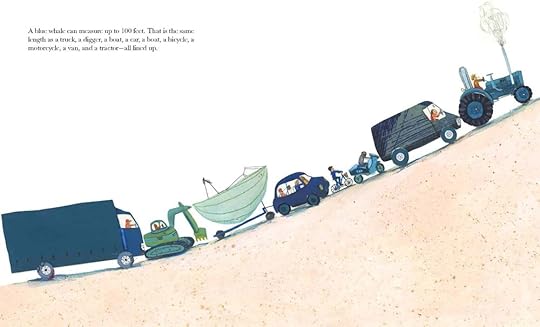
This is a fascinating book for children about the largest creature on our planet. Desmond has a terrific way of describing things so that kids can more easily understand and be amazed. For instance, the blue whale can measure up to 100 feet . . . which essentially means nothing to a child. BUT, when the author tells you:
That is the same as a truck, a digger, a boat, a car, a bicycle, a motorcycle, a van, and a tractor -- all lined up.
and
A blue whale's heart is the largest of any animal. It is as big as a small car . . .
Well, let the oohing and aahing begin!
A blue whale's tongue weighs three tons, and its mouth is so big that 50 people can stand inside it.
Wow!
I learned a lot from this book, and would HIGHLY RECOMMEND it to both adults and children.
I guess that perhaps I was expecting Jenni Desmond’s artwork in her The Blue Whale to be somewhat more intensely ocean and blue whale oriented. For while her illustrations of blue whales at sea are indeed and certainly visually stunning and as such also a wonderful combination of imagination and reality, personally, I have unfortunately found much of Desmond’s non whale-themed pictures (which are generally used to compare and contrast) not all that aesthetically interesting, not all that visually evocative and engaging. And yes, to and for my eyes, that little boy with his red crown and striped shirt, he in fact seems rather visually obnoxious even (kind of like he and not the whales are actually and in fact what is special and important in The Blue Whale, not to mention that I also tend to find it just a trifle self praising and boasting that Jenni Desmond has the little boy depicted as reading her, has him reading this very book, with the same title and cover image).
Combined with the fact that while I have certainly enjoyed the presented text and have even learned information about blue whales of which I was not aware, the lack of source acknowledgment, the fact that Jenni Desmond has not bothered to include suggestions for further reading (has in other words failed to provide any and all bibliographical information), this has certainly taken away much of my potential reading pleasure and has for The Blue Whale limited my rating to three stars maximum, and yes, a rather low and grudging three stars at that (although I would still and without too many reservations recommend The Blue Whale as for one, illustrations are a question of personal likes and dislikes and for two, I do know and realise that I do tend to often be a bit anal with regard to non fiction picture books always needing a bibliography).
This book is a bit too enamored with itself (to the point of being self-referential - it starts by telling us a boy is reading a book about the blue whale and shows us this book's cover). As a junior high essay, it would probably get a C. The organization and presentation are poor. A bunch of little facts about the blue whale are delivered in succession, often accompanied by silly comparisons (32 feet - the height of nine seven-year-old boys). The illustrations are attractive but often get caught up in the silliness (we see that stack of nine boys in a boat).
I preordered this book based on its gorgeous cover and the buzz I was hearing about it being a beautiful book about whales and oceans and measurement and wow. And, wow! An incredible read aloud for children who love to be amazed by nature. I loved the illustration of the blue whale's mouth with 50 people standing in its lower jaw! Hoping Jenni Desmond decides to do more books with a nonfiction flair. This is a must own.
The natural world is fascinating, and this wonderful non-fiction picture book would make a great read/read aloud book for both kids and adults. The illustrations in this book are beautiful, and the factual text is conveyed in a simple, straightforward, and entertaining manner. I learned some stuff along the way as well, and would highly recommend this one if you have young readers in your home.
Using entertaining and informative comparisons - the blue whale's heart is the size of a small car, it weighs as much as fifty-five hippopotami, and can fit up to fifty people in its massive mouth - author/artist Jenni Desmond spins an engrossing and educational 'story' in The Blue Whale. Much like Jason Chin, an American author/artist who often uses fictional framing devices in his picture-books, in order to introduce non-fictional information, this talented British picture-book creator begins her book with a young boy reading about blue whales, and presents her subsequent facts in a kid-friendly way. The result is a title that is every bit as fun as it is educational.
As a huge admirer of Jason Chin, mentioned above - my favorites of his are his debut, Redwoods, and his most recent, Grand Canyon - the fact that Desmond's book reminded me so strongly of his work is a huge point in its favor. I really enjoy picture-books that find a way to make non-fiction interesting and entertaining for young readers and listeners, and Desmond definitely does that here. The artwork in The Blue Whale is just as appealing as the text, with adept use of colorful and quirky figures and objects combined in amusing ways. The pile of hippos, on the page where the text is discussing the blue whale's weight, was particularly droll. Recommended to anyone looking for engaging works of natural history and non-fiction for the picture-book set. For my part, I now intend to track down Desmond's The Polar Bear!
Aside from the framing device of a child taking down a book to read...and then nodding off to sleep in the end (fully unconscious, and more than the blue whale itself can ever do--as complete unconsciousness would mean drawing no breath)--which was decidedly lame--this is a fine nonfiction picture book that makes many facts about this gargantuan creature accessible to children. Desmond largely does this through comparing the whale's features to other objects more familiar to children.
Again, I don't understand why Desmond didn't just write an accessible, nonfiction picture book minus having a boy reading about it. If she wanted a human frame to the whale's story, she really ought to have developed it much more.
I think Desmond nailed it with the amount of information on each page: not so much that it will lose kids' interest, not so little that it leaves you wishing for more.
As happens so often, a curious child opens a book and starts to read about whales. Along with the boy, readers will learn interesting facts about whales. The facts are fascinating in their own right, but since they are complemented by illustrations depicting the text, they are even more accessible to young readers and help them understand and easily digest the information that is provided here. For instance, one illustration shows 50 people standing inside the mouth of a whale, and another one displays its eye in its entirety--six inches wide, almost staring at readers. The book even shows several vehicles chugging up a hill as they represent just how enormous a whale can be--100 feet in length! The illustrations, created with collage, paint, and colored pencil, and then digitally scanned, are quite memorable.
A baby blue whale drinks about 50 gallons of its mother’s milk each day. A single breath of an adult blue whale could inflate 2,000 balloons. You could fit 50 people on a blue whale’s tongue!
This book is filled with other relatable facts about the largest living creature on our planet, intriguing and entertaining the youngest readers. We follow the adventures of a young reader reading in bed who opens this very book about blue whales, and pursue him as he falls into the action of the story. He ends up back in his bedroom (a little like Max in Where the Wild Things Are) after completing his learning adventure.
Jenni Desmond’s illustrations are full of grace and movement with bright colorful details that draw the reader to look a little more closely.
An informative picture book about blue whales that puts facts and figures into terms kids can relate to.
A great nonfiction book on blue whales. The way Desmond translates the information into everyday objects kids can understand is fantastic. The illustration style is a blend of almost impressionist and little kid drawing style, but I like the blend in this book better than in some of her other books. There are numerous other nonfiction books on whales out there, but this is a good intro to some of the others that are more text-heavy.
A straightforward and not-too-complicated book all about blue whales. The book gives a lot of facts about these whales, and relates the scale in terms of stacked children, diggers, and other things kids readily understand. The illustration is really lovely, too. I know a couple of science-inclined 4 year olds that would really enjoy this.
This is really a reread that's been read over and over by my young readers.
Once upon a time... a young boy takes a book off a shelf, and, lying on his bed wearing a red crown that looks suspiciously like those tissue paper crowns that come in Christmas crackers, he begins to read a book called The Blue Whale. And so do we...
Desmond's lovely meta-fiction picture book introduces readers to the magnificence of "the largest living creature on our planet," the blue whale, through factual information, comparisons, and stunning illustrations. Using simple and direct language, readers learn, for example, that the world's largest creature has a big 1,300 pound heart, actually the size of a small car; that blue whales can weight as much as 160 tons, about the same as 55 hippopotami.
A blue whale's anatomy would, of course, require it to be proportional to its size, and thus, it has a 6" eye, a 3 ton tongue, and a mouth so big 50 people could stand inside it. Not surprisingly, a full grown whale eats four tons of food per day, mainly krill, a shrimp-like sea creature. A baby blue whale can drink up to 50 gallons of its mother's milk everyday.
Desmond's text is only half the story, and her beautiful illustrations tell the rest of the tale. Done in a combination of collage, paint and color pencil, with a palette of predominantly ocean-worthy blues and whites, they offer readers an interesting mixture of realistic and imaginative images.
Be sure to read the Author's Note at the beginning of the book to better understand what she is trying to do with this book. There's lots more information throughout The Blue Whale, just waiting for a curious child to come along and begin reading.
This is just a lovely, lovely book. It is full of "true facts" (as my 7 year old would say!) about the blue whale, delivered as illustrations and text. For example, when the book states how long an average blue whale is in feet, the illustration shows a line of vehicles (tractors, buses, cars, etc.) to help the child understand. Many of the illustrations are mesmerizing and my children love just looking at them.
Sometimes, when reading this to my children, I skip over some of the details as they are quite specific and feel a bit more like a science text book.
One aspect of this book that I appreciate a great deal is that there is no added normative storyline about the child who anchors the story. The story begins with a "child" who is not specified by gender either in the words used or the clothing. the child is simply described by their curiosity, boundless energy, and love of whales. So many children's books include what I think are unnecessary messages about heterosexuality and romance.
The Blue Whale by Jenni Desmond is a wonderful informational text about the blue whale. Though written almost as a narrative, illustrations show the main character as he discovers interesting facts about the blue whale. The beautiful illustrations and wealth of information inside make this book truly amazing. Facts about the blue whale are written in context so that young readers are able to understand the characteristics of this animal. Children of all ages would love this book. This book would be an excellent mentor text to help teach students about the use of similes and metaphors in grades 3-5. Similes and metaphors are used when the author describes how a blue whale can blow air "as high as 32 feet." This book could also be integrated into a math lesson about nonstandard measurement for Kindergarteners and 1st graders. Many measurements mentioned are given in another method of measurement that students can visualize. For example, the flukes of their tail can be 18 feet long or the wingspan of a small plane. Since the author uses so many other measurements to describe blue whales, this book could also be used to as a mentor text to help students create descriptive visualizations through their writing. Overall, the author's uses of rich descriptors and ability to provide detailed information in context make this a wow book!
The first of Jenni Desmond's endangered animal non-fiction series. Like Polar Bear, which I read first, it gives lots of information and beautiful pastel illustrations, along with an overlying conceit of a little child reading their favourite book. Extremely beautiful and engaging, although I was fascinated just a little more by the polar bear.
Absolutely loved this book! The comparisons she makes are wonderful for children to help them grasp the size of these wonderful creatures. The illustrations complement the text so nicely.
2019 Family Dinner Book Club book. Beautiful nonfiction picture book about blue whales. So many good comparisons that children can relate to for the size of the animal and his unique features.
It's rare to find a really good and engaging non-fiction book for early readers. It's even rarer, within that category, to find a good non-fiction PICTURE book for really early readers. Sure, there are books with pictures of shells, or doggies, or things like that, and they can be great fun. But this book is different. It is entertaining, but it has weight.
Most textbooks consist, not surprisingly, of text. There are some photos and drawings and sidebars, but they're mostly print. Now reverse that. Think of a textbook that is mostly drawings. Charming and informative watercolor-style drawings. Now add some text and some captions around the edges. Make those captions and paragraphs direct and to the point, but with an engaging little-kid friendly lilt to them. That's basically what you get here.
Lots of the analogies and descriptions are kid oriented. (You don't get the whale's length in terms of meters, but in terms of how many big diggers that would be.) That's clever and creative and both invites and informs a little reader. It seems pretty clear that while this is a book about blue whales, it's also about teaching a youngster what non-fiction is and how it can be fun. The reality of blue whales is as cool as any fictional creature and this book subtly gets that point across. It also gets a kid used to being treated like a student. By that I mean the book never aims down at the reader, but rather gently challenges the reader to step up. (Something isn't "big", it's "colossal".)
Kids know when they're being patronized and they know when they're being challenged, and this book, with its subject, color and style, stands as a wonderful example of the challenging and rewarding and entertaining book. What a nice non-fiction find.
Please note that I received a free advance ecopy of this book in exchange for a candid review. Apart from that I have no connection at all to either the author or the publisher of this book.
The Blue Whale is an amazing book and what makes it special is the captivating blending of scientific facts with a sensitive and warm presentation, leading to an immediate interest of readers in the life of blue whales, “magnificent and intelligent creatures” how Jenni Desmond calls them.
What once used to be considered a monster of the seas, it is now, due to the researches and studies of the marine biologists, seen as a spectacular and intelligent species of animals, a mammal intriguing and fascinating humanity by size, behavior and sagacity. Despite the fact that blue whales are now a protected species, they continue to endure serious threats, so Jenni Desmond undertakes a double position with the book – creating an engaging presentation of the blue whale but also sending a message that is aimed to touch hearts and consciousness and turn the admiration of these beautiful creatures into their protection.
"From the early 1900s into the 1960s, blue whales were hunted to near extinction for baleen, oil, blubber, and meat. More than 360,000 whales were killed. In 1966, blue whales became a protected species through a global ban on whale hunting. Nevertheless, blue whales remain few in number and are still threatened by many things, such as collision with ships, destruction of habitat, pollution, and entanglement in commercial fishing gear."
Using the voice of an inquisitive boy, a king over the plush toys in his room who reads the book about the whales, Desmond friendly introduces the scientific facts about the giant creatures, using engaging and accessible comparisons. We find out that a blue whale has the length of a truck, a digger, a boat, a car, a bicycle, a motorcycle, a van and a tractor all lined up, that its real colour is gray but it looks bright blue underwater and that it weighs about the same as a heap of 55 hippopotami.
The Blue Whale by Jenni Desmond is a lovely educational children’s book. While at first glance the book appears to be a picture book, it isn’t actually a fictional account. Instead, the book is full of facts concerning Blue Whales. Children will learn how they breathe, what they eat, how large they are, and their migration patterns, just to scratch the surface. All of this information is accompanied by large, colorful illustrations that follow a young boy across the pages as he absorbs the information along with the reader.
The book is a little bit meta, beginning and ending with the child reading a copy of The Blue Whale himself. The pictures throughout illustrate the various facts that are described, such as showing a pile of fifty-five Hippopotami to demonstrate the average weight of a full grown Blue Whale. The only downside to this book is that the facts come across a bit too clinical, and don’t appear to have been tweaked to be easier absorbed by a younger child. Due to this, the age appropriateness of this book falls closer to the end of the 4 to 8 years recommendation. Even so, the illustrations are lovely, and children always surprise us with what they manage to retain.
All said, The Blue Whale is a visual treat, and a wonderful source of information for young minds.
Stunningly beautiful illustrations are the highlight of this nonfiction picture book for children. I always enjoy marine animal books and these gorgeous pictures of whales create a sense of awe. The pictures show the story of an imaginative boy reading the very same book we are and he is included in the illustrations which compare the size of whales to everyday objects to help appreciate their enormousness. The text itself is purely factual, told in a simple and straightforward manner concentrating on interesting and entertaining facts. Lovely picture book for about preschool to Gr. 3.
De blauwe vinvis is een prentenboek boordevol informatie over het grootste zoogdier ter wereld. Er komt veel informatie op de lezer af, maar het wordt nergens te overweldigend. De verhaallijn van het kind dat een boek over de blauwe vinvis gaat lezen is minder geslaagd en misschien wel overbodig. Toch mag het boek er zijn. De dromerige illustraties brengen de blauwe vinvis dichtbij en de weetjes houden de aandacht vast. Leuk voor kinderen die helemaal weg zijn van het dierenrijk of die een origineel onderwerp zoeken voor een spreekbeurt.
All the raves this book has gotten has been well deserved. It would make a great follow-up read to Julie Fogliano's If You Want to See a Whale and reminded me of Jason Chin's Coral Reefs. A boy reads about blue whales and his world is suddenly immersed in facts about this giant water creature. The illustrations are playful. One of those non-fiction picture books that'll make for a great read-aloud.
A little boy reads a book about blue whales and learns interesting facts presented in ways that are informative, entertaining, and 100% appealing to children.
The way the facts are graphically presented brought to mind the work of Steve Jenkins and Robin Page, though the collage, paint, and colored pencil artwork gives each image the look and feel of a child's mental image as suggested by the text.
Ideal for kids interested in non-fiction, animals (blue whales specifically), and nature. This is for your Ranger Rick/Zoobooks-loving little ones. Extremely pretty illustrations. It's a lot of science and a lot of pages though, so if your young ones are more geared towards fictional stories (like I was as a child), this may get boring for them before reaching the end.