In " Warped Notions," written by Eddie Campbell, Constantine is drawn into a web of time travel and terror when he's accosted by the ghost of Sir Francis Dashwood, the founder of the Hellfire Club. Dashwood needs Constantine's help to avert a disaster that could threaten the very fabric of reality. Then, Paul Jenkins begins his Hellblazer run with "Dreamtime"! John Constantine plunges deep into an arcane landscape where a powerful entity known as the Rainbow Serpent intends to punish man's treatment of the environment by clearing the earth of all animal life.
Paul Jenkins is a British comic book writer. He has had much success crossing over into the American comic book market. Primarily working for Marvel Comics, he has had a big part shaping the characters of the company over the past decade.
This is a bit of a mixed bag of stories due to three different writers in this one. Jamie Delano's story about why Chas will do anything Constantine is pretty good and quite disturbing. Then there's Eddie Campbell's story about urban legends coming to life. It's a neat idea but Campbell's storytelling is so obtuse I didn't know what was happening throughout most of it.
Then new creative team Paul Jenkins and Sean Phillips begin what will be a great long run of Hellblazer. John's in Australia at the end of Campbell's story so Constantine goes walkabout. I quite liked John's time in the Dreamtime. Then there's a really hard to follow one issue story about a guy bicycling through time. Then to cap it off is John Constantine at his conniving best in Critical Mass. A demon possesses a friend of John's kid in order to trade for John's soul to give to the First of the Fallen. It's a nice bookend to Dangerous Habits. Jenkins and Phillips really kill it with this story that ends the book.
I've been waiting just short of 20 years for this volume. I'm thankful for a horrible movie and a whitewashed TV show finally getting the old Hellblazer collections on track.
In Another Part of Hell (84). Delano's back, and this is a terrific story. It's a powerful one-off, and it's also great for the light it sheds on the Chas/John relationship. [8/10]
Warped Notions (85-88). I've never been able to connect well with Eddie Campbell's writing, and this is no exception. It may be that he's too subtle, it may be that this is such an abrupt departure from Ennis' run, and it may be that the end of the story is rather sudden. There are some fascinating bits though, like the ghosts and the idea of urban legends come to life (although that's never used to its best potential and it feels a bit redundant with "Larger than Life" back in #23). So ultimately, this is an interesting arc, with some flaws. [6+/10].
And after that I'm happy to see our new regular writer actually come aboard.
Dreamtime (89-90). I have to commend Paul Jenkins for continuing right on with where Eddie Campbell had left the story. Too many Hellblazer authors have moved on to their own supporting cast and their own antagonists; Jenkins may be the only one who gave a lot of attention to what came before him. With that said, this was another story that I wasn't thrilled with, and together with Campbell's story it was enough to make me give up Hellblazer these many years ago, when they were originally published. It's slow and it's so far outside of Constantine's normal comfort zone that it felt like a bad intro for a new writer. Still, the focus on an earth goddess is intriguing, as I know Jenkins returns to the topic in his later work [6/10].
Riding the Green Lines (91). This story is all over the place and has too much verbiage, but the core image of a phantom bicyclist floating through the night is haunting [7/10].
Critical Mass. (92-96). I've long been sad that Jenkins' Constantine was out-of-print, and this is a large part of the reason why. This story is a magnificently iconic story about Constantine. He's the trickster personified, the man who knows all the angles, and the screw-up all at the same time. This story does a great job of bringing in both Delano's stories about Astra and Ennis' stories about the First of the Fallen, and manages to book-end everything from "Newcastle" to "Dangerous Habits". At the same time, Jenkins expands upon his new supporting cast, begins to lay the foundation for his vision of a more English Constantine, and introduces a major plot element that has repercussions down the road. Without this being in print, Hellblazer was missing one of its major lynch-pins ... and a terrific one [9/10].
This book as a whole is a bit hit or miss, mostly because of the mediocre material from 85-90, but once Jenkins really gets to tell his own stories, it takes off.
Critical Mass is a mess of a story. It came to a point I did not care for any character in it. It gets a bit better later on - when it stops being preachy. Knocking off a couple of stars because of the preachiness.
Well, it literally took me two weeks to read this because I kept staring it at on my shelf and just going 'uuuuuuuuuuugh' so ...that pretty much sums up how I feel about it lol.
It starts with a random issue from Delano that is just ...such a thing. Includes Chas' mom and John trying to seduce a monkey and me thinking about how Delano's stuff is always so weirdly sexist. Next we've got some weird urban legends coming to life evil ghost dude trying to end the world thing. Features John going to Australia and playing white savior with the natives. [loud groaning] The last storyline is a bit better but still not enough for me to up the rating. First of the Fallen is back and so is some child-stealing demon so we get to go down the whole Astra road all over again. I'm wondering how long they can possibly milk that for but I'm sure it'll just keep coming back up, even though it should technically be considered resolved after this volume.
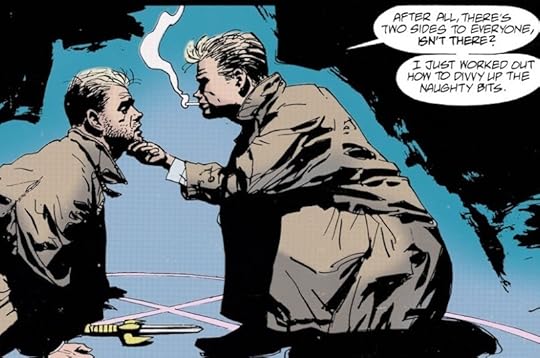
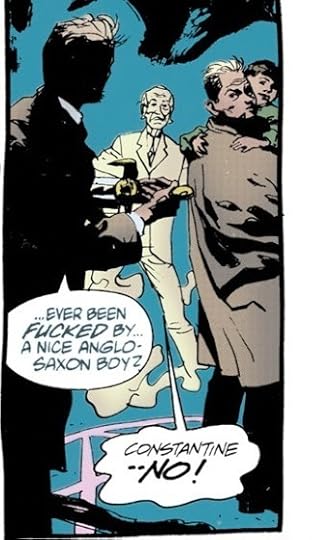
Anyway, have some panels that are hilarious out of context:
Oh, This was awesome. Totally bravo performance. The first couple of one-shots preceding this volume weren't all that! But Critical Mass takes Paul Jenkins to a whole other field, writing wise. The story follows an old friend of JC, Richard meeting up with him and introducing him to his family, Michele, the wife and Syder, the gawky, but adorable son. While on a field trip to a haunted house, Syder gets lost and stumbles upon an old gnarly gentleman, who happens to be the demon, Buer. Buer is out to get JC, because JC is pivotal in the devil's plan to break free of his shackles, but JC has to willingly offer his soul to the Devil. So Buer possesses Syder and in his place demands JC barter his soul for the boy's, while tormenting JC with the unfortunate farce that was Newcastle. Question is, will JC save the boy, or save his already miserable self? No spoiler alert, trust me, it's one of the coolest manipulations Constantine has pulled off in the series so far. It'll make your head spin.
Probably my least favourite volume so far, considering how long it took me to force my way through it. That said, there are some great stories in here, the done-in-one issues being a highlight and the titular Critical Mass story being Constantine at his scheming best. The Hellfire Club story is a bit odd, and the Dreamtime story is probably an issue too long, which drag the volume down and make for slow going at the beginning, hence why it took me so long to motivate myself to read the better, latter half of the trade.
A volume with comics by three different writers is almost inevitably a mixed bag. (Though occasionally they might all be top notch like the ones in vol. 4, The Family Man, which included stories by Neil Gaiman and Grant Morrison, as well as my favourite HB writer so far, Jamie Delano.)
The Delano story here, in #84 - apparently set in the 1970s when John & Chas were young - gets a bad rap, but, whilst some of the details about the monkey aren't great, I like the overall arc of Chas' mother, the concept of her familiar, and John's role - it generally works as far as I'm concerned. Delano is just more on my wavelength I guess. And as someone who grew up with a difficult mother and wanting to be rescued from her clutches by some interesting man, this storyline was always going to click with me - and make me grok Chas' long-term loyalty to John, and that for him it's about even more than John's charisma, adventures and betting tips. (1. I'm glad I didn't read this in the 90s because on some level, it would have reinforced my excessive expectations of other people. 2. Couldn't help thinking of my poor first uni boyfriend; he probably never had a clue that was one of the main causes of my desperation, and of course if I had articulated it in actual words, it would have scared him off further.) 'Rescue from abusive parent' seems to be a recurring theme of Delano's HB stories, and that's fine by me.
Then onto Eddie Campbell's story, which surprised me by having four issues, #85-88, not just one.) I knew of Campbell as the writer of Bacchus (which I've not read), essentially an equivalent of American Gods for the Greek pantheon. And here he was writing a story around the ghost of Sir Francis Dashwood, of 18th-century Hellfire Club fame, also featuring among other entities a twisted version of E.T.A. Hoffman's Tomcat Murr.
After several volumes in which it felt like Garth Ennis was using the story to rant about hellfire-and-brimstone traditional Irish Catholicism, and channelled that into permanent features of the HB/DC universe, I was pleased to see this volume - via both Campbell and Jenkins - making its way back onto the territory of English ghosts, occultism, paganism and nature mysticism, which Delano had given at least as much space as stern Christian cosmology, and currents of the 80s & 90s like repressive Tory policies and the frequency of Boeing plane crashes. I may have been brought up a Catholic, but that fearsome side of it, like Catholic guilt, more or less escaped me; it's something I recognise but don't really connect with IYSWIM. (If we ever ended up at a mass with a priest giving hellfire sermons - and those were almost always Irish priests - my mother would always say we wouldn't go back to his masses, and by and large stuck to this - perhaps that's related to my sense of rightness and relief in getting away from the fictional reflection of such stuff in this series.) Whereas stories that echo the worlds of Robin of Sherwood, The Dark is Rising, Alan Garner - with a cast of crusties [US: gutter-punks] and road protestors, quotes from Paracelsus, and ideas like "the collective ghost of the London mob"? Yes please.
There were in the middle - in the second half of Campbell's story and the first few issues of Jenkins' - somewhat dubious adventures with an indigenous Australian "witch doctor" (sic), Jeffo. Sometimes, especially in Campbell's hands, this wasn't nearly as bad as I was expecting - and like the American Indians in 'Damnation's Flame' in Volume 8, and the London black activists around George Shaw who featured in that volume and some earlier stories by Ennis, it is mostly asserted, especially in Campbell's story, that Jeffo and other aboriginal people don't need Constantine's magic. There is still a slight whiff of colonial adventures about the brief expedition to Papua New Guinea (it might have been good to have a page or two in which indigenous magicians found the trapped entity and saw it off more thoroughly than Constantine did). And Jenkins' continuation of the Australian adventure is clumsy, lurching back and forth between reasonable and embarrassing/insulting in its handling of the politics and representation. (Though I think it needs to be acknowledged that it seems to have been more of a thing in the 20th century, indigenous spiritual workers sharing with some promising white Western seekers, albeit not as common as some Westerners liked to make out. The separatism that makes us extremely wary of books about this wasn't always as emphatic as it has been over the last decade.)
I'd heard plenty of bad things about Paul Jenkins' Hellblazer run, although the ratings for most of his volumes aren't noticeably worse than those by other writers. In his first couple of issues here, the writing was slow, flat and mediocre. But it warmed up somewhat later, especially once Constantine was back in Britain, and there were a few pages where he managed to conjure the descriptive magic that Delano and occasionally Ennis also had, and it overall became a faster and somewhat more involving read. If it had all been like #89-90 that would have been quite a slog to read. The imitation 17th century prose in #91 was embarrassing, and throughout his issues here, Jenkins uses clunky metaphors that often jar with character or setting. The art was occasionally clumsy too, in ways I didn't notice elsewhere in the series, and I wondered how much of this is due to the writer's instructions to the artist. (Why on earth would an ancient female spirit have visited medieval England while wearing a very 1990s crop top and ruffled above-the-knee skirt?)
Thematically he had Constantine re-treading old ground, including a site possessed by events of centuries ago (like the slave plantation in Alan Moore's Swamp Thing #41-42), squatters and road protestors (like in Delano's The Fear Machine).
The opinions of JC's mate Rich, one of the protestors, show how views that belonged broadly on the left in Britain 25 years ago now sound closer to something from the right: "they're pullin down the standin stones and putting bypasses through the old green lanes. Setting up some kind of network so we can all be buried under lorryloads of French apples. …They're afraid of us mate. They know there's power in the old sites an' that so they're trying to wipe 'em from the face of the earth." The bit about the French apples should, I think, be seen in the same context as the anti-globalisation protest of the 00s (though there was also an old left-wing tradition of opposition to the EEC as was). And of course there were plenty of small-c conservative National Trust members opposed to roadbuilding and similar developments in the 90s as well, but I'm thinking of the shift that became especially noticeable in the second half of the 2010s, where socialist-leaning works like Joe Kennedy's Authentocrats portrayed trends such as historical heritage imagery and the nature-writing revival as implicitly paving the way for the Brexit vote and associated racism.
Then there is a storyline which will recur again and again through HB, a child-snatching demon and the story of Astra. (As I've seen from the iffy cartoon adaptation of Mike Carey's All His Engines (2005).) And the prose, where it worked, often seemed derivative of earlier writers on HB. Constantine's encounter with Aleister Crowley was odd, and a disappointing, anticlimactic use of such a notorious and towering figure who is undoubtedly part of the inspiration for the protagonist himself. Though, is this the storyline which created 'Demon Constantine', who would feature more heavily in the Milligan run? What with this, and previously the encounter with his "golden boy" twin at the end of the Delano run, it seems like Constantine is being made to undergo a transformation with each long-term change in writers - as with Doctor Who's regenerations for new actors - to justify the inevitable personality shift in the character. (Except it seems like Jenkins is trying to have it both ways, changing the character a bit, but not in a way that would really reflect what's said to have happened - because that would make him too different from what fans know.)
Nevertheless, overall, the Jenkins was better than I expected - and I still like the return to Delano-esque rural/occult themes over Ennis' emphasis on the evils of Christianity - but not hugely exciting. However, I will continue to remind myself that I am allowed to enjoy Jenkins' HB work and that I should be wary of letting myself automatically conform to friends' negative opinions about it.
Paul Jenkins is one of my favorite Hellblazer writers so far. I thoroughly enjoyed the Critical Mass arc, and couldn’t put it down. The Australia bit was fun too, and I liked Eddie Campbell’s writing, and the way the Dreamtime was represented, visually and narratively. Overall, this is a very solid volume, and a great example of why I love Constantine and his misadventures.
Hellblazer Vol- 9: Critical Mass collects issues n º 84 to 96 of the title "John Constantine: Hellblazer". In the previous volume Garth Ennis finished is long-running work on Hellblazer; Volume 9 brings us the first stories of a writer that will also have a long and seminal run on "Hellblazer", a run that oddly enougth remained uncollected in tradepaperback form until now. The writer in question is Paul Jenkins. However this Vol. 9 does not open with Paul Jenkins run in the title but with a great one-shot story by the "Hellblazer-defining" writer Jamie Delano in the issue # 84 titled "In Another Part of Hell". This great story reveals to the reader the reason why Chas remains forever indebeted to John Constantine. It's a surreal, oddly tragicomical story that only Delano could pull off. The artwork is by Sean Phillips, whose style is, to my mind, absolutely perfect for Hellblazer. It's easily a 9/10 in my book. Next up is Eddie Campbell's four-issue long story "Warped Notions" (issues 85-88). It's a grat story that stems from the idea of Urban Lgends coming to life but that develops into a globe-spanning adventure with considerable historical and literary references. It's a great storyline. Art is once again assured by Sean Phillips. (8/10). Issues 89-90 brings us "Dreamtime", the first of many Paul Jenkin's written "Hellblazer" story. It concerns an earth deity who seeks retribution for the harm caused by a company that is selling the resources of the aboriginal land to the higest bidder. It's not an amazing story but it's far from dull and somewhat elevated by Sean Phiilip's artwork. (6/10). Issue 91 features the story "Riding the Green lanes", a somewhat forgetable tale once again penned by Paul Jenkins. It's the weakest story in the volume whose biggest saving grace is Sean Philips artwork. (5/10). Issues 92-96 feature the five-part storyline "Critical Mass", also penned by Paul Jenkins and drawn by Sean Phillips. This story is hands down the best of the lot collected here. It's dialogues and concept are great and provides us with a great rendition of the coniving trickster John Constantine we know and love. The story is stock-full of nods and references to canonical characters and events created by previous Hellblazer writers and even presents us with a very cathartic and important event in Con-Job's life. As in the rest of the volume, Sean Phillips' art is absolutely mesmerizing and exciting.(9/10) This volume wetted my apetite and curiosity towards Paul Jenkin's work on the title. The stories presented here showcase that he knows the character he is writing for very well and that he has a knack for writing dialogue. And it's quite a joy to know that Sean Phillips will be drawing most, if not all, the stories penned by Jenkins. Bring on Volume 10.
Volume Nine of Hellblazer was very good. It starts off with a very cool story about why Chas owes John Constantine and is willing to do anything for him as a true friend. I enjoyed seeing the reason behind their friendship.
The next story arcs were just ok. In one, JC must deal with a restless spirit that can change reality and in the other, JC goes to Australia to deal with a Serpent spirit and help the locals while he takes a spirit walk. These two stories, for me, were just ok. The Australia story was better than the restless spirit.
But then Jenkins hits his stride with the excellent "Critical Mass" story. This is what Constantine is all about. A demon named Buer has decided he will possess the son of JC's friend. If JC trades his soul to Beur, then he can send it to the First of the Fallen (who is now in a mortal shell in Greece) and he can regain his place in Hell. A very cool story which has Constantine teaming up with Aliester Crowley to outwit a demon and the Devil himself. Again. Loved it!
A good volume, though it is the strength of the final story arc of "Critical Mass' that truly makes this volume. Wonderful stuff!
Now this is more like it. I honestly did not expect to enjoy this as much as I did. In large part, this was because Sean Philips, the new main illustrator, is stunning. His linework and inking has so much weight and texture to it. The layouts (which honestly were rarely weak in Hellblazer) haven't looked this good since Dave McKean did a story. It just finally looks... occult. Everything is so sinuous, expressive and dark. I just love looking at the book, and this is the first time a main illustrator has elicited these feelings in Hellblazer.
Eddie Campbell's story is something of a shaggy dog, at times delightful and confused. It, and Jenkins's tying up of loose ends in the couple issues that followed Campbell's run were the only weak bit in the book. The main arc in the volume, the titular "Critical Mass" was excellent. An excellent spiritual (heh heh) sequel to the wonderful Dangerous Habits arc. John Constantine found a definitive way to outwit the First of the Fallen, and has never before been so successful. And yet, in the last pages, Jenkins found a way to sour this victory in a very satisfying fashion.
One thing I really enjoyed about both Campbell's and Jenkins's writing was the return to both the literary and punk roots of the character. There's nothing that really defines the character more for me than his relation to both literature and music, and the occasionally conflicting synergy of these elements. These things transcend even the occultism that makes up the bread and butter of the stories. Constantine is a character that taps into the old and obscure, the occult in its literal meaning. He is also someone defined by a music that violently rejects the Status Quo, that at the time challenged itself to peaks of novelty. The push and pull of the old world and the new world, the way these worlds augment each other, that give Constantine his unique texture and characterization. This is what distinguishes him from so many other Occult Detectives.
Well not too quick. First we have Delano come back first, and...it's a pretty great issue. Then we have Eddie Campbell, a writer I never heard of, chun out one of the most long, tedious, and confusing stories I've ever read in comic medium. Once we get past that we're introduced to Jenkins Hellblazer...except the first short story is like a bad ET knockoff. Then we FINALLY get to the Critical Mass story and...it was pretty good.
Seriously the middle is pretty bad. I was slogging through it. My brain was just like "What in the world is this shit? And why is it so boring..."
But let us talk about the good. Delano first story is actually really fun, crazy, sick, weird, and all the things I love about Hellblazer. Which at first was weird to me because I did not like the majority of Delano's run but this was great. With a crazy ass chimp and a fat disgusting mother, John must find a way to help his friend get away from the two monsters.
The last story, Critical Mass, is very similar to Ennis first big one. A boy is possessed by a demon and in order to release him, he tells John he MUST give him his soul. So John must figure a way to outwit the demon. It's pretty fun, and the last two issues are great, though it took a bit to get there with a lot of padding.
I'm torn between a 2 or a 3, because a large portion I didn't like. But it wasn't all bad and ended good. I'll rate it a 2.5 here but I'll bump it to a 3, only cause even with some bad stories the art stays solid.
In “Critical Mass”, the ninth volume of John Constantine, Hellblazer: the ghost of Francis Dashwood, an 18th-century rake and founder of the infamous Hellfire Club, enlists a reluctant Constantine to stop the Apocalypse (or at least a relatively inconvenient cosmic approximation); Constantine ends up in Australia, meets some aborigines, goes on a spiritual walkabout, and makes friends with an aboriginal serpent deity who’s hungry for land-poachin’ whities; a friend of Constantine’s who went missing years ago turns out to have been stuck in a time warp this whole time; the child of a young couple that Constantine used to punk out with has been possessed by a demon; Satan, stuck in eternal exile by Constantine as a mortal in Greece, comes across an opportunity to regain his place in Hell and seek retribution against Constantine; the souls of lost children, including the one that Constantine let get away in Newcastle, may have a chance to be set free, as long as Constantine doesn’t fuck it up…
A new writer—Paul Jenkins—-and artist—-Sean Phillips (one-half of the extraordinary Ed Brubaker/Sean Phillips creative team behind the awesome graphic novel series “Fatale” and “Kill or Be Killed”)—brings a wonderful new perspective to the Hellblazer series, as well as a potentially new beginning for Constantine. Although, if there is one constant in the universe, it is that Constantine will always be an insufferable prick.
This is really more like 2.5 stars, and represents a pretty massive dropoff in quality following Ennis's character-defining run. Whereas Ennis's approach to Hellblazer was full of energy and life and humanity, while still managing to be a constantly surprising Constantine vs. The Minions of Hell thrill ride.
Now, we're left with what feels like a book trying to figure out what to do with itself now that it's dad has gone. Yeah, Garth Ennis is Hellblazer's dad, who cares.
I mean, the book starts with a ludicrous Jamie Delano one-off flashback story about a time Constantine had to vanquish an old witch's hyper-sexual chimpanzee by pretending to be in love with it. I mean, if it was a comedy issue, that might be kind of fun, but it ain't.
Then we have a 4-issue waste of time by Eddie Campbell, where Constantine just flies around to a bunch of places, witnesses weird things, does nothing to stop them, takes no other discernible action besides being "along for the ride," and then has the plot wrapped up in a single page. It's potentially the weakest Hellblazer story I've read yet, and there were some real stinkers early on.
Then, we finally arrive at Paul Jenkins' run, which begins here and lasts a total of 40 issues. And, while I found the final story arc, "Critical Mass," to be the best by far in this collection, it doesn't bode well for how I'm going to feel about Jenkins' run overall.
For starters, Jenkins very much feels like he's writing in the shadow of Ennis. "Critical Mass" is basically just "Dangerous Habits" but with a slightly different ending (one that arguably makes no sense). Ennis really invented the idea of Constantine being a trickster and con artist, whereas Delano and Alan Moore always just wrote him more as a generalized scoundrel. Jenkins is smart to continue that approach here, since it's probably what people want to see most out of a Constantine story, but by all but copying the structure of "Dangerous Habits" (which echoes in "Rake at the Gates of Hell," Ennis's final story that was published a mere 7 months before "Critical Mass"), Jenkins doesn't really succeed in setting himself apart.
In addition, Jenkins is a massive over-writer. He crams tons of narration boxes into tiny panels, describing things that could very easily be told just from looking at Sean Phillips' excellent artwork (one of the saving graces of this book). His storylines meander at times, taking us down paths we don't really need to be going down, often for the sake of developing characters who end up barely mattering to the plot.
And, like I said, the finale of "Critical Mass" just unfortunately doesn't track. I even re-read it a few times to try to figure out what exactly I was missing as to why Constantine's particular trick manages to win the day, but I just can't figure it out. Honestly, a demon who is confronting Constantine just kind of gives up his advantage for no reason I can discern. And that ain't great for a plot that's mirroring one of the best Hellblazer stories of all time.
So, not the best. I didn't hate this by any means, but it does feel like my Great Hellblazer Readathon is going to slow down quite a bit over the next few trades. Oh well. Nothing lasts forever.
The story this collection is named after has been a favourite of mine for a decade. I hunted the issues down on ebay, and held a grudge against DC for not collecting it in a trade paperback. So I'm very glad to finally get my hands on this book. Paul Jenkins, for all that DC didn't seem to appreciate him, writes a pitch-perfect Constantine, and Sean Phillips' art doesn't just capture John Constantine as well as he's ever been captured, and drench his world in the appropriate amount of shadow, and get all the local detail right (one of my pet peeves about some Hellblazer artists is that their Britain doesn't much feel like Britain; and Hellblazer is, in a way, about Britain) - it is also genuinely aesthetically pleasing, to me. I would gladly frame most of these pages and put them on my walls. The other stories collected in here are a one-shot by Jamie Delano, about which I have mixed feelings, a somewhat muddled four-parter by Eddie Campbell, and Jenkins' very first story, which ties up some lose ends left by Campbell, and which has more than a whiff of Problematic Cultural Appropriation about it. Also, there's a Jenkins one-shot about... cycling, and the English civil war. There's stuff to like in all of these (lots and lots of Sean Phillip's fantastic art, for one), as well as some stuff that doesn't quite work, but Critical Mass really is what makes this volume essential. Jenkins writes a very human Constantine, without ever quite making us forget that despite all his regrets and occasional attempts at redressing wrongs, John Constantine is also a first-rate bastard.
I'll put this review right down the middle. Half almost gibberish in its incoherent story telling (Eddie Campbell) but it ends with a five parter that was as satisfying as any I have read in Hellblazer (Thanks to Paul Jenkins). Jenkins took a few issues to get his feet after Campbell's mess of a story (Warped Notions) but the entire volume is made better due to Sean Phillips' excellent art.
Warped Notions had a semi interesting idea...I guess...a ghost wants to get John to go around the world so reality will come undone. But it is so poorly written and so confusing and the mystery isn't laid out in a way we go "oh my!" at the end, but rather "um..ok...so none of this makes sense". I really hate lazy writing and this is lazy writing at its worst. Some neat ideas but no effort to put it together in a well told tale.
Critical Mass - the ending five parter is so nice because it - unexpectedly - put a bookend on the Astra story. It was a nice story of John overcoming the odds and snatching victory out of the jaws of defeat but the added touch of Astra made it especially nice for me. I would still say Garth Ennis' take on "tricking the devil" was much better written and the trick more imaginative (Dangerous Habits - which is still my fav Constantine story) but this was also very well done.
Overall - while one of my less enjoyable Constantine reads it still had enough highlights to make it enjoyable. But you do have to slog through a VERY weak first half to get to the best of the volume.
This is a half-n-half anthology which consists of parts that were plainly never intended to be welded together. So it's a not entirely rewarding experience.
Yet there are some entertaining interludes and these include a simply brilliant back-story set in John's youth. This explains his close relationship with Chas and features Constantine at his best, using guile and deceit to bamboozle a bestial horror (which happens to be... erm... Chas' mother). It's deliciously crude and clever, a perfect blend of black humour and backstreets noir with a supernatural slant.
The final storyline follows similar themes, as JC must once more outwit the first of the fallen to prevent his soul being harvested in hell. But there's something lacking in the storytelling here. All the Hellblazer elements are present... but it doesn't sparkle or snark like classic Constantine.
Parts of the Critical Mass 5 parter were enjoyable (I think part 2 of 5 was my highlight) but the restvof this book felt derivative and trying too hard. Maybe Paul Jenkins finds his strode in later books, or maybe following Garth Ennis is too great a challenge.
First thing I want to mention about this volume is the art. Sean Phillips had done a handful of fill-in issues here and there on Hellblazer over the years, but with this collection he becomes the regular artist, and it's just wonderful. Not too many artists have been so perfectly suited to a title-- Phillips work is sketchy, focused on forward images over backgrounds, the character's body language and facial expressions feel real, the color palette is muted and atmospheric, and it all just clicks. There are three different writers in "Critical Mass", but it all hangs together by the thread of Phillips' art.
As usual, some spoilers follow.
To begin, we have the return of the master. It's so good to see Jamie Delano back on Hellblazer, even if it's just one issue to get this volume rolling strong. "In Another Part of Hell" is one of my favorite Constantine stories. It's weird and creepy and funny, and reveals at last why Chas owes John. It's mostly flashback, to when Constantine first arrived in London back in the mid-70s, and encountered Chas' horrible mother Queenie and her disgusting familiar, a monstrous monkey called Slag. Queenie and Slag have been making Chas' life hell, so young John takes it upon himself to deal with the situation. There are bits in this story that made me laugh out loud. I had thought before that the one thing Ennis had on Delano was a sense of humor, but I take it back. This story is funnier, to me, than any Ennis comedy, because it's darker and less juvenile. It's one of my favorite Hellblazer stories.
Eddie Campbell fills in for four issues after that for one of the more bizarre stories in the Hellblazer canon. Constantine is shanghaied by the ghost of Sir Francis Dashwood, a cat-headed demon called Murnarr, and a Venus Di Milo looking demon (?) called Bona Dea to help them address an outbreak of... I guess weirdness and synchronicity occurring all over the globe. The journey takes them to Philadelphia first (where John meets the ghost of Ben Franklin), and then the Australian outback, where Constantine begins to realize that it's actually Dashwood causing all the trouble. Murnarr is killed by the Rainbow Serpent (more about that in a minute) and Constantine traps the wicked Dashwood in a tree, where he won't be able to cause any further harm. I've read that this is an unpopular story amongst fans, but I kinda liked it, even if it didn't make a lot of sense, mostly because Eddie Campbell's sense of humor appealed to me.
And then we get the debut of new regular writer, Paul Jenkins, which is kind of a big deal because these Hellblazer volumes mark the first time Jenkins run has been collected, and that's long overdue. He's a seriously under-rated Hellblazer writer.
His first couple issues, though, are a bit shaky. He admirably picks up the reins where Campbell left off, in Australia, where with the help of the Aborigines Constantine goes into the Dream Time and confronts the Rainbow Serpent. Some evil land developers are set to force the natives off the land, and Constantine bargains with the Serpent for help, realizing that it's not the Serpent who controls the Dream Time, but the people. This one has some good moments, but it's not particularly memorable.
Back in England, we meet some of the new supporting cast in Constantine's eccentric pal Rich the Punk, his wife Michelle, and their young son Syder. These folks will function as Constantine's family for the duration of Jenkins run, and Rich especially is a great character.
In the 5-part "Critical Mass", Jenkins really gets rolling and makes Hellblazer his own. Since his defeat at the hands of Constantine and Ellie, the Devil has been unhappily living as a mortal, working a fishing trawler in Greece. Hell has carried on, but the First of the Fallen is missed by one demon in particular, the connessuer of children's misery Buer. Buer possesses the body of young Syder, holding the boy's soul for ransom until Constantine willingly gives up his own to the Devil in exchange; this will re-instate the Devil back in Hell. As an added incentive, the demon also reveals that he has the soul of Astra, the young girl who Constantine was unable to save way back in Newcastle in 1978.
Constantine calls in a favor from Jack of the Green, a sort of deity/fairy/something out of British mythology, and Jack takes Constantine to Abaton, a sort of fabled mystical dream place, where Constantine learns what he needs to know: the demon Buer's name. For all the good it does him. An encounter with the Phantom Stranger (last time we saw the Stranger, it was at Constantine's 40th birthday and John accidentally pissed on his shoes; note how differently Jenkins treats the character) makes Constantine realize he can't get out of this one. The only way to save Syder and Astra and all the other children being tormented by Buer is to willingly give himself up.
So he does. After a fashion...
One pile of mud and shit, one complicated spell, and one visit to the shores of Loch Ness to visit Aleister Crowley later, and Constantine pulls off another amazing con job, denying the Devil his due yet again. The First is back in Hell, but with only a makeshift soul to unleash his fury upon. He decides to take a horrified Buer to make up the difference. Syder is freed, and so is Astra at long last, and all the other children trapped in Hell. There is a great bit at the end where the First of the Fallen finally gets something out of his system that had been infuriating him since the end of "Dangerous Habits"-- one "Up yours" deserves another, right?
So Paul Jenkins wraps up his first major story arc for Hellblazer, taking only a few issues to find his footing, and delivers quite nicely. I like that he expertly picks up threads from Constantine's history and uses them, all the while setting up new characters and sowing little seeds for future stories. It's already clear he's going in a different direction than Ennis or Delano, drawing heavily on British folklore and mythology, so that should be interesting. He also gives us a Constantine who's just tired and wants to be a good person. We'll see how long that lasts...
I took a pretty long hiatus from reading Hellblazer after I finished Garth Ennis' run - I'm not a fan of Ennis and his Hellblazer was pretty much everything about his storytelling conceits that I dislike. I was finally ready to come back and I'm glad that, when I did, Paul Jenkins was ready to bring back everything about John Constantine that I love. The first half of the book is a pretty ephemeral story set in the Australian outback against Aboriginal myth, which I found a little too mysterious; the second half, however, was a return to classic Constantine (but with the wisdom and cunning he's gained over the course of the series). It's dark, frightening, tense, and ultimately victorious - in that way that makes you wonder if Constantine has really thought through the consequences of his actions. I'm finally excited to get to volume 10.
I'm a little torn about this one. It has a few different storylines in one volume. The first half of the book was just like a fever dream to me and I was lost for most of it. Of course, the plot was about dreams and weird realities and such so that's probably why I felt that way. Overall though, I prefer a little more coherence in my stories. It was very abstract, and probably very good for people who like those type of stories, but for me it was just too far out.
The last half of the book is a more traditional Hellblazer story dealing with demon possession that is a sequel to some earlier stories. The ending of this one was a little confusing, but it was still much more to my liking than the stories set in the dream realm.
Overall not a bad volume, and I'm sure many Hellblazer fans will love it. But for me personally it was more in the middle.
I paused reading the Hellblazer here for more than a year because of how slow this volume starts. I was, however, surprised to find myself enjoying reading it after the first few issues. This book, as most reviews explain, is a mixed bag. Yet, it is more or less an average-good Hellblazer volume.
[84] In another part of hell (2/5): See, the cover on this one tells you most of the story. It is a one-shot by Constantine's creator, Jamie Delano, where the character narrates ts first and last encounters with Chas's disgusting witch of a mother and her nasty familiar ape who has a knack for perverted stuff. I found the story too disturbing even for this series, yet it tells you how Chas became indebted to Constantine, so you might want to skim through it.
[85-88] Warped Notions (3/5): While performing an exorcism, Constantine encounters a handful of demon spirits led by the ghost of Francis Dashwood, who came to request his aid in preventing the fabric of reality from shattering. Now Constantine is running aimlessly around the world, hopping from country to country to find the source of the problem and eliminate it. The story is hard to follow and has many characters jumping in and out without contributing much to the plot, but it is nonetheless fun and has a clean, satisfying conclusion.
[89-90] Dream Time (3/5): Warped Notions concludes in Australia, and Paul Jenkins, the new regular writer, picks up nicely from there. The Rainbow Serpent, a deity of the aboriginals, is threatened by settlers stealing its land. Deam Time is just another story where some character in the universe, this time a god, falls in Constantine debt and another average-good story in the book.
[91] Riding the Green Lines (4/5): Riding the Green Lines is an A-grade one-shot where you meet more of Constantine's friends from the old days, hearing some of their stories and enjoying them solving the mystery of their friend who went biking one day and never came back (hint: he lept back in time).
[92-96] Critical Mass (3/5): A child-enslaving demon, Buer, has possessed the son of Constantine's friend from the previous volume. Buer offers to release the child's soul in exchange for Constantine's, planning on handing Constantine's soul to the First of the Fallen to bring back his reign in hell. Critical Mass is most people's highlight of this volume. I, too, enjoyed it for the same reasons most people have, Yet I was also annoyed with the many inconsistencies it had with previous arcs, and sometimes even with itself. Neither Buer's reason for helping the First of the Fallen nor how he came to have Astra's soul are explained (Astra's soul was originally claimed by the demon Nergal). Additionally, Paul Jenkins forgot that Ellie was only disguised as Astra when she stapped the First of the Fallen, and he gave the Holy Dagger she used to Astra herself in this volume. These are only a few of the inconsistencies I ran across. On the other hand, yes, it is a thrilling story. It brings back vibes from the earliest issues when Constantine conned demons and traveled between dimensions to run errands. I also liked how in the end, even though Constantine wins again, we see that his actions have consequences, foreshadowing trouble to come. I think that if I hadn't known Constantine's history, I would have given this one 4/5.
Nobody should have had to follow Garth Ennis's run on Hellblazer. It wasn't perfect by any means, but it really defined someone a character who'd been muddled its creators. Ennis had a focus and a story with a definitive (but by no means final) ending.
On paper, allowing the original Hellblazer writer, Jamie Delano, to come back and set the tone for the future of the series is a good idea. But the series didn't get the creative Hellblazer, Volume 3: The Fear Machine Delano, instead it's the preachy, unfocused plotting of Hellblazer: The Devil You Know. It's a shame. I just put down the book and remember nothing about his issue except that I didn't enjoy it. It felt like when Claremont came back to the X-Men in the 21st century. The magic was just gone.
Eddie Campbell's run wasn't much better for me. It Was more focused than Delano's, and it did have a message, and followed the pattern of something magical trying to trick Constantine, but failing in the end. But the dialogue seemed hokey and unrealistic after so many issues of Ennis, and I didn't care about the villains.
The beginning of the Jenkins run was eventually more promising. His first issues were shaky, and when he both reintroduced Satan (not Lucifer, he has his own book), and completely telegraphed the "Uncle Con Job has to save some widdwe babeees" nonsense, I wanted to throw the book across the room. But he, at least, seems to be building to something, even if it is just retelling the Ennis run with a few different supporting characters.
This is a Throughly Skippable collection. If you're not invested in reading the full run of the book, I wouldn't waste my time on this one, even though there are some impressive names on the cover. Maybe if you buy it as an early Sean Phillips Art Book, it would be more satisfying. I have never seen a badly drawn issue of a comic with his name on it, and he drew most of the issues in this collection.
Weird collection. First issue is Jamie Delano's return to the comic. He wrote the first fortish issues. I like him, but he can be hit or miss. This story is somewhere in between. I think it's suppose to be funny, but I just found it odd, and not in a great way. The second story, which is by Eddie Campbell, starts out great, then turns into nonsense after about two issues. I'm so glad he didn't become the main writer as as planned initially. I don't know why it falls apart suddenly, but there's a group that shows up similar to Grant Morrison's Invisibles and it's just straight nonsense. I skipped the last issue of this because I think it was so bad. Also, I can't point my finger on it, but there was something with the way he wrote John's dialogue that was completely off. Felt more like an imitation than the real thing. There are some random issues that I skipped by Paul Jenkins, the new Hellblazer writer, which wrap up the Campbell story. Finally, after the collection concludes with Critical Mass, the title story and one of the absolute best Hellblazer stories ever. A demon claims John's friends' son because of him, so he has to figure out a way to save the boy. Really excellent. Can't believe this one isn't talked about more. I'd rank it up there with The Family Man and Dangerous Habits, easy. 5/5 So basically, the last five issues are really the only things worth reading in this, though I do think they make this collection worth owning. One fantastic thing about this collection is Sean Phillips's artwork. I think he did every issue in this collection and he's just great. His facial expressions and charaction reactions are just spot on. I didn't quite realize it till now, despite having read a bunch of stuff he's worked on, but he's definitely one of the best comic artists out there. Hellblazer often has bad art, but this is now one of those times.
i started reading this and immediately missed garth ennis' more wordey, dialogue-heavy writing that felt more like a heightened novel with supernatural elements. delano's one-off issue here is fine, feels very isolated from the previous arcs but it's a nice read. it's when i got to eddie campbell's story, "warped notions", that i got very bored. this story - plus the writing - has a very different tone, it reminds me a lot of Hellboy, which is a comic i don't really like. it's more aimed at being quirky and adventurous, you know, like regular mainstream comics, while the rest of the series felt more like literature. following the first issue of this story, i skimmed through the rest of the book and paid a bit more attention to paul jenkins' "critical mass", which is an improvement from the previous but still very far from what i read Hellblazer for. i also don't like the direction the story takes, feels like a betrayal of everything that happened during ennis' run and how he wrapped that up nicely. john no longer loves kit, the devil is back in control, ellie hates him... and for what? that's the kind of thing that happens in Spider Man comics. it's disrespectful and makes me disillusioned with the future of the series.