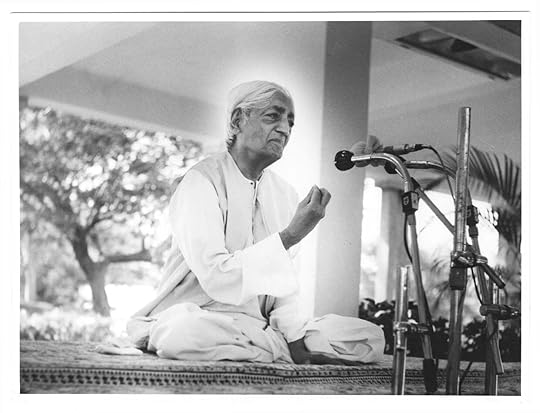
"Temos hoje um espantoso saber técnico, graças ao qual o homem é capaz de ir à Lua, de manejar um computador, de matar milhares dos seus semelhantes a grandes distâncias... Mas ainda não resolvemos os nossos problemas humanos (o medo, o conflito, o sofrimento...). Porque não temos uma mente livre, sem barreiras, que vê as coisas tal como são, que vê por que homem se separa da natureza e dos outros seres humanos? Estaremos nós prisioneiros do nosso condicionamento, do nosso modo mecânico de pensar?... Será possível libertarmo-nos, e assim passarmos para uma dimensão totalmente diferente?... Não digamos que isso é possível, ou que não é possível. Investiguemo-lo." - diz Krishnamurti. Nada mais revelador do que a observação de nós mesmos que ele nos convida a fazer, explorando connosco a nossa realidade psicológica, que se projecta no mundo. E, somos surpreendidos por evidências "perturbadoras", abrindo brechas na rotina do quotidiano... Para lá dos muros com que nos separamos, a descoberta do sentido holístico da Vida e de uma dimensão diferente, aberta ao voo - voo da mente livre.
Jiddu Krishnamurti was born on 11 May 1895 in Madanapalle, a small town in south India. He and his brother were adopted in their youth by Dr Annie Besant, then president of the Theosophical Society. Dr Besant and others proclaimed that Krishnamurti was to be a world teacher whose coming the Theosophists had predicted. To prepare the world for this coming, a world-wide organization called the Order of the Star in the East was formed and the young Krishnamurti was made its head.
In 1929, however, Krishnamurti renounced the role that he was expected to play, dissolved the Order with its huge following, and returned all the money and property that had been donated for this work.
From then, for nearly sixty years until his death on 17 February 1986, he travelled throughout the world talking to large audiences and to individuals about the need for a radical change in humankind.
Krishnamurti is regarded globally as one of the greatest thinkers and religious teachers of all time. He did not expound any philosophy or religion, but rather talked of the things that concern all of us in our everyday lives, of the problems of living in modern society with its violence and corruption, of the individual's search for security and happiness, and the need for humankind to free itself from inner burdens of fear, anger, hurt, and sorrow. He explained with great precision the subtle workings of the human mind, and pointed to the need for bringing to our daily life a deeply meditative and spiritual quality.
Krishnamurti belonged to no religious organization, sect or country, nor did he subscribe to any school of political or ideological thought. On the contrary, he maintained that these are the very factors that divide human beings and bring about conflict and war. He reminded his listeners again and again that we are all human beings first and not Hindus, Muslims or Christians, that we are like the rest of humanity and are not different from one another. He asked that we tread lightly on this earth without destroying ourselves or the environment. He communicated to his listeners a deep sense of respect for nature. His teachings transcend belief systems, nationalistic sentiment and sectarianism. At the same time, they give new meaning and direction to humankind's search for truth. His teaching, besides being relevant to the modern age, is timeless and universal.
Krishnamurti spoke not as a guru but as a friend, and his talks and discussions are based not on tradition-based knowledge but on his own insights into the human mind and his vision of the sacred, so he always communicates a sense of freshness and directness although the essence of his message remained unchanged over the years. When he addressed large audiences, people felt that Krishnamurti was talking to each of them personally, addressing his or her particular problem. In his private interviews, he was a compassionate teacher, listening attentively to the man or woman who came to him in sorrow, and encouraging them to heal themselves through their own understanding. Religious scholars found that his words threw new light on traditional concepts. Krishnamurti took on the challenge of modern scientists and psychologists and went with them step by step, discussed their theories and sometimes enabled them to discern the limitations of those theories. Krishnamurti left a large body of literature in the form of public talks, writings, discussions with teachers and students, with scientists and religious figures, conversations with individuals, television and radio interviews, and letters. Many of these have been published as books, and audio and video recordings.
The thing about reviewing Krishnamurti: confining his message into this kind of "knowledge" can contradict his message. He doesn't teach anything secret or even "religious" as we know it. When he explains things, you agree with him and you want to think he is extremely smart, but he tells you how to know things the way he does. He explains how our minds are conditioned by past knowledge accumulation, and we miss things now because we substitute what is real- what life reveals here and now - with what we already know. This needs to be practiced, because if a person talks, thinks, or writes about it too much, the understanding of Krishnamurti's teaching may also be bound in the past. We don't understand reality because we assume we already understand it and never open to learn new things from life. How to practice: take quiet time and watch your thoughts. Observe them, as Krishnamurti says, as clouds passing by. I've done this practice for months now and it does lead to understanding. I have begun to understand why I believe things, how I can be controlled by what I'm told to believe, and what IS, apart from my past projections of accumulated knowledge. He calls this "intelligence."
Крішнамурті говорить про такі речі як страх, залежність і тиша. Особливістю цієї книги в тому, що це записи лекцій і як у кожному живому записі, думка інколи переривається, недоотримує цілковитого закінчення. Тому планую почитати ще кілька його книг щоб зробити для себе висновок.
Yayınevi: Ruh ve Madde Yayıncılık, 1998. 174 sayfa.
büyük düşünürün 1969 da isveç, paris, amsterdam ve londra da yaptığı 12 konferans-söyleşilerinin metni.
osho, l. rampa ve diğer bilgeliği avrupa ve amerikaya öğretmeye giden hintli yoga ve felsefe üstadlarının hayatları ve kitapları benim için altın değerinde.
I say one can live that way only when one knows how to be free from all stupidities of ones life. To be free from them is only possible in becoming aware of ones relationship, not only with human beings but with ideas , wth nature , with everything. j .krishnamurthi. The rest is with you,
Fin samling af konferencer om frihed, fragmentering, meditation, fred, frugt, ændring, om at se ... Krishnamurti har en yderst personlig stemme, der afspejler sine erkendelser. Han taler på en frisk og inspirerende måde om netop de ting som er værd at koncentrere sig om.
I liked the constant message to the reader/audience to not take anything Jiddu says at face value, and instead to explore what he is saying ourselves. The questions he tells us to ask ourselves and challenges us to understand better are compelling and make me want to continue down the path of understanding myself. It’s not an easy read though. At least for me, the first half of the book required multiple breaks, rereading and contemplation. The format of Q&As from different talks may be partially to blame. It was difficult to follow sometimes and left me wondering if a thought was incomplete or that he should have explained more/better, especially on the topic of fear. Then there is the tone - it’s condescending many times but I think it is worth ignoring to focus on the points the author is making.
[ Για να μάθουμε αυτό -αν είναι δυνατό- δηλαδή, το να μην ονειρευόμαστε καθόλου, έτσι ώστε ο νους να είναι αληθινά φρέσκος όταν ξυπνάει το πρωί, χρειάζεται να έχει κανένας επίγνωση κατά τη διάρκεια της ημέρας, να έχει επίγνωση των υπαινιγμών και των νύξεων. Αυτά μπορεί κανένας να τ' ανακαλύψει μόνο στις σχέσεις' όταν παρατηρείται τις σχέσεις σας με άλλους, χωρίς επίκριση, κρίση, αξιολόγηση' απλά παρατηρώντας πώς συμπεριφέρεστε, τις αντιδράσεις σας' βλέποντας χωρίς καμία εκλογή απλά παρατηρώντας, έτσι ώστε κατά τη διάρκεια της ημέρας το κρυμμένο, το ασυνείδητο, ξεσκεπάζεται.]
🐓 [Μπορούμε να ξέρουμε τι είναι η αγάπη μόνο όταν ξέρουμε πώς να πεθάνουμε για τα πάντα του χθες, για όλες τις εικόνες της ευχαρίστησης, τις σεξουαλικές ή τις άλλες' τότε, όταν υπάρχει αγάπη, που είναι καθεαυτή η αρετή, που είναι καθεαυτή ηθική -όλη η ηθική υπάρχει σ' αυτήν- μόνο τότε εκείνη η πραγματικότητα, εκείνο το κάτι που δεν μπορεί να μετρηθεί εμφανίζεται.]
🐓 [Ο διαχωρισμός παρουσιάζεται όταν υπάρχει φόβος. Όταν αγαπάτε δεν υπάρχει το "εμένα" και το "εσένα" το "εμείς" και το "αυτοί". Αλλά τώρα θα πείτε, "Πώς μπορώ να αγαπήσω; Πώς μπορώ να αποκτήσω αυτό το άρωμα;" Υπάρχει μόνο μία απάντηση σ' αυτό' κοιτάξτε τον εαυτό σας, παρατηρείστε τον εαυτό σας' να μην καταστρέφετε τον εαυτό σας, αλλά να παρατηρείται και από αυτή την παρατήρηση, βλέποντας τα πράγματα όπως είναι, τότε ίσως θα έχετε αυτή την αγάπη. Αλλά πρέπει να δουλέψει κανείς πολύ σκληρά στην παρατήρηση, να μην είναι οκνηρός, να μην είναι δίχως προσοχή.]
🐓[ Η λογικότητα συνεπάγεται το να μην έχει κανείς αυταπάτες, να μην έχει καθόλου εικόνες για τον εαυτό του ή για τους άλλους. Λέτε: "είμαι αυτό, είμαι εκείνο, είμαι μεγάλος, είμαι μικρός, είμαι καλός είμαι ευγενής"' όλα αυτά τα επίθετα είναι εικόνες για τον εαυτό μας. Όταν έχει κανείς μία εικόνα για τον εαυτό του είναι σίγουρα τρελός, ζει σε έναν κόσμο από ψευδαισθήσεις.]
🐓[ Είσαστε αυτά τα έπιπλα, αυτό το σπίτι, αυτά τα χρήματα, αυτή η σημαία. Το να ζειτε μ' αυτό τον τρόπο σημαίνει όχι μόνο να ζειτε μία ρηχή, ανόητη ζωή, αλλά το να ζείτε στη ρουτίνα και την ανία. Και όταν ζείτε στη ρουτίνα και την ανία πρέπει να έχετε βία.]
🐓 [Όλη μας η ζωή, απ' τη στιγμή που γεννιόμαστε μέχρι να πεθάνουμε, είναι ένας ατελείωτος αγώνας για να προσαρμοστούμε, να αλλάξουμε, να γίνουμε κάτι. Και αυτός ο αγώνας και η σύγκρουση δημιουργεί τη σύγχυση, κάνει το νου δυσκίνιτο και η καρδιά μας χάνει την ευαισθησία της.]
I liked this book , it got me thinking deeply about my life and how we perceive reality
The main idea of this book - I think - is that realization or pure perception of reality could be an immediate change of one's perception not a gradual one , so he refuses all methods of realization because method implies time and he think it could be instantaneous through observing and attention.
why 4 stars not 5 ? because I did not like when he talk about how childish and ignorant all religions and other schools of spirituality , i think it is an unfair generalization .
And here are some of my favorite quotes from this book :
"to understand there must be freedom and energy ; those two things we must all have - great energy and freedom to observe . If you are tied to a particular belief , if you are tethered to a particular ideational utopia , obviously you are not free to look "
"is action always approximating itself to an ideal , to a principle , to a pattern ? and we said such action is not action at all , because it creates contradiction between what 'should be' and 'what is'. "
This book is a series of many other books that I have read by K and it all seems to be have been read in the right order thus the insight I have to let go and follow the natural intelligence in oneself like how K describes the way to live. I love the way that in all of K’s book there is consistency and therefore a reinforcement of the insight within you.
Krishnamurti is just beyond of this world. Our world includes all the misery of racism, close minded, religion and family restraints and we are not ready to see it from a different point of view.
He has a clear crystal eyesight on these chains and points out not a method, not a practice but a suggestion: just pay attention. Look closely of what is happening to you.
It is up to us to understand and change our mindset!
This is a sweeping 700 page history of the United States. While the auithor is Canadian, his love of America comes through with considerable facts and a clear bias.
The book covers from the mid 1750’s to the 2nd term election of Obama.
Mr. Black examines the rise of the United States from a group of individual colonies to a super power to and including the current decline. He speaks to our strengths and well as some of our weaknesses and hints at our future.
He examines the contributions of Benjamin Franklin (clearly his favorite) George Washington, Thomas Jefferson, Andrew Jackson, Henry Clay, Abraham Lincoln, U.S. Grant, Theodore Roosevelt, Woodrow Wilson, Franklin D. Roosevelt, Roosevelt and Winston Churchill, Harry S Truman, Dwight D. Eisenhower, John F. Kennedy, Richard M. Nixon, and Ronald Reagan. Yes, it is a lot cover – but it is, after all, 700 pages.
Being a student of Lincoln, I found this excerpt particularly good:
“When the Union was strong enough to suppress an insurgency, a new leader, at the head of a new party, was elected on the promise that the rights of slaveholders would be protected, but that slavery could not expand into areas where it was uneconomic and foreign, and when this was confirmed an unacceptable to the South, proceeded with judicious cunning until the south initiated hostilities. In a prolonged masterpiece of sage and benign execution, Lincoln kept foreigners at bay, promoted outstanding generals, emancipated the slaves (95% in rebel states), so that the abolitionists and those who cared only for the union were satisfied, as the proclaimed emancipation incited slave resistance in the south. Lincoln won, slavery was abolished, the Union saved and automatically became one of the most powerful nations in the world, just 82 years after its independence was achieved. A providential leader appeared with unassailable intellectual and moral position and adequate pressure for long enough for the forces of disunion and to start to ‘bind up the nations wounds.’ The tactics of founding the new party, taking it over, and leading it to victory, and the strategy of formulating the issue and the execution of the conduct of the war, were all masterpieces of brilliance and nobility.” Yes, I liked that a lot. But then I am a bit biased.
A dialogue back and forth between J. Krishnamurti, a man raised to become a religious world leader yet who decided it was all bullshit and left all forms of organized political and religious authority, and a questioner.
Krishnamurti fervently and passionately argues that awareness is the necessary element to combat all the evil in the world. Yet he does not want to combat anything - for that is conflict and a waste of time - instead we must see “what is” through an intense dedication to sight.
He sees our conditioning and our traditions as the thing from which we must rid ourselves. He sees fear as that which holds all humans captive. He also sees the world as “burning” and holds an overall pessimistic view on humanity at large.
Very different from other scholars of eastern thought, there is a profound sense of pessimism permeating through this dialogue. Yet there is a radical insistence that, above all, we must look beyond what we think we can see. I doubt whether his ideal can ever be achieved (for he balks at the very concept of achievement and ideal). But I still found it to be a very fruitful read for all that it gives me to contemplate.
edit jan 30 2025: looking back it is funny at how much I misinterpreted him the first time
Οκ, αυτό το βιβλίο δε δούλεψε για μένα. Η κεντρική του ιδέα ότι για να νικήσεις το φόβο, ο τρόπος είναι να σταθείς από απόσταση και να τον παρατηρήσεις, είναι μεν κάτι αξιόλογο σαν ιδέα, καθώς και μερικές άλλες παρόμοιες ιδέες του βιβλίου, αλλά είναι τόσο πλατύ που καταντάει κουραστικό και δύσκολο (όχι απαραίτητα δυσνόητο, αλλά είναι σαν να παίζεις τικ τακ τοε επί 3 μήνες και να μην το έχεις βαρεθεί σε μια βδομάδα). Θα προτιμούσα να βρω κάποιο άλλο ενδιαφέρον βιβλίο που επεξεργάζεται το θέμα του φόβου και γενικά της διαχείρισης αρνητικών συναισθημάτων.