“A magical map of memory and vision.”—Dean Rader, author of Self-Portrait as Wikipedia Entry
In her mesmerizing sixth poetry collection, Blood Wolf Moon, Elise Paschen weaves constellations throughout, of stars and birds and light and darkness and beauty and horror and nature and humans and history, making shape and meaning of what’s around us and even who we are.
In this riveting sixth poetry collection, Paschen explores the story lines of her Osage heritage. The core of the book grapples with a dark period of American history, “The Reign of Terror,” when outsiders murdered individual members of the Osage for their oil headrights. Paschen searches her cultural past and family history in poems about the land, ancestors, childhood, loss, nature, transformation, flight and language.
In this cinematic book, she builds drama in overlapping narratives, reinventing ways to approach the line on the page. Described by poet Timothy Donnelly as “one of today’s most formally astute poets,” Paschen opens Blood Wolf Moon with the long poem, “Heritage,” a bracelet of crown poems, then shifts registers to formal poems and prose sequences. Poet and editor Ester Belin calls the concluding poems with their use of Osage language, “significant leaps into literary sovereignty.” Blood Wolf Moon Captivates with its emotional intensity and unrelenting quest for the translation of identity. It’s a book you can’t put down.
My Osage name descends from the Buffalo clan. I seek out bodies of water, the way those who came before settled along the deep tributaries, the veins on the backs of our hands, hands I recognize in those oval family portraits—long, lean, poised. I was born in the month of the Blood Wolf Moon.
Lupines devouring the earth, slate blue wolves, carving silhouettes in the sky, waters blown across land masses, the azure-cold lake, the infinite lake masquerading as an ocean. These are some of the striking images the poet paints with words, weaved throughout a history of her family, people, land, and the struggles, pain, and joy. Beautiful and accessible.
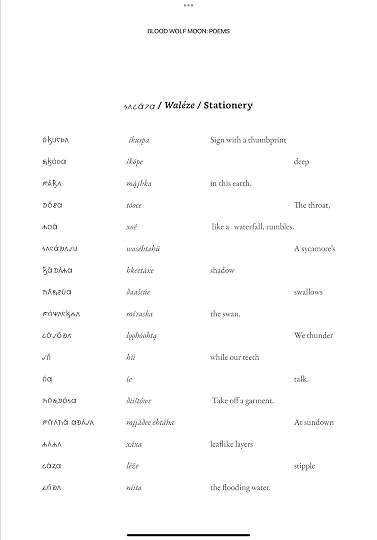
I am always interested in learning a little of the language of the author’s people, and I couldn’t get her Osage name transcribed correctly. This is at the end of one of her poems, which is helpful, and there are poems near the end that also celebrate the words of her people. The Osage orthography 𐓏𐒰𐓓𐒰𐓓𐒷 Osage 𐒻𐒷 words 𐒼𐒰𐓏𐒰 𐓏𐒰𐓊𐒷𐓐𐒻 wild horse 𐓈𐓂𐓊𐒷 throat 𐓍𐒷𐓒𐒷 tongue 𐓏𐒷𐓍𐒻͘ rope
Some words and phrases I have copied to use in my photo captions: ni-ko-ha: at the edge of the water májhka: in this earth. Olįį : Within my heart Htaacé: the wind.
To the door of the House of Mystery I have come. from an Osage song
HERITAGE
Once I had a name for everything I possessed, but now am silent, afraid to trespass. When I leave the conversation, or seem preoccupied, I travel that island where lupines in summer devour the rocky terrain, those flowers named after the slate blue wolves who keen in night’s hollow, who scavenge the tundra, across the hectares and hectares, the way they test the air, how their topaz eyes never lose sight of their quarry,…
The Water People, The Name Givers, gave appellations to The Sky People, The Land People. I have always been earth-bound and obstinate, drawn to these rising and falling hills, the tallgrass prairies, the Deer Rutting Moon hovering over the ridge….
My Osage name descends from the Buffalo clan. I seek out bodies of water, the way those who came before settled along the deep tributaries, the veins on the backs of our hands, hands I recognize in those oval family portraits—long, lean, poised. I was born in the month of the Blood Wolf Moon.
LUPINE NOCTURNE Ranks of purple bloom invade. The plant, named wolf, devours dirt and silt and loam. On this island it’s constant dusk. Lose track of hours. The name, from wolf, devours a bullseye moon, quixotic sun. Constant dusk turns minutes to hours while speech grows slow like black pearl sand. A bullseye moon, quixotic sun muscle for place, take out the sky. My speech grows slow, the grit of sand. So hard to sleep in wolfsbane light. Dirt and silt and loam on this island. I cannot sleep. It’s always light. The ranks of purple bloom invade— with every spike, take out the sky.
DAHLIA AUBADE Growing here In the crook
Of a sleeve The blue note
Each one tolls Heavenward
Sky anthem Root to slip
Knot of rope Bell so clear
QUARREL OF SPARROWS When I take flight far from the house— lonely for choirs, riotous in trees— a visitation of wings, whirs, arcs in sky, then lights on city sidewalk.
I liked this and may use it in my course in the spring. Students would enjoy seeing how the poems are crafted, and there are plenty of opportunities to explore issues we will be considering throughout the semester.
I love this poet's work and this volume is my favorite. The poems are intimate yet deftly formal. The world building creates an amazing journey for the reader.