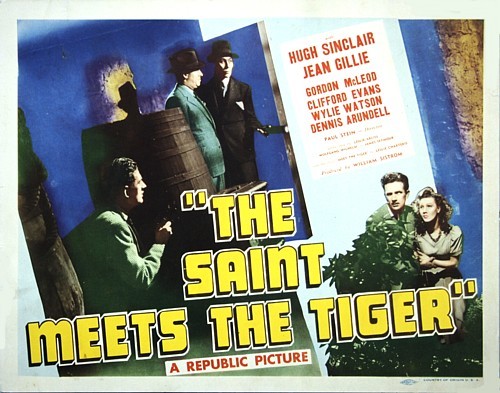
The TL;DR - For fans of the 1960's Saint TV show, the Saint Meets the Tiger may be a rough transition back into the original works, due to inconsistencies in portrayal between the show and the book. But if you're willing to set-aside your preconceptions of how the Saint sounds and acts, at least initially, you'll find a charming little seaside adventure with a modern day Robin Hood sticking it to some pleasantly-unpleasant characters in a set piece very much rooted in the 1920's.
Detailed CAWPILE review below:
🔸 Characters🔸
In The Saint Meets the Tiger there are two main protagonists; Simon Templar (the eponymous Saint) and Patricia Holm. If coming from the Saint tv show, the differences in Templar's character may be slightly jarring, as this is a much rougher character, not fully formed. Charteris comments on this himself in later writings, that this really was Templar in his infancy. And while he isn't representative of what the character will become, he still sets the basic framework of a modern day Robin Hood, albeit one that talks nearly constant nonsense almost like the Doctor would in Dr. Who, covering for flashes of dangerous competency.
Surprisingly for his first appearance in print, Templar himself gives up quite a bit of stage time to Miss Holm, who acts as the viewer's surrogate being thrust into his world of gentleman's adventure. Where Templar is the old hand at his brand of knavery, Holm is the naturally talented newcomer, who still makes some rookie mistakes that nearly gets her killed. This adds to her believability, even if her eagerness to get stuck in with Templar is surprising (and delightfully progressive) for the time period.
The main antagonist, the Tiger, doesn't officially make their appearance until the last few pages, acting more as a chess master moving pieces around to counter the Saint's moves from behind a curtain. Unfortunately, their time in the spotlight is brief, and their exit unworthy of the pomp and circumstance leading up to it.
The true villains of the piece are the Tiger's lieutenants, who I won't name as it does take a little while before we are made sure that they are, in fact, the villains, and despite it being a nearly 100 year old story, I don't want to spoil. There are two, with one playing the 'leader' in the Tiger's absence, and having the most overt menace. Both are thieves playing at being gentlemen, vs gentlemen playing at thieves. They're both, frankly, fun, because while they are outmatched in the 'game' Templar is playing, they're more than capable of scoring points against him in his arrogance.
For supporting characters, we have a couple that stand out in Dr. Carn and Orace, as well as a few bit players who are little more than set dressing.
All and all though, the cast is excellent.
8/10
🔹Atmosphere/Setting🔹
Imagine filling a room with con-artists, who know all the other people in the room are con-artists, and then sitting back to watch them try to con one another out of each other's ill-gotten gains.
This is the overarching 'feel' of the book, where just about everyone is in on the joke, but they're still playing their roles with gusto because that's how the game is played. In a modern sense, it reminds me somewhat of Orlais in the Dragon Age franchise - everyone's a spy trying to undo everyone else, but you'd be considered crude and uncouth to do so openly.
The story very much plays out lightly, and while our heroes do end up in mortal danger from time to time, the blitheness with which they face their death grants levity to nearly every scene, at the cost of reducing the feelings of actual mortal danger.
This is held-out by the setting itself; a picturesque little hamlet by the sea, described as utterly boring and causing Templar to enter into routine within 3 days of arriving. It's just the sort of place the English gentry would nip down to for a weekend, or retire looking for peace and quiet where nothing much of substance happens. And this same feeling of a weekend adventure carries throughout the book.
9/10
🔸 Writing Style🔸
The writing style shows its age - it is very much a product of the roaring twenties, with a great deal of period slang that I had to look up and confirm that I did understand what I was reading. Because of this, it didn't flow as well as a modern offering would to my mind. Additionally, Charteris slips into a fair bit of telling us that X character, "Could see that Y character was deadly serious" or "was absolutely certain that Y character meant what they said" and so on.
Telling, not showing. It doesn't ruin the experience, but it does pull you back from immersing yourself fully in it.
Dialogue is a mixed bag - in keeping with the atmosphere, I'd say 80% of it sounds much the same way the prose does; like an English gentleman is relating a story over tea. Polite by our standards, even when in-story someone is being rude or attempting to be menacing. It helps to set the atmosphere and is largely consistent.
Of the remainder, I'm splitting it between "Saint Babble" and "Orace". When the Saint is trying to confound someone, he tends to slip into repeat colloquialism, or talking about things separate to the point of the scene. I understand it's within his character to misdirect, but at some point you do just wish he'd get serious. And eventually he does... but it takes a while. And Orace... dear lord... Charteris chose to give his speech (and that of the other sailors) a phonetic spelling, making it a chore to slog through when he opened his mouth.
Despite these small quibbles, I powered through the book in no time, so they are definitely quibbles and should not be taken as a reason to avoid the book.
6/10
🔹 Plot 🔹
It's very much a 'Robin Hood' story for a weekend's adventure. Simon Templar has come to steal from some very bad men, in part for the money, mostly for the thrill, and also possibly for the girl who catches his eye almost immediately.
While the core plot itself follows most whodunit conventions (as, even on a re-read, I'd say I was into the last 50 pages before I realized who the Tiger really was), the advertised hunt for the Tiger is really secondary to the attempted theft of the Tiger's ill gotten gains.
Where things are different is in how the Saint goes about his campaign, boldly stating his intentions to the enemy and daring them to stop him. And you can tell that all throughout, no one really knows what to do with him. So it lends fresh perspective on the classical story.
I mentioned it before, but the only real issue I have with the tale is that it doesn't do the Tiger service in the end. A villain on par with Simon Templar should've had a better climax.
8/10
🔸 Intrigue🔸
As noted before, even though I've read this before (20 yrs ago) I had completely forgotten the identity of the Tiger. So it was a pleasure to spend the story guessing who it might be all over again, and there were just enough clues leaked to give me an idea who they might be just before the reveal, but not before that.
I did find, however, that despite taking 305 pages to tell the story, much of that was sparring with dialogue between the different parties, and less was spent on actually solving the problem of the treasure to be stolen/absconded with. So while there were obstacles in our heroes' paths, the investigation itself was very short and direct.
The intro was fantastically paced, as was the end, but I did find the middle bit (coinciding largely with the temporary disappearance of Templar from the narrative) sagged a bit.
7/10
🔹 Logic / Relationships🔹
Just shoot him already!
Several times in the book the enemy has Templar to their mercy, but for some bizarre reason decide not to remove him. Usually, it's because of Patricia (who most of the enemy want to marry, for some strange reason - never mind that she wants nothing to do with them), but it's very odd how hesitant they are to pull the trigger. Which, inevitably leads to their difficulties with Templar.
Additionally, there are a few unrealistic deus ex machina moments that result in strangely good fortune for the protagonists, by which their plot would've failed utterly but for that fortune. Towards the end there are some characters who show up abruptly to tie up the story, despite having been more-or-less stranded previously. And the story glosses over how they got themselves a boat and were able to catch up for the finale.
I find, looking back, that for things to have worked out for Templar and gang we have to handwave a lot of minor inconsistencies and agree to accept that this is just how it all happened.
5/10
🔸 Enjoyment🔸
Despite its flaws, I still enjoyed revisiting the first of the Saint's adventures. It didn't really 'feel' as polished as an episode of the show, but it didn't have to, because this was an early tale in the Saint's history. For the two days it lasted, it was a fun romp.
Physically, it was an easy read; this copy is a standard pocket-book. Print was large enough I didn't struggle with the words on the page. My specific copy was bought used, and the previous owner had absolutely wracked the spine; thankfully no pages were falling out, though the corners of the cover have started to wear away into rounded edges. Still physically quite enjoyable to hold in one hand while sipping a drink in the other.
9/10