

What do you think?

Orphans
Les orphelins
130 pages, Paperback
First published January 1, 2005
About the author
Hadrien Laroche
14 books2 followersHadrien Laroche is a former student of the Ecole normale supérieure. He was visiting professor at Dartmouth College (1985- 1986) and a fellow of the School of Criticism and Theory. There he met Jacques Derrida and Patricia Williams. He completed his doctorate in philosophy under Derrida in 1996 at the Ecole des Hautes Etudes en Sciences Sociales (EHESS); Derrida considered Laroche, his last doctoral student, as “one of the most talented and original thinkers of his generation.”
He has published essays on Jean Genet, Paul Cézanne, Marcel Duchamp (“La machine à signatures,” Inculte #18, 2009) and three French-language novels—Les Orphelins (Paris: Allia/J’ai Lu, 2005), Les Heretiques (Paris: Flammarion, 2006) and La Restitution (Paris: Flammarion, 2009) —which have placed him at the forefront of contemporary French writing
He has published essays on Jean Genet, Paul Cézanne, Marcel Duchamp (“La machine à signatures,” Inculte #18, 2009) and three French-language novels—Les Orphelins (Paris: Allia/J’ai Lu, 2005), Les Heretiques (Paris: Flammarion, 2006) and La Restitution (Paris: Flammarion, 2009) —which have placed him at the forefront of contemporary French writing
Ratings & Reviews
Friends & Following
Create a free account to discover what your friends think of this book!
Community Reviews
Displaying 1 - 5 of 5 reviews

July 17, 2014
As an artist, he was an orphan of truth. He had art to heal himself of truth.
[*]
Perhaps nobody is lonely. That’s hopeful to think of, like an antidote to all the miserable thoughts about one’s existence. And perhaps everyone is lonely, everyone is an orphan. By holding this delicate thread of incertitude, one reaches the threshold of this ingenious novella where three interrelated stories stand in front of us like three aesthetically designed doors behind which dwells a melancholic, intriguing and playful contemplation of the word ‘orphan’. A word I have always given a serious thought to but within the confines of the available English definitions only and a word I’ll now see with a different and broader perspective altogether.
At all costs, society protects its mothers. Even at the cost of its sons and daughters- absurd!
While dealing with an unexplained absence, a miscommunication between life and death takes place in a forlorn apartment whose owner is having difficulty in locating a truthful and tangible point of origin for herself. Not too far away, the hollow beauty of a mountain chalet and its residents is gradually deteriorating because of a reckless architectural plan and a vague destiny. And following a trail from that very chalet, a unique word imagery comes alive when a solitary walker indulges in an imaginative reverie about his distant relative who is trying to break free from the viscid web of a directionless parenthood, which is also a running theme throughout these 3 stories narrated by a common and somewhat voyeuristic narrator, Hadrien.
Everyone lived right next to a huge library. The books may well have been read, but he was struck by the extent to which they had nothing to do with the lives of the people who had supposedly read them.
The concept behind this book really appealed to me and all the more appealing was the voice that executed that concept. A voice that is easygoing, humorous, controlled and extremely impactful during the instances of strong but subtly pointed opinions which are further accentuated by the right balance of inventiveness and traditional storytelling. If the fleeting moments are captured with great clarity, a right amount of space is also left between the lines for the readers to have an engaging time with the narrative. I hardly found any flaws in this literary design.
--------------------------
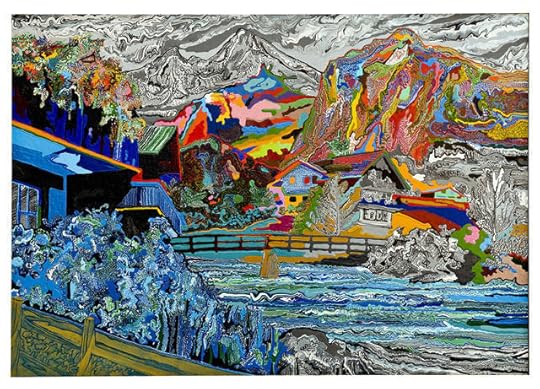
[*] Mountain Chalet, By: Cham Hendon
[*]
Perhaps nobody is lonely. That’s hopeful to think of, like an antidote to all the miserable thoughts about one’s existence. And perhaps everyone is lonely, everyone is an orphan. By holding this delicate thread of incertitude, one reaches the threshold of this ingenious novella where three interrelated stories stand in front of us like three aesthetically designed doors behind which dwells a melancholic, intriguing and playful contemplation of the word ‘orphan’. A word I have always given a serious thought to but within the confines of the available English definitions only and a word I’ll now see with a different and broader perspective altogether.
At all costs, society protects its mothers. Even at the cost of its sons and daughters- absurd!
While dealing with an unexplained absence, a miscommunication between life and death takes place in a forlorn apartment whose owner is having difficulty in locating a truthful and tangible point of origin for herself. Not too far away, the hollow beauty of a mountain chalet and its residents is gradually deteriorating because of a reckless architectural plan and a vague destiny. And following a trail from that very chalet, a unique word imagery comes alive when a solitary walker indulges in an imaginative reverie about his distant relative who is trying to break free from the viscid web of a directionless parenthood, which is also a running theme throughout these 3 stories narrated by a common and somewhat voyeuristic narrator, Hadrien.
Everyone lived right next to a huge library. The books may well have been read, but he was struck by the extent to which they had nothing to do with the lives of the people who had supposedly read them.
The concept behind this book really appealed to me and all the more appealing was the voice that executed that concept. A voice that is easygoing, humorous, controlled and extremely impactful during the instances of strong but subtly pointed opinions which are further accentuated by the right balance of inventiveness and traditional storytelling. If the fleeting moments are captured with great clarity, a right amount of space is also left between the lines for the readers to have an engaging time with the narrative. I hardly found any flaws in this literary design.
--------------------------
[*] Mountain Chalet, By: Cham Hendon

May 3, 2015
A strange, spellbinding book, heavy on metaphors and symbolism. I struggled through the first part of the book - Hannah, nee Bloch, the woman orphaned by history - as I tried to come to terms with the author's challenging style. But then parts two and three were much easier to read. Or perhaps I had got used to the style. Moments of luminous prose and very poignant scenes: the mother who creates family albums with pictures of celebrities and brand names from magazines; the young man smashing his father's automatic signature machine - trying to get rid of his family name, as it were; Hannah's deadly mix of home-made vinegar. Of course, I can also relate to the landscapes and description of Swiss mountain village and chalet of the second story, that of Helianthe nee Bouttetruie. She suffers from a rare disease and seems to be living in a cursed house, but she speaks thirteen languages and moves with ease between cultures, perhaps always running away from herself.
A book to read slowly, deliberately, a book to think about, philosophise. More like poetry or a philosophical tract than an actual novel, but nevertheless interesting. Kudos to Dalkey Archive for undertaking the translation of this 'difficult', non-commercial book and I hope there will be others like it.
A book to read slowly, deliberately, a book to think about, philosophise. More like poetry or a philosophical tract than an actual novel, but nevertheless interesting. Kudos to Dalkey Archive for undertaking the translation of this 'difficult', non-commercial book and I hope there will be others like it.

October 3, 2014
The narrator of this fairly short and unusual book finds shelter with 3 different people, all of whom are orphans in some sense of the word, and all of whom are haunted by events in their past and the difficulty of expressing their feelings. Linked by the narrator, and also by the initial letter of their names, they each tell their stories to the narrator. H. née Bloch is an old Jewish woman, who lost her father in the camps. H. née Bouttetruie is a young woman with a rare disease, living with her husband in a remote mountain chalet. H. né Berg is a troubled adolescent who has rejected his parents. Covering a period from the Second World War to the present, the book is a reflection on loss and bereavement, loneliness and the lack of communication, and general existential angst. And I found it all rather tedious and pretentious and couldn’t relate to any of the characters. Not one for me.

July 21, 2014
This short book is just a sort of novel one would "expect" from a person whose PhD mentor was Jacques Derrida. "The object of her work was time and the event. A present that obliged one to rethink the past. A scar: the mark of suffering, of pain, of illness which no longer exists, but whose trace remains visible". And indeed all three "stories" are about the time and the event, history, body and the power of thinking refracted through the figure of people who became orphans exactly through the workings of time. I just hope Dalkey Archive Press publishes the rest of Laroche's works. I will be the first in line to read them.

Read
February 21, 2015Very good translation, but Laroche's style overall is too cold for me. He writes well, but he's got no soul.
Displaying 1 - 5 of 5 reviews