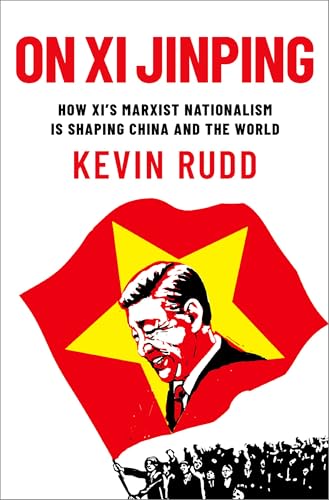
An authoritative account of Xi Jinping's worldview and how it drives Chinese behaviour both domestically and on the world stage.In his new book, On Xi Jinping, former Australian Prime Minister Kevin Rudd provides an authoritative account of the ideological worldview driving Chinese behaviour both domestically and on the world stage--that of President Xi Jinping, who now hold near-total control over the Chinese Communist Party and is now, in effect, president-for-life. Rudd argues that Xi's worldview differs significantly from those of the leaders who preceded him, and that this ideological shift is reflected in the real world of Chinese policy and behaviour. Focusing on China's domestic politics, political economy, and foreign policy, Rudd characterises Xi Jinping's ideological framing of the world as "Marxist-Leninist nationalism." According to Rudd, Xi's notion of Leninism has taken the party and Chinese politics further to the left in comparison to his predecessors. Also, his Marxism has also taken Chinese economic thinking to the left-in a more decisively more statist direction and away from the historical dynamism of the private sector. However, Chinese nationalism under Xi has moved further to the right- towards a much, harder-edged, foreign policy vision of China and a new determination to change the international status quo. Xi's worldview is an integrated one, where his national ideological vision for China's future is ultimately inseparable from his view on China's position in the region and the world. These changes in worldview are also reflected in Xi's broader rehabilitation of the concept of "struggle" as a legitimate concept for the conduct of both Chinese domestic and foreign policy--a struggle that need not necessarily always be peaceful.Finally, Xi's ideological worldview also exhibits a new level of nationalist self-confidence about China's future--derived from China's historical and civilizational strengths but reinforced by his Marxist-Leninist concept of historical determinism and the belief that the tides of history are now on firmly China's side. A powerful analysis of the worldview of arguably the most consequential world leader of our era, this will be essential reading for anyone interested in how Xi is transforming both China and the international order, and, most importantly, why?
Kevin Rudd is one of the most pre-eminent analysts of China in the Western world. He has held many distinguished positions after exiting Australia’s parliament, including Chair of the Asia Society, and is currently Australia’s Ambassador to the United States. He has also recently published two books: The Avoidable War and On Xi Jinping. The latter is the subject of this piece and stems from Rudd’s PhD from Oxford University. The book is an examination of Xi Jinping’s Marxist-Leninist nationalism and how his ideological fervor is shaping China and the world.
I read the shorter version, which comprises chapters 1, 3, 4, 14, 15, and 16. I did this because I had already studied Xi Jinping Thought during my Honours thesis. These chapters outline Rudd’s thesis on Xi’s ideology and how it underpins everything China does. It begins by providing a historical overview of ideological development in China over the millennia with a focus on the Chinese Communist Party (CCP) era. It then pivots to analysing how this is shaping contemporary China and what the contours of Chinese domestic and international affairs will look like in a post-Xi world. This book is academically written, which may deter some readers.
Xi believes in historical and dialectical materialism, whereby contradictory forces of the capitalist West will lead to its inevitable fall. He has also seen the contradictions of the Deng-Jiang-Hu reform and opening period that underscored dramatic economic growth, yet concomitant inequality and diffusion of power away from the CCP. The CCP must once more own the means of production. Moreover, he has begun the Sinification of Marxism to meet traditional values of Chinese culture, particularly by returning China to the Middle Kingdom status it held prior to the century of humiliation.
Although insightful, Rudd’s scholarship was not particularly novel or revisionist. This was surprising considering that the purpose of a PhD is to generate original knowledge to a specialist subject area. Interestingly, some of Rudd’s conclusions echo ideas I explored in my Honours thesis, How the ideational underpinnings of the [first] Trump Administration may have been causing a “New Cold War” with a rising China. That thesis was written four years ago. My findings were underpinned by scholarship that was available at the time. What distinguishes Rudd from the scholars I relied on during my studies is that, having written his work four years later, he had access to a broader collection of Xi Jinping’s speeches.
Despite this criticism, Rudd will play a pivotal role for Australia and international relations theorists as we navigate the implosion of the American-led world order. I write this as Iran and Israel have tentatively agreed to an American-sponsored ceasefire. Although Iran and China have close ties, the latter has done little in the latest eruption of war in the Middle East. This has two causes, one practical and the other ideological. First, China does not have the wherewithal nor desire to intervene in foreign wars. Second, China under Xi is focused on expanding their power in the Pacific, including plans to one day retake Taiwan.
China’s rise has gone largely unimpeded due to America’s recent ideological incoherence and strategic distraction. Successive administrations have been distracted by quagmires in the Middle East. Bush began shifting American attention more to China prior to being bogged down in Afghanistan and then Iraq. Obama wanted to pivot to Asia, but Middle Eastern wars continued to rage, and new ones emerged. There was a slight reprieve during the first Trump administration, which was reversed under the Biden administration as new wars erupted post-October 7, with America’s bombing of Iran’s nuclear sites being the latest chapter in this saga. How can America prepare for war with a superpower while its military hardware is perennially stationed in the Gulf.
Xi is ideologically driven, whereas the current American administration is essentially an incoherent demagoguery. My Honours thesis was largely accurate until the second Trump administration. I argued that America had returned to a neorealist posture aiming to contain China like they had during the Cold War, yet concluded that comparisons to the Cold War were historically inaccurate. However, despite this inaccuracy, I predicted that such nomenclature would stick as a lazy heuristic if repeated enough. Where I have been wrong, however, is that I argued that America would remain the bastion of the neoliberal rule-based international order. Instead, it presently ignores international law, praises dictators, bullies allies, and has become an unreliable ally unless you are Israel.
China is becoming more assertive on the world stage under Xi’s ideological tutelage. This is made easier when America withdraws from international institutions that it created. It is made even easier when America is led by a capricious man without a coherent ideology other than appeasing his own ego. Considering Rudd’s book, current ambassadorship, and current geopolitical tensions, Rudd has a piercing front row seat into the affairs of both countries. Australia and the West are lucky to have him. However, despite his value, his role as ambassador may be numbered as the Trump administration continues to treat one of their most loyal allies, Australia, with contempt.
Basically Xi Jinping really believes in Marxism-Leninism (with Chinese Characteristics of course) instead of just faking it or being agnostic about the subject. Just read the recommended chapters no need to slog through this as its just his PhD thesis. The Avoidable War is the more interesting title by him.
The arguments are nothing novel, Rudd is predominantly pulling large swaths of text from Xi's speeches and summarizing them in a sentence or two, which is something any college student can do. Honestly reads like an overly long Foreign Affairs monthly essay.
Do yourself a favour and just read Avoidable War, thoroughly enjoyed that, but this was very very boring. I'm clearly not the target audience but much of this is basically impenetrable jargon that I just found mind numbing. Should have taken Rudd's own advice in the opening chapter and just read his selection of 4 chapters rather than slogging through the whole thing
Reading Kevin Rudd's PhD thesis was not on my 2026 bingo card, nor did I ever expect to be reading a 900 page thesis for fun.. I think I'm more of a nerd than I originally thought!
This was an incredibly academic piece, not for the faint hearted and not for those who don't like deciphering what has been said ever other sentence. In saying that though, I could not think of a better person to write this. Kevin Rudd is an incredibly intelligent and impressive scholar, not only was he the Prime Minister of Australia, but he also chaired the Asia Society and was the Australian ambassador to the US. Although it is a slog, I recommend it for anyone interested in current Chinese political theory or for people who think Xi Jinping is some unreadable mysterious political figure (crazy concept in the west but he's actually just a competent leader).
One of the best books I read this year; very thorough, systematic and intelligent. Having visited China for the last 30 years or so, and having read several (many) books about its history and current affairs, this book made me connect many dots/ see logical connections which I hadn’t seen before.
The book is distinctly not a classical biography, say about the raise of Xi, his childhood, coming to power etc. Rather it focuses on the policy shift of the CCP, and by extension that of China, under Xi’s leadership. It’s hard to summarise over 400 pages of dense text (this book is not suited for casual lite reading); but in essence it analyses Xi’s rupture with (Deng’s) past, and his relentless drive towards the Leninist/ Marxist left and the Nationalist right. In simple terms; to the left as the party and the state will control “everything” (leaving little space for individual freedom), and to the right as it (re-) establishes China as a proud self-confident nation (with a rich and proud 5,000 years of history).
Kevin Rudd makes you see “his” (i.e. Xi’s) logic and perspective; the need for more equality in China, the risk of the country going backwards (like during the Opium Wars) if there is no strong central leadership (by the CCP). And internationally, against the decline of the US, and the need for China to be more assertive in defending its own interests. And in addition to that, the need for a global civilising Marxist campaign under Chinese leadership.
It’s a fascinating read, certainly for me as a “western” reader. It made me relive my memories of the Soviet Union of my youth, and makes me wonder whether this can last/ how it will play out, and what the consequences will be for all of us. The advances of China over the last decades are phenomenal, and in many technological fields China is taking a global lead. Defending the interest of China and making its citizens better off are fully justifiably aims. However I wonder how a “Party of One” (clin d’oeil to Chun Han Wong’s book) can navigate these challenges if it suppresses discord and internal debate, and puts loyalty to the leader and his aims as the sole criterion.
Kevin Rudd basically distils Xi Jinping Thought for a Western audience and adds on a lot of the typical things you hear from Western media about China and Xi, discourses about rules based order, China's 'aggressive/assertive' stance, etc etc.
Very interesting analysis of Xi’s thought from a relatively unbiased perspective. Instead of constantly trying to deduce whether Xi is right or wrong, Rudd explains what he believes, and places Xi’s thought in the wider Chinese Marxist canon.
I didn’t realize just how ideological Xi was compared to recent Chinese leaders. He is a dyed in the wool true believer in the Marxist dialectic and so-called scientific socialism. It has led him to move China to Leninist left politically, the Marxist left economically, but the nationalist left politically.
Xi’s fatal flaw is his reliance on the determinism of Marx. History is not subject to immutable laws about class, struggle, and contradiction. If U.S. foreign policy can embrace its true liberal values—brining the global south into power at global political institutions, reforming the excesses and inequality of modern capitalism, moving to tackle the climate crisis—it can stop the rise of China. We can use our power to build a truly liberal, equal, and just world order based on fundamental human dignity, freedom, and shared prosperity.
Kevin Rudd, former Australian Prime Minister and one of the most influential Western voices on China, has spent decades studying Chinese politics and engaging with its leadership. His insights are genuinely valuable, and the book offers a detailed examination of Xi Jinping's worldview through his speeches, writings, and political ideology.
That being said, the book is painfully academic and often feels more like a scholarly dissertation than an accessible analysis. Much of it reinforces what I already understood: Xi has systematically dismantled much of Deng Xiaoping's political legacy and moved China back toward a more Maoist model of centralized power and ideological control.
A valuable book, certainly, but not one I particularly enjoyed reading.
It’s a tough one to judge. This is based on the author’s PhD thesis at Oxford. While the research is obviously very good and there are many interesting facts about the current Chinese policy, the writing is very academic and very boring. I was determined to get through, so I persevered, but it was a struggle.
This biography is certainly a scholarly work, covering just over four hundred pages of text, sixty-five pages of footnotes, over one hundred pages of bibliography, much of it in Chinese and a twenty page index. But I found it difficult to put the book down for very long. I was continually thinking tell me more and where is this leading. The book is very well organised for non-experts like me. It begins with purpose and its core arguments, continuing through definitions of Chinese core ideological concepts, and presents a historical survey of Chinese ideology. Then it moves subject-by-subject through Xi’s evolving ideology, and its effects on China’s domestic and foreign policy. There are three final chapters dealing with China’s future and China’s future after Xi. The book makes it clear that Xi’s ideology has evolved considerably from Mao, Deng, Jiang and Hu. It is also clear that Xi is deeply intellectually committed to Marxism and to Leninism ‘with Chinese characteristics’, and he speaks about these theories as being ‘scientific’ and ‘proven effective in the Chinese context’. Mr Rudd backs up every bit of Xi’s ideology with multiple historical references, usually in the form of published quotations. For example, he documents China’s shift in its foreign policy with quotations from high-ranking diplomats. On the subject of whether or not China will invade Taiwan, he says that Xi has demanded that the People’s Liberation be ready to do so by 2027, and that he would like to do it by 2032, but that if there is a significant chance of failure, he would delay. Xi clearly thinks that his political ideology is clearly superior to democracy/capitalism. He has apparently conceded that capitalism is superior for economic growth, because he has reigned in the Chinese private sector, knowing that this would slow economic growth. He is aware that Leninism, which Xi has applied to the running of the Communist Party, and Marxist surveillance of the Chinese people represent a risk of revolution. But surveillance is growing, not shrinking. Xi argues that Marxism is completely congruent to classical Chinese culture, and he enumerates examples of Chinese culture without seeming to recognise the apparent conflicts between the two. Religious freedom, individual freedom and true justice are clear examples. Unfortunately, Mr Rudd and Mr Xi are not able to debate these points, but perhaps Western diplomats and politicians can do so. This book is a timely, very welcome, thought-provoking study of an influential, but largely unknown national leader.
In On Xi Jinping, former Prime Minister Kevin Rudd provides a comprehensive analysis of the political and ideological motivations of China's enigmatic leader. Rudd argues that President Xi, unlike his reformist predecessors, is turning China sharply toward a stricter, ideologically rooted form of politics. Through analysis of official CCP documents, speeches, and literature, Rudd posits that Xi is simultaneously moving China further to the left economically (Marxist) and ideologically (Leninist), while shifting further to the right (nationalist) in terms of foreign policy.
Whether these drastic shifts are truly based on deeply held ideological beliefs or are merely a pragmatic next step in a long-term plan laid out by leaders past remains open to debate. However, Rudd believes that Xi really means what he says, and that it would be foolish to dismiss his words as mere rhetoric.
From a personal standpoint, as someone without a strong background in the study of China or politics in general, this book served as an edifying primer on President Xi's path to power, his long-term goals, and his vision for the future of a once-great power (possibly soon to be great again). That said, readers should approach this book with a strong interest in the subject, as Rudd is methodical and thorough in his assessment, sparing none of the finer, and sometimes tedious, details. I occasionally found myself having to push through much of the dry economic analysis and noticed that Rudd tends to repeat himself to emphasize key points.
Despite this, there is much that I found interesting, particularly the latter part of the book, which takes on a more speculative rather than historical tone as it explores the future of China under Xi’s leadership. Will China continue to become more ideologically extreme in response to external pressures, or might it return to a more centrist path? If the aging Xi manages to hold on to power long enough for the younger, more patriotic, and enthusiastic generation to step into positions of authority, "Xi Jinping Thought" may continue to dominate for decades to come.
Whatever your view of Xi Jinping’s impact on China's rapid rise, positive or negative, On Xi Jinping makes a clear case that it could not have happened without the ambition and keen political mind of President Xi.
This book dives into Xi Jinping’s mindset and China’s long-term strategy, unfolding in three phases: reclaiming respect, achieving growth… and now, asserting global power.
For years, China stayed in the shadows. Today, it’s stepping into the spotlight—at the UN, in global finance, and in international development.
Its strengths? Strategic vision and the growing retreat of the U.S. as a reliable leader of the free world.
Its weaknesses? A lingering commitment to communist ideology, which stifles innovation and limits anything that isn’t considered “truly Chinese.”
Mind-blowing fact: China is the only civilization that has remained for thousands of years in the same territory with an unbroken cultural identity.
A fascinating read on today’s shifting geopolitics. 📘🌍
Must read book for any professionals working China issues to better understand the why of the CCP. Mr Rudd brings translated internal Chinese Communist Party documents to support and demonstrate the depth and course of CCP ideology and that ideology’s impact on the observable world. For those who are simply fellow China curious travelers then the books opening chapter recommends a helpful abbreviated reading plan as you may not care about the finer points of Marxist thought. All in all, one of the best and most insightful book I’ve read in China. This plus Kissinger’s On China are a solid foundation to better understand modern China.
I was expecting more from Rudd. The book was not bad, it just lacked context and explanation. It focuses strictly on the beliefs and actions of Xi, but it would have been much more illuminating if Rudd had spent more time on explaining the context of his thinking, both in terms of how the Party thought about the needs for a strongman as Xi, and the evolving geopolitical context.
This is a very academic book which the author does tell you ahead of time is exactly what it is and so this is really one of the very few books that I got about a third of the way through and then scan through the rest so just not what I was looking for.
The late Michael Brooks used to describe Sam Harris as a “hysterical man who speaks calmly“. This is exactly the impression I get from Kevin Rudd… except towards the concluding chapters of the book he starts sounding a lot more like a hysterical man who speaks hysterically.
Imagine a woman meets a guy, and right at the beginning of their relationship he tells her he doesn’t want children. She thinks “He doesn’t mean that. I can fix him. I can change him.” They date for a few years, and he repeatedly insists that he doesn’t want children. She nods knowingly, imagining that when the time comes, she can change him. She can fix him. They then get married and as the years go by she begins demanding that he honor their agreement and give her children. He says I told you all along. I never wanted any children.
She has a tantrum, starts screaming and yelling, accuses him of duplicity and all kinds of nefarious things. She feels absolutely justified in her sense of betrayal.
This is exactly what Kevin Rudd’s reaction to the developments in China over the past decade. He was absolutely convinced for decades that China was on the way to become, well… Us! To quote Full Metal Jacket, “inside of every gook there’s an American trying to get out!”.
Ever since China started opening up their economy to the world in the late 70s in the Deng Xiaoping era, the entire western intellectual and corporate elite, the Washington Consensus and the NGO industrial complex crowd were absolutely convinced that slowly, gradually, China was becoming capitalist. With the fall of the Soviet Union, and China becoming further integrated to the global economy, western elites became increasingly confident that this process would eventually lead to a full-blown capitalist economy in China, multiparty market democracy, and eventual dissolution of the Chinese communist party.
This did not happen.
Instead, as China emerges onto the global stage as a rising power, and the US centered, unipolar moment is in decline, western elites are becoming more and more hysterical.
“Deng Xiaoping will be rolling over in his grave!“ Rudd tells us. According to him, Xi’s immediate predecessors, Deng Xiaoping, Hu Jintao and Jiang Zemin, had secretly rejected communism, and were closet capitalists leading China quietly towards a western style democracy and, most importantly, perpetually subordinate to the West in general and the US specifically, and the “rules based order”.
Then the villain, Xi Jingping came along, a committed Marxist-Leninist. This will become Rudd’s mantra. In a pattern that becomes as tiresome as it is repetitive, he will quote a passage from Xi, then begin screeching “Marxist-Leninist! Marxist-Leninist! Marxist-Leninist!”
It seems that single-handedly, Xi has instituted a reign of terror, browbeating and bullying everyone in the politburo, the party, and indeed the nation with his Marxist-Leninist-ism. I mean, up until now, China has kept a low profile and has never interfered with whatever the US wants to do. But now? Now China is engaging in aggression all over the place!
What does this “aggression” consist of? Are they bombing anyone? Have they invaded anyone? Have they participated in regime change coups? Funded dictatorships, or radical Islamic militias?
No.
These acts of aggression consist entirely of speaking in a way that Rudd doesn’t approve of.
The CCP declares that the Chinese economy is unbalanced, and it should be restructured to bring about the common prosperity of every Chinese person, not just a handful of tech billionaires? - “Marxist-Leninist!”
China opposes US led wars? - “Marxist-Leninist!”
Xi argues the world should follow the UN charter rather than an ambiguous “rules based order” where the US makes the rules and orders everyone around? - “Marxist-Leninist!”
China engages in coalition building with second and Third World countries in BRICS, Shanghai Cooperation Organisation, and the belt and road initiative? “Marxist-Leninist!”
The phrase “a community with a shared future for mankind”—also translated as “a community of common destiny for humanity” becomes the international rallying cry for the CCP? “Marxist-Leninist!”
In fairness, this is a rather interesting book. Rudd is very learned and clearly understands the Marxist-Leninist orientation the CCP is doubling down on. He presents a pretty fair description of the concepts of dialectical materialism and historical materialism which guide the thinking, action and interpretation of world events of Xi Jinping and the CCP. The problem is that rather than engaging with these ideas and explaining how the ideology that underpins neoliberal free market capitalism is a better guide to understanding reality, he instead screeches “Marxist-Leninist!” over and over again, as if that settled the argument.
In spite of that, I thought it was a wonderful book at summarizing the philosophy behind the events and decisions in modern China. It also gives us a great insight into the evermore, paranoid and delusional minds of the NGO/Washington, consensus crowd.
I wrote a dissertation on how a mass movement tried and largely succeeded in converting an ideology into practice (in my case it was the little known anarcho-syndicalist movement of Argentina 1890-1930). Combined with my knowledge of Chinese politics and history, this made this book to be a fascinating study for me of how ideology can also be political practice. Often ideologies are seen as simple overlays and rationales for personal power and ways to control others, often by individual fanatics. But in communist and fascist states we have seen that ideological regimes have much great breadth and depth in their nations, often extending far beyond their borders. If overly detailed in the text itself (a lot could have been left as citations to support Rudd's conclusions), Rudd presents a clear picture of Xi's thought processes, how he expanded this into remaking the Chinese state and Communist Party (CCP) and how both have become reflections of his revision of Chinese Marxism-Leninism and nationalist view of the world.
Rudd attempts here and there to predict what will happen next under Xi and after and does indicate some of Xi's strengths and weakness and of his increasingly ideological orientation. But Rudd unfortunately does not go into great detail in presenting a critique of Xi and mostly presents only Xi's speeches, writing and CCP documents to prove that Xi is ideologically driven in thought and action. For example, he points to a fundamental contradiction of Xi's new Chinese nationalist Sino-centric CCP model but with roots based on foreign, western models and analyses (German-English Marxism and Russian Leninism) blended with Chinese and Maoist historical experiences and reactions. But Rudd does not look much at what this does or could do to actual practices in China. While Xi is going to great lengths to create a society that reflects his thinking, organizing skills and personal will, these other influences are likely to continue. Xi's powerful regime is still one man's view and subject to his own failings (especially as he ages) and ethnocentric thinking that his and the Chinese perspective is central to the world. The book's last chapter inadequately looks at these shortcomings.
Nevertheless, Xi combines his personal desire for power (not well discussed) with his concerns for the development and well-being of his country. When one looks at pre-communist Chinese history his successful predecessors were similarly focused - fulfilling the Mandate of Heaven (welfare of the nation), organizing and effective use of power and coercion (including wealth), and the creation of an educated administration with experience and expertise to effectively implement the wishes from the top. While Xi demands personal loyalty to him he also demands education and knowledge, expertise, scientific inquiry (along Marxist lines), and the effective policy implementation.
I couldn't help but think as I read the book about how the US (which Xi sees as China's and his main opponent/enemy and obstacle to success) is countering with a chaotic and inconsistent approach, often responding more to what he says for our consumption than to what China is doing. The Trump administration is a gift to Xi's plans beyond anything he could have dreamed of. Instead of a planned, well executed vision and opposition with its own ideology of capitalism and individual freedom, we see a dismantling of most of our international good will and soft influences (including ability to communicate), combined with attacks on allies, tariffs on everyone other than Russia and friends of Trump, and starting a costly and losing war inexplicable to almost everyone. This is matched by a dismantling and even attack on many of our domestic resources, research and ability of our national government to effectively carry out any policies other expulsion of immigrants and seeking revenge on the President's opponents- all coupled with a dismantling of our counterintelligence apparatus. In short, a comprehensive attack on science and expertise and much of the US population.
Contrasted with Xi's vision and his execution of that vision, one cannot but think very rough days are ahead for and in the US. Xi is likely to be here for decades and so is the damage that Trump has created even if efforts are made to reverse course.
As Rudd puts it, he aimed to lay out a comprehensive overview of Xi Jinping's ideology, and i think he accomplishes this objective. There are trade-offs to this approach: although some ideological frameworks are studiously described, other concepts are referenced but not unpacked. There are some arguments on the economics chapters that I think suffer a bit from this; other arguments are clearly leaning on assessments from other scholars. (I guess thats not necessarily a bad thing, but can muddy the waters a but if you're trying to take Xi's ideology on its own terms.) More fundamentally, by only focusing on ideology (basically a lot of text-based analysis), you miss important changes that complicate that frame. For instance, he spends very little time discussing the personnel around Xi (e.g., Li Keqiang, Liu He, Wang Huning, or even the fact that Xi was Vice President during the latter half of Hu's givernment). Each of these people have their biases and axes to grind, even if Xi is the undisputed ruler, and I think they seek to move policy in the direction of these biases in the context of a broader ideological project. Case in point, Li Keqiang and Liu He are no longer in government following the 20th Party Congress - does that not raise questions about ideological continuities and discontinuities? Rudd doesn't really engage with this, its outside the scope of his project.
I thought the chapter on the UN was strong - the interviews he conducted were interesting.
Very disappointing. As a work of scholarship, it is poorly argued and at its core appears to be more opinion dressed up in fancy academic language. Rudd has an annoying argumentative style that litters the text: "This is A. B is a possible explanation for A. Therefore B caused A." His attempts at "gotcha scholarship" fall flat e.g. presenting the deviation from Deng's "hide your strength and bide your time" strategy as criticism, without addressing the quite obvious point that perhaps "now is the time?". But I was quite willing to give this a 2 or 3 stars pass until I reached the concluding chapters where Rudd suddenly introduces the usual litany of western critiques of China as simple assertions and uses that as the basis for contextualising his conclusions. If one followed his advice at the beginning of the book and just read the 4 or so cherry-picked chapters to skip the dry academics, one may get the impression that all those statements in the conclusion were well argued and established with evidence somewhere in the text. But, no, they are not. That strikes me as particularly intellectually dishonest.
Essential reading for anyone seeking to understand Xi Jinping’s China
I have studied China for many years and wrote my master’s thesis on Xi Jinping Thought, so I approached this book already well acquainted with the subject. Even so, I found Kevin Rudd’s On Xi Jinping incredibly enlightening.
Rudd brings unusual depth to his analysis, combining serious scholarship with firsthand experience and a nuanced understanding of Chinese politics, ideology, and language. His explanation of how Xi’s Marxist nationalism shapes both domestic governance and China’s approach to the world is particularly valuable. The book sharpened my understanding of ideas I had studied extensively while also offering perspectives and connections I had not previously considered.
This is an insightful, thoughtful, and highly relevant work. I strongly recommend it to China specialists and general readers alike—especially anyone who wants to understand not merely what Xi Jinping is doing, but the ideological framework driving his decisions.
Kevin Rudd’s On Xi Jinping is an intellectually substantial work that repays the reader’s attention. Its opening chapters serve as a propaedeutic grounding in philosophical and ideological thought before the central arguments are advanced, and Rudd demonstrates evident erudition throughout.
It is not, however, without shortcomings. Certain passages are markedly redundant, reiterating propositions already sufficiently established, and the prose can be needlessly abstruse—an ornate, specialised register that at times obscures rather than illuminates.
Reservations aside, it remains a commendable read for those willing to navigate its denser stretches
So good I literally finished the audiobook and started it back over again. Of course, you can see some reviewers here who are already experts, and I understand why this would be a bit boring for them, but if you want an extremely coherent overview of how Xi Jinping has changed the direction of China during his tenure, this is that book.
I would have liked just a tiny bit more detail about specific economic proposals and some more direct evidence of China's increasing incursions into neighboring countries' waters and airspace. There was some already but I did find myself wanting to look up more info in both of those sections. I'm really splitting hairs though.