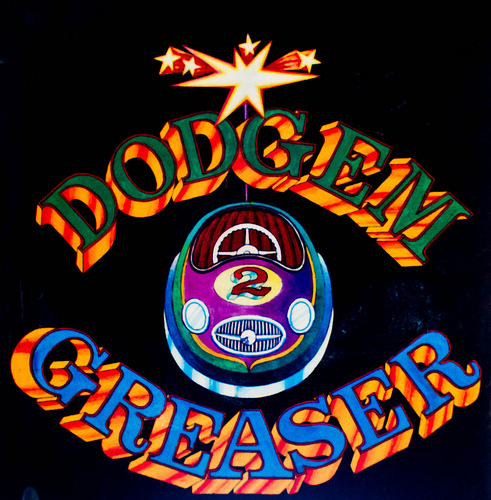
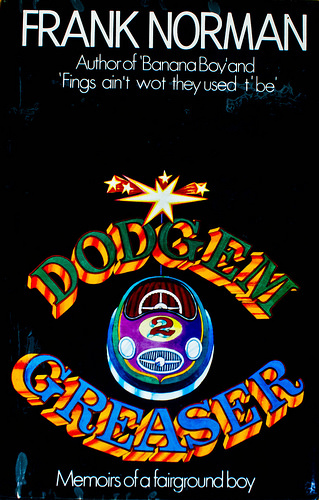
After his rigid, repressed upbringing as a Barnado Boy (detailed in 'Banana Boy' (1969)), Frank Norman found work with a travelling fairground in 1947, at the age of 16. The dramatic release and independence of this life change are described in 'Dodgem Greaser' (1971) with kaleidoscopic brilliance and vigour; the urgency of his wild, half nervous grabs at life is matched the vivid and often vicious world in which he found himself.
This was a world where you humped enormous beams to build the dodgem track in record time to get a bonus, where you sweated out the beer of the night before as you leaped between the dodgems short changing the customers, where townspeople spat at you and shut you out of their pubs, where the inevitable girls wating till the ground was closed were tumbled in the woods at night and left the next week; where among the prizefighters and bearded ladies and midgets, you found your own height and fought for it.
'Dodgem Greaser' is a remarkable novel, full of insight and feeling; it establishes Frank Norman as one of the most natural writers of our time.
Frank Norman (9 June 1930 – 23 December 1980) was a British novelist and playwright.
His reputation rests on his first memoir Bang to Rights (1958) and his musical play Fings Ain't Wot They Used T'Be (1960), but much of the remainder of his work remains fresh and readable. Norman's early success was based in part on the frankness of his memoirs and in part on the style of his writing, which contained both renditions of cockney speakers and his own poor spelling. Jeffrey Bernard in an obituary of Norman wrote that he was...
a 'natural' writer of considerable wit, powers of sardonic observation and with a razor sharp ear for dialogue particularly as spoken in the underworld.
Frank Norman (9 June 1930 – 23 December 1980) was a British novelist and playwright. His reputation rests on his first memoir Bang to Rights (1958) and his musical play Fings Ain't Wot They Used T’Be (1960). At the time of writing all his books are out of print however most are readily available second hand, although some (those I've yet to buy) are annoyingly expensive. My hope is that, in time, I will read his entire output as I've been very impressed by what I've read so far.
Dodgem Greaser (1971) is the fourth book I’ve read by Frank Norman and is another memoir, and it immediately follows on from Banana Boy (1969), Frank's account of growing up as an orphan in Dr. Barnados children's homes during the 1930s and 1940s. At the end of Banana Boy Frank realises, as a 16 year old out in the world for the first time, that a typical 9-5 lifestyle is not for him so he gets a job working on the dodgems for a travelling fairground. This job, as a Dodgem Greaser, whilst underpaid and generally undertaken by criminals on the run, gives Frank the freedom, independence and life lessons that were denied him by his rigid, repressed upbringing as a Barnado Boy.
Having read his two memoirs from the late 1950s and early 1960s (Bang to Rights (1958) and Stand On Me (1960)) I am amazed and impressed by just how much Frank's writing progressed in the intervening decade. He was barely literate when he wrote Bang to Rights, which was published complete with all his spelling mistakes, however Dodgem Greaser is a superbly readable account of Frank's life on the road, and is testimony to what an accomplished writer he'd become.
The fair moved every week or two to a new location, so Frank and his team, led by the memorable Blackie, and their boss Mr Burns, was an uncompromising world of hard graft and hard living. Humping enormous beams to build and take down the the dodgem track, drinking the wages in the nearest pub, leaping between the dodgems to collect money from the customers, encountering habitual hostility from the local townspeople who were rightly wary of the "didicois", and pulling the local girls drawn to the thrill of the fairground and the dodgem greasers, it was a life rich in incident.
During the summer months the fair was also home to freak shows, boxing, fortune telling, etc. and an associated group of Romani gypsies who travelled with the fair and who Frank is fascinated by and manages to befriend.
Interestingly Frank describes this book as a novel and I suspect he's taken a few liberties with the truth. Not least losing his virginity which he'd already accomplished in Banana Boy. My guess is that he has incorporated stories that he'd heard from other people in this book. Although he narrates the story in the first person, he is never referred to as Frank, or named, except as "kid", which also suggests this is, at least in part, not wholly his story. Whatever the provenance of the tales they do all have the ring of authenticity and I came away feeling I'd gained another fascinating insight into a lost world. In addition to these insights readers will encounter fights, sex, hardship, drama, comedy, kindness, tragedy, Satanists (!) and some memorable characters. Dodgem Greaser is a page turner, and another winner from Frank Norman whose books are ripe for rediscovery.
And, as a concluding aside, the title Dodgem Greaser must surely be the greatest Glam Rock band or song that never was.