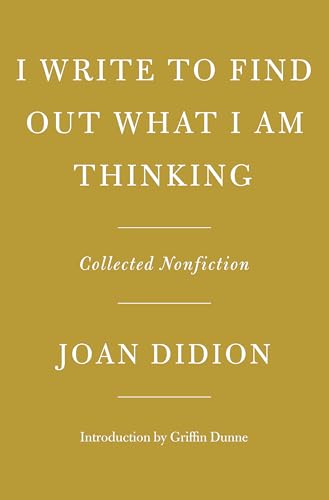
This second hardcover omnibus edition of Didion's collected nonfiction contains her final four Blue Nights, South and West, Let Me Tell You What I Mean, and her bestselling and most famous work, The Year of Magical Thinking.
In her essay “Why I Write” (included in this volume), Joan Didion explained what lies behind her iconic nonfiction "I write entirely to find out what I’m thinking, what I’m looking at, what I see and what it means.” Across her long and prolific career, readers have been blessed time and again by her brilliance as a prose stylist and a social commentator.
From her unforgettable reckonings with grief (for her husband in The Year of Magical Thinking and for her daughter in Blue Nights), to her exploration of two iconic regions of America in South and West, through the indelible pieces of reporting collected from across her career in Let Me Tell You What I Mean, the books collected here show Didion at her bearing witness to our history, illuminating our culture, and shedding light on the human condition.
Everyman’s Library pursues the highest production standards, printing on acid-free cream-colored paper, with full-cloth cases with two-color foil stamping, decorative endpapers, silk ribbon markers, European-style half-round spines, and a full-color illustrated jacket. Contemporary Classics include an introduction, a select bibliography, and a chronology of the author’s life and times.
Joan Didion was an American writer and journalist. She is considered one of the pioneers of New Journalism along with Gay Talese, Hunter S. Thompson, and Tom Wolfe. Didion's career began in the 1950s after she won an essay contest sponsored by Vogue magazine. Over the course of her career, Didion wrote essays for many magazines, including The Saturday Evening Post, Life, Esquire, The New York Review of Books and The New Yorker. Her writing during the 1960s through the late 1970s engaged audiences in the realities of the counterculture of the 1960s, the Hollywood lifestyle, and the history and culture of California. Didion's political writing in the 1980s and 1990s often concentrated on the subtext of political rhetoric and the United States's foreign policy in Latin America. In 1991, she wrote the earliest mainstream media article to suggest the Central Park Five had been wrongfully convicted. In 2005, Didion won the National Book Award for Nonfiction and was a finalist for both the National Book Critics Circle Award and the Pulitzer Prize for The Year of Magical Thinking, a memoir of the year following the death of her husband, writer John Gregory Dunne. She later adapted the book into a play that premiered on Broadway in 2007. In 2013, she was awarded the National Humanities Medal by president Barack Obama. Didion was profiled in the Netflix documentary The Center Will Not Hold, directed by her nephew Griffin Dunne, in 2017.
This collection is comprised of four books: The Year of Magical Thinking, Blue Nights, South and West and Let Me Tell You What I Mean. My ratings of the books are as follows:
The Year of Magical Thinking ⭐⭐⭐⭐1/2 Blue Nights ⭐⭐⭐1/2 South and West ⭐⭐ Let Me Tell You What I Mean ⭐⭐⭐1/2
I have more detailed reviews for the individual books on my page. As far as this collection goes, I appreciated Griffin's introduction, and it was interesting to then see him mentioned multiple times in Blue Nights. I found the pairing of these pieces really odd, though, as well as their order in the collection. To start with her most vulnerable, grief-ridden books and then end with notes on popular culture didn't feel right to me.
If I'd curated this book, I would've omitted South and West completely (not her best work and honestly not even close to being a fully fleshed out concept. I appreciate that these are genuinely just notes from a journal, but after reading her own thoughts on publishing an author's unrefined notes and outlines in "Let Me Tell You What I Mean," I struggle to see the value here). I would've started with Let Me Tell You What I Mean, which is a great sampling of her nonfiction writing, and then Blue Nights, ending with The Year of Magical Thinking.
3.5ish stars rounded up
Thank you NetGalley and Knopf, Pantheon, Vintage, and Anchor for the e-ARC.
This is a new, beautifully put together collection of Joan Didion's last four books - The Year of Magical Thinking, Blue Nights, South and West, and Let Me Tell You What I Mean, ably introduced by Griffin Dunne, Didion's nephew.
The Year of Magical Thinking looms over the other three as a shattering masterwork. Blue Nights is also powerful reading - and Didion's last book. Taken together, they are an extended essay on grief. As Didion herself said, "(t)he reason I had to write it down, is that no one had ever told me what it was like." I found myself returning to Magical Thinking over and over and suspect it will haunt me for a long time.
And yet in some ways the most unexpected part of this collection is two fragments, notes Didion took for works she never finished, South and West. Had she finished the first, her notes on her travels through the south in 1970 would have been her "Road to Wigan Pier Diary." Even only as notes, her observations and opinions remain fascinating. Joan Didion in Mississippi, 1970: "The isolation of these people from the currents of American life in 1970 was startling and bewildering to behold. All their information was fifth-hand and mythicized in the handing down." 56 years, and nothing has changed.
Griffin Dunne's intro is thoughtful and moving (and funny - on a film set, Dunne noticed an actress on the project eagerly reading The Year of Magical Thinking between takes and asked her what she thought about it. She commented "Nobody gets it...but she does," and then wondered if Didion had written anything else!). As is usual for Everyman's Classic editions, the book is beautifully put together, well bound with a ribbon bookmark, and includes a very helpful timeline and bibliography. Very, very much worth reading, and owning.
The first two parts, year of magical thinking and blue nights, were beautiful, painful, and intense. They had soul and purpose. The second two were so incredibly boring I fell asleep anytime I tried to read them🙃