Carl Jacob Christoph Burckhardt was a historian of art and culture, and an influential figure in the historiography of each field. He is known as one of the major progenitors of cultural history, albeit in a form very different from how cultural history is conceived and studied in academia today. Siegfried Giedion described Burckhardt's achievement in the following terms: "The great discoverer of the age of the Renaissance, he first showed how a period should be treated in its entirety, with regard not only for its painting, sculpture and architecture, but for the social institutions of its daily life as well." Burckhardt's best known work is The Civilization of the Renaissance in Italy (1860).
I'm rather glad that I accidentally got this single volume of a 2-volume edition, because it is clear that Burckhardt and I are simply not interested in the same things at all, and his analysis is not actually interesting enough to justify being bored by, for example, his take on the public speeches and letters of humanist secretaries to minor Italian princes and to what degree they exhibit 'pure' Latin. Certainly the big idea of the first chapter, conceptualizing the rule of these minor princes -- adventurers, mercenaries, whose rule was "illegitimate", whose realms had no religious (i.e. traditional, dynastic) justification, but "whose existence was founded simply on their power to maintain it," and therefore practiced a "deliberate adaptation of means to ends", as "the state as a work of art", is very interesting. Because basically none of us today can even conceive of a state in any other way than this, and it's interesting to think of it as a novelty, and to try to wrap one's head around the older way of thinking. I think Tolkien did, for example, but GRR Martin clearly cannot and does not even realize there is an older way of thinking to wrap one's head around -- the classic modern liberal positivist blindness embodied in his famous question, "What is Aragorn's tax policy?" And my experience on Crusader Kings fora gives me plenty of reason to suspect that basically no one can think of a medieval king except in Renaissance despot terms (or rather, in 20th Century dictator terms), like Martin, where of course all means are adapted to ends: to maintain power, the only legitimacy; and any religious or chivalrous etc idea is always either cynical playacting or stupidity.
Anyway. That's interesting to me; it's not interesting to Burckhardt, who lived in an age of hereditary monarchs, and states still slowly coming into existence and even more slowly detaching from them. He doesn't want to discuss the medieval mind but the Renaissance one. It's interesting that compared to The Waning of the Middle Ages, a book that rather condemns its subjects and their culture but is absolutely chock-ful of wonders from beginning to end, this book, which praises its subjects as 'the first-born among the sons of modern Europe', is instead full of horrors and bores. Burckhardt's humor is welcome, his nationalist notions (I mean his assumption that "national character" is necessary for "greatness") are strange, his assumption that all his readers know every twist and turn of Renaissance politics is exasperating, but ultimately, his text is just kinda boring. And that's too bad.
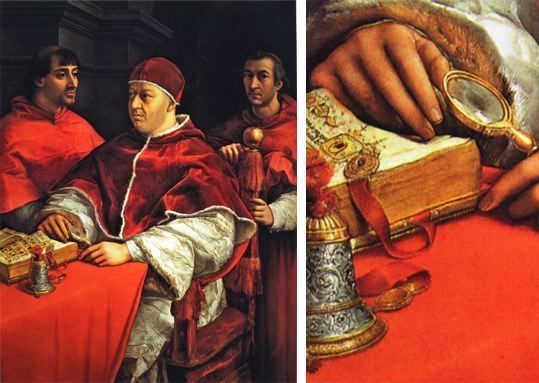
Le pape Léon X avec ses neveux Giulio de Medici et Luigi de Rossi - Raphaël
Une bonne introduction à la "Renaissance". En quelques chapitres thématiques, Jackob Buckhard couvre l'essentiel de ce phénomène qui s'étale, en Italie, sur plusieurs siècles, et lequel s'est manifesté par une situation politique très particulière et agitée, et un engouement extraordinaire pour les belles lettres, les beaux arts et les antiquités. C'est l'occasion de présenter quelques faits marquants, quelques personnages remarquables.
J'ai globalement bien aimé cet ouvrage qui a aiguisé mon appétit et ma curiosité pour cette période, pour laquelle je n'avais, et n'ai encore, qu'une vision lacunaire et un peu trop franco-centrée. Je regrette seulement une petite impression de manque d'ordre, et surtout la qualité absolument déplorable de la numérisation disponible en ligne! Sinon le style de l'auteur est plutôt agréable, soutenu par un enthousiasme non désagréable, et que ne verse heureusement qu'assez rarement dans le travers de la partialité. Bonne lecture.