Pyramid, 1972, paperback. Cover code #N2776, copyright page says this the 4th printing but is the 5th printing. This 1959 novel is the story of a conquered Earth's government-in-exile returning to free the home planet.
Called "AJ" by friends, Budrys was born Algirdas Jonas Budrys in Königsberg in East Prussia. He was the son of the consul general of the Lithuanian government, (the pre-World War II government still recognized after the war by the United States, even though the Soviet-sponsored government was in power throughout most of Budrys's life). His family was sent to the United States by the Lithuanian government in 1936 when Budrys was 5 years old. During most of his adult life, he held a captain's commission in the Free Lithuanian Army.
Budrys was educated at the University of Miami, and later at Columbia University in New York. His first published science fiction story was The High Purpose, which appeared in Astounding Science Fiction in 1952. Beginning in 1952 Budrys worked as editor and manager for such science fiction publishers as Gnome Press and Galaxy Science Fiction. Some of his science fiction in the 1950s was published under the pen name "John A. Sentry", a reconfigured Anglification of his Lithuanian name. Among his other pseudonyms in the SF magazines of the 1950s and elsewhere, several revived as bylines for vignettes in his magazine Tomorrow Speculative Fiction, is "William Scarff". He also wrote several stories under the names "Ivan Janvier" or "Paul Janvier." He also used the pen name "Alger Rome" in his collaborations with Jerome Bixby.
Budrys's 1960 novella Rogue Moon was nominated for a Hugo Award, and was later anthologized in The Science Fiction Hall of Fame, Volume Two (1973). His Cold War science fiction novel Who? was adapted for the screen in 1973. In addition to numerous Hugo Award and Nebula Award nominations, Budrys won the Science Fiction Research Association's 2007 Pilgrim Award for lifetime contributions to speculative fiction scholarship. In 2009, he was the recipient of one of the first three Solstice Awards presented by the SFWA in recognition of his contributions to the field of science fiction.
Budrys was married to Edna Duna; they had four sons. He last resided in Evanston, Illinois. He died at home, from metastatic malignant melanoma on June 9, 2008.
Good, but I agree with another reviewer that stated the book spent a bit too much time in the characters' head. For example, he would look at a character and then there would be three pages about civilization and the meaning of life or some such thing and then we're back into the story for two pages or so.
I also didn't get the sense that our lead was in great danger going back to earth. I mean, his whole thing is going back to earth to save it from the invaders who have already made their home there, but he only encounters a few his entire visit. I feel like these guys should be at every corner. And then when he does run into one, again, there's about three or four pages giving us a description of what the 'Vader looks like and then it's subtly explained how he gets passed them.
So it's really a mixed bag with this one. There's just enough action to keep you reading, but enough time spent in our lead's head that makes you want to close it. But I suppose I liked it more than disliking it, so I've given it three stars.
Prieš dvidešimt metų įvyko Įsiveržimas. Ateivių rasė okupavo Žemę. Vyriausybė ir paskutinysis prezidentas spruko. Tiesa, nepakako perbrist upelį – teko belstis net už ketverių šviesmečių, į buvusią žemiečių koloniją, bet jau kažin kada atsiskyrusią. Žemėje gi tarsi savo namuose laisvai tvarkosi ateiviai ir tik saujelė su tuo nesusitaikiusių žemiečių pasitraukė į kalnus bei miškus, slapstosi ten žeminėse bei slėptuvėse ir svajoja kada nors nusimesti okupantų jungą. O juos medžioja net ne tiek ateiviai, kiek kiti žemiečiai, priėmę okupantų primestą gyvenimo būdą. Žinant Budrio ir jo šeimos biografiją – aliuzijos aiškesnės už aiškias. Vyriausybė išeivijoje, partizanai miškuose. Dvi galingos jėgos – ateiviai ir buvusioji kolonija. Pastarieji mielai užstotų žemiečius (kad ir savų tikslų vedini), bet jėgų pusiausvyra pernelyg trapi, tad į atvirą konfliktą su ateivių rase veltis irgi nesinori. Ir štai – gal dėl tų aliuzijų, o gal ir šiaip – pusė knygos skaitėsi labai smagiai. O tuomet viskas pasikeitė. Pagrindinis veikėjas, prezidento išeivijoje sūnus Michaelis Wiremanas ėmė elgtis, švelniai tariant, keistokai. Budrys staiga įpynė grynai socialinės fantastikos skyrių apie klasifikavimą – ateivių visuomenės organizavimo pagrindą. Bet ir ta kryptimi eiti nepanoro. Tada paniro į ilgus ir gana painius filosofavimus. O tada – opa, mes jau finale. Ir nusispjaut, kad praleidome bene svarbiausią dalį – kaip gi iki to finalo buvo nueita? Keista knyga, paliekanti tokius mišrius įspūdžius. Tarsi dvi visiškai atskiros ir netgi gal skirtingų rašytojų rašytos dalys. Skystas ketvertas, bet smarkiai skystas. Ir tai – labiausiai už tą pirmąją pusę.
The tone of the novel is very introspective. Characters get a lot of screen time to examine their thoughts and feelings. Some of it seems honest, some of it seems utterly obnoxious. It is challenging to be patient while characters start musing on their intentions, purpose, destiny, and morals – especially when these moments are pasted against an action movie scenery.
Budrys is working out his personal agonies and loyalties (and those he saw in his father) against the backdrop of space empires. But all resistance forces are the same, all oppressors are the same. And who are the men on either side?
Its heavy and dismal and really not for a lot of readers. But it is authentically Budrys.
Another one from the book box from my late father. He had a lot of science fiction paperbacks mainly from the 60s and 70s. This is one from 1990! But it's a slightly revised version of a story written by the author in 1959. The author Algis Budrys (1931-2008) was an SF author, editor and critic-and captain in the "Free Lithuanian Army." However, there was no such army as Lithuania was occupied by the Soviet Union in 1940. But such a background does help explain the story. Earth has been occupied by humanoid aliens ( called "the Invaders") but some humans have escaped and have a colony in space. From there, young idealistic Michael Wireman is sent back to Earth to contact guerrilla fighters continuing to resist the Invaders. The problem is that Wireman finds a planet at peace and actually prospering under the benevolent rule of the aliens. In fact, not only have most Earthers accepted alien rule, but they have come to oppose the guerrillas as disturbers of the peace. How do you bring about a revolution when most people are content with the status quo? Interestingly, in the case of Budrys' Lithuania, they were never able to overthrow their occupiers, but became free due to the collapse of the Soviet Union...
The Falling Torch was originally published in 1959 as a fix-up novel composed of several linked short stories, and has been reprinted many times since, most recently in 2016. It owes its longevity, probably, to the reputation of its author, who was best known as an SF critic, but had also a sterling reputation as a writer. Algis Budrys produced at least two undoubted classics (Who? and Rogue Moon, both Hugo nominees), as well as some others equally well-written, but less likely to stand the test of time (Michaelmas, Hard Landing, Blood & Burning), and even some pretty bad ones (The Amsirs and the Iron Thorn).
Torch is quite brief (159 pages in my Jove edition) and concerns the evolution of a dispossessed young man, Michael Wireman, into a great world leader who liberates occupied Earth from its alien conquerors, the Invaders, or Vaders. I use the term alien advisedly, because, as portrayed here, they are almost completely human in appearance--so human, in fact, that the protagonist is able to pass himself off as an Invader simply by stealing a uniform; nevertheless, Budrys is at pains to tell us that the two species cannot interbreed. The technology here is of the era (that is, 1950s, or even earlier), and the introduction of a slightly superior automatic rifle is supposed to shift the balance of power in favor of the Earth rebels. All this strains credulity, and it's not helped by the prose, which I found awkward at times (unusual for Budrys, usually an accomplished crafter of sentences). Budrys tells his story through relatively minor incidents, leaving large-scale political and military events in the background or skipping over them entirely. I have a feeling that this approach worked better in the original short story format than in the novel.
All this to say that I'm with the majority here; this is a mediocre novel at best, interesting in places and difficult in others, best left to fans of Budrys. I do recommend his other novels which I have mentioned within the review.
President Wireman and his cabinet were in a ship in orbit when it became clear that Earth was lost to the invaders. They left for Cheiron in the Centaurus system. The Centaurians weren’t prepared to wage a war on the Earth’s behalf. For twenty years the Earth government in exile has been there. Now they got word that an arms factory has a bunch of obsolete weapons they can give to the resistance on spec. Now that they’ve got something Wireman wants to take everything back to Earth, but most of the cabinet members have created new lives they can’t easily give up. As Thomas Harmon is leaving he sees the president’s son. At twenty-five Michael Wireman longs for Earth his mother described. Harmon takes the boy (from his old man’s perspective) back to the meeting. It’s decided to send Michael to Earth with the weapons where he’ll meet with a resistance cell.
Quick read. I guess you'd call this coming of age for Michael, because if you're hoping for details on how the invaders win or are thrown off Earth, you lost. This is how Michael comes to Earth as a raw soldier with just the idea of liberating Earth men. He's quickly disillusioned with the resistance, and just as quickly finds he has no place with the invaders. 3.5 stars, it was interesting enough until it stopped and then gave us an epilogue.
This novel begins with a prologue. The city of Geneva is preparing for the funeral of the president of the Earth: Michael Wireman. The incoming president, is musing about what kind of man his predecessor was and what kind of man he himself is. There is a lot of musing in this book.
The narration then takes a jump 55 years into the past. On the planet of Cheiron, the exiled government of the Earth is meeting. It has been 20 years since the earth was invaded by an alien race, simply called the Invaders. After many years, the president of the earth, Ralph Wireman informs the cabinet, that the Centauran government has finally agreed to help them in their quest to retake the earth.
Michael Wireman and a Centauran official named Potter, parachute to earth with a cache of weapons. They connect up with the rebels. The rebel leader, a fellow, by the name of Hammil has decided to test out the new weapons by attacking an invader outpost.
Potter dies, but not before signing a document that allies Hamill with the Centauran government directly, bypassing the government in exile. Wireman is sickened by Hammill’s thuggishness, and by the duplicity of the Centauran government. He turns himself in to the Invaders. He is questioned, and then he’s given, a classification test by a human named Hobart.
Michael Wireman is an unskilled, uneducated sort of guy. He has never accomplished anything. The classification test shows him to be of no use to the Invader government. There is no place for him on earth. He gets angry and flees the Invader facility killing a guard along the way.
A lot of time is spent on Wireman’s reflections as he kidnaps another Invader guard and then steals a car. He crashes the car and is helped by a bake shop owner named Mrs. Lemmon. He claims he has been a captive of the Invader government and has been tortured. Mrs. Lemmon then agrees to help him.
The invader army is quite small on earth. Earth has been subdued. The earthlings go about their lives rarely thinking of their lost freedom.
Afterwards, Ralph Wireman and the exiled earthlings return to earth. Ralph is quite old now and he's quite emotional. He makes an interesting insight as he attempts to control tears of joy: “It may be that in the end we cross the borderline of human flesh’s ability to contain emotions; that for all our care, the moment comes when control is lost. That may be death. And that may be our afterlife; Each of us going down into that private world-laughter for those who have a memory of joy; sorrow for those who have a memory of grief; our pasts, our lives, reduced to one great quintessential pang, and then, as our sense of clocks and days is left behind, there’s eternity.”
Ralph and his son Michael are very different people. Ralph plans; Michael does not. Ralph reasons; Michael does not. But in the end, they are alike in that they both question their own actions and thoughts, such as they are. Their ruminations are the bulk of the book.
This is a short book. And for that I am grateful. I kept thinking that something more was going to happen, but I was wrong. I kept reading because I remembered enjoying the author’s book, Who?
Sometime in the 25th century, Earth was invaded by aliens who were about as close to human as the Vulcans of Star Trek. Earth’s government in exile moved to the Centaurian System, Earth’s only interstellar colony, where they became second-class citizens. Think Russian nobility in Europe after the Bolshevik Revolution. The aging president in exile sends his son, Michael, to join the dissidents hiding out in Earth’s mountains. Michael is minimally trained and has no idea what he wants to do with his life. To his surprise, he discovers that no one has any more idea what they are about than he does. He learns to be a ruthless leader who will shoot you in the back of the head yet conceal your body from an old lady who would be shocked by the blood.
In an afterword to the second edition of Falling Torch, Algis Budrys calls an autobiographical reading of the novel “plausible nonsense.” He was born in a town in Lithuania that was taken over by the Russians, and his father was a Lithuanian diplomat. Budrys insists, though, that the book aims at a more general meditation on the inexplicable gestation of great leaders. He is fascinated, he says, by how many leaders were strangers to the cultures they ruled, “how many were peculiar in some way, how many passed through a major crisis that ought to have destroyed them, and how little their biographers have succeeded in explaining their turns of mind.” He also apologizes for “the absence of computers, lasers, and digital watches” in his version of the 25th century.
Those who don’t like the book often complain that it is too introspective. Personally, I will forgive it for not being an action movie. It sold well to its original audience,
This entire review has been hidden because of spoilers.
Impressed by "The Amsirs and the Iron Thorn," I wanted more. Disappointingly, "The Falling Torch" offers only a faint hint of Budrys' talent. It begins with a little funeral fifty-four years in the future (you can't very well call it a prologue, but neither is epilogue appropriate), the narrative of which is all over the place, switching between past and present tense at random; it's not a very inviting introduction. As for the story, a race of very-human-like aliens known only as the "Invaders" (which is ridiculous, by the way; surely they call themselves something!) conquered Earth at some point (the history is vague and confusing). For the last 20 years or so, a handful of politicians and their families have been exiled on Alpha Centaurus IV. They're getting up in years, growing complacent with their new off-world careers (the Prime Minister is the top chef at a hotel, etc.). An opportunity to strike back at their alien overlords finally presents itself, but they're not getting any younger and seem completely unmotivated. The plot is ultimately dismissed. However, as the hotel chef exits their clandestine meeting, he passes the president's estranged, introverted son in the hallway and concludes he's just the man for the job (for some reason).
Our "protagonist's" name is Michael Wireman, and he's called almost nothing but in the narrative, which is never a good idea. Try continuously discussing a specific person without ever dropping their last (or first) name and see how natural it doesn't feel.
We spend a lot of time in random characters' heads as they have meaningless, illogical, abstract political thoughts (I'm admittedly politically illiterate). I couldn't understand or sympathize with anyone, and M. W. sickened me by the end. Disapproving of his peers' actions, he willingly surrenders to the "Invaders," agreeing to take their little "classification" test. But mid-way through, he becomes hysterical, ranting nonsensically to the human psychologist. According to the test results, he's unusually mediocre (or something along those lines). The shrink says his only chance is to flee, so M. W. knocks out the doctor, then steps out into the hall and kills a guard. During his escape sequence, he proceeds to break three bones in quick succession, which I found comical. Forced to ditch his getaway vehicle (the doctor's car) because of some vague trouble, he—and this is what disturbs me the most—ropes in a lonely old woman who owns a little tea shop. Initially, she turns him away, but after seeing his wounds and hearing his improvised sob story of how the "Vaders" imprisoned and tortured him (when in fact, ALL of his injuries were self-inflicted!), she offers sanctuary. With complete faith in this total stranger, she risks everything, even abandoning her business/home. In the span of a few pages, M. W. had surrendered, thrown a tantrum over his mediocrity, changed his mind about surrendering, murdered an unsuspecting guard, wrecked a doctor's car, and manipulated an old woman with a life-changing lie, all without remorse...
If this guy is so abnormally average as to have no place in the universe (according to psychology and the aliens' computer, anyway), why does he decide he's the perfect man to lead humanity in rebellion against their friendly but well-armed overlords? Besides, he's clearly unstable. I just don't think the author thought it through.
The Cheirons oppressed by the nameless "Invaders" are also human beings?! (The history is completely lost on me.) The human characters are apparently speaking the "Invaders'" tongue the entire time (think Metal Gear Solid 3: "By the way, your Russian is superb."). But when it's belatedly brought up, all Michael had said was someone's name; that wouldn't sound any different. Imagine someone who doesn't speak a word of English visits England and some native overhears him uttering the name "Franz Hammil," and not a word more, only for the eavesdropper to solemnly conclude: "Speaks our language." ...
Uses of "loom" (verb): 2 Uses of "here and there": 1 Uses of "lamely": 1 Uses of "blurted": 1 ...
Strangely, there were specific typos throughout where threee of the same lettter are present where only two ought to be. I only noticed four examples of this, but it stoood out. And some sentences were questionably structured. - Typos, etc.: "If he weren't braced when the pilot fired him out, he would go pinwheeeling across the sky, a broken doll." (p. 42) - "When he saw the silent figure loom up before him, he started. 'Liberty,' the hulking croaked." (p. 46) - "'Gentlemen, please,' Potter said nervous vehemence..." (p. 51) - "But Michael Wireman had been too dazed—too continually surprised to wake up each morning and realize, in a newly refreshed wave of warmth each morning, that he was going to Earth, and was going to fight, and was going to do something—in short, that he was going to begin his life—to stop and think." (pp. 53-54) - "The shallow bowl of the valley was flat with a filling of the stuff, and it was spilling over the lower rim and pouring down the mountainside as though this entire range, its vegetation grown and nourished in dark secret deeps, had sudden thrust itself above the surface of a sea of soured milk." (p. 56) - "Supplemented by trained corps of armor and artillery, suppported from the air, and with their opponent's resources localized by the presence of C.S.O. ships in the Solar System, such an army could destroy the Invader garrison on Earth without the C.S.O landing so much as a single man to help them." (p. 59) - "Newsted's eyes glittered, and Michael Wireman had no trouble understanding that the reverse situation was far more likely to appply." (p. 60) - "On or two engagements and Hammil would be through, the dissidents scattered once more." (p. 144) - "He and the boy stood in a moment without time, and consequently all time—all their past, all their lives together—were of a piece, with no part pushed aside by some more recent part, but all towering like a monolith, so that what he and the boy were, at this moment, were something infinitely greater than the one day of an individual grippped by life, which men in ordinary parlance call a man." (p. 150) ...
The Sci-Fi veil was extremely thin on this character study adventure. It was an entertaining story to read but there really was not much effort placed on the "science" elements of a story set 500 years in the future. A future where interstellar travel is not only possible, but large fleets go to war against alien races. At the same time there are human elevator operators and people worry about switchboard operators eavesdropping on conversations! It's a bit comical in that regard. None of that was enough to stop me from enjoying following the unfolding plot and watching the protagonist evolve. Can anyone explain why Budrys always used both first and last name EVERY TIME he referred to the main character in the third person?
It has the framework of what could possibly be a mildly interesting sci-fi story but is completely broken up by a bunch of internal and external monologues. If you’re a fan of musing and pondering, you’re in for a ride.
Besides that the main character is not very likeable and seems undeserving of the position he finds himself in at the end. Perhaps the hero did grow into this position somehow but the author does not seem interested in interrupting the characters’ streams of reflections to show us this growth.
If we were shown more of the action that is not actually happening but only referred to before or after it has happened, it would have been a better book.
Falling Torch is considered a classic SF novel, which is a bit ironic because the science fictional elements--a resistance movement that drives out an occupying force of alien Invaders from Earth--are almost irrelevant to the theme of the book: a meditation on the origins of the "great man" in human history. Nevertheless, it was an entertaining and quick read.
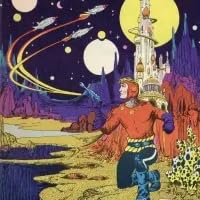
Underrated, I think due to cover making it look like an action-packed war-against-alien-invaders pulp story. That’s not what this book is. It’s more introspective and concerned with ideas about political identity and leadership. That is, it’s very Algis Budrys, and if you like his other books, this book is definitely worth a read.
A story of galactic revenge. The Galactic Empire oppresses Earth. The government-in-exile, led by Michael Wireman, attempts to retake Earth and defeat the Galactic Empire.
The work is much more real than it seems. Indeed, the author is the son of the consul general of the Lithuanian government-in-exile after the invasion and oppression of the country by the communist horror.
Actually, I listened to an audiobook version of this novel.
I really want to read "Michaelmas" and "Rogue Moon" by this author, but alas, so many books so little time. Those two titles seem to be much more original and interesting.
This book is now in the public domain, that's why it wound up as an audiobook from one of the smaller talking book vendors.
It seems to be a pretty run-of-the-mill military sci-fi novel where an off world colony of humans try to take back Earth from human-like aliens who have taken over.
Perhaps, there is some deeper allegorical meaning that I'm missing here, but I always get that feeling from novels anyway.
Als die Fremden im Jahre 2439 die Erde überfielen, flohen sie vor der Übermacht und gründeten im Centaurus-System auf einer von Menschen besiedelten Welt eine Exilregierung. Jahrzehnte vergingen, bevor sie daran denken konnten, die Herrschaft der Invasoren zu brechen. Schließlich kehrt ein junger Mann vom Centaurus zur Erde zurück. Er soll mit der Untergrundbewegung Kontakt aufnehmen und die Erde von der Fremdherrschaft befreien …
Ein Fix-up aus drei Storys und wie meistens üblich merkt man es der Geschichte an. Ansonsten war die Story nichts Besonderes 2,5 Sterne
Leaders of earth, fleeing a collapse of government after an invasion, live out their lives in another system as exiles from Earth, hoping someday to bring the President and the Cabinet back into power and overthrow the invaders. And finally are given a chance to try to bring their cause back home.
Well written... main characters nicely drawn.
Over too soon, and not the ending I'd have expected. But, that's what makes for a good story!
Serendipitously, organizing GoodReads' Budrys database brought me to this novel, something that I read in Michigan during a summer vacation way back in childhood, having been mightily impressed by its cover at the time.
I'm disappointed. I always have a high expectation when I find and then go to read an Algis Budrys book. Maybe I am just expecting too much of him. I'm removing him from my 'top tier' of SF authors for that time period.
As for the story, it just didn't engage me. I found myself not caring at all.
Interesting, "old style" science fiction -- invasion by aliens, humans fighting back, etc. Most interesting was the similarities between Budrys' life and events in the novel.