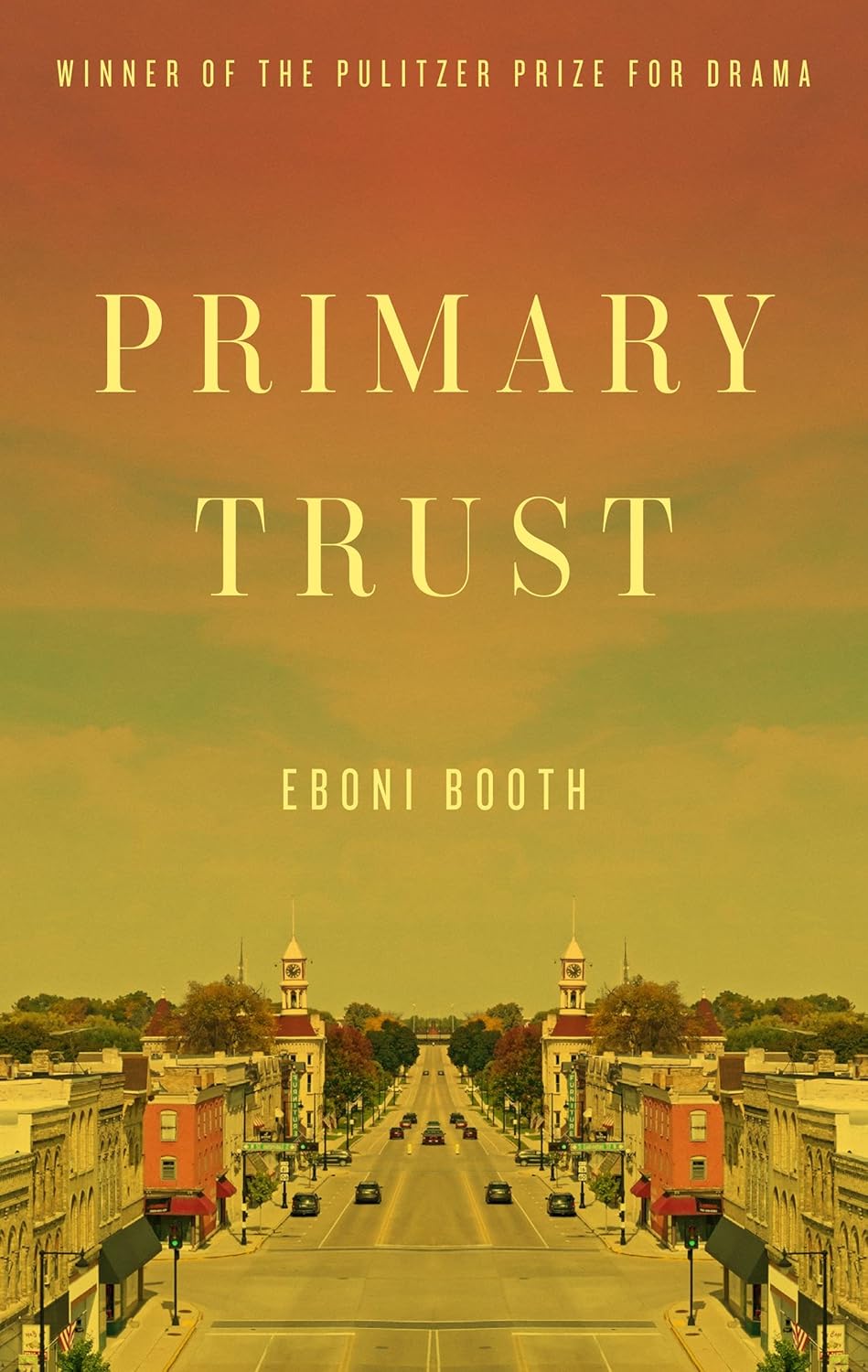
Meet Kenneth, a 38-year-old bookstore worker who spends his evenings sipping mai tais at the local tiki bar. When he's suddenly laid off, Kenneth finally begins to face a world he's long avoided – with transformative and even comical results. Primary Trust is a touching and inventive play about new beginnings, old friends and seeing the world for the first time.
Primary Trust premiered off-Broadway at the Laura Pels Theatre on May 4, 2023. Directed by Knud Adams, the production starred William Jackson Harper and featured Eric Berryman, April Matthis and Jay O. Sanders.
A very interesting take on imaginary friends and how we cope with loss. Kenneth (K) is a 30ish African American bookstore employee who has an imaginary friend named Bert (B). The nature of the relationship between K and B unfolds in a tiki restaurant that K frequents after work almost everyday. As other characters are introduced the 'insulating' position B plays in the life of K is both humorous and based on childhood trauma - a very hard perspective to pull off!
I just reviewed the list of works which won the Pulitzer Prize for drama and was surprised to discover I've seen 53 of them in performance. In a few weeks, this will make the 54th and - unless it plays much better than it reads - it will be keeping company with the lower 5. Honestly, given that it's 70% soliloquy (jazzed up somewhat by having one actor personify an imaginary friend), it would be less awkward as a radio production.
This, only the second play to be published by Booth, just won the Pulitzer Play for Drama 2024 - and I kind of despair to think this was the best they could find. It's not truly awful, and the reviews seem to indicate that it played much better than it reads, primarily due to a stellar cast in the initial production off-Broadway a little over a year ago (indeed, William Jackson Harper, who essayed the MC, is nominated for the Tony Best Actor Award this year for his work in Uncle Vanya).
I guess I just didn't buy into the main conceit, which is (and this isn't really a spoiler, as it is explained on the 2nd page of the play!) that the central character, Kenneth, a 38-year-old man-child, has an imaginary friend named Bert, who is the only one he can relate to or talk with. Because of his delayed social adjustment (he may or may not be neurodivergent - that isn't clear), which is further explained via an understandable childhood trauma, Ken's dialogue has rather an off-putting childishness to it.
I guess in production, this can be worked around, but it was a non-starter through most of the play for me. Plus - half of the play is in direct address to the audience, which I never seem to like ('show me, don't TELL me!') Maybe if I get the chance to see it in production, I will be more generous - and pleasantly surprised!
[OK, this is probably going to be an unpopular rant and get me accused of being a racist: but in the past 10 years, 9 out of 10 of the Pulitzer Drama winners have been POC or other minority playwrights; 12 out of the 20 finalists, were also minority playwrights. Now far be it from me to suggest that something OTHER than quality has been the criteria for the selection committee this past decade - some of these, such as the musical Hamilton, were certainly deserving, but ... Maybe they are just trying to make up for the first 100 years of the award, 96% of which went exclusively to white men.] https://www.youtube.com/watch?v=GmVYq...
I ready this play for class, my professor said she tries to have the class read whichever play wins the Pulitzer that year. Wow I mean it’s obvious why Primary Trust won. It’s so brilliant, such a moving depiction of grief and loss and love and loneliness and friendship. I just finished reading it and I’m sitting here sobbing. I wish I had gotten to see it on stage at Roundabout I just know William Jackson Harper must’ve been phenomenal as Kenneth.
“‘Work was good. I had my high solution numbers and no one seemed to have discovered Bert. It was better than I could’ve imagined. But I felt quiet and lonely.’”
love me a good character study and i really enjoyed the idea that the show is based around. a really interesting look at friendship and opening yourself up to other people and the world around you. i also enjoyed how the show played with time and what was real and what was imaginary. i wish that there was a little bit more because the ending came kind of quickly and i just wanted some more time with the characters. i can tell that it’s a much better show to watch than to read but i still enjoyed it a lot.
A truly beautiful play (Pulitzer 2024) I wished I’d seen when it was in Chicago last year. It takes up race and class with straight-ahead directness but is never didactic. The problems of the main character, Kenneth, seem organic to any person orphaned as a child, but especially a Black kid who loved his only parent (his mother) with every piece of himself. Kenneth is incredibly likable and at moments uplifting, a feat in itself given his long-standing struggle with the character Bert. I hope to see it staged.
i randomly picked this up at dog eared books in sf because one of the employees blurbed it saying "there are so rarely plays about kindness, and i promise you none of them are as gorgeous as this one." and every word rang true. this was lovely, delightful, emotional, and heartfelt. adored this play! is 2025 the year of plays for me??
It's a cliche at this point, but some plays are so so much more enjoyable on stage than on the page. This is very much one of those instances. As many other reviewers pointed out, the protagonist being a 38-year-old man with nobody but an imaginary friend to keep him company is a hard sell on the page, but I totally believed this premise while watching a performance.
Loneliness has a million different looking manifestations (which is pretty much the take away point of Edward Hopper's oeuvre), and I think Primary Trust did a fantastic job showing how crushing it can be. Especially now I think it is important for people to be reminded that loneliness is not a terminal illness, but something one can arise from.
I really loved the language, tone, pacing, and underlying depth to this play. Kenneth is a sad, three-dimensional, and deeply interesting character in the way that Booth presents him. Kenneth's operating system is disrupted in a big ways and Booth sensitively and creatively explores how these quakes do and don't transform Kenneth. Unfortunately, I was saddened that the ending came about so abruptly and by my feeling in a bit of undercooking. I felt there was more arc to complete in the final 12-17 pages that wouldn't necessarily have led to resolution but something on more of a footing. Overall though, I appreciated the opportunity to dive into this often beautiful and smart play.
The 2024 Pulitzer Prize winning Best Play is an inventive, compassionate, moving work, full of intriguing characters that are recognizable in their struggles and foibles: folks just trying to keep body and soul together and the rent paid. Eboni Booth captures the heroism in everyday folk: the humor, the coping rituals, the way an outstretched hand can change a life forever, the caring community that is the only safety net we have.
In an age infatuated with AI, PRIMARY TRUST celebrates the human being: each one unique, ever-changing, and to be cherished.
A first rate play deserving of all the plaudits it has gotten. The story is about personal growth as Kenneth (the Protagonist) has suffered a lot in his life including the death of his mother and has learned to cope by going to the same bar every night and drinking Mai tais. He sits in a corner and talks to his imaginary friend Bert. After years of being friendless except Bert a waitress encourages him to get a new job at a bank where he seems to overcome his mental struggles and branch out.
Eboni Booth's Pulitzer winner explores the solitude that births itself from trauma, and a man's desire to reconcile that with an upheaval in his life as a bookstore worker in a small town. Earnest and heartfelt, I found this to be a hauntingly good metaphor for the cold indifference of life during the Pandemic. How did we cope with such forced isolation as a species built on the concepts of sociability? How are we still recovering? How will this trauma be handed to our next generations, who didn't experience it first-hand?
Very surprised how empty I found this. Twee direct address and montages? A wholesale Harvey “homage” (ripoff)? I’m sure William Jackson Harper nailed the monologue in the middle, and it is well written, but one heartbreaking cathartic speech does not make up for a script that otherwise reads like a Tyler Joseph Ellis TikTok parody. Maybe I totally missed something, maybe I’m crazy, but almost from jump I felt I was being punked.
I read the script and really enjoyed it. The frequent time jumps (which even occur after just a single line) can make it a bit confusing to follow on the page, but I understand that this structure is meant to be experienced on stage rather than simply read. Despite that, I found it both hilarious and deeply heartbreaking.
Kenneth, a neurodivergent person, creates an imaginary friend, Ben, after suffering a traumatic event in his childhood. Ben stays with him well into his adulthood. At 38, when the familiar starts to change, Kenneth must find a way to survive. But, will he also be able to let go of Ben and accept a real life support system?
A bit stunned that this won the 2024 Pulitzer for Best Drama. The story of Kenneth, 38, who loses his job at a bookstore, after it is sold. He spends a lot of time drinking mai tai's and talking to his imaginary friend Bert. Orphaned at 10, Kenneth has had a difficult life, and his life begins to change when he meets Corrina, who suggests he get a job at a local bank.
This was an assignment for my class, but I've havent put it down since I've read it! It's such an amazing story about embracing new things, accepting change, and letting go of the things that we cherish but need to say goodbye to. I highly recommend reading the play, and if anyone knows where I can watch the play. PLEASE! Let me know.
I hope this plays better than it read. I always like to read a play before I see it performed -- it helps me not have to focus on the plot and focus on the nuances of the writing. I had high hopes for this since it won the Pulitzer Prize for drama but I found it on the verge of annoying. Maybe I am too cynical and just cannot believe that people are that kind.
it's always a pleasure to find a play that's able to construct characters and worlds that feel lived-in and real. booth sketches out a portrait of a man who, by all accounts, is inconsolably lonely, and it's lovely to watch him gradually open himself up to the world
I don't think I've ever read a play before. Other than bits of Shakespeare. This was sweet and punchy. It felt like a cousin to poetry. Words that have to be perfectly chosen and placed. Easy to read in one short sitting, and worth your time.
"I don’t believe in God or Heaven or Hell, but I do believe in friends."
this Pulitzer Prize-winning play REALLY touched me, and I am so happy I decided to sit down and give it a try. I was incredibly touched by this piece - and I think it told a story of healing and bravery in a new, unique way.
This won a Pulitzer??? Truly meh, not bad but painfully meh. Beginning was terrible. Exposition dumping, tell-don't-showing, felt like molasses to read, no no no.