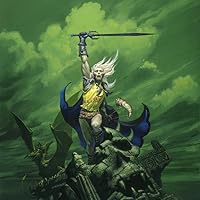
Questioning the meaning behind life’s great conundrums is just part and parcel of Quentin S. Crisp’s I Reign in Hell. Take this existential diagnosis from the narrator in “Petseta” as Exhibit A: “Any part of your life, or your life in its entirety, could be a dream whose meaning you have forgotten.” These are words that hold true for a character whose answer to life arrives in a moment of déjà vu. As in other stories from this anthology, reality may in fact be an endless cycle of déjà vu, opening the door to as many answers as it does endless speculation.
Although Crisp’s writing here operates outside the norms of conventional genre tropes, his stories are often rooted in elements of the supernatural. For instance, he channels his inner Lovecraft in “The Recluse,” which sees the discovery of a hermit’s arcane language that leads to a new sort of freedom not yet known by man. In “The Mermaid” the fairy tale cliché of living happily ever after is morphed into a hideous nightmare when a beachcomber’s fantasy comes to fruition but at the expense of his lust for perfection. With “The Legacy” Crisp preys on the most primal of fears: arachnophobia. Deep-seeded childhood trauma is usually the culprit, but fear can also be inborn. And for one grandson clearing out his deceased grandmother’s house, it becomes a family heirloom best left for the incinerator.
However, Crisp also branches out into the realm of magical prose with stories that may just restore your faith in humanity. “Far-Off Things” is innocence personified for a boy whose only glimpse at love is in a girl he adores from afar, proving that love is fleeting and should always be cherished. Similarly, “Italiannetto” is a touching evocation and reminder of the platonic relationships in one’s life — where true love can be found in more than just romance.
In two ambitious, never-before published novellas, Crisp ventures into a newfound arena of narrative form. His “Scorpion and the Butterfly” is like gurus gone wild beyond the grave. The eternal dance of parrying for position never dies with death; it only grows stronger. While “Fractalism” is a cerebral look at a man’s botanical influence on himself and his surroundings, leading him to uncover an unlikely villain within his metamorphosis.
You may not see the humor in I Reign in Hell, but the title alone will tell you all you need to know about Quentin S. Crisp. He is never one to pass up a clever dig at the literary powers that be. And I Reign in Hell is no longer an unfulfilled publication dream: it’s a moment of déjà vu come to life.
Contents The Legacy The Psychopomps The Mermaid Far-Off Things The Recluse Unimaginable Joys Italianetto Suicide Watch Scorpion And Butterfly Fractalism Petseta The Little One: A Meditation Nail Soup For The Soul
• Signed by Quentin S. Crisp and artist Harry Brockway. • 500 signed copies. • Bound in three-piece black and red Skivertex cloth. • Dustjacket, frontispiece, and individual story art by Harry Brockway. • Patterned endpapers. • Head and tail bands. • 5¾ × 8½ inches. • 600 pages. • Published June 2024. • ISBN 978-1-61347-084-8.
I had only read Shrike by author Crisp before this collection. I was swept away by the intellectual lyricism and emotion of his prose in that novella and hoped for more of the same in I Reign in Hell.
I got that and more.
This collection of 12 morbidly melancholic tales (and one essay) can be loosely classified as horror, but it is not the gross-out horror so prevalent in today's fictions. Rather, it's the nightmarish stuff that makes your skin crawl and the hair on your neck, arms, and legs prickle.
But it is the progression this collection represents that impresses as much as the works do. The selections are more or less a chronological progression in Crisp's career that shows him maturing as writer from the dread-inducing "The Legacy" (arachnaphobes, beware!), to the heartachingly horrifying "The Mermaid", to the dizzying "Suicide Watch." Along the way, there is the stunning reminisce "Italiannetto" and the thought-provoking "Unimaginable Joys."
By the time the reader gets to the two new tales of the book, "Scorpion and Butterfly" and Fractalism", he has gotten a good primer on Crisp's quest for love, self, and meaning in an ambivalent, maybe even hostile, universe. I'll need to read "S&B" again at a later time because I know I missed something; but "Fractalism" is a masterpiece of physical and philosophical horror.
The final three selections were more optimistic (for me) and a good way to end the book. The essay "The Little One: A Meditation" stands out as one of my favorites of IRiH.
With exquisite prose and philosophical fecundity, Crisp's Reign is a trove of melancholia in which every reader will find something to identify with. And as we learn in "Unimaginable Joys," the difference between heaven and hell is merely a matter of perspective.
I choose to view Crisp's infernal reign as heavenly.
I've never read Quentin S. Crisp before, so I wasn't sure what to expect. What I got was this collection of literary weird at times dreamlike fiction that drifts toward the philosophical.
The stories aren't really plot driven and as such focus heavily on atmosphere. Crisp does an excellent job with the atmosphere in each story so it works. The prose is very elegant and lush. The horror aspects of the writing aren't there to scare you so much as they are to unsettle you or make you uncomfortable through ambiguity or downright strangeness. Reminds me a lot of Aickman and HPL Dream Cycle stories.
I liked the collection more at the start and less at the end. Stories like The Legacy, The Mermaid, and Suicide Watch are among the best I've read. Later stories drift far heavier into the philosophical and become quite arduous to read at times. They're not without their merit, but they were more of a chore than I prefer in my reading.
All in all I'd say Crisp is must read Weird Fiction and I will be seeking out more.
It’s a rare and baffling experience to encounter a single author whose work is simultaneously so brilliant that it's instantly captivating, and at times so alienating that some stories are impossible to finish. Yet, that was my exact reaction to Quentin S. Crisp's "I Reign in Hell," a deeply literary collection that proved to be a potent journey of both masterful highs and frustrating lows.
The collection's power and its pitfalls stem from the same source: a dense, literary style focused on the internal, fractured states of its characters. On a technical level, the prose is impressive. However, when it's not anchored to a narrative, it can become stagnant and disengaging, much like my experience with Kathe Koja's Bad Brains. Where Crisp truly excels—and where this collection finds its mastery—is when he pairs that immersive style with a compelling plot. This is where the book truly shines, in standout stories like "The Psychopomps," "The Mermaid," "The Recluse," "Unimaginable Joys," and "Suicide Watch." In these, the atmospheric writing and the storyline lock into a perfect harmony, creating an experience that is both psychologically deep and narratively engaging.
Unfortunately, this balance is not maintained throughout the collection, leading to a starkly uneven reading experience. I found myself completely unable to finish more experimental pieces like "Fractalism" and "Scorpion and Butterfly." The former felt frustratingly slow before devolving into a type of body horror I found more exploitative than profound, while others, like "Nail Soup for the Soul," simply meandered through evocative moods before petering out without a satisfying resolution.
Yet, what makes this collection linger in the mind is the way unexpected moments of grace pierce through the oppressive darkness. Crisp shows a profound understanding that the search for beauty and connection within a bleak world is what gives the struggle meaning. "I Reign in Hell" is therefore recommended for the patient reader—one who appreciates a demanding literary voice and is willing to navigate the stories that don't land to find the truly brilliant gems hidden within.
I started this back in October for Halloween, and was so overwhelmed by the horror and beauty of the first few stories that I decided I should read one of QS Crisp's shorter collections to start with. So I read Morbid Tales, and found it brilliant. I Reign in Hell, however, was a slog to get through, and at one point I marked it as DNF. Crisp's worldview becomes increasingly in-your-face and polemical as the book progresses. Having read these stories and his Substack, it's obvious he belongs to the group of post-liberals that can be termed the "heterodox" who are notorious for their cantankerous hatred for anything modern. Really, they just support the conservative status-quo, and I think it would be a disservice to Crisp to lump him in totally with this crowd, because when he is at his best, he is able to convey his thoughts with a clear kind of lucidity. One of my favorite pieces was the essay The Little One, about a children's picture book that has always held sway over him. He reads it through a Taoist analysis, and it made me hungry for more of his work on this level. About half the collection isn't even horror, but confessional fiction, some of it melancholy and inspired, but a lot of it tedious. My favorite stories in the whole collection were The Mermaid (from Morbid Tales), and Unimaginable Joys, which are flights of pure lyrical fantasy. I think the weakness of the collection overall is that it's just too much. It's 599 pages, and I don't feel like it really represents a best of selection, because so much of it is lugubrious and a canvas for Crisp to rant on about his political views with little in the way of subtlety.
An unexpectedly fantastic writer. It took me three times as long to read this book as expected, as I would stop to reread sentence after sentence. A writer's writer.
I bought this book from Jerad at Centipede Press primarily because it was such a handsomely bound tome. “But who is this author?” I thought. So one day I cracked it open, and blammo! The experience was like having my brain rendered into chilled gelatin. Quentin S. Crisp then proceeded to slice it wafer-thin before my eyes and serve it to me on a silver platter. If this sounds appealing to you, then read on.
I can’t quite remember the name of the novella about the mermaid, but it was one of the finest pieces of work I’ve ever had the pleasure of reading. It was so good that I would still give this book 5 stars if every other story was just him telling me to go fuck myself. Seriously good, and the other stories were excellent as well.
Quentin S. Crisp is a supremely talented author and I look forward to digging into the rest of his catalogue.