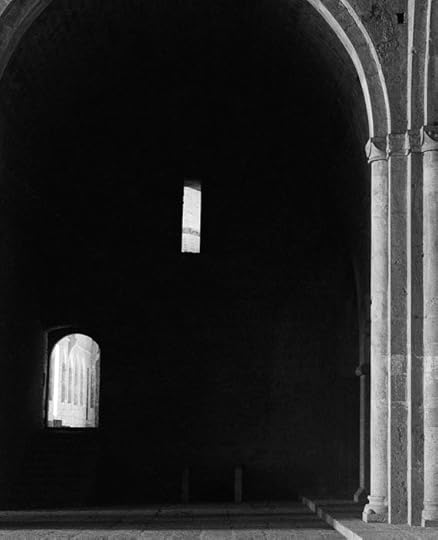
Le Thoronet Abbey, one of the wonders of twelfth-century Cistercian architecture and still revered by architects today, nestles in a wooded valley in Provence, South of France. This book is a pictorial appreciation of the abbey, photographed by Lucien Hervé in the mid-1950s and introduced by Le Corbusier. 'The pictures in this book are witnesses to the truth,' says Le Corbusier of Hervé's photographs of the Romanesque abbey. Hervé's exquisite study presents the building throughout the course of a day, depicting the changing play of light and shadow on its stone vaulted exterior and interior. Highly textured and almost abstract in quality, his photographs reveal how the abbey is defined as much by light as by the conventions of Romanesque architecture, to communicate the intense spirituality of the Cistercian monastic order. Arranged according to the canonical hours of prayer, Hervé's photographs are complemented by quotations from the psalms and the saints. An essay by Father Samuel of the Abbey of Notre-Dame de Sept-Fons provides a profound insight into the Cistercian monastic order, while the renowned state-of-the-art architect John Pawson contributes a personal appreciation of this fine example of Cistercian architecture.
This coffee table book is meant to be put on your lap to meditate on the 'holy simplicity' of Cistercian architecture.
The book itself is a lovely object. Not quite a square format, it provides just the right heft. The fine cloth and the rich stock of paper come with additional tactile pleasures.
The book's main selling point are Lucien Hervé's classic black-and-white pictures, first published in 1956, of the Abbaye Le Thoronet, nestled in a densely wooded valley in Provence, south of France. The wayward, almost abstract compositions, and the restrained tonal palette strike one as almost deliberately artless.
The images are arranged according to the canonical hours of prayer and accompanied by quotations from psalms and saints. For me, these short bits of texts were more evocative than the images of the spiritual ardour of medieval Christendom. Particularly some of the quotations from mystics such as St Bernard of Clairvaux and Gilbert of Swineshead struck a chord. This one by cistercian monk and philosopher Isaac de l'Etoile might as well be culled from from Rilke's Neue Gedichte:
"To be sensible is the property of all things in this world, but their last state is that in which it is written of them that they 'reach from extremity to another, ordering all things with strength and sweetness."
Mysterious glimpses of a spiritual and intellectual world of which I've always thought I know next to nothing ...
The book concludes with a thumbnail sketch of the history and architecture of the Cistercian Order by an anonymous monk of the Abbey of Notre-Dame de Sept-Fons and an afterword by modernist and minimalist architect John Pawson. This epilogue raises a lot of questions. While I salute Pawson's masterful realisations in ecclesiastical architecture (Novy Dvur, Augsburg, Pannonhalma) I have the audacity to question whether he has grasped the architecture's inner logic. Pawson starts from the assumption that St Bernard translated his theology into a set of design guidelines that were then turned into tactile reality by a master architect or designer (typically, "a man of whom, sadly, we know nothing"). David Turnbull and Tim Ingold, among others, have questioned this 'blueprint' conception of design, particularly related to 12th-century medieval architecture. According to their view, these buildings emerged as a result of a collective learning process, underpinned by a fervent spirituality, rather than from a preconceived masterplan. This paradoxical fusion of rigour and open-endedness is interestingly mirrored by St Bernard's insistence on the notion of 'freedom and sensibility' as guideline in a most disciplined monastic life. In that sense it seems arch-modernist Le Corbusier, who provided the foreword to the original publication with Hervé's pictures, articulated a deeper understanding when he characterised this kind of architecture as 'the unending sum of positive gestures' and stresses the generative potential of the material itself:
"Stone is thus man's best friend; its necessary sharp edge enforces clarity of outline and roughness of surface; this surface proclaims it stone, not marble; and 'stone' is the finer word. The way stone is dressed takes into account every fragment of the quarry's yield; economy coupled with skill; its form is always new and always different. Bands, vaulting-stones of arch and vault, ways of setting a window in the thickness of a wall, paving, unsupported pillar and archivolt, roofs and their baked tiles (the same tile endlessly multiplied, male and female - a population of tiles), the shafts of columns, both free-standing and engaged, plinth and capital (but none of these things are there to catch the eye) ... such are the words and phrases of architecture. Utter plenitude. Nothing further could add to it."
The pleasure that went with the perusal of this book was considerably heightened by the aural backdrop of Sofia Gubaidulina's 1978 Concerto for Piano and Chamber Orchestra 'Introitus'. The piece's slow tempo and austere orchestral garb, and the piano's insistent, tranquil psalmodizing in the bass seemed like a perfect musical complement to this meditation on light and space.
One of my favorite quotes from the text (p. 54): "Your desire is to see, then listen: hearing is a step towards vision." - St. Bernard of Clairvaux (1090-1153)