Jump to ratings and reviews
Rate this book

Mis fantasmas

Rate this book
Una incursión mordaz y original al eterno campo de batalla de las relaciones entre madres e hijas

Helen Grant siempre ha sido un misterio para su hija. Bridge apenas conserva recuerdos de sus padres antes del divorcio, pero intuye que aquellos años de matrimonio fueron decisivos para moldear una personalidad que a ella se le antoja incomprensible. En la plenitud de su vida y su carrera, Bridge afronta una relación hostil con su madre, a la que apenas ve una vez al año. Aunque es consciente de que Helen siempre ha dejado mucho que desear como figura materna, Bridge quiere tirar del hilo y entender –o quizá solamente hacer entender a su madre– por qué las cosas nunca terminaron de funcionar entre ellas.

Con un sentido del humor y una clarividencia deslumbrantes, Mis fantasmas es un acertadísimo retrato de ese vínculo fascinante y excepcional que une –y desune– a madres e hijas, y que, como en el caso de Helen y Bridge, oscila entre lo frustrado y lo frustrante, el cariño y la crueldad, la ternura y el rencor mutuo. El logro genial de Gwendoline Riley es brindarnos una voz única e irrepetible que, no obstante, representa a infinidad de mujeres, una voz de una potencia capaz de sacudir los cimientos de la siempre compleja relación entre una madre y una hija.

204 pages, Paperback

First published April 1, 2021

226 people are currently reading
13440 people want to read

About the author

Gwendoline Riley

11 books278 followers

Ratings & Reviews

What do you think?
Rate this book

Friends & Following

Create a free account to discover what your friends think of this book!

Community Reviews

5 stars
1,204 (22%)
4 stars
2,300 (42%)
3 stars
1,425 (26%)
2 stars
354 (6%)
1 star
86 (1%)
Displaying 1 - 30 of 745 reviews
Profile Image for Roman Clodia.
2,901 reviews4,660 followers
April 17, 2021
A wonderfully poisonous novel which really nails all the pain that can be contained in dysfunctional mother-daughter relationships, where separation is never really possible and where that inescapable bond is also a kind of stranglehold.

This seems deceptively simple in writing style at first, but the book cleverly uses a limited first person perspective, inviting readers to think about both Bridget's obsession with her mother, and all the things she never says but which underlie her vexed and troubled relationships with both parents, the 'phantoms' of the title who haunt her psyche.

Riley is brutal in her exposure of these women and the way they lacerate each other while never acknowledging the bitterness and resentments between them. Read this alongside Burnt Sugar for another disturbed tale of maternal bonds gone awry. For all the cool surface, this book packs a huge emotional punch.
Profile Image for Fionnuala.
887 reviews
Read
March 23, 2023
I haven't read a book in a while that had so many tributes from other writers—on the front cover, on the back cover, inside the front cover, inside the back cover, on both sides of the flyleaf—thirty in all! Perhaps I don't read enough contemporary novels.

Truth to tell, such quantities of praise eat away at my expectations, and I go into the reading with an eyebrow slightly raised. But reader, the first eyebrow was swiftly followed by the second as it hit me how good Gwendoline Riley's writing is!

So I went back and read the tributes properly and nodded in agreement over and over. I was disappointed that no one mentioned what I thought was the most interesting aspect: that this book reads like a true life memoir though it's not. The narrator is a most intriguingly written fictional character. She sounds like a writer, she paces her story with skill, moves back and forth in time expertly, knows how to describe scenes with a few carefully chosen words. But in spite of the fact that she writes mostly about her mother and father, and hardly mentions her personal life at all, it was what fascinated me the most, and I began to wonder how Gwendoline Riley had set about creating this memoir/novel.

I imagined her writing a larger story first, with the narrator, Bridget, fleshed out into a very complex character, and her parents and sister being secondary to Bridget's own story. Then I imagined Riley deciding to let Bridget narrate the whole thing herself, and because Riley had created her in so much detail, because she knew her so well, she allowed her to shape the story—and leave it full of gaps about herself. Because after all, the character who is telling the story can decide to leave out entire chunks and only examine what she wants to examine, and with as cold an eye as she chooses. But for all the gaps in this story, and the very cold and clinical approach to telling it, the novel really gets under your skin...devastating, bleak, unforgettable," to quote one of the tributes.

I'd add that Riley's novel is a master class in pared-back writing. I know that phrase sounds exactly like blurbspeak—but, well, none of the blurbs actually said it.
Profile Image for Alwynne.
941 reviews1,607 followers
October 28, 2022
Gwendoline Riley’s fascinating exploration of a mother and daughter's fractured relationship is narrated by Bridget whose connection to her mother is unusually strained. Bridget’s is an unsettling account, in which she’s almost absent from the proceedings, a shadowy figure recounting the details of her life with her mother in a strangely-detached manner. This is compounded by Bridget’s abrupt shifts in register from informal to awkwardly formal, as if she’s attempting some kind of forensic examination of her interactions with her mother Helen, known as Hen. The novel opens with a glimpse at a different mother-daughter dynamic, the one between Hen and her own mother, which is marked by a common language, a shared perspective, elements completely missing when it comes to Bridget and Hen’s interactions.

Although on the surface Riley’s is a relatively straightforward, slice-of-life narrative, at times I felt as if I was trying to decipher some kind of puzzle. So much about the ways in which Bridget behaves are mysterious, not allowing her mother to stay with her during her yearly visit to London where Bridget’s based, avoiding her sister Michelle, even though there’s no evidence of a significant schism between them. What is revealed of Bridget’s everyday life seems stable, mundane even, a reliable partner, a decent flat, and a carefully-nurtured cat. She represents herself as a bookish child, the odd one out in her family, still smarting from her legally-mandated visits to her estranged father, who’s depicted as a cartoon-like, working-class stereotype, the "wideboy" with thwarted ambitions, who communicates through relentless, abusive forms of teasing. But as what’s essentially a domestic tragedy unfolds, I was less and less sure about Bridget’s reliability, and more and more interested in what she was concealing.

Hen’s represented as by turns diffident and difficult, unable to make lasting connections, resentful of the limited choices available to women of her generation, someone who’s forever trying to blot out the world around her, by turning everything up to the highest volume. Loud TVs, strident radios are the backdrop of her existence, all the standard trappings of someone overwhelmed by anxiety. Yet Bridget’s portrayal of Hen displays a level of cruelty that seems disproportionate to her failings as a parent, entirely lacking in compassion. Part of this seems to be broadly generational but a great deal might be attributed to the rarely-acknowledged damage that can result from growing class and cultural divides: Bridget’s educated, presumably successful in her chosen career, but seems desperate to position Hen as somehow lesser, often resorting to contemptuous comparisons to dogs and cats when she’s describing Hen’s behaviour. This relentless ‘othering’ is bewildering at times, unconvincing at others, almost as if Bridget by pigeonholing Hen is actually trying to fend off her own anxieties, or any possible suspicion that she may resemble her mother in any way, shape or form. But there’s also a sense of underlying guilt as if, in offering up this skewed portrait of her time with Hen, Bridget is attempting to absolve herself of responsibility for what happened between them. All of these gaps, and lingering questions, contributed to the force and surprising complexity of Riley’s story, admirably compressed and disciplined, oddly hypnotic.

Thanks to Edelweiss and publisher New York Review of Books for an ARC

Rating: 3.5/4
Profile Image for Meike.
Author 1 book4,971 followers
January 4, 2021
Gwendoline Riley is just fantastic when it comes to challenging the reader to ponder complex human relationships (see First Love, nominated for the Women's Prize, the Gordon Burn Prize, the Goldsmiths Prize, etc. pp.). In "My Phantoms", she tells the story of Bridget and her mother Helen a.k.a. Hen, and by framing their relationship wholly from Bridget's perspective, one starts to wonder in how far the mother's personal traits and the events portrayed are tainted by the daughter's limited perspective, personal resentments and own flawed personality. We witness these two wrestling each other and it becomes impossible to take sides - and it's this oscillation, the thin ice on which we have to draw our conclusions that gives the text suspense and renders it so intriguing.

While Bridget lives with her boyfriend John (who hardly features), her twice-divorced mother lives alone, always trying to immerse herself in the life around her, trying to fit in and do everything right without really opening up, only to become bitter when her perceived conformism doesn't lead to success - at least that's Bridget's perspective, and it's not necessarily correct, especially as Bridget could be interpreted as cold and condescending. But then again, we do not know everything that happened in these women's past, so we don't know what pain the mother inflicted on her daughter. As Hen ages, Bridget and her sister are forced to come to terms with the new situation and its demands.

In large parts, this book is very sad and depressing (not necessarily a bad thing, literature is not here to cheer us up), but the aspect of the text being an emotional riddle - as ultimately are many human relationships - made it unputdownable for me and I read it in one sitting. I hope Riley's challenging and innovative work will once again make some prize lists.
Profile Image for Gumble's Yard - Golden Reviewer.
2,189 reviews1,797 followers
December 16, 2022
A book largely if not entirely unrecognised by prize lists (other than a Gordon Burn Prize longlisting) but which seems to feature on multiple book of the years lists for 2021.

“She’s clearly frightened of engaging. That’s a sad thing. A sad and defensive thing. Here’s a better way to put it, she was in an a priori reality …. And that reality was not going to yield to another reality”


I have previously read the author’s fragmentary account of abusive relationships “First Love” which was shortlisted for a whole host of awards (including the Women’s Prize and Goldsmith Prize).

As part of the shortlisting for the latter the authors are interviewed, in a fairly set format, in the pages of the New Statesman in the weeks between shortlist and winner announcement (the exception being this year when some still oddly unexplained delays in unveiling the shortlist meant the interviews, other than the winner, were published on line).

In her interview, when Gwendoline Riley was asked how she approaches voice she said

“Well, I just tune in, really. It’s interesting what people get up to under the guise of having a conversation. I’ve heard that marriage counsellors tell couples not to say “always” or “never” when arraigning their spouses. “You always put me down!” “You never listen!” That’s inflammatory. You should say, “You sometimes put me down.” I’m not sure what that is. I remember a woman who used frequently to use both of those adverbs about herself and then add a question tag, too. Things like, “Well I never buy low-fat, do I?” or “I’ve always hated Jonathan Ross, haven’t I?”. So there was this need to constantly assert things about herself, a certain proud vehemence, then this anxious little question: a retreat. I notice things like that.”


And I felt that this skill came to the fore in this her latest novel.

The New Statesmen also, in a brief review of her career, talked of a series of novels with a recurring “dysfunctional family dynamic” each narrated by first person female writers “who aged in step with” the author. And that tradition continues to here, as does what I think is another key part of her writing, a narrator who is far happier to turn their notice and gaze on others rather than on herself.

This novel is narrated by Bridget (now in her 40s) and living in London with her boyfriend. That relationship however is not the subject of her account, instead it is her troubled relationship with her mother Helen (Hen) – based in Liverpool, together with an initial account of the equally dysfunctional relationship, Bridget, and Bridget’s sister Michelle had with their estranged and now dead father Lee.

Bridget’s account of Lee is simply brilliantly written. I can only really describe it as an autopsy – painstakingly as well as painfully, dissecting his speech, his affections, his mannerisms, his beliefs, even his heroes (Derek Hatton pretty well says it all) to find what both drove and ultimately blocked his heart and mind.

Bridget’s account of her mother takes up most of the book – and is less clear cut as her mother is perhaps more of a developing character. In earlier life almost proud of her unhappiness, simply because such unhappiness (an unfulfilling job, an unhappy marriage) was, in her view, to be expected and to accept it dutifully almost expected of one. Later she seems desperate to find acceptance and community but this only drives her to ill advised decisions (a city centre flat purchased with Friends style aspirations which basically turns out to be in student digs) or if not her very desperation repels others.

Perhaps the biggest difference between the two is in how they seem themselves as viewed by others unknown – Lee as being affirmed by them, Helen as judged by them

Those spectral associates my father raised didn’t persecute him. They were a supporting cast: a wise counsel or a happy coterie, rushing to fill in coveted positions in his court. Leave it to my poor mother to have those awful tormenting busybodies as her imaginary fellows.

But perhaps the real puzzle to solve is Bridget herself – and here we get very few direct clues, relying instead on the tangential and reflective.

Bridget may be excellent at rather merciless observation and cutting commentary on the quirks of others and judgement on their character; but she is almost entirely lacking in empathy (what truly behind their behaviour), compassionate understanding and most of all self-awareness (she never really reflects either on how her own actions could drive the behaviour or what she could really do differently).

So for example her clearly callous annual treatment of her mother on her birthday trip to London – distancing her from her house and boyfriend – and her assumption that Michelle will take on the real burden of dealing with her mother on a day to day basis, go unremarked by her, but not by the reader.

Overall like all the author’s books not a comfortable read but a distinctive one.

My thanks to Granta Publications for an ARC via NetGalley.
Profile Image for Lee.
381 reviews7 followers
January 1, 2023
Riley's best novel, I think, uncomfortably funny and poignant and featuring typically excellent dialogue and deeply complex characters with just the wrong combination of self-perception and neuroses. The closest comparison is probably Mike Leigh -- both seem equally repelled by and attracted to their players. And both feature protagonists -- in this case three memorably damaged characters, Bridget, her father Lee and her mother Helen -- who talk at each other, rather than engage in conversation.

The first fifth of the book offers a withering distillation of Bridget's dad, Lee Grant, an appalling (but sadly all-too-recognisable) boomer English male. He's one of those men who has long since decided -- or perhaps this is merely my assumption; perhaps he has no choice (the novel, as with all Riley's novels, is full of such conundrums) -- to basically ignore reality and exist entirely in a fantastical construct in which he is king, while everyone else is subject to his whims and pre-conceptions, and are either useful (as fodder for his mindgames and hectoring 'badinage', or purely as playthings, extensions of his own imagination) or stubborn. In the latter case, he will either badger them or deride them -- particularly if they're one of his daughters.

This opening section delivers some of the novel's more hideously memorable moments (there are many throughout; you'll probably cringe as much as you would during an entire season of Curb Your Enthusiasm). Lee will hound his captive daughters during the weekends in which they're consigned to spend time with him: yet their apparent resignation at this is in fact a restless managerial strategy; he is such an appalling man-child that they need to constantly monitor his moods in order to second-guess -- and hopefully prevent -- some of his more ghastly habits, such as pinching Bridget hard if she's 'showing off' by reading a novel (he can't handle anyone exhibiting any kind of wilful intelligence, certainly not a woman) or stealing the book from her and ridiculing her habit of reading it. Bridget isn't even given the privilege of renouncing these often over-physical invasions: to do so would be to initiate yet more savagery (all masquerading as 'banter'). As awful as he is, he's a great fictional narcissist, so desperate to control everything -- especially his property, his children --that he routinely fabricates parts of his history to suit his mood and to (as he sees it) out-manoeuvre his adversary (everyone -- especially his kids, who might get ideas about actually making something of their lives, rather than instead simply making one up from moment to moment -- is an adversary, someone to get the better of). He is utterly horrendous and yet brilliantly realised, so loathsome as to be fascinating, a charmless, yet mesmerising, snake.

Then there's Bridget's mum, Helen, whose deadened state we can't help but at least partially attribute to her former husband, and who is similarly, though for different reasons, completely unbearable. She is no less self-absorbed than Lee Grant, yet, certainly in my case (and the presentation up-front of the malignant father is surely partly key to this) her behaviour, often terrible, is offset by Riley's perfect rendition of character, largely through dialogue. Helen is so wretched -- and without any working fantasy-life to inhabit -- that her selfishness, her inexorable attraction to disaster, her failure to effectively communicate with anyone, her invasive awkwardness, her inability to happily emote or engage in any kind of meaningful intimacy with Bridget, are all manifestations of a much fuller hidden history in which we can't help but become invested. She is awful, yet we root for her, and hope, despite knowing otherwise, that she might claw her way back from the ruins of her long-wrecked life and, at the very least, say the right thing just the once to her daughter. Nothing of the sort happens, but Riley makes you want it to happen, and forces you to question why this is the case: in doing so, she performs the rare feat of prompting a bit of self-examination, an empathy test, the same self-examination Bridget has undergone by way of this extended assessment of a deeply problematic woman whose death is nonetheless powerfully effecting. With the book, Riley ultimately says, via Bridget: Yes, this woman is deeply problematic, in many ways impossible to endure, yet her living state is as much a tragedy as is her demise. And: How did she become who she was, before she wasn't? It's a considerable feat, to have written a novel full of disconnectedness, tricky, high-maintenance people, and yet in doing so ask very important and compelling questions that are interesting enough to completely sidestep matters of whether the characters are likeable, or whether the story is original.

As for Bridget: like everyone else, she's a product of a lot of things: in her case the UK since the 70s, and two very different but equally difficult parents. That she's also difficult and problematic is hardly a surprise; that she's busy thinking about the plight of other people, rather than purely her own, and that she's just as interested in her parents as she is angry and irreconciled at least suggests she will elude their fate.

Thank you to NetGalley for an advance reading copy of the novel in exchange for an honest review.
Profile Image for Claire Fuller.
Author 14 books2,502 followers
January 12, 2022
A fascinating character study about a mother and a daughter. What if you've always been ambivalent about your mother, or sometimes even hated her? What happens when she grows old, becomes ill, and needs you? Is it possible to find some love? My #librarianhusband read this too and had a very different take on it to me. He thought the mother was awful. I thought the daughter should have tried harder. Either way, it's a good read.
Profile Image for Paula Mota.
1,668 reviews567 followers
February 28, 2023
3,5*

Mais intensa do que “Frio Suficiente para Nevar” de Jessica Au, mas menos visceral que “Açúcar Queimado” de Avni Doshi, eis outra obra sobre a relação difícil entre mãe e filha, e esta deixou-me um vazio imenso. Ainda assim, diria que “My Phantoms” é uma expressão demasiado dramática para uma pessoa que não parece minimamente assombrada com os espectros do seu passado.
Bridget não teve sorte com nenhum dos progenitores: o pai é um fanfarrão alarve, a vergonha de qualquer adolescente em público, enquanto a mãe é uma aluada, que parece estar sintonizada num canal diferente das pessoas que a rodeiam. Duas personagens a quem Ricky Gervais e Joanna Lumley poderiam dar corpo na perfeição.

‘Have you brought a book to pose with?’ he said to Michelle, who didn’t answer, only shook her head.
‘You don’t fancy posing like your sister?’ he said.
And again, Michelle fixed her eyes on the sky outside and faded out of the moment, as we’d both learned to do. She smiled mildly.
“Dickhead”, said my father.


Quando o pai fala, Bridget refugia-se no silêncio. Quando a mãe fala, Bridget parece não partilhar a mesma língua que ela. São penosos os fins de semana que Bridget e a irmã têm de passar com o pai após o divórcio, saídas essas a que ela põe fim assim que completa 16 anos. É, pois, com alívio e frieza que aos 26 anos recebe a notícia da morte do pai, mas ainda vai a meio a penosa jornada com a mãe que vive noutra cidade, com quem não consegue dialogar nem expressar afecto e com quem, muito contrariada, janta uma vez por ano.

When she appeared to react, these weren’t reactions at all, were they? But her performing what she thinks she is. Or what she has decided she is. So the performance was desperately committed but gratingly false.

É desconfortável assistir a todos os encontros entre elas, e essa alienação é contagiosa, porque nenhuma delas me suscitou a mínima comoção ou empatia. É uma relação filial que apodreceu sem se perceber os motivos, e o facto de serem pessoas sem nada em comum não chega como explicação. Há pessoas que se comportam como galinhas de aviário, e este é um perfeito exemplo disso.

It hurt me, too, to have it all valued at nought. Again, I could drop my smile quite suddenly, seeing that. I could snatch back the smile, and the rest, as any fraught child might be moved to repossess an unappreciated gift.
Profile Image for Carol.
410 reviews456 followers
March 23, 2023
This is a spare memoir-like novel full of noxious, circular dialogue between a daughter and her impenetrable and frustrating mother.

The narrator is Bridget, an independent woman in her 40s as she begins her remembrance of her mother, Helen (Hen). All the exchanges are filtered through Bridget and take up most of this story as mother and daughter circle each other warily revealing as little as possible within their painfully awkward meetings.

What a potent and intimate account of a toxic mother/daughter relationship! An unnerving yet mesmerizing character study.

Unforgettable ****4.5 Stars****
Profile Image for Antigone.
613 reviews827 followers
August 17, 2023
Gwendoline Riley is a rising literary light in Great Britain, an author The Times Literary Supplement has proclaimed to be one of the twenty best British and Irish novelists working today. In this, her latest book, she tackles the failed bond between a mother and a daughter.

Helen Grant has always been a mercurial presence in Bridget's life. Possessed of a personality that is completely self-directed, Helen's choices rarely (if ever) considered the needs of those who surrounded her or the impact such a singular focus might have on the children she was raising. A chasm opened, as they often do; an emotional gulf that repudiated connection, dependence, trust, and grew over time into full-blown physical estrangement. Helen is now entering her twilight years and desirous of the maternal bond she never extended the effort to create. Bridget, currently in her forties with a life of her own, must somehow contend not only with her mother's desire but society's expectation of a daughter with a parent in decline.

I've been reading my way through easily half a dozen stories in a similar vein - some fiction, some not - all of which tend to explore the tension that exists between genuine compassion and justifiable resentment. Riley's is a particularly British pocket of concern in both culture and consciousness. Add to this the textual twist of dialogue that strays (frequently) from back-and-forth between two people to a single voice speaking continuously in separately quoted lines and it is easy as a foreign soul to feel that foreignness. I'm not sure it helps that the dynamic here remains so staunchly static - but perhaps I'm simply hewing to the curve of my country's penchant for at least an attempt at emotional resolution? I don't know.

My Phantoms was definitely worth a look, and assisted in giving context to an author so many have been talking about.

Profile Image for Laubythesea.
594 reviews1,957 followers
September 23, 2024
Igual tendría que mirármelo porque es ver que un libro habla de familias disfuncionales y relaciones familiares complicadas y es que me tiro en plancha a por él.
 
‘Mis fantasmas’ lo hace desde el punto de vista de Bridget, una mujer adulta, con la vida aparentemente bien compuesta, pero con una serie de heridas abiertas desde la infancia que atañen, especialmente, a la relación con sus padres. Que la verdad, ambos son para darles de comer a parte. Eso sí, acabas odiando a uno y deseando con todas tus fuerzas, saber todo lo que no llega a decir el otro.
 
A través de cómo Bridget se relaciona con su madre en el presente (de forma forzada, fría y obligada) se nos va construyendo sin explicitarse en muchos casos como fue la infancia de ella y su hermana. La autora explora como el trauma en la infancia marca los adultos en los que nos convertimos. Como la falta de entendimiento, de cariño, de apoyo y validación se convierten en fantasmas que te persiguen para siempre, aunque el resto no pueda verlos.
 
El personaje de Hen, la madre, es brutal. Te lleva a extremos como lector. No estamos ante alguien “malvado” aunque si egoísta. Alguien que ha vivido siempre en base a las apariencias, culpando de su insatisfacción y decisiones de las que se arrepiente siempre a cualquiera menos a ella. Que no entra en el molde de “madre” que hemos creado y deseado. Asustada de lo que puede encontrar dentro de sí, evita a toda costa la confrontación con el pasado e incluso con su propio presente. Un personaje al que crees que odiarás y, sin embargo, acabas compadeciendo al entender que tal vez, ella también es víctima de sus fantasmas.
 
El padre aparece poco, pero es que la autora no necesita más para presentar a una de esas personas que arrasan con todo y no respetan nada. Estoy segura de que tú también conoces a alguien como él.
 
Hubo algún momento en el que me chocó lo frío de la narración, sin embargo, luego me di cuenta de que es algo buscado por la autora. Como Bridget habla de sí misma y su vida, marcando las distancias, usando el cinismo, es una forma de caracterizarla. No es fácil y muchas veces no se quiere hablar de uno mismo, indagar en lo que sabes que no es bonito de tu vida. A veces quieres dejar el pasado en paz y solo mirar el presente que te has construido. Y parece que ella no quiere que nadie llame a su puerta, especialmente su madre.
 
Una historia llena de lagunas donde Bridget no está preparada para meterse y otras donde no la dejan. En su propia vida hay lugares a los que no tiene acceso y eso solo levantará aún más los muros que separan a madre e hija.
 
Así, como los fantasmas, hay mucho en esta novela que no se ve, pero que sientes que está ahí, presente en los silencios y en el rencor que no desaparecen.
Profile Image for Hugh.
1,293 reviews49 followers
August 11, 2022
I took a break from the Booker longlist to read this one for a discussion in the 21st Century Literature group.

It tells the story of a very dysfunctional mother/daughter relationship - neither of them is particularly likeable and neither comes across very well in this bleak but often funny dissection. Like Riley's earlier First Love, it is a book that is easier to admire than to love.
Profile Image for Paul Fulcher.
Author 2 books1,960 followers
November 13, 2020
I was not susceptible, but then nor did I ever quite feel that I was the intended audience when she took on like this. There was some other figure she’d conceived and was playing to. That’s how it felt. Somebody beyond our life.

Gwendoline Riley's striking novel 'First Love' was one of 2017's most memorable books, winner of the Geoffrey Faber Memorial Prize for Fiction and shortlisted for the Goldsmiths Prize, Gordon Burn Prize, Women's Prize for Fiction, James Tait Black Memorial Prize and Dylan Thomas Prize. My review: https://www.goodreads.com/review/show...

First Love's focus was on Neve's mutually toxic relationship with her (in her account abusive) partner Edwyn, but one that Edwyn claimed was rooted in her troubled upbringing, torn between her bully of a father and her comically fussy and eager-to-please, yet also capricious mother.

My Phantoms, to be published in 2021, is her next novel. It is narrated by Bridget, in her forties, and is an account of her difficult relationship with her mother 'Hen'.

My mother was born in February 1947, in the Hospital Madre Rafols. They called her Helen, after my grandfather’s mother, but she renamed herself, effectively, when her first attempts to pronounce that name produced instead a proud, high ‘He’en!’ My grandmother had thrilled to that, taking the fault as an audacity, which had naturally left her helpless. So then Helen was Hen. The resolute Hen. The remarkable Hen.
...
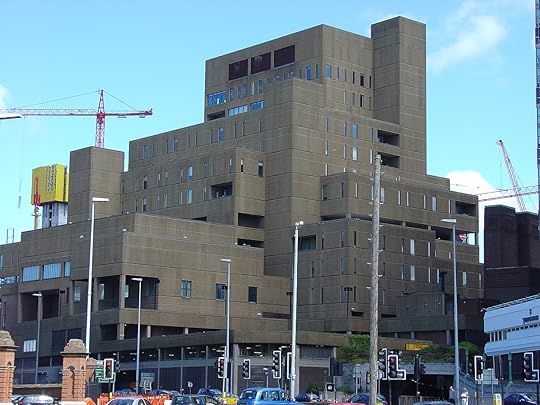
She was a secretary. Later she moved back up north and retrained in IT. She worked at Royal Insurance in Liverpool for nearly thirty years, in an ugly building, an assemblage of dirty yellow blocks with arrow-slit windows, which she and her colleagues were encouraged to call ‘the Sandcastle’.


description

Bridget's mother and father were married only a few years, separating when Bridget was two, but her father claimed custodial visiting rights, and the first part of the novel largely focuses on him. It says much about him that he regards Derek 'Degsy' Hatton as a role model, living in a fantasy world of imagined triumphs and social connections:

My father so relished his own triumphs– or the triumphs of people he thought were like him, like Derek Hatton – that it followed (I suppose) that he took an equal, or an equivalent, portion of pleasure in other people’s failures. Their disappointments, their humiliations. He could never hear enough about the inadequacy of people who weren’t him. And as with his boasting about his past, these things didn’t need to have actually happened for him to enjoy them. The fact that he enjoyed them somehow brought them into being, with each innocuous piece of news you shared with him somehow always ending up as a perfect illustration of some risible misstep. Between your mouth and his ear the facts got bent backwards. So he was neither a prospector nor a connoisseur of human falling short, really, but rather a sort of processing plant which turned all incoming information into the same brand of thrilling treat: that someone had had a knock-back or that someone had looked a fool.

But Bridget and Hen's relationship is at the heart of the novel , and in Bridget's account of her mother, she is someone oddly content with her inadequate lot in life:

That what my mother did or had done was what ‘everybody’ did or what ‘people’ did was sovereign; that it was ‘normal’: she would pronounce that word with urgent emphasis. Other considerations didn’t get much room. Her antipathy to her circumstances was no spur to change; I think it was the opposite, in a way, back then. My mother loved rules. She loved rules and codes and fixed expectations. I want to say– as a dog loves an airborne stick. Here was unleashed purpose. Freedom, of a sort. Here too was the comfort of the crowd, and of joining in. Of not feeling alone and in the wrong.
...
I think she liked finding life a little bit crap. It encouraged her, in a way. ‘Boring’ films, ‘crap’ exhibitions, ‘mad’ people, these she could happily talk about. This was a world she could be part of. And events that had gone wrong: they were a boon, too. One year, she’d been to a lecture where a microphone had failed to work. That cheered her up no end. ‘Talk about It’ll be Alright on the Night,’ she said. ‘Everyone was shouting, “Speak up.” And this poor man was going bright red!’ It hit a sweet spot, an experience like that.


Their mother-daughter relationship is a very distant one. Helen goes through a second, similarly ill-starred marriage, and Bridget, who barely sees her mother on a regular basis, forms a relationship of her own. Helen takes an, unwelcome, interest in her life, but on their annual meet-up, close to their mutual birthdays, Bridget always feels that any conversation has no real connection:

I felt that what I said was being scrabbled through for some currency quite other than meaning or information: rather for the glitter of that old magic coin, the token she could hold tightly and exchange for entry, for a real welcome, into her imagined other.

As with First Love, Riley presents a one-sided first-person narrated view but leaves the reader to form their own, more rounded view - for example on why Bridget refuses to let Helen meet her partner and is reluctant to let her in when one day she tracks down their address on Bridget's door (Helen has to resort to desperation to use the loo to gain access).

Riley described her debut novel, in a 2004 interview, as "very intense, formally aggressive" and while there was black humour to be found in First Love, that element remained. My Phantoms is, while having again comic touches, a rather sadder book, particularly as Helen ages. I am tempted to also say a more mature book, except that could imply a unintended slight to the previous novels.

Overall, not as distinctively striking as First Love, but still worthwhile.

Thanks to the publisher via Netgalley for the ARC.
Profile Image for Kate O'Shea.
1,326 reviews191 followers
March 25, 2023
Why have I not read any Gwendoline Riley before?

I loved this book. It is a dark look at the relationship between a woman and her parents. At the beginning of the book we have Bridget's relationship with her father, who reminded me of the caricature comedy father from Harry Enfield who delights in getting one over on his small boys. There's that sense of I'm better than you that pervades the whole of these chapters. The father delights in trying to wrongfoot his young daughters, who appear to have his measure and give up playing his game very early on.

The rest of the book concentrates on the even more peculiar relationship between Bridget and her mother. This is equally, if not more strained. If the father was a low level bully then the mother (Helen, or Hen) is so passive aggressive it's often painful to listen to. The wheedling, sorry-for-myself voice morphs into verbal attacks so quickly it'd make your head spin. It's hardly any wonder that Bridget becomes the person she is so far as her mother is concerned.

I listened to the audio version which is masterfully narrated by Helen McAlpine (who I note was a finalist for Narrator of the Year). Ms McAlpine does an incredible Liverpudlian accent (my sister in law is from that area and it felt like I was listening to her).

The book itself is not the easiest of reads because of the subject matter but the writing is sublime. Highly recommended for those who enjoy a family story with a twist.
Profile Image for Neil.
1,007 reviews760 followers
December 1, 2020
One thing you quickly notice as you progress through this novel is that the narrator is not going to tell you much about herself: she is far more comfortable when she can direct her attention elsewhere. This can be very frustrating for the reader, but that frustration is actually one of the strengths of the novel.

My Phantoms is narrated by Bridget. In the opening chapters, she tells us about her father, Lee, and her dysfunctional relationship with him. But the majority of the book concerns her relationship with her mother, Hen. As we read, we quickly become aware that there are fault lines in all the relationships (daughter-father, daughter-mother, wife-husband). We also become aware that we are being presented with a one-sided view of those relationships and it is up to us as readers to piece together a more rounded view and draw our own conclusions about what has caused these fault lines.

This is similar to Riley’s previous novel, which is the only other of her novels that I have read, “First Love”. That novel told us about a woman in an abusive relationship but gave us just one side of the argument, so to speak. In my review then, as a woman gave us her evaluation of past relationships, I wrote that “perhaps the strength of the book is that is leaves the readers to evaluate these relationships and decide for themselves where the fault line in the dysfunctional relationship lies.” You could take that novel at face value, or you could read between the lines and see other forces at work, things that the narrator either could not or would not see.

The same applies here. Bridget appears cold and unemotional, and she is not giving us much in the way of insight. Largely, this seems to be because she is almost completely lacking in self-awareness or empathy. This is where the reader’s frustration comes in, because as you read, you will almost certainly begin to wonder why it is that Bridget cannot see what you can see. You will also begin to form your own views on things that Bridget never sees fit to tell us about, or which she chooses not to follow through on. Why, for example, does she not want her mother to meet her boyfriend? And there are hints of something sinister sounding in her parents’ relationship that we can only speculate about.

I really appreciated the writing style in this novel. What could have been a very depressing read was made engaging and absorbing because of the way the narrative is written. Yes, Bridget is frustrating to spend time with because she is oblivious to so much around her, but even in the midst of frustration and damaged relationships, there is humour and there is a lightness of touch.

For me, this probably isn’t as powerful as “First Love”, but, on reflection, I think it feels more mature.

My thanks to the publisher for an ARC via NetGalley.
Profile Image for Adam  McPhee.
1,528 reviews341 followers
July 28, 2023
Great novel. Very powerful rendering of a strange kind of seemingly self-inflicted loneliness, though later we learn this strange personality is a result of trauma from being abused by a husband. The mother divorces and outlives him, yet that social disability sticks with her and only compounds itself over time because the mother has no family/community to integrate into. And the daughter narrator is so interesting too, she realizes early in life that there's can be no real emotional connection with her mother and just manages the relationship coldly, from a remove. But then in those intense dialogues she's variously giving and withholding those weird anecdotes that her mother feeds on in lieu of emotion.

I think this bit of dialogue from the disinterested boyfriend John is pretty clearly the key:

Accomplishes a lot in so little space. Going to be thinking about this one for a long time to come.
Profile Image for Kansas.
815 reviews487 followers
October 1, 2024
https://kansasbooks.blogspot.com/2024...

“No puedo decirte cómo tienes que vivir, mamá. Pero aquí todo tiene pinta de ser un poco provisional, ¿no? Como si pensaras que algo va a sacarte de todo esto, así que da lo mismo. Como si hubiese otra cosa a la que huir.”


Confieso que aunque en un principio me atraía mucho leer a Gwendoline Riley, también me acerqué a este libro con algo de desconfianza. Ya se están convirtiendo en algo repetitivas las historias de familias disfuncionales, y estirando aun más el chicle, las historias de los tiras y aflojas entre madres e hijas. Muy poquitos autores saben contar esto bien y que no suene a falso, a historias forzadas que de alguna forma quieren aprovechar las modas imperantes. Al principio pensé también que esta autora podría tirar hacia la autoficción, y la verdad es que es otro tema en ese aspecto que también está muy en boga y de la que estoy algo cansada. De lo poco que llevo leído sobre ello, Kate Zambreno en su Book of mutter es quién más me ha impactado por lo natural que suena, porque esto de que una novela te emocione por los temas que toca, no es tan fácil y la Zambreno lo consiguió en su momento, pero ya digo que me sorprendió gratamente descubrir que esta obra de Gwendoline Riley no era autoficción, sino una novela y el hecho de que esté escrita en primera persona puede dar lugar a ese engaño, porque la Riley ahonda tanto en la llaga, que durante un momento de la lectura me tuve que replantear y dudar de si realmente era autoficción o no. Este es uno de los detalles que más me han convencido del estilo de Gwendoline Riley, y es el hecho de que inconscientemente vaya calando tanto en una narración aparentemente nada llamativa pero aquí es dónde está su secreto: cala de verdad, sonríes, te turbas, incluso te enfadas con la madre o con lo hija pero como tampoco hay grandes dramas, sino un día a día en diferentes encuentros, es un impacto que funciona más a un nivel cerebral en el que el lector es el que se tendrá que  ajustar y ahondar en los diálogos:: la autora huye de cualquier manipulación y deja que sea el lector el que vaya montando el rompecabezas emocional en su cabeza. Gwendoline Riley en ningún momento se pone sentimental ni rebusca en el corazoncito del lector, sino en un estilo fluido, directo e incluso elíptico, consigue el más difícil todavía: calar.


“Odio. Odio. Odio. Pero mi madre no odiaba. No era más que una palabra que usaba. No era más que su manera de anunciarse. Pensaba que sonaba vital y deslumbrante. Pensaba que la diferenciaba.”


Es difícil no sentirse identificada con algunas escenas, porque esta brecha entre padres e hijos a veces puede ser dificílmente soportable, y ya sabemos que la familia es un tema que puede llegar a ser muy tóxico por lo que exigen de uno. En el caso de esta novela, la narradora, Bridget Grant, ha tenido una infancia traumática debido a la separación de sus padres, eso le pasará factura ya de adulta. Su padre, un egocéntrico de libro, fallecido unos años antes, dejó una huella que contará en diferentes encuentros que pueden resultar muy divertidos pero al mismo tiempo muy incómodos para la niña que fue Bridget, y con una hermana con la que apenas tiene contacto, ve a su madre solo un par de veces al año: “Las dos sabíamos que no valoraba la calidad ni la esencial de ningún encuentro. Exactamente por eso no quería que sucediera.“ Encuentros obligados un par de veces al año que Bridget cuenta en primera persona a lo largo de diferentes momentos durante unos años sazonado de retazos de su infancia, como por ejemplo, cuando su padre la recogía a ella y su hermana para pasar el fin de semana que le tocaba, en la que ambas hermanas miraban por la ventanilla del coche avergonzándose, de la cháchara del padre.... Durante la mayor parte de la novela, Bridget intenta mantener un contacto mínimo con su madre, de cumpleaños en cumpleaños, resultando en unos encuentros incómodos en los que no se entablan conversaciones como tales sino que hay una nube de incomodidad siempre en la atmósfera, una turbación que Gwendoline Riley consigue traspasar al lector, que llegado un punto, se siente un invitado más a la mesa queriendo dar media fortuna por esconderse en un rincón. Una novela basada en diálogos chispeantes pero con una profunda carga psicológica, en la que el lector pronto irá captando que en estos diálogos se esconde mucho más de lo que percibimos a simple vista. Hay un autocontrol continuo por parte de Bridget para no estallar y echarle en cara su infancia a su madre, y esto se percibe perfectamente en la tensión que casi consigue palparse durante la lectura de esta novela.


"La ví muy pequeñita, colgada entre las dos muletas grises. También la vi más vieja, pero es que hacía años que no la veía a la luz del día, aunque la luz diurna que entraba en aquel descansillo era bastante tenue."


El trabajo de la autora es muy sutil, ahonda con una habilidad que admito que me parece muy difícil de conseguir. Esa obsesión que ejerce Bridget por el hecho de que su madre no invada su espacio, su vida privada, intentando mantenerla alejada y estableciendo solo encuentros en restaurantes alejados de su casa, casi que dicen más de la hija que de la madre. Es fascinante el retrato que la autora hace de la madre, Hen, insegura, frágil, acomplejada, siempre huyendo, pero es quizás más fascinante lo que vamos averiguando de Bridget, su hija, porque al ser una narración en primera persona, conoceremos a su madre solo desde su perspectiva, desde su visión de la niña que aun sigue siendo por no haber superado los complejos de su infancia... En apenas dos pinceladas, la autora ha hecho un retrato brutal de dos mujeres, que se parecen mucho más de lo que ellas creen. En apariencia están en polos opuestos, pero no sé hasta qué punto Bridget es consciente de que esa distancia que ejerce hacia su madre o hacia su hermana, la convierten en un alter ego de su madre, porque de alguna forma Bridget ha triunfado en la vida, pero emocionalmente tiene las mismas carencias que su madre.


"- Pero... tampoco era nada personal -dijo John mientras escurría el estropajo-. No tenía nada que ver conmigo ni contigo. Está claro que le da miedo implicarse. Y eso es muy triste. Triste y una defensa. Voy a explicarlo mejor, tú madre estaba en una realidad a priori. Ha sido mi sensación. Una realidad que no iba a ceder ante otra realidad".
- La realidad de la realidad."


Ha sido una lectura que he disfrutado muchísimo por lo que consigue transmitir Gwendoline Riley; el estudio de personajes es bestial por lo sutil y por el finísimo hilo, no tanto que separa a madre e hija sino porque será un hilo que, milagrosamente, todavía las mantiene unidas, un hilo que en cualquier momento podría romperse, y el diálogo ilustra con inteligencia la relación de ambas. Una lectura incómoda, reconocible y totalmente viva. Menos es más, y en este aspecto esta autora triunfa. He adorado el personaje de la madre, Hen, con qué sutil emoción la retrata a través de sus diálogos inseguros, evasivos, huidizos. Aparentemente está todo en los diálogos, pero lo que no se dice es mucho más revelador. Gwendoline Riley es de las buenas. Tiene talento. No la dejéis escapar.


"Al igual que con el odio por su trabajo, por el lugar dónde vivíamos, al igual que con su matrimonio y con haber tenido niños a modo de mascarada de alto riesgo, concebida para engañar a todos menos al Especial, quien se suponía que vería más allá de todo aquello: su aislamiento no podía sino apuntalar todavía más su autoimagen. Era la inadaptada del cuento de hadas. La niña cambiada al nacer. Solo tenía que esperar y ser valiente."

♫♫♫ Ghosts again - Depeche Mode ♫♫♫
696 reviews32 followers
June 9, 2021
I'm fascinated by the glowing reviews of this sad little book. I found it deeply depressing and claustrophobic. Such unhappy solipsistic people, with not a single moment of joy - or even pleasure - in their lives. The writing style was appropriately bland and the dialogue was appropriately tedious to read. But not my sort of book at all.
Profile Image for Tony.
1,032 reviews1,909 followers
Read
December 4, 2023
This is an odd book, but I never didn't enjoy it. It's odd, first and foremost, because of the characters. They're, well, odd. I started just now to describe them, but - backspace, backspace, backspace - I realized that's the whole point of the book: to let the characters act. In other words, the characters are the plot. And I've never really experienced that before, I don't think.

Anyhow, Bridget is the first-person narrator. Through her we meet her father, her mother, and her mother's second husband, all dysfunctional, drawn to the point of caricature. And still, the writing is pared down.

But there's something off with Bridget, too, even though, as narrator, we only see her judgment of others. Yet, she says things that are harsh, cryptic. She can be chillingly distant. We're not totally on her side. There are things not told to us. So, whose fault is the fractious relationship with her mother? And why doesn't she answer the phone when her sister calls? These are things I'd like to know.

But look at me, calling characters in a book odd. What are my Phantoms?
Profile Image for Mark George.
7 reviews15 followers
August 16, 2021
Thankfully I had the time to devour this in one session. One of those books that popped up on my Twitter feed and then just happened to be staring at me from the shelf at work when I walked in the next day. It just had to be read, and I wasn’t disappointed. Riley is devastating in her portrayal of a dysfunctional Mother/Daughter relationship. The dialogue is brutal at times, but Riley handles it all with an insight and a delicacy that allows this slim novel to pack a real punch.
Profile Image for meliverse.
122 reviews36 followers
August 13, 2024
Aile, sinema ve edebiyat için delik deşik edilmeye müsait ne şahane bir kaynak. Elimdeki şey de sonuçları ve hatta sonuçsuzluğuyla iyi bir deneyim yaşattı. Sarsılmayı sevenler için dürüst ve güçlü bir roman. Yüksek lümenli aydınlatmaların altında, Grant ailesinin otopsisindeyiz. Okura bir yandan analiz edilecek yığınla veri bırakılmış, diğer yandan duygudan duyguya, düşünceden düşünceye geçmesine olanak sağlanmış.

Kitap boyunca anlatıcı Bridget Grant geçmişinin “hayaletler”iyle boğuşuyor, ebeveynleriyle, en çok annesiyle. Başlangıçta babasının toksikliklerini anlatmayı tercih etmiş. Baba Lee zevzekliğin sınırlarını zorlamayı seven, tuhaf ve inanılmaz yorucu bir adam. Tekinsizliği nedeniyle onunla ilgili kısımları her an tehlikeli ya da kötü bir şey olacak hissiyle okudum. Babanın zehirli davranışlarına maruz kalan tek kişi Bridget değil, diğer kardeş Michelle de “kurban”lardan biri ve tabi eski eşi Helen (nam-ı diğer Hen) de. Öyle ki Hen, üzerinden yıllar geçmesine rağmen Lee için “Kimseye anlatmadığım şeyler var. Bana yaptırdığı şeyler.” diyor. Bridget ailesinin “işlevsiz”liğinin farkında olacak ki dördünün bir arada olduğu zamanları anlatmaya gerek görmemiş. Bu nedenle “o eski mutlu (!) günlerde” neler yaparlar, ne hissederlerdi pek bilmiyoruz.

Kitabın devamında odağına annesiyle olan ilişkisini alıyor. Artık babası hayatta değil. Yalnızca annesiyle, o da yılda bir kez doğum günü kutlamalarında görüşüyor. Hen oldum olası işinde, yaşadığı yerde, evliliğinde mutsuz, tatminsiz bir kadın. İçinde bulunduğu koşullardan nefret ediyor. Aslında Bridget annesinin “farklı” olmak için nefretle ilişki kurduğunu düşünüyor. Onun hiçbir yere dahil olamadığı gibi sonunda hep dışlanmakla burun buruna geldiğinin, tutunamadığının, hayranı olduğu şairi karısıyla gördüğünde “Ben neden o kadının yerinde olamıyorum.” diyecek kadar yalnız olduğunun farkında. Ancak bu Hen tarifini Bridget yapıyor. Bu tarifteki kadın gerçek Hen mi, emin olamıyoruz. Çünkü anlatıcı Bridget’i de tanımıyoruz. Okura kendisini açmayan, her fırsatta geri çekilmeyi ihmal etmeyen katı biri.

Son doğum günü görüşmelerinin ardından, Hen habersizce Bridget’in evinin kapısına geldiğinde kırılganlıkların onarılabilir olduğuna dair inancımız doğuyor. O kapının önünde Hen’in “Acaba kızım beni içeri alacak mı?” tedirginliği çok ama çok sarsıcı. Okurken Toni Erdmann’ı, Ines’in babasının ziyaret sahnesini hatırladım. Ines babasını gördüğünde şaşırıp “Doğum günüme daha vardı. Neden o zaman gelmedin?” dediğinde, babası şakacı bir tavırla ''Bilet daha ucuzdu.'' diyordu. Aslında Hen de olduğu gibi Ines’in babası da köpeği öldükten sonra içine düştüğü “yalnızlık” üzerine kızıyla bağ kurmak için bir yol aramaya başlıyordu. Artık ne vesileyle olduğundan bağımsız, bir umut, bulduğu her kanalı açmayı deniyordu. Her neyse, o akşamki olaydan sonra da duvara tosluyorlar. Bridget’in şu cümleleriyle onlarla birlikte ben de duvara yapışmış olabilirim. “Fakat iyi niyetle, en azından daha iyi niyetle anneme karşı dürüst davrandığımda bile çabalarım aynı sığlıkta karaya oturuyordu. Dikkatini dağıtabiliyordum ama bundan fazlasını yapamıyordum. Arkadaşlığımdan payına düşeni alamıyor, teselli bulamıyordu. Aslında delik bir kabı doldurmaya çalışıyordum ve bundan ötürü, dikkatini tamamen ve sonsuza dek dağıtamayacağım için o akşamlar genellikle keyifsizlikle sonlanıyordu; onu oyalayacak kalıcı bir şeyin yokluğunda eline tek geçen buydu: Hiçlik.”

Anlaşılması, içinden çıkılması zor bu anne ve kız ilişkisindeki roller çok dağınık, eller birbirine bir türlü uzanamıyor. Beklentiler ve onlara karşı geliştirilen savunma mekanizmaları çok keskin, çok açmaz. Annenin de kızın da performe ettikleri rollerin ardını görmeye gönüllü olup olmadıklarını sorgulatacak pek çok gelişme yaşanıyor. Bridget ve annesi her defasında az önceki örnekte olduğu gibi duvara toslayacaklarını bilerek neden bu işlevsiz ilişkiyi sürdürmeyi seçiyorlar? Bağlılıkla bir ilgisi olabilir mi? Örneğin, Bridget annesiyle konuşacak konu bulma çabasıyla ona Elene Ferrante romanlarını hediye ediyor. O romanlarda kendisine tanıdık gelecek bir şeyler bulacağını, hoşlanacağını umuyor. Ancak burada da atılan bebek adımları sonuçsuz kalıyor. Böyle ne çabalar, ne çabalar var.

Kimse içine doğduğu aileyi seçemediği gibi dünyaya getireceği çocuğu da seçemiyor. Çoğunlukla içinde bulunulan ortamın adı “aileyse” yaşananlarla "uyumlu" olmak en kolay (?) olan tutum. Oysa hepimiz biliyoruz ki bir insanın başka bir insana yap(a)mayacağı şeyler aile içinde rahatlıkla yapılabiliyor. Çoğunlukla bunlar sorgulanmıyor bile. Dünya bunun mağdurlarıyla dolu. Tüm bunlara bakarak bu romanda haklı ya da haksız ayrımı yapmak neredeyse imkansız, o muhasebede kimi nereye konumlandıracağımız muallak. Sanırım kitabın okura bir tarafı işaret etmiyor olmasından tamamından olduğu gibi çok hoşlandım.
Profile Image for merixien.
671 reviews669 followers
January 30, 2025
Aile anlatılarını okumayı genel olarak seviyorum. Ancak Hayaletlerim beni arada bırakan bir kitap oldu. Kitabın size hazırladığı büyük sürprizler ve karmaşa yok ama bir şekilde elinizden bırakmadan okuyorsunuz.

Anlatıcımız Bridget, tekil halleriyle bile asla bir aile kurmaması gereken kişilerken, gidip birbirlerini bulup evlenen ve ebeveyn olan iki insanın kızı. Kitap ilk önce babasıyla ilgili anılarıyla açılıyor ki bu bölümün kısa tutulmasına ayrıca memnun oldum. Zira Lee Grant’ın zehirli, narsist, zorba ve yalancı karakterine dayanacak gram sabrım kalmamıştı. Michelle ile Bridget yerine sinirlenmekten helak oldum adeta. Sonrasında kitabın ana konusu olan anne-kız ilişkisine geçiyoruz ki bu noktadan sonrası tam bir duygusal rollercoaster. Tam Helen’i anlamaya çalışıp sempati duymaya başlıyorsunuz ki bir anda bir duvara çarpıp öylece kala kalıyorsunuz. Aynı hissi Bridget ile de yaşıyorsunuz. Gwendoline Riley adeta bu aileyle bir bağ kurmanızı ya da içlerinden birisini kendi kanatlarınızın altına almanızı asla istemiyor, buna izin vermiyor. Yine de kitap boyunca Helen’in birkaç kere tekrarladığı “herkesin yaptığı buydu, çocuk yapmak da mecburiydi.” cümlesi bu işlevsel ailenin özünü açıklıyor gibiydi. Başta da dediğim gibi size hazırladığı sürprizler yok ama büyük -hatta bazı noktalarda gaddarca- bir dürüstlükle doğrusal ilerleyen sorunlu bir aile hikayesi. Açıkçası ben biraz da Michelle’in iç dünyasını ve karakterini de görmek isterdim. Çünkü annesiyle babasının karakterinden çok fazla iz taşıyan Bridget’in isyanlarının arkasında çoğu yükü yüklenip sessizliğe gömülen kardeşi daha çok merak ettim. Eğer anne-kız ilişkilerini okumak ilginizi çekiyorsa ve kararsız, narsist, drama queen aile üyelerine gösterecek yeterli sabrınız varsa bir şans verin.
Profile Image for Emmeline.
442 reviews
August 8, 2022
My sister calls incredibly depressing books or movies “wrist-slitty,” and I was full on ready to slit both wrists after this one. I would say there’s a spectrum of “depressing” and “tragic,” with Greek plays and Thomas Hardy being on the tragic side – all the bad feelings come with a flip side of exhilaration because of the intersection of character flaws and bad luck, and this for me was more purely depressing. There was no exhilaration. I recognized what was happening, it stirred up some familiar but unpleasant feelings. That isn’t to say there’s no artistry in the book; there’s plenty. But you’ll only want to read it if you can handle some serious doom and gloom.

It's a tight narrative circling around the relationship between Bridget (approximately forty) and her mother Hen. Bridget is educated and has moved up in the world. Hen, though from a middle-class family, has settled into a kind of solvent but uninspiring existence after two bad marriages.

Bridget and Hen have dreadful communication. They speak in yearly meetings, and by the occasional misunderstood text message. They are incapable of bonding over anything – shared history, Coronation Street, Elena Ferrante. Bridget moves resolutely forward with her life, refusing to introduce her mother to her long-term partner. Hen is constantly on the go, and yet her life remains static and unsatisfying. She claims to want very little. Bridget declares she has a constant look of “expectation” on her face, an expectation which is impossible to satisfy. Most of the book consists of pared back, elegantly written exchanges between the two, though an early section deals with Bridget’s father.

All in all I found this impeccably written and worthy of thought and discussion. It is full of the everyday truths of awkward family relationships, in which one person has left the other behind… or thinks they have.

At the same time, it was so unrelievedly bleak and depressing that I admit I was happy when the brief 200-odd pages came to an end.
Profile Image for fantine.
250 reviews757 followers
August 26, 2022
One of the best-written explorations into the complexities of mother-daughter relationships I have ever read.

A woman is young and bright and then has a breakdown in college. She falls pregnant and then decides to have another baby. Her marriage is traumatic, but we don't know this until later. This is just what women do, what is expected of them, she tells her youngest.

The second daughter of Helen dubbed 'Hen' is Bridget and navigating her relationship with her mother has never been easy. There seems to be, beneath their polite veneer, no familial bond.

The women live an ebb and flow of reaching out and pushing back, never acknowledging their deep-seated resentment towards each other. Hen does seem a ridiculous woman; unable to live too long in one place until she finds an irredeemable quality, in a constant state of searching for friends whilst complaining of the ones she has, and, is unable to maintain intellectual conversation–a failing Bridget fixates on. Her passion seems to be Soap operas and sudoku, and she repeats a limited series of catchphrases that delight only herself.

We learn all this through a first-person limited perspective. The narration is detached and pleasant as if the story of her ridiculous mother’s life is an anecdote being told to a dinner party. The flippancy in which Bridget describes her mother’s behaviour, especially in times of distress, becomes bewildering. Hen’s failings as a parent seem to include her working-class status, with Bridget, a well-educated, now well-to-do young woman often comparing her mother’s behaviour to animals. She takes enjoyment, acting almost triumphant when Hen makes simple mistakes or embarrasses herself. She is not like her mother, she makes this very clear. Hen is cringy, she says weird things, is attracted to disaster and certainly self-absorbed, but the thing is, she is charming to almost everyone except Bridget.
As Hen grows older and begins to need help and care, it becomes clear that there is a deep anger and sadness in these women, both traumatised by the same narcissistic man in different ways. It feels as though Hen has been stunted by her experiences, her behaviour often teenagerly. Bridge matured young and resents this motherly role she takes on, treating her mother like a not particularly bright child. Neither acknowledges this cycle, but we hold out hope all the way to the end, that they will heal.

There comes a time in life, often when we near the age our parents were when they had us, that the realisation that they are human beings sinks in. This is hard to accept of mothers, especially mothers who bared the full weight of parenting and became family figureheads, non-human entities with the power to punish and reward. When does it become, as an adult, our responsibility to take care of them, to hear their pain as they heard ours? There is a great deal of guilt in acknowledging the suffering our mothers may have endured by bringing us into the world.

In one of the most heartwrenching moments in this novel, and one of the only instances Bridget’s guilt feels more than implied is when Hen, in a moment of extreme vulnerability tells her daughter that there are traumas inflicted upon her by her ex-husband, Bridges father, that she has never told anyone. Things he made her do. Bridget gives an appeasing ‘Right’, before distracting her with searching for therapists in an action that feels akin to giving a baby a rattle. Before this interaction as Bridget tries to convince her mother to get therapy, she says “You’ve had a tough time. Wouldn’t you like someone to acknowledge it?”
This marks a shift in the novel, as we begin to understand how vast the chasm between them is, and that Hen, through the eyes of Bridget may not be entirely accurate.

This was a stunningly complex novel, the indifferent voice may throw some off but persevere and you will be rewarded. The disconnection holds space for the reader’s experiences, for nuance, and for an aching.

I forgot this book at home whilst away for 3 months, so took a break halfway through. I might have given this five stars if I hadn't taken this pause and forgotten parts. I will definitely reread at some point.
Profile Image for Sarah.
1,251 reviews35 followers
March 30, 2021
4.5 rounded up

ETA: rounded my rating up... more to follow!

My first Gwendoline Riley novel, and I wasn't quite sure what to expect from My Phantoms - the early reviews led me to expect something impressive, but I wasn't quite prepared for the hefty emotional punch this slight novel packed.

Bridget is our narrator, but she is someone we only glean snippets of information about through her interactions with others. I took the "phantoms" of the title to be that of her parents, given what we learn about her relationship with them: they come across as two people who seem to have their own complex issues, with this indicated through Bridget's direct interactions with them, but it is also alluded to that her mother, Hen, had a fraught marriage with Bridget's father, which was quite likely abusive. I suppose equally Hen, too, is haunted by her own phantoms - the life she believes she deserves to have, and is not quite what she feels she has been promised (but, as Bridget says: promised by who?).

It is clear from Bridget's interactions with her mother that they have never really seen eye to eye, and Bridget's struggles to communicate with her mother seem to stem from her mother's uncertainty of her own self; with Bridget's partner, John, being a therapist, she is able to see this perhaps more clearly than others might. What makes this novel work so well is the way Riley deftly insets the reader into Bridget's head. As a reader I felt her frustrations with her mother deeply. Some may consider that her attitude towards Hen is at times petulant and callous, but it is clear that Hen herself has much unresolved trauma, making her a difficult person to be around and to have a genuine relationship with. The way their relationship is written makes it feel wholly real, and is brilliantly evoked through their interactions and conversations.

Not a light read, but still highly recommended.

Thank you Netgalley and Granta for the advance copy, which was provided in exchange for an honest review.
Profile Image for reading is my hustle.
1,673 reviews347 followers
March 9, 2023
Bridge? she said. Bridge?

woah. this book set me on edge. it's a bleak story about a mother daughter relationship that has no easy answers; this is not a relationship that can be fixed. each interaction between the two is a repeat of the last. both seem to want something different though that never happens. you learn about the narrator (bridget) via a series of conversations with her mother (hen). hen has an inexplicable hold over bridget & i couldn't work out why she continued to be so angry . the tension between the two is mean, stunted, & missing joy or warmth. riley is a master at dialogue & i'll be incorporating he does not seem overburdened with manners into my conversations. i love her for that.
Profile Image for JacquiWine.
676 reviews174 followers
December 15, 2021
(4.5 Stars)

My Phantoms is Gwendoline Riley’s sixth novel, a brilliantly observed, lacerating portrayal of a dysfunctional mother-daughter relationship that really gets under the skin. This book has attracted a raft of praise recently, largely prompted by Andy Miller’s enthusiastic support for it on Twitter. It’s a deeply uncomfortable read, veering between the desperately sad and the excruciatingly funny; and yet, like a car crash unfolding before our eyes, it’s hard to look away.

The novel is narrated by Bridget, who is difficult to get a handle on, other than what she tells us about her parents, Helen (aka ‘Hen’) and Lee Grant. Lee, who features heavily in the early chapters of the book, is one of those awful men who delight in badgering anyone who happens to fall within their orbit, physically pinching or goading his daughters on a regular basis. Bridget and her sister Michelle employ various strategies to pre-empt and deal with his mockery – some of them successful, others less so. He is a truly dreadful character, but sadly all too recognisable. (I had an uncle in a broadly similar vein, a loudmouth who taunted me for going to university when I really ought to have been working to earn a proper wage.)

He [Lee] could never hear enough about the inadequacy of people who weren’t him. And as with his boasting about his past, these things didn’t need to have actually happened for him to enjoy them. The fact that he enjoyed them somehow brought them into being, with each innocuous piece of news you shared with him somehow always ending up as a perfect illustration of some risible misstep. Between your mouth and his ear the facts got bent backwards. So he was neither a prospector nor a connoisseur of human shortcomings, really, but rather a sort of processing plant which turned all information into the same brand of thrilling treat: that someone had had a knock-back or that someone had looked a fool. (p. 21–22)

Hen is another complex, deeply flawed character, albeit in a completely different way to Lee. Now in her late sixties, twice-divorced and living alone in Manchester, Hen is constantly trying to join social clubs and groups without ever developing any real friendships or meaningful relationships with others. Any degree of emotional investment on Hen’s part is sadly lacking. Moreover, there is a sense of Hen doing these things without deriving any enjoyment or pleasure from them, going through the motions of a social life because it’s what people should do.

To read the rest of my review, please visit:

https://jacquiwine.wordpress.com/2021...
Profile Image for Baz.
360 reviews397 followers
September 12, 2022
Bitter, caustic, awful. Riley’s story of a young woman’s account of her fucked-up parents, and her relationship to them, is a thrillingly creepy, chilling one. The scale is small, but the psychology goes deep, quickly, immediately, and the reader is in it from beginning to end. It’s an onslaught, and I was captivated, not wanting to come up for air.

Riley is an excellent prose stylist. No word in it is extraneous. Her phrasing, the way her sentences move, the fluency, are a pleasure. She’s very clever, funny in a way that is not amusing, and very sharp. The writing doesn’t necessarily flaunt, but any reader who’s alert to word choice and well-crafted sentences will acknowledge and get pleasure from the panache and swagger and sophistication of the prose.

These are embattled characters. Hard, edgy, domineering. Riley writes them powerfully, with great control. They’re so disturbing, but my heart went out to them? To everyone except the father, that is. And isn’t that the point.

Near the end the narrator’s sister says about their mother, ‘She’s furious. You can feel it coming off her.’ Similarly you can feel, throughout the book, the keyed-up narrator’s barely contained, boiling emotions coming off the pages, like steam.

A great read.
Profile Image for María Amparo.
348 reviews85 followers
October 13, 2025
Aunque me costó un poco entrar en la historia por la particular y directa forma de contar de Riley, la verdad es que justamente este estilo ingenioso-lacónico, preciso y de una mordacidad quirúrgica consiguió atraparme. ¿Y cómo no, por otra parte? Una historia tan particular que sin embargo puede hacerse extensiva a cualquiera de nosotros, y a nuestras escarpadas relaciones con madres, padres y hermanos/as.

Riley se centra en el retrato de la madre, pero la descripción de esa madre y sus carencias al final son también las de la narradora. Y como he dicho, no resulta difícil identificarse con su frustración y con su pereza.

Sin embargo, confieso que me han resultado extraordinariamente interesantes los pocos capítulos dedicados al padre. Creo que es el más gráfico y perfecto retrato del marichulo básico que he leído, y sin necesidad de florituras o discursos. El ejemplar solo necesita la prosa firme y despiadada de Riley para comprenderle y odiarle. A diferencia de este, a la narradora, la madre le inspira ternura pese a enorme incordio que le supone.
Profile Image for Banu Yıldıran Genç.
Author 2 books1,425 followers
December 21, 2024
sevgili başak güntekin önerdi bu kitabı okumamı. malum “annelik” en önemli dertlerimizden, “anneler ve kızları” da varoluşumuzu belirleyen yegane unsurlardan biri. gwendoline riley genç sayılabilecek bir yazar ve hemen hemen tüm yazdıkları ses getirmiş. “hayatletlerim” altıncı romanı.
anlatıcımız bridget, annesi helen’i anlatmaya başlıyor önce. helen tek çocuk, kendisiyle ilgili limitli bilgi veriyor, garip sınırları var, kocası lee’den boşanıyor ve iki kızıyla onlar evden ayrılana dek ve sonrasında yine uzaklarda bir yerde, coğrafi olarak değil, ruhen. arkadaş edinemiyor, gelip geçici hevesleri var, hiçbir şeyde tutunamıyor.
sonra bridget’in gözünden babayı tanıyoruz. evlerden ırak. sorumsuz, büyümemiş, irrite edici bir erkeklik timsali. adam kızlarını aşırı derecede rahatsız etse de helen bir gün bile eski kocasıyla yüzleşip konuşmuyor. kızları hazırlayıp paketleyip gönderiyor her hafta sonu.
sanırım ortadoğu ve akdeniz’in kesişiminde aile odaklı yaşadığımız işin bu romandaki aile ilişkilerini mümkün değil anlayamadım. anlatıcımız bridget sağlıklı sanmayın sakın, o da kendini bize hiç açmadığından neden annesini bir kez olsun evine çağırmadığını, neden ablasıyla görüşmediğini hiç anlayamıyoruz. ortada aktarılan, ipleri kopartan majör bir problem de yok.
hiç görüşmeyen iki kızkardeş, oradan oraya taşınan anne ve annesinin evine 5 yılda 1 ameliyat sonrası vs yardımcı olmak için giden kızları. aklım almadı desem yeri.
noel, doğum günü vs için yılda 1 dışarda buluştuklarında hep gerilen muhabbetler. evet bridget’in annesiyle derdi var ve kesinlikle ne o ne annesi bu konuyu konuşup çözmeye yanaşıyor. roman boyunca bu beni delirtti.
sonlara yaklaştığımızda hiç tanımadığımız abla michelle’in çok daha yumuşak ve fedakar olduğu ortaya çıkıyor. açıkçası yazarın bizi her karakterden bu denli uzak tutmasını pek sevmedim. annie ernaux tarzı dibine kadar samimiyeti daha çok seviyorum.
annenin hastaneye kaldırılması sonrası bi zahmet refakatçi olan bridget’ın (refakat de bizdeki gibi 7/24 değil, akşam 6 dedin mi yallah otele) hasta kadına ettiği laflar, çocuk gibi didişmesi, kapris yapan ölümcül hasta kadına memnun olmayacağını bilseydim gelmezdim sıkıntıdan öldüm 4 gündür filan demesi beni şoktan şoka soktu. bence bridget’ta ana-babasının açtığı derin yara ve sorunlu davranış asıl olarak burada gün yüzüne çıktı.
bilmiyorum çok mu ebeveyn odaklıyım ama babamın hastalığındaki halimizi düşündükçe romanda yaşananlar beni gerdi. romanın bence en etkileyici yeri finaliydi. bakımevi ve cenaze görüntülerinin birleşmesi, koltuktan mekanizmayla kaldırılan hastanın gözümün önünde taşınan tabut, hatta yakılmaya taşınan tabut imgesi oluşturması yazarın gücünü en sonunda hissetmemi sağladı.
iş bankası çağdaş dünya edebiyatı, hep çok iyi çeviri ve editörlüklerle ilerliyor.
This entire review has been hidden because of spoilers.
Displaying 1 - 30 of 745 reviews

Can't find what you're looking for?

Get help and learn more about the design.