

What do you think?

A Coming of Age
Danger in Paradise.
The first colonists to reach Tigris thought they had found Eden... but the planet had a horrifying effect on their children. Babies born there developed frightening telekinetic powers at the age of five. No one could control them -- and as the changelings grew and became aware of their abilities they initiated a bloodbath of chaos and violence that nearly destroyed the planet.
Two centuries after the Lost Generation, Tigrins have learned to cope with their strange planet and its effects. But a new threat is rising. In secret a medical researcher is experimenting with the TK ability. His guinea pigs are stolen children; his object, to extend their powers past adolescence and into adulthood. If he succeeds, Tigris faces disintegration.
The first colonists to reach Tigris thought they had found Eden... but the planet had a horrifying effect on their children. Babies born there developed frightening telekinetic powers at the age of five. No one could control them -- and as the changelings grew and became aware of their abilities they initiated a bloodbath of chaos and violence that nearly destroyed the planet.
Two centuries after the Lost Generation, Tigrins have learned to cope with their strange planet and its effects. But a new threat is rising. In secret a medical researcher is experimenting with the TK ability. His guinea pigs are stolen children; his object, to extend their powers past adolescence and into adulthood. If he succeeds, Tigris faces disintegration.
294 pages, Paperback
First published January 1, 1984
About the author
Timothy Zahn
506 books8,821 followersTimothy Zahn attended Michigan State University, earning a Bachelor of Science degree in physics in 1973. He then moved to the University of Illinois at Urbana-Champaign and achieved an M.S. degree in physics in 1975. While he was pursuing a doctorate in physics, his adviser became ill and died. Zahn never completed the doctorate. In 1975 he had begun writing science fiction as a hobby, and he became a professional writer. He and his wife Anna live in Bandon, Oregon. They have a son, Corwin Zahn.
Ratings & Reviews
Friends & Following
Create a free account to discover what your friends think of this book!
Community Reviews
Displaying 1 - 30 of 32 reviews

May 8, 2008
I can't even describe how wonderful this book is. In a post-earth world, children are endowed with telekinesis, a power they lose once they hit puberty. Since kids have all the power, great strides are taken to keep them in check, and evil "Oliver Twist-like" people are out to take advantage of their abilities. This book uses that backdrop to evoke the very real bittersweetness of simply GROWING UP. Like all great science fiction, the futuristic settings and fantastical elements are all just a stage to tell a story truer to our own lives. This book is out of print. I had to buy a used copy on Amazon a couple years back. But an amazing read through and through.

January 12, 2016
Zahn can do better than this. Much better.
Perhaps this was an early learning-to-write story.
Perhaps this was an early learning-to-write story.

August 2, 2026
Un romanzo semplice nello svolgimento, ma decisamente complesso nelle implicazioni filosofiche.
Sul pianeta Tigris una colonia umana appena installata scopre che i loro figli iniziano a sviluppare potenti poteri telecinetici dall'età di cinque anni; questi svaniscono con la pubertà che, su Tigris, viene chiamata Transizione.
Due secoli dopo la Generazione Perduta, ossia la generazione di bambini telecinetici che ha quasi distrutto la civiltà umana, assistiamo ad una società umana alquanto strana. I bambini dall'età di 5 anni vengono portati dai genitori negli "alveari" dove passeranno l'infanzia sotto il controllo dei preadolescenti (ancora dotati di poteri telecinetici) a loro volta controllati dagli adulti ormai privi di questo potere.
I bambini sviluppano i loro poteri telecinetici, lavorano attivamente sotto la guida di preadolescenti e adulti e non vanno a scuola. Non sanno leggere o scrivere: fu proprio la capacità di conoscenza, oltre al potere telecinetico a portare la civiltà umana sull'orlo della distruzione. Così abbiamo gli adulti che dominanno la conoscenza ed i bambini condizionati all'obbedienza che posseggono il potere ma non hanno il sapere.
Andranno a scuola dopo la transizione, ossia verso i 13 o 14 anni, imparando a leggere, scrivere e far di conto a partire da quell'età.
Il libro è un mystery SF, presenta come protagonisti principali un detective di polizia adulto ed il suo braccio destro, ossia un preadolescente, affiancati da Lisa, una preadolescente precoce che, violando le regole, inizia ad imparare a leggere ed a scrivere mentre possiede ancora i poteri.
I villains sono principalmente un "fagin" ed i suoi bambini. Sì, Zahn ha elevato il nome del villain di Oliver Twist a categoria di criminali, la principale di Tigris, perché se riesci a controllare dei bambini che hanno poteri telecinetici allora questi lavoreranno per te e farai soldi.
Quindi una sequenza di scene d'azione molto ben fatte e con una sequenza lineare di pensiero assistiamo all'indagine del detective per rintracciare un bambino di 5 anni rapito da quello che sembra essere il maggiore scienziato del pianeta. Forse per esperimenti destinati a prolungare i poteri telecinetici dopo la pubertà? Forse perché è il suo padre naturale che lo ha salvato da neonato da un fagin?
La psicologia dei personaggi è molto dettagliata e ben definita ed è, soprattutto, credibile nelle premesse del romanzo. Un gran bel romanzo che obbliga a riflettere su molti argomenti.
4 stelle e mezza.
Sul pianeta Tigris una colonia umana appena installata scopre che i loro figli iniziano a sviluppare potenti poteri telecinetici dall'età di cinque anni; questi svaniscono con la pubertà che, su Tigris, viene chiamata Transizione.
Due secoli dopo la Generazione Perduta, ossia la generazione di bambini telecinetici che ha quasi distrutto la civiltà umana, assistiamo ad una società umana alquanto strana. I bambini dall'età di 5 anni vengono portati dai genitori negli "alveari" dove passeranno l'infanzia sotto il controllo dei preadolescenti (ancora dotati di poteri telecinetici) a loro volta controllati dagli adulti ormai privi di questo potere.
I bambini sviluppano i loro poteri telecinetici, lavorano attivamente sotto la guida di preadolescenti e adulti e non vanno a scuola. Non sanno leggere o scrivere: fu proprio la capacità di conoscenza, oltre al potere telecinetico a portare la civiltà umana sull'orlo della distruzione. Così abbiamo gli adulti che dominanno la conoscenza ed i bambini condizionati all'obbedienza che posseggono il potere ma non hanno il sapere.
Andranno a scuola dopo la transizione, ossia verso i 13 o 14 anni, imparando a leggere, scrivere e far di conto a partire da quell'età.
Il libro è un mystery SF, presenta come protagonisti principali un detective di polizia adulto ed il suo braccio destro, ossia un preadolescente, affiancati da Lisa, una preadolescente precoce che, violando le regole, inizia ad imparare a leggere ed a scrivere mentre possiede ancora i poteri.
I villains sono principalmente un "fagin" ed i suoi bambini. Sì, Zahn ha elevato il nome del villain di Oliver Twist a categoria di criminali, la principale di Tigris, perché se riesci a controllare dei bambini che hanno poteri telecinetici allora questi lavoreranno per te e farai soldi.
Quindi una sequenza di scene d'azione molto ben fatte e con una sequenza lineare di pensiero assistiamo all'indagine del detective per rintracciare un bambino di 5 anni rapito da quello che sembra essere il maggiore scienziato del pianeta. Forse per esperimenti destinati a prolungare i poteri telecinetici dopo la pubertà? Forse perché è il suo padre naturale che lo ha salvato da neonato da un fagin?
La psicologia dei personaggi è molto dettagliata e ben definita ed è, soprattutto, credibile nelle premesse del romanzo. Un gran bel romanzo che obbliga a riflettere su molti argomenti.
4 stelle e mezza.
November 6, 2019
While this book's core concept was interesting, and a neat way to approach a power imbalance between teens and adults, I didn't feel like it explored the ramifications as much as it could have. This is largely a mystery novel in terms of structure and focus, but there's little mystery to it when multiple POVs show us almost every part of the plot long before the protagonists discover them.
Atmospherically, it reminded me of McCaffrey's Crystal Singer books - something about the sci-fi setting being used to marry technology and supernatural powers.
Also: I always pictured the kids flying crosslegged, as if they were sitting on invisible carpets, which was kind of hilarious
Atmospherically, it reminded me of McCaffrey's Crystal Singer books - something about the sci-fi setting being used to marry technology and supernatural powers.
Also: I always pictured the kids flying crosslegged, as if they were sitting on invisible carpets, which was kind of hilarious

July 11, 2010
As I have mentioned previously, Timothy Zahn is my absolute favorite author. I first read his works with Heir to the Empire and have continued to enjoy his non-Star Wars books. As a mini-goal, I have decided to read all of his works. This was another of his older works that I picked up in a used bookstore.
Plot:
The planet Tigris is strange not necessarily for its flora, fauna, or alien life. Something about the planet has bestowed a "gift" upon anyone between the ages of 5 and puberty--telekinesis. This "gift", however, quickly turned into a curse during the Lost Generation, in which much technology was lost. Since then, society has changed to reign in the children who have this ability to "teek" anything they see or touch.
Lisa Duncan is a preteen (actually 14, but she hasn't yet reached puberty) who is not looking forward to losing her gifts in Transition. So, she decides to get ahead on some schooling and learn how to read. However, this proves to be a serious error and leads her into much trouble.
Meanwhile, a scientist, Dr. Matthew Jarvis, kidnaps a 5-year old orphan boy and starts some break-through experiments on him that could uproot the entire Tigrin society. Stanley Tirrell and his righthand, Tonio, a preteen, rush out to find the lost boy and to keep Dr. Jarvis' discovery from falling into the wrong hands.
Good:
Wow! I was not exactly looking forward to reading this book just because the concept didn't sound that interesting. But as I started reading, the story drew me further and further in. I felt Lisa's pain at seeing her childhood come to a close. I understood her actions to try to "get ahead" of the crowd. I also cheered on Tirrell and Tonio as they slowly picked their way through the rubble of the mystery.
Besides pretty interesting characters (namely Lisa Duncan and Tirrell in a smaller sense), the story is awesome. Timothy Zahn creates this world without spending pages upon pages of boring history lessons. He retells it only as necessary and convinces me as the reader that the characters know their history and don't feel like they have to regurgitate it for the audience to understand what is going on.
There is enough action towards the end to grip the audience. You are never quite sure who will win in the end.
Bad:
Very minimal. The language was quite intense, which was quite unlike Zahn. Also, the villain, Omega, was rather dry, certainly nothing like his villain, Thrawn.
Dialogue/Sexual Situations/Violence:
A lot of da**, he**, and sh**. Mention is made of a sexual relationship between two teens and the kidnapped child is illegitimate. The Lost Generation wrought havoc on society 200 years previously. Omega is not afraid to use children and their teekay power to harm others.
Overall:
Impressive! Most impressive! For a book that I thought would be dull, this kept me very entertained. Give it to Timothy Zahn to pull off another good book!
Plot:
The planet Tigris is strange not necessarily for its flora, fauna, or alien life. Something about the planet has bestowed a "gift" upon anyone between the ages of 5 and puberty--telekinesis. This "gift", however, quickly turned into a curse during the Lost Generation, in which much technology was lost. Since then, society has changed to reign in the children who have this ability to "teek" anything they see or touch.
Lisa Duncan is a preteen (actually 14, but she hasn't yet reached puberty) who is not looking forward to losing her gifts in Transition. So, she decides to get ahead on some schooling and learn how to read. However, this proves to be a serious error and leads her into much trouble.
Meanwhile, a scientist, Dr. Matthew Jarvis, kidnaps a 5-year old orphan boy and starts some break-through experiments on him that could uproot the entire Tigrin society. Stanley Tirrell and his righthand, Tonio, a preteen, rush out to find the lost boy and to keep Dr. Jarvis' discovery from falling into the wrong hands.
Good:
Wow! I was not exactly looking forward to reading this book just because the concept didn't sound that interesting. But as I started reading, the story drew me further and further in. I felt Lisa's pain at seeing her childhood come to a close. I understood her actions to try to "get ahead" of the crowd. I also cheered on Tirrell and Tonio as they slowly picked their way through the rubble of the mystery.
Besides pretty interesting characters (namely Lisa Duncan and Tirrell in a smaller sense), the story is awesome. Timothy Zahn creates this world without spending pages upon pages of boring history lessons. He retells it only as necessary and convinces me as the reader that the characters know their history and don't feel like they have to regurgitate it for the audience to understand what is going on.
There is enough action towards the end to grip the audience. You are never quite sure who will win in the end.
Bad:
Very minimal. The language was quite intense, which was quite unlike Zahn. Also, the villain, Omega, was rather dry, certainly nothing like his villain, Thrawn.
Dialogue/Sexual Situations/Violence:
A lot of da**, he**, and sh**. Mention is made of a sexual relationship between two teens and the kidnapped child is illegitimate. The Lost Generation wrought havoc on society 200 years previously. Omega is not afraid to use children and their teekay power to harm others.
Overall:
Impressive! Most impressive! For a book that I thought would be dull, this kept me very entertained. Give it to Timothy Zahn to pull off another good book!

November 30, 2020
A Coming of Age by Timothy Zahn is exactly the kind of thing Tim Zahn is good at writing: a whodunit with a science fiction milieu and a heavy dose of intrigue. Is is also further evidence that Zahn is the most consistent sci fi writer in the business, as it was published in 1984, and I honestly couldn’t tell. The man just keeps writing to the same standard, year in and year out. This was only his second published novel, but Zahn did have a couple of dozen short stories in print by then, which is less common now for an author just starting out.
I suppose one clue as to the age of the book might be the psychic powers: an idea that was pushed heavily by John Campbell and a frequent element of Campbelline era science fiction, but has since fallen out of fashion. On the world of Tigris, children develop telekinetic powers at around the age of five. Their strength continually grows as they do, with pre-teens capable of lifting thousands of pounds of weight at once, until it all abruptly comes crashing down on them at about puberty as their powers fade.
Zahn’s strength as a world-builder is in taking a world fundamentally like our own, changing one thing, and following the implications to a logical end. And in this case logic takes you to some pretty strange places. In this world, almost all heavy labor is done by children. Mining, construction, even power generation. All of that psychic power gets put to work.
Schooling, on the other hand, does not even begin until puberty hits, and the power fades. Partly this is because children are useful, and partly this is rooted in the bitter experience known as the Lost Generation that haunts Tigrin history. Since this is a whodunit, I won’t spoil exactly what that entails. The result of that cataclysm is that all children are taken from their parents around age five, and raised in the unsubtly named Hives.
A predilection for child labor isn’t the only thing that the world of Tigris shares with Georgian England. Power, ignorance, and naiveté make telekinetic children popular targets of scam artists and conmen know as Fagins, since copies of Oliver Twist seem to have survived the Lost Generation. Small minded Fagins might content themselves with training children to be pickpockets and thieves, but whole new vistas in crime are available on Tigris.
This is an element that makes A Coming of Age seem more contemporary to me. Zahn’s description of the psychology of grooming is all too accurate. Today, when the McCarrick Report is freely available, and organizations like the Boy Scouts offer training courses on how to spot the manipulation of children, this knowledge is easier to come by now than it would have been in the 1980s.
Another bit done well is the technobabble surrounding the research of one of the characters on why telekinesis ends around puberty. I am close enough to the world of small-molecule hormone research to have heard this kind of thing myself, and while I’m far from an expert in the field and thus unable to offer any substantive assessment, Zahn did at least capture the feel of how researchers in this field tend to talk about their work, rather than assembling complex-sounding but otherwise nonsense words.
As the title tells us, this is not only a whodunit, but also a coming of age story. A girl on the cusp of womanhood faces the Transition, when she will lose her powers, move out the Hive in which she has grown up, and join the wider society. Anticipation, fear, and a terrible awkwardness are all on display as this fourteen year old comes to terms with what growing up means on Tigris..
It is relatively common for cultures to have sharply delineated worlds for children and adults, with a rite of passage marking the boundary between the two. Tigrin society, like ours, does not formally differentiate between genders, which makes some sense as telekinesis eliminates many of the physical differences. However, rites of passage are almost always strongly gendered when they do exist. I wonder whether Tigrin society mostly lacks a true rite of passage, as there are many hints it doesn’t go well.
However, we do not actually see the Transition in the text, only its shadow looming over everyone. Which is just as well, while it is a fun thing to speculate about, I’m not sure it would have made this book more interesting to see the event itself. The Transition impels many characters to act as they do, but everyone has a different relationship to it. For some, it is a looming deadline. For others, a distant and painful memory. It can be an opportunity, or a dragon to slay.
While there is a character who serves as the primary antagonist, in a sense the Transition itself is the real antagonist of the book, and the driver not just of these events, but all events in the history of Tigris after humans came to live there. Why not come along for the ride and see how Zahn crafts all that into a story?
I suppose one clue as to the age of the book might be the psychic powers: an idea that was pushed heavily by John Campbell and a frequent element of Campbelline era science fiction, but has since fallen out of fashion. On the world of Tigris, children develop telekinetic powers at around the age of five. Their strength continually grows as they do, with pre-teens capable of lifting thousands of pounds of weight at once, until it all abruptly comes crashing down on them at about puberty as their powers fade.
Zahn’s strength as a world-builder is in taking a world fundamentally like our own, changing one thing, and following the implications to a logical end. And in this case logic takes you to some pretty strange places. In this world, almost all heavy labor is done by children. Mining, construction, even power generation. All of that psychic power gets put to work.
Schooling, on the other hand, does not even begin until puberty hits, and the power fades. Partly this is because children are useful, and partly this is rooted in the bitter experience known as the Lost Generation that haunts Tigrin history. Since this is a whodunit, I won’t spoil exactly what that entails. The result of that cataclysm is that all children are taken from their parents around age five, and raised in the unsubtly named Hives.
A predilection for child labor isn’t the only thing that the world of Tigris shares with Georgian England. Power, ignorance, and naiveté make telekinetic children popular targets of scam artists and conmen know as Fagins, since copies of Oliver Twist seem to have survived the Lost Generation. Small minded Fagins might content themselves with training children to be pickpockets and thieves, but whole new vistas in crime are available on Tigris.
This is an element that makes A Coming of Age seem more contemporary to me. Zahn’s description of the psychology of grooming is all too accurate. Today, when the McCarrick Report is freely available, and organizations like the Boy Scouts offer training courses on how to spot the manipulation of children, this knowledge is easier to come by now than it would have been in the 1980s.
Another bit done well is the technobabble surrounding the research of one of the characters on why telekinesis ends around puberty. I am close enough to the world of small-molecule hormone research to have heard this kind of thing myself, and while I’m far from an expert in the field and thus unable to offer any substantive assessment, Zahn did at least capture the feel of how researchers in this field tend to talk about their work, rather than assembling complex-sounding but otherwise nonsense words.
As the title tells us, this is not only a whodunit, but also a coming of age story. A girl on the cusp of womanhood faces the Transition, when she will lose her powers, move out the Hive in which she has grown up, and join the wider society. Anticipation, fear, and a terrible awkwardness are all on display as this fourteen year old comes to terms with what growing up means on Tigris..
It is relatively common for cultures to have sharply delineated worlds for children and adults, with a rite of passage marking the boundary between the two. Tigrin society, like ours, does not formally differentiate between genders, which makes some sense as telekinesis eliminates many of the physical differences. However, rites of passage are almost always strongly gendered when they do exist. I wonder whether Tigrin society mostly lacks a true rite of passage, as there are many hints it doesn’t go well.
However, we do not actually see the Transition in the text, only its shadow looming over everyone. Which is just as well, while it is a fun thing to speculate about, I’m not sure it would have made this book more interesting to see the event itself. The Transition impels many characters to act as they do, but everyone has a different relationship to it. For some, it is a looming deadline. For others, a distant and painful memory. It can be an opportunity, or a dragon to slay.
While there is a character who serves as the primary antagonist, in a sense the Transition itself is the real antagonist of the book, and the driver not just of these events, but all events in the history of Tigris after humans came to live there. Why not come along for the ride and see how Zahn crafts all that into a story?
August 12, 2008
While it's not Zahn's best book, this is still enjoyable. A Coming of Age is a fairly light read, but has an engaging plot and a fair amount of humor.

June 21, 2010
I read this book in elementary school and have kept it on my shelves ever since!
Read
October 23, 2025The children of Tigris have extraordinary telekinetic gifts-but are these special powers a blessing or a curse? On Tigris, children develop telekinesis beginning at the age of five. By the time they're pre-teens, though, their special abilities peak, then slip away as they reach maturity. Being able to "teek" gives them power-even over most adults-until they gradually become regular teenagers, no longer special, no longer with authority and status. Some handle the Transition better than others. Lisa Duncan always thought she'd mature gracefully, but at age fourteen, and close to losing her abilities, she's confused and uncertain about what the future will bring. That is, until she gets drawn into the experimental plan of Dr. Matthew Jarvis, whose scientific discovery may alter Tigrin society forever. . . .

April 28, 2026
Amazing early work by Zahn
Ive been reading alot of Zahn books this year as I am a fan of his Star Wars work. This book was one of his earlier novels and yet shows how much Zahn could build a science fiction world with great characters and tell a great story. This one was not as sci fi as other books ive read by him but this story didn't need spaceships and multiple different species of aliens. Great story and I recommend it to anyone interested in ready other Zahn novels.
Ive been reading alot of Zahn books this year as I am a fan of his Star Wars work. This book was one of his earlier novels and yet shows how much Zahn could build a science fiction world with great characters and tell a great story. This one was not as sci fi as other books ive read by him but this story didn't need spaceships and multiple different species of aliens. Great story and I recommend it to anyone interested in ready other Zahn novels.

September 24, 2018
A fast read, and a fun treatment of an intriguing idea. Ever so slightly dystopic.
Heads up: There's a mention in the opening chapter of the physical changes which puberty brings about in a girl, but it is quite brief, and I didn't find it at all erotic (but then, I am a woman).
Heads up: There's a mention in the opening chapter of the physical changes which puberty brings about in a girl, but it is quite brief, and I didn't find it at all erotic (but then, I am a woman).

August 13, 2019
An early Zahn sci-fi. Interesting concept but the author didn't yet have the skill to flesh it out into a more interesting and compelling story. There were too many coincidences and sudden realizations.

October 29, 2017
Entertaining but Predictable
Interesting concept of kids developing telekinetic powers and their effect on society. A decent book, but ultimately nothing in it surprised me.
Interesting concept of kids developing telekinetic powers and their effect on society. A decent book, but ultimately nothing in it surprised me.

January 30, 2018
An interesting idea, executed without much flavor. The characters don't feel fully developed and the things happening to carry the story forward seem rather transparent.

August 11, 2025
An interesting scifi thriller, but the writing style was lacking in personality. Made for a bit of a boring read. Not too excited about this one.

October 21, 2012
This was my first encounter with Timothy Zahn. Since A Coming of Age does not have high rating on Goodreads (only 3.6) and it was written in 1984 I started reading this book with caution.
There are so many older novels that simply got run over by new styles or trends. But do not be afraid, I can assure you that this is not the case with A Coming of Age. Timothy Zahn writes with a straight-forward matter-o-fact style that never gets old. His world building is so subtle than you don't even notice when and where he explained all that unknown customs and terms.
I can become overwhelmed if authors piles up all the data at the beginning of book or if he keeps bombarding me with unknown (invented) words. Sometimes, I can even give up reading the book altogether because of that. So this is a BIG plus for me.
When the Humans colonized planet Tigris, they never imagined that it would lead to genetic mutations that will trigger telekinetic powers in kids at the age of five. Or that those same powers will inexplicably disappear when children reach puberty.
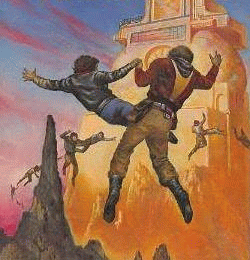
When someone first mentions telekinesis my first association is moving and throwing objects around. But Timothy Zahn gives us a delightful new aspect to this ability - flying. Anybody else thinking about 'Peter Pan'? :)
Unfortunately (as we all know) children are usually the ultimate hedonists. The do not plan or think about the future - they only want to satisfy their current needs. So what will happen if that type of humans had the most power in society? And what would be solution to that?
In A Coming of Age, Timothy Zahn does not gives us a pretty picture of society. This is a great book for a book club to discuss possible alternatives and flaws in the structure Tigris' society is organised.
We are introduced to the world of planet Tigris through eyes of a couple of characters: Lisa Duncan (coming of age teen who is going to lose her telekinetic powers soon), Stanford Tirrell (quirky detective working on a child-kidnaping case), Dr. Matthew Jarvis (brilliant scientists) and Prophet Omega (shady leader of mysterious new cult).
Altough character building of others is not neglected, most attention is devoted to Lisa Duncan. When you read about her thoughts and fears, you read about the usual problems that coming of age teens meet: dealing with changes in your body and how the society and your friends will accept them.

You gotta like Lisa - she is smart, innovative, ambitious, inquisitive... And she is not afraid to break the rules. ;)
In the end, of course, all the plot lines untangle and all the characters clash together in an ultimate showdown. Yes, there is big aerial battle. ;)
This book has something for everybody. A little bit of mystery, coming of age teen problems, dystopian fiction about oppressive government and enough action and adventure to keep you interested until the end.
I recommend this book to fans of: classic science fiction, quirky detectives, coming of age stories or speculative fiction about colonization of other planets.
Disclaimer: I was given a free eBook by the publisher via NetGalley in exchange for a honest review. This text is also posted on Amazon and my blog.
There are so many older novels that simply got run over by new styles or trends. But do not be afraid, I can assure you that this is not the case with A Coming of Age. Timothy Zahn writes with a straight-forward matter-o-fact style that never gets old. His world building is so subtle than you don't even notice when and where he explained all that unknown customs and terms.
I can become overwhelmed if authors piles up all the data at the beginning of book or if he keeps bombarding me with unknown (invented) words. Sometimes, I can even give up reading the book altogether because of that. So this is a BIG plus for me.
When the Humans colonized planet Tigris, they never imagined that it would lead to genetic mutations that will trigger telekinetic powers in kids at the age of five. Or that those same powers will inexplicably disappear when children reach puberty.
When someone first mentions telekinesis my first association is moving and throwing objects around. But Timothy Zahn gives us a delightful new aspect to this ability - flying. Anybody else thinking about 'Peter Pan'? :)
Unfortunately (as we all know) children are usually the ultimate hedonists. The do not plan or think about the future - they only want to satisfy their current needs. So what will happen if that type of humans had the most power in society? And what would be solution to that?
In A Coming of Age, Timothy Zahn does not gives us a pretty picture of society. This is a great book for a book club to discuss possible alternatives and flaws in the structure Tigris' society is organised.
We are introduced to the world of planet Tigris through eyes of a couple of characters: Lisa Duncan (coming of age teen who is going to lose her telekinetic powers soon), Stanford Tirrell (quirky detective working on a child-kidnaping case), Dr. Matthew Jarvis (brilliant scientists) and Prophet Omega (shady leader of mysterious new cult).
Altough character building of others is not neglected, most attention is devoted to Lisa Duncan. When you read about her thoughts and fears, you read about the usual problems that coming of age teens meet: dealing with changes in your body and how the society and your friends will accept them.
You gotta like Lisa - she is smart, innovative, ambitious, inquisitive... And she is not afraid to break the rules. ;)
In the end, of course, all the plot lines untangle and all the characters clash together in an ultimate showdown. Yes, there is big aerial battle. ;)
This book has something for everybody. A little bit of mystery, coming of age teen problems, dystopian fiction about oppressive government and enough action and adventure to keep you interested until the end.
I recommend this book to fans of: classic science fiction, quirky detectives, coming of age stories or speculative fiction about colonization of other planets.
Disclaimer: I was given a free eBook by the publisher via NetGalley in exchange for a honest review. This text is also posted on Amazon and my blog.

July 22, 2014
Lisa, at fourteen, is still considered a "preteen" because she hasn't begun to go through puberty. And that's just as well for her, because the onset of puberty means the loss of power in her world. On the planet Tigris, children born there develop telekinetic powers around age five and lose them again when entering adulthood. The balance of power in their world is therefore very different than it had been for their distant ancestors on Earth; children can overpower adults easily, and they did so long ago in the planet's history. They've chosen to deal with this imbalance by isolating the children from outside society and socializing them differently--while having them use their abilities to generate power for the world while refusing to educate them until they lose their powers. Older children are socialized to control younger children, and though many of them--like Lisa--do not look forward to losing their abilities (especially since they can no longer fly!), there is some appeal in learning to read, but it's a huge adjustment and a heavy period of depression for young adults.
Lisa hopes her powers will stay as long as they can, but at the same time she's concerned about being behind when she does transition, so she tries to learn to read on her own, secretly. Meanwhile, a scientist has kidnapped a boy and is experimenting on him to see if he can get the telekinetic powers to remain beyond childhood. This may well threaten their carefully balanced society, considering it was rampaging children who destroyed all their advances 200 years ago before they knew their powers weren't forever. In any case, the kidnapped child must be rescued, and it's up to a policeman named Tirrell (and his preteen helper, Tonio, along for some muscle on the team) to rescue him. Lisa gets involved as well, and finds herself way in over her head. . . .
Really fascinating story--I've never seen a society quite like this in science fiction, and it makes sense that extreme measures would have to be taken to control children with superpowers if adults don't have them. I loved the realism of the bitterness that infuses transitioning--sure adulthood has perks, but I think it's very realistic that suicide rates would be high for these young people, having lost something so integral to their way of thinking and now having to go on to be responsible and deal with puberty and try to function. I do wonder how everything was so utterly destroyed when children couldn't be reliably controlled, though--they basically set the society back a long way, to the point that they could no longer travel between worlds, since too much was destroyed and they were no longer a spacefaring population. I related to Lisa a lot about not being in a rush to leave childhood, too, and it was cool that she wanted to learn to read.
Lisa hopes her powers will stay as long as they can, but at the same time she's concerned about being behind when she does transition, so she tries to learn to read on her own, secretly. Meanwhile, a scientist has kidnapped a boy and is experimenting on him to see if he can get the telekinetic powers to remain beyond childhood. This may well threaten their carefully balanced society, considering it was rampaging children who destroyed all their advances 200 years ago before they knew their powers weren't forever. In any case, the kidnapped child must be rescued, and it's up to a policeman named Tirrell (and his preteen helper, Tonio, along for some muscle on the team) to rescue him. Lisa gets involved as well, and finds herself way in over her head. . . .
Really fascinating story--I've never seen a society quite like this in science fiction, and it makes sense that extreme measures would have to be taken to control children with superpowers if adults don't have them. I loved the realism of the bitterness that infuses transitioning--sure adulthood has perks, but I think it's very realistic that suicide rates would be high for these young people, having lost something so integral to their way of thinking and now having to go on to be responsible and deal with puberty and try to function. I do wonder how everything was so utterly destroyed when children couldn't be reliably controlled, though--they basically set the society back a long way, to the point that they could no longer travel between worlds, since too much was destroyed and they were no longer a spacefaring population. I related to Lisa a lot about not being in a rush to leave childhood, too, and it was cool that she wanted to learn to read.

June 1, 2011
I've enjoyed Timothy Zahn's works ever since I discovered The Last Command in a bookstore in Hong Kong around 1996. It was part 3 of a trilogy, but written so well that starting there wasn't a problem at all. I've followed him ever since.
That's why I was surprised to find I'd never heard anything about this book. Written in 1984, it's not nearly as war/military as other books he wrote around then (Cobra, The Blackcollar). I really enjoyed jumping into the book without reading any summaries or reviews, especially now that I've seen them. Even the quick blurb on Goodreads feels like "OMG Spoilers".
The setting was interesting and unique -- where most scifi stories have us travelling in space, this one focuses on a small region of one planet after a small dark age. The technology is back to 1900s level, but they compensate with one big twist: telekinesis. Kids on this planet can 'teek' at will (provided the object is held in sight or feel), so they have 'chores' like doing the lifting at construction sites, or even just spinning a huge flywheel to generate power at a power station. They can even fly! But they lose this ability at puberty, hence the title of the book.
That's why I was surprised to find I'd never heard anything about this book. Written in 1984, it's not nearly as war/military as other books he wrote around then (Cobra, The Blackcollar). I really enjoyed jumping into the book without reading any summaries or reviews, especially now that I've seen them. Even the quick blurb on Goodreads feels like "OMG Spoilers".
The setting was interesting and unique -- where most scifi stories have us travelling in space, this one focuses on a small region of one planet after a small dark age. The technology is back to 1900s level, but they compensate with one big twist: telekinesis. Kids on this planet can 'teek' at will (provided the object is held in sight or feel), so they have 'chores' like doing the lifting at construction sites, or even just spinning a huge flywheel to generate power at a power station. They can even fly! But they lose this ability at puberty, hence the title of the book.

June 12, 2012
Great, little-known sci-fi adventure that reads kind of like a detective story.
It all started with the Lost Generation--that was the first set of children who exhibited powers of telekinesis. The chaos, the destruction they wreaked in that one generation was unimaginable--but then, it stopped. When the children reached puberty, their telekinesis disappeared. After that, society was much more careful. Children were separated from their parents at the age of five, when their "Teekay" first began to appear, and were placed in special "hives" where they could be properly monitored and taught to use their abilities for good while they had them. They would not be educated until after their transition,to keep them from abusing their powers.
It was the system Lisa had grown up with and she never questioned it... until it was her turn to experience transition. With the prospect of losing her Teekay looming over her, Lisa felt increasing anxiety at entering the world of adulthood. She decided to take a bold, maybe even a risky step and ask one of her friends who had already left the hive to help her start her studies early. Daryl would meet her in the park and begin to teach her to read. But when Lisa's secret lessons are discovered, Daryl mysteriously disappears from his school. Lisa, feeling responsible and terrified at what might have happened to him, begins to look for him in spite of stern warnings to forget about it. Her search lands her right in the middle of a kidnapping investigation, a con-artist's dangerous game and a scientific discovery that could turn Lisa's world on its head.
It all started with the Lost Generation--that was the first set of children who exhibited powers of telekinesis. The chaos, the destruction they wreaked in that one generation was unimaginable--but then, it stopped. When the children reached puberty, their telekinesis disappeared. After that, society was much more careful. Children were separated from their parents at the age of five, when their "Teekay" first began to appear, and were placed in special "hives" where they could be properly monitored and taught to use their abilities for good while they had them. They would not be educated until after their transition,to keep them from abusing their powers.
It was the system Lisa had grown up with and she never questioned it... until it was her turn to experience transition. With the prospect of losing her Teekay looming over her, Lisa felt increasing anxiety at entering the world of adulthood. She decided to take a bold, maybe even a risky step and ask one of her friends who had already left the hive to help her start her studies early. Daryl would meet her in the park and begin to teach her to read. But when Lisa's secret lessons are discovered, Daryl mysteriously disappears from his school. Lisa, feeling responsible and terrified at what might have happened to him, begins to look for him in spite of stern warnings to forget about it. Her search lands her right in the middle of a kidnapping investigation, a con-artist's dangerous game and a scientific discovery that could turn Lisa's world on its head.

November 12, 2012
After reading this book, I am adding more Timothy Zahn novels to my to-read pile. The story was not what I was expecting, but it was fantastic. I was expecting a fast-paced action story, and instead I got a thought-provoking detective novel.
The world building is what makes this story shine. Zahn asks the question "What would happen to our society if children suddenly developed the powers of telekinesis?" His answer: A world dependent on depriving children of knowledge until after their powers disappear at puberty, keeping them in line with a "hive" system where the children mentor each other. This new society also gives reign to adults who kidnap kids from their hives, exploit their abilities through manipulation, and then discard them after the kids reach puberty, leaving them without a home or education.
It is a bit slow moving at first, but picks up as the mystery of a kidnapped boy unraveled. The story mainly follows three characters: Lisa, a girl struggling with her upcoming transition to adulthood and loss of her teeking abilities; Tirrell, the detective looking for the kidnapped boy; and Omega, a "prophet" manipulating a large group of children for his own purposes. It is only near the end of the book that we discover how these characters intersect as answers to the mystery are revealed.
A Coming of Age is a fascinating read with a thought-provoking set of events and characters. If sci-fi mixed with a healthy dose of gritty mystery sounds good to you, give this one a go!
The world building is what makes this story shine. Zahn asks the question "What would happen to our society if children suddenly developed the powers of telekinesis?" His answer: A world dependent on depriving children of knowledge until after their powers disappear at puberty, keeping them in line with a "hive" system where the children mentor each other. This new society also gives reign to adults who kidnap kids from their hives, exploit their abilities through manipulation, and then discard them after the kids reach puberty, leaving them without a home or education.
It is a bit slow moving at first, but picks up as the mystery of a kidnapped boy unraveled. The story mainly follows three characters: Lisa, a girl struggling with her upcoming transition to adulthood and loss of her teeking abilities; Tirrell, the detective looking for the kidnapped boy; and Omega, a "prophet" manipulating a large group of children for his own purposes. It is only near the end of the book that we discover how these characters intersect as answers to the mystery are revealed.
A Coming of Age is a fascinating read with a thought-provoking set of events and characters. If sci-fi mixed with a healthy dose of gritty mystery sounds good to you, give this one a go!

October 19, 2012
A Coming of Age is one of several Timothy Zahn books Open Road Media re-released as ebooks in October. I wondered how different a book written in 1984 would stand against today’s popular fiction. It’s easy to see a difference between a book written now and one written in the 19th Century, but would a book written over twenty-five years ago be that different?
Yes. But not in a bad way.
A large percentage of the book is from the Lisa’s point of view, a young girl on the brink of puberty, but this is not a young adult book. It has none of the typical angst you often see in today’s teen characters. There is no romance. A Coming of Age is more like a SciFi Crime Drama, a mystery set on another planet with twists and turns so complex I was always on the edge of my seat.
The other differences are not something I can put into words, though I’m sure words played a big part. Sentence structure and word choice are a product of the times. The difference wasn’t huge, but there was a subtle feeling I’d been transported back in time despite the book’s setting in the future.
One thing I found refreshing was the lack of over-explanation. Zahn left it up to his readers to interpret subtle clues about the plot and alien terminology from the context. I felt like a grown-up, reading a book that gave me a chance to flex my brain.
Lastly, I don’t say this often, but this book would make an exceptional film!
Yes. But not in a bad way.
A large percentage of the book is from the Lisa’s point of view, a young girl on the brink of puberty, but this is not a young adult book. It has none of the typical angst you often see in today’s teen characters. There is no romance. A Coming of Age is more like a SciFi Crime Drama, a mystery set on another planet with twists and turns so complex I was always on the edge of my seat.
The other differences are not something I can put into words, though I’m sure words played a big part. Sentence structure and word choice are a product of the times. The difference wasn’t huge, but there was a subtle feeling I’d been transported back in time despite the book’s setting in the future.
One thing I found refreshing was the lack of over-explanation. Zahn left it up to his readers to interpret subtle clues about the plot and alien terminology from the context. I felt like a grown-up, reading a book that gave me a chance to flex my brain.
Lastly, I don’t say this often, but this book would make an exceptional film!

November 10, 2013
Another not-new-Zahn but new-to-ebook Zahn. This had the feel of an earlier work, but I still enjoyed it. At least until the end where it started to drag just a teensy weensy bit.
It's all about the what-if idea of kids who have telekinetic abilities at a young age that they lose at puberty. Surely someone would try to exploit this, right? While I liked the one young girl trying to prepare for her new life without powers as well as the detective, the rest of the story suffered a bit from a not-mean enough villain and a lack of backstory.
To explain: There were lots of crazy old TV show Batman-like setups where the bad guy left our heroes in mortal peril... and of course they escaped! I started thinking, if this dude was so awful, surely he'd just be killing these peeps by now. Also the Goodreads summary does more to explain the reason for the telekinesis and the world situation than the book does. Seriously. Even so, I like Zahn and his ideas and if more of his old books show up as ebooks I'll probably read those eventually, too. I'm a loyal reader like that.
It's all about the what-if idea of kids who have telekinetic abilities at a young age that they lose at puberty. Surely someone would try to exploit this, right? While I liked the one young girl trying to prepare for her new life without powers as well as the detective, the rest of the story suffered a bit from a not-mean enough villain and a lack of backstory.
To explain: There were lots of crazy old TV show Batman-like setups where the bad guy left our heroes in mortal peril... and of course they escaped! I started thinking, if this dude was so awful, surely he'd just be killing these peeps by now. Also the Goodreads summary does more to explain the reason for the telekinesis and the world situation than the book does. Seriously. Even so, I like Zahn and his ideas and if more of his old books show up as ebooks I'll probably read those eventually, too. I'm a loyal reader like that.

December 28, 2013
This is one of my favorite Timothy Zahn books. On a far-off planet, children develop telekinesis at age five, and lose it during puberty. A social structure designed to prevent the carnage that happened when these powers were first discovered has grown. Children are taken away from their parents to live in hives, where they work to use their gift and earn points to integrate into future society.
It's not deep, transgressive SF, but reads more like true young adult science fiction done right. A fun story about growing up and the fear of change. It doesn't feel dated, and the telekinetic battles are clever without being overtly violent. The worldbuilding isn't the deepest, but it's clever and works well for the scope of the novel.
It's a very likable book that would make a great intro to SF for a young teen. One of my favorites by him.
It's not deep, transgressive SF, but reads more like true young adult science fiction done right. A fun story about growing up and the fear of change. It doesn't feel dated, and the telekinetic battles are clever without being overtly violent. The worldbuilding isn't the deepest, but it's clever and works well for the scope of the novel.
It's a very likable book that would make a great intro to SF for a young teen. One of my favorites by him.

April 23, 2014
I wanted to like this one more than I actually liked it. The premise was intriguing: kids develop telekinetic powers but adults don't have them. The balance of world building vs just accepting the state of things was off somehow. I actually liked that Zahn didn't spend any time explaining these powers and only hinted at how it came to be. But then it became crucial to a plot point, and I felt I needed to understand the world better to really get involved in the story.
The genre-defying elements were nice, a bit mystery, a bit adventure, a bit sci-fi. However, the multiple plots felt very disjointed to me. A good story but not a great one.
*ARC from NetGalley in exchange for an honest review
The genre-defying elements were nice, a bit mystery, a bit adventure, a bit sci-fi. However, the multiple plots felt very disjointed to me. A good story but not a great one.
*ARC from NetGalley in exchange for an honest review

August 19, 2008
If you look at the listing of works this author has written, it is obvious he's written a BUNCH (lots of it series work for multi-authored storylines), but this is the only book of his I've read, and I enjoyed it muchly. I was very young when I first read it, though, and the way Zahn created a world based around a different balance of power was quite appealing to me. (Children developed amazing powers around the age of five, which went away as puberty hit; as a result, the world had to be rearranged to control them during this period.)

June 27, 2011
_A Coming of Age_ by Timothy Zahn (1984). Cool ideas, good execution, and a strong novel. This isn't as strong as Zahn's later novels, but the premise is good, and if it were adapted correctly, it would make a good sci-fi movie. The ending is fairly quiet, but let's be honest. Timothy Zahn's "weaker" material is like the Canadian rock band Rush's "weak" songs: It's a lot stronger than 90% of the stuff coming down the pike. I highly recommend Zahn's books, because frankly, you *could* have to wade through books that are a *lot* less satisfying.

March 25, 2015
That was quite fun. It is much more of a YA book than most of Zahn's stand-alone scifi books. It takes place on a Earth-colonized world where kids have telekinetic abilities until puberty, when their abilities fade forever. As a result, their lives are carefully managed. Predators called "fagins" coerce kids into working for them. And Lisa is almost a teen.
I would have loved this story when I was a preteen myself. It wasn't bad as an adult, either. And this marks the last of the Zahn books I picked up in that sale that one time.
I would have loved this story when I was a preteen myself. It wasn't bad as an adult, either. And this marks the last of the Zahn books I picked up in that sale that one time.

September 22, 2013
Zahn's writing is as always, admirable, and he makes use of his skills to enhance what in most authors hands would be an overly simplistic tale into something quite magnificent. This is easily the best of Zahn's non Star Wars books that I have read so far and I might even go so far as to say that this equals those works. The one time that I have seen Zahn not just rely on his writing skills but on fashioning a semi-intricate story and then executing it.

July 19, 2011
Its an easy read and despite the subject matter revolving around children, its merit is mostly on the idea of power, withholding of knowledge and corruption.

March 20, 2013
It was OK. Kind of a reverse X-Men where the kids get their powers pretty much at birth and then lose them with puberty. That Lisa chick cries way too much. LOL.
Displaying 1 - 30 of 32 reviews