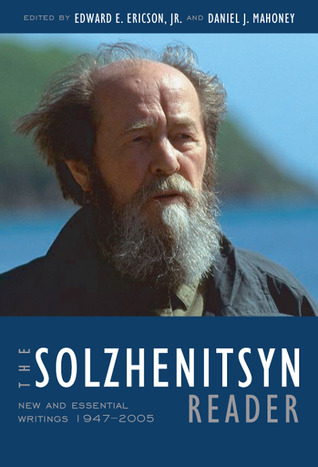
This reader, compiled by renowned Solzhenitsyn scholars Edward E. Ericson, Jr., and Daniel J. Mahoney in collaboration with the Solzhenitsyn family, provides in one volume a rich and representative selection of Solzhenitsyn's voluminous works. Reproduced in their entirety are early poems, early and late short stories, early and late "miniatures" (or prose poems), and many of Solzhenitsyn’s famous—and not-so-famous—essays and speeches. The volume also includes excerpts from Solzhenitsyn's great novels, memoirs, books of political analysis and historical scholarship, and the literary and historical masterpieces The Gulag Archipelago and The Red Wheel. More than one-quarter of the material has never before appeared in English (the author’s sons prepared many of the new translations themselves). The Solzhenitsyn Reader reveals a writer of genius, an intransigent opponent of ideological tyranny and moral relativism, and a thinker and moral witness who is acutely sensitive to the great drama of good and evil that takes place within every human soul. It will be for many years the definitive Solzhenitsyn collection.
This is a fantastic sampler of the works of Aleksander Solzhenitsyn. It covers everything from his poetry to his short stories to excerpts from his longer works to speeches, essays, miniatures, and prayers. It includes a very informative biography of his life as a prologue, and each piece has an introduction by the editor explaining the work and its context.
I have learned so much from this. There is so much about Soviet Russia that I never knew. In fact, it has revealed to me just how little I know of even my own country's history during that time. Solzhenitsyn's appeals to the West were humbling and eye-opening, and his writings of what it was like living in Soviet Russia (especially the excerpts from The Gulag Archipelago) were shocking. I cried many times reading this massive book. There is so much here that should not be lost. So many lessons that we need to learn and carry on into the future. I had always heard about "the evils of Communism", but Solzhenitsyn shows them to you through the eyes of both himself and others whose thoughts and stories he painstakingly collected (and at very great personal risk). His philosophy on art, his views on the soul, and his calls for nations to exercise humility and self-restraint are absolutely inspiring.
Though this book is only a collection of samples and not his entire books, it does form a cohesive whole, taking you from his earlier writings and into those of his later years. It also forms a clear picture of Russia's recent history which explains SO MUCH about them. It was heartbreaking to read. You begin to ache along with Solzhenitsyn that Mother Russia would find herself again. I've been inspired to learn more. Kudos to the editors for picking and arranging this collection in such a thoughtful way! You could absolutely use this book as a textbook in a high school or college course and find much to teach on (history, literature, politics, philosophy, poetry, war, etc).
Having recently joined the Eastern Orthodox church (of which Solzhenitsyn was part...as much as one can be in Soviet Russia), I had heard before of the mass killing of Orthodox Christians under Stalin. But not much. This is only the second book I've read to mention it, and it's horrifying and astounding just how many people were systematically killed by their own government (it's an unbelievable number). The Orthodox were nearly wiped out, the rural classes were nearly wiped out, the intelligentsia were nearly wiped out, on and on and on! It's amazing that anyone is left in Russia! Solzhenitsyn bears witness to the colossal damage this did to Russian culture, history, and society. But he also adds, to which I agree, that: "Hitler had all the luck. Everyone talks about his camps. No one cares about ours." It does baffle my brain that this genocide happened right on the heels of Nazism, and no one talks about it. In fact, Solzhenitsyn brings up ways in which the West (USA included) willfully turned a blind eye to it and even sent Russian refugees to their deaths. But he's right. No one talks about it. No one cares. I've been inspired to learn more about this time period because the silence is suspicious and deafening. And I've also been inspired to keep praying for Russia, and to work on myself as a writer. I mean, Solzhenitsyn is credited with single-handedly toppling the Soviet regime strictly through his pen. That's the power of literature for you!
I hugely recommend this to anyone interested in modern history, Soviet-Russian history, philosophy, or has a love for Russian or classic literature in general. There is just so much here, and Solzhenitsyn definitely deserves his place among the Greats of Russian literature. His life is fascinating, his stories are gripping, and his wisdom is so desperately needed in our world. Lord, have mercy on us all.
Future generations will shake their heads in wonder at the way one of the greatest thinkers and prophet of the 20th Century was so misrepresented and ignored. During the Cold War he was lauded in the West as a symbol of opposition. But when Solzhenitsyn turned out to be also critical of the materialistic capitalist society he was quickly dropped as the "darling" of the West.
Now, as so many of the promises of capitalism also turn out to be hollow, it might be possible to re-evaluate this thinker. This collection has everything you need to understand his philosophy, including his Nobel prize acceptance speech, key chapters from the Gulag Archipelago and other talks and essays.
This book contains a superb collection of Solzhenitsyn's most important works. In addition to his short stories, the editors carefully crafted selections from his lengthier novels. The Miniatures and The Red Wheel were my two favorite choices throughout the reader.
This book, and all of Solzhenitsyn's work should be read by everybody and in particular Communist sympathizers for which I continually run into. Solzhenitsyn's love of his country (Russia) is apparent within all of his writings as is his sadness for what befell it. His descriptions of the Cancer Ward and the Gulags are crystal clear, you can feel the hunger and severe cold of Russian winters. I would like to take up the Gulag Archipelago but that will have to wait until I have the free time.
Solzhenitsyn's work can certainly stand on its own. But the introductory essay in the reader opens up the historical experience, literary influences, and purpose of the Nobel laureate's work in a way that can only inform one's reading of his novels and poetry. An excellent introduction to those considering reading Solzhenitsyn's writings.
This sampling of Solzhenitsyn's works is breath-taking. Erickson introduces each selected Solzhenitsyn work with background on factors influencing and explaining the selected work enabling the reader to better appreciate Solzhenitsyn's reason(s) for taking the risks he did in producing the work. Without Ericson's contextual comments, one might not appreciate Solzhenitsyn's courage in writing critically about a regime which brutally punished critics nor would one appreciate the spiritual component of Solzhenitsyn's writings. Solzhenitsyn's love of country in light the suffering he endured and witnessed reflects the heart and soul of a man completely devoted to his Christian faith. That he would remain a fervent patriot until his death speaks to his faith in that he was able to separate hatred of the communist system while loving the nation which spawned it. The strength in Ericson's compendium of Solzhenitsyn's work is that it contains short stories, speeches that are hard to find and gives readers a deepened and broad sense of Solzhenitsyn's devotion to Christianity, his moral compass and his concerns about the rotting impact of decadence in western societies, particularly the American society.
A perfect introduction to Solzhenitsyn! I have read most of his work before, but enjoyed the descriptions of the background of them, and how the authors commented on the work, put them in context.
We can also read excerpts of the coming translations into English of some of the missing parts of the "The Red Wheel", his 9 part epic on the Russian revolution.
At the end of this textbook you will also find a collection of short stories, or "miniatures" as he called them. Among those the gem "A Prayer" that became very loved as part of the underground literature before Solzhenitsyn's work could be officially published in the Soviet Union.
Solzhenitsyn is 5 star. This book, however, has section prefaces that are written like a high school student trying to complete an assignment with a word count requirement but didn’t read the book and, as such, relied on Wikipedia and a thesaurus.
If you want to read this book, skip the inane prefaces to each section and just read Solzhenitsyn’s words. Better yet, just read the original works.
I have never read solzheitsyn before (in fact, I can hardly spell his name), but I have always had a curiosity about Russia. This book is currently knocking my socks off. He is seriously insightful, but, perhaps because it is the translation, the rhythms of his thoughts are cracking my categories a bit. He is anti-modern in a sort of fun way, because I only know of Medieval anti-moderns, and he is not that, but he is still intreaguing and I am definitly enjoying it. Here are a couple of my favorite quotes. "Only through the repentance of a multitude of people can the air and the soil of Russia be cleansed so that a new, healthy, national life can grow up. We cannot raise a clean crop on a false, unsound, obdurant soil."
"repentance is the first bit of firm ground underfoot, the only one from which we can go forward not to fresh hatreds but to concord. Repentance is the only starting point for spiritual growth."
This is how he describes the problem in Russia, "God need not be written in with a capital letter, but Government must be."