Jump to ratings and reviews
Rate this book
Rate this book
In his monumental narrative of the outbreak of the First World War and the ill-fated Russian offensive into East Prussia, Solzhenitsyn has written what Nina Krushcheva, in The Nation , calls "a dramatically new interpretation of Russian history." The assassination of tsarist prime minister Pyotr Stolypin, a crucial event in the years leading up to the Revolution of 1917, is reconstructed from the alienating viewpoints of historical witnesses. The sole voice of reason among the advisers to Tsar Nikolai II, Stolypin died at the hands of the anarchist Mordko Bogrov, and with him perished Russia's last hope for reform. Translated by H.T. Willetts.

August 1914 is the first volume of Solzhenitsyn's epic, The Red Wheel; the second is November 1916. Each of the subsequent volumes will concentrate on another critical moment or "knot," in the history of the Revolution. Translated by H.T. Willetts.

896 pages, Paperback

First published January 1, 1971

326 people are currently reading
6239 people want to read

About the author

Aleksandr Solzhenitsyn

256 books4,075 followers
also known as
Alexander Solzenitsyn (English, alternate)
Αλεξάντρ Σολζενίτσιν (Greek)

Works, including One Day in the Life of Ivan Denisovich (1962) and The Gulag Archipelago (1973-1975), of Soviet writer and dissident Aleksandr Isayevich Solzhenitsyn, awarded the Nobel Prize for literature in 1970, exposed the brutality of the labor camp system.

This known Russian novelist, dramatist, and historian best helped to make the world aware of the forced Gulag.

Exiled in 1974, he returned to Russia in 1994. Solzhenitsyn fathered of Ignat Solzhenitsyn, a conductor and pianist.

https://en.wikipedia.org/wiki/Aleksan...

Ratings & Reviews

What do you think?
Rate this book

Friends & Following

Create a free account to discover what your friends think of this book!

Community Reviews

5 stars
895 (31%)
4 stars
1,113 (39%)
3 stars
608 (21%)
2 stars
154 (5%)
1 star
50 (1%)
Displaying 1 - 30 of 219 reviews
Profile Image for Abeselom Habtemariam.
58 reviews73 followers
September 15, 2024

‘’The individual must not allow friendship to degenerate into self-abasement. He will never be thanked for it and this is even more true of the state. How long would France remember Russia’s sacrifice, her blood tribute? Knowing all this, you must still show yourself worthy of your calling.’’
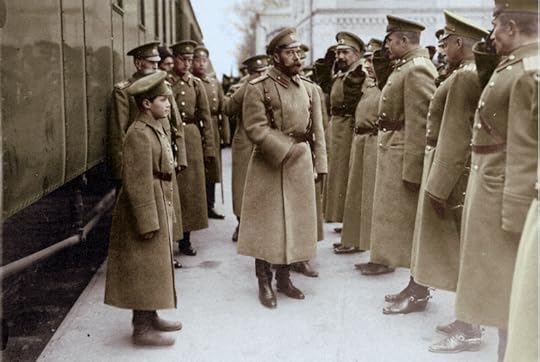

August 1914 is the first volume in The Russian Nobel Laureate Aleksandr Solzhenitsyn’s The Red Wheel Series. It is a historical fiction epic set during the first world war. Centered predominantly around The Battle of Tannenberg (August 26 - August 30, 1914), it however covers some of the most pivotal moments (‘’Knots’’) that led up to the 1917 Russian Revolution.

At the turn of the century the absolute monarchy of The Russian Empire was headed by Tsar Nicholas II. Nicholas was a mild tempered, indecisive and apprehensive man who was deeply passionate about spending time with his family, playing tennis and photography. He reigned over his 170 million subjects, the overwhelming majority of whom were peasants. Russia was a great power, if only due to its vast territory and population. Its political system was archaic and decrepit. Its economy was still heavily agrarian. It lacked the industrial muscles of its European counterparts. This is despite its rapid industrialization in the 1890s, attributed to the reforms enacted by prime minister Sergei Witte. In the summer of 1914, the nation would hurl itself into the first world war as part of its Triple Entente obligations and its desire to protect Serbia from Austria's wrath. The mobilization of the army, which was the largest army in the world at that time, was unpopular amongst many Russians; the government however was severely out of touch with public opinion.


The early years of the 20th century were trying times for the Russian Empire. The defeat of its army and navy at the Russo-Japanese War (Feb 8, 1904 – Sep 5, 1905) was a great catastrophe. Within the Empire, the air was thick with political assassinations, labor strikes, mutinies, calls for revolution and general public discontent. The first world war was an opening for the Tsar to rally patriotic fervor around the throne. The events that transpired soon after would instead expedite his abdication. The facts on the ground revealed that Russia simply did not recover sufficiently enough from its exploits in the Far East and from its domestic tribulations to engage The Germans and The Austro-Hungarians.

‘’To this place the united forces of Slavdom had come in 1410 and shattered the Teutonic Knights near the little village of Tannenberg, between Hohenstein and Usdau. Half a millennium later fate had so arranged things that Germany could exact retribution (das Strafgericht).’’


The Battle of Tannenberg (or at times referred to as The Second Battle of Tannenberg) was one of the most prominent battles on the eastern front during The Great War. It is remembered for enduring the names of the German commanders Paul Von Hindenburg and Erich Ludendorff. Even though it mostly took place around Allenstein, East Prussia, the Germans actually named it after Tannenberg, 31 km to the west. This was to avenge the Teutonic Knights’ defeat at the hands of the Polish-Lithuanian alliance at the First Battle of Tannenberg in July, 1410.

The outcome of the battle was calamitous for Russia. The Russian 2nd Army under the command of Alexander Samsonov was thoroughly obliterated. The 1st Army under Paul von Rennenkampf didn’t fare much better either. The two Generals, who were veterans of the Russo-Japanese war, despised each other and coordinated their army’s movement poorly throughout the battle. Tannenberg laid bare the weaknesses at the heart of the Tsar’s army.


With a mix of mostly historical and some fictional figures, Solzhenitsyn breaks down this battle with precise descriptions of the armies and the geography of East Prussia. Most of all, he gives us an excellent soldier's point of view through the characters. Tolstoy wrote majestically about The Napoleonic Wars in War and Peace despite being born a good decade after the wars. Solzhenitsyn too was born a month after the end of the first world war and four years after the Battle of Tannenberg. But the world both of them were born into was profoundly shaped by the wars that they wrote about.

‘’I realize that death is often the penalty to be paid for one’s beliefs. And I feel strongly at times that the day will come when some murderer's plan will succeed. Still, you only die once’’

Pyotr Stolypin

‘’Stolypin helped the Russian people to learn a useful lesson: either march to freedom by overthrowing the tsarist monarchy, under the leadership of the proletariat; or sink deeper into slavery’’
Vladmir Lenin

Another important historical event that Solzhenitsyn focuses on, is the assassination of Russia’s third Prmie Minister, Pyotr Stolypin. In a series of chapters dedicated to this key event, he first explores the political life and motives of the assassin and double agent, Dmitry Bogrov. Subsequently, Solzhenitsyn goes on to carefully examine Stolypin and why his assassination was a watershed moment in early 20th century Russia. He describes it as ‘’The opening shots of the fusillade at Yekaterinburg’’ in reference to the execusion of the Romanovs at the hands of Bolshevik revolutionaries in Yekaterinburg, seven years after Stolypin’s assassination.

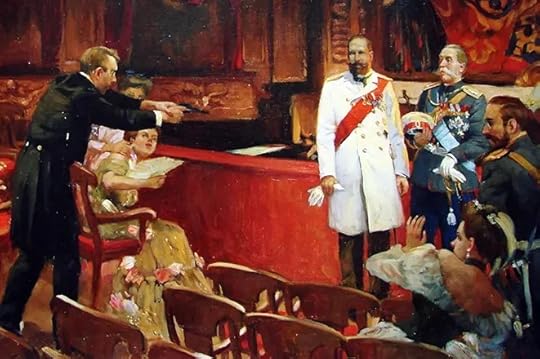
At points, there are extended essay type discussions on Stolypin’s reforms. Eventually though, the aim of this section of the book is to provide a lively narrative to the assassination, which became one of the precipitating factors for the decline of The Russian Empire. Stolypin was both a rural reformer and a monarchist who executed offenders ruthlessly. That latter trait made him a target of multiple assassination attempts by revolutionaries while the former made him The Tsar’s best hope of sustaining the increasingly frail monarchy. On September 14, 1911 (September 1, 1911 old style), inside the Kiev Opera House, Bogrov would succeed in fatally wounding Stolypin in the presence of the Tsar.


‘’The men of the Vyborg Regiment had been pounded for over an hour by the Germans, but they showed no urge to run. No, just as stones carried along by the ice cap survive its melting, survive centuries and civilizations, survive storms and scorching heat, so did these soldiers sit and refuse to be dislodged. They had inherited it from their forefathers, this age-old, unbreakable, inescapable habit; men must suffer patiently, there is no escape.’’


August 1914 is indeed chiefly about the battle of Tannenberg. But it’s also about Russia’s transition into modernity at the outset of the 20th century. The first world war was a pivotal time in history in which empires were collapsing around the world. It was the time Tsar Nicholas II and the 304-year old reign of The Romanovs over The Russian Empire came to an end. Russia’s performance during the war was an ominous sign that times were changing for the Tsar and the nation. The modernity that needed to be injected into the Russian soul and its compatibility with its essential ‘’Russianness’’ is Solzhenitsyn’s main concern. In other words, it is the clash between the need for revolution and the necessity for maintaining tradition and identity (the latter symbolised by The Tsar). Yet another juxtaposition of these two worlds is, the highly effective and mechanised German army against the gritty yet militarily outdated Russian army at Tannenberg.

As a small aside, I took pleasure in the scene where Sanya goes to Leo Tolstoy’s residence at Yasnaya Polyana just to get a glimpse of his hero. They end up having a small chat along lime tree lined paths in Tolstoy's backyard. Solzhenitsyn never met Tolstoy, on account of being born eight years after Tolstoy’s death. It was clear to see Solzhenitsyn was speaking through Sanya to Tolstoy. Solzhenitsyn read War and Peace when he was only ten and has credited Tolstoy as one of the authors that inspired him to write (alongside Fyodor Dostoevsky and Alexander Pushkin). Solzhenitsyn didn’t necessarily agree with Tolstoy’s view of history but he can’t deny his influence on his works either.


Some factors, besides its page count, might make this book a difficult read. Events in the book are told in a non-linear timeline. There are abrupt jumps from one location to another. At times, a character mentioned hundreds of pages prior might suddenly reappear. Then there is the issue of keeping up with the Russian naming system. All this might make the reading experience somewhat grueling. On top of that, one has to be keenly interested in Russian history and The First World War to read this book of about 900 pages.

Speaking of my own reading experience, it was simply spectacular. All the difficulty that the book presents is worth enduring if only just to understand and appreciate what Solzhenitsyn accomplished with this tremendous work.
Profile Image for Dan.
1,249 reviews52 followers
April 8, 2019
In the Russian Army of 1914, rear guards did not save themselves by surrendering. Rear guards died.

August 1914 is an epic novel about the complete rout of Russia’s 2nd army at Tannenberg in modern day Poland which occurred in the opening month of WWI. It was notable as an ominous sign that Russia’s military would be no match for Germany either organizationally or technologically. This book was written by Alexander Solzhenitsyn in 1971 and while it is not as heart wrenching as Solzhenitsyn’s other great ‘historical’ novel The Gulag Archipelago, it is exemplary in the way of War and Peace.

There are a wide array of characters in the novel but the main story is largely focused on the story of the officers and how this slaughter occurred. It is rare in war literature where an author makes a compelling and sympathetic case for the commanders. In this book the story of two of the Generals, Samsonov and Martos, and a Colonel, Vorotyntsev, are central to the book.

The prose in this book is excellent. The only criticism I have is that since this battle is as central to Russian history as Gettysburg is to American history there isn’t a great deal of historical context. There are a lot of Russian and Prussian names and places that can be overwhelming too since there are no maps. In the first half of the book it took me the better part of two months to get through. It took me only one day to finish the latter half however as it became clear who the significant characters were and the tragedy that was unfolding was riveting.


4.5 stars. For anyone who likes WW1 history it is, in my opinion, one of the best books, although fictionalized, of what was happening on the Eastern front.
Profile Image for Peiman E iran.
1,436 reviews1,088 followers
October 20, 2018
‎دوستانِ گرانقدر، این کتاب نوعی رمانِ تاریخی به شمار می آید و نویسندهٔ آن <الکساندر سولژ نیتسین> رویدادهایِ جنگِ جهانی اول در نبردِ تاننبرگ، در ماهِ اوت از سالِ 1914 را بررسی میکند
----------------------------------------------
‎در ماهِ اوتِ سالِ 1914 ارتشِ بزرگِ تزار، از مرزهایِ پروس (آلمان) گذر کرد و واردِ آلمانِ شرقی شد.. ولی زمانی که سربازانِ شوروی واردِ شهر شدند، با کمالِ تعجب مشاهده کردند که شهر ساکتِ و خالی از سکنه میباشد. ولی در حقیقت این دامی بود که آلمانیها برایِ آنها برپا کرده بودند و زمانی که روسها به مرکزِ شهر و مازوری رسیدند، آلمانی ها از هر سو آنها را محاصره کردند و کشتاری بزرگ از روسها به راه انداختند... دلیلِ مهمِ این کشتار و شکست، از طرفی هوشِ جنگیِ فرماندهانِ آلمانی بود و از سویِ دیگر، ضعف و بی کفایتی و غرورِ پوشالیِ سرانِ نظامی و دولتمردانِ نظامِ تزاریِ شوروی بود
‎رویدادهایِ آن شکست، به صورتِ دقیقی همراه با داستانهایِ چند وجهی در این کتاب بیان شده است.. سربازانِ شکست خورده، خسته و نامید، هر یک به سویی پراکنده شده و فرار میکنند..سران و فرماندهانِ روس، با حالی آشفته، نمیدانند چگونه سربازانِ وحشت زده را جمع کرده و یا دستوراتِ لازم را به آنها بدهند... ژنرال سامسونف، آنقدر پریشان حال است که حتی سربازانش نیز به دستوراتش گوش نمیدهند.. بنابراین سامسونف به گوشه ای میگریزد و خودکشی میکند
‎سرهنگ وروتینتسف، سوار بر اسب، به هر گوشه از میدانِ جنگ سرکشی میکند و از رویدادهایِ جنگ گزارش تهیه میکند و این گزارشات را به ستادِ جنگیِ دوک نیکلا، ارائه میدهد، ولی دیگر ای�� گزارشها بی فایده است و کار از کار گذشته است
‎در میانِ این سربازان، گروهبان آرسن بلاگداریف، روحیهٔ خویش را از دست نداده است و با شوخی و خنده، سعی دارد تا روحیه را به سربازانِ روس، بازگرداند.. ولی آنهایی که اندک روحیه ای در خویش دارند، کاری به جنگ نداشته و مشغولِ جمع آوری غنیمتِ جنگی و غارت میباشند و در فکرِ نجاتِ جانشان میباشند
‎این شکستِ بزرگ، به نوعی سببِ پایه گذاری هایِ نخستینِ انقلابِ اکتبر در شوروی میباشد
‎نویسنده هرزگاهی از میدانِ جنگ و داستانهای مربوط به آن خارج میشود و نوشته هایش را به سویِ حال و هوایِ روشنفکران، لیبرال ها و سوسیالیستها میبرد و آن را ترسیم میکند و به نوعی نشان میدهد که چگونه این رویدادها در آیندهٔ سرزمینِ شوروی تأثیر خود را گذاشته و شوروی مذهبی که در خرافات و موهوماتِ دینی غرق شده است و مردمانش در ناآگاهی فرو رفته اند، جایش را به روسیهٔ صنعتی و پیروِ دانش میدهد
‎موردی که بیش از همه چیز خواندنِ این کتاب را ممکن است برایتان دشوار کند، نام ها و عناوینِ زیادی میباشد که در جای جایِ کتاب به چشم میخورد.. ممکن است برخی از نام هایی که در فصلهای نخستینِ کتاب با آنها آشنا شده اید، با گذشتِ زمان و جلو رفتن داستان، از یادِ شما پاک شود
‎نوعِ بیانِ رویدادها و داستان نویسیِ سولژ نیتسین، ترکیبی از داستایوسکی و تولستوی میباشد.. و زندگیِ او نیز سرشار از سختی و مبارزه بوده است... او در نامه ای که به یکی از دوستانش نوشته بود، به استالینِ دیکتاتور و بیخرد، توهین و ناسزا گفته بود و به همین سبب، هشت سال از زندگی خویش را در بند گذراند و سپس تبعید شد و در دورانِ خروشچف، آزاد شد .. پس از آزادی، درس دادن به دانش آموزان را انتخاب نمود... سولژ نیتسین، کتابهایش درشوروی، ممنوع بود.. بنابراین آثارش را در اروپا چاپ کردند و در سالِ 1970 جایزهٔ نوبل را دریافت کرد... در سالِ 1974 بازهم او را بازداشت کردند و به خارج از کشور تبعید شد و تا فروپاشیِ شوروی، در آمریکا به زندگی ادامه داد
---------------------------------------------
‎امیدوارم این ریویو در جهتِ آشنایی با این کتاب، کافی و مفید بوده باشه
‎<پیروز باشید و ایرانی>
Profile Image for Jan-Maat.
1,684 reviews2,489 followers
Read
June 21, 2019
I read the shorter, potentially cropped or incomplete version of this would be epic years ago. It impresses through bulk and scale. The set up of the initial chapters has us criss-crossing European Russia introducing us to various upper class characters on the verge of World War One, Solzhenitsyn fictionalises his story to allow Lev Tolstoy to still be alive and to talk to one character (he had been dead since 1910 in reality), I feel this is Solzhenitsyn shaking hands with his role model and putting on his mantel, and the early emphasis on aristocrats abandoning traditional Russian ways or planting foreign trees,using English motor cars, establishing English or Japanese gardens establishes a parallel with War and Peace - the natural leaders of the country are not Russian enough and therefore doomed to a beating until they can reconnect with their roots.

The novel deals with the embarrassing total defeat of a Russian army at the hands of a much smaller German force (though admittedly on their home territory) at the battle of Tannenberg in August 1914, for Solzhenitsyn this defeat is both a revelation and a condemnation of the state of Russia, and a harbinger of future bleaknesses to come. Personally I think his vision history is unfair, although crushing defeated, the army was at least capable of offensive action and remained so for several years (admittedly with massive amount of military equipment provided by the allies) and the army had bee in a steady process of reform and improvement for the preceding past century, unfortunately as generally in life doing ones best is very nice but tends not to be good enough, certainly in this case not good enough to overcome the problems of underdevelopment and relative backwardness compared to Imperial Russia's western neighbours.

There's not much to recommend about this book apart from the relative novelty of the subject matter to an English speaking audience. But even as a first world war novel it comes across as unusually heavy handed. On the whole I'd recommend Dr Zhivago or Red Cavalry in preference.

Profile Image for Ray.
698 reviews152 followers
October 11, 2016
Bought secondhand and devoured in a single overnight reading. Back in the day when I could do an overnight read - my rock and roll years.

Re-read and enjoyed a couple of times since.

An excellent read.
Profile Image for Paul Haspel.
725 reviews216 followers
August 22, 2025
August of 1914 was truly a calamitous month. The First World War broke out on the fourth day of August; and by the end of that month, the imperial Russian Army had suffered one of the most catastrophic defeats in military history. At the Battle of Tannenberg in East Prussia, virtually all of Russia’s 2nd Army was killed, wounded, or captured. The casualty figures range from 70,000 to 120,000 for the Russians, as opposed to less than 15,000 for their imperial German adversaries. In the battle’s aftermath, the Russian commander, General Alexander Samsonov, shot himself.

To call the story of Tannenberg epic would be almost an understatement; and for that reason, it is understandable that the great Russian novelist Aleksandr Solzhenitsyn was drawn to it. In his 1971 novel August 1914, Solzhenitsyn sets forth his view that the disasters of that month reveal much regarding the historical factors that led to the Russian revolution of 1917, the destruction of the tsarist regime in Russia, and the establishment of the Soviet regime that replaced it.

Solzhenitsyn gained fame as a dissident writer within the Soviet Union. Imprisoned for eight years for critical comments about Stalin in a private letter, Solzhenitsyn used his experiences in the Soviet prison-camp system as a basis for his first novel, One Day in the Life of Ivan Denisovich (1962). His chronicling, in both fiction and non-fiction, of the flaws and failings of the Soviet system won him the Nobel Prize for Literature in 1970, and resulted in his expulsion from the U.S.S.R. four years later. August 1914, published right in the middle of that period, drew a large and appreciative audience in the West. I still have vivid childhood memories of seeing a hardback copy of the book on a shelf in my grandparents’ apartment in Washington, D.C.

August 1914 includes historical figures from the time of the Tannenberg battle as well as fictional characters. General Samsonov is, of course, an important character in the novel, and Solzhenitsyn’s portrayal of him is striking. The book’s Samsonov is old, slow-thinking, used to obeying orders, accustomed to moving up in the system by following orders without question. At the same time, however, Solzhenitsyn suggests that Samsonov is the product of a system that, for centuries, has discouraged initiative and rewarded blind obedience to absolute commands from on high:

Samsonov would have been happier if he could have carried out orders just as he received them. But what if the orders made no sense? What if they were obviously detrimental to the motherland?

He had not been given a general objective and told to use his own method of achieving it; the way had been prescribed down to the minutest detail, and the slightest deviation brought a sharp rebuke. The Army Commander was left no more freedom than a hobbled horse.
(p. 155)

In stark contrast with the unfit-for-command General Samsonov is Colonel Georgii Vorotyntsev, who represents the might-have-beens of August 1914. Vorotynstev is an able young officer who exhibits personal courage in response to the physical and psychological stresses of combat; after one sleepless night, with the prospect of at least a week of pitched battle in East Prussia ahead of him, he reflects that “This was what he was born to do. These were the greatest days of his life – the days for which every regular officer lives. He did not feel downcast; he felt buoyant and light-hearted. He was beyond caring whether or not he ate or slept” (p. 202).

Moreover, Vorotyntsev has new ideas for how a modern army could wage a modern war, and he emerges as a skilled leader who might have brought the battle of Tannenberg to a quite different conclusion. At one point, he volunteers to go to a particularly crucial part of the front, and gets there in spite of many dangers, insisting to both superiors and subordinates that “Just another hour could change the whole situation.” He finds two battalion commanders and a regimental adjutant, convenes an informal council of war, and gets right to work: “Corps HQ is ten versts away, and as you see, they have sent nobody over. Army regulations allow a ‘council of the senior officers present’ to take command when necessary” (p. 403).

Vorotyntsev’s ideas for redeployment strike a chord: “The bright flame of his assurance kindled an answering glow in the senior infantry officers. They were not stick-in-the-muds – while the battle was being decided in the thunder of guns all around them, impotent inaction was a torment” (p. 409). The situation on this part of the front, for the beleaguered Russians, is relieved; but sadly, Vorotynstsev is not in command of the whole Russian Army, and the history-minded reader already knows that, under Samsonov’s command, the Russians are doomed to catastrophic defeat.

What Vorotyntsev sees regarding the incompetence of high command is also seen by junior officers exercising tactical command on the battlefield. Two battery commanders in a strategically important portion of the battlefield meditate upon the uncomfortable nature of their situation:

If the 2nd Army had entered Prussia like the head of a charging bull, those now at Rothfliess station were the tip of its right horn. The horn had penetrated the body of East Prussia to two-fifths of its depth. While they held Rothfliess station they were cutting the main line, the last line but one by which the Germans could switch their forces laterally across Prussia. Clearly, the Germans would want that station at any price. It would have been sensible to put the whole of the 6th Corps right there.

But fate had been kind in one way: they no longer had any brainless busybodies over them. That was the worst possible position to be in. Their fragile handful was the tip of the horn, but it was at least in their power not to do silly things.
(p. 300)

In a manner that might remind some readers of Leo Tolstoy’s War and Peace, Solzhenitsyn also provides the perspective of participants at lower level levels of leadership. Sasha Lenartovich, a revolution-minded young man commanding a platoon in the fighting around Neidenburg, feels at one point that “He could not have got into a more ridiculous situation. To die for the autocracy at twenty-four!” (p. 501). Yet as his forces start to engage the Germans, Sasha finds that he is “enlisted” in the fight in spite of himself: “Although he had no desire for victory and would make no effort toward it, Lenartovich was gratified to note that the Germans were outgunned” (p. 503).

When the Russian forces achieve success on this portion of the front, Sasha finds that “He was bursting with a strange feeling of triumph: his first victory won not in debate, but won with his body, with his arms and legs….How easy everything now seemed! The cup of hope was running over. He would survive this war! How precious life was!” (p. 509). Unfortunately, it is not long before such assessments come to seem grossly over-optimistic. Here, Solzhenitsyn seems to be commenting on the effect that war can have on those who are fighting in it.

Solzhenitsyn, as mentioned above, is interested in Tannenberg and August 1914 in term of what it reveals about Russian society on the verge of revolution. A scholar named Varsonofiev engages in conversation with two students named Sanya and Kotya who are on their way to the battle, and offers critiques of the Marxist view of “history” as a rational, mathematically precise process that can be predicted and tracked by a person with the “correct” theoretical orientation.

When Kotya asks about the social order, Varsonofiev says, “Don’t get carried away with the idea that you can invent a model society and then twist your beloved people into the right shape to fit it”, and adds that “History…is not governed by reason” (p. 601). When Sanya asks what history is governed by, Varsonofiev sternly replies that “History is irrational, young men. It has its own organic fabric which may be beyond our understanding” (p. 601).

The reader also gets to hear civilians reflecting on the prospects for revolutionary change in Russia. When a young woman named Veronika objects to individual murder as a means of bringing about that sort of social change, her revolution-minded Aunt Agnessa responds in terms that sound quite Soviet, insisting that “It isn’t murder!...We have been left with no hope of breaking through except by way of violence. In the long run, what we need is a general revolution, of course. But terror, and only terror, leads revolution by the hand! Without terror to guide it, revolution would simply get bogged down in the Russian mud and clay. Only the winged horse of terror can drag it out. You must not look at terror itself, but at its lofty aims. Terrorists do not kill this or that individual – in his person, they are endeavouring to kill evil itself!” (p. 800) In Aunt Agnessa’s words, one senses Solzhenitsyn looking ahead to the time of the Cheka and the N.K.V.D. and SMERSH and the K.G.B.

Other civilians simply express concern regarding the human cost of war. Another young woman, Ksenia, is visiting with the Kharitonovs, a family that has tried to protect Ksenia from her autocratic father. Once the war has started, a school headmistress named Aglaida Fedoseevna shows Ksenia “a graduation photograph of Yarik [Kharitonov] in second lieutenant’s uniform!” Ksenia, looking at the photo with the headmistress, finds that Yarik “looked even more like a little boy, in that huge cap and with that high collar, than he did in shirt sleeves around the house. He had tightened his straps till they were vertical, and looked so pleased with himself!” Aglaida Fedoseevna says with sadness that Yarik “could have been a third-year student now, and no one would have touched him”, and then shows Ksenia the postmark on Yarik’s letter. “[T]here’s the Ostrolenka postmark, which means it’s the southern army, Samsonov’s – He’s right in the middle of it all”. The narrator then records that “suddenly the most ordinary of teardrops fell on to the seven of hearts” (p. 1307).

There are also some interesting experimental novelistic techniques at work throughout August 1914. Sometimes, a passage of conventional prose will be interrupted by the word “SCREEN,” followed by what seems more like a screenplay. In one of the book’s later battle passages, for instance, an advance guard under the command of one Colonel Pervushin is trapped in a very bad place, surrounded by Germans. The narrator records that “Each little success seemed only to make things worse for the Russians. Their strength was ebbing, they were getting hungrier, thirstier (the wells had been blocked), their ammunition was running out, they had more wounded on their hands, the ambushing forces were stronger all the time. Their only hope was a bayonet charge” (pp. 703-04). As Colonel Pervushin, already wounded twice by enemy bayonets, gives the order for the charge, the word “SCREEN” appears, and then we are in the midst of what looks and feels like a cinema treatment or scenario:

Close-up. We see

Pervushin, moving cautiously because of his wounds. The blood on his face, his neck, his tunic.

The hole in his cap. His cap is tilted, not at the regulation angle.

His fierce mustaches are drooping. There is no defiance and no humour now in his wide-eyed stare, only desperation.

He speaks to no one, and no one comes near him. These few minutes of reflection may be the last in his fifty-four years of life.
(p. 704)

I’m not sure why Solzhenitsyn engaged in that particular bit of literary experimentation, but it certainly was dynamic and attention-getting.

In Chapter 65 of August 1914, there is a drastic change of pace. Solzhenitsyn veers over into a long digression on the life and career of Pyotr Stolypin (1862-1911), a pre-World War I prime minister remembered for his energetic and comprehensive reform efforts.

In Solzhenitsyn’s telling, Stolypin emerges as a sympathetic figure, whose efforts at reform are meant to strengthen the Russian state and forestall the possibility of violent revolution. Yet many of his reform initiatives are stymied due to the whims of Tsar Nicholas II and his family, and Stolypin himself is eventually assassinated by a revolutionary, at the Kyiv Opera House, within sight of the tsar and his attendants.

August 1914 is part of a larger cycle of three novels called The Red Wheel, and the long section on Stolypin no doubt makes more sense within that larger context. For me, the Stolypin section was informative in historical terms, but I found Solzhenitsyn’s depiction of the battle of Tannenberg more compelling. It was what I went to August 1914 for, and I found the novel to be a sad and powerful depiction of the horrors of war and the drama of historical change.
Profile Image for Ted.
515 reviews737 followers
January 26, 2019
August 1914 is a monumental work, part history, part historical fiction, part a detailed account of the battle of Tannenberg (26 August - 30 August 1914) with fictional elements interwoven, including mini-biographies and accounts of key elements and episodes of Russian history in the years leading up to World War I.

In reading the book I sometimes wondered Is this fiction or fact? It's wasn't always possible to decide (at least with my limited knowledge) But eventually I concluded that obviously significant historical episodes, and the biographical information of the main (non-fictional) characters are as accurate as could be desired. The back of the book contains an index of names, so that when a character is mentioned, one can always check this list to see if this was a real living person. In most cases (certainly the minor characters) they are. There's also a useful map back there.


Some of the high points for me:

Chapters 10-21 are a masterful depiction of the total ineptitude of the Russian GHQ, and the appalling chaos that resulted as the Russian First and Second Armies attempted to join battle with the German Eighth Army.

Chapter 22 relates the activities of Lenin in the years leading up to the war. And then The War!
A joyful inspiration took place in his dynamic mind … TRANSFORM THIS WAR INTO CIVIL WAR! And this war, this war will bring all the governments of Europe down in ruins!

He stood by the parapet, looking down on the square with his hands raised, as though he had taken his place for a speech but was not quite ready to begin.

Daily, hourly, wherever you may be, protest angrily and uncompromisingly against the war! But … (the dialectic essence of the situation.) But … will it to continue! See that it does not stop short! That it drags on and is transformed! A war like this one must not be fumbled, must not be wasted.

Such a war is a gift from history!


Chapter 25 has a hilarious section, "Russian eccentricities as seen by the Germans".

A couple of the chapters towards the end get immensely long … Chapter 65 (Pyotr Arkadievich Stolypin), over 70 pages; and Chapter 74, which mixes some of the main fictional characters into history, 100 pages. But not boring at all, at least for me.

A book that needs to be read by a fan of Solzhenistsyn, or a reader with an interest in the events in Russia in that fateful first 20 years of the last century.


. . . . . . . . . . . . . . . . . . . .
Previous review: Public Power in the Age of Empire
Next review: 2018 on Goodreads
Older review: Far From the Madding Crowd

Previous library review: Life and Fate
Next library review: Immortality
Profile Image for Bettie.
9,978 reviews5 followers
January 25, 2016


http://www.bbc.co.uk/programmes/b04fyd8h

Description: A new adaptation for radio of Nobel Prize-winner Aleksandr Solzhenitsyn's epic story of the first battle of the Eastern Front in 1914 - which was a disaster for Russia. Solzhenitsyn's book was published in the West one year after he won the prize - with sections about Lenin omitted. It was only after his expulsion from the USSR that the complete book was available. This new production is narrated by Fiona Shaw.

In August 1914, Colonel Vorotyntsev advances into East Prussia in search of the elusive front line. As he encounters the truth about the German war-machine his military ideals rapidly tarnish and he must decide whether to volunteer his men for certain death or retreat. At the outbreak of the First World War, the Russian advance met with catastrophic results. Bungled orders, poor and insufficient supplies, out-dated equipment and tactics, and deliberate misinformation resulted in chaos and the near-annihiliation of the army at the hands of the Germans. Three years later the tsarist regime fell as Lenin led the October Revolution.


Your average Russian 'Boris' is still being fed daily doses of misinformation, and hazard to guess that should a war footing be declared, they would fare no better next time around. For that very reason, this book is still relevent today. Current misinformation comes no fouler than out of the mouth of a certain Vladimir Medinsky:

Medinsky is so keen to demonstrate Russia’s superiority to other nations that he has even said that Russia’s perseverance in the face of all twentieth-century catastrophes, indicates that “our people have an extra chromosome.”.Source


I cannot believe that the Russian population is blanket Down's Syndrome

Take a moment to think about those who have lost their lives so senselessly.

Narrator Fiona Shaw
Vorotyntsev Alex Waldmann
Samsonov Michael Bertenshaw
Arseni Sion Pritchard
Sasha Lenartovich Mark Edel-Hunt
Yaroslav Kharitonov Will Howard
Lenin Clive Hayward
Grokholets Robert Pugh
Filimonov Sam Dale
Krymov Simon Armstrong
Ofrosimov Matthew Watson
Artamonov David Cann
Tanya Melangell Dolma
Kramchatkin Chris Gordon
Luntsov Sion Ifan
Agafon Alex Hope

5* The First Circle
3* One Day
The Gulag Archipelago 1918-1956: Left unrated for a reason
3* Cancer Ward
3* August 1914
4* We Never Make Mistakes: Two Short Novels
Profile Image for Capsguy.
157 reviews180 followers
May 12, 2011
Ever wanted to smack someone in the face because of their insistent incompetency and blatant disregard for others just because of their own self-interests? Then you're going to have a lot of sympathy for the Russian soldiers who lost their lives in Russia's opening campaign in World War I.

As always, typical Russian/Solzhenitsyn epic, wide array of characters caught up in something bigger than them with each having different opinions on religion, politics, and society. Not as 'great' as Cancer Ward or In The First Circle, but definitely a text of great value if not for its historical referencing alone.

As others have noted, if you're not a big buff for World War I history, this may not be for you, as this was not written solely for a pretty little story for the reader to be able to fully appreciate without any background knowledge or willingness to look things up while reading the book.

If you're going to check this out, please check out some of the other works Solzhenitsyn has on offer, as his writing style is unique and some may not be so familiar with his ability of wittily critiquing some of the most serious topics, or the almost consistent debating of aforementioned topics throughout a nearly 900 page novel. The book itself is big (not speaking in terms of page numbers), with the text being relatively small, but as usual, the majority of readers will just read the abridged version and be under the delusion that they've read the same book.
Profile Image for Jacob Aitken.
1,687 reviews418 followers
March 3, 2020
This is Solzhenitsyn’s counter to Tolstoy’s view of history. Actually, it’s a counter to everything Tolstoy believed. Solzhenitsyn arranges his philosophy of history around a series of “nodes” or “knots” that describe the fall of Russia. Particularly fine is his brutal, yet fair and realistic critique of both liberalism and blind monarchism. How do I know he is being fair? If you can find yourself in the critique and say “Ouch,” then you know he is being fair to all sides.

Both liberals and Russian monarchists today think Solzhenitsyn was a pure Russian nationalist. He might have been in his private life, but that doesn’t come through in his writings. He is very critical of the Tsar and in other writings (e.g., The Russian Question) he thinks every war Russia fought was a bad idea.

And his take on the Jews is more balanced than people on either side realize. He mocks the anti-Jewish attitude of conservative Russians just before the Revolution. One of the characters had the name Isaaki (named after St Isaac), so the University thought he was Jewish and wouldn’t let him in. He proved he wasn’t Jewish and then realized, “His acceptance rested on his having proved that he did not belong to the nation through which Christ had come into the world” (Solzhenitsyn 20).

Solzhenitsyn is aware of the existential danger that Russia faced, and not just from Satanists like Lenin. Russia had lost two big wars, Crimea and Japan. She could not afford another loss (112). Even worse, Russia had failed to listen to Dostoevsky and form an eternal alliance with Germany. Such would have protected her against the Bolsheviks (and forever doomed the British banking clans). Neither scenario, however, would be realized. Russia was doomed before the war began.

What Russia Should have Done


1) Tell France to go pound sand.
2) Expand the invasion of East Prussia beyond the Maurian lakes. Amputate the whole thing (208).
3) Following Dostoevsky’s instructions, Russia should have formed an “eternal alliance” with Germany (114). Indeed, “peace between Germany and Russia was far preferable to this disastrous alliance with those circus artistes from Paris” (348).

Nota Bene:

a) German General Hermann von Francois was of Huguenot descent (214).
b) “It was one of those moments in war when time contracts to an explosion, when action must be instantaneous and nothing can be put off” (191).
c) There is a fun scene where an old man finds out that Sanya and Kotya are Tolstoyan and Hegelian, respectively (399-401). As someone who used to be a pure Hegelian, I enjoyed this part. It also reveals that a Hegelian affirms the existence of the state. This means a Hegelian can’t be a Marxist. It’s important to make this basic distinction, otherwise conservatives come off as conceptually inept.

The whole section is a wonderful critique of ideology. We shouldn’t impose a government from top down as a way to “fix” society (409). Rather, the people of a country should focus on developing its soul. An example of this is the misguided attempt to “make the world safe for democracy.” That is the essence of Revolution and Bolshevism.

d) One is often struck by the similarities of the Russian “intelligentsia” and the “Woke” Americans of today. Both sneer at the idea of a nation’s history. Indeed, both sneer at the idea of nations. Both are socialistic. Some characters in the book are accused of being part of the “Black Hundreds,” an ultra-nationalist (and probably xenophobic) paramilitary group in Russia. If someone is a patriot, then he is a Black Hundred by definition. It’s similar to today when anyone who loves America is an evil nationalist and probably a member of the KKK.

That’s another lesson today’s conservatives should learn from Solzhenitsyn. Revolutionary socialists want you dead. You cannot reason with them. You cannot tell them “No, I am not a racist or ______.” They are only waiting to line you up against the wall.
Profile Image for Katia N.
710 reviews1,110 followers
October 12, 2017
2.5/5

On a purely literary merit it is a big and tiresome slog. It is designed to be 10 volumes' chronicles devoted to the events which has lead to the Revolution of 1917. So the parts about the fictional characters are alternated by the parts about real historic figures and events. The construction is complex and really awkward. Initially the fictional parts were relatively lively with interesting set of characters and several story lines. But the gaps between dropping a particular line and coming back to it are too big to emphasise with the characters. So i stopped caring about the fictional parts.

The historical chronicle is meticulously detailed and relatively slow moving. His method is to pick a historical event or a figure and drill so dip that it becomes overwhelming after a while. This book is devoted to two main themes: the beginning of the First World War from the perspective of the Russian front; the personality and the achievements of Pietr Stolypin, the Russian Prime Minister and strong leader, who was assassinated in the Kiev Opera in 1911 by a terrorist (at the same time the informer of the police), Merdco Bogrov. Those two historical figures are juxtaposed to each other for obvious reasons. But if Stolypin's life seems to be based on numerous sources, Bogrov's life and his motivation seems to be presented in more fictional way - it is unclear how Solzhenitsyn has compiled it. Solzhenitsyn presents him as a lonely, evil revolutionary who wanted to outsmart everyone (including the Okhrana) and succeeded. While for me, with the hindsight of another century, it seems more likely that he was the hand of the state secret service.

There is a little episode about Lenin travelling to Zurich and this one is more readable. That is the only reason why I would try to read the second instalment of these chronicles.

However, if one even manage to ignore monarchist, nationalist ideology (Russia is unique country in which democracy should be very different from the Western one - sounds familiar isn't it?) which is streaming from every page, it is still not very well written book.

I've never read Solzhenitsyn before, so my view is based only upon this book. I've started the second part already (November 1916) and it is going a bit easier sofar. I do not think i plan to finish all 10 volumes. I will finish the second book and then probably dip into the rest. I read in original Russian.

PS
About the war - that the part i was not particularly interested, so I might misinterpreted some details, but the general story is relatively traditionally told - courageous soldiers, especially from the peasant backgrounds, treacherous, cowardly and incompetent HQ. Lies at the papers. I think the readers who are interested in the detailed description of the war from the Russian point of view and possess the initial knowledge on the subject, might find it more interesting than i did.
Profile Image for Oz.
17 reviews
December 20, 2010
This is probably my favorite book of all time. Alexander Solzhenitsyn was brilliant. If you don't like WWI history, this book is not for you, but it was excellent. It was fiction, but centred around the campaign in Tannenburg, Prussia. There wasn't much of a plot other than the campaign, though the characters made up for it, and is the first in a series of four, the last of which has not been translated into English as yet. It was 622 pages, but well worth reading.
Profile Image for Sue.
1,438 reviews650 followers
Read
November 8, 2014
question whether I read this back in the day when I was reading Solzhenitsyn.
Profile Image for Ivan.
360 reviews52 followers
June 30, 2019
Primo volume di un ciclo di romanzi storici, cinque per l'esattezza, denominato "La ruota rossa", ovvero la rivoluzione russa. Solzhenitsyn volle farne nello stesso tempo una ricerca storica e un romanzo, o meglio un'opera storica rigorosa e documentata sotto forma di romanzo. E il primo volume, quello dell'inizio della guerra del 1914 e del disastro dell'esercito russo a Tannenberg e ai Laghi Masuri, è un malloppone zeppo di dati, movimenti di truppe, ubicazioni geografiche etc., che se hanno il rigore di un'opera storica, rendono molto pesante la lettura (quattro stelle, che potrebbero essere anche cinque).
L'edizione italiana della Ruota rossa non andò oltre l pubblicazione del secondo volume. Complotto contro Solzhenitsyn che nel frattempo si era reso inviso a destra, sinistra e centro per le sue posizioni molto sui generis? Per anni ho cercato i successivi volumi in italiano: non ci sono. Forse ha ragione Sergio Romano: volumi così corposi e specialistici difficilmente si sarebbero venduti sul mercato italiano. Chi se ne faceva carico? Mondadori, come i primi due? (https://www.corriere.it/lettere-al-co...)
Profile Image for Eadweard.
604 reviews521 followers
October 28, 2016
4.5

Just short of 5/5 because some bits I found really hard to get through and I say this as a fan of russian literature and history.

I wouldn't recommend this to someone who's just getting into russian literature. If you have no knowledge of the Battle of Tannenberg nor late 19th / early 20th century russian history and politics, you might as well do some reading first or else you won't enjoy the first 300 pages nor the rest of the book for that matter.

There's a long chapter in which he treats us to a history lesson about the Duma which reads like a really dry (but fun) history book, I can see why some people might dislike it (it was me and by the end of it I was getting tired).

Really engaging, fascinating events, dry at times, interesting cast of characters (but don't read it for them). I hope to read the next volume next year.
Profile Image for Elizabeth.
495 reviews53 followers
Want to read
March 20, 2023
My dad has been working his way through the The Red Wheel and The Gulag Archipelago for years and years. However, seeing the huge volumes lined up in a row on our bookshelves has been... extremely daunting, to say the least. But he's slowly been convincing me, and someday I'll humbly approach this epic. Someday.
Profile Image for Timons Esaias.
Author 46 books80 followers
March 4, 2017
I read the original version of this soon after it came out in English, at the beginning of the '70s, along with Lenin in Zurich. I liked it a lot, and it led me to much further reading on the subject of the Russian Front of WWI. I admired the novel in its original form, with its many memorable scenes, and desperate situations. I've owned the "Red Wheel" version since it came out, and finally got around to reading it.

Solzenhenitsyn's additions and revisions turned it into a shapeless mess, to be quite honest. Where it had been an actual novel with characters (both fictional and historical) and scenes, it is now a novel with a 300+-page non-fiction flashback crammed into it. The intruded section is, at best, like the utterly interior narration of the Lenin chapters -- but carried on endlessly, almost without dialogue. At worst, it's an overblown monarchist rant. Neither one belongs in a novel, and most certainly they have no place in this novel.

[The technique of writing entirely interior monologue, without exterior scenes, made sense in the Lenin chapters, because the guy was portrayed as living entirely in his own head. He was essentially the only remaining member of the Bolshevik party, in his view. So there was an artistic excuse for the choice. And when one read Lenin in Zurich you were aware that it wasn't intended to be a book in itself, but a series of outtake chapters. But here we get Stolypin, and Bogrov, and Kurlov and the Tsar all presented the same way; with even less pretense at fiction, most of the time, because it's not "thoughts in time" but just mental recapitulation. The other problem, which I didn't see as much in the Lenin chapters, is that each character's section is given in a relentless monotone. Stolypin energetic, Bogrov evasive, Nicholas endlessly indecisive yet whiney. That is not a good formula for a novel. To be frank, it's just not good.]

The whole design of The Red Wheel was that he would write extended novels on snapshot months from the First World War. August (which goes into September, given the use of the Russian Orthodox Julian Calendar) of 1914 was to be the first snapshot, which A.S. called a 'knot.' But in the revised version he suddenly stops to throw in a bundle of "other knots" from the past. This consists of a panegyric to Stolypin (presented as Russia's last, best hope), intercut with a biography of his assassin, intercut with reflections by the bureaucrats who did nothing to stop the assassination, and then a mental flashback of Nicholas II from when his dad got ill until the outbreak of the War. Solzhenitsyn pretty clearly shoved this in with a bad conscience, because he puts much of it (especially the Stolypin bio) in a smaller font, and tells the reader they can skip it if they choose. His excuse is "The author would not permit himself such a crude distortion of the novel form if Russia's whole history, her very memory, had not been so distorted in the past, and her historians silenced." Well then, say I, write a history, for crying out loud.

As I implied above, all the added material should have been in a book of its own. The problem, I'm sure, is that it's neither fiction nor history, neither fish nor fowl, and not interesting enough to sell. Which probably tells us all we need to know about why the third and fourth volumes of The Red Wheel have never been translated and published in English, and likely never will be. The bad idea seems to have gotten worse as it went along. (I'm still planning to read November 1916 in the coming months, but I see from the Table of Contents that he pulled the same stunts there.)

Enough complaining. The majority of the text is the original snuck-out-of-the-USSR novel about the beginning of the war and the loss of the Second Army (under General Samsonov) in the Battle of Tannenberg. It follows many different characters, civilian and military, giving us a very wide perspective of Russian life in the period, and the social and political disarray of the times. There's a student visiting Tolstoy, a landowner buying his no-good son out of the draft, politically active college girls, young officers, and so on. Big canvas, interesting events. Then we jump to a concentration on the Second Army, and all its problems. Second Army was sent to invade East Prussia (being the left hook of a two-army assault) weeks ahead of the planned schedule (meaning it was a little better than 1/3 strength). Like all such armies, it was dependent on railroads for supplies, and it got supplies from the rail line to the troops almost entirely by horse-drawn wagons and oxcarts. The German Army also had many wagons, but they also had trucks, which enabled them to supply the flanks further from the railroad. This meant, simply, that the Germans would almost automatically outflank the Russians; which they did, which meant Samsonov got completely surrounded and crushed. Later the First Army met almost the same fate, but that happens after the novel. The book doesn't explain the logistical mismatch in detail, but it has one haunting line in which an officer wonders if the fate of the campaign isn't being decided by those horsecarts, before the first shot is fired. (Yep, it was.) The book describes the chaos very well, which is one of its strengths.

One of the brilliant conceits of the novel is that there's a colonel from GHQ who got himself sent to Second Army to "find out what is really going on" and who is on a mission to be at the crucial point in the battle and help make everything go right. This means he's rushing around from unit to unit, trying to make sense of everything, and trying to get the generals to do sensible things. The reader benefits from such a character, of course, as he gives logical coherence to the disparate threads; and is essential to the final scene.

There was a great book here, written by a Nobel laureate, based on research that couldn't be done in the West during the Cold War. Now that novel is concreted into a messy conglomerate that still has some historical interest, if you don't mind the bizarre monarchist bias that overwhelms it. Ah, well.
Profile Image for John.
1,680 reviews131 followers
January 12, 2025
Thoroughly enjoyed the first volume of this trilogy of Russia’s disastrous first battle in WW1. The incompetence of the Russian high command is breathtaking. It helped a lot for me the map at the back of my edition to give a visual perspective of the battle terrain in East Prussia.

Colonel Vorotyntsev the hero of the story realizes the disconnect of what is happening on the battlefield and how the high command refuses to intervene. Communication and lack of intelligence result in the catastrophic defeat of the Russian side.

Solzhenitsyn captures the ill-equipped Russian army response to the German’s superbly. Even though the Russian Army was superior in numbers their rapid advance into East Prussia resulted in them being defeated at Tannenberg.

The story of the heroic common soldiers compared with the gossip, muddle headed arguments at headquarters and weird idiosyncrasies of the commanders is captured brilliantly by the author.

A great read.
Profile Image for Laura.
7,132 reviews606 followers
September 6, 2014
From BBC Radio 3 - Drama on 3:
A new adaptation for radio of Nobel Prize-winner Aleksandr Solzhenitsyn's epic story of the first battle of the Eastern Front in 1914 - which was a disaster for Russia. Solzhenitsyn's book was published in the West one year after he won the prize - with sections about Lenin omitted. It was only after his expulsion from the USSR that the complete book was available. This new production is narrated by Fiona Shaw.

In August 1914, Colonel Vorotyntsev advances into East Prussia in search of the elusive front line. As he encounters the truth about the German war-machine his military ideals rapidly tarnish and he must decide whether to volunteer his men for certain death or retreat. At the outbreak of the First World War, the Russian advance met with catastrophic results. Bungled orders, poor and insufficient supplies, out-dated equipment and tactics, and deliberate misinformation resulted in chaos and the near-annihiliation of the army at the hands of the Germans. Three years later the tsarist regime fell as Lenin led the October Revolution.

Dramatised by Robin Brooks from the translation by H.T.Willett

Sound Nigel Lewis & Catherine Robinson

BBC Cymru Wales production.
Profile Image for Sherrie.
686 reviews2 followers
April 5, 2021
Alexander Solzenitsyn has a remarkable way of telling two stories at once. First, this is the story of a battle gone horribly wrong and how leadership have failed their soldiers. This story is one of perseverence, horror, military strategy, and struggle. Second, this is a story of the absurdity of the human condition, the roles we play in society, and how those very roles can strangle us.

Russian literature, and Solzenitsyn in particular, is best when probing the human condition and I find that aspect of this story incredibly appealing. The effective, logical mind of Vortontytsev balanced against the natural, intuitive Blagodaryov was my favorite sub-plot and truly one of those relationships that we can learn from. The scene when Samsonov prays, without words, and how that is described...wow. One of the most powerful prayer scenes I've ever read.

Overall, if you are into Russian literature and haven't read this one, you really should. But only after you read Cancer Ward because it's still my favorite Solzenitsyn. :)
Profile Image for Huw Evans.
458 reviews34 followers
November 11, 2011
Ironically,I am writing this review on the 11th November. I have categorised it as fiction but there is a strong factual element - can I call it military faction? After Ivan Denisovich, the size of this book came as a surprise and the writing expands to fill the space between the covers, without lapse or hiatus. We remember our own war dead, but seem to have forgotten that the Russians lost twice as many men as did the UK. The appalling carnage at the beginning of the war is well described where men without uniforms or weapons were thrown at a the opposition. In that fact alone lies much of the origin of the Russian revolution.
Profile Image for Mimi.
1,860 reviews
August 18, 2014
I correctly anticipated how appropriate it would feel to read this in August 2014 - exactly 100 years after the events in this novel. I did not anticipate how eager I would be to return each time to this amazing novel, discovering well drawn characters, a scathing indictment of Russian military culture at the beginning of the Great War, and a humbling and breathtaking faith. Definitely one to re-read.
Profile Image for Timothy Lissimore.
90 reviews5 followers
October 2, 2025
As Virginia Woolf said of George Eliot's Middlemarch, this is a book for grown ups. The hard-hitting themes of war, death, betrayal, courage, selflessness are all explored with devastating clarity and force. This reads more like a historical document than a novel and I'm sure the detailed descriptions of the various military operations have been well researched by the author. The result is an overwhelming sense of the futility and bleak stupidity of war.

The generals of the Russian forces do not come out well. Their corruption and self-serving decisions are portrayed mercilessly, while the consequences of their confusion and disorganisation on thousands of Russian soldiers are described with relentless eloquence. There are many unsung heroes too, who, taken by force from their ordinary rural lives, thrown into the fray facing the superior Prussian artillery, ill equipped, lacking in basic training and yet who demonstrate extraordinary valour, intelligence and devotion. Arsenii Blagodaryov is one such character: beautifully depicted: a man with multiple qualities and abilities. One of the most stirring episodes in the whole book is the burial of an officer from another regiment in the middle of the forest, surrounded by danger on all sides, where Blagodaryov assumes the role of hierophant, leads the service for the defunct officer, intoning the liturgy and in this way further impresses Colonel Vorotyntsev. The latter is another extraordinary character whose quest for the truth of what has happened during the critical four day period in which a whole corps perished (apart from those that managed to get away) is compelling and ultimately gets him into deep trouble.

There were some loose ends for me: what happened to the Tomchak family and especially Roman who is so vividly drawn at the outset and then who never reappears? Ditto the fascinating Isaaki (Sanya) with whom the work begins.. his meeting with Tolstoy, his discussion with his school friend, the journey from his village. He reappears briefly when he teams up with Vorotyntsev and the others but we never hear anything more. I'm assuming that these characters appear again in later volumes of this series of historical novels. But I did find it disappointing that we know nothing of their experience of the war.

On the whole though a wonderful achievement. How does he do it? Solzhenitsyn maintains our interest through all those lengthy battle scenes, with a large cast of characters and a complex plot.. how does he maintain the inspiration, the freshness of language and the passion? Just brilliant.
This entire review has been hidden because of spoilers.
Profile Image for Dollie.
1,351 reviews38 followers
March 20, 2022
In the summer of 1914 Russia started fighting with Germany for various reasons and this book is the story of the fighting that went on that summer. Russia wasn’t prepared for war, but felt they needed to help their ally, France, and also wanted to show England how strong they still were. There were other reasons, too. The story started out with young people discussing their politics, but the bulk of the story was the fighting and how little regard the generals had for one another and how incompetent they were to lead troops into battle. It seems that one earned rank by how close they were to the Tsar. They were Grand Dukes and Princes, not soldiers. There was one general who was trying to be a good leader, General Samsonov, who was in charge of the Second Army. Due to no orders from above and a lack of any response from headquarters, he had no supplies (like ammunition or vehicles to move anything), his men were volunteers and they were trying to battle German tanks with swords. Due to the fact that all the other generals were getting involved as little as possible, twenty thousand men were killed and seventy thousand were taken prisoner. Samsonov placed all the blame on himself and committed suicide. When a tribunal was held, several of the generals spoke and put all blame on Samsonov. They didn’t want the Tsar to think anything which they did, or didn’t do, could be connected to such loss of life. Only one general was brave enough to stand and tell the truth and the other generals had to face it. The last line of the novel is “Untruth did not begin with us; nor will it end with us.” I love history, and really don’t know much about Russian history, so I’m really glad I read this book. It may be dated (published in 1972), but that’s okay because the war was more than 100 years ago. The author wrote very well and really painted a picture of what those times were like and how the Russian people felt. I found it to be a very interesting read and there were times when I really didn’t want to put it down, because I had to know what happened next. It made me want to read more about Russian history.
Profile Image for Kim.
712 reviews13 followers
January 12, 2020
"August 1914" is a novel by Russian novelist Aleksandr Solzhenitsyn about Imperial Russia's defeat at the Battle of Tannenberg in East Prussia. The novel was completed in 1970, first published in 1971, and an English translation was first published in 1972. The novel is an unusual blend of fiction narrative and historiography, and has given rise to extensive and often bitter controversy, both from the literary as well as from the historical point of view.

Now that first paragraph is directly from Wikipedia word for word. If I had written it I wouldn't have used the word "historiography" since I didn't know there was such a word and now have to go look it up, and that is exactly how I felt about this entire book. I was almost always confused about one thing or another and always having to go look something up, either paging back through the book when a character just seemed to pop up and I would have no idea who it was anymore so I'd have to go back and find him or her. Sometimes I never did find them. A lot of the time I just sat puzzling over why in the world the people in charge of the Russian armies would make the horrible decisions that they made. I was baffled over what these Generals seemed to be doing most of the time. Chapter 22 just disappeared altogether with a note at the end of Chapter 21 saying:

"Chapter 22 is omitted at the author's request."

I suppose I could look at the bright side and say that at least I was spared trying to figure out who was who for one chapter. There were lots and lots of people in this book. Some of them I would get interested in, then they would disappear never to be seen again. Near the beginning of the book we are introduced to a family by the name of Tomchak, I think. I got interested in these people, all with long, unsayable names; the father Zakhar Ferapontych, his wife Evdokia Ilinichna; their son, Roman and his wife, Irina (I forget their long names and I'm not looking them up again) and their daughter Xenya. Then they all just disappeared from the story and until even one of them ever entered it again - and only one did - 600 pages later I had forgotten who it was.

That's how this book was for me. The longest section of the book is military history with lots of fictional characters, outlining in every detail I can imagine several days of the disastrous Russian offensive against the Germans at the very beginning of the war. This was like reading an encyclopedia of military science to me. Now I have no idea how military science really should work, but if it works the way it did in "August 1914" I am amazed that anyone ever wins any war unless they just fight until everyone is dead and whoever has anyone left standing is the winner, or they all get sick of fighting and just agree to stop. Because if orders like the Russian armies were given daily happen in every army, no one can win. Early in the book some regiments of XIII Corps march through a forest and spend the night in Omulefoffen wherever that is. The next morning they are ordered to march northward which they do for a while before being ordered westward, through the same forest they had marched the day before. All day they march until the sun is setting they finally stop to rest when:

"Worried-looking officers on horseback gallop back and forth for an hour, though neither troops nor the junior officers were told anything. Finally, the regimental commander called for the senior officers, and once again with much creaking, shouting, confusion, and lashing of the horses in the gun teams, the entire divisional column turned around and marched back to where it had come from."

I stopped reading here to try to figure out why the officers would have the men leave the town and then turn around and go back, but unable to solve the mystery I went back to the book and kept reading hoping it would soon be cleared up, it wasn't:

"The peasants in uniform grew sullen and began muttering that their senior officers were all Germans and were purposely driving the troops to exhaustion and despair before they had even started fighting.....They did not stop at twilight but obediently retraced their steps, and the stars were out when they returned to the village of Omulefoffen and lit their field kitchens in the same places as the day before."

Solzhenitsyn can tell you better than I can how this first battle went:

"Kabanov had been given no artillery support. His ammunition wagons had been unable to get through to his position, and as a result only one out of four of his machine guns could operate. Before long, there would be no rifle ammunition either. So in the fourteenth year of the twentieth century the only weapon against German artillery was the Russian bayonet. Evidently, the regiment was doomed to perish; but though the death sentence which he had to pronounce on every single man lay on his conscience, this did not affect the clarity with which he took the necessary decisions: where to draw his boundary lines, where to position strong points so that bayonet attacks could be made across the shortest possible stretches of ground, how to sell their lives most dearly, and how to gain as much time as possible.
One such boundary Kabanov chose at Dereuten, where the high ground was favorable; one of his flanks was secured by a large lake, the other by a chain of smaller lakes. There the Dorogobuzh regiment stood and held its ground throughout the bright, sunny afternoon and the evening. There they exhausted their ammunition; there they counter-attacked three times with the bayonet; there, at the age of fifty-three Colonel Kabanov was killed, and of every company fewer than one in twenty were left alive."


Then there is this:

"The column of men on foot is led into a cage for people, fenced in with barbed wire, so makeshift as to be little more than symbolic, on temporary poles stuck into the ground. Here the prisoners are strewn about on the bare earth, lying, sitting, clasping their heads, standing, walking, exhausted, some with their arms in slings, some bandaged, some unbandaged, some bruised, some with open wounds, and others, for some reason, in nothing but their underwear; some are barefoot and none of them, of course, has been fed. Mournful, forsaken, they look at us through the barbed wire.
A novel problem - how to hold so many people in an open field and prevent them from running away?
Where are they to be put?
The novel solution - a concentration camp!
The fate of men for decades to come.
The herald of the twentieth century."


This is all making my headache once again and giving me that "why can't everybody just leave everybody else alone" feeling. So I am done talking about "August 1914". I should go and find something fun to read but believe it or not "First Circle" by the same author is next on the shelf and I doubt that it is fun to read. I know that if I read "August 1914" over again I would be less confused the second time, I would begin to know who all these people are and maybe even understand why they were doing the things they were doing, if I read it enough perhaps I would understand everything about it, I'm just not sure I have the energy for it. One last puzzling thing to me:

At this point the Germans are on one side of the "woods and hills" the Russians on the other. The both sides hold their ground, occasionally firing at each other, or rather in the direction of each other, dig fox holes, all that type of thing, the whole day goes by then as the sun sets there is this:

"The sun set behind the lake, whence there soon rose a delicate new moon. The Russians who observed it saw it over their left shoulders, the Germans over their right."

I used to sit and ponder how the sun set over the Russians shoulders and the Germans shoulders at the same time if they were facing each other, and if they weren't facing each other why are they holding their ground on the same side, and why would the Russians see it over one shoulder and the Germans over the other? I used to ponder it but I don't anymore, too many other confusing things came between us and I gave up. Ok, I'm going to look up the word historiography and then decide if I have the energy to tackle "The First Circle". Perhaps I'll watch the sunset. Happy reading.
Profile Image for Matt.
748 reviews
July 29, 2024
It is a nation that is politically on edge since a failed revolution after a humiliating military defeat, and now it declared war to defend a little nation no one cared about resulting in patriotic fervor and a ticking clock. August 1914 is the first installment of what author Alexander Solzhenitsyn planned to be a cycle of novels following the death of Imperial Russia and birth-pangs of the Soviet Union.

Given the ambitious plan that Solzhenitsyn had in mind, this book does not stand on its own while part of a greater whole. While the main storyline, the destruction of Russian Second Army at the Battle of Tannenberg, is complete and leads to a cliffhanger ending it’s the other storylines that are simply introduced for later in the series especially in view of the various 1917 revolutions and the aftershocks. That said Solzhenitsyn’s characters are interesting and those with introduced storylines would be interesting to follow in future volumes, however the “main character” of the book is Colonel Vorotyntsev whose journey among the units of Second Army essentially shows the unprepared state of the army and how the private soldiers as well as junior officers gave pride to the uniform while dying to no purpose because of the stupidity of the General Staff. While I knew the outcome of the battle and how depressing it would be to see so many soldiers that the reader would meet that I knew were going to be dead by the end of the book, Solzhenitsyn made me care and that was very well done. If I’m ever able to find the other books of this unfinished cycle I’d give my time to reading them.

August 1914 is Alexander Solzhenitsyn opening installment of a cycle of novels that detail the death of Imperial Russia and birth of the Soviet Union, it’s depressing not only because of how little chance Russian soldiers have but also because it’s Russian literature and what else can you expect.
Profile Image for L Fleisig.
27 reviews11 followers
September 10, 2012
Aleksandr Solzhenitzyn's ("A.S.") August 1914: The Red Wheel paints a marvelous portrait of Russia at the crossroads of the 20th century. By way of background, I read David Remnick's Resurrection about Russia's post -USSR struggles. Remnick writes a beautiful chapter on A.S., his life, his exile, Western Europe and the U.S. intelligentsia's dismissive treatment of him, and his return to Russia. Reminick's extraordinary discourse on A.S. is the perfect prelude to this work because it allows the reader to view the work with a greater respect for the man and his vision.

The work itself is compelling in its own right. Some have suggested that it would be helpful to have some background knowledge of the events leading up to W.W. I, the revolutionary ferment enveloping Russia between 1901 and 1917, and the "players' involved in that process. Fair enough comment, but not essential. The reader should not be scared off from this work merely because he/she does not consider themselves particularly knowledgeable about Russia. A.S.'s descriptions of the Battle of Tannenburg, the life and times of Stolypin and Bogrov, his assassin, make for both beautiful writing and a deeper understanding of the events the made the October revolution a foregone conclusion.

Finally, A.S.'s focus on the disastrous Battle of Tannenburg sheds great light on a critical battle that has not been more than cursorily examined by eminent historians such as Maritin Gilbert or even Winston Curchill in his classic World Crisis. My sole disappontment was with A.S.'s use of what may be called the 'camera-eye' or multi-media type inserts. It seemed stale compared to its breathtaking freshness when used by Dos Pasos in his U.S.A.. trilogy. It also seemed to detract from the beauty and flow of the writing itself. (Looking back, Dos Pasos didn't suffer from the distraction.) The reader with any interest in Russia, world history, military history, or just plain good literature should seriously consider reading this work.
Profile Image for Guy Portman.
Author 18 books317 followers
October 15, 2016
3.5 Stars

Set in the years leading up to The Revolution, this monumental book is Solzhenitsyn’s interpretation of a turbulent period in his country’s history, beginning with the outbreak of World War I. We follow Russia’s invasion of East Prussia, a hapless campaign, culminating in the near destruction of the Second Army at the Battle of Tannenburg, and the suicide of its commanding general, the blundering Alexander Samsonov.

Subsequent sections encompass the life of Prime Minister Pyotr Stolypin, and his assassin, the privileged socialist Dmitri Bogrov, who is implicated as an informer for the Tsarist secret police, the Okhrana. Another segment is devoted to Tsar Nicholas II, Russia’s last monarch.

Blending fact and fiction, August 1914 is a history novel that sees the author deviate from his familiar theme of Communist oppression, staged in gulag and cancer ward. Its eight hundred plus pages, dense prose, excruciating detail and challenging vicarious approach will deter many.

This is a presumptuous text with a didactic tone that leaves its ever-controversial creator open to accusations of hubris. Whilst August 1914 appealed to this reader, a Solzhenitsyn devotee, he would argue that the author’s consummate ability to develop character is eroded somewhat by the relentless detail and historical discourse.
101 reviews3 followers
September 9, 2009
This is a must read book for anyone who is interested in almost any aspect of European literature and/or Russian history and literature. Solzhenitsyn has a way of writing that immediately involves the reader in the scene, the characters, the situation he creates. He develops characters that stay with one, and makes one want to read more and more about their lives. After this, I read Cancer Ward and First Circle and he creates worlds within worlds in these books as well.
Displaying 1 - 30 of 219 reviews

Can't find what you're looking for?

Get help and learn more about the design.