

What do you think?

Schattenfroh
An intricate, metaphysical, ambitious “psychogeography of the self” that both disrupts and elevates the 21st century vision of the novel.
Our narrator is held in complete darkness and isolation. His endless thoughts are turned into the book we are reading—Schattenfroh—directed by none other than the narrator’s mysterious jailer by the same name. Undulating through explorations of Renaissance art, the German reformation, time-defying esoterica, the printing process in the 16th century, Kabbalistic mysticism, and beyond, Schattenfroh is a remarkable book that, in turn, asks the remarkable of its readers.
Interruptions, breaks, and annotations both buoy and deceive, and endless historical references, literary allusions, and wordplay construct a baroque, encyclopedic quest. Schattenfroh’s publication in English marks a seminal moment in the history of the literary form.
Our narrator is held in complete darkness and isolation. His endless thoughts are turned into the book we are reading—Schattenfroh—directed by none other than the narrator’s mysterious jailer by the same name. Undulating through explorations of Renaissance art, the German reformation, time-defying esoterica, the printing process in the 16th century, Kabbalistic mysticism, and beyond, Schattenfroh is a remarkable book that, in turn, asks the remarkable of its readers.
Interruptions, breaks, and annotations both buoy and deceive, and endless historical references, literary allusions, and wordplay construct a baroque, encyclopedic quest. Schattenfroh’s publication in English marks a seminal moment in the history of the literary form.
1001 pages, Paperback
First published September 1, 2018
About the author
Michael Lentz
29 books46 followersMichael Lentz is a German author, musician, and performer of experimental texts and sound poetry.
Ratings & Reviews
Friends & Following
Create a free account to discover what your friends think of this book!
Community Reviews
Displaying 1 - 30 of 103 reviews

Want to Read
May 4, 2025Hey gang -- if you have read and enjoyed books like Solenoid and are excited about upcoming translations like Michael Lentz's Schattenfroh, please consider donating to the publisher, Deep Vellum, who just had their National Endowment for the Arts grant cancelled by the Trump Administration.
These translated works have a very niche audience as it is, and the publishers need help to keep their important work going.
Donate here if you're able!
These translated works have a very niche audience as it is, and the publishers need help to keep their important work going.
Donate here if you're able!

Read
October 20, 2025Schattenvideo now available: https://www.youtube.com/watch?v=2Wo5b...

May 27, 2019
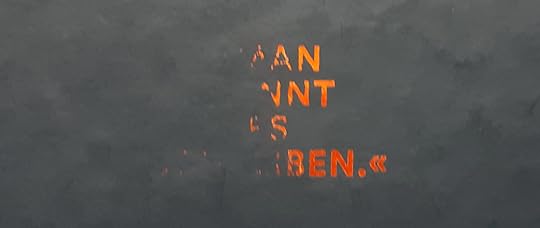
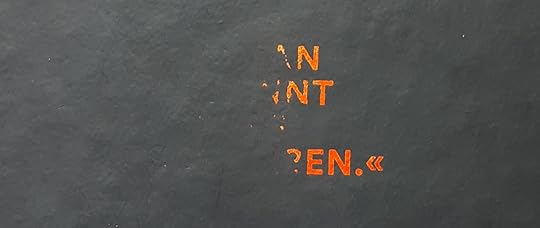
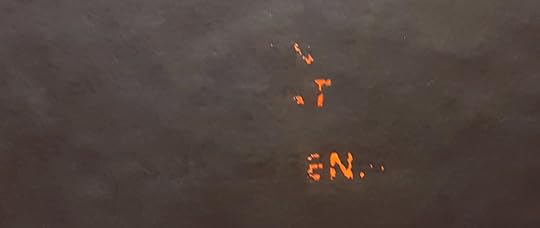
»MAN NENNT ES SCHREIBEN.« IT IS CALLED WRITING – on the back cover of this brick, in golden-red letters, these four words are the only thing resembling something that one might call a “blurb”. If you fetch this book off a shelf in a book shop, considering to buy it, you’ll be left pretty much in the dark about its content, and, I have to admit, this review won’t probably help either. I’ve made several photos of this “blurb”, for a reason that will become apparent in the fourth paragraph below. Here’s how it looked like on day two of my reading experience.
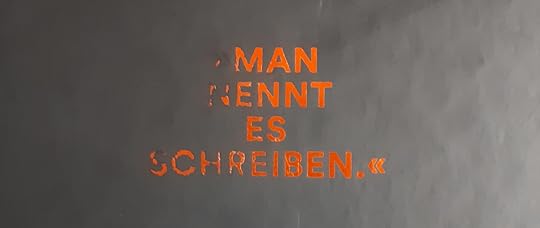
Incidentally, “It’s called writing” is also the opening sentence, and the closing one too. In between there are 1008 pages of rather dense prose. If you would ask me what exactly this book, a novel with the subtitle Requiem, is about, I have to dodge a bit, because it’s really hard to tell. There’s a first-person-narrator, that is undisputed, and it’s also pretty clear that the narrator goes by the name of Nobody, although weather this is his real name, or an assumed one, I cannot be sure. The narrator, by his own admission, is writing the book Schattenfroh, that is probably the book at hand, but he is not actually writing it, but thinking into into existence, something like that, anyway. There’s also a character named Schattenfroh, who’s not to be confused with the book, although this character might as well have written the text, or at least parts of it. Nobody knows, but he never really tells. By the way, there’s no German word schattenfroh, no adjective I mean, and if there was one, it would mean something like shadow-happy or fond of shadows. However, I was surprised to learn that the name Schattenfroh does indeed exist, for instance there’s a neurologist (of all professions!) by the name of Christoph Schattenfroh.
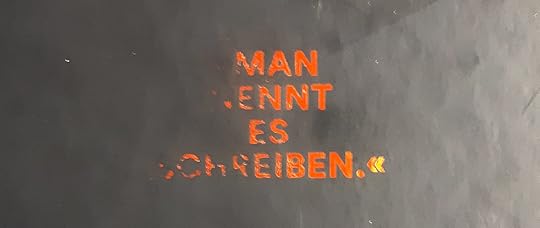
The Schattenfroh character in the book is somehow forcing the narrator, writer, thinker to write, narrate, think his book. He might be the devil, or he might be Nobody’s late father, or an alter ego of him or of the father, or perhaps he’s switching between all these roles as the text moves further. Like I said, it’s hard to tell. Thankfully, on page 30, the author reveals a list of things to come, which can be read as some kind of table of contents, because otherwise the text has no chapters. “A large painting is to be seen, an office, a father, a cell, a medieval meal, an interrogation, a black page, a hell, a toad, a chimera, an open book, Ruprecht, Rilke, a heavenly journey, the ladies of the seven anterooms, a throne of God, a tapestry, a city map, a small mother-of-god-house, a city wall, a wooden doll, a fratzenstuhl*, a woman at the window, a carpet, a curtain, a cell, a sword, an interrogation, an execution, the office, a library, mother in a big traiņ, a nursing home, a suitcase and a girl, 23 houses, a second library, a key, a whole house, the Last Judgment, a hearing aid device, a park bench, grandfather, the Eifel, Prüm, a meeting, a fountain, a battle, an arrest, a print shop, a pact with the printer, a pressbengel**, a castle, a cell, an interrogation, a pamphlet against Luther, an execution, an intensive care unit, body and soul, a dying, a death, a Hürtgenwald, a pub, a chasm, a verdict, an executioner’s sword, a photograph, a trunk, a river.”
* a baroque chair with a carved grotesque face on its backrest
** a lever to turn the screw of an early printing press
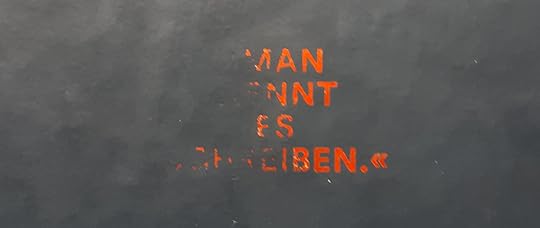
As you can see the letters of the “blurb” are slowly fading away and start to disintegrate. The same goes for the letters H, T, and O of the title, and what once was SCHATTENFROH has now become SCATENFRH.
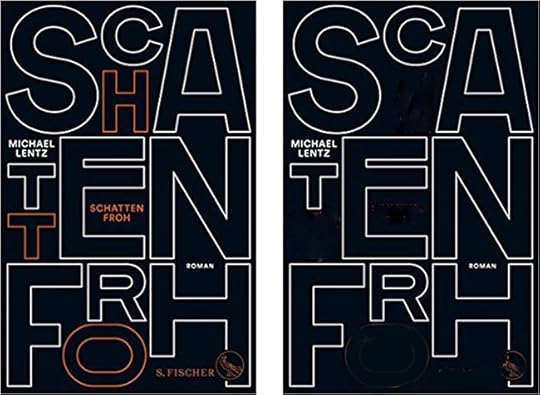
I assumed some printer in the print shop picked the wrong material or color for these letters, or an unfitting pressbengel, and I was about to file a complain. But now, after reading the entire book, I have to say it totally makes sense, and I actually think this was intentional, or at least a lucky coincidence. A major theme, it appears to me, is life and death and there are some deep thoughts about death and dying, the best ones I read in a long while, especially near the end of the book when the Father … but I don’t want to reveal to much. Better find out yourself. Suffice to say that, at least to me, Schattenfroh is running circles around Karl Ove Knausgård’s attempt in putting the death of his father into words.
Speaking of other books, there’s a bibliography of works which is seven pages long and placed right in the middle of the novel and, of course, belongs to the novel, іs part of the non-existing “plot”. It contains the usual suspects like Beckett, Cervantes, Dante, Kafka, … but also quite a few non-fictional titles and many books or authors I haven’t even heard about, and it includes itself, Schattenfroh by Schattenfroh. I also wonder how the real author of Schattenfroh, this time I mean Michael Lentz, was able to include the page number of the bibliography on the page with that number in his text before the book was even typeset? It’s quite confusing.
Apart from life and death, and the means of how the latter one can be enforced unto others, there’s a great deal of talking about God too. And about Jesus, the son of God, who is also miraculously God himself, and since this book is narrated by a son who is telling about his father, one cannot help but see a connection of these two pairs. Another pairing, God vs Devil, is reflected in Müntzer vs Luther, if you follow the author’s notion. I have to admit, I didn’t know much about either of these two Reformers before, but now I want to read more, especially after I found out about Müntzer’s (aka the Antiluther) “battle sermon”, which is partially reproduced here, but unfortunately overwritten.

What else is there to say? I’m mightily impressed by this book, I’m awed, and I think, no, I know that I only understood a fraction of the text, let alone internalized it, so you can say I’m humbled too. This book cries out for a second reading, or possibly a third one. I might as well stop reading other books altogether, and only read Schattenfroh from this day on. This is what is called reading. It’s always difficult to make comparisons with other books. Perhaps Robert Musil’s MAN WITHOUT QUALITIES, or Peter Weiss’ AESTHETICS OF RESISTANCE have aroused similar euphoric feelings in me after finishing it; and, of course, Arno SChmidt’s BOTTOMS DREAM (although that one plays in a league of its own anyway). After some pondering, I decided to give this book five stars, because that’s all I can do, even though I consider Schattenfroh far beyond any petty rating system.
Until now, the novel is only available in German, and translating it into another language will be a mission impossible indeed. But that’s what I thought about SChmidt’s book as well, until John E. Woods came along and proved me wrong. Alas, Woods had announced that he considered his work as a translator to be complete. I’m sure he would have a field day in translating this one (and good luck with the anagrams).

PS: Definitely also check out the first English review on The Untranslated blog!

This work is licensed under a Creative Commons Attribution-NonCommercial-ShareAlike 3.0 Unported License.
Incidentally, “It’s called writing” is also the opening sentence, and the closing one too. In between there are 1008 pages of rather dense prose. If you would ask me what exactly this book, a novel with the subtitle Requiem, is about, I have to dodge a bit, because it’s really hard to tell. There’s a first-person-narrator, that is undisputed, and it’s also pretty clear that the narrator goes by the name of Nobody, although weather this is his real name, or an assumed one, I cannot be sure. The narrator, by his own admission, is writing the book Schattenfroh, that is probably the book at hand, but he is not actually writing it, but thinking into into existence, something like that, anyway. There’s also a character named Schattenfroh, who’s not to be confused with the book, although this character might as well have written the text, or at least parts of it. Nobody knows, but he never really tells. By the way, there’s no German word schattenfroh, no adjective I mean, and if there was one, it would mean something like shadow-happy or fond of shadows. However, I was surprised to learn that the name Schattenfroh does indeed exist, for instance there’s a neurologist (of all professions!) by the name of Christoph Schattenfroh.
The Schattenfroh character in the book is somehow forcing the narrator, writer, thinker to write, narrate, think his book. He might be the devil, or he might be Nobody’s late father, or an alter ego of him or of the father, or perhaps he’s switching between all these roles as the text moves further. Like I said, it’s hard to tell. Thankfully, on page 30, the author reveals a list of things to come, which can be read as some kind of table of contents, because otherwise the text has no chapters. “A large painting is to be seen, an office, a father, a cell, a medieval meal, an interrogation, a black page, a hell, a toad, a chimera, an open book, Ruprecht, Rilke, a heavenly journey, the ladies of the seven anterooms, a throne of God, a tapestry, a city map, a small mother-of-god-house, a city wall, a wooden doll, a fratzenstuhl*, a woman at the window, a carpet, a curtain, a cell, a sword, an interrogation, an execution, the office, a library, mother in a big traiņ, a nursing home, a suitcase and a girl, 23 houses, a second library, a key, a whole house, the Last Judgment, a hearing aid device, a park bench, grandfather, the Eifel, Prüm, a meeting, a fountain, a battle, an arrest, a print shop, a pact with the printer, a pressbengel**, a castle, a cell, an interrogation, a pamphlet against Luther, an execution, an intensive care unit, body and soul, a dying, a death, a Hürtgenwald, a pub, a chasm, a verdict, an executioner’s sword, a photograph, a trunk, a river.”
* a baroque chair with a carved grotesque face on its backrest
** a lever to turn the screw of an early printing press
As you can see the letters of the “blurb” are slowly fading away and start to disintegrate. The same goes for the letters H, T, and O of the title, and what once was SCHATTENFROH has now become SCATENFRH.
I assumed some printer in the print shop picked the wrong material or color for these letters, or an unfitting pressbengel, and I was about to file a complain. But now, after reading the entire book, I have to say it totally makes sense, and I actually think this was intentional, or at least a lucky coincidence. A major theme, it appears to me, is life and death and there are some deep thoughts about death and dying, the best ones I read in a long while, especially near the end of the book when the Father … but I don’t want to reveal to much. Better find out yourself. Suffice to say that, at least to me, Schattenfroh is running circles around Karl Ove Knausgård’s attempt in putting the death of his father into words.
Speaking of other books, there’s a bibliography of works which is seven pages long and placed right in the middle of the novel and, of course, belongs to the novel, іs part of the non-existing “plot”. It contains the usual suspects like Beckett, Cervantes, Dante, Kafka, … but also quite a few non-fictional titles and many books or authors I haven’t even heard about, and it includes itself, Schattenfroh by Schattenfroh. I also wonder how the real author of Schattenfroh, this time I mean Michael Lentz, was able to include the page number of the bibliography on the page with that number in his text before the book was even typeset? It’s quite confusing.
Apart from life and death, and the means of how the latter one can be enforced unto others, there’s a great deal of talking about God too. And about Jesus, the son of God, who is also miraculously God himself, and since this book is narrated by a son who is telling about his father, one cannot help but see a connection of these two pairs. Another pairing, God vs Devil, is reflected in Müntzer vs Luther, if you follow the author’s notion. I have to admit, I didn’t know much about either of these two Reformers before, but now I want to read more, especially after I found out about Müntzer’s (aka the Antiluther) “battle sermon”, which is partially reproduced here, but unfortunately overwritten.
What else is there to say? I’m mightily impressed by this book, I’m awed, and I think, no, I know that I only understood a fraction of the text, let alone internalized it, so you can say I’m humbled too. This book cries out for a second reading, or possibly a third one. I might as well stop reading other books altogether, and only read Schattenfroh from this day on. This is what is called reading. It’s always difficult to make comparisons with other books. Perhaps Robert Musil’s MAN WITHOUT QUALITIES, or Peter Weiss’ AESTHETICS OF RESISTANCE have aroused similar euphoric feelings in me after finishing it; and, of course, Arno SChmidt’s BOTTOMS DREAM (although that one plays in a league of its own anyway). After some pondering, I decided to give this book five stars, because that’s all I can do, even though I consider Schattenfroh far beyond any petty rating system.
Until now, the novel is only available in German, and translating it into another language will be a mission impossible indeed. But that’s what I thought about SChmidt’s book as well, until John E. Woods came along and proved me wrong. Alas, Woods had announced that he considered his work as a translator to be complete. I’m sure he would have a field day in translating this one (and good luck with the anagrams).
PS: Definitely also check out the first English review on The Untranslated blog!
This work is licensed under a Creative Commons Attribution-NonCommercial-ShareAlike 3.0 Unported License.

November 5, 2025
The conflict with the earthly father and the one with the heavenly Father, the liberation promised in the Word and the liberation promised in the word, and the primacy of the text as it relates to the individual.
Will be back for a longer review….
Nobody, was captured and held prisoner by an entity calling itself Schattenfroh. A device was placed over Nobody’s head to collect his thoughts. The thoughts were then transcribed into words, producing the novel Schattenfroh.
“Your mission should read: 'Nobody recognizes himself!’”
The novel Schattenfroh reviews a large span of German history; the works of painters, writers, and philosophers; considers the changes in German religious thought and the state of the Christian church; and explores the relationships in Nobody’s family, particularly his relationship with his father.
"’All things were made by him; / and without him was not any thing made that was made.’ What does that mean? The Word was there before God.
Or: God was first within it, as Word. The Word strode forth from itself as differentiation. As God, it named and called into being by naming-even itself. Thus did the world arise as the difference between Wordgod and Godword.”
Months after finishing Schattenfroh I am left with two thoughts, the Word and the word and the liberation of man. According to the novel, we were created by the divine Word and the Word was there from the beginning with God. Men then crafted their ideas into words and the words were then used to explain and shape reality, though with many limitations.
“If the Voice of God is the bridge between God and Man, then Man is the walker to and fro upon this bridge...In prayer, he wishes to call God down to him...God does not appear outside the human body...but within...The other-God—is in my voice.”
Then I am left with the Word and the word as liberation. Martin Luther reexamined the Bible and came to the realization that a priest was not necessary to intercede on behalf of a sinner, starting the Protestant Reformation of 1517. Here the personal relationship between a man and the divine becomes codified in the Christian faith. Thomas Müntzer then goes further to state that God wanted man not only to be free spiritually but in his material, earthly life. The German Peasant Revolts of the 1520s found the holy Word a source of liberation. Finally we end with the text of Schattenfroh, which was violently extracted from Nobody, destroyed. A small victory, the word and liberation intertwined again.
“The goal is freedom from the Word, which is exterior, the goal is the effect of the inner word....”
This was an impossible review to write but I could not let the year end without writing a few words about this extraordinary piece of fiction. I purchased my copy of this book directly from Deep Vellum to support this independent press during a time their national grant was denied.
Will be back for a longer review….
Nobody, was captured and held prisoner by an entity calling itself Schattenfroh. A device was placed over Nobody’s head to collect his thoughts. The thoughts were then transcribed into words, producing the novel Schattenfroh.
“Your mission should read: 'Nobody recognizes himself!’”
The novel Schattenfroh reviews a large span of German history; the works of painters, writers, and philosophers; considers the changes in German religious thought and the state of the Christian church; and explores the relationships in Nobody’s family, particularly his relationship with his father.
"’All things were made by him; / and without him was not any thing made that was made.’ What does that mean? The Word was there before God.
Or: God was first within it, as Word. The Word strode forth from itself as differentiation. As God, it named and called into being by naming-even itself. Thus did the world arise as the difference between Wordgod and Godword.”
Months after finishing Schattenfroh I am left with two thoughts, the Word and the word and the liberation of man. According to the novel, we were created by the divine Word and the Word was there from the beginning with God. Men then crafted their ideas into words and the words were then used to explain and shape reality, though with many limitations.
“If the Voice of God is the bridge between God and Man, then Man is the walker to and fro upon this bridge...In prayer, he wishes to call God down to him...God does not appear outside the human body...but within...The other-God—is in my voice.”
Then I am left with the Word and the word as liberation. Martin Luther reexamined the Bible and came to the realization that a priest was not necessary to intercede on behalf of a sinner, starting the Protestant Reformation of 1517. Here the personal relationship between a man and the divine becomes codified in the Christian faith. Thomas Müntzer then goes further to state that God wanted man not only to be free spiritually but in his material, earthly life. The German Peasant Revolts of the 1520s found the holy Word a source of liberation. Finally we end with the text of Schattenfroh, which was violently extracted from Nobody, destroyed. A small victory, the word and liberation intertwined again.
“The goal is freedom from the Word, which is exterior, the goal is the effect of the inner word....”
This was an impossible review to write but I could not let the year end without writing a few words about this extraordinary piece of fiction. I purchased my copy of this book directly from Deep Vellum to support this independent press during a time their national grant was denied.

August 31, 2025
Enveloped in a mind-bending fractal of Renaissance art, eschatology, and Germanic history, Lentz’s “Schattenfroh” teeters between brilliance and inscrutability. In his introduction to an English audience, German author and musician Michael Lentz showcases his erudition and presents readers with an intoxicating riddle to solve. Translated by Max Lawton, this surrealist work draws readers into a journey of metaphysical proportions, pushing the boundaries of linguistics and narrative.
The encyclopedic novel unfolds through the perspective of "Nobody," or Neimand in German. Nobody is confined in a dark, isolated cell with a face mask equipped with the technology that harnesses his thought processes, or “brainfluid”, and converts them in real time into the very novel being read. His jailor is Schattenfroh, a metaphysical nightmarish creature, who simultaneously represents God, Lucifer, and Lentz’s father. Schattenfroh and the Frightbearing Society, a play on the 17th-century Fruitbearing Society, impose totalitarian control over Nobody and commission him to write “Schattenfroh”. After the outlandish foundation for the novel is set, it slides into an expansive, time-warping quest through the German Reformation, war-torn Düren, and Renaissance-inspired hellscapes.
Nobody’s odyssey begins with an eschatological ceremony featuring depictions of Hieronymus Bosch’s painting The Last Judgment”: “Through a toad-studded archway strides an unsightly figure, more beast than man, with red-hot eyes and a barred blast furnace with glowing coals for a belly, which, with its zippered black robe, makes it appear to be the triangular eye of God. It wears a green turban upon its head, from which green cloths, decorated with pearls upon their upper thirds, flow to the right and to the left. The hell-fire in its belly beats through its head. Its maw is open wide, displaying four pointed canines before its fire-flaming gullet. As master of ceremonies, it carries a fourfold scythe, with which it shall twist the word in my mouth four times over.” This ceremony takes the form of a trial that declares humanity’s presumed guilt and eternal damnation and proves to be one of many interrogations throughout the novel. The event also serves as an initiation for Nobody’s travels through Germanic history and Lentz’s own familial past.
While Nobody’s voyage whirls him through historical Germany, amidst landmark events, Lentz weaves autobiographical threads into the narrative, creating a flurry of memories and fantastical depictions that portray a stain of ancestral trauma: “The lifelong fear of becoming like those from before, then one is to lie only a few steps away from them, for this is, indeed, a family plot and that is what one possesses, even if one has lost one's life.” Totalitarianism is explored through a kind of unholy triad formed by Schattenfroh, Adolf Hitler, and Nobody’s father.
From allusions to Lutherans and criticism of Pope Pius XII to the direct implantation of figures like Thomas Müntzer, religious upheaval permeates the work. Lentz drowns readers in a deluge of philosophical notions and exhaustive references, in an effort to examine Christ’s crucifixion as the seminal act of violence: “Faith is all about suffering, only the experience of the cross counts if one wishes to receive the testimony of God into one's heart, all else is mere semblance, I say.” This intense exploration extends beyond theology into metaphysics; from a device coined “Hegel” to the Kabbalistic concept of Tzimtzum, much of the novel is rooted in an attempt to leap outside existence—or “being-in-itself”—exemplified by a looping narrative that appears to write and erase itself continuously.
Despite its panoptical narrative and clever constructs, its complexity comes at a cost. The narrative becomes constipated at times due to its endlessly referential and self-reflexive theatrics, including scrambled names, anagrams, and frequent interruptions that substitute mental gymnastics for clarity. With a handwritten list of Allied bombing victims spanning nearly 80 pages, mysterious ciphers, and various interpolations, it will likely attract a cultish audience while remaining confoundingly futile for many.
Spanning 1,000 pages, Lentz’s edifice blends esoteric inventions with introspective prose, effortlessly stacking and folding into an Escheresque structure that is difficult to extract definitive messages from. It’s a novel that demands patience, multidisciplinary comprehension, and an openness to grapple with Lentz’s experimental devices. Just as the end of the novel returns to its beginning, readers seeking to grasp its depths must reread it, peeling back each layer with every pass. It could very well be a century-defining novel or remain cherished solely by a targeted niche willing to lose themselves in its shadows—only time will tell.
The encyclopedic novel unfolds through the perspective of "Nobody," or Neimand in German. Nobody is confined in a dark, isolated cell with a face mask equipped with the technology that harnesses his thought processes, or “brainfluid”, and converts them in real time into the very novel being read. His jailor is Schattenfroh, a metaphysical nightmarish creature, who simultaneously represents God, Lucifer, and Lentz’s father. Schattenfroh and the Frightbearing Society, a play on the 17th-century Fruitbearing Society, impose totalitarian control over Nobody and commission him to write “Schattenfroh”. After the outlandish foundation for the novel is set, it slides into an expansive, time-warping quest through the German Reformation, war-torn Düren, and Renaissance-inspired hellscapes.
Nobody’s odyssey begins with an eschatological ceremony featuring depictions of Hieronymus Bosch’s painting The Last Judgment”: “Through a toad-studded archway strides an unsightly figure, more beast than man, with red-hot eyes and a barred blast furnace with glowing coals for a belly, which, with its zippered black robe, makes it appear to be the triangular eye of God. It wears a green turban upon its head, from which green cloths, decorated with pearls upon their upper thirds, flow to the right and to the left. The hell-fire in its belly beats through its head. Its maw is open wide, displaying four pointed canines before its fire-flaming gullet. As master of ceremonies, it carries a fourfold scythe, with which it shall twist the word in my mouth four times over.” This ceremony takes the form of a trial that declares humanity’s presumed guilt and eternal damnation and proves to be one of many interrogations throughout the novel. The event also serves as an initiation for Nobody’s travels through Germanic history and Lentz’s own familial past.
While Nobody’s voyage whirls him through historical Germany, amidst landmark events, Lentz weaves autobiographical threads into the narrative, creating a flurry of memories and fantastical depictions that portray a stain of ancestral trauma: “The lifelong fear of becoming like those from before, then one is to lie only a few steps away from them, for this is, indeed, a family plot and that is what one possesses, even if one has lost one's life.” Totalitarianism is explored through a kind of unholy triad formed by Schattenfroh, Adolf Hitler, and Nobody’s father.
From allusions to Lutherans and criticism of Pope Pius XII to the direct implantation of figures like Thomas Müntzer, religious upheaval permeates the work. Lentz drowns readers in a deluge of philosophical notions and exhaustive references, in an effort to examine Christ’s crucifixion as the seminal act of violence: “Faith is all about suffering, only the experience of the cross counts if one wishes to receive the testimony of God into one's heart, all else is mere semblance, I say.” This intense exploration extends beyond theology into metaphysics; from a device coined “Hegel” to the Kabbalistic concept of Tzimtzum, much of the novel is rooted in an attempt to leap outside existence—or “being-in-itself”—exemplified by a looping narrative that appears to write and erase itself continuously.
Despite its panoptical narrative and clever constructs, its complexity comes at a cost. The narrative becomes constipated at times due to its endlessly referential and self-reflexive theatrics, including scrambled names, anagrams, and frequent interruptions that substitute mental gymnastics for clarity. With a handwritten list of Allied bombing victims spanning nearly 80 pages, mysterious ciphers, and various interpolations, it will likely attract a cultish audience while remaining confoundingly futile for many.
Spanning 1,000 pages, Lentz’s edifice blends esoteric inventions with introspective prose, effortlessly stacking and folding into an Escheresque structure that is difficult to extract definitive messages from. It’s a novel that demands patience, multidisciplinary comprehension, and an openness to grapple with Lentz’s experimental devices. Just as the end of the novel returns to its beginning, readers seeking to grasp its depths must reread it, peeling back each layer with every pass. It could very well be a century-defining novel or remain cherished solely by a targeted niche willing to lose themselves in its shadows—only time will tell.

September 17, 2025
I only hear . . . , “A small mistake in the beginning is a big one in the end.” Schattenfroh, he is the Big Other that perpetually changes its shape, the processes put themselves to paper.
Guessing that an understanding of the Biblical Book of Daniel would be helpful here. I am not familiar. Far from suggesting there's a lynchpin to a successful reading, I reflect that my mixed experience was likely to be expected and probably would have warranted three stars until the final 130 pages--that final section was captivating and at least offered a playful coalesce of the novel's themes. There are repeated riffs on the Reformation and the advent of movable type as a counterpoint to apocalyptic images from Bosch to the Third Reich.
As noted, my favorite element of the book was the inclusion of a supplemental reading list, one which included several titles by Emmanuel Levinas and again I was found lacking. The idea that a flaw from a copyist or even an author can be magnified through repetition is an even greater risk during Benjamin's Mechanical Reproduction. What is the endpoint of such investigation, is it ashes from Gehena or the self-erasing model that Lentz presents us within the camera obscura of the opening sections: a stylus powered by brain fluid? Alongside the warping of messages is the dehumanization of ordering systems (please page Nick Land -- someone is alluding to cybernetics) with the extreme example being the impalement by the Ottomans along the river Drina which is cited to test the prescriptive merits of literature. The coroner’s report on the Crucified One was a bit unexpected as are meditations on beheading and the more general phenomenon of pain porn where our author bends Celan to a lyrical approximation. There are glosses along the notion of Das Man as interpreted by Heidegger, alas this is in a smoky Eck not in a surgical center where eerily the family of the protagonist is brought to the fore only to wasted away from disease.
Guessing that an understanding of the Biblical Book of Daniel would be helpful here. I am not familiar. Far from suggesting there's a lynchpin to a successful reading, I reflect that my mixed experience was likely to be expected and probably would have warranted three stars until the final 130 pages--that final section was captivating and at least offered a playful coalesce of the novel's themes. There are repeated riffs on the Reformation and the advent of movable type as a counterpoint to apocalyptic images from Bosch to the Third Reich.
As noted, my favorite element of the book was the inclusion of a supplemental reading list, one which included several titles by Emmanuel Levinas and again I was found lacking. The idea that a flaw from a copyist or even an author can be magnified through repetition is an even greater risk during Benjamin's Mechanical Reproduction. What is the endpoint of such investigation, is it ashes from Gehena or the self-erasing model that Lentz presents us within the camera obscura of the opening sections: a stylus powered by brain fluid? Alongside the warping of messages is the dehumanization of ordering systems (please page Nick Land -- someone is alluding to cybernetics) with the extreme example being the impalement by the Ottomans along the river Drina which is cited to test the prescriptive merits of literature. The coroner’s report on the Crucified One was a bit unexpected as are meditations on beheading and the more general phenomenon of pain porn where our author bends Celan to a lyrical approximation. There are glosses along the notion of Das Man as interpreted by Heidegger, alas this is in a smoky Eck not in a surgical center where eerily the family of the protagonist is brought to the fore only to wasted away from disease.
October 1, 2025
Schattenfroh initially presents a series of fun experiments, stretching the reader out and expanding the horizons of the text. As it develops and accumulates, the architecture of the text becomes visible and there are interesting things going on there, especially on the metafictional level regarding the two main figures of the book.
This is very "easy" reading in that it doesn't demand intensive concentration but rather imaginative flexibility and pliability. You can fly through this book. It reminds me of EDM or something in that way. I was constantly reminded of other books and media as i read through. This posture mirrors the themes at play in the narrative: language (as death, murder), tyranny/subordination, violence, fathers and sons.
The text doesn't perfectly cohere, and not infrequently it can feel like the reader is compelled skim over passages that seem to be present only for their texture or initial shock/disorienting effect, which serves a purpose but feels weak.
The ending is satisfying, as is the turn in the concluding section to a direct engagement with the emotional heart of the book.
Lawton's translation is great. There were clearly many difficult decisions that seem (to this non-German speaker) to be handled thoughtfully and effectively.
Worth the time; will probably reread. 4 stars.
EDIT: It's been some weeks and this book has left almost no lasting impression on me. Unfortunately, a disposable and forgettable, though unique, experience. Revising score down to 3.
This is very "easy" reading in that it doesn't demand intensive concentration but rather imaginative flexibility and pliability. You can fly through this book. It reminds me of EDM or something in that way. I was constantly reminded of other books and media as i read through. This posture mirrors the themes at play in the narrative: language (as death, murder), tyranny/subordination, violence, fathers and sons.
The text doesn't perfectly cohere, and not infrequently it can feel like the reader is compelled skim over passages that seem to be present only for their texture or initial shock/disorienting effect, which serves a purpose but feels weak.
The ending is satisfying, as is the turn in the concluding section to a direct engagement with the emotional heart of the book.
Lawton's translation is great. There were clearly many difficult decisions that seem (to this non-German speaker) to be handled thoughtfully and effectively.
Worth the time; will probably reread. 4 stars.
EDIT: It's been some weeks and this book has left almost no lasting impression on me. Unfortunately, a disposable and forgettable, though unique, experience. Revising score down to 3.

December 17, 2025
Node/Greift
One called this reading/Man nannte es Lesen
Others will describe Schattenfroh much better than I ever could, so I'm not even going to try. Instead, my experience:
About two years ago when I started paying closer attention to the wider Booktube community, I found myself on The Untranslated’s page reading about what appeared to be a Very Important Work of German LiteratureTM called Schattenfroh. Its description really pulled me in: a “psychogeography of the self”! And what a magically evocative title! However at 1,001 pages, picking up Schattenfroh in German was going to be extremely unlikely. I’ve been trying to mentally prepare myself to tackle Die Niederschrift des Gustav Anias Horn from Hans Henny Jahnn’s Fluß ohne Ufer for almost 20 years, so another monster was not in the cards. When the translation was announced, I became excited to finally discover what all the fuss was about and the more I read about it the more it became evident that I was going to be missing out on a lot of stuff that translation simply could not capture. The language was going to be too firmly entrenched in itself. So I found a reasonably priced copy in German and read it in parallel.
Once I had both editions, I realized that the only way I was going to be able to ensure that I could comprehend what was going on was to keep a personal reading guide. About two weeks after I started, Andrei at The Untranslated had published his. It not only far surpassed anything I could have put together on my own, but it also helped me to check my understanding while grappling with the scope of this profound, expansive, and difficult novel (the entries for the artworks saved me what probably would have been hours of fruitless searching). If I didn’t have the translation to fall back on, I practically would have had to do one of my own as I read it. I found myself cutting several losses with the original German, but generally did OK. Without an English copy, reading Schattenfroh would have taken me much longer than I was prepared to endure and I likely would have given up in favor of doing anything else. Having taken me three meditative months to complete, it felt like crossing the Sahara on a camel. The long way.
This is the first of Max Lawton’s translations that I’ve read and it had to have been a gargantuan effort. He not only had to contend with the sheer size of the novel and monstrous sentences but also passages in older forms of German, local dialects, poetry, tone variation matching, structural restrictions, experimental text formatting, constant use of German’s indirect speech verb form, specialized technical vocabulary, and even providing translations of other works never having appeared in English before (usually in excerpts), not to mention wrestling with untranslatables. I raise my hat to his clever solutions for some of the stickier bits of text. However, there are also a handful of mistakes and minor omissions that go beyond difference of opinion. Clarification liberties in the form parentheticals and in-line explanations of German ranged from the necessary to the puzzling. Regardless, these instances will be glossed over by most readers. This is a major achievement, and I don’t do this for a living, so I *can* shut the hell up. Bringing this work to a wider readership is more important.
As I progressed, I noticed that the reading guide on The Untranslated listed some of the several anagrams, references, and diversions that Lentz employs throughout the work as open questions. It seemed like an invitation for assistance and I began sending Andrei everything I was able to not only solve, but also tease out from the original that was lost in translation or provide cites for references that were impossible to capture, ranging from the factual to the analytical to the conspiracy theory maniacal. He graciously and patiently took the time to respond to each of them when he could have told me to buzz off.
Solving some of the anagrams, decoding the recurring themes and symbolism, and doing loads of tangential reading were genuinely enriching and did wonders for my ego, but did I actually like the book beyond the entertainment of working out these details? It’s been a mixed bag. I’m typically wary of postwar novels that exceed 500 pages and there were moments that felt like real work to get through. If the pagination of Schattenfroh weren't a structural choice, which it was, would its length have been absolutely necessary? It was hard to not view dozens of pages as filler while knowing that Lentz’s intent was to write 1,001 pages. The action progresses in a trippy / surrealist-associative / stream of consciousness manner that you find yourself surrendering to pretty quickly. Identity is constantly in flux and the main character has no character to speak of, which is intentional rather than detrimental. The writing is dense, cerebral and obfuscatory to the point where you can’t be sure if you’ve fully understood what’s going on. The broad themes are totalitarianism in all of its forms, the surveillance state, revolt, and the author dealing with the death of his father (his mother’s passing is often mentioned as well). Some rare moments are beautifully written and while I haven't experienced the death of a parent yet, Lentz takes you there unflinchingly. In many ways, it read like a love letter to the German language. Schattenfroh’s obvious influences will only scratch the surface of what the reader will be faced with and I cannot claim to have recognized them all. The scenes of ekphrasis are high points separated by the occasional speed bumps of less interesting episodes, though no less strange than any of the others. Despite anything that felt like a slog, this is not a novel that one forgets and I'm sure I'm going to be chewing on it for a long time - to borrow an image from the text, it has dug itself into me like a Lucifertick and may have fundamentally changed how I conceptualize the literary experience from all of its angles. It's also seemingly spoiler-proof because there's little that can be described as plot and it's tough to accurately describe what it's about to the uninitiated without sounding insane. That’s not necessarily a bad thing.
At about page 700, I felt the relief that comes with knowing that the end was in sight, however the energy to finish was starting to dwindle. Reading it in parallel felt like a fight from the beginning, but long descriptions of architectural and printing press details had me longing for any other book on my pile. It began to pick up again around page 800 and I was excited to see how everything would play out.
I couldn’t shake the constant question: Who is this book for? It purportedly has had a more enthusiastic reception among readers of English than German, but given all of the deep dives into German literature, history, religion, mysticism, art, architecture, and local geography, a lot of which I was learning about for the first time, how much of this novel in all its twists, turns, and potential research digressions was going to be lost on the everyday, though intrepid, reader of English? Does it really matter if 90% of it goes over a reader's head if it succeeds in striking a chord with them? Am *I* the baseline target audience for this book: a detail-oriented obsessive who decided against getting an advanced degree in Germanistik, but continues to foster a love for the language and its literature nevertheless? This book appeals to a certain type, but I'm not sure what that type is. There's a lot of “flex” and obscurity mining here, so I suppose it depends on how you respond to that kind of literature. I recommend it to the daring, though reluctantly.
(That I finished Schattenfroh on my father's birthday is an unnerving coincidence.)
One called this reading/Man nannte es Lesen
Others will describe Schattenfroh much better than I ever could, so I'm not even going to try. Instead, my experience:
About two years ago when I started paying closer attention to the wider Booktube community, I found myself on The Untranslated’s page reading about what appeared to be a Very Important Work of German LiteratureTM called Schattenfroh. Its description really pulled me in: a “psychogeography of the self”! And what a magically evocative title! However at 1,001 pages, picking up Schattenfroh in German was going to be extremely unlikely. I’ve been trying to mentally prepare myself to tackle Die Niederschrift des Gustav Anias Horn from Hans Henny Jahnn’s Fluß ohne Ufer for almost 20 years, so another monster was not in the cards. When the translation was announced, I became excited to finally discover what all the fuss was about and the more I read about it the more it became evident that I was going to be missing out on a lot of stuff that translation simply could not capture. The language was going to be too firmly entrenched in itself. So I found a reasonably priced copy in German and read it in parallel.
Once I had both editions, I realized that the only way I was going to be able to ensure that I could comprehend what was going on was to keep a personal reading guide. About two weeks after I started, Andrei at The Untranslated had published his. It not only far surpassed anything I could have put together on my own, but it also helped me to check my understanding while grappling with the scope of this profound, expansive, and difficult novel (the entries for the artworks saved me what probably would have been hours of fruitless searching). If I didn’t have the translation to fall back on, I practically would have had to do one of my own as I read it. I found myself cutting several losses with the original German, but generally did OK. Without an English copy, reading Schattenfroh would have taken me much longer than I was prepared to endure and I likely would have given up in favor of doing anything else. Having taken me three meditative months to complete, it felt like crossing the Sahara on a camel. The long way.
This is the first of Max Lawton’s translations that I’ve read and it had to have been a gargantuan effort. He not only had to contend with the sheer size of the novel and monstrous sentences but also passages in older forms of German, local dialects, poetry, tone variation matching, structural restrictions, experimental text formatting, constant use of German’s indirect speech verb form, specialized technical vocabulary, and even providing translations of other works never having appeared in English before (usually in excerpts), not to mention wrestling with untranslatables. I raise my hat to his clever solutions for some of the stickier bits of text. However, there are also a handful of mistakes and minor omissions that go beyond difference of opinion. Clarification liberties in the form parentheticals and in-line explanations of German ranged from the necessary to the puzzling. Regardless, these instances will be glossed over by most readers. This is a major achievement, and I don’t do this for a living, so I *can* shut the hell up. Bringing this work to a wider readership is more important.
As I progressed, I noticed that the reading guide on The Untranslated listed some of the several anagrams, references, and diversions that Lentz employs throughout the work as open questions. It seemed like an invitation for assistance and I began sending Andrei everything I was able to not only solve, but also tease out from the original that was lost in translation or provide cites for references that were impossible to capture, ranging from the factual to the analytical to the conspiracy theory maniacal. He graciously and patiently took the time to respond to each of them when he could have told me to buzz off.
Solving some of the anagrams, decoding the recurring themes and symbolism, and doing loads of tangential reading were genuinely enriching and did wonders for my ego, but did I actually like the book beyond the entertainment of working out these details? It’s been a mixed bag. I’m typically wary of postwar novels that exceed 500 pages and there were moments that felt like real work to get through. If the pagination of Schattenfroh weren't a structural choice, which it was, would its length have been absolutely necessary? It was hard to not view dozens of pages as filler while knowing that Lentz’s intent was to write 1,001 pages. The action progresses in a trippy / surrealist-associative / stream of consciousness manner that you find yourself surrendering to pretty quickly. Identity is constantly in flux and the main character has no character to speak of, which is intentional rather than detrimental. The writing is dense, cerebral and obfuscatory to the point where you can’t be sure if you’ve fully understood what’s going on. The broad themes are totalitarianism in all of its forms, the surveillance state, revolt, and the author dealing with the death of his father (his mother’s passing is often mentioned as well). Some rare moments are beautifully written and while I haven't experienced the death of a parent yet, Lentz takes you there unflinchingly. In many ways, it read like a love letter to the German language. Schattenfroh’s obvious influences will only scratch the surface of what the reader will be faced with and I cannot claim to have recognized them all. The scenes of ekphrasis are high points separated by the occasional speed bumps of less interesting episodes, though no less strange than any of the others. Despite anything that felt like a slog, this is not a novel that one forgets and I'm sure I'm going to be chewing on it for a long time - to borrow an image from the text, it has dug itself into me like a Lucifertick and may have fundamentally changed how I conceptualize the literary experience from all of its angles. It's also seemingly spoiler-proof because there's little that can be described as plot and it's tough to accurately describe what it's about to the uninitiated without sounding insane. That’s not necessarily a bad thing.
At about page 700, I felt the relief that comes with knowing that the end was in sight, however the energy to finish was starting to dwindle. Reading it in parallel felt like a fight from the beginning, but long descriptions of architectural and printing press details had me longing for any other book on my pile. It began to pick up again around page 800 and I was excited to see how everything would play out.
I couldn’t shake the constant question: Who is this book for? It purportedly has had a more enthusiastic reception among readers of English than German, but given all of the deep dives into German literature, history, religion, mysticism, art, architecture, and local geography, a lot of which I was learning about for the first time, how much of this novel in all its twists, turns, and potential research digressions was going to be lost on the everyday, though intrepid, reader of English? Does it really matter if 90% of it goes over a reader's head if it succeeds in striking a chord with them? Am *I* the baseline target audience for this book: a detail-oriented obsessive who decided against getting an advanced degree in Germanistik, but continues to foster a love for the language and its literature nevertheless? This book appeals to a certain type, but I'm not sure what that type is. There's a lot of “flex” and obscurity mining here, so I suppose it depends on how you respond to that kind of literature. I recommend it to the daring, though reluctantly.
(That I finished Schattenfroh on my father's birthday is an unnerving coincidence.)

Want to Read
September 15, 2018tRanSlate pLeeZeee! --->screw it. checks=in=the=mails. I can read German. Why wait. 2019 I'm reading a 1008 page Meisterstuck auf Deutsch.
First ever English=Sprach review now up over at the untranslated ::
https://theuntranslated.wordpress.com...
Hör mal zu ::
"What was it like to be THERE in 1851, when Moby-Dick was published? Or in 1913, when Swann’s Way came out? Or in 1922, when Ulysses crashed into our culture like a meteor and changed it forever? Or in 1955, when The Recognitions was not recognised for the masterpiece it was? Or in 1959, when The Tin Drum inaugurated the birth of new German literature: complex, linguistically overwhelming, and irreverent? Now I know because I was THERE in 2018, when Michael Lentz’s Schattenfroh saw light. Some critics were upset that this novel had not been nominated for any literary prizes. To which I can only say: Are you even serious? Prizes imply competition, but what competition can we talk about when dealing with perhaps the greatest German-language novel of the 21st century up to now? This in equal measure baroque and surrealist explosion of a novel belongs to the pantheon of the best works of world literature published in the past two decades, which includes so far Miquel de Palol’s The Troiacord, Antonio Moresco’s Songs of Chaos, and Mircea Cărtărescu’s Solenoid. In some fifty years, the grandchildren of the literary judges who chose to ignore Schattenfroh will be studying it at universities and maybe even writing their PhD theses about it, whereas most of today’s German prize-winning books will be completely forgotten."
Also, read his last paragraph and thank him. This is BIG stuff!
_______
What's going on? FAT=ass German books've been rolling off the presses?
Schattenfroh: Ein Requiem
Am Weltenrand sitzen die Menschen und lachen
Freuden der Jagd
Frohburg. Roman
Die Stunde zwischen Frau und Gitarre
Risiko
Durchzug eines Regenbandes
First ever English=Sprach review now up over at the untranslated ::
https://theuntranslated.wordpress.com...
Hör mal zu ::
"What was it like to be THERE in 1851, when Moby-Dick was published? Or in 1913, when Swann’s Way came out? Or in 1922, when Ulysses crashed into our culture like a meteor and changed it forever? Or in 1955, when The Recognitions was not recognised for the masterpiece it was? Or in 1959, when The Tin Drum inaugurated the birth of new German literature: complex, linguistically overwhelming, and irreverent? Now I know because I was THERE in 2018, when Michael Lentz’s Schattenfroh saw light. Some critics were upset that this novel had not been nominated for any literary prizes. To which I can only say: Are you even serious? Prizes imply competition, but what competition can we talk about when dealing with perhaps the greatest German-language novel of the 21st century up to now? This in equal measure baroque and surrealist explosion of a novel belongs to the pantheon of the best works of world literature published in the past two decades, which includes so far Miquel de Palol’s The Troiacord, Antonio Moresco’s Songs of Chaos, and Mircea Cărtărescu’s Solenoid. In some fifty years, the grandchildren of the literary judges who chose to ignore Schattenfroh will be studying it at universities and maybe even writing their PhD theses about it, whereas most of today’s German prize-winning books will be completely forgotten."
Also, read his last paragraph and thank him. This is BIG stuff!
_______
What's going on? FAT=ass German books've been rolling off the presses?
Schattenfroh: Ein Requiem
Am Weltenrand sitzen die Menschen und lachen
Freuden der Jagd
Frohburg. Roman
Die Stunde zwischen Frau und Gitarre
Risiko
Durchzug eines Regenbandes

November 1, 2025
I feel that Schattenfroh is a book for a particular type of reader. If you like philosophy, theology, art history, and digging into puzzles then this could be for you. The absence of much of a plot isn’t usually a problem for me as long as I like the ideas being examined, but in this case I never got very deep into the book. I admit to doing a surface reading for the most part and I took more pleasure in other peoples ideas and theories about the book than the actual material. It may be that the book was too smart for me or that I was lazy but it just didn’t grab me. That’s not to say that there isn’t good stuff here. The writing is quality and there is enjoyment to be had bouncing around from one art piece or historical reference to another. The real rewards probably come from being a studious type who commits to the project of this book. It deserves a second reading and maybe I will get to it someday. Who knows.

May 6, 2026
certainly answers to that one henry james description of big books as 'loose, baggy monsters', but i'm afraid i wasn't entirely convinced by this as the generational masterpiece that mr. untranslated has been touting it as. it certainly is a large, digressive, experimental novel with a lot of ambition, but for me personally it never quite lived up to that even though there are some stand out sequences(e.g. the narrator is put through a kind of trial by satan in the form of a demon with a firebreathing grille in his chest who turns into a rat, innumerable descriptions of the narrator's father's labyrinthine beaurucratic office, the narrator ends up in a german city in the 1500s and is consigned to building the wall forever as punishment, etc). part of it is probably that i am not particularly on the wavelength of any of the obsessions that plague the narrator, such as the protestant reformation and its reverberating effects on german history, kabbalah and the associated rabbinic tradition or the many and varied theological references and discussions, but i also wasn't all that taken with the style. on occasion Lenz lapses into long germanic sentences that are quite enjoyable, but a lot of it is fairly workmanlike and not as stylistically varied as you might expect from a book of this length. it is however still pretty cool that something as weird as this got translated and turned into a meme for the benefit of 10 people online though, so good job on that one deep vellum press.
June 4, 2026
At times during this long journey I was lost, numbed, frustrated, even bored. And amazed. Are you up on your German history and culture? Like any thousand-page book, highs and lows. At the final page my mind broke with contradictory propositions : 'I will never read this book again' / 'I will read this book again.' In fact, it demands multiple reads, not to be taken lightly with a novel of this size and density. I truly do not know what else to say about it. Perhaps it's too soon, my brainfluid is boiling.
Star ratings are sorta stupid, but here we are. I'm giving it a 5 just because it f-ed me up.
Star ratings are sorta stupid, but here we are. I'm giving it a 5 just because it f-ed me up.

November 12, 2020
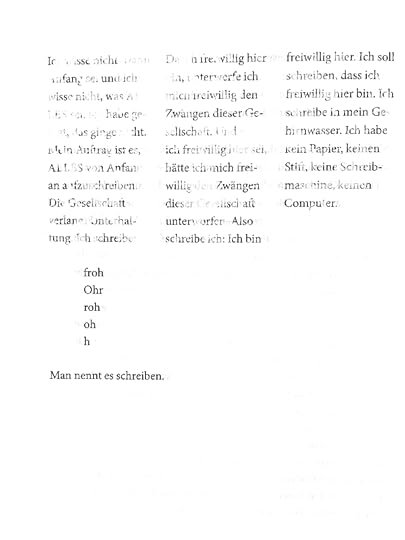
Da jeder Versuch, dieses von Form und Inhalt her ungewöhnliche Buch in ein paar knappen Sätzen adäquat zusammenzufassen, angesichts der vielfältigen Interpretationsmöglichkeiten zum Scheitern verurteilt sein muss, zitiere ich einfach mal folgende Passage daraus:
"Das Buch Schattenfroh ist ein liber ruinarum. Es ruiniert meine Erinnerungen, indem es sie stilllegt, um sie zu sezieren. … Was nun, stillgelegt, bleibt, ist eine Ruine, ein vollkommenes Archiv, dessen Außen nur noch in seinem Inneren zu finden ist: wenn niemand es liest; liest es aber jemand, bricht er die Ruine auf, setzt in ihr gebundene Kräfte frei, macht aus dem Requiem erhabener Stille, die Schattenfroh ist, eine nur von ihm, dem Leser, zu dirigierende Jagd nach Sinn und Veranschaulichung, deren Signal der Charakter eines jeden Buchstaben gibt, Jagdsignale, so nichtkünstlerisch wie nur etwas, das Startsignal, das Totsignal, der Leser nimmt ein Leichenensemble in Sicht, Schattenfrohs Panoptikum, und es fragt sich, ob es ein Leichenensemble der Zeichen ist, Totholz oder ob die Zeichen quicklebendig, was sie bezeichnen aber nur tot ist, und das ist ja Gefahr und Hoffnung des Lesens, eine Semiose zu befeuern, die zugleich setzt und zerstört, die Schöpfung und Verlöschen zusammenfallen lässt, das eigene Leben als Lesen erlöst."
Und so ist diese Schrift hier selbst ein Nachbild und sein zitterndes Verblassen...
"Das Buch Schattenfroh ist ein liber ruinarum. Es ruiniert meine Erinnerungen, indem es sie stilllegt, um sie zu sezieren. … Was nun, stillgelegt, bleibt, ist eine Ruine, ein vollkommenes Archiv, dessen Außen nur noch in seinem Inneren zu finden ist: wenn niemand es liest; liest es aber jemand, bricht er die Ruine auf, setzt in ihr gebundene Kräfte frei, macht aus dem Requiem erhabener Stille, die Schattenfroh ist, eine nur von ihm, dem Leser, zu dirigierende Jagd nach Sinn und Veranschaulichung, deren Signal der Charakter eines jeden Buchstaben gibt, Jagdsignale, so nichtkünstlerisch wie nur etwas, das Startsignal, das Totsignal, der Leser nimmt ein Leichenensemble in Sicht, Schattenfrohs Panoptikum, und es fragt sich, ob es ein Leichenensemble der Zeichen ist, Totholz oder ob die Zeichen quicklebendig, was sie bezeichnen aber nur tot ist, und das ist ja Gefahr und Hoffnung des Lesens, eine Semiose zu befeuern, die zugleich setzt und zerstört, die Schöpfung und Verlöschen zusammenfallen lässt, das eigene Leben als Lesen erlöst."
Und so ist diese Schrift hier selbst ein Nachbild und sein zitterndes Verblassen...

Read
October 13, 2025For several years now, I have been seeing Andrei of the Untranslated blog praising Schattenfroh on X, a book he read in the original German. Fast forward to Will Evans of Deep Vellum taking on this whopper of a novel, getting it translated by Max Lawton, and now published!!!! I don't believe that I ever added Schattenfroh to my TBR list as it "appeared" to be way above my reading level.
So come September 10th, seeing people sharing their copies of Schattenfroh on X, I could not resist any longer.I got a reading buddy to agree to read with me, and I ordered my book! I couldn't wait to get started!
A month later, and I have finished reading this brick of a novel! I feel really good about doing so. You know how there are posts about people being caught doing performative reading, well let me just say that I was embarrassed to be out reading Schattenfroh in public. I believed that it would make me look pretentious. Seriously! I would quietly slip the book out of my book bag and quickly open it up on my lap in an attempt to make the book appear smaller. I would then drape my arms around the book's edges to hide its size. I wasn't going to waste valuable reading time when I had it. Every minute of reading matters.
I would liken reading Schattenfroh to spending an entire day at an art museum. There would be some paintings that you would give a perfunctory glance to and others that you would engage with on a deeper level. Then you come across this great big installation that you just stare at dumbfounded trying to find order in its disorder. It certainly helped that Andrei who was overseeing our posts on X and Bluesky provided us with invaluable help by posting a reader's guide and recently also shared a fascinating interview with Michael Lentz which as readers I'm sure we all wanted to get inside the author's head to see what it was that he was thinking!
So Andrei writes, "James Joyce's ideal reader is famously the reader suffering from an ideal insomnia". Who is the ideal reader of Schattenfroh? Were you ready for the fact that not a lot of people would be ready to dedicate the time and effort necessary for understanding the book?"
Michael Lentz: " Yes, I did not count on a large readership and I am quite content that there have been a few readers who have engaged deeply with Schattenfroh including some in literary scholarship. This book does not fit into the contemporary German literary scene, which has its advantages and disadvantages.The advantage for me was that I had complete aesthetic freedom. The disadvantage for the publisher S. Fischer was that the book, to put it
mildly, was not a bestseller. But both the publisher and the author knew that in advance. It is wonderful that such a book can still be published at all. On the one hand, the ideal reader is someone who knows my book better than I do myself. On the other hand, the so-called naive reader is the ideal one: he reads without preconceptions, untroubled, and is not
disturbed by occasional incomprehension -in life
one does not always understand everything, and
reading is part of life. Taking things literally reveals wondrous networks of meaning that appeal to all the senses; it sparks the imagination directly. It allows for a kind of reading that feels almost tactile."
Me: Yes! That’s me! I'm the so called naive reader!"
Each reader of Schattenfroh will have his/ her own unique reading experience, which will give them a journey all their own. I've read a few novels that were long and difficult, so I knew that I was capable of going the distance, but upon reading the last page, I did put the book down saying I don't know what I just read.
Take this journey. There will be turbulent waters.
Just hold tight to your raft.
I will spend tomorrow reading and rereading Andrei's blog posts to try to gain more understanding.
"The real is repetition. A repeated assault and a repeated resistance."
#Lentz25 #Schattenfroh
The reels:
1. https://www.instagram.com/reel/DOa_jI...
2. https://www.instagram.com/reel/DOr4fi...
3. https://www.instagram.com/reel/DPG8dC...
4. https://www.instagram.com/reel/DPZFdd...
5. https://www.instagram.com/reel/DPkQjn...
6. https://www.instagram.com/reel/DPurHt...
So come September 10th, seeing people sharing their copies of Schattenfroh on X, I could not resist any longer.I got a reading buddy to agree to read with me, and I ordered my book! I couldn't wait to get started!
A month later, and I have finished reading this brick of a novel! I feel really good about doing so. You know how there are posts about people being caught doing performative reading, well let me just say that I was embarrassed to be out reading Schattenfroh in public. I believed that it would make me look pretentious. Seriously! I would quietly slip the book out of my book bag and quickly open it up on my lap in an attempt to make the book appear smaller. I would then drape my arms around the book's edges to hide its size. I wasn't going to waste valuable reading time when I had it. Every minute of reading matters.
I would liken reading Schattenfroh to spending an entire day at an art museum. There would be some paintings that you would give a perfunctory glance to and others that you would engage with on a deeper level. Then you come across this great big installation that you just stare at dumbfounded trying to find order in its disorder. It certainly helped that Andrei who was overseeing our posts on X and Bluesky provided us with invaluable help by posting a reader's guide and recently also shared a fascinating interview with Michael Lentz which as readers I'm sure we all wanted to get inside the author's head to see what it was that he was thinking!
So Andrei writes, "James Joyce's ideal reader is famously the reader suffering from an ideal insomnia". Who is the ideal reader of Schattenfroh? Were you ready for the fact that not a lot of people would be ready to dedicate the time and effort necessary for understanding the book?"
Michael Lentz: " Yes, I did not count on a large readership and I am quite content that there have been a few readers who have engaged deeply with Schattenfroh including some in literary scholarship. This book does not fit into the contemporary German literary scene, which has its advantages and disadvantages.The advantage for me was that I had complete aesthetic freedom. The disadvantage for the publisher S. Fischer was that the book, to put it
mildly, was not a bestseller. But both the publisher and the author knew that in advance. It is wonderful that such a book can still be published at all. On the one hand, the ideal reader is someone who knows my book better than I do myself. On the other hand, the so-called naive reader is the ideal one: he reads without preconceptions, untroubled, and is not
disturbed by occasional incomprehension -in life
one does not always understand everything, and
reading is part of life. Taking things literally reveals wondrous networks of meaning that appeal to all the senses; it sparks the imagination directly. It allows for a kind of reading that feels almost tactile."
Me: Yes! That’s me! I'm the so called naive reader!"
Each reader of Schattenfroh will have his/ her own unique reading experience, which will give them a journey all their own. I've read a few novels that were long and difficult, so I knew that I was capable of going the distance, but upon reading the last page, I did put the book down saying I don't know what I just read.
Take this journey. There will be turbulent waters.
Just hold tight to your raft.
I will spend tomorrow reading and rereading Andrei's blog posts to try to gain more understanding.
"The real is repetition. A repeated assault and a repeated resistance."
#Lentz25 #Schattenfroh
The reels:
1. https://www.instagram.com/reel/DOa_jI...
2. https://www.instagram.com/reel/DOr4fi...
3. https://www.instagram.com/reel/DPG8dC...
4. https://www.instagram.com/reel/DPZFdd...
5. https://www.instagram.com/reel/DPkQjn...
6. https://www.instagram.com/reel/DPurHt...

Read
August 28, 2026Where to even start? A man is being held in a room, and it’s all Schattenfroh’s fault you see. What is Schattenfroh? Hard to even say. Is it a spirit? A high-tech phenomenon? Good fucking luck.
At some point, I gave up trying to solve all the big puzzles, and just engaged with each moment where our narrator goes back and forth in time, throughout German history, with extended discussion of art and theology. And a lot of stuff about his dad. And if I got some kind of overarching message, it is the complicated male relationship with one’s own father, and – and maybe this is what Lentz was getting at – all our fathers, be it the heavenly father, the fatherland, and the fraught relationship the individual has with all those big senpai.
It’s 1000 pages. I spent damn near a month on it. And yet I was at no point bored or tired of it. I picked up my book, and waited to see what Schattenfroh was going to show me today.
At some point, I gave up trying to solve all the big puzzles, and just engaged with each moment where our narrator goes back and forth in time, throughout German history, with extended discussion of art and theology. And a lot of stuff about his dad. And if I got some kind of overarching message, it is the complicated male relationship with one’s own father, and – and maybe this is what Lentz was getting at – all our fathers, be it the heavenly father, the fatherland, and the fraught relationship the individual has with all those big senpai.
It’s 1000 pages. I spent damn near a month on it. And yet I was at no point bored or tired of it. I picked up my book, and waited to see what Schattenfroh was going to show me today.
December 23, 2025
One calls this typing, lol.
Typos on P33 l12, P194 l14, P284 l28, P377 l12, P488 l30, P644 l1, P652 l13 (missing the word 'not'), P790 l19, P944 l24 and P967 l27.
On P669 l9 the word 'with' surely should be 'over'?
On P850 should 'stalagmite' at l10 not be replaced with either 'column' or 'stalagnate'?
Anyway, there's a lot to like in this book, unfortunately the good is vastly overshadowed by the insane idea that it needed to be 1000 pages long. The whole idea of random dreamscapes is fine but it really is too shapeless and idiosyncratic to be entertaining. I got the feeling throughout that it must have been a lot of fun to write but this doesn't mean it is fun to read. The narrative voice is very flat throughout and while it does at times manage to be engaging there are long, long sections which read like low-effort journalese. Also, anagrams belong on daytime quiz-shows and games for children and shouldn't be within a thousand miles of any book aimed at adults. It is juvenile nonsense and while this particular book might have the excuse that it's examining the limits of language, the whole anagram schtick wore thin after page 20 and severely lowered my opinion of the author's intentions throughout the book. Ignoring that, the problem of the narrator being needlessly cryptic with the identity of the paintings not being referenced is a near-fatal flaw, I found myself, like others, referencing The Untranslated blog just to have half an idea of what the narrative was about. The conceit of the character being dragged through medieval paintings was fun but the reticence to directly engage the reader is explicable only if the intention is to obfuscate for no practical purpose. Much of the writing on religion was shallow and uninteresting and repetitive and tiresome and repetitive. Sometimes less is more. Pages 72 to 146 of this book isn't even text, it's "handwritten" names of people killed in war bombings, I think just to help with the page count.
I think half this book could have been cut, to be honest, and it might have made a more interesting and intriguing story, but it really is a 'baggy monster' with no real narrative structure, no discernable characters we should care about, no emotional heft, there are passages describing horrific tortures which read like the narrator is going to the shop for milk, there's two pages of weird mummy stuff exactly half-way through, I kept going because I was hoping for a strong finish but all we get is an emotionless reminiscence-dump and a spiteful kick at small-townsfolk before another infuriating bout of god-damned anagrams (If you're quoting Paul Adler, have the respect to print his name properly, seriously, what is the point of jumbling his name??) leading up to the final pages which are to be honest, unsatisfactory.
Anyway, I suppose the attempt to write something about the abstractions of history and language and identity should be applauded but this book needed a cruel and miserly editor to cut away much of the self indulgence and needless verbosity and it might have made for a much better read.
Typos on P33 l12, P194 l14, P284 l28, P377 l12, P488 l30, P644 l1, P652 l13 (missing the word 'not'), P790 l19, P944 l24 and P967 l27.
On P669 l9 the word 'with' surely should be 'over'?
On P850 should 'stalagmite' at l10 not be replaced with either 'column' or 'stalagnate'?
Anyway, there's a lot to like in this book, unfortunately the good is vastly overshadowed by the insane idea that it needed to be 1000 pages long. The whole idea of random dreamscapes is fine but it really is too shapeless and idiosyncratic to be entertaining. I got the feeling throughout that it must have been a lot of fun to write but this doesn't mean it is fun to read. The narrative voice is very flat throughout and while it does at times manage to be engaging there are long, long sections which read like low-effort journalese. Also, anagrams belong on daytime quiz-shows and games for children and shouldn't be within a thousand miles of any book aimed at adults. It is juvenile nonsense and while this particular book might have the excuse that it's examining the limits of language, the whole anagram schtick wore thin after page 20 and severely lowered my opinion of the author's intentions throughout the book. Ignoring that, the problem of the narrator being needlessly cryptic with the identity of the paintings not being referenced is a near-fatal flaw, I found myself, like others, referencing The Untranslated blog just to have half an idea of what the narrative was about. The conceit of the character being dragged through medieval paintings was fun but the reticence to directly engage the reader is explicable only if the intention is to obfuscate for no practical purpose. Much of the writing on religion was shallow and uninteresting and repetitive and tiresome and repetitive. Sometimes less is more. Pages 72 to 146 of this book isn't even text, it's "handwritten" names of people killed in war bombings, I think just to help with the page count.
I think half this book could have been cut, to be honest, and it might have made a more interesting and intriguing story, but it really is a 'baggy monster' with no real narrative structure, no discernable characters we should care about, no emotional heft, there are passages describing horrific tortures which read like the narrator is going to the shop for milk, there's two pages of weird mummy stuff exactly half-way through, I kept going because I was hoping for a strong finish but all we get is an emotionless reminiscence-dump and a spiteful kick at small-townsfolk before another infuriating bout of god-damned anagrams (If you're quoting Paul Adler, have the respect to print his name properly, seriously, what is the point of jumbling his name??) leading up to the final pages which are to be honest, unsatisfactory.
Anyway, I suppose the attempt to write something about the abstractions of history and language and identity should be applauded but this book needed a cruel and miserly editor to cut away much of the self indulgence and needless verbosity and it might have made for a much better read.

November 1, 2025
Some things that stood out to me:
Schattenfroh is autofiction. Lentz is writing about himself but also himself as a stand-in for all of Western civilization. The main character is named Nobody (a reference to the name Odysseus gives to the Cyclops in The Odyssey). As Nobody, Lentz writes about his parents, his city, his country, and his epoch.
One of the primary symbols of the book is the palimpsest (some written material where the original has been erased and something else written on top). Every individual is a palimpsest of everything that came before them. They are a product of their history. In Schattenfroh, Nobody is himself, his father, his grandfather, his city, his country, Hegel, Heidegger, Bosch, Freud, Jesus Christ, etc. The page of his life is a palimpsest under which are written the stories of all of humanity. He is a story told in four dimensions; a panopticon.
Lentz explores the idea of interrogation as reformation. As he examines himself, as an objective observer, he can't help but become a subjective participant. But his participation isn't entirely as an observer because in order to understand what he's seeing, he must retell it. He writes the story of his understanding of himself and, in the process, gets things wrong, introduces errors, and finally reforms himself. So in a sense, his interrogation is a malignant force, torturing the story of who he was before this self-reflection. In the end, he becomes someone new: the self-examined self.
A frequent device Lentz uses in the book is ekphrasis. You often find Nobody wandering around in the scenes of a painting, describing his experience as a participant. He's able to do this because those works are part of him. He is the palimpsest of his history, so as he explores the secret corridors of his psyche, he's able to enter into these pieces of art that underwrite him. There are even some scenes at the end where he explores the ekphrases of his own family photographs.
Schattenfroh is metafiction. The reader is involved as a participant in this process of interrogation and reformation. There are occasional references to the page numbers of the book itself; what we're reading is the story of the malignant destruction of Nobody and his resurrection as something new, and we are accomplices.
Schattenfroh is maximalist. There are many scenes that, arguably, don't have individual importance, but are necessary as one among many examples of the themes. The preponderance of text is an essential component of the book.
There's a completely black page in the book (a reference to Tristram Shandy) that represents this process of interrogation and retelling. And there's a completely white page that represents the final product of reformation. The black text is interpretation and the white text is ontology. The blank page is the "ur-text" of all creation, the palimpsest containing the white text of all of human history.
There's a bibliography in the middle of the book, listing something like 165 books. Lentz incorporates all of them in Schattenfroh.
Schattenfroh is hugely ambitious, tremendously fascinating, and frequently boring. It isn't perfect, but it's still a work of genius. I've never read anything like it. I've never even heard anything like it. It's exciting to know that there are still things left to explore in fiction.
Schattenfroh is autofiction. Lentz is writing about himself but also himself as a stand-in for all of Western civilization. The main character is named Nobody (a reference to the name Odysseus gives to the Cyclops in The Odyssey). As Nobody, Lentz writes about his parents, his city, his country, and his epoch.
One of the primary symbols of the book is the palimpsest (some written material where the original has been erased and something else written on top). Every individual is a palimpsest of everything that came before them. They are a product of their history. In Schattenfroh, Nobody is himself, his father, his grandfather, his city, his country, Hegel, Heidegger, Bosch, Freud, Jesus Christ, etc. The page of his life is a palimpsest under which are written the stories of all of humanity. He is a story told in four dimensions; a panopticon.
Lentz explores the idea of interrogation as reformation. As he examines himself, as an objective observer, he can't help but become a subjective participant. But his participation isn't entirely as an observer because in order to understand what he's seeing, he must retell it. He writes the story of his understanding of himself and, in the process, gets things wrong, introduces errors, and finally reforms himself. So in a sense, his interrogation is a malignant force, torturing the story of who he was before this self-reflection. In the end, he becomes someone new: the self-examined self.
A frequent device Lentz uses in the book is ekphrasis. You often find Nobody wandering around in the scenes of a painting, describing his experience as a participant. He's able to do this because those works are part of him. He is the palimpsest of his history, so as he explores the secret corridors of his psyche, he's able to enter into these pieces of art that underwrite him. There are even some scenes at the end where he explores the ekphrases of his own family photographs.
Schattenfroh is metafiction. The reader is involved as a participant in this process of interrogation and reformation. There are occasional references to the page numbers of the book itself; what we're reading is the story of the malignant destruction of Nobody and his resurrection as something new, and we are accomplices.
Schattenfroh is maximalist. There are many scenes that, arguably, don't have individual importance, but are necessary as one among many examples of the themes. The preponderance of text is an essential component of the book.
There's a completely black page in the book (a reference to Tristram Shandy) that represents this process of interrogation and retelling. And there's a completely white page that represents the final product of reformation. The black text is interpretation and the white text is ontology. The blank page is the "ur-text" of all creation, the palimpsest containing the white text of all of human history.
There's a bibliography in the middle of the book, listing something like 165 books. Lentz incorporates all of them in Schattenfroh.
Schattenfroh is hugely ambitious, tremendously fascinating, and frequently boring. It isn't perfect, but it's still a work of genius. I've never read anything like it. I've never even heard anything like it. It's exciting to know that there are still things left to explore in fiction.
January 9, 2026
Schattenfroh positions itself, both expressly in its text and in it's recent marketing push, as a grandiose tome, a great and important work of 21st century literature. Unfortunately, it is more akin to maximalist junk food. Obscurantism abounds, massive digressions that lack meaningful thematic cohesion or world building belabor the experience, and it is, in the most pejorative sense of the word, "encyclopedic". Specifically in that its history and facts provided routinely fail to coalesce into anything more than the experience of reading successive Wikipedia articles rendered in a literary voice.
There is certainly a vivid imagination at play here, if nothing else Lentz is unpredictable. There is no way to tell what will happen next, and while that starts off as a positive it becomes a detriment to the book at a certain point. Characters, scenes, behaviors and ideas remain totally erratic and disconnected from the beginning of the book all the way to the end. There is just no real throughline here to hold, no central ideas at play, no philosophy or deeper thoughts to really sink one's teeth into. His writing never really builds itself into a novel, as a reader the acceptance of obscurity comes with the presupposition that there is indeed some meaning underlying it all and that it will eventually be discernable. Lentz may have had this meaning in his head somewhere, but it never made it into the pages.
This would not be the end of the world if these fragments were compelling. They are not. A thousand pages is a lot of room to ruminate and work with, so if Lentz is not interested in telling any semblance of a story or conveying an overarching idea, what is he doing? Well he doesn't go wide as many maximalist works do. There is no panoramic societal/cultural view or assessment, quite the opposite in fact. We are trapped with Lentz's "nobody" character, who seems to have zero capacity for reflection outside of himself. Okay then, perhaps we can go cerebral, which Lentz aims for and widely misses the mark.
His attempts at erudition fall flat, there is a lot of fact/history recitation without any attempt to mine for meaning. And his much lauded ekphrasis is weak as well, for a book predicated on a character traveling through great works of art his prose describing them lacks rhythm and color, the writing style is sterile and doesn't really fit what he's trying to do at all. For a book of this size you would expect better prose.
Not only that but he never actually makes the art in question identifiable, unless you buy his second book Innehaben (only in German) that explains the ekphrasis and will supposedly provide you other insight and meaning that the novel itself is lacking. His need to make a second explanatory book should have made it apparent to him that the actual novel was sorely lacking, but I suppose that connection eluded him.
Ultimately Schattenfroh has very little to offer. Lentz's two recurring themes are his abusive parents and his hatred of religion, and his religious preoccupation especially is a weak point of the novel, more interesting segments constantly devolve into railing against religion without saying much of depth or interest at all, very tiring to read after a certain point. Schattenfroh is a great deal of words with precious little to say.
There is certainly a vivid imagination at play here, if nothing else Lentz is unpredictable. There is no way to tell what will happen next, and while that starts off as a positive it becomes a detriment to the book at a certain point. Characters, scenes, behaviors and ideas remain totally erratic and disconnected from the beginning of the book all the way to the end. There is just no real throughline here to hold, no central ideas at play, no philosophy or deeper thoughts to really sink one's teeth into. His writing never really builds itself into a novel, as a reader the acceptance of obscurity comes with the presupposition that there is indeed some meaning underlying it all and that it will eventually be discernable. Lentz may have had this meaning in his head somewhere, but it never made it into the pages.
This would not be the end of the world if these fragments were compelling. They are not. A thousand pages is a lot of room to ruminate and work with, so if Lentz is not interested in telling any semblance of a story or conveying an overarching idea, what is he doing? Well he doesn't go wide as many maximalist works do. There is no panoramic societal/cultural view or assessment, quite the opposite in fact. We are trapped with Lentz's "nobody" character, who seems to have zero capacity for reflection outside of himself. Okay then, perhaps we can go cerebral, which Lentz aims for and widely misses the mark.
His attempts at erudition fall flat, there is a lot of fact/history recitation without any attempt to mine for meaning. And his much lauded ekphrasis is weak as well, for a book predicated on a character traveling through great works of art his prose describing them lacks rhythm and color, the writing style is sterile and doesn't really fit what he's trying to do at all. For a book of this size you would expect better prose.
Not only that but he never actually makes the art in question identifiable, unless you buy his second book Innehaben (only in German) that explains the ekphrasis and will supposedly provide you other insight and meaning that the novel itself is lacking. His need to make a second explanatory book should have made it apparent to him that the actual novel was sorely lacking, but I suppose that connection eluded him.
Ultimately Schattenfroh has very little to offer. Lentz's two recurring themes are his abusive parents and his hatred of religion, and his religious preoccupation especially is a weak point of the novel, more interesting segments constantly devolve into railing against religion without saying much of depth or interest at all, very tiring to read after a certain point. Schattenfroh is a great deal of words with precious little to say.
November 14, 2025
Schattenfroh moves from surrealist phantasmagoria with stream of consciousness writing, intermingled with fastidiously researched facts and hidden messages, to something intensely emotional, personal, honest, and raw. An escape diary that explores memories, experiences, history… and structural engineering… diving into and hiding within, merging worlds of canvas, identities, and imagination in ways I can’t even begin to comprehend. In the last few hundred pages my personal experiences with loss gave me a tremendous sense of relation with the intentions of this book, it became a mirror at points, and I’m very grateful for that.
This is really a masterwork of unbounded creativity, love, devotion, and perseverance. Uncaring of any and all judgement. He put it all out there, left absolutely nothing behind.
I’d be lying if I said I loved every page. There were definitely (many) times where I felt lost and unconnected, but, I look at this book as climbing a mountain: there were difficulties, but when the journey was finished, the satisfaction, towering sense of accomplishment, and awe of the experience totally overcame any and all pain. And this is why it gets a five star rating.
This is really a masterwork of unbounded creativity, love, devotion, and perseverance. Uncaring of any and all judgement. He put it all out there, left absolutely nothing behind.
I’d be lying if I said I loved every page. There were definitely (many) times where I felt lost and unconnected, but, I look at this book as climbing a mountain: there were difficulties, but when the journey was finished, the satisfaction, towering sense of accomplishment, and awe of the experience totally overcame any and all pain. And this is why it gets a five star rating.
September 22, 2025
Some spoilers. Can one even spoil this book?
"Literature is no dalliance, no pastime, it is time" (Lentz 552).
"...less a book being assembled than a chaotic hybrid of gathering up the world from all compass points..." (Lentz 821).
This will be more a scattershot smattering of thoughts than a concise, collated review—all mostly collected here in chronological order as I read.
In brief: this comes short of a masterpiece for me, for it does have its share of drudging sections, but the whole of this is incredibly ambitious, with a thematic reach toward many of the ideas that so compelled me as a student, and as a reader of Lispector, Bolaño, Pessoa, Borges, Dostoevsky, etc.
_____________
•Reminds me of the Ludovico Technique, the way Nobody is strapped to some throne, some device, and made to "watch" images. Gives me DARK CITY and BRAZIL vibes, like an alternate future where the sun is shut out, and a technocratic, dystopian society rules. Massive Giger and Beksiński vibes. A Dante without his Vergil (unless SCHATTENFROH is his Vergil), a jaunt through Bosch and Altdorfer. Tarkovsky. Satantango (Both film and novel; but more so that the film is, like Schattenfroh, an immense time sink). Cronenberg. Like a baroque painting, a palindromic, ouroboric novel.
•The title suggests "happy shadows". Frightbearing Society (allusion to the historic Fruitbearing Society), as if to suggest they are harbingers of horror that have now taken up the new hegemonic structure of the world.
•Schattenfroh as Satan, Death, Father, every character. "He is one who lives in both heaven and hell..." (606). It's perhaps right there in the name: SCHATTENFROH, "shadowglad," Joyful Shadow, as if the Great Shadow is spent in no other emotion but joy as he seeks to upend and raze every good thing in the universe ("Schadenfreude" = "damagejoy"). Like a gleeful child knocking down building blocks in a microcosm of a great cataclysm. "...I still have no proof that the fallen angel, my father, and Schattenfroh are one—the Trinity of the Frightbearing Society" (556). Is it possible that Schattenfroh, the jailer, is masquerading as literally every character that appears in the novel? In a footnote on p. 671, amid an anagramic assortment of Schattenfroh's name, "Toter" appears, which translates as "Dead Man." Which comfortably aligns itself with the idea that Schattenfroh is also Death, but also the fact every "character" in the novel are ostensibly dead.
•Could also be a kind of anchoritic text. A figure is locked alone in a cell whereupon he writes and writes about God, fear of heaven and hell, death, longing for salvation....which is essentially what is going on (maybe) here.
•They are recording Nobody's thoughts for posterity. But to what purpose? A simple catalog of human psychogeography? Is humanity endangered?
•Every instance of the word "nobody," capitalized or not, gives me suspicion, makes me raise an eyebrow. Even "somebody." "Anybody." No body. Some body. Which makes sense as Nobody's body is virtually nonexistent and unimportant... the only thing SCHATTENFROH needs are his thoughts... an apparently weaponized stream of consciousness, an induced (auto)biography of the soul.
•His father serves literal words to his employees, some from the Book of Revelation, as if they're ingesting the apocalypse.
•Torture and pain and death. Absurdly, naughty children on Santa's list are crucified. Is Nobody experiencing a form of torture? He descends into hell, becomes a guest of Satan, Gehenna, the chimera, Cerberus. His father leapt into the black page, a blackness so suffused with words that it appears as a black plate. Is this wall of infinite language hell? Is it an Orpheus tale?
•The list of names, of the dead in a bombed-out city during WWII. Hitler, Nazism come to the fore, as if to say that fascist horror somehow explains the twisty ramblings of Nobody. Like an infection that infected language—which has become this postmodernist, post-language novel that we are reading.
•References to specific pages elsewhere in the book. Fourth wall breaks, including a direct appeal to Lentz? (281). Anagrams. Puns. Cryptograms. Ciphers. Symbols. Paintings. Book burning a la Fahrenheit 451, with references to flamethrowers. An inordinate amount of bowel-related jokes. Invokes or evokes Borges, Foucault, Kafka, Kant, Nietzsche, Saussure, Derrida, and dozens more.
•A tribunal with a doll called to the stand, book-eaters, book mountains, public executions, naked mothers and sons that are either incestuous or how the son wishes to return to the womb, systematic journeys through houses made from letters that grew from the flesh of a man's torso, hell is both a geometric ink blot made of thousands of overlapping words and a pencil is the wicked snake that tempted Eve.
•A section where the image of Jesus nailed to the cross is described in anatomical detail, expressing concern with how the lacerated and impaled body was to maintain itself as blood and water and life drained from it. Brings a refreshed concern over how this mangled display of grotesque gore is displayed in hundreds of thousands of churches, where young eyes, depending on the zeal of the carpenter or caster, look upon the detail of ankles pierced, wrists punctured thoroughly, and a crown of thorns, irregularly and gruesomely, pierce skin, stopped short only by the hardness of the skull.
•How it, at least with this edition, impossibly starts on page 19. 18 pages do not precede it. Is this anything? [EDIT: Solved, I think, after a fact: the original German-language edition runs at 1008 pages, while the English translation runs 1001, so the 7 "missing" pages + the 11 that precede the English-translated novel proper add up to explain this mystery... plus, as it was more than likely done to keep up the self-reflexive, frequent, and direct remarks about page numbers within the narrative.]
•And all one final thought:
There seems to be cyclical fathers and sons motif running through the novel as it relates specifically to comparing Father and Nobody, and eventually Grandpa, with God and Jesus. As if the Father (God) must watch Nobody (Jesus; the son) suffer at the hands of others as nothing more than an onlooker. But there's a genealogical trade-off, that the Son will eventually take up the mantle of the Father, and watch his own progeny suffer, over and over again in an ancestral timeline of humanity that has been architecturally formed by nothing other than pain, sorrow, and misery. A kind of "cell division," mitosis, that is described in the novel's final pages.
Later, with Father, Nobody is told by his father that, upon a cross, crucified, is someone that looks like his son. "He looks like you... let's go over to him...there's no doubt: that's you." (689). And who does Nobody say he sees: nobody.
Grandpa is literally beaten with a crucifix by the Gestapo. And his own imprisonment by the Nazis mirrors Nobody's. However, Grandpa's forced writings are based in statistics, mathematics, as he is a math teacher, while Nobody's is rooted in literature. Later, Father threatens to beat a man with a cross, as if any cruciform shape is a viable weapon, an arbiter of pain, as once was during Christ's jaunt through the streets of Jerusalem toward Golgotha.
In the final pages, upon Father's deathbed, he's described as becoming a shadow, a Schatten, and eventually SCHATTENFROH. A joyful shadow. (940). Previous pages paint a terrifying picture of death and the afterlife, but then, here, is the point in the novel at which we discover the bliss of death? Is this after all an optimistic novel?
Did Nobody escape at the end, and replace himself with the golem? Get disintegrated and replaced? Replaced by another poor soul that, in a hypothetical sequel, will, like Nobody, take a concaving odyssey through not only their history but of their nation's history? A new jailer-prisoner pairing repeated forever and ever?
"Literature is no dalliance, no pastime, it is time" (Lentz 552).
"...less a book being assembled than a chaotic hybrid of gathering up the world from all compass points..." (Lentz 821).
This will be more a scattershot smattering of thoughts than a concise, collated review—all mostly collected here in chronological order as I read.
In brief: this comes short of a masterpiece for me, for it does have its share of drudging sections, but the whole of this is incredibly ambitious, with a thematic reach toward many of the ideas that so compelled me as a student, and as a reader of Lispector, Bolaño, Pessoa, Borges, Dostoevsky, etc.
_____________
•Reminds me of the Ludovico Technique, the way Nobody is strapped to some throne, some device, and made to "watch" images. Gives me DARK CITY and BRAZIL vibes, like an alternate future where the sun is shut out, and a technocratic, dystopian society rules. Massive Giger and Beksiński vibes. A Dante without his Vergil (unless SCHATTENFROH is his Vergil), a jaunt through Bosch and Altdorfer. Tarkovsky. Satantango (Both film and novel; but more so that the film is, like Schattenfroh, an immense time sink). Cronenberg. Like a baroque painting, a palindromic, ouroboric novel.
•The title suggests "happy shadows". Frightbearing Society (allusion to the historic Fruitbearing Society), as if to suggest they are harbingers of horror that have now taken up the new hegemonic structure of the world.
•Schattenfroh as Satan, Death, Father, every character. "He is one who lives in both heaven and hell..." (606). It's perhaps right there in the name: SCHATTENFROH, "shadowglad," Joyful Shadow, as if the Great Shadow is spent in no other emotion but joy as he seeks to upend and raze every good thing in the universe ("Schadenfreude" = "damagejoy"). Like a gleeful child knocking down building blocks in a microcosm of a great cataclysm. "...I still have no proof that the fallen angel, my father, and Schattenfroh are one—the Trinity of the Frightbearing Society" (556). Is it possible that Schattenfroh, the jailer, is masquerading as literally every character that appears in the novel? In a footnote on p. 671, amid an anagramic assortment of Schattenfroh's name, "Toter" appears, which translates as "Dead Man." Which comfortably aligns itself with the idea that Schattenfroh is also Death, but also the fact every "character" in the novel are ostensibly dead.
•Could also be a kind of anchoritic text. A figure is locked alone in a cell whereupon he writes and writes about God, fear of heaven and hell, death, longing for salvation....which is essentially what is going on (maybe) here.
•They are recording Nobody's thoughts for posterity. But to what purpose? A simple catalog of human psychogeography? Is humanity endangered?
•Every instance of the word "nobody," capitalized or not, gives me suspicion, makes me raise an eyebrow. Even "somebody." "Anybody." No body. Some body. Which makes sense as Nobody's body is virtually nonexistent and unimportant... the only thing SCHATTENFROH needs are his thoughts... an apparently weaponized stream of consciousness, an induced (auto)biography of the soul.
•His father serves literal words to his employees, some from the Book of Revelation, as if they're ingesting the apocalypse.
•Torture and pain and death. Absurdly, naughty children on Santa's list are crucified. Is Nobody experiencing a form of torture? He descends into hell, becomes a guest of Satan, Gehenna, the chimera, Cerberus. His father leapt into the black page, a blackness so suffused with words that it appears as a black plate. Is this wall of infinite language hell? Is it an Orpheus tale?
•The list of names, of the dead in a bombed-out city during WWII. Hitler, Nazism come to the fore, as if to say that fascist horror somehow explains the twisty ramblings of Nobody. Like an infection that infected language—which has become this postmodernist, post-language novel that we are reading.
•References to specific pages elsewhere in the book. Fourth wall breaks, including a direct appeal to Lentz? (281). Anagrams. Puns. Cryptograms. Ciphers. Symbols. Paintings. Book burning a la Fahrenheit 451, with references to flamethrowers. An inordinate amount of bowel-related jokes. Invokes or evokes Borges, Foucault, Kafka, Kant, Nietzsche, Saussure, Derrida, and dozens more.
•A tribunal with a doll called to the stand, book-eaters, book mountains, public executions, naked mothers and sons that are either incestuous or how the son wishes to return to the womb, systematic journeys through houses made from letters that grew from the flesh of a man's torso, hell is both a geometric ink blot made of thousands of overlapping words and a pencil is the wicked snake that tempted Eve.
•A section where the image of Jesus nailed to the cross is described in anatomical detail, expressing concern with how the lacerated and impaled body was to maintain itself as blood and water and life drained from it. Brings a refreshed concern over how this mangled display of grotesque gore is displayed in hundreds of thousands of churches, where young eyes, depending on the zeal of the carpenter or caster, look upon the detail of ankles pierced, wrists punctured thoroughly, and a crown of thorns, irregularly and gruesomely, pierce skin, stopped short only by the hardness of the skull.
•How it, at least with this edition, impossibly starts on page 19. 18 pages do not precede it. Is this anything? [EDIT: Solved, I think, after a fact: the original German-language edition runs at 1008 pages, while the English translation runs 1001, so the 7 "missing" pages + the 11 that precede the English-translated novel proper add up to explain this mystery... plus, as it was more than likely done to keep up the self-reflexive, frequent, and direct remarks about page numbers within the narrative.]
•And all one final thought:
There seems to be cyclical fathers and sons motif running through the novel as it relates specifically to comparing Father and Nobody, and eventually Grandpa, with God and Jesus. As if the Father (God) must watch Nobody (Jesus; the son) suffer at the hands of others as nothing more than an onlooker. But there's a genealogical trade-off, that the Son will eventually take up the mantle of the Father, and watch his own progeny suffer, over and over again in an ancestral timeline of humanity that has been architecturally formed by nothing other than pain, sorrow, and misery. A kind of "cell division," mitosis, that is described in the novel's final pages.
Later, with Father, Nobody is told by his father that, upon a cross, crucified, is someone that looks like his son. "He looks like you... let's go over to him...there's no doubt: that's you." (689). And who does Nobody say he sees: nobody.
Grandpa is literally beaten with a crucifix by the Gestapo. And his own imprisonment by the Nazis mirrors Nobody's. However, Grandpa's forced writings are based in statistics, mathematics, as he is a math teacher, while Nobody's is rooted in literature. Later, Father threatens to beat a man with a cross, as if any cruciform shape is a viable weapon, an arbiter of pain, as once was during Christ's jaunt through the streets of Jerusalem toward Golgotha.
In the final pages, upon Father's deathbed, he's described as becoming a shadow, a Schatten, and eventually SCHATTENFROH. A joyful shadow. (940). Previous pages paint a terrifying picture of death and the afterlife, but then, here, is the point in the novel at which we discover the bliss of death? Is this after all an optimistic novel?
Did Nobody escape at the end, and replace himself with the golem? Get disintegrated and replaced? Replaced by another poor soul that, in a hypothetical sequel, will, like Nobody, take a concaving odyssey through not only their history but of their nation's history? A new jailer-prisoner pairing repeated forever and ever?
January 15, 2020
Wow,
Was habe ich da grade gelesen. Selten so ein komplexes Werk gelesen. Vergleichbar mit Joyce Ulysseus, Proucst auf der Suche nach der verlorenen Zeit.
Ein Buch was man viele Male lesen und trotzdem nur die Hälfte erfasst :)
Worum geht's?
Ein Mann sitzt eingesperrt in einem dunklen Raum und muss ein Buch schreiben. Wahrscheinlich, das was wir lesen. Er schreibt es mit seinen Gedanken.
Gezwungen zu schreiben wird er von Schattenfroh, eine mysteriöse Gestalt, welche manchmal als der Vater des Autors oder als Gottheit auftritt.
Es geht schlichtweg um alles: Tod, Religion, Der Vater des Autors, Krieg.
Es gibt mindestens vier Metaebenen. Am meisten beeindruckt ein Abschnitt in der Handschrift des Autors, in welchem alle im 2. Weltkrieg in Düren(Heimatstadt von Michael Lentz) Menschen erwähnt werden. 60 Seiten lang.
Es gibt Abschnitte in Dichtform, in altdeutsch, Zeichnungen, Gemälde.
Mit diesem Werk ist Michael Lentz das vielleicht beste deutsche Werk des 21. Jahrhunderts gelungen. Für alle die Sprache schätzen ein Genuss. Für manche können die 1000 Seiten eine Qual sein. Es gibt keine Handlung, nur Gedanken, tlw wie ein Essay.
Ganz große Literatur
Was habe ich da grade gelesen. Selten so ein komplexes Werk gelesen. Vergleichbar mit Joyce Ulysseus, Proucst auf der Suche nach der verlorenen Zeit.
Ein Buch was man viele Male lesen und trotzdem nur die Hälfte erfasst :)
Worum geht's?
Ein Mann sitzt eingesperrt in einem dunklen Raum und muss ein Buch schreiben. Wahrscheinlich, das was wir lesen. Er schreibt es mit seinen Gedanken.
Gezwungen zu schreiben wird er von Schattenfroh, eine mysteriöse Gestalt, welche manchmal als der Vater des Autors oder als Gottheit auftritt.
Es geht schlichtweg um alles: Tod, Religion, Der Vater des Autors, Krieg.
Es gibt mindestens vier Metaebenen. Am meisten beeindruckt ein Abschnitt in der Handschrift des Autors, in welchem alle im 2. Weltkrieg in Düren(Heimatstadt von Michael Lentz) Menschen erwähnt werden. 60 Seiten lang.
Es gibt Abschnitte in Dichtform, in altdeutsch, Zeichnungen, Gemälde.
Mit diesem Werk ist Michael Lentz das vielleicht beste deutsche Werk des 21. Jahrhunderts gelungen. Für alle die Sprache schätzen ein Genuss. Für manche können die 1000 Seiten eine Qual sein. Es gibt keine Handlung, nur Gedanken, tlw wie ein Essay.
Ganz große Literatur
September 25, 2025
I'm hopping back on to Goodreads specifically to talk about Schattenfroh.
The hype is well deserved. This is an ambitious, uber-erudite, visionary mountain of a book.
This thing is narrated like a goddamn freight train running at maximum steam. Lentz just keeps on blasting forward, through labrynthine discussions of medieval esoteric thought, mind-fuck detours through famous paintings and works of art, German history (both national and regional), autistic technical logorrhea around structural engineering and printing presses... ad infinitum, etc. etc. etc.
But at the heart of the whole thing, this is a requiem for a man's father. And for the impossible, all-consuming, symbolic-beyond-myth role that a father plays in the life of his son.
I laughed out loud at least 15 times while reading the book, and there were maybe three or four moments that virtually brought me to tears.
Make no mistake this isn't some cold, dourly teutonic 1000 page brick. Schattenfroh SEETHES with life, and teams with light and darkness.
It's a world beating piece of literary art. Like the best work of Samuel Beckett and James Joyce, this book WILL find it's readership, in time.
If you think of yourself as an ambitious reader, this is a singular experience. It simply does not read like any other book you will find.
The hype is well deserved. This is an ambitious, uber-erudite, visionary mountain of a book.
This thing is narrated like a goddamn freight train running at maximum steam. Lentz just keeps on blasting forward, through labrynthine discussions of medieval esoteric thought, mind-fuck detours through famous paintings and works of art, German history (both national and regional), autistic technical logorrhea around structural engineering and printing presses... ad infinitum, etc. etc. etc.
But at the heart of the whole thing, this is a requiem for a man's father. And for the impossible, all-consuming, symbolic-beyond-myth role that a father plays in the life of his son.
I laughed out loud at least 15 times while reading the book, and there were maybe three or four moments that virtually brought me to tears.
Make no mistake this isn't some cold, dourly teutonic 1000 page brick. Schattenfroh SEETHES with life, and teams with light and darkness.
It's a world beating piece of literary art. Like the best work of Samuel Beckett and James Joyce, this book WILL find it's readership, in time.
If you think of yourself as an ambitious reader, this is a singular experience. It simply does not read like any other book you will find.

June 7, 2026
‘Schattenfroh’ is undoubtedly one of the most challenging and rewarding books I’ve read in a long time. Ulysses, Finnegans Wake, Gravity’s Rainbow and Infinite Jest have a new member in their ranks.
I finished it about three weeks ago, and have held off writing anything primarily because I don’t yet fully understand it. But what I can offer is a little insight for those thinking of reading it.
It’s a work that deserves multiple reads, and as with the monumental works I’ve mentioned above, I’d be prepared to not understand everything on your first trip. In order to get the most out it knowledge of philosophy, art history, German history and German literature will most definitely help. However if like me, you don’t have all that at your fingertips, I’d highly recommend research whilst reading. There are reviews and articles online to offer aid, most notably The Untranslated’s blog, which includes a readers’ guide and summary of the entire novel. I’d say these are a must for all new readers, unless you feel secure in the areas I’ve mentioned. For German readers there is of course ‘Innehaben’, also by Lentz, which, to my current understanding is a non-fiction guide to the theories of ‘Schattenfroh’. (James Elkins has written a great essay available on Substack about the combined reading of both works.)
Reading ‘Schattenfroh’ is challenging, demands patience and perseverance, and is absolutly worth it. The novel centres around multiple works of art, with ekphrasis functioning as one of its principal driving tools. For first-time readers, keeping up with these images presents itself as one of the main challenges, as most arrive unannounced, with characters bouncing from one image to another with little notice. To deal with this, The Untranslated’s reading guide is a lifeline.
Philosophy is equally central. Lacan, Derrida, Girard, Heidegger and Wittgenstein are all known to me, though I’m not nearly familiar enough with their work to immediately spot all the ways Lentz explores and plays with their theories. Fortunately we had Braden Matthew ( @biblio_therapeia ), author of ‘Solarium’, in our reading group who studied philosophy for seven years.
There are also tons of literary references and quotes. A few key titles worth familiarising yourself with include:
- The Old and New Testaments
- Dante: Inferno
- Plato: Republic
- St Augustine: Confessions
- René Girard: I See Satan Fall Like Lightening
- Heinrich von Kleist: Michael Kohlhaas
- Samuel Beckett: Malone Dies and The Unnameable
This list however barely scrapes the surface. Lentz actually provides a full bibliography on p.575 of the novel. Stylistically, your biggest help is gonna be Beckett. I’d highly recommend reading The Trilogy first (Malone Dies is mentioned in the book’s bibliography, but the presence of The Unnamable should also be felt by anyone familiar with it). Also listen to Bach’s St John’s Passion.
Praise must be given to Max Lawton’s faultless translation job, a gargantuan and formidable task. It’s an astonishing achievement.
I’ll certainly return to ‘Schattenfroh’. It’s a reading experience unlike anything else (probably what it shares most Joyce, Pynchon and David Foster Wallace). It’s fiercely original, certain to divide opinion, and could spark decades of essays and debate. Like Ulysses, it hit some criticism upon its release, but already people are returning to it. Though its ultimate legacy remains to be seen, it is absolutely one of the most original, challenging, rich and provoking works I can think of in many years.
I finished it about three weeks ago, and have held off writing anything primarily because I don’t yet fully understand it. But what I can offer is a little insight for those thinking of reading it.
It’s a work that deserves multiple reads, and as with the monumental works I’ve mentioned above, I’d be prepared to not understand everything on your first trip. In order to get the most out it knowledge of philosophy, art history, German history and German literature will most definitely help. However if like me, you don’t have all that at your fingertips, I’d highly recommend research whilst reading. There are reviews and articles online to offer aid, most notably The Untranslated’s blog, which includes a readers’ guide and summary of the entire novel. I’d say these are a must for all new readers, unless you feel secure in the areas I’ve mentioned. For German readers there is of course ‘Innehaben’, also by Lentz, which, to my current understanding is a non-fiction guide to the theories of ‘Schattenfroh’. (James Elkins has written a great essay available on Substack about the combined reading of both works.)
Reading ‘Schattenfroh’ is challenging, demands patience and perseverance, and is absolutly worth it. The novel centres around multiple works of art, with ekphrasis functioning as one of its principal driving tools. For first-time readers, keeping up with these images presents itself as one of the main challenges, as most arrive unannounced, with characters bouncing from one image to another with little notice. To deal with this, The Untranslated’s reading guide is a lifeline.
Philosophy is equally central. Lacan, Derrida, Girard, Heidegger and Wittgenstein are all known to me, though I’m not nearly familiar enough with their work to immediately spot all the ways Lentz explores and plays with their theories. Fortunately we had Braden Matthew ( @biblio_therapeia ), author of ‘Solarium’, in our reading group who studied philosophy for seven years.
There are also tons of literary references and quotes. A few key titles worth familiarising yourself with include:
- The Old and New Testaments
- Dante: Inferno
- Plato: Republic
- St Augustine: Confessions
- René Girard: I See Satan Fall Like Lightening
- Heinrich von Kleist: Michael Kohlhaas
- Samuel Beckett: Malone Dies and The Unnameable
This list however barely scrapes the surface. Lentz actually provides a full bibliography on p.575 of the novel. Stylistically, your biggest help is gonna be Beckett. I’d highly recommend reading The Trilogy first (Malone Dies is mentioned in the book’s bibliography, but the presence of The Unnamable should also be felt by anyone familiar with it). Also listen to Bach’s St John’s Passion.
Praise must be given to Max Lawton’s faultless translation job, a gargantuan and formidable task. It’s an astonishing achievement.
I’ll certainly return to ‘Schattenfroh’. It’s a reading experience unlike anything else (probably what it shares most Joyce, Pynchon and David Foster Wallace). It’s fiercely original, certain to divide opinion, and could spark decades of essays and debate. Like Ulysses, it hit some criticism upon its release, but already people are returning to it. Though its ultimate legacy remains to be seen, it is absolutely one of the most original, challenging, rich and provoking works I can think of in many years.

Read
October 4, 2025well, I've read Schattenfroh, but I'm not finished with Schattenfroh. for now, no star rating. but I do recommend... potently brilliant. but truly a lot to process.

November 17, 2025
"Schattenfroh: A Requiem" or How I Learned to Stop Worrying and Love the Frightbearing Society.
Writing a cohesive review of this is like walking out of Ives’ 4th symphony humming the melody.
Impossible to attach a star rating. To whom would I even recommend this book that was not written but seemingly transcribed all at once by the author from his various ghosts and memories? Kudos to translator Max Lawton for (I can’t say deciphering) communicating(!) the author’s vision. 5 stars to him alone. I give myself 4 stars for actually finishing and to Herr Lentz who operates on a different plane of thought and existence, I say, I am very sorry for the loss of your parents.
A portion of this quote from Bernhard’s "Old Masters: A Comedy" relates my Schattenfroh reading experience. Sections of this book engrossed me, and others I knew “no more than an air passenger knows the landscape he overflies”.
An anecdote: One theme of the book is the writing table the narrator uses. Lentz describes it as a “wunderblock” that keeps residual tracings of all who have previously written on it. He writes, “And is this not how our soul works? The retina and eardrum would at once be full of script, permanent traces forming upon them, the whole of that which constitutes memory slides systematically deeper into us…”
At one point while reading, I happened to be sitting in a brightly lit area and noticed faint images of writing on the cover. Nothing discernible but definitely letter markings. Had these been on the cover all along and I just now noticed them? Was this book itself a "wunderblock"? Then I recalled I had been doing a crossword and happened to use this book as my hard surface - These were my tracings! I’m reading a library copy, so will a future reader notice my faint scribblings and think, like me, this was some subtle message about the book itself? Heretics have been crucified for less.
Writing a cohesive review of this is like walking out of Ives’ 4th symphony humming the melody.
Impossible to attach a star rating. To whom would I even recommend this book that was not written but seemingly transcribed all at once by the author from his various ghosts and memories? Kudos to translator Max Lawton for (I can’t say deciphering) communicating(!) the author’s vision. 5 stars to him alone. I give myself 4 stars for actually finishing and to Herr Lentz who operates on a different plane of thought and existence, I say, I am very sorry for the loss of your parents.
A portion of this quote from Bernhard’s "Old Masters: A Comedy" relates my Schattenfroh reading experience. Sections of this book engrossed me, and others I knew “no more than an air passenger knows the landscape he overflies”.
An anecdote: One theme of the book is the writing table the narrator uses. Lentz describes it as a “wunderblock” that keeps residual tracings of all who have previously written on it. He writes, “And is this not how our soul works? The retina and eardrum would at once be full of script, permanent traces forming upon them, the whole of that which constitutes memory slides systematically deeper into us…”
At one point while reading, I happened to be sitting in a brightly lit area and noticed faint images of writing on the cover. Nothing discernible but definitely letter markings. Had these been on the cover all along and I just now noticed them? Was this book itself a "wunderblock"? Then I recalled I had been doing a crossword and happened to use this book as my hard surface - These were my tracings! I’m reading a library copy, so will a future reader notice my faint scribblings and think, like me, this was some subtle message about the book itself? Heretics have been crucified for less.

Want to Read
September 7, 2025I'm not sure when I will get around to reading this one, but figured I'd might as well share this for those of you taking the plunge...
- A Visual Guide to Shattenfroh
- A Reader’s Guide to Shattenfroh
- A Visual Guide to Shattenfroh
- A Reader’s Guide to Shattenfroh
July 29, 2026
The high hopes I had for Schattenfroh mellowed pretty quickly and vanished soon thereafter. It did not work for me in any way, shape, or form. While the idea of a lengthy experimental novel that some dared to compare to Finnegans Wake appealed to me, what I found was derivative and shallow. I read it all, but it was a miserable experience.
Right off the bat (or close enough, being a mere 53 pages into the text itself), I had a bad feeling. Nobody, our narrator, is enlisted by his father to record the names and ages of people killed during the November 16, 1944 bombing of Düren. Lentz sets the scene as being important to Nobody, and Nobody's father has his assistants watch over his work and is told if he makes an error he will have to eat the pages and start over. Yet we get 74 pages of very poor handwriting scrawling out these names, as if Lentz himself didn't even bother to commit to the bit. As such, it all comes off as ghoulish and tasteless. Lentz thinks he can hide behind the corpses and demand we respect it because they're the dead. There's nothing beyond the gesture towards these names because Lentz is incapable of creating any genuine feeling.
And that's what so much of Schattenfroh is: empty gesturing. Schattenfroh is a book chock-full of references. There's a large set of ambitious readers who bewitch themselves with their own wit and cleverness, convinced that the spectacle of knowing and chasing down references is itself a good reading experience; for them, Schattenfroh is the best kind of book. While I can appreciate engaging with references in a book—and while some of the references here were things I have an interest in—I couldn't for the life of me see any substantial connection to Lentz's book. They just felt like they were for his book to hide behind, to gesture to in hopes the reader would mistake the referent with Schattenfroh itself. If I had any sense of feeling or emotion in Lentz's text, I could connect it to the emotion of the referent, but Schattenfroh is a cold, lifeless, bland block of a book. At no point does it evoke emotion.
For a book supposedly centered on the conscious experience, the reader is frustratingly denied any interiority to Nobody/Schattenfroh. The words scared, confused, sad, ashamed might appear, but we never feel them through the text. Even in scenes of torture, incest, and death there's not even a tittle of feeling. Instead we get endless, objective, flat description. Gesturing outward without ever achieving or establishing anything in itself, it's tedious. Since Schattenfroh is such a frigid, lifeless piece of text, I feel confident it'll at least be forgettable. Tender mercies...or should I say "רחמ"?
As for the supposed "experimental" aspect of the book, I was left completely underwhelmed. Lentz literally uses pages from Sterne's Tristram Shandy (and after that utilizing the clunky "Ach, poor father!" to stand in for "Alas, Poor Yorrick!"), he poorly imitates Beckett throughout, and employs mind-numbing anagramical wordplay ever couple dozen pages. It all adds up to a whole lot of a whole lot of nothing. You can't help but consciously and constantly wish you were reading Beckett or Sterne or Joyce or O'Brien (to name just a few Irish writers) or Arno Schmidt or Borges or Barthes or Calvino or Marguerite Young or Virginia Woolf or William S. Burroughs or Krasznahorkai...or anyone other than Michael fucking Lentz. It feels insulting to put those great writers in the same sentence as that little man.
Lentz begins Schattenfroh with definitions for SCHATTENFROH, SCHADENFREUDE, and SCHADENFROH. Since I've completed it, I'd like to suggest the following:
GESHITTENFROH: glad to be done with this shit.
Right off the bat (or close enough, being a mere 53 pages into the text itself), I had a bad feeling. Nobody, our narrator, is enlisted by his father to record the names and ages of people killed during the November 16, 1944 bombing of Düren. Lentz sets the scene as being important to Nobody, and Nobody's father has his assistants watch over his work and is told if he makes an error he will have to eat the pages and start over. Yet we get 74 pages of very poor handwriting scrawling out these names, as if Lentz himself didn't even bother to commit to the bit. As such, it all comes off as ghoulish and tasteless. Lentz thinks he can hide behind the corpses and demand we respect it because they're the dead. There's nothing beyond the gesture towards these names because Lentz is incapable of creating any genuine feeling.
And that's what so much of Schattenfroh is: empty gesturing. Schattenfroh is a book chock-full of references. There's a large set of ambitious readers who bewitch themselves with their own wit and cleverness, convinced that the spectacle of knowing and chasing down references is itself a good reading experience; for them, Schattenfroh is the best kind of book. While I can appreciate engaging with references in a book—and while some of the references here were things I have an interest in—I couldn't for the life of me see any substantial connection to Lentz's book. They just felt like they were for his book to hide behind, to gesture to in hopes the reader would mistake the referent with Schattenfroh itself. If I had any sense of feeling or emotion in Lentz's text, I could connect it to the emotion of the referent, but Schattenfroh is a cold, lifeless, bland block of a book. At no point does it evoke emotion.
For a book supposedly centered on the conscious experience, the reader is frustratingly denied any interiority to Nobody/Schattenfroh. The words scared, confused, sad, ashamed might appear, but we never feel them through the text. Even in scenes of torture, incest, and death there's not even a tittle of feeling. Instead we get endless, objective, flat description. Gesturing outward without ever achieving or establishing anything in itself, it's tedious. Since Schattenfroh is such a frigid, lifeless piece of text, I feel confident it'll at least be forgettable. Tender mercies...or should I say "רחמ"?
As for the supposed "experimental" aspect of the book, I was left completely underwhelmed. Lentz literally uses pages from Sterne's Tristram Shandy (and after that utilizing the clunky "Ach, poor father!" to stand in for "Alas, Poor Yorrick!"), he poorly imitates Beckett throughout, and employs mind-numbing anagramical wordplay ever couple dozen pages. It all adds up to a whole lot of a whole lot of nothing. You can't help but consciously and constantly wish you were reading Beckett or Sterne or Joyce or O'Brien (to name just a few Irish writers) or Arno Schmidt or Borges or Barthes or Calvino or Marguerite Young or Virginia Woolf or William S. Burroughs or Krasznahorkai...or anyone other than Michael fucking Lentz. It feels insulting to put those great writers in the same sentence as that little man.
Lentz begins Schattenfroh with definitions for SCHATTENFROH, SCHADENFREUDE, and SCHADENFROH. Since I've completed it, I'd like to suggest the following:
GESHITTENFROH: glad to be done with this shit.
October 28, 2025
In a way I was disappointed - this was far too easy to read on a sentence level (and some of those sentences were quite clunky). Its reference points aren't exactly abstruse (you're into Bosch paintings? Kabbalah, too?) but it's enough for every review of this tome to call it something like "deeply erudite". The novel shines brightest while dealing directly with the frightbearing society stuff (even if I find the Stasi inspiration a little bit silly), the dangers of historicization (you can only really historicize where there is no history, of course), all the creation / destruction talk lands well. Really takes advantage of the page, in that the prose is occasionally ornamental to it, or sometimes a page is diagetically blank, etc. But even this is old hat by now in experimental novel land. Sterne was doing that in the 18th century! I enjoyed this well enough but perhaps reading it in the shadow of the hype for it was a mistake, might revisit in like, a decade.

October 5, 2025
“I have clearer memories of the things around you than you.”
At first schattenfroh feels like this psychedelic, gothic dream - here’s this odd setting of a man lamenting on the trouble of his relationship with Father who could be Schattenfroh who could be something more than that. For a long time I felt lost with this book, literally feeling like I’m walking alongside the protagonist as we dip in and out of these long sequences of memory surrounding family, religion, bouts of artistic expression and long, hellish journeys through Bosch paintings - not to mention philosophical musings, expressions of grief, loss, and glimpses of identity.
At its core, Schattenfroh is a man trying to understand himself through the lens of what he has left after the death of his parents. What’s left to be learned and done with these substantial cornerstones of his life, what’s to be understood from death, what comes before it, during it, and after it. What’s to be understood in the face of memory. To forgive the past and look forward to what can come out of this grief.
There’s a physicality and metafictional quality to the novel. Every time you pick up the tome you physically feel its weight, the way it sort of drags you into its darkness. Even the size of the book, the meandering, the page structure, all of it comes to this forefront - this understanding of writing and rewriting, a complete overhaul, a destruction and creation of language and memory in order to comprehend and believe there is a way out. To come to terms.
The book defines itself at the gate as a requiem. It remembers the ones it has lost, and mourns them.
At first schattenfroh feels like this psychedelic, gothic dream - here’s this odd setting of a man lamenting on the trouble of his relationship with Father who could be Schattenfroh who could be something more than that. For a long time I felt lost with this book, literally feeling like I’m walking alongside the protagonist as we dip in and out of these long sequences of memory surrounding family, religion, bouts of artistic expression and long, hellish journeys through Bosch paintings - not to mention philosophical musings, expressions of grief, loss, and glimpses of identity.
At its core, Schattenfroh is a man trying to understand himself through the lens of what he has left after the death of his parents. What’s left to be learned and done with these substantial cornerstones of his life, what’s to be understood from death, what comes before it, during it, and after it. What’s to be understood in the face of memory. To forgive the past and look forward to what can come out of this grief.
There’s a physicality and metafictional quality to the novel. Every time you pick up the tome you physically feel its weight, the way it sort of drags you into its darkness. Even the size of the book, the meandering, the page structure, all of it comes to this forefront - this understanding of writing and rewriting, a complete overhaul, a destruction and creation of language and memory in order to comprehend and believe there is a way out. To come to terms.
The book defines itself at the gate as a requiem. It remembers the ones it has lost, and mourns them.

Read
October 13, 2025I've switched to Substack, but just in case people might be interested: I am not mystified by this novel. If you'd like some facts and a review of some issues, it's all here:
https://open.substack.com/pub/jamesel...
https://open.substack.com/pub/jamesel...
Displaying 1 - 30 of 103 reviews