Walter Kempowski's 1971 biographical fiction novel Tadellöser & Wolff (and which has the title of An Ordinary Youth in English translation) might be the first of Kempowski's German Chronicle novels if one considers its date of publication. However, with regard to historical time, Tadellöser & Wolff actually comes after both Aus großer Zeit (Days of Greatness) and Schöne Aussicht (which does not seem to have been translated into English, and that is too bad, since it leaves a large gap between Days of Greatness and An Ordinary Youth).
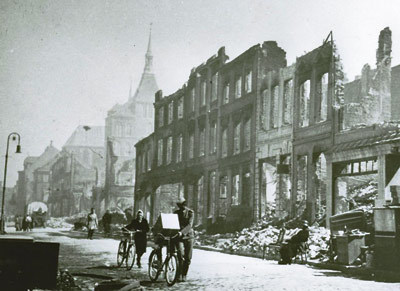
But while Tadellöser & Wolff (which is also the most well known of Kempowski's German Chronicle books and has even been made into a film) is technically considered to be fiction, the presented story is drawn so directly and heavily from the author's, from Walter Kempowski’s own boyhood experiences, from his and his family's life in Rostock, Germany, during the Third Reich, during the Nazi regime, that I for one and most definitely find Kempowski's text majorly and intensely autobiographical and as such also rather more non-fiction than fiction in scope and nature (but which is actually also something I personally have much enjoyed and do appreciate about Tadellöser & Wolff). For this autobiographical, taken from actual and realistic life, this non fiction and historically authentic and accurate feel of Tadellöser & Wolff, it really and nicely gives a wonderfully delightful and also enlightening textual immediacy and I as a reader equally and certainly do feel as though I am being given with Tadellöser & Wolff not only a first person narration from Kempowski's pen but that I am also getting to know the entire Kemposwski clan (as well as WWII Germany and Germans in general for that matter) on an intimate, on a personal level and in a historically authentic and accurate manner.
And albeit part of me certainly (with some personal and I guess entirely German feelings of guilty discomfort) kind of misses detailed information of the Holocaust being shown and critically addressed in Tadellöser & Wolff, well, because the text is written from the point of view of the youngest son, of Walter, who was four years old in 1933 and sixteen in 1945, I did not in fact expect many if any textual Holocaust details to be presented in Tadellöser & Wolff unless the Kempowskis had been actively resisting the Nazis and had made it their mission to find out what was going on and to publicly speak out against this, but no, this obviously but unsurprisingly is not at all the case in Tadellöser & Wolff. As while the members of the Kempowski family are seemingly and from Walter Kempowski's remembrances and his featured narrative not actively and rabidly supportive of Adolf Hitler et al, they also do not in any way resist and fight against the National Socialists either, they are shown as being what most Germans likely were during WWII, so-called Mitläufer, running along to the tune and the dictates of the government, even sometimes willingly and uncritically accepting and believing Nazism and Adolf Hitler's ridiculous lies, which for me definitely is quite emotionally problematic, but it also does not take away from the fact that I have definitely very much enjoyed reading Tadellöser & Wolf and very warmly do cherish the textual foray into WWII Germany and what a German family like the Kempowskis was like (and that this was obviously the case for much of Germany in general).
Furthermore, just to say that I for one do also majorly value the textual honesty of Walter Kemposwki's remembrances and that Tadellöser & Wolff would indeed be a very very much distasteful and uncomfortable (even quite personally unacceptable) story for me had Kempowski even remotely attempted to textually render his family as for example being anti Nazi resistance fighters when this does not represent the truth, because with WWII and with National Socialism, I for one (and with my German background) always want and need honesty and truth and which I do believe Tadellöser & Wolff and Kempowski's printed words very nicely provide, and that I am also rather majorly pleased that not everything textually encountered in Tadellöser & Wolff is just about WWII and National Socialism, that much of Walter Kempowski's text shows a close-knit, affectionate family, with their own private jokes and stories, breakfast routines, dinner quarrels, moods, anxieties, and that at first, no one, neither the parents nor even more the children suspect and comprehend the incoming chaos and cataclysm of WWII.
Now finally, with regard to Walter Kampowski's writing style for Tadellöser & Wolff, well, I do have to say that it took me a rather long time to get used to Kempowski bringing the German (and Rostock) past to life through a rather distracting and textually all over the place choir of multiple voices (dialogue, song, architecture, literature, commercials, political slogans and so on and so on) and that often sentences are not only really short and choppy but also seem to quite regularly lack verbs (are thus not always grammatically correct, and that this means that I as a German language instructor would probably not consider using Tadellöser & Wolff in a German as a Second Language classroom). But yes, after my initial stylistic frustration and distraction, I did get increasingly accustomed to (and also appreciative of) how Walter Kempowski writes in Tadellöser & Wolff and that Kempowski's many textually jumpy sketches of Rostock and of his own family, rather brilliantly mirror the contents of Tadellöser & Wolff, by stylistically showing the turbulence of Germany racing towards war and also becoming increasingly intolerant and ready to accept and not question the worst of National Socialism, with Tadellöser &, Wolff thus being a kind of time capsule, and that Walter Kempowski's personal family story with sadness and resignation demonstrates how even those Germans who did not intensely support Adolf Hitler but did nothing actively against National Socialism's rising tide of power, of racism and intolerance certainly do have some collective guilt to consider and to accept.
And yes, I have now ordered the entire German Chronicle series from my local independent bookstore and am especially looking forward to reading the as mentioned above first novel (chronologically) Aus großer Zeit (and am kind of wondering if Walter Kempowski's family story will perhaps also feel a bit similar to Thomas Mann's Buddenbrooks but without the family decadence and decay).