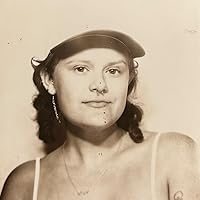
Zan de Parry is invested in whatever teaching moment poetry is capable of. Like a poem could be a poem with a rose or it could be a rose-colored poem, and de Parry is going to lead you to drink a cool glass of rose water, it really brings out the rose in the poem. Like what it feels like smelling a rose while you’re reminded of your grandmother, whose bathroom smelled like roses, and who gave you a talking to one time. It was about roses, their soft and delicate boldness. What I’m describing, of course, is an interdimensional experience of roses, and you can be assured De Parry’s poems are giving interdimensional-ness. An eye to the many dimensions that might be playing out in narrative. Think of how every rose has its thorns, think of each thorn as a dimension, then think of de Parry’s imagination tangling the thorniness into a network of situations.
But I would caution you not to jump into de Parry’s book thinking that’s what you’re going to find in Cold Dogs’s first poems. The book is like a gradient moving from lite to colorful. It starts with minimalism. It flashes minimalism intermittently throughout the book. It could be poems about a dog. Or an angel. Poems you might have left on a sticky note for your significant other. And it was reported she wore a wry smile for the rest of that day. If you’re like me, and you read your poetry book from beginning to end, then you might find some usefulness in these opening poems. They depict a poetics for the small gestures a poet makes. They are poems arising from inklings of thought. Like some of the mid-2000s books by Josh Beckman, Noah Eli Gordon, and Joshua Marie Wilkinson. Where the poem merely intones an implied narrative, and that note exists as as the entirety of the poem. Because those moments were to be larger than any individual moment. Think Wordsworth’s Preface to the Lyrical Ballads, where he argues the poet is most sensitive to the evocative in nature or human nature. And so the poet evokes it into language. This method typically relies on a deep investment in brevity, marvels at the potential available within the evocative. But for my tastes, the commitment to minimalism often leaves a lot of the poem out of the poem.
What I find interesting about de Parry’s book is how it elaborates further on those minimalistic gestures. Like he’s committed to minimalism, and the poems at the beginning of the book are teaching his reader what a minimal poem can evoke. Then when the poems shift into more elaborate situations, the poems move into sets of declarative poetic lines. Lines that feel like minimalist gestures, especially with the ambiguity connecting one line to the next (is it grammatical? subtle and partial enjambment?). But all these lines speak to some larger moment. Like the poem, “The Dog,” that thinks about a dog’s creature comforts. Or “The Deputy” that could be considered a Russell Edson-ish meditation on the word “avuncular.” I would argue that it’s the relationship between minimalism and the more involved surreal perspectives on the present that make this book a pleasure to read!
This summer, Alan Felsenthal of indie press The Song Cave mailed me an advanced reading copy of Zan de Parry's debut full-length poetry collection, Cold Dogs. A book by an author I was unfamiliar with, it quickly became not only my favorite poetry collection of 2024, but the best ARC I think I’ve ever received. The unique collection is packed with a signature vernacular both matter-of-fact and uncommon. Sparse yet dense. Absurdist yet realistic. Rural and urban at the same damn time. The line between reality and absurdism, dreamspeak and normalcy is a mode Parry handles masterfully. Making bathtub gin with calloused hands. Laughing to keep from weeping, weeping to keep from laughing.
Along with having him in Chicago on November 6 as part of my Neon Night Mic reading series, I was fortunate enough to pick his brain about his debut collection, his past intersections between literature and theatrics, his history of odd-jobs, his DIY press with his brother, and enough media recommendations to overwhelm your local library: https://www.neonpajamas.com/blog/zan-...
She brought me metal pansies She said there’s a story in her family of a duck Like all ducks this duck wore water But didn’t like the wetness — Zan de Parry / “If Feathers Were Cigarettes”
He gently folded my head into my chest And my face into my groin Friend, let me show you an informal way to achieve dreams — Zan de Parry / “I Let The Terrorist Touch My Head” / Cold Dogs
I can’t wait to take you home and rob you Break your chaste and taste it with masa To get a piece of your galore Show up out of the woods at like 1000 AM… — Zan de Parry / “Barn Door”
I read that this year’s our copper anniversary I will ask for a copper penis as a gift, to stir jam Maybe next year a lot of fruit will grow at the cottage? — Zan de Parry / “Copper Anniversary”
I feel no urge to put this in any tradition, to compare or contrast. Reading this only made me reconsider my own tradition, and tend to the eggs poetry planted in me as a teenager. Are they rare ikura, ripe for harvest? Or are they teenagers themselves now? Inspiring to read someone deep in the weeds with the scruffs of the eggs necks.