The Eagle and The Lion is a story of the imperial rivalry between two of the greatest empires of the ancient world – how they rose and eventually fell.
The Roman empire shaped the culture of the western world against which all other great powers are compared. Stretching from the north of Britain to the Sahara, and from the Atlantic coast to the Euphrates, it imposed peace and prosperity on an unprecedented scale. However, the exception lay in the east, where the Parthian and then Persian empires ruled over great cities and the trade routes to mysterious lands beyond. This was the place Alexander the Great had swept through, creating a dream of glory and conquest which tantalised Greeks and Romans alike. Caesar, Mark Antony and a long succession of emperors longed to follow in Alexander's footsteps. All failed. Only here did the Roman empire slow down and eventually stop because it was unable to go any further.
Following seven centuries of conflict that ultimately, neither Rome nor Persia would win, The Eagle and The Lion delves into the clash, context and journeys of these entities of great power and the people caught in their wider struggle.
Adrian Goldsworthy, born in 1969, is the author of numerous acclaimed books, including biographies of Julius Caesar and Augustus. He lectures widely and consults on historical documentaries for the History Channel, National Geographic, and the BBC. He lives in the UK.
Valiant effort but Goldsworthy may have bit off more than he could chew. The available sources unfortunately don't match the ambition. There are some high points but they get a bit buried in the unknown.
Survey of the relations between the Roman and later the Eastern Roman empires and the Parthian and later the Sasanian empires between the 1st Century BCE and the 7th Century CE.
"Good fences make good neighbors"— Robert Frost, "Mending Wall,"
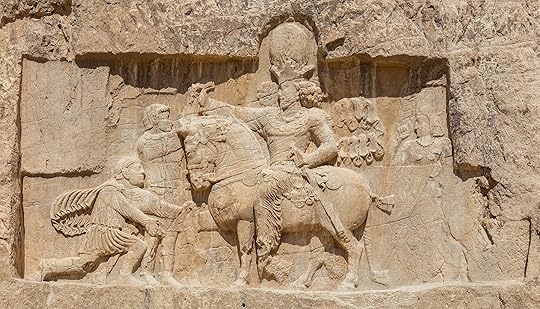
Bas-relief near Kazerun, Iran, showing the victory of the Sasanian King of Kings Shapur I (215 - 270 CE) over the Roman Emperor Valerian (199 - 260 CE) at the Battle of Edessa, 260 CE.
My dead tree version was a door-stopping 609-pages, which included Maps, Illustrations, a Bibliography, and an Index. It had a UK 2023 copyright.
Adrian Goldsworthy is a British historian and novelist who specializes in ancient Roman history. He is the author of over ten nonfiction history books and ten works of fiction. I have read several of his books. The last being The Wall (City of Victory #3) (my review).
Firstly, this is an advanced/intermediate-level book on a particular aspect of Roman history. It is not meant for a general reader. A prepared reader needs a general knowledge of the entire Roman period, including the Byzantine Empire, and a good understanding of the geography of the Eastern Roman Empire.
TL;DR Review
This thick book covers more than 700 years of Roman and Persian history. It describes the relations between two of the longer-lasting empires of the ancient world that continued into the medieval period, while sharing a border.
The Romans, both the Empire and the Eastern Empire, shared a border for three centuries with the Parthians and four centuries with the Sasanians. (The Parthian and Sasanian empires are collectively considered "Persian".) Both Roman and Persian empires had become heirs to the Hellenistic kingdoms of the ancient world. During the longest part of their history, the Romans were ruled by an emperor or emperors, and the Persians by a King of Kings. The Roman emperor ruled over directly controlled provinces, while the King-of-Kings generally ruled over a collection of semi-autonomous fiefdoms. Throughout those 700 years, the empires were rivals. Both empires were wealthy and populous. Both shared similar challenges whilst ruling the territories in the ancient and medieval eastern margins of the Intermediate Region.
The Roman Republic first came into contact with the Parthian Empire in the 1st Century BCE. The Imperial Roman frontier with the Parthians eventually spanned approximately 1800 km (1100 miles), traversing what is now eastern Turkey, northeastern Syria, northwestern Iraq, western Iran, and western Armenia in the 1st and 2nd Centuries CE. In the 3rd Century, the Fall of the Parthian Empire and the rise of the more aggressive Sasanian dynasty, originating from a Parthian vassal kingdom, brought changes to the border. They had a more centralizing and expansionist policy than their predecessors. This lead to increased warfare between the empires. Up to the Fall of the Western Roman Empire at the end of the 5th Century, the Roman-Persian frontier remained relatively unchanged. However, it was a fluid, fortified, and contested border. The Sasanian empire's collapse in the mid-7th Century to the Arab Conquest ended the Roman/Persian rivalry. Both sides had been weakened by an extrodinary 25 year long, continuous war. The surviving Byzantine (Eastern Roman) Empire's frontier with the Arabs was also contested. The Byzantine frontier in the Middle East contracted, shifting further westward, away from the old Sasanian frontier, leaving whole provinces behind.
The Romans and Persians were rivals for centuries. Neither could conquer the other, or permanently occupy enough of the other's territory to render them marginal. Many conflicts occurred between them, resulting in an expensively, heavily fortified and militarized frontier for both. This cordoned zone burdened both empires, and it may have eventually led them to their mutual decline. Civil wars, which periodically wracked both empires, were particularly damaging. The opposing empire uses the disorder to its advantage. In particular, the rivalry weakened both empires when dealing with barbarian incursions, which both suffered from.
However, the longevity of the seven-century rivalry is remarkable in itself. Both empires provided large populations with stability, security through the rule of law, prosperity, and related advanced cultures. This was rare in the later centuries of the ancient period and the early Middle Ages for even short periods of time.
This book contained a wealth of information on a long period of Roman history, particularly of the Eastern empire. For a reader with the right background, it would be an interesting read. However, there are holes in the history. Goldsworthy did not have enough scholarly sources to provide a consistent high level of detail for the entire 700 year narrative. At about 600 pages, it could have been 200 pages shorter if the history had started in the 1st Century CE rather than providing an almost complete Roman history.
The Review
The well-groomed text was in keeping with the Head of Zeus (Bloomsbury) publisher's highest standard. The copyediting was meticulously done. The prose was in an academic style. The book was logically organized and contained a minimum of repetition or unnecessary digression.
However, the lengthy survey of Roman history, proceeding from the Carthaginian War to the end of the Pax Romana, was extraneous. A reader would have been better served starting at around 100 CE with the origins of the Parthian frontier.
Maps inadequately supported the geography and evolution of circumstances. There were several scale, regional maps of the frontiers of the empires. However, in my version, the topographical details were too faint to be easily readable. This made it hard to discern the natural barriers (mountain passes, river valleys) that made up the frontier. I recommend having a period atlas available to relate the geographical locations and conditions found in the narrative.
The illustrations were good. They were color photographs. Most of them were artifacts, although there were several surviving Roman and Persian structures. I would have liked to have seen a few artists' reconstructions of the infrastructure.
The Bibliography, Index, and citations were professionally done. In addition, the Bibliography contained recent and significant works on Roman history.
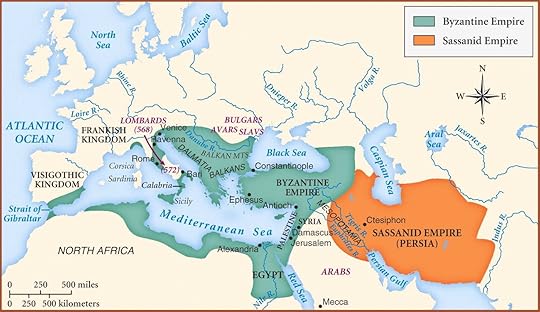
Early Medieval Byzantine/Sasanian Empires frontier ~6th Century CE under the strong Roman emperor Justinian I (527 - 565 CE) and the strong King of Kings Khusro I (531 - 579 CE).
Goldsworthy approaches organizing the book's narrative primarily by emperor, by king-of-kings, and by dynasties. Significant events within a reign are noted, and their long-term influences are highlighted. Starting with Roman dictator Sulla's (138 - 70 BCE) Civil War (83 BCE – 82 BCE), he follows through to the Fall of the Sasanian Empire (651 CE), spanning approximately 750 years.
The fortunes of both the Roman and Persian empires waxed and waned over the centuries. Interestingly, the Fall of the Western Roman Empire did not affect relations with the Persian Empire. In general, whenever either or both empires were affected by civil war or barbarian incursions far from the Roman/Persian frontier, there was a likely chance of war. Long intervals of peace typically extended, whilst any warfare, along with revanchism, encouraged more warfare. Warfare was particularly prevalent in the 3rd, 4th, 6th, and 7th centuries. However, a watchful peace was normal, with warfare being occasional. Generally, warfare was limited, with objectives that were narrowly defined, reducing the chances of a broader conflict.
Goldsworthy makes the point that over the centuries, the military of both empires became very similar. The original Parthian military was a mounted force of light (mounted archers) and heavy (cataphracts) cavalry, with few infantry. Note the origin of the Parthian Shot here. The Romans were a combined arms force of primarily infantry, with light cavalry auxiliaries and sappers. Over the centuries, the Romans greatly increased their mounted component, whilst the Persians increased their infantry and engineers. Engineers become an important component in the siege warfare that characterized the conflicts of the later centuries. That the military of both sides evolved to fight the other, while the barbarians pressing on both empires fought differently was not lost on Goldsworthy.
Warfare between the empires was one of their most expensive efforts. Initially, Romans and Persians pursued profit, driven by the desire for booty and slaves at the others expense. The Sasanians frequently used the threat of war to extort treasure from the richer Romans. War could also the result from assuring a succession. For example, a Sasanian victory against the Romans could legitimize a new King of Kings amongst his always restive vassals. However, as the frontier hardened with fortified cities, rarely were victories great enough to make wars profitable. Additionally, maintaining a frontier defense was costly in both manpower and financial terms. The standing armies of the empires were always their most significant budgetary expense. However, the cost of maintaining "peace through strength" against the rival empire, in addition to lesser threats (barbarians) on other frontiers, was a mandatory expense for both empires that their complex and diverse economies could sustain. For example, Emperor Julian (331 - 363 CE) dismissed the barbarians as mere backward tribes, and regarded Persia as the traditional enemy. (He died on campaign in 363 CE against the Persians in what is now Iraq.)
Oddly, Goldsworthy makes only short mention on the complicated events, over a short period of time, of the Arab Conquest that resulted in the fall of the Sasanian Empire and relegation of the Eastern Roman Empire into a mere kingdom. The aftermath of a prolonged general conflict between the two and mutual, simultaneous civil wars is the explanation.
Still, the two empires co-existed for long centuries. For long periods, both sides accepted restraint on their rivalry. It's not provable that their rivalry benefited each other, but the duration of the relationship into the 7th Century disproves that it weakened them substantially.
Interestingly, Goldsworthy only includes one chapter on inter-empire trade. The Persian empire straddled the land trade route of the Silk Road. Luxury goods, such as silk and black pepper, entering the Roman Empire, and wine and glassware entering the Persian Empire, generated substantial tax revenues. Note that a secondary, seasonal water route existed from Egypt to India, bypassing the Persian toll gates, for the Romans to use. Over the centuries, I could only assume that the cross-border trade between the empires was substantial. A criticism I have is that he frequently described the Romans as being "richer and more populous", without ever quantifying the statement. Roman wealth is brought up, by their willingness on many occasions to "pay for peace". However, the economics of this were rarely elaborated on. For example, "What percentage of the empire's yearly revenues were the hundreds of pounds of gold paid to the extorting Sasanian's?"
A significant issue with this book was that it was primarily based on Roman sources. In some ways, modern knowledge of the Parthians and Sasanians is almost as meager as that of the long-conquered Carthaginians. The Sasanian dynasty, in its early decades, actively erased the Parthian legacy from within its territories. Only Roman and archaeological evidence survives of them. Likewise, only Roman, medieval Arab, and archaeological evidence survives of the Sasanians. Finally, the Roman record is the result of medieval Western, including Byzantine, sources and archaeology, which have significant gaps, particularly in the 5th through 7th centuries. For example, the Parthian succession of the King of Kings is only complete due to coinage analysis. If a King-of-Kings did not occupy the throne long enough for coinage with a "head side" to be minted and widely distributed, they are lost to history. However, in general, this book's narrative is extremely Roman-centric, with the Persians being very shadowy due to a lack of sources.
Summary
This was a long book, but it could have been shorter. It was written for readers with a substantial knowledge of Roman history into the early Medieval period. It took a majority military and diplomatic approach to the relations between the empires. Unfortunately, the historical or archeological record does not exist to verify all its assertions and conclusions thoroughly.
This book was longer than it had to be. The most essential information pertains to the 600 years from the Roman Principate under Emperor Trajan (98 - 117 CE) in 100 CE to the Fall of the Sasanian Empire to the Arabs in 651 CE, during the reign of Constans II (641 -668 CE) as the Eastern Roman emperor. Instead, Goldsworth began the narrative with the start of the Imperial period in the 1st Century BCE, during the Republic. Those 200 pages could easily have been summarized.
There are no primary sources and few secondary sources on the Parthian and Sasanian empires from the ancient and medieval eras. (A substantial amount of likewise Roman sources are also absent.) The archeological record and an interpretive analysis of the surviving Roman and medieval Arab documents and histories were needed to understand these empires histories. To his credit, Goldsworthy admits, "we don't know" several times. Perhaps too few times?
The conclusion I arrived at was that the two empires pushed against each other like tectonic plates. Wars were very opportunistic earthquakes, used to seize a slim advantage from rivals whose military capabilities and territorial occupations had rendered them near equals in capability. The cost of security, infrastructure maintenance and development, civil services, and the Imperial bureaucracies was a heavy burden on them, but not insurmountable. (I suspect the trade benefits were substantial?) That the two empires survived in near equilibrium for so long is beyond my ken.
Goldsworthy presents a modern military and diplomatic interpretation of imperial coexistence from the ancient to early medieval eras. He sufficiently describes the conflicts, actions, or inactions that affected the empires. However, the known unknowns as well as unknown unknowns for writing a history like this are substantial.
Had higher expectations for this book; it didn't deliver.
While it could be engaging at times, I failed to hold my attention all the way through. That said, there were several takeaways.
1. The Romans never intended to conquer the Parthians/Sassians. Although Rome was the bigger power, the Parthians could put up a good fight. 2. To assume that the Parthians/Sassians were victims of Roman aggression give Rome to much power and the Persians too little agency. 3. The Romans suffered several defeats at the hands of the Parthians such as Carrhae and Suphar I's capture of Valerian, the Roman Emperor.
I've had mixed experiences in reading Adrian Goldsworthy's books. His biography on Julius Caesar was fantastic but there are other works that keep me engaged.
Adrian Goldsworthy writes historical fiction that are as informative as a history book and history book that are as entertaining as novel. This is a well researched book that made me learn about a part of the Roman history that was new to me. It was an excellent read Highly recommended. Many thanks to the publisher for this ARC, all opinions are mine
The Eagle and The Lion is a slightly underwhelming exploration of the dynamic between the Roman and Persian empires. While Edward Gibbon's works offer a more comprehensive description of this period, this book falls a bit short in delivering fresh insights from new research, which can be a disappointment.
However, it does shed light on the limits of our knowledge, especially regarding the Persian empire, acknowledging the gaps in historical understanding. The book interestingly points out how external empires were often leveraged to boost internal prestige and how internal strife was a reliable predictor of external conflicts. Essentially war was never sustainable, but peace was never prestigious.
Two quotes stand out for encapsulating the essence of the book: "*The overall pattern is from long periods of peaceful coexistence which, which sometimes broke down. Whether from coincidence, their own agenda, or the side effects of Rome's lack of internal stability, the era of the Sassanians witnessed far more conflict than that of the Assasids."*
Another notable quote is, "The emperor ... looked out on the world certain of the superiority of their empire. Outside was barbarism. ... The Persian empire was less barbarous than anyone else, but being more advanced and civilized still left them markedly inferior to Rome. The Sassanians felt much the same about themselves. They were the center of the world, leaders in the struggle between the truth and the lie. The Romans were much less chaotic than other peoples while remaining markedly inferior." This passage vividly illustrates the mutual perceptions of superiority, something akin to the US + China today, or US + Japan in the lead up to WWII.
This book is a largely narrative history of relations between the Roman Empire and the variety of empires that ruled the areas to the east of the Roman Empire between the Mediterranean Sea and what we not call India. The story covers the time between the initial imperial contacts, during the time of the Republic and the Civil War, and up through the growth of the Rome Empire (or Principate) established by Augustus. East of the Roman territories, there were various dynasties and imperial houses, including the Parthians, Arsaces, and the Sassanians - who became the strongest as they grew, along with a variety of intermediary states, such as Armenia. The time frame for the book extends from the Roman Republic up until the decline and demise of the Western Roman Empire and the arrival of the first Islamic waves that swamped both Rome and Persia in the 7th century.
This is the story of an entire subsystem of the Roman universe that fails to receive sufficient attention given the dominance of Rome (which got to write many of the histories) and the relative importance of Han China - or later Tang China - and what came to be the Silk Road. The bipolar approach towards looking at the history of the region is really well done and the book is suggestive of how the empire worked, including its basic administration, foreign relations, and dispute resolution.
The more I think about it, the dyadic focus of the book is one of its greatest strength. It is too easy to think of an empire or a nation as a single set item that is following out its design to research its full potential over the course of its lifespan. Today, many still think this way regarding the rise and fall of nations, in ways that suggest predesigned breeds of animals following out their design requirements. This get not so careful and even careful readers into thinking of a “logic of history” nations and peoples are condemned to follow. The problem with this is that whatever logic or plan is apparent in a history only becomes apparent with the passage of time after critical events have unfolded. We never see the paths not taken nor the alternate futures that failed to unfold.
A dyadic view looks at thinks differently, in that the two sides of a dyad grow and adapt and customize their behaviors in terms of each other. Actor A observes and responds to Actor B, who responds in term back to A and takes advantages of opportunities that A’s choices present. A responds further to B and the cycle continues for an additional round. The future is not clear here either, but at least the sources of conduct within the dyad can be better understood. “Containment and the sources of Soviet Conduct” anyone? Add more actors, it just gets more complicated - remember the Cold War, right?
What is especially interesting about Goldsworthy’s book is how both the Romans and the Sassanians did not seem to be paying full attention as the threat from rising Islam grew to dominance. When did either the Emperor or the ‘King of Kings” see it coming? When was it too later to respond. This is especially difficult to figure out when Goldsworthy’s treatment of both empires as increasingly administrative states is taken into consideration. The strategic and macro view, such as it was, came from the top, but how did that translate into local action in a world without electricity or fossil fuel energy when the fastest communication was on the order of our “pony express”?
There is still a lot in the book, so I may come back again, but the book is a valuable enhancement to the typical history of Rome and is well worth reading.
From the First Century BCE until the Seventh Century CE, Rome and Persia (the latter actually two different Empires, which we can refer to simply as the Parthians and the Sasanians) were the largest long-standing empires in the Western World. During most of that time they were at peace with one another, a wary cold war in which both sides tried to maintain dominance. But there were also frequent conflicts, though not to try to overwhelm the other but for more limited gains, such as dominance in the border territories. This didn't come to an end until the Arab conquests in the Seventh Century when the Sasanians were overwhelmed and Rome (at this point, reduced to the Eastern Empire) reduced to simply a kingdom centered on Constantinople.
Adrian Goldworth gives a detailed account of the history. I'm a Roman history buff, but I confess that there is much of this part of the history -- particularly past the Third Century CE -- that I wasn't familiar with, so much of this was fascinating. Goldsworthy does a fine job summing up and provide a good perspective, while also explaining clearly what we know and what we are just assuming based on limited evidence for certain periods.
Recommended for those interested in Ancient History.
Adrian Goldsworthy always writes extremely well-researched books that allow the reader to immerse themselves in ancient eras. This is another in that long line of highly informative works. The author approaches the topic of Rome and Persia in a narrative style that makes reading the vast amount of information easy and enjoyable.
Three major points stood out to me: 1) Rome and Persia (also during the times they were Parthia) were two large, powerful empires that mostly struck a balance of power during their centuries of existence. They generally resorted to verbiage to paint the other as less than, but did, infrequently, launch major attacks against the other with little-to-no lasting effect. This ensured the continued existence of each. 2) Armenia was put in the position of being a "football" that was metaphorically tossed back and forth between the two major powers. It reminded me of Poland during the 20th century. 3) I would never have wanted to be a man who was a member of a royal family or in power. Their lives were usually ridiculously short and violent. The list of Roman and especially Persian men who were killed so that another could have power is long and horrifying. The ancient world (and parts of the world today) was filled with men who craved power and wealth and who would stop at nothing to get them. There were, of course, some women who participated in these machinations and murder, but they are few and far between. It was a man's world and power was the aphrodisiac.
Rome and first Parthia, then Sassania (both Persia) fought a sometimes hot and often cold war for 700 years. Their inability to restrain themselves from a final apocalyptic scale showdown that enabled the rise of the Arabs (much to the detriment of us all) offers a stark warning against those who struggle to accept restraint and a workable balance of power. Their fatal denouement, however, was not inevitable, as so much of their prior history showed it could be done. In fact, this was one of the more stable bipolar rivalries after the first and last chaotic periods.
Goldsworthy gives us the facts when he has them and admits when supposition due to flaws in the historical record require them.
I read most of this book while on a trip to Armenia, and its amazing how many times that land and others near it reappear in the narrative. Its a hard world out there for smaller states, but temporary respites can be found such as the Roman-Parthian buffer arrangement where a Parthian prince became king of Armenia but with the succession subject to Roman approval. Something I mention, albeit in passing, here: https://geotrickster.com/2024/11/27/m...
Up until now I think I have only ever given Goldsworthy 5 stars for everything he has done - and for good reason. In The Eagle and The Lion, however, he misses the mark.
While brilliant if written as a doctoral thesis - if stripped of all the divergences - this somewhat fails as a history book. From a narrative standpoint, the flow is weak and it can often feel like just jumping from one reign to the next and sharing what we know of the interactions between the two great powers during that period. While less centralised, I think this topic is better served by separate histories on the two empires or by a more concentrated history on more limited time periods.
For those well versed on the subject or the empires themselves, much of what is here is a repeat of what you've read previously from Goldsworthy or others. There is too much background history at every step. This makes a bigger more marketable book but one that diverts too often from its task at hand.
Some time back I read a book about the Mongolians, in particular at the western edges of their advance, and how those kingdoms related to what I know as the Crusader States. It completely blew my mind because I've read a bit about the 'Crusades' general era, and that book made me realise just how western-focussed my understanding had been: the invading Europeans connecting back to Europe and maybe Egypt (thanks to Saladin); maybe you'd hear about the Golden Horde occasionally. But interacting with the Mongols was HUGELY important.
This book does a similar thing for Rome. My focus has always been on the Republic and early principate, so maybe that has had an influence. But in my reading, Crassus' loss at Carrhae is present but (at least in my hazy memory of what I've read), it's almost like Parthia comes out of nowhere to inflict this defeat. Persia then looms as the Big Bad, but I think that dealing with the Germanic tribes and the Goths etc seem to take a lot more space. Even for the eastern empire, which is definitely not my forte, regaining Italy etc and fighting west and north (and internally) seems to get more attention.
And then you read a book like this. It is, of course, heavily leaning in the other direction; that's the entire point, to start redressing some of the UNbalance that otherwise exists. These two empires could be seen as, and describe themselves as, the "two eyes" or "two lanterns" of the world (those are Persian descriptions); for basically their entire collective existence they were the two largest empires in this area (China probably rivalled them at least at some points, but although there were tenuous commercial connections, they're really not interacting in similar spheres). It makes sense that the relationship between them, and how they navigated that relationship, should be a key part of understanding those two empires.
Goldsworthy does an excellent job of pointing out the limitations in ALL of the sources - Greco-Roman, Parthian, Persian - and clearly pointing out where things could do with a lot more clarity, but the information just doesn't exist. Within that, he's done a really wonderful job at illuminating a lot of the interactions between Rome and Parthia/Persia. And he also clearly points out where he's skipping over bits for the sake of brevity, which I deeply appreciate in such a book.
It's not the most straightforward history book of the era. It covers 700 years or so, so there's a lot of dates, and a lot changes in this time as well - republic to principate to later empire, for Rome; Parthian to Persian; countless civil wars on both sides. A lot of leaders with the same or similar names, unfamiliar places names, and all of those things that go towards this sort of history book requiring that bit more attention. I definitely wouldn't recommend this as My First Roman History Book! But if you're already in the period and/or area, I think this is an excellent addition to the historiography. Very enjoyable.
El libro es narrativo, con muchos detalles, se centra más en lo militar, esperaba una conexión entre ambos imperios más allá de conflictos militares, mirar más intercambios como lo cultural o económico, solo se menciona una vez. Hay muchas contextualización, se pierde en varias ocasiones en hilo conductor, entiendo que es para situar a las personas que no conocen mucho la historia. La verdad me centré más en el ámbito persa a la hora de leerlo. Está bien un libro para conocer más.
En la introducción, el autor afirma que el mayor rival del imperio romano fue el imperio iraní, entre ambos pueblos hubo tanto guerra como paz, ninguno de los dos tuvo las capacidades para una destrucción total. Una cuestión a tener en cuenta es que la mayoría de las fuentes son romanas en este estudio.
El primer capítulo se sitúa en el año 90 antes de cristo donde se nos describe el primer contacto entre los partos y los romanos en la que la delegación parta se le demostró el gran poder de roma, la cuestión de este acontecimiento es que las fuentes romanas son muy sesgadas al mostrar a los persas como déspotas al supuestamente ejecutar posteriormente al enviado parto, Orobazo, inclusive no se tiene una fecha clara de tal encuentro y solo se usó para mostrar el posterior ascenso al poder de Sila.
El segundo capítulo empieza con la tesis de que la guerra en la república romana no interesaba mucho a los persas puesto que estos también tenían sus propios problemas internos, el autor aquí describe cómo fue el ascenso de los partos al aprovechar la debilidad del imperio seleúcida, pese a que estos últimos lograron unas victorias en Mesopotamia a manos de Antíoco VII en el 130 a.c, muchos pueblos como babilonia se rebelaron ante estos debido a que durante la dominación parta fueron mejor gobernadas por lo que posteriormente sería asesinado en una guerra el rey seleúcida.
Con Mitrídates II en el trono se aseguró de conquistar los territorios perdidos y con ello consiguió en el 111 a.c tener armenia a su lado, luego de la muerte de este gran rey los armenios aprovecharon para expandirse. Una cosa importante que destaca el autor al final de este apartado es que los partos contaron con un gran ejército eficaz y motivado para ganar las guerras además que usaron las élites locales a su favor en su ascenso al poder.
El tercer capítulo entre el 70 al 54 a.c ambos imperios estaban concentrados en sus problemas internos, roma estaba pasando por una guerra civil, donde posteriormente llevarían la guerra contra los pónticos, estos serían derrotados y buscarían ayuda en los partos, aunque estos se mostraban reacios a tal ayuda. en siria por su parte los partos retrocedieron ante los romanos sin un combate claro, por otra parte, el rey parto Fraates III, intentó intervenir en armenia, aunque no lo logró debido al costo del asedio. Pompeyo se reuniría luego con este rey parto para tratar de delimitar las fronteras de ambos imperios, luego de la muerte de este rey parto, existió una guerra por el poder en la que al final triunfó Orodes II sobre Mitrídates III.
En torno al año 54 a.c empieza la ofensiva de craso contra el imperio parto en donde hacen un primer avance en el Éufrates y muchos pueblos locales reciben a los romanos puesto que los persas no estaban tan consolidados, luego detendrían su avance para entrenar soldados y conseguir más suministros a causa del invierno, lo que demuestra este primer avance romano es que el general tenía mucha libertad para iniciar un avance contra los persas, aunque no conocía muy bien el terreno de la región.
El cuarto capítulo nos sitúa en la batalla en el dónde en el 53 a.c, roma esperaba que armenia mandara refuerzos cosa que no pasó, mientras ellos sucedían, los partos querían negociar, pero los romanos se sentían confiados de ganar, cosa que también pasaba con los persas. Los romanos querían aprovechar la guerra civil que estaba sucediendo en el imperio persa, aunque esta ya había llegado a su fin por lo que el nuevo rey iba a reunir más fácilmente tropas.
Entre el ejército de los partos se encontraban los famosos arqueros a caballo los cuales podían disparar mientras se movían en el campo de batalla, otra unidad importante de estos persas era los catafractos los cuales eran un jinete sin escudo, pero contaban con una gran armadura y una lanza de casi 3 metros. la autora firma que sí había una cierta influencia de la guerra esteparia en los partos, pero desde los aqueménidas ya había una traición de la caballería, otra cosa destacar de los partos es que preferían la calidad es que la cantidad de tropas, ya que no era fácil entrenar a los arqueros a caballo.
En el 53 a.c, los partos iniciaron una invasión a armenia con el objetivo de deshacer el apoyo de estos hacia roma, esta fue la razón de que este pueblo no ayudará en la empresa romana, craso por su parte se lleva avanzando, aunque esta marcha era bastante dura a causa de devastador calor, el rey parto Orodes II, estaba centrado en su campaña contra armenia, por lo que debió delegar a otra persona la lucha contra el avance romano. Si bien las flechas de los persas eran bastante imponentes no dejaban muchos muertos lo que hacían más que todo eran hostigarlos y tenían un constante suministro de flechas gracias a los camellos cercanos.
Los partos tenían la tradición de siempre alejarse y huir para cambiar la situación a su favor, por su parte los romanos, se sentían más seguros al mantener terreno, el hijo de Craso, Publio, cometió el error de intentar seguir a los partos lo cual costó su asesinato y con ello la desmoralización del ejército romano, posteriormente en un intento de negociación craso muere, pero los partos no podían destruir lo que quedaba el ejército romano ya que también se encontraba desgastados. por ello se llega a un acuerdo y los partos se mostraron como victoriosos. Igualmente, el rey persa no podía aprovechar mucho la victoria ya que todavía se encontraba inestable su imperio luego de la guerra civil.
Ya en el 52 a.c inició una invasión persa hacia Siria, aunque igual no se logró muchos triunfos, una cosa muy importante a destacar es que la cuestión de los persas era una de las muchas preocupaciones que tenían los romanos en sus asuntos políticos.
La nueva guerra civil romana mantuvo a los partos neutrales, Orodes II, no quería intervenir, en el año 40 a.c, un ejército romano compuesto mayoritariamente por persas lograron tomar gran parte del territorio sirio ante unas fuerzas romanas que se encontraban muy debilitadas, esta ofensiva fue muy sorpresiva para roma, pero, en el 38 a.c, luego de dos batallas un príncipe parto muere. la cuestión era que los partos se sentían muy confiados luego de su victoria en Carras, por lo que ahora se podía demostrar que los romanos podían vencer.
El nuevo rey parto Fraates IV, estaba centrado en asegurar su nuevo reino por lo que no inició una lucha contra los romanos, el emperador Antonio iniciaría un avance por Armenia aunque no siguió avanzando mucho más a la falta de suministros, el resultado de la ofensiva de este emperador romano es que no logró someter a los peces y por el contrario tuvo muchas bajas, sí consiguió fue que armenia fuera más leal en el 34 a.c a Roma. Pero, ambos imperios demostraban que estaban a la par.
El sexto capítulo que abarca desde el 30 a.c hasta el 4 d.c fue una época de relativa paz entre ambos imperios, el surgimiento de la figura de emperador por parte de roma hizo que fuera mucho más estable la política exterior de roma, en el año 31 se llevó a cabo una guerra por el poder en el trono persa en la que los romanos no intervinieron, aunque el emperador romano podía lanzar una expedición contra los partos se habían que eran enemigos muy duros y eran tan fáciles de conquistar como las tribus bárbaras. Fraates IV, logró un acuerdo con roma para que no intercediera en su lucha por el trono y luego devolvió presos y símbolos imperiales, empezaría así una época de intercambio de regalos entre ambos reyes.
Un nuevo rey parto Fraataes, mantendría una amistad con roma ya que lograría ser reconocido por estos frente a sus rivales, Artabano II, sería el nuevo rey parto, el cual lograría mantener la paz con los romanos a causa de sus problemas internos, muchas veces los romanos intentaron mandar príncipes para arrebatar el trono al rey persa aunque muchas veces no resultaba y no había ningún problema puesto que el apoyo romano era indirecto, con la muerte de este rey persa quedaría dividido el imperio en dos, el nuevo rey persa Vologaeses I, en el 52 invadiría armenia, pero los romanos conquistaron este lugar gracias a algo que no tenían los persas que eran armas de asedio, esto fueron las campañas de Corbulo.
Estos combates entre ambos imperios se llevaron a cabo en armenia y no se llevaron a cabo batallas campales, pero en el año 66 los partos tomarían el poder en armenia, pese a que esto pareciese una victoria para los persas muchas veces los que se ponían en tronos cercanos podían rebelarse a la autoridad mayor, nuevamente se entrarían una fase de pase entre ambos imperios al punto de que los partos ofrecerían su ayuda a los romanos en una rebelión judía.
El siguiente capítulo nos demuestra cómo los enviados oficiales por roma eran en su mayoría pertenecientes al ejército como centuriones o prefectos los cuales no tenían autoridad de decisión, las bases que tenían los romanos en el Éufrates funcionaban más como un lugar administrativo y la frontera entre ambos imperios contrario a lo que se cree si era clara y no era muy constante la entrada de un ejército hacia otro territorio. la ruta de la seda como nos la cuenta el autor era más transitada por mar que por tierra, los romanos usaban el mar rojo para traer especias e incienso de la península arábiga, por su parte mucha de la seda traída desde china pasaba por el imperio persa. los chinos a su vez recibían mercancía de roma como monedas de plata o vasijas azules, roma también era el lugar de paso de otros productos como el marfil de áfrica o el ámbar de Escandinavia.
Los partos siempre se beneficiaron de que el comercio sea atravesado por su territorio, pero el autor afirma, que los más interesados en el comercio de ambos imperios eran los reyes regionales y autoridades de las ciudades comerciales, con lo que se quiere demostrar con este capítulo es que pese a las diferencias de ambos imperios no estaban cerrados el uno del otro e inclusive nos muestran el ejemplo de un culto zoroastrismo en roma.
Muchas tropas empezaron a estacionarse cerca de armenia por parte del imperio romano por lo que los persas intentaron mantener la diplomacia ya que en el año 75 estaban centrados en sus luchas contra los pueblos alanos, en el año 110, se llevó a cabo una guerra civil por el trono entre Osores I y Vologaeses III, pese a la aparente debilidad de los partos estos seguían sobreviviendo.
En el año 114 trajano conquistó armenia y empezó su avance para la conquista de Mesopotamia, los reyes regionales de este lugar no lograron resistir a los romanos los cuales lograron grandes triunfos estos pudieron llegar a entrar en babilonia y usar los ríos Tigris y Éufrates como vías de suministros, los romanos se vieron favorecidos por supuesto por la lucha que se estaba llevando dentro del imperio persa, esta vez los romanos si querían quedarse en las nuevas provincias que habían conquistado.
Las rebeliones que se llevaron a cabo en contra de las guarniciones romanas frenaron ese intento de asentamiento a largo plazo, parece que en esta ocasión los partos también se dieron terreno para luego reagruparse, internas se podían de ver a causa de las exigencias de los romanos a los locales o que se habían dejado pocas tropas en estos lugares a causa del constante avance romano, estos últimos también tuvieron problemas en otros lugares y aunque lograron hacer un contraataque en contra de estos lugares el emperador Trajano moriría y el nuevo emperador Adriano abandonaría estas provincias a causa de que para él serían muy costosas de mantener.
Los partos también se centrarán en sus problemas y no atacarán a los romanos, aquí el autor no sabe bien los motivos que llevaron a trajano a iniciar estas campañas parece que quería asegurar las provincias de Siria y Asia menor sumado con sus intereses de guerra y victoria, nuevamente un problema para ambos imperios por lo que en el 161 los partos invadieron armenia ante una roma que no estaba preparada para este ataque y los persas llegaron inclusive hasta siria, pero tal avance no duró mucho.
En el año 165 los romanos volverían a obtener conquistas y victorias en Armenia y Mesopotamia, aunque luego se retiraron para negociar y luego serían impactados por la peste antonina. El emperador Severo, llevaría a cabo otra campaña igual que sus antecesores para tomar varias ciudades y derrotar al rey parto por lo que se creó una nueva provincia romana en Mesopotamia, con ellos se demostraba que el equilibrio de poder se estaba inclinando ante roma, pero seguí haciendo un rival a considerar.
En el capítulo 10, las ganancias romanas contra los partos eran modestas tomando en cuenta el tamaño del imperio persa, los constantes enfrentamientos entre ambos imperios preparaban todo el terreno para una nueva guerra, un nuevo emperador romano Caracalla, quería seguir la guerra en Mesopotamia, aunque luego moriría y el rey parto Artabano IV, reunión ejército para vengarse de los romanos y de tener el avance de estos aunque luego lograría en una batalla que roma le pagara tributo. en el 227 los partos aprovecharán las guerras en roma para retomar sus territorios en Mesopotamia.
Esto último ocurrió durante el ascenso del nuevo rey persa sasánida Ardashir I, el ascenso al poder de esta nueva dinastía eliminaría cualquier rastro de la pasada, el ascenso al poder de este gobernante persa empezaría desde el poder local para luego adquirir nuevas dinastías y finalmente vencer al rey parto. Esta rebelión no era estrictamente una persa contra los partos ya que estos últimos también ayudaron al nuevo rey. Los cambios más importantes en esta nueva dinastía era el solo zoroastrismo que leyó legitimidad divina a los nuevos emperadores, el poder persa nuevo era más centralizado y en el ámbito militar estos persas contaban con mejores habilidades de asedio y un ejército mejor organizado, usaban más la infantería y los elefantes de guerra.
La nueva dinastía persa controlaría la misma tierra que sus antecesores, el nuevo rey persa quería mostrarse legítimo con avances y victorias ante los romanos, cosa que consiguió ya que este rey era muy capaz de conseguir victorias y los romanos se encontraban en una grave crisis. el hijo de este emperador persa sería Sapor I, el cual quería demostrar su valía derrotando a los romanos, cosa que logró y mostró por medio de diferentes monumentos e inscripciones, lo que demuestran las pruebas arqueológicas es que se iniciaron avances persas aunque posteriormente en el 243 los romanos también querían asegurar la legitimidad de sus emperadores por medio de guerras contra los persas, estos últimos cada vez se reforzaban más en su poder al conquistar el imperio Kushan y lugares del golfo pérsico.
Los persas también dominaron parte de armenia e iberia y su gran victoria se logró con la caída de Antioquia, la cual sólo tomaron su botín para luego retirarse, posteriormente Dura sería la próxima destruida, las grandes victorias de los persas se debían principalmente al uso de armas de asedio por lo que contaban con mejores técnicas de asedio y ahora sí estaban a la par de los romanos, sus ejércitos también se estaban convirtiendo en cada vez más profesionales.
La que marcaría la derrota definitiva de roma sería la captura de Valeriano por parte del rey por lo que se pondría fin a la campaña romana en oriente, pese a que los persas seguían adentrándose más al imperio romano como hasta capadocia nunca intentaron tomar estas tierras para sí mismos sólo querían conseguir botín. Las grandes victorias persas lograron poco en cuestión de ganancias territoriales, lo que sí consiguieron fue afianzar la nueva dinastía sasánida.
Sapor I, se concentraría luego en sus fronteras orientales, toda la derrota romana se debió a varias crisis que estaban sucediendo dentro del imperio romano en el siglo III, para la década del 260 roma llevaría a cabo un contraataque que llegaría a las afueras de la principal ciudad persa, con esto se mostraba una nueva confianza por parte de los romanos el cual un emperador se hizo llamar rey de Persia, para el 270 Sapor I moriría, con ellos se iniciaría la cuestión de la sucesión. En el 282 otra expedición romana se aprecia que no tendría gran impacto. Lo que deja marcada esta época es el deseo de venganza por parte de los romanos.
Con la muerte del anterior gobernante persa empezaría una lucha en el que varios gobernantes no duraría mucho, en esta época existió una descentralización gradual del estado persa, la creación de sistemas de riego y el traslado de personas todos ellos hechos de manera gradual. Armenia nuevamente fue el foco de disputa de los dos imperios, donde el dominio persa es arrebatado por los romanos en el 297, en el que estos ejércitos llegaron hasta Tigris y con ello posteriormente Diocleciano fortalecería las fronteras orientales, para finales del siglo III, no hubo grandes batallas campales y solo se efectuaron pequeñas incursiones.
Constantino, aunque tenía el deseo de iniciar una campaña contra Persia por el deseo de gloria y por el rumor de un charlatán de grandes riquezas en india no efectuó tal campaña a causa de su muerte. el nuevo rey persa Sapor II, lideraría nuevas campañas hacia arabia y su mayor deseo era el de retomar la armenia y Mesopotamia pérdida anteriormente en el tratado celebrado con Galerio, en el contexto este gobernante ambos imperios se encontraban muy iguales y las ciudades ahora se encontraban fuertemente defendidas, antes de llevar su campaña en occidente el rey persa sometió a tribus esteparias cerca de Uzbekistán.
El inicio de la campaña persa empezaría con la pérdida de Amida, el segundo éxito de los persas se llevó a cabo con el asedio de Bezabde, para finales de 360 Constancio II, no logró una victoria sustancial contra los persas. Sería en el 363 que juliano atacaría los persas nuevamente la clásica campaña de marchar hacia el Éufrates logrando grandes éxitos pero que al final se retira luego de la muerte de juliano ese mismo año.
Las legiones romanas que habían avanzado hacia Mesopotamia se encontrarán en una situación desesperada por lo que tuvieron que ceder partes de Mesopotamia y armenia por lo que la expedición de juliano terminó en desastre, demostrando igualmente que los romanos eran capaces de avanzar muy adentro del imperio persa. el acuerdo de paz firmado en el 363 incluiría una declaración de paz de más de 30 años, pero está duro solo 6 años ya que los persas invadieron armenia eliminar a un rey que no estaba de acuerdo con sus lineamientos, llevarían también a cabo la invasión de iberia.
El emperador Valente sería el que lograría retomar armenia a favor de los romanos, con la muerte de Sapor II, daría inicio clásica lucha por la sucesión del imperio cosa que también estaba pasando en los romanos con su lucha contra los godos, en el 387 se dividiría armenia y para el 399 un rey persa mantendría buenas relaciones con los romanos, posterior a esto el autor describe todo lo relacionado con la invasión de los bárbaros al imperio romano y la caída del occidente romano.
Es importante destacar que los persas hicieron muy pocas persecuciones religiosas, ambos imperios se vean como los líderes y los otros eran vistos como inferiores, los persas nunca tuvieron una única capital tal como Constantinopla ya que el emperador se movía por varias ciudades, también en esta época se llevó a cabo un ejército más permanente y fronteras más guarnecidas en ambos contrincantes.
Las incursiones eran lo más común entre ambos imperios, pero su
خاطرة نبرد با رومیان در هنر و ادبیات ایران برجستگی دارد، و فکر نمیکنم فقط خاطره باشد. ایران و روم هنوز در حال نبردی تنگاتنگ با هم هستند. کانون این نبرد هم مثل همیشه میانرودان، سوریه و ساحل شرقی دریای مدیترانه بود و هنوز هم هست. رومیها کمی پس از شکلدادن به جمهوری خویش به آسیای غربی و میانرودان نزدیک شدند. آنها تازهوارد بودند. اوروبازوس، سردار پارتی نزدشان رفت تا آنها را از نزدیک ببیند و بشناسد، مگر بتواند روابطی دوستانه با آنها برقرار کند. ولی این نخستین دیدار فرجام مطلوبی نداشت: نقل است که فرماندة رومی وی را مجازات کرد. نخستین کشمکش نظامی جدّی میان ایران و روم در زمان اُرُد دوم رخ داد؛ شاهی که پدر و برادرش را برای تکیهزدن بر تخت به قتل رساند؛ چنان ترس از فروافتادن از آن داشت که پس از آنکه سورنا، سردار توانمند ایرانی، در نبردی باشکوه با روم به پیروزی رسید، درست چند ماه بعد و به بهانة خیانت، وی را مجازات و به مرگ محکوم کرد تا پاسخی شایسته به پیروزی او داده باشد!!! ولی رابطه میان ایران و روم، دستکم در زمان حکومت پارتیان، همیشه در جنگ و برخوردهای نظامی محدود نمیماند. بارها پیش میآمد که نجبا و شاهزادگان به قلمرو اصلی روم فرستاده میشدند، بدانجا فرار میکردند و یا به بهانة «تربیت راستین» بدانجا گسیل داشته میشدند. باری امپراتور آگوستوس کنیزی به نام موسا را نزد فرهاد چهارم پیشکش آورد. او به این دختر دل بست و پس از آوردن پسری از وی، او را در مقامی والا نشاند. موسا چنان قدرتی یافت که دسیسهای چید تا دیگر پسران و اهلوعیال فرهاد چهارم به ایتالیا فرستاده شوند و چنین، راه برای بر تخت نشستن پسر وی هموار گردد. فرهادک که بر تخت نشست، صورت موسا، ملقب به کنیز ایتالیایی، با لقب «الهه» روی سکهها نقش بست! در زمان پارتیان همة بخشهای آسیای غربی و جنوب غربی، چهلتکهای از پادشاهیهای محلی ریز و درشت و کوچک و بزرگ بود که همگی، دستکم در ظاهر اختیاردار سرزمین خویش بودند. آنها با شاهنشاهِ ایران پیمان میبستند. البته در مرزهای غربیتر قلمرو، بهویژه آن سرزمینهای تحت احاطة قبایل، پادشاهیها و دولتشهرهای عرب، این پیمانبندی چندان نیز سفت و محکم نبود. بارها پیش میآمد که پادشاهیهای آن مناطق میان دو جانب روم و ایران در نوسان باشند و گاه نیز به هیچکدام از این دو روی خوش نشان نمیدادند. در مجموع، دوران حکومت پارتیان بر ایران، دوران آرامش و صلح افزونتری بود. پارتیان هیچ مناقشة ایدئولوژیک یا گفتمانی با رومیان نداشتند و در پی هیچ رستاخیزی هم نبودند. رومیان در چشم پارتیان شاید، بهویژه در مرزهای غربیتر قلمرو ایرانزمین، رقیبی جدّی در نظر میآمدند، اما دشمنان ذاتی نبودند و از هیچ نبرد خیر و شر و هیچ آرماگدونی خبری نبود. گاهی، برای مثال در زمان ولگاش یکم پارتی و نرون رومی، کشمکشی بر سر ارمنستان شکل میگرفت، که آن هم دیری نمیپایید. شاهنشاهی ایرانی و جمهوری/امپراتوری رومی حد و حدود خویش را میشناختند و بیشینة قلمرو یکدیگر را به رسمیت میشناختند. رومیان در چشم پارتیان «بیگانگان متخاصم» نبودند؛ همسایه بودند؛ همسایگانی که میشد با آنها همزیستی و گاهی نیز کشمکش داشت! این دوران ولی همیشگی نبود. در ایران، اردشیر ساسانی که خویش را از تبار خدایان میدانست و قهرمانِ راستینِ جبهة حق علیه باطل، با سرنگونی آرتابانوس چهارم به قدرت رسید؛ خویش را شاهنشاه همة آریائیان خواند و از همان ابتدا سودای فتح سوریه و نواحی شرقی مدیترانه را در سر پروراند. او مأمور بود تا شکوه و عظمت «تاریخی» نیاکان هخامنشی خویش را از نو احیاء کند و برای این کار ابایی نداشت از اینکه «تاریخ» حضور پارتیان را تا حد امکان بزداید. او رومیان را میراثداران اسکندر متجاوز میدید و دشمنانی همیشگی در شمار میآورد که سرزمینهای آریایی را زیر سلطة نامشروع خویش درآوردهاند (بماند که خود و خاندان افسانهای وی گویا از قلمرو هندوپارتی به فارس نقل مکان کرده بودند!) اگر او خویش را شاهنشاه آریائیان خواند، پسرش شاپور یکم (یک ماشین جنگیِ تمامعیار) از آن هم فراتر رفت و همة جهان را قلمرو خویش خواند و خود را «ولیِ امر هر دو عالم» نامید: «شاهنشاهِ آریائیان و ناآریائیان!!» او از تبار مزدا اهورا بود؛ پاک و نجیب و پاکزاده. بماند که ما ایرانیان در اسطورهپردازی بسیار قهّاریم و خوش داریم که خود را همواره در جایگاه «مدافع» قرار دهیم (حتی آنجا که هجوم میآوریم هم خود را مدافع چیزی میدانیم که از پیش متعلق به مای اساطیری-افسانهای بوده و از ما به زور ستانده شده است؛ مدافع حرم برای مثال!!) ولی شاپور یکم دستکم در دو مورد آغاز کنندة قطعی و مسلّم جنگ با رومیان بود. قرار بود تا کشمکش ایران و روم به پدیدهای ابدی و ذاتی ارتقاء یابد؛ روم دیگر یک همسایه نبود؛ «دروجی» بود که باید برای همیشه توسط شمشیر «راستانِ اهورایی» از صحنة تاریخ و جغرافیا محو میشد. او در این راه توفیق هم یافت. گوردیون جوان در نبرد با او کشته شد، فیلیپ به نمایندگی از رومیانِ بیامپراتور مقابل وی زانو زد و در نبردی دیگر نیز، والرین به تنها امپراتور رومی شهرت یافت که به اسارت برده میشد. با این حال، او هرگز در پی تصرّف هیچ سرزمینی نبود. یا اینکه دستکم نتایج لشکرکشیهای وی به اینجا ختم نشد. تنها به شهرها حمله و آنها را تاراج میکرد و مردمان را به عنوان نیروهای کار به اسارت میگرفت تا شهرهای قلمرو خویش را بسازد. پس از تاراج آن مناطق را به حال خود رها و خالی میکرد. ساسانیان چیزی را به شاهنشاهیِ ایرانی افزودند که تا پیش از آن امری بیسابقه مینمود: «موبدِ موبدان» را! نبرد خیر و شر آنها نیازمند یک دستگاه کلیسایی تمامعیار بود که از بطن یک زرتشتیت سامانمند برخیزد. اگر الفبا اقتباس شد تا کتب اوستایی هم بهشکلی سامانمند تنظیم و نگارش شوند، تنها و تنها برای تقویت این نهاد و جایگاه نوین بود. حالا دیگر همهچیز برای «آرماگدون» آماده بود. جنگهای مذهبی در مرزهای ایران و روم آغاز شد و رو به گسترش نهاد. البته ایرانیان در این کار تنها نبودند. رومیان نیز درست در حول و حوش همین زمان پوست انداختند. پس از اصلاحات دیوکلتین که یکی از نتایج آن علاوه بر تضعیف قطعی سنا و عناصر جمهوری در قلمرو تحت فرمان خویش، تقسیمبندی آن به دو جانب شرقی و غربی بود، کنستانتین با پایهگذاری قسطنطنیه و ارتقاء آن به یک مرکز مذهبی-حاکمیتی مهم، به دین مسیحیت مشرّف شد تا گویا از فواید این دین رو به گسترش نهاده در خاورنزدیک بیشترین بهرههای استراتژیک و ژئوپولتیک را ببرد. و درست در همین حولوحوش هم بود که سرزمینهای شرقی شاهد ظهور پادشاهیهای بودایی متعصب بودند. جهان میانه آرامآرام وارد مرحلهای میشد که امروز با همة پوست و گوشت و استخوانمان آن را میشناسیم: نبردهای مذهبی! کنستانتین غیرمسیحیان را سرکوب نکرد. آنها هنوز آزاد بودند تا به هر خدایی که میخواهند گرایش نشان دهند. با این حال گرایش به مسیحیت مجالی شد تا با مسیحیان قلمرو شرقی ارتباطی استراتژیک برقرار کند و آن را دستاویزی کند برای گسترش نفوذ شرقی خویش!! رومیان وارد حفرهای شدند که ساسانیان باز کردند! یکی از شاهنشاهان ساسانی ولی گویا میخواست تا خلاف جهت آب شنا کند. اتفاقاً به وی لقب «بزهکار» یا گناهکار داده شد؛ در نبرد خیر و شر، حق و باطل، ذرهای شک و تردید در راستی آرمان گناهیست نابخشودنی! (حالا هر چه!!) یزدگرد یکم ساسانی نه تنها تلاش کرد تا روی خوشی به نهاد موبدان و موبدِ واقع در رأس آن نشان ندهد، از آن بدتر تمام تلاش خود را به کار بست تا حاصل کار و ز��مت ایرانیان را صرف هزینههای نظامی و لشکرکشی و غارتگری نکند و از هرگونه تنش نظامی با رومیان تا حد ممکن فاصله بگیرد. از آن گناهآلودهتر، او تصمیم گرفت تا علیه هونها (قبایل سکایی آسیای میانه که دشمن مشترک ایران و روم به شمار میآمدند) با رومیان پیماننامههای همکاری نظامی-استراتژیک مشترک ببندد! (وا مصیبتا!!) او بیش از هر شاهنشاه دیگر ساسانی تا آن زمان اقلیتهای دینی قلمرو خویش را آزاد گذاشت. و هر کدام از این موارد در نوع خود خطایی بود که با هیچ آب زمزمی نمیشد آن را شست. میشد حدس زد که عمر چنین شاهنشاه سر به هوایی دیر نپاید و بهرام پنجم با حمایت تمام قد موبد موبدان به عنوان جانشین وی بر تخت بنشیند. و خب طبیعی بود که به محض نشستن بر تخت، به جنگها و کشمکشهای دینی درون قلمرو خویش از نو دامن بزند و نبرد با رومیان اهریمنسرشت را از نو آغاز کند. بهرام پنجم شاید یکی از نخستین شاهنشاهان ایرانی بود که دست به «تغییرکیش» از بالا و با زور زد. او تلاشهایی جدّی را برای رواج دین زرتشتی میان ارمنیان به خرج داد که کشمکش شرق و غرب را از اساس وارد مرحلة تازهای نمود. حالا دیگر میشد حدس زد که مثلاً در زمان ژوستینین، شاه ارمنستان به دربار رومی پناه ببرد، به دین مسیحیت تشرّف یابد و بدین وسیله تحت حمایت تمامعیار امپراتورِ جهانِ مسیحی درآید. معلوم بود که قباد یکم از این حرکت خوشش نیاید و جبهة حق را بهشکلی عمیقتر در آن نقطه از آسیای غربی فروکند! در کل ماشین غارتگریها و لشکرکشیهای شاهنشاهان ساسانی حدومرزی نمیشناخت. خسرو یکم به تنهایی یکی از شاهکارهای این ماشین نظامی مهار ناپذیر بود که از اتفاق از دوران سستی و ضعف رومیان نیز تا توانست به سود غارتگریهای خویش بهره برد. بااینحال در سدههای چهارم تا هفتم میلادی، جمعیتشناسی آسیای غربی در حال از سر گذراندن دگرگونیهایی بود که بنا بود تا در آخر، ایرانیان و رومیان، هر دو را در شوکی عمیق فرو ببرد. نواحی غربی قلمرو ساسانیان و شرقیترین حدود قلمرو رومیان، در احاطة قبایل، دولتشهرها و پادشاهیهای ریزودرشت اعراب بود. آنها در طول چند سدة گذشته شکل و حال یکپارچهای نداشتند. سبکهای زندگی متفاوت و دوری و نزدیکی به کانونهای قدرت و مسیرهای تجاری-نظامی موجب شده بود تا خودشان به بافهای چهلتکه تبدیل شوند. گاهی با یکی از این قدرتهای بزرگ شرقی و غربی علیه دیگری همپیمان میشدند، گاهی نیز با هر دوی آنها به جنگ میپرداختند. در بیشتر مواقع نیز به درگیریها و غارتگریهای میان خودشان سرگرم بودند. گروههایی از جنگجویان که معمولاً به عنوان اعراب یا ساراسین توصیف میشدند، حملات متعددی را به قلمروهای هر دو امپراتوری انجام دادند. این چیز جدیدی نبود. رومیان و ساسانیان به طور یکسان در گذشته برای ایجاد خطوط مستحکم و استقرار نیروهای نظامی برای بازدارندگی یا مقابله با حملاتی از این دست، تلاش زیادی کرده بودند. اعراب، در نظر رومیان و ساسانیان، نه با یکدیگر متحد بودند و نه احتمال داشت که تحت یک رهبری کاریزماتیک گردهم آیند. هر چند زمان نشان داد که چقدر چنین منظری میتواند با واقعیتهای روی زمین فاصله داشته باشد. خسرو دوم ساسانی، که گویا میتوان او را آخرین شاهنشاه واقعی ایران پیش از ورود اسلام نامید، دریچهای را گشود که یک فضای بکر را برای تنفس اعراب به آنها بخشید. او یک جاهطلب و جنگطلب تمامعیار بود. شاید بشود اینطور توجیه کرد که اگر رومیان به متحد او، موریس، دستدرازی نمیکردند، با اقدامات متقابل و خصمانة وی مواجه نمیشدند. شاید این را هم بتوان به عنوان توجیه آورد که در هیچ کجا هیچ نقلی از وی مستند نیست که نیت کرده باشد تمام قلمرو ایران هخامنشی را دوباره احیاء و زیر سلطة خود درآورد. ولی آنچه در عمل رخ داد، جنگهای طاقتفرسا، سنگین، هزینهبر و ویرانیآور «بیستوپنجساله»ای بود که این شاهنشاهِ قدرقدرت، این پیامآور نور و راستی و پاکی، این اهورا-آفریدة جبهة حق علیه باطل بر مردم ایران و نواحی غربیتر آسیای غربی تحمیل کرد و دقیقاً همة سرزمینهای تحت فرمان نخستین شاهنشاهان هخامنشی را ضمیمة قلمرو خویش ساخت. ضعف و سستی داخلی و نظامی رومیان بر شدت این ماشین جنگاوری مهارناپذیر افزود. سرزمینهای عَرَبی یکی پس از دیگری در احاطة مستقیم شاهنشاه ساسانی در آمد و پادشاهیهای کوچک و بزرگ میانه، گاهی واقعاً بدون هیچ دلیل موجّهی از میان رفت. اورشلیم به راحتی تصرّف شد! و به نظر میرسید که ایران بار دیگر قلمرو باشکوه، آریایی و اهورایی خویش را زیر نظر «شرع مقدّس مزدیسنا» زنده ساخته است. ولی تاریخ بارها نشان داده است که هیچکس از فردای خود خبر ندارد!! رومیان آرامآرام قبایل عرب و سرزمینهای آنها را به حال خود رها کردند تا بلکه بتوانند چارهای برای پیشرویهای خسرو دوم بیابند. از آن سو ترکان و ارانهای آسیای میانه رفتهرفته با یکدیگر متحد شدند تا بهتر و بیشتر قدر فرصتی را که این جنگ بیستوپنجساله فراهم ساخته بود بدانند. و اعراب برای نخستینبار صاحب یک شخصبت وحدتبخش به نام «محمد» شدند تا یک هویت منسجم، یکپارچه و بیسابقه بدانها ببخشد. نخبگان عرب دمشق و غزه و پالمیرا در پی ایجاد هویتی بودند که آنها را در تقابل «سیاسی-نظامی-دینی» با هر دوی ساسانیان و رومیان قدرتمند سازد. دیری نگذشت که رویای تشکیل یک امپراتوریِ عربی در نواحی میانی هوش از سر این نجبا برد. اسلام آمد و به عنوان یک گفتمان سیاسی-نظامی منسجم، هم علیه مسیحیت شورید و هم زرتشتیت! زبان عربی کاملترین کلام خداوندی شد و عرب به قوم برگزیده ارتقاء یافت. چند وقت پیش جایی در توئیتر متن یک کاربر ناشناس را به نام «سامان» خواندم دربارة نماز و نقش آن در تبدیلکردن اعراب خودخواه، یکدنده، پراکنده و بیقاعده به ماشینهای جنگی متحد و منسجم، حرفشنو و زیرفرمانرو! خودم به شخصه تا پیش از خواندن آن متن چنین دیدی نسبت به نماز و کارآیی سیاسی-نظامی آن نداشتم و این موضوع را در منابع دانشگاهی دیگری نیز تا به حال نخواندهام. ولی به نظرم بیراه هم نیست اگر نماز را در کنار خمس و زکات، بازوهایی جدی در ایجاد ساختار منسجم یک امپراتوری عرب نوظهور بدانیم که قرار بود تا با دو شیرِ کهنسال و خسته دست و پنجه نرم کند و با چابکی و شادابی هر چه تمامتر، هر دو را بر زمین زند. شاید برای همین هم هست که در روایتهای مختلفی که از جنگهای قدیم و جدید مسلمانان بیان میشود، اقامة نماز جماعت در میانة میدان نبرد تا میزان والایی برای مسلمانان مهم به شمار آمده و میآید! خسرو دوم خودش فکر میکرد یک کورش دیگر است. ولی پس از یک دورة طولانی و جانکاه و ویرانیآور کشورگشایی و همسایهآزاری، معلوم شد که به راحتی بازی را به هراکلیوس و روم از نو احیاء شده باخته است. متصرّفات او به سرعت یکی پس از دیگری از دست رفت؛ اورشلیم و آثار مقدّس آن آزاد و بازگردانده شد، خودش به دست رقبایش کشته شد و هراکلیوس پیروزی نهایی بر جاهطلبیهای اهورایی ساسانی را جشن گرفت! پس از خسرو دوم، عالمی از جانشینان موقت، حکومت ساسانیان بر ایران را عملاً در مغاک فروپاشی فرو بردند. بیان یک نکتة نغز تاریخی در این میان خالی از لطف نیست. تصرّف اورشلیم توسط خسرو دوم، عملاً مسیحیان روم شرقی را دو شقه کرد. عدّهای از آنها باور قطعی داشتند که یهودیان به آنها خیانت کرده و شریک ساسانیان بودند. البته این ادعا بیجا نبود. ایرانیان و یهودیان به گواهی تاریخ باستان، بنا به هر دلیلی متحدان طبیعی یکدیگر به شمار میآمدند و فلات ایران یکی از نقاط طبیعی رشد یهودیت به شمار میآید. در طول قرن ششم میلادی نیز، برای مثال شاهد ظهور یک پادشاهی نیرومند یهودی در یمن هستیم که یکی از متحدان قطعی ساسانیان در آن حوزة جغرافیایی محسوب میشد و هر چند در نهایت توسط مسیحیان اتیوپی طومارش برچیده شد، در مقاطعی توانست جلوی پیشروی رومیان را در شبهجزیرة عربستان بگیرد و حافظ منافع ایرانیان در آن منطقه باشد. در نهایت، رویای اسکندر و کورش، چنانکه در ذهن دیوکلیتن و همة شاهنشاهان ساسانی نقش بسته بود، با ظهور یک امپراتوری تازهنفس و نوظهور، امپراتوریِ عرب-اسلامی با داعیهای جهانی، محو شد و از میان رفت. ترکان و ارانها و دیگر قبایل آسیای میانه، آیندة درخشان و پرشکوه خویش را در این امپراتوری نوظهور دیدند و یکی پس از دیگری بدان گرویدند و «دیوار گرگان» را با شمشیرهای آن فروریختند!
In 'The Eagle and the Lion' Adrian Goldsworthy has set out to achieve the almost impossible: to provide a complete history of the relationship between Rome and Parthia/Persia across seven centuries, from the first contact between Sulla and Orobazus in the 90s BCE until the fall of the Sasanian, and the great reduction of the Roman, empires during the Arab conquests in the seventh century. This is no mean feat. For while most might be aware of a few significant moments - the Battle of Carrhae, for example, or the capture of the emperor Valerian - so much more happened that is little known, little understood, and little sourced.
This is the beauty of 'The Eagle and the Lion'. In casting his story across the full period of contact, Goldsworthy has shown that our perceptions are distorted. Absolutely, these were two massive, aggressive empires, dominating huge swathes of territory and commanding significant numbers of subjects and allies. At their peaks, the two empires combined controlled the land from what is now Pakistan to Britain, with tentacles reaching far beyond. This level of power was not achieved through being 'nice'. Yet for much of their combined existence, Rome and Parthia/Persia lived in something approaching peace - with sabres. Limited wars with limited outcomes were sometimes fought - or negotiated around - in the frontier zones, but usually the empires were too well balanced for one to achieve total annihilation of the other. This is not to say there was no struggle for dominance, but there are many ways to skin a cat, and posturing and propaganda could be as effective as significant bloodshed in achieving the desired outcomes. Only when there were perceptions of extreme weakness, or massive destabilisation, might goals change.
There is, obviously, the potential for a parallel to be drawn here. With war in Ukraine, often painted as an all-out battle between East and West, in the forefront of the public's mind and the ongoing colder global 'conflict' between the two hemispheres providing perhaps a more permanent backdrop, there is much to contemplate. Goldsworthy's point, amidst complaints about the public tending to look no further than Nazi Germany for similarities, is that it is possible for strong empires to live successfully, if not necessarily happily, side by side. As he says, ‘While it is hard to prove that the rivalry benefitted both empires and contributed to their success and longevity, it certainly does not appear to have been a major source of weakness.’ (P. 520.) Weakness for the Romans and Persians instead came from upsetting that fine balance in pursuing something more akin to a total war, in seeking to obliterate on the one hand and defend against an existential threat on the other. Across the book, Goldsworthy is illustrating the simple point that not all lessons from history have to be drawn from the first half of the twentieth century. This argument certainly holds up for the current global situation; whether it is equally as strong for the more localised issue remains to be seen.
The fact that the argument is not so convincing when applied to Ukraine is, perhaps, a symptom of the type of book Goldsworthy has written. The longue durée approach provides a fascinating insight into the lifespan of ideas, cultures, and empires, but it is not revealing when we want to consider independently specific events, movements, or people. It is the weather forecast of the history world: it's great at stating whether somewhere in a rather large geographic area is going to have rain, but it doesn't tell me if I need an umbrella to walk to the shop. So we see how the two empires interacted with each other over centuries: we learn to spot the signals that tell us some sort of fighting will break out or when the empires will tire and sue for peace; we see the movement of the border like the tide waxing and waning on the sand, the current pulling individual cities this way and that. But it is not possible for a moment to come alive any more than it is possible to command the sea to retreat.
Goldsworthy is aware of the problems of his approach, just as he is aware of the problems of the sources, which - where they exist at all - tend to be Greco-Roman. And just as he has taken steps to overcome the bias in the sources, using additional, non-documentary material where possible to ensure the Parthian-Sasanian point of view receives due attention, he has also worked hard to overcome the inherent issues with covering so much history in so little space. The narrative is strong, characters stand out, and certain events are covered in gripping detail. There is pace, and there is colour. There is also considered and consistent challenge to many prevailing assumptions, proven with sound logic and the ability to draw on seven centuries of examples. In doing so, Goldsworthy has managed to marry two disparate methods of writing history. In going broader he has added depth to our understanding, not just about the Romans and the Parthian-Sasanians, but about how all empires live and die - and how they can co-exist together.
A superb accounting of the relationship between Rome and Persia. much more than just a military history. Goldsworthy recounts in breif throughout, the history of both Empires. this provides a welcome review of well trodden ground when it comes to the Roman side, and a knew perspective for the Parthians and Sassanids. Goldsworthy even adds a brief glimpse into ancient China when examining trade and economy of the Persians. Rome and Persia ebbed and flowed against one another, neither one ever determining to annihilate the other. Though there were exceptions, Trajan, and Kusrow II, most Emperors and king of kings found it better to keep a status quo. I was surprised at how similar both empires grew to be in the end. unfortunately the last great war between the two powers left them weak and unable to withstand the new force rising in the area. what's ironic is that rome itself helped bring to power their greatest enemy. the tale of Kusrow II, Mariuce, and Heracleus, is definitely the highlight among highlights.
I would recommend this book to those armed with a general knowledge of the Roman empire though Goldsworthy does do a good job of explaining the context of any given situation.
The Eagle and the Lion is a very worthy attempt by Adrian Goldsworthy to tackle a massive portion of the history of the Roman empire than is often neglected and overlooked, and that is Rome's dealing with the empires that arise on its eastern borders after the fall of Alexander's successor states, that being the Parthian and then the Sasanian Empire which covers a period of almost a thousand years.
The only thing that holds The Eagle and the Lion back is the fact that for a lot of the period cover the source material available is limited at best, anyone familiar with Roman history will know we have big gaps in our knowledge of events, and the Parthian and Sasanian sides are even more limited. With that limitations though, Adrian Goldsworthy deliveries a very coherent and well put together chronological history of the interaction's between they two massive power blocks that dominated the Mediterranean and Middle East.
The topic and lens are interesting, but events are discussed at too high a level. The interest seems to be more in weaving a narrative than actually relating the known facts. As just one example, the text discusses Emperor Trajan's "deteriorating health" prior to his stroke. But among the primary sources - Cassius Dio (68.33–34), The Historia Augusta (Life of Hadrian 4–5), Aurelius Victor (Epit. 13), Later summaries (Eutropius, etc.) - not a one says that his health had been deteriorating.
I like Goldsworthy on the Roman Empire and related topics. That said, it’s frustrating, as I’m sure it is to specialist historians, that so little is reliably known about Persia. The two big powers butted heads for 700 years without really committing to a “total war” of conquest, not least because conquest of either was impossible given distances, land mass etc. The Romans pushed east far more than the Persians, although Armenia was always in play. What stands out is the sheer bloodiness of Roman politics with murder as a campaign tactic - the Parthians and Persians were no slouches either!
This was a very comprehensive history of the rivalry between these two empires. At times it veered to heavily in general Roman history, losing sight of its thesis. It was a solid history.
A valiant and largely successful attempt to capture 700 years of history. There are gaps (of course) but Goldsworthy captures the essential dynamic between the two empires.
Notes In the first big confrontation with Mithridates VI, the Romans fortified themselves in a strong position and avoided battle, all the while cutting the Pontic army off from sources of supply—an approach nicknamed ‘kicking the enemy in the guts’.
Crassus, magistrate of Republic, operates far enough away from governor/senate to be micromanaged - guided by instructions and precedents, but decides what to do with power. If enough senators disapprove, he can be replaced or prosecuted but only once he returns home.
Closer to Greco-Roman cavalry is the Cataphract, helmet and armor covering body, arms, legs - mail, bronze, scales, laminate. Armored horse. Kontos - slim-shafted spear. Konto/shooting bow needs 2 hands. Stirrups not yet invented but riders aided by horned saddle, originated in steppes 4th century BC. Horse-archers/Cataphracts require considerable skill/training/expensive equipment, tended to be nobles.
Horse-archer uses speed. Rushes line. Turns right (right-hander naturally shoots left), riding parallel. Saracen manuals say loose arrow when galloping horse is mid-stride, accomplished archer can shoot three times in 1.5 seconds.
Roman helmets, mail armor, long semi-cylindrical shields from 3 layers of plywood covered in calfskin can stop an arrow except at short range. But faces, right arms and legs are unprotected.
Surena stations baggage camels with bundles of arrows not far so horse archers just go back and restock.
Ventidius' light infantry with slingers who outrange horse archers. Stones are harder to see in flight than arrows, harder to dodge and can hit a helmet and concuss, no need to penetrate armor.
Hadrian carried in a litter, asked by an old woman to hear her case. He says no time, she says then stop being emperor. He gives her an audience.
Tiberius on role of princeps - holding wolf by the ears. Even truer for the Arsacid king of kings.
Unlike Tiberius/Augustus - Caligula/Claudius had no military exploits before becoming emperor, so they were more aggressive.
Legionary humiliation - passing under the yoke - duck head to bend under a frame of spears.
Nero demande Tiridates travel to Rome to receive the royal diadem, right to rule Armenia. Tiridates, one of the magi, a Zoroastrian priestly caste, forbidden from crossing water, offered to show submission to an image of Nero rather than in person.
Chinese given presents of ostriches and ostrich eggs as well as other unfamiliar curiosities, including a hornless unicorn - gazelle. They noted the importance of magicians in the land, presumably the magi. Chinese silk brought to Syria,unravelled, reworked into a finer thread and dyed - sent back and sold in Chinese markets, who assumed the Romans produced their own, distinct type of silk. Also market for entertainers from far afield, so slaves trained as musicians, dancers, jugglers went from the Roman provinces
Trajan wins many victories in the East, gets six acclamations as Imperator (right to hold a triumph), but even more pleased with title of optimus - the best.
Caracalla tried to rape a vestal virgin and then had her and three of her fellow priestesses executed for breaking their vow of chastity. All of them were entombed alive.
Macrinus was not a member of the senatorial order but an equestrian and, worse, a Mauretanian from North Africa who had one ear pierced for the earring fashionable in that region.
Praetorian prefects had always been equestrians, precisely because it was felt unwise to permit any senator to command the soldiers closest to the emperor, lest he seek to replace him. At first, the prefects’ duties were restricted to controlling the guard, but over time these expanded as emperors chose to rely on them, using them as administrators and legal advisors. Macrinus was first and foremost a lawyer, and he had little direct military experience.
Sasanian kings would rule for four centuries, almost as long as the Arsacids. Thus, it is the convention to speak of Parthia and Parthians up to 224 and Persia and Persians afterwards. The tendency is to see Ardashir I as a very clear break with the past, not simply in religion but in government, culture, and military practices. Certainly, under the Sasanians many aspects of the state appear to be different compared to Arsacid Parthia. Royal authority seems much more centralized, sanctioned by a ‘state’ religion, differences in language, and the symbolism of power.
Roman infantry spreading caltrops—iron spikes welded together so that however they fell one prong pointed upwards—to injure cavalry.
picture of Palmyrenes is of a people able to cooperate and work with others. The tribal system apparently linked those who dwelt mainly in the city together with the farmers from close by, the shepherds and goatherds from a little further afield, those who raised camels and travelled far more, and the traders
Zenobia, like Cleopatra, remembered as linguist, scholar, ambitious, but of stern virtue unlike latter's sensuous seductress. Makes love to husband Odaenathus and admits him back into her bed only if she is not pregnant. Can ride and hunt, extremely beautiful, dark-eyed, dark-skinned.
Diocletian ruled for twenty years before voluntarily retiring—a unique decision in the history of the empire up to this point. He created a system known as the tetrarchy: the rule of four, as opposed to the principate, or rule of one. dividing the empire for administrative purposes into an eastern and western half. In each, a senior emperor titled Augustus ruled with the assistance of a junior emperor with the title of Caesar
When Hannibal was defeated, Carthage was forced to make an annual payment to Rome for the next fifty years. Later, a Carthaginian offer of full repayment in one lump sum was refused, for this was meant as a reminder of defeat and subordination. the payment was completed in 151 BC, and just two years later Rome provoked the Third Punic War
Pomp and ceremony, not least parades of soldiers and massed standards, provided a backdrop representing the immense and unmatchable might of Rome, and most often the emperor or his representative sat on a raised platform. Any courtesy shown to the other side, and usually there was plenty on display, was a mark of condescension rather than necessity, and appropriate to the dignity of the Roman. In 375, the emperor Valentinian harangued the ambassadors of the Germanic Quadi at such length and with such passion that he had a stroke and died. While the rage was seen as excessive if characteristic of the man, no Roman doubted his right to speak to barbarians in this way.
Narses I sent a trusted advisor to Galerius around 299. This man compared the Roman and Persian empires to two lamps; like eyes, ‘each one should be adorned by the brightness of the other’, rather than seeking to destroy. The imagery may be genuine, for near the end of the sixth century a king of kings sent a letter to the emperor stating that it was the divine plan that ‘the whole world should be illuminated… by two eyes, namely by the most powerful kingdom of the Romans and by the most prudent sceptre of the Persian state’, who between them held down the wild tribes and guided and regulated mankind.
Emperors resided in Constantinople, giving the city an importance that Rome had lost long ago. There was a Senate, although it was no more meaningfully independent than it had been since the early days of the principate. More importantly, there was the imperial court and the substantial bureaucracy surrounding it. A praetorian prefect, long since divorced from his military role, presided over deputies in five dioceses, which in turn were subdivided into more than forty provinces covering the remaining empire. Other senior ministers—notably the magister officiorum, whose duties included running the court and supervising the immediate imperial bodyguard units—dealt with administration, including finances, correspondence, and legal cases. Altogether, there were enough civilian bureaucrats to amount to a small army, dressed in military-style uniforms with very clear symbols of rank and status, each of which brought pay and set rights. At the head, at least nominally, was the emperor, whose life was surrounded by intricate protocol, with public occasions marked by orchestrated displays of loyalty and reverence.
Constantinople’s population could be volatile and violent, whether from disputes over matters of faith or other grievances. Circus factions—‘the Blues’ and ‘the Greens’, originally supporters of teams of charioteers—grew into much larger organizations who could sometimes take sides or protest or riot on their own behalf.
The Sasanian Persians thought much the same about themselves. They were the centre of the world, leaders in the struggle on earth between the truth and the lie. The Romans were less chaotic and primitive than other peoples while remaining markedly inferior. The king of kings was meant to personify justice and the rule of good law. His ministers and commanders, including the regional kings, were similarly expected to govern well and fairly. Alongside them was the parallel hierarchy of priests and high priests, with the mobad of mobads at its head. Despite the seeming equivalence in a spiritual sense of his title, he was no more the equal of the king of kings than a bishop was the equal of the emperor, and there were several strains of Zoroastrianism rather than a single uniform doctrine. Sasanian monarchs made clear that they were divinely appointed and from the beginning maintained a priestly role. Priests sometimes acted as agents of the state, just as bishops sometimes did in the Roman empire.
There were three ways of dealing with such a threat, or indeed one posed by any other tribal people tempted to attack. The first was to bribe them, sending gold or whatever else the leaders valued. Perhaps this was presented as gifts or as payment for some service, but in essence it was the same as the Anglo-Saxon kingdoms of England paying Danegeld to keep Viking armies away, or small businesses giving protection money to the mafia. Once the principle was established, ending such payment was likely to provoke an especially ferocious onslaught as reprisal. There was also never anything to prevent arbitrary increases in the amount demanded, while by its nature, a willingness to pay encouraged other war-leaders in other regions to seek a similar deal. In contrast, the second option was to use military force to dominate the potential raiders. This was likely to be more expensive in the short term but offered glory and was clearly a more honourable way to deal with the threat. Yet it was not always easy to strike a decisive blow against any Huns, even when they had become more settled, and there was always the risk that they would outwit and maul, or even destroy, an invading force. At best they might be persuaded or forced to submit, but such an object lesson was likely to need repeating in the future, not least because burning crops and seizing livestock were bound to fuel hatred and the desire for revenge. Finally, there was the option of defence and fortification to protect vulnerable communities from raids, making it as difficult as possible for attackers to reach their targets and then return home with their loot. By its very nature, this was another costly solution, since anything built had to be maintained and garrisoned for as long as the threat persisted. It also meant putting in place defences to protect every vulnerable region; otherwise, attackers simply sought out the gaps and weak spots. None of the options was cheap, and none was guaranteed to work on its own.
As had been seen in 395, failure to defend the passes permitted raiders like the Huns to attack into both Roman and Persian territory.16 A theme running throughout the fifth century and beyond was the Sasanian assertion that since the defences in this region protected both empires, the Romans should help to maintain them. This was not entirely new, since centuries before, Vespasian had declined an Arsacid request for similar cooperation, but now, with Armenia partitioned, the borders of the two empires were joined and the threat was more immediate to both. Again and again, Sasanian ambassadors asked the Roman emperor to contribute.
Romans stuck with the siege well beyond the usual campaigning season, relying now on blockade and convinced that the defenders would soon run out of food. They were right, but the Persians bluffed well, and when negotiations for surrender began, they hid their precarious situation. A Sasanian army of twenty thousand—all that could be massed in the absence of Kavadh I—approached the Romans, hoping to begin negotiations concerning the city and its garrison and, perhaps, the wider conflict. The Romans agreed to let a convoy of food pass into Amida as a gesture of goodwill but took care to ensure that one general was absent when the oath was taken to keep to these terms. This man then ambushed and destroyed the convoy. Similar behaviour on the part of the Sasanians would doubtless have been presented as shameful treachery rather than a clever stratagem.
Kavadh I went further by suggesting that Justin adopt Khusro I as his son, ensuring that the Romans would support the latter’s claim, at the very least with diplomatic pressure and perhaps even with money and military force if necessary. Justin and Justinian were keen on the idea, until a senior advisor warned them that adoption by the emperor in Constantinople would give the Sasanian prince and his descendants a claim to rule the Roman empire. No source hints that this was ever Kavadh I’s intention, and modern historians are quick to point out the unlikelihood of Khusro I or any other Sasanian actually being able to win acceptance as emperor. This is surely true, although it is far less certain whether all Romans at the time would have considered it to be wholly impossible. Some very unlikely men had become emperors since the third century, and the empire itself had divided, the west had fallen, and the east had changed profoundly in ways that earlier generations surely had not imagined. Caution among senior ministers about the proposal was understandable, for at the very least such a claim might have offered the Persians an additional grievance to revive in every negotiation in the future or even provide a pretext for war.
Instead of full adoption as his son, Justin was persuaded to offer the lesser honour of adoption ‘by the spear’, something usually reserved for the kings of tribal peoples to cement an alliance. This was essentially an honorary status and did not in any way commit the Romans to active financial or military support of the emperor’s ‘son’. Negotiations continued and were well advanced, with legations composed of very senior figures meeting on the borders of the empire and Khusro I waiting near Nisibis to undergo whatever formal ceremony was necessary to complete the agreement. Over time, the Sasanians realized the implications of what was being offered and surely saw treating the son of the king of kings like some petty warlord as a clear insult.
Culturally, the Roman empire had changed a good deal, most of all as its sense of identity became ever more exclusively Christian, reducing the importance of older Greco-Roman culture. Justinian barred ‘pagan’ education, closing down the philosophical schools of Athens. This prompted one group of scholars to travel to the Sasanian court, hoping to find a true philosopher-king in the person of Kavadh I or his son. They seem to have been disappointed or simply homesick, for Khusro I secured their safe return to live—but not teach—in the Roman empire during one of his treaties with Justinian.
The stirrup appears to have been invented on the steppes and was probably first seen in the west when the Avars arrived, although it is unclear when the Romans and the Sasanians copied it. In time, its use would lead to changes in the design of the saddle, the four-horned type in use since at least the third century BC being replaced by other patterns, since the horns were no longer necessary. Stirrups help a rider to jump and make it easier to train recruits to a functional level of horsemanship. They were not necessary for shock action, something a wide variety of ancient cavalry had repeatedly shown; Parthian, Roman, and Sasanian cataphracts were capable of performing without them.
The only specific use mentioned in the Strategikon was the recommendation that a medic should bring both stirrups to one side of the saddle so that he could ride supporting a wounded soldier in front of him, each man with one foot in a stirrup.
Greek and Roman catapults were torsion engines, power derived from twisting a cord of sinew or hair, storing energy in springs held by washers, releasing it to shoot a missile. complex to manufacture and maintain, the strength of the metals limited the size of these ballistae. Chinese innovation made much larger engines practical, used heavier stones as missiles, the trebuchet. A tall stand supported a long throwing arm mounted on a pivot. sling on one end, hauled downwards and a missile placed. large team of men took up the ropes attached to the opposite end. pulled it down, lobbing the missile high. Later, counterweights come into use, adding more force to the throw
The early centuries of the Pax Romana had demilitarized much of the empire, a process taken even further after so many generations of civil wars made emperors reluctant to permit a situation where provincial populations could readily be armed and organized under any circumstances. In the sixth and seventh centuries, the Roman and Sasanian empires each had a hard outer crust, but once through this fortified and defended zone, the interior was vulnerable and largely unprotected.
Khusro II had one of the most remarkable careers of any Sasanian—or Arsacid—ruler. Forced into exile as a youth, he had returned with Roman aid, won a civil war, and fought to establish himself The murder of his former ally Maurice prompted him to go to war against the Romans, whether through genuine outrage or as a useful pretext is uncertain. Either way, he did spectacularly well and dreamed of extinguishing the old rival once and for all. He almost succeeded,but in the end his resources were stretched too thin. This gave the Romans a chance, and the talent of Heraclius and the hard marching and fighting of his soldiers brought the Roman empire back from the brink. Barely a year and a half after the Avars had failed at Constantinople, the man who had expanded the Sasanian empire to its greatest extent was overthrown, condemned for his ‘crimes’, and executed
The premise of the book is very intriguing. People who delve further in the roman history and go further than the principate period will surely find the roman-parthian/persian rivalry very interesting. Especially the fact that romans tolerated this neighbor to the east for centuries without any serious thought (besides the initial expeditions) given to its eradication. This book, in essence, is a summary of the established narrative from traditional sources about the relationship between the two powers. It does not go over the newer studies to give details and explain the more recent theories, which was especially disappointing for me. Works from Touraj Daryai, Khodadad Rezakhani and Parvaneh Pourshariati have advanced our understanding of Sassanids in the later periods, which would have been especially helpful to give a fair view of both sides. Instead, we get a detailed view of the Roman side (common knowledge for someone who would be interested in this book), and a summary of the traditional sources from the other side. However, to be fair, the narrative helps putting the puzzle pieces from the Sassanian and Roman histories together. Also, it is refreshing to read about roman history from the viewpoint of another realm, arguably equally civilized. One annoying problem that I had with the text was the insistence on using "Arabian gulf" instead of "Persian gulf", which is very weird especially given the prevalence of Persian Sassanids over the aforementioned gulf area.
This time Adrian Goldsworthy deals with a rather neglected and forgotten corner of Roman history, the Roman-Parthian/Persian relations and he does it in his usual engaging style. Every book by Adrian Goldsworthy is so good you don't want it to end.
A sadly disappointing book whose concept held much promise. A self styled narrative history of the relationship and wars between Persia and Rome - would’ve been vastly improved if Goldsworthy had committed harder to telling the story in a meaningful way. There is an absolutely lack of noteworthy prose that the book largely blurs into a pedantic step by step account of siege and counter siege of border fort after border fort. Lack of Persian sources is made up for with safe and unimaginative speculation. The only chapter I found genuinely engaging was on the structure of the Persian Empire and discussions of what it actually meant to be a King of Kings and made me consider how Rome centric our titles and concepts of Empire are. In general would say that Goldsworthy fell prey to that old adage ‘try to cover everything and you cover nothing’.
Would recommend ‘Justinian’ by Peter Sarris for a richer account of the Eastern Roman Empire during this time period. And perhaps ‘Persian Fire’ by Tom Holland for Persia.
بتاريخنا العربي نادرا ما نقرأ عن التاريخ السابق للفتوحات العربية، فهي ليست مذكورة إلا بفقرات متفرقة في كتب الحوليات التاريخية، هذه الكتب تبدأ تاريخها غالبا مع قصص الأنبياء وبعض الاسرائيليات ثم تاريخ العرب قبل الإسلام وبعض علاقاتهم مع الفرس والروم، والتي بأكثر الحالات قصص خرافية. لذا تاريخ السبعة قرون التي بين مبعث الرسول وميلاد عيسى عليهما الصلاة السلام مليئة بالأحداث الرائعة والتي تهم تاريخنا العربي القديم. هذا الكتاب من أفضل ما قرأت عن هذه السبعة قرون والتي تحكم بها الصراع بين الفرس والروم على منطقتي العراق والشام، الصراع الذي لم يتمكن أحد الفريقين من حسمه لمصلحته وجعل المنطقة منطقة عبور للجيوش المتحاربة من الجهتين والتي كانت شديدة التدمير ولم ينجو منها أي مكان في هذه المنطقة. الكتاب ضخم لضخامة المدة الزمنية التي يغطيها وسعة رقعة الأحداث، إلا أن المؤلف وفق باختيار الأحداث المهمة وذات العلاقة بهذا الصراع وترك كل ما ليس له أهمية. هذا التاريخ شيق بالنسبة لي لأن هذا الصراع انتهى بأضخم الحروب بين الطرفين والتي شن بها كسرى أنجح حملاته العسكرية واحتل الشام وفلسطين ومصر وحاصر القسطنطينية، عندها اضطر القيصر هرقل أن يبدأ بتكوين جيش جديد من الصفر ويقوم بهجوم معاكس ويطرد كسرى من جميع المناطق التي احتلها ويصل حتى عاصمة كسرى ، المدائن ويهدمها ثم ينقلب الفرس على كسرى ويقتلوه. كل هذا تم بعشر سنين فقط. ثم لم ينعم هرقل بنصره هذا إلا بأشهر قليلة، حتى بدأت الفتوح الإسلامية والتي طردته من جميع فتوحاته وانتصاراته من جهة وانهت الدولة الفارسية جميعها من الجهة الأخرى. لذا لن تستطيع فهم تبعات الفتوحات الإسلامية على هذا العالم القديم إلا بفهم هذا الصراع بين الفرس والروم، وعندها فقط ستستشعر هذه الدراما السينمائية التي انهت الصراع بوقت قصير وبخسارة الطرفين من فريق ثالث كان مغمور حتى تلك اللحظة.
A well written book limited by the sources available that ultimately doesn’t say anything particularly novel or interesting on the subject. Goldsworthy is one of the great contemporary Roman historians, that’s beyond question, but his latest book on the centuries long rivalry between Rome and Persia falls somewhat flat. In his introduction, Goldsworthy admits that Parthian and Sassanian sources are limited due to censorship and the limited availability of archaeological exploration in the Middle East. As a result, even though they have co-billing in the title, the book reads more as an overview of Roman history with guest appearances by Persia throughout. If you are unfamiliar with the shared history between these two great civilizations of the ancient world, then this is an excellent introductory text; however, it does not offer much more to those already familiar with the timeline of antiquity. Indeed, at times it felt like Goldsworthy was padding out the runtime of the book by going into exhaustive detail on the most tangential subjects and recapping at the beginning of chapters what he had already spent several pages concluding in the previous one. Good but not great.
This book is an overview of the seven centuries of rivalry and conflict between the Roman and Persian Empires, starting with the first diplomatic encounter in the 90’s BC and ending with the defeat of both empires by the Arab invasions of the 630’s AD. Dealing with 700 years in the history of two vast, complex and evolving empires in 500 pages (2024 paperback edition) obviously means that this is an overview that is at times impressionistic and that leaves out the complex details of many aspects of political, economic, social and cultural life. Indeed the narrative is heavily weighted towards the military aspects of this history, which is not surprising since this is the author’s field of personal expertise. This is also, in part, the result of the focus of the available sources.
The author himself openly recognizes the limitations of the available source material: more available source material on the Roman side; more abundant material on the times of military conflict and less on more peaceful periods; etc. The book tries to remedy this in part by also incorporating the results of archeological research, but overall the available literary sources form the basis (and constraints) of the narrative. Goldsworthy tries very hard to present important episodes from both the Roman and Persian perspective and does achieve a certain balance in that regard. But there is still a very uneven coverage of the whole period, with whole decades of peace passing in the blink of an eye while certain other periods of conflict are related in minute detail. Indeed, certain campaigns and battles are related in such detail by an expert military historian that they may be difficult to fully comprehend for the general reader. Then again, these detailed and very well-written passages of military history are central to one of the main themes of the book: that the conflict between these two vast empires was one neither side could in the end decisively win by destroying of conquering the other (and that – on the whole – both sides fully realized this). Hence the sub-title (in the English edition).
While a lot of the events in the author’s narrative will be familiar to the reader with a good background knowledge of ancient history, Goldsworthy does provide a number of insights and theses that I found interesting. His argument for considering the whole of the Parthian and Sassanid periods as basically one Iranian imperial tradition is convincing (see his examples of the continuity in the role of certain elite clans throughout the Arsacid and Sassanid dynasties). The above-mentioned thesis that this was a conflict that was qualitatively different from all other conflicts that Rome and Persia experienced with other neighbours – because it was the only one in which there was no possibility of outright victory – is also convincing. From this follow a number of deductions about the very nature of the conflict: a sort of superpower-rivalry in which both sides consciously drew back from an all-out war (with the exception of the final conflict in the early 7th century) and played out a lot of their conflict through interventions in client- and buffer-states (notably Armenia and other kingdoms in the Caucasus) and through attempts to distract the other by encouraging other outside forces (notably the successive waves of migrations from the steppes to the North and East of both empires). All of this is covered very well throughout this book.
Goldsworthy also pays a lot of attention to how both empires used this conflict in their domestic propaganda and imagery. And he demonstrates how both sides ultimately influenced each other and actually came to copy each other, although in this respect too the narrative is very slanted to the military aspect. We learn in great detail about how both sides came to resemble each other in military equipment, tactics, siegecraft, etc. What I found missing was how both sides influenced each other in cultural, religious, and ceremonial aspects. The spread of Eastern religions (notably the cult of Mithra) in the Roman Empire or the mutual influence between the Judeo-Christian traditions and those of Zoroastrianism and Manichaeism are basically not addressed. Similarly, the author downplays (in my view) the role that the very divisive nature of the conflicts between various traditions in Eastern Christianity (Chalcedonians versus non-Chalcedonians, etc.) played in weakening the allegiance of certain parts of the Eastern Roman Empire to the capital in the 5th and 6th centuries. And while the author does try to pay attention to the role of trade routes – including those that provided a conduit between both empires and China and India – and to economic developments in general, this gets pretty short shrift overall.
Interesting – and at times contradictory – is the author’s fairly brief treatment of the sudden end, brought about by the swift victory of the Arab armies over both the Roman and Persian Empires in the 630-640’s AD. On the one hand he argues that it is wrong to see this as the “natural” result of Rome and Persian having weakened themselves through a centuries-long conflict so they were “easy” prey for the Arabs, united by a new faith. To the author the centuries-long conflict between both empires was a testament to their unique strength and resilience rather than the cause of their downfall. On the other hand, he does – in the end – recognize that the final conflict of the early 7th century did prove uniquely exhausting (because, unlike in earlier periods, the Persians went for an all-out war of conquest) and thereby did contribute to the defeat of both empires by the Arabs. Overall, I found this a very well-written and interesting book. And the criticisms above about certain neglected aspects do not detract from that. A proper understanding of history requires both detailed and complex monographs and grand overarching surveys that explore grand themes over a longer period of time. This book is an excellent example of the latter.