A plane crashes in the vast Northern Territory of Australia, and the only survivors are two children from Charleston, South Carolina, on their way to visit their uncle in Adelaide. Mary and her younger brother Peter set out on foot, lost in the vast, hot Australian outback. They are saved by a chance meeting with an Aboriginal boy on walkabout, who teaches them to find food and water in the wilderness, but whom Mary can’t bring herself to trust.
Though on the surface Walkabout is an adventure story, darker themes lie just beneath. Peter’s innocent friendship with the Aboriginal throws into relief Mary’s no longer childish anxiety, and together raise questions about how Aboriginal and Western culture can meet. And in the vivid descriptions of the natural world, we realize that this story—a deep fairy tale in the spirit of Adalbert Stifter’s Rock Crystal—must also be a story about the closeness of death and the power of nature.
Donald Gordon Payne was an English author of adventure novels and travel books.
Donald Gordon Payne was born in Denmark Hill in South East London in January 1924. His father, Francis, was a New Zealander, who served in the First World War with the ANZACS. His mother was Evelyn Rodgers, a nurse during the Great War.
He was educated at Dulwich College Preparatory School and then at Charterhouse School. As a child he travelled with his parents to New Zealand and parts of the East coast of Australia – an experience which left him with a lifelong affection for these countries.
Deferring his place at Corpus Christi College Oxford, he enlisted in the Fleet Air Arm in 1943. After training at Sealand, near Liverpool, and at Kingston, Ontario, Canada he was awarded his wings and joined Swordfish Squadron 811 and later 835. He took part in Atlantic and Russian convoys in 1944 and 1945 as a Swordfish pilot, mainly on anti-submarine duties.
After the war he studied at Oxford and became an editor and ghost writer for the London based publishing firm of Christopher Johnson. From there he moved into a full-time career as a writer.
Using James Vance Marshall as a pseudonym, Payne wrote such books as A River Ran Out of Eden (1962) and White-Out (1999). His most famous book is probably Walkabout (1959), first published as The Children and later made into a movie starring Jenny Agutter.
Payne has also used Ian Cameron and Donald Gordon as pseudonyms. As Donald Gordon, he published, among others, Riders of the Storm (2002), an official history of the Royal National Lifeboat Institution. As Ian Cameron, he wrote The Lost Ones (1961), later dramatized by Disney as The Island at the Top of the World, as well as The Mountain at the Bottom of the World (1975) and The White Ship (1975).
He disliked publicity of any kind, preferring to stay out of the limelight. During his long and distinguished publishing career he made few author appearances, notably for the Royal Geographical Society, the Royal Lifeboat Institution and the Reader's Digest.
He lived in Surrey, England, and had four sons and one daughter. He passed away on 22 August, 2018 at the age of 94.
I saw the movie based on this novel many years ago and I’m glad I finally read the book. The beginning is much less dramatic than the start of the movie, but certainly dramatic enough. Unlike in the film version, the children are Americans, South Carolinians in fact, and that’s important to the story based on their reactions to the Aborigine boy. The white boy calling the older boy “darkie” every time he addresses him is jarring and, even though it’s never commented upon by the omniscient narrator, that makes the narration effectual, especially near the end of the book with the usage of a certain word.
I’m never sure how much I will like a so-called survival story, but I enjoyed this one. Descriptions of the area were taken, with permission, from the writings of the Australian James Vance Marshall, the name that Donald Payne (the real name of the writer of the story portion of this book) used as his pseudonym. I particularly loved two longish sections about the activities of two different types of birds.
While reading, I couldn’t help but be reminded of my recent read of Personal Score: Sport, Culture, Identity by Ellen Van Neerven and, though I didn’t intend it, I’m glad I read the two books fairly close together. Payne was English; van Neerven was born in Australia, they're of an Indigenous clan. I’m sure Payne got many things wrong with his account of Aborigine culture, but I still found that his novel spoke to the spirit of van Neerven’s book. The latter calls for a return to Indigenous practices that have been ignored and almost completely lost to Australia. The Aborigine boy demonstrating information crucial for the white siblings’ survival is Indigenous knowledge in action. Without this kind of recourse, it won’t be only fictional children that can’t survive but all of us.
School required reading. Which is surprisingly engrossing.
I'm going to be honest here, I actually did enjoy this quite a lot. I know, for some people reading for school makes a book less fun for them because of all the analyzing every little thing, quizzes on every chapter etc etc, but for me when my teacher explains all those little things about the book, it's actually interesting. I like it when my teachers ask us those "pointless" questions about the book and I absolutely love answering the questions and having discussions about it with the rest of my class. However, because this is "school required reading," it is not the cause of my low rating. (I'll explain it later on in my review and it's a huge spoiler, it will be marked don't worry!)
The story starts out with two white, Christian kids from the modern world, Mary (age 13) and Peter (age 8) plane crashed in an Australian desert. There, they meet an Aboriginal boy, known as bush boy frequently throughout the book. These kids are from different cultures and different worlds. Where Peter and Mary live in the modern world, the Aboriginal boy lives in a tribe, oblivious to the fact that there is a more modern and advanced world out there.
Mary, being older and mature takes the role of a mother and has the responsibility of taking care of Peter. Living in a time of racism, she was raised to be taught that black men are lower and bad just because of their race. She doesn't like the Aboriginal boy from the moment she meets him, but is forced to rely on him for survival since he is the only person out in the Australian deserts (also because Peter is stubborn and wants the bush boys help in order to survive.)
The author does a fantastic job at describing the Australian desert. When I think Australia, I always think Kangaroos, but never think about the hot and dry deserts. In this book we learn about the setting and the different types of animals (that I didn't even know existed.)
As the book blurb says, the differences between their cultures and not being able to understand each other, leads to a tragic misunderstanding.
Warning: This is a huge spoiler!
Other than that, it was a super quick read, it was only 100 and something pages, though I've been reading this since last year bc you know, worksheets quizzes etc etc. It was a bit boring in place, but not a bad read. The part in the spoiler tag explains why I disliked it and why it's the cause of my low rating.
This novel was written by Donald G. Payne by 1959, who used the pseudonym James Vance Marshall, in honor of a man who lived in the outback of Australia and collaborated with Payne in its creation. Walkabout did not receive much attention until 1971, after a movie based on the book, but not faithful to it, was released, to critical acclaim.
Eleven year old Mary and her eight year old brother Peter are residents of Charleston, South Carolina who find themselves stranded after their Adelaide-bound plane has crashed and exploded in the desert of the Northern Territory of Australia. They are only lightly injured, but the captain and navigating officer, the only other people on the plane, were killed. The two struggle to find water or food, until they encounter a naked Aborigine boy, who is performing a walkabout, a ritual essential for manhood in his tribe. The unnamed boy has never seen white people, and is fascinated by them. Peter almost immediately bonds with the Aborigine, despite their lack of a shared language; the older Mary, who is more familiar with the customs of the Jim Crow South, is repulsed by the strange black boy, but she realizes that he and her brother must rely on him in order to survive.
Peter and Mary follow the boy, who takes them under his wing and shows the "amazingly helpless" pair how to search for water, and hunt for and cook food. The boys become playmates and comrades, while the half-child half-adult Mary maintains her distance while harboring jealousy for her brother's attachment to the Aborigine, his lack of reliance upon her, and her desire to join them in their childish games. A simple misunderstanding between Mary and the Aborigine leads to a tragic consequence, which places all of their lives in jeopardy.
I found Walkabout to be a mildly enjoyable though repetitive and heavy-handed story about cultural misunderstandings and similarities, which can best be thought of as a dated young adult novel. The novel shines in its descriptions of the flora and fauna of the Australian outback, but the structure of the story and the portrayal of the three characters was overly simplified and ultimately disappointing.
So when we read James Vance Marshall's 1959 novel Walkabout (which original title seems to simply have been The Children) in the spring of 1980 for grade seven English, most of our in-class debates of course generally and I believe also quite naturally dealt with and centred primarily on the often casual and seemingly acceptable paternalism and racism depicted by the author and that especially Mary is often absolutely presented as the epitome and standard of the former (and that despite the wonderful and evocative descriptiveness of James Vance Marshall's vision of Australian flora and fauna, in particular that Mary seemed to our 1980 eyes like almost an unnatural caricature of racist paternalism and stubbornness made Walkabout rather problematic at best, although also an interesting vehicle for discussion). And both us students and our teacher therefore considered Mary's means and ways (her behaviours, her actions) for the most part massively entitled and arrogant, for without the Aborigine's help and support, Mary and Peter surely would have died of hunger and thirst in the Australian Outback, which indeed seemed to make Mary's attitudes and perceptions, while perhaps if not probably historically accurate, understandable and even somewhat relatable also really hard to personally accept, considering that they ended up very likely causing the Aborigine who had been helping them to die (although personally, even in grade seven, I for one did not ever really quite totally believe that Mary physically actually precipitated their Aborigine helper and rescuer' death or even spiritually caused it, but that the boy more than likely truly died of Peter's cold, that he likely succumbed because he had not previously been exposed to Western germs and therefore had no natural way of fighting this with his own immune system).
But be that as it may, and while I still do consider the above mentioned and uncomfortably almost natural and "normal" depiction of paternalism and racism in Walkabout an essential and important issue and problem, what has very unpleasantly surprised me upon rereading (and something we also never really discussed when we read the novel in grade seven) is how consistently sexist if not even a trifle misogynist James Vance Marshall tends to be especially with his approach to Mary. For he basically describes only her and her alone as the bastion of racism, and certainly seems in my opinion to insinuate that Peter is not that much if even at all tainted by Mary's racial intolerance. And while it is of course also clearly shown in Walkabout that Mary is just acting on and repeating that which she has herself been told and taught, sorry, as an older reader coming back to the novel for the first time in decades, there does seem to be a rather insidious criticism and yes even a bit of a rejection of Mary as a woman present in some if not much of James Vance Marshall's narrative, that for example her horrified, unfriendly and unaccepting reactions to the Aborigine boy helping them are also much dependent on Mary being female and he an unclothed and therefore for her inherently inappropriate male (and indeed and furthermore, at the end of Walkabout, now that the Aborigine has died, it is suddenly younger brother Peter who has become the undisputed and naturally accepted "male" leader of the story and older sister Mary who has become the follower, the damsel in distress who naturally and of course needs to be rescued and protected by her brother).
I saw this movie when I was either in high school or college in early 1970’s. I was impressionable and rather naive to the world and yet open. It had a huge impact on me. Culturally It’s about a young man doing his walk about in Australia. A young teen woman - school girl in uniform - and her much younger brother - are left in the outback by their dad. And they find each other and he helps them find water and stay alive and they walk together. It’s a very sensual movie and I found it quite beautiful. It was my first introduction to the outback and the Original people. And also living close to the earth which I had no idea of then. And how amazing it was. How sustainable - if you opened to it and others ways of living.
I found a book about the movie - written afterwards- in someone’s free book cubby in front of their house. And I wanted to read it. But I’ll be honest it didn’t have the same feel of the movie. Something was missing. I just would recommend the movie.
Over the years I saw the movie 2 other times. It was very much a period piece but I was still drawn to it and the natural way the young man lived in and with nature. The contrast between the youths was quite great. The young girls stereotypes and upbringing were in great contrast.
Walkabout was the very first book I was ever assigned for school. I remember very little of the discussions my class had about the book, but vividly recall almost every page of the book itself.
I'm surprised at people saying nothing happens in the book because in my mind, each plot point and each detail of Peter and Mary's interactions with the bush boy stand out clearly even 17-18 years after I read it: Mary clucking like a mother hen around Peter, the bush boy teaching the city kids to get water by sucking reeds, the bush boy trying to communicate with the city kids and vice versa, Mary giving the bush boy her underpants, the frenzied eerie ceremonial dance which is the precursor to tragedy, the bush boy realizing Mary is a girl and tossing her the heaviest load to carry, the kids eating a rock wallaby... It was all so well done and so very memorable.
I went in knowing absolutely nothing about Australia, this book was my introduction to words like "outback" and "wallaby". But I never felt lost while reading it, not even in the beginning, which is a testment to the clarity of the prose.
The only reason I'm not giving this book more stars is because it also scarred me a little. Mary, you see, is such a wet blanket. Decidedly the Uncool One, the one who clings to meaningless symbols of civilization at the expense of the more meaningful aspects of it, the one most in need of a lesson, the one who is systematically stripped of her power and self-esteem throughout the course of the book, both by the characters and by the narrative.
I didn't grow up seeing a lot of strong female characters in the media - I grew up in India in the 1980s, I had never seen or read a book with a female protagonist before. Walkabout's Mary was the FIRST real (i.e. independent) happily-female character (unlike George in Famous Five) I ever read about who was powerful and clearly a protagonist ... as it turned out, only in the beginning. Then the whole point of the story turned out to be to strip her of power and utterly destroy her.
I was immensely frustrated with Mary and immensely ashamed of myself by the end of her story. It didn't help that the boys in my class were totally gloating by the end, reading out loud their essays that talked about how this book showed them Mary being a "typical emotional weak girl" and how it fell to boys to show her the way to live and survive. To this day I can't think of Walkabout without that twinge of shame and depression.
Then there is the question of racism which is something I only see in the book in retrospect. The book employs the well-worn "noble savage" stereotype in its depiction of the bush boy, often in a direct authorial explanation rather than any "showing" incidents. The moment when the bush boy tosses a heavy load for Mary to carry is actually his most human moment, THE only one where he isn't acting the part of earth-mother native helping white folks. And then, even though the book is called "Walkabout" and it is the bush boy who is on this journey toward manhood, he dies and the journey to manhood becomes Peter's instead. It would have been so easy to avert it but of course the dark skinned helper must die to further the white heroes' journey. Really sad.
The book is at kids' reading level but because of the potentially sexist and racist message contained in it, I would NOT recommend it to any kids. So, two stars.
It’s a harrowing narrative as you’d expect but the real treasure of the book is the descriptions of Australia and the wildlife—evocative and casually precise, you’d think he’d get repetitive talking about how hot it was in the outback but nope! It was a beautiful portrait of a harsh but vibrant landscape.
This was a lovely transport to somewhere new and unexpected, the writing is effective, the setting well-described, and the story comfortingly linear. But there is a seam of racism that grows deeper than the language ("darkie" and "pickaninny" are troublesome, to say the least). The author acknowledges a difference in cultural interpretations that describes each character's actions, perhaps the author's effort to disrupt racist stereotyping, but it all lays on a foundation of salvation from the "savage" that goes largely unexplored. The white people are rescued and restored to comfort, while the aboriginal hero suffers from a lack of scientific/rational understanding. Just watched the film Mother! last night, and can't help but see parallels...
Die Geschichte ist eigentlich nicht schlecht: zwei Kinder sind die einzigen Überlebenden eines Flugzeugabsturzes im australischen Outback. Nur durch die Hilfe eines Aboriginie-Jungen können sie überleben. Was mich an dem Buch allerdings furchtbar stört, ist der Rassismus. Obwohl beiden Kindern klar ist, dass sie ohne den Jungen sterben würden, behandeln sie ihn wie einen Menschen zweiter Klasse. Und dies sind nicht nur die Gedanken der Kinder, auch der Erzähler bezeichnet weiße Menschen ganz eindeutig als überlegene Rasse. Es ist verständlich, dass dies das Gedankengut der 1950er-Jahre war. Nicht verständlich ist mir, dass der Verlag nicht zumindest in einem Vor- oder Nachwort darauf hinweist.
I'm not entirely sure why I read this book. Maybe because it was reissued by NYRB, and I find it difficult to pass up their titles used? I bought this book at Barnes & Noble. If you live in the Twin Cities and find yourself in possession of a Barnes & Noble giftcard, I highly recommend checking out the HarMar location. They have used books! Wonderful, glorious used books. Not the best selection and not particularly well-priced, but used books nonetheless. Walking in to HarMar it's fun to breeze past those poor suckers at the too-prominent nook display trying to figure out technology that they probably don't need and won't use. Me, I'll take a used book any day. If I lose a book, I'm out 5 bucks. If I throw a book across the room in anger, the book is usually fine. I understand the arguments in favor of e-readers, they're just not for me. Anyway...this book. The narrative here is very simple and straight forward, with many lyrical descriptions of the beauty and ruggedness of the Australian Outback. It's billabong this and platypus that. Which is all fine and good and pleasant enough to read about. But in the end, I don't agree with the moral of this story and I also didn't find it very plausible. Maybe read the book if you are a fan of the movie? That being said, if you are going to read Walkabout, I recommend reading it in book form. Kindle can piss off. You can buy the book here: http://www.indiebound.org/book/978159...
5/7 - This was a set book for literature in about Year 9. Thinking about it now, over a decade later, after only reading it that one time, I'm surprised at how many details of the plot I remember. I didn't love it or hate it, landing at either end of the rating scale usually being the best way to make a book memorable. The 'just okay' books, of which Walkabout was one (from what I remember) tend to be the ones I forget. I'm interested to see if I get more out of this than I did as a 15-year-old. To be continued...
5/7 - Not bad, not bad at all. A solid 3.5. I had a wobbly chin in one scene, which surprised me - that this would be able to evoke an emotional reaction from me was unexpected (only a small one, mind, but it was definitely there). I think I remember feeling disdain for the Aboriginal boy because it seemed to me that he willed himself to death when it wasn't necessary for him to die. His death was a senseless waste. That's what I thought when I was 15. I understand this strange behaviour slightly better now and found myself feeling strong irritation at Mary's irrational fears of the Aboriginal boy. If she hadn't shown fear in her eyes the boy probably would not have died. He'd already gotten over the cold he contracted from Peter and was getting better, but still he believed so fervently that Mary had seen the Spirit of Death in him that he was able to make himself die, make his body give up and shut down. For a slightly forced read so I could review it before donating it to the library this was quite enjoyable. I wouldn't read it again, but would recommend it to someone interested in some classic Australian fiction.
Five stars for the description of Australian landscapes, flora, and fauna, one star for frequent use of the word "darky"...
I'm being glib, but I do think this little novel is a good example of why we need diverse authors to tell diverse stories. I'm not sure that the middle-aged Englishman who wrote this novel really firmly grasps or can express the inner life of preadolescent girls from the American south, and I know for darn sure he doesn't know much about Aboriginal Australians. I found myself cringing every time the author made sweeping statements about Aboriginal lifestyles, emotions, culture, religion... even the introduction in this edition of the text admits that "it is true that much of what Marshall attributes to Aborigine culture, including the ritual of the walkabout [ed. note: !! that's the whole subject of the novel!] seems mostly to be his own concoction." (p. xii). It also points out that the unique Aboriginal ability to die by autosuggestion (the climactic plot point, in fact) is "perhaps...another of Marshall's fanciful versions of Aborigine culture" p. xiii.
In other words, the author has a hyperromantic idea about indigenous people, wants to tell a Christ parable, and ignores all semblance of reality, not to mention cultural sensitivity, to achieve his tale. Oh, and his white children are from Charleston, South Carolina which lets him get away with saying "darky" all the time. Great.
Walkabout is a story of diversity, three children's experience of life through great diversity - culturally, environmentally, racially and rite of passage, death is also addressed.
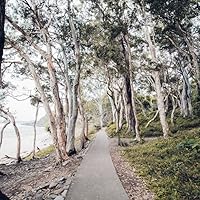
The arid desolate, barren land of Australia's Northern Territory is vividly described explaining the difficult surrounding Mary and Peter contended with, while bush boy was one with nature, again contrasts tying the story together.
"Sturt Plain, where the aircraft had crashed, is in the centre of the Northern Territory. It is roughly the size of England and Wales combined; but instead of some 45,000,000 inhabitants, it has roughly 4,500, and instead of some 200,000 roads, it has two, of which one is a fair-weather stock route. Most of the inhabitants are grouped around three or four small towns ��� Tennant Creek, Hooker Creek, and Daly Waters ��� which means that the rest of the area is virtually uninhabited. The Plain is fourteen hundred miles from Adelaide and is not a good place to be lost in."
Two separate worlds and three children vastly differing, teaching, learning from each other. Leaning on each other in the name of humanity and its greatest sacrifice.
A subtle story with a powerful message, sad and warming.
Nicolas Roeg's 1971 adaptation of the same name comfortably sits inside my favourite fifty films of all time! It's a stunning piece of cinema that deserves to be seen by everyone at-least once in their lives. In fact I'd say that it's vastly superior to this book, which I happened to enjoy a great deal. The jist of the story sees two young white siblings (older sister, younger brother) stranded in the Aussie Outback for different reasons in both versions. They struggle to survive in the harsh landscape until they happen to stumble across an Aboriginal boy going on his walkabout. What follows is a culture clash between two ways of life. This book (and film) is filled with a ton of commentary on casual racism, puberty, environmentalism, tabula rasa and exploitation. All of these elements come into play against the backdrop of a story about surviving in the wilderness.
The prose here is so breezy to read I finished the book in around two hours. It's fitting because the film is one of the most beautifully shot pieces of cinema you could hope to watch. The descriptions of the Aussie Outback act as the books cinematography and it's equally as impressive. Where this book doesn't quite match the film is in the characterisation. I found Roeg's version to be more sympathetic towards the characters, especially the Aboriginal boy than the book. If I hadn't of watched the film beforehand I don't think I would've felt as attached to the characters as I was.
Also, this book was written in 1959 by a middle-aged white guy so some of the terminology used is pretty outdated, but if you can look past that then there's a really strong story here. I highly recommend checking the book out, but if not, the film is a MUST watch!
Walkabout is a classic book about two American children who become stranded in the Australian outback after a plane crash. They are rescued by an Aboriginal boy who teaches them how to survive in this difficult climate. It is a short, easy read that is written for children, but I think this powerful book deserves an adult audience too.
Walkabout was first published in 1959. It reads like an Australian classic, but was actually written by an English author who spent time studying the country. The descriptions of the Australian landscape were superb and I was particularly impressed by the details of the Aboriginal culture, many of which were new to me.
I read it to my sons (aged 8 and 10) and they both enjoyed it – particularly the scenes involving the Australian wildlife.
The overall message of the book is one of tolerance and understanding between different cultures, so it was useful to use this text to explain issues around racism. The only problem was the strength of language. I was quite shocked by some of it and deliberately toned down the racist language when reading this to my boys.
This is an atmospheric little book with a simple, but engaging story. I can see why it is a set text in many schools and recommend it to those who enjoy reading about the natural world.
I think it's unlikely such a book would be written today.
It's obvious the author knew Australia very well, and amazing how much description he managed to cram into such a short book, without it feeling intrusive. Instead, it's almost as if the children themselves are turning their heads, taking everything in, from the strange dances of water birds to the differences between the forest and the desert. The Aboriginal boy's thoughts are well blended, without being a stark contrast or feeling like there's more of a divide between the children, and the author sensitive to cultural differences.
My edition also contained pictures and some captions from the movie. I haven't seen it, but as you might expect it seems much more dramatized, more extreme, than the book. I enjoyed the gentle, unobtrusive writing and and matter-of-fact way in which these 2 American children just decide to walk south to Adelaide. I probably won't watch it.
This was a short, mildly enjoyable book. Throughout most of the story almost nothing happens, except for the death of the bush boy, and it continues that way until the end of the book. The first half was thoroughly captivating but along the way it got way too repetitive in its descriptions of the Australian outback (though very well written), and it didn’t really feel like it was going anywhere. It had a good message about cultural differences and acceptance but Marshal could have taken it a bit further and emphasized it more.
Overall, it had some good moments, but it was a fairly OK book to me. 2.5
When I was a child living in New Zealand, our fourth form class did a social studies unit on the Aboriginal peoples of Australia, and as a culminating activity, the teachers screened Nicolas Roeg's excellent 1971 film Walkabout for us. I was utterly mesmerized, and I've re-watched that same film many, many times over the years: it's one of my all-time favorite movies, alongside Andrei Tarkovsky's Mirror and Bruce Robinson's Withnail and I.
Somewhere along the way, I learned that Roeg's cinematic version was based on a novel, and it's taken me this long to finally get my hands on a copy (kudos to NYRB Classics for keeping this one in print). While James Vance Marshall's book is an interesting read, it's a pretty slight work, spending much of its time in lush descriptions of the flora, fauna, and the mineralogy of the Australian outback. The language is lush and beautiful, and adds color to an otherwise minimal narrative of wilderness survival.
Roeg's film version honors all of this rich description, but builds out Marshall's simple Edenic tale into a mystical rumination on the violent conflict of modern technological society with the nomadic culture of the Aboriginal Australians. In Marshall's novel, two of the protagonists are visiting Americans, whose racist condescension towards their Aboriginal companion is both dated and distracting. By making all of the characters Australian, Roeg's version centers the impact of the story by exploring what it means for people who are cultural and linguistic strangers to share the same land.
I'm glad I read the original novel of Walkabout, but compared to the cinematic version, it's very much the lesser work.
I thought I had read this as a child or teenager, but I had a clear idea of the ending that turned out to be wrong, so I must have misunderstood what happened at the end when I was younger. I knew two children were alone in the desert of central Australia because of a plane crash. Anyway, that's how it starts and fortunately for them they meet a native Australian boy on walkabout who helps them find water and food.
However, it's not a sunny little story of how kids are blind to racial differences. The American girl and the Australian boy are just too old for that. It's more about the (sometimes unintentionally) devastating effect of white people and European/North American culture on native Australian and other societies and cultures.
Since Adelaide might be the closest thing my globe trotting mother has to a home town and since her family lived for a while with the Australian First Nations in Queensland, I couldn't help but be interested in this staple of Aussie classroom literature.
Cursory research suggests that Marshall romanticizes the First People's way of life far beyond what is authentic. (His very notion of the "walkabout" is apparently suspect.) Noble Savagery and the worn out but persistent trope of "civilization vs primitivism" suffuse the entire text. Nevertheless, as a story of cultural encounter, it possesses some genuine poignancy, and as a love letter to the Australian desert it is superb.
I enjoyed this book very much. My favorite part was when Mary realized that race shouldn't divide us, that we're all human, and our souls are all equal. I also liked the brotherly relationship between Peter and the aborigine boy, and the wonderful descriptions of the Australian outback. One thing I was dissatisfied with, is that we never learned the boy's name. I think that even if the older kids didn't care about introductions, the inquisitive Peter should have thought of it. I was sad about the bush boy dying, but I think the book would not have had the same impact if we removed the tragic fact
I was confused by some reviews' mention of racist language. Not in my edition. (The 1978 Sundance edition, free online: https://openlibrary.org/books/OL81991... ) Being a digitized version, I could search the text for the words mentioned; they are not found anywhere in the book. I did remember seeing the n-word, so I did a search, got two hits for that, but they are not racist in context. He wasn't like the Negroes back home. His skin was certainly black, but beneath it was a curious hint of undersurface bronze... His hair wasn't crinkly but nearly straight, and his eyes were blue-black. That's just a physical description, using the word Mary would have been familiar with. Which is not to say Mary isn't prejudiced - she really IS - but the language is fine in this edition. And Mary also turns out fine by the end.
I strongly disagree with the sentiment that the author made the bush boy a "noble savage." Anyone who thinks that doesn't know much about Australian aborigines. Their willingness to help strangers is not overstated; that actually is how they are, as a culture. If the story featured natives of any other part of the world, I would agree that they're too idealized, but in Australia, this is accurate. (Well, I don't know about *every* tribe, but this seems to be pretty typical.) I've only watched documentaries, so I don't have any books to cite, but the anthropological studies are out there. I think everyone should learn more about Australia, both the land and its people; they're so different from the rest of the world that people can't relate, so they call it all "unrealistic" ...kind of like when people first heard of kangaroos, right? "creatures that had heads like deer, stood upright like men, and hopped like frogs [and carried their young in abdominal pouches]." Yeah, that could never happen. ;)
I remember as a kid seeing Walkabout at the theater when I was much younger. My recollections of the movie are at the best hazy but when I saw the book by James Vance Marshall, I thought I should give it a try. In the introduction it appears that the movie was much darker and quite different from the book.
So about this book. Basically two young Americans, sister and brother, Mary (16) and Peter (8), from South Carolina, are flying across the Northern Territory of Australia in a small plane when it crashes. They are on their own in the wilderness Australian outback and must try and find some sort of civilization? On their trek they meet a young Aborigine boy who is on his walkabout, a trek of his own from which he will achieve manhood if he survives.
This chance meeting is the basis for the story, a clash of cultures. The Aboriginal boy is ancient, lives off the land, communes with nature. Whereas Mary and Peter come from Charleston SC , a modern world and during the time this book was written (1959) were raised with certain attitudes towards blacks. This does form an issue in the story, not so much for Peter, who finds common cause with the Aborigine boy, starts learning his language and for the most part finds the whole journey a great adventure. But for Mary, there are many difficulties, especially the nakedness of the Aborigine. This causes a tension throughout the story, one that is misinterpreted by both.
It's a fascinating story, a wonderful picture of Australia's outback and also of the belief systems of the 3 children. It's a great adventure but much more than that and well worth reading. A relatively short story but intense and a page turner you will find difficult to put down. (4 stars)
On the surface, "Walkabout" begins as standard mid-century fare: a kind of children's adventure story with a little racism thrown in for good measure, the kind of "Boy's Life" kind of shit where Timmy saves Jefferson Swaying-Branch from the mean kids beating him up because he's Injun or whatever. But this novel makes certain that you understand that is something else completely different than what you thought it was when you started it. Two white kids from South Carolina survive a plane crash in the Northern Territory and meet an Aborigine kid on walkabout who helps them survive and also helps them learn early that, in the words of my grandmother, god bless her, "Motherfuckers just wanna live". So, a work of quiet, simmering beauty and simplicity, meant for children's eyes and grown-up souls.
I've read this book numerous times and I still can't get over how beautifully written it is by Marshall about the vastness of Australia's wilderness. The description of the wildlife nature is incredibly intricate which I enjoyed very much. The relationship between the children and the Aborigine boy was simply admirable and touching. The poignant part where the Aborigine boy convinced himself that he was going to die made me think of how fragile, yet how powerful our minds can be, that it can be self-constructive and self-destructive. This book portrays the huge contrast between the "civilised" society that we know of, and the tribal, natural way of life of the Aborigines'. A good escapism, adventurous book that I recommend anyone to read!
Had never heard of this novel until reading review in NYRB, which I gather is actually the Intro to new NYRB edition. Siegel's intro also comments on a film version of the novel, which, though it sounds interesting in its own right, departs in some significant ways from the book (but then, don't they all ... or most) but that difference only highlighted the appeal of the novel. Sounds like another literary resurrection from NYRB worthy of our celebration and gratitude (and another cool cover, which should please GR Friend S. Sloat ever so much!)
Peter, eight, and Mary, thirteen, survive a plane crash and begin to try to walk to their original destination across many miles of the Australian backcountry. Along the way, they encounter a member of an indigenous group of people The boy is on a walkabout, a rite of passage for his group of people, but he decides to help the two children find their way. He teaches them to seek water and find food and make fire.
Walkabout is a vivid picture of almost uninhabited Australia, with beautiful descriptions of the wildlife and the plants and the land.
Lovely idea of children rescued in the Australian Bush by Aboriginal boy. But very dated writing--very patronizing towards the boy, very ridiculously English "American" children, and very romanticized version of children and Australia both. The book wants to be a psychological study, a travel guide, an allegory, and a moral fable. The best parts are when it just wants to be a story. There aren't enough of those.